
Life, 1921-11-10 · page 4 of 34
Life — November 10, 1921 — page 4: what you’re looking at
What you’re looking at
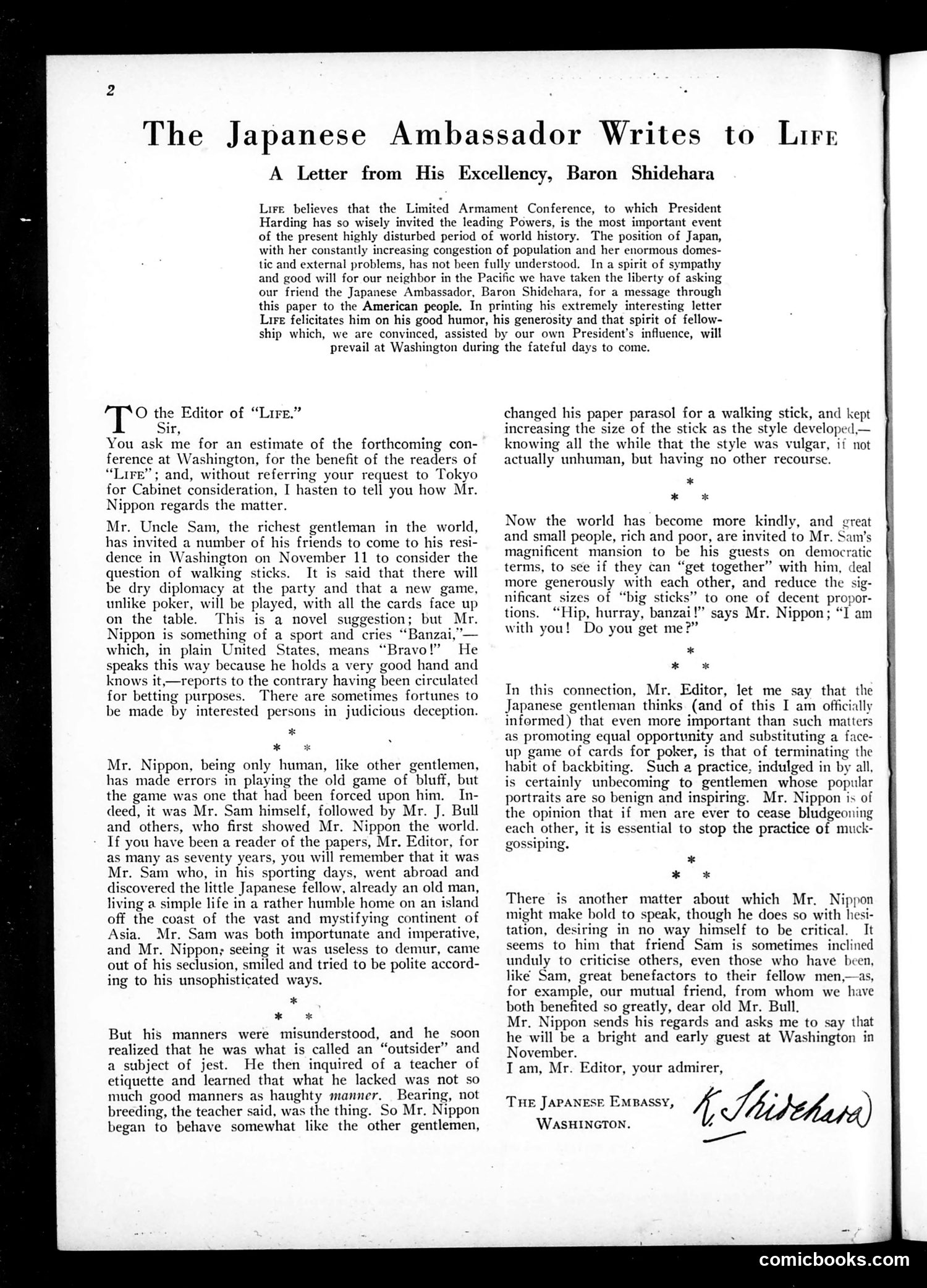
This page contains a letter from Baron Shidehara, Japanese Ambassador to the United States, published in *Life* magazine. Rather than a political cartoon, it's satirical commentary on diplomatic etiquette. The letter humorously describes how Ambassador Shidehara was misunderstood as an "outsider" at Washington social events—specifically, his practice of using a walking stick (which grew larger as his "style developed") was mistaken for crude behavior. The satire targets both cross-cultural misunderstandings and American assumptions about foreign diplomats. Shidehara defends himself while critiquing backbiting and gossip among gentlemen, and praises an upcoming Limited Armament Conference as important for world peace. The piece uses gentle humor to address diplomatic tensions during the early 1920s period of arms-control negotiations.
📄 Transcribed text from this page (OCR, searchable)
Machine-transcribed from the original scan — historical spelling and the odd misread are preserved.
The Japanese Ambassador Writes to Lire A Letter from His Excellency, Baron Shidehara Lire believes that the Limited Armament Conference, to which President Harding has so wisely invited the leading Powers, is the most important event of the present highly disturbed period of world history. The position of Japan, with her constantly increasing congestion of population and her enormous domes- tic and external problems, has not been fully understood. Ina spirit of sympathy and good will for our neighbor in the Pacific we have taken the liberty of asking our friend the Japanese Ambassador, Baron Shidehara, for a message through this paper to the American people. In printing his extremely interesting letter Lirt felicitates him on his good humor, his generosity and that spirit of fellow- ship which, we are convinced, assisted by our own President's influence, will prevail at Washington during the fateful days to come. O the Editor of “Lire.” Sir, You ask me for an estimate of the forthcoming con- ference at Washington, for the benefit of the readers of and, without referring your request to Tokyo for Cabinet consideration, I hasten to tell you how Mr. Nippon regards the matter. Mr. Uncle Sam, the richest gentleman in the world, has invited a number of his friends to come to his resi- dence in Washington on November 11 to consider the question of walking sticks. It is said that there will be dry diplomacy at the party and that a new game, unlike poker, will be played, with all the cards face up on the table. This is a novel suggestion; but Mr. Nippon is something of a sport and cries “Banzai, which, in plain United States, means “Bravo!” He speaks this way because he holds a very good hand and knows it,—reports to the contrary having been circulated for betting purposes. There are sometimes fortunes to be made by interested persons in judicious deception. * Mr. Nippon, being only human, like other gentlemen, has made errors in playing the old game of bluff, but the game was one that had been forced upon him. In- deed, it was Mr. Sam himself, followed by Mr. J. Bull and others, who first showed Mr. Nippon the world. If you have been a reader of the papers, Mr. Editor, for as many as seventy years, you will remember that it was Mr. Sam who, in his sporting days, went abroad and discovered the little Japanese fellow, already an old man, living a simple life in a rather humble home on an island off the coast of the vast and mystifying continent of Asia. Mr. Sam was both importunate and imperative, and Mr. Nippon; seeing it was useless to demur, came out of his seclusion, smiled and tried to be polite accord- ing to his unsophisticated ways. * * But his manners were misunderstood, and he soon realized that he was what is called an “outsider” and a subject of jest. He then inquired of a teacher of etiquette and learned that what he lacked was not so much good manners as haughty manner. Bearing, not breeding, the teacher said, was the thing. So Mr. Nippon began to behave somewhat like the other gentlemen, changed his paper parasol for a walking stick, and kept increasing the size of the stick as the style developed — knowing all the while that the style was vulgar, if not actually unhuman, but having no other recourse. * x Ok Now the world has become more kindly, and great and small people, rich and poor, are invited to Mr. Sam's magnificent mansion to be his guests on democratic terms, to see if they can “get together” with him, deal more generously with each other, and reduce the sig- nificant sizes of “big sticks” to one of decent propor- tions. “Hip, hurray, banzai!” says Mr. Nippon; “I am with you! Do you get me?” * * * In this connection, Mr. Editor, let me say tha Japanese gentleman thinks (and of this I am offi informed) that even more important than such matte as promoting equal opportunity and substituting a face- up game of cards for poker, is that of terminating the habit of backbiting. Such a practice, indulged in by all, is certainly unbecoming to gentlemen whose popular portraits are so benign and inspiring. Mr. Nippon is of the opinion that if men are ever to cease bludgeoning h other, it is essential to stop the practice of muck- * * * There is another matter about which Mr. Nippon might make bold to speak, though he does so with hesi- tation, desiring in no way himself to be critical. It seems to him that friend Sam is sometimes inclined unduly to criticise others, even those who have been, liké Sam, great benefactors to their fellow men,—as, for example, our mutual friend, from whom we have both benefited so greatly, dear old Mr. Bull. Mr. Nippon sends his regards and asks me to say that he will be a bright and early guest at Washington in November. T am, Mr. Editor, your admirer, THE JAPANESE Empassy, WASHINGTON. comicbooks.com