
A complete issue · 34 pages · 1921
Life — September 29, 1921
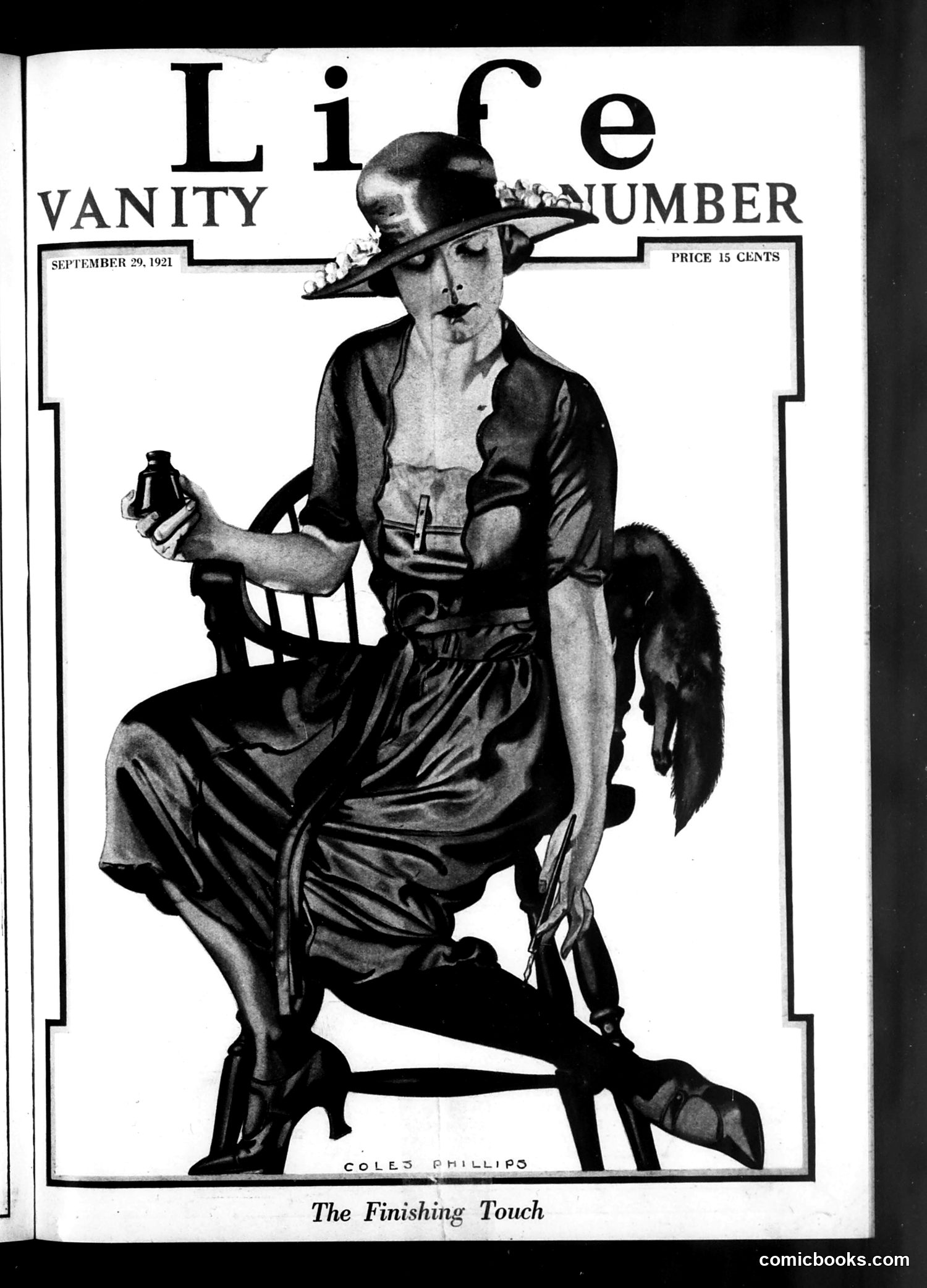
This cover by Coles Phillips depicts a fashionable woman applying cosmetics, titled "The Finishing Touch." The image satirizes 1920s women's grooming culture and the emerging cosmetics industry during the Jazz Age. The woman's stylized appearance—with her dramatic hat, bare arms, and focus on makeup application—reflects the "modern woman" of the post-WWI era, who increasingly adopted makeup and fashion as markers of independence and modernity. The satire likely critiques both the commercialization of beauty standards and society's changing attitudes toward women's public appearance. The phrase "finishing touch" suggests cosmetics as essential completion of feminine identity—a commentary on consumer culture's influence on women's self-presentation during this period of social transformation.
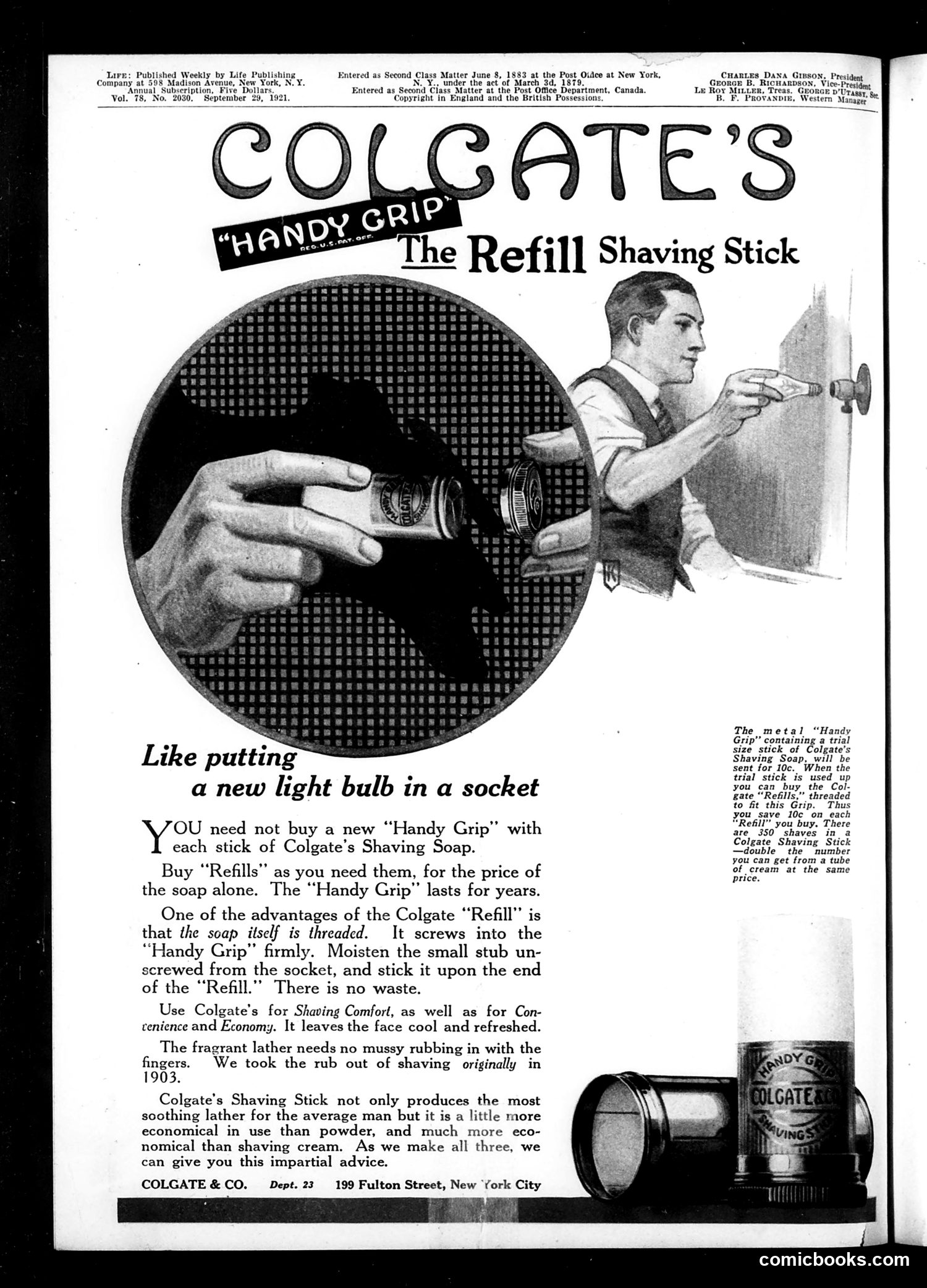
This page is **primarily an advertisement**, not political satire. It's a 1921 Colgate & Co. product advertisement for their "Handy Grip" refill shaving stick. The ad uses a visual comparison ("Like putting a new light bulb in a socket") to explain the product's key innovation: the soap refill screws into a reusable grip handle, similar to replacing a lightbulb. This was marketed as economical—customers bought only soap refills, not new grips repeatedly. The two photographs show the grip's metal construction and demonstrate its use during shaving. The accompanying text emphasizes convenience, economy, and comfort compared to powder or cream alternatives. This is commercial product marketing, not satirical commentary. The "lightbulb" analogy was simply a contemporary technological comparison meant to appeal to early 20th-century readers.
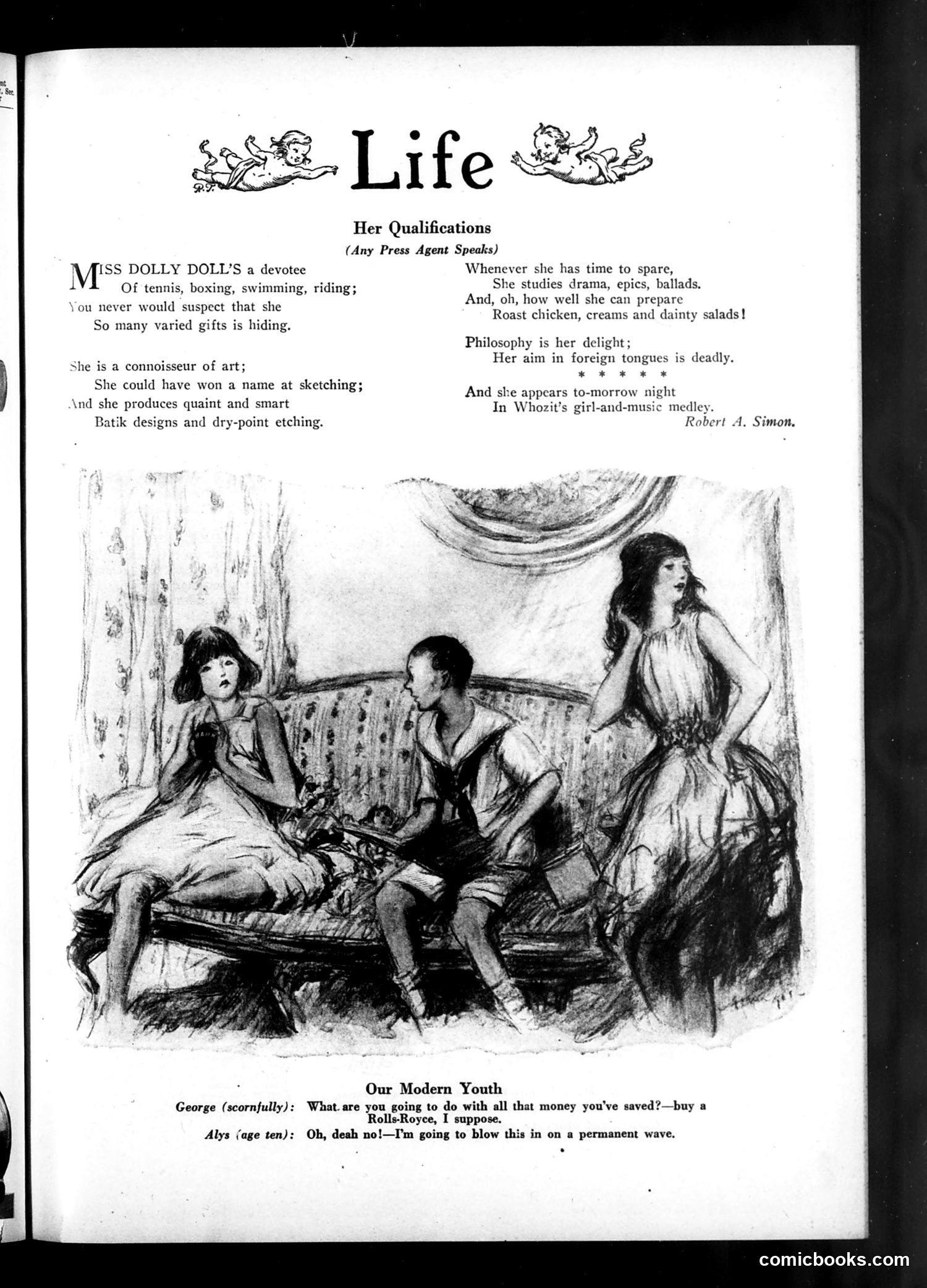
This page satirizes modern youth and women's independence in the 1920s. The upper section praises "Miss Dolly Doll" for her multi-talented qualifications—athleticism (tennis, boxing, swimming), artistic skills (sketching, batik design), and intellectual pursuits (philosophy, languages, cooking). The tone is gently mocking the "New Woman" ideal of the era. The lower cartoon depicts three young people, with a girl named Aby (age ten) boasting she'll spend her savings on a permanent wave (a fashionable hairstyle treatment), while her brother George scornfully questions this frivolous expense. The joke satirizes youth consumerism and vanity—even children prioritizing trendy appearance over sensible financial planning. This reflects 1920s anxieties about changing social values and youth culture.
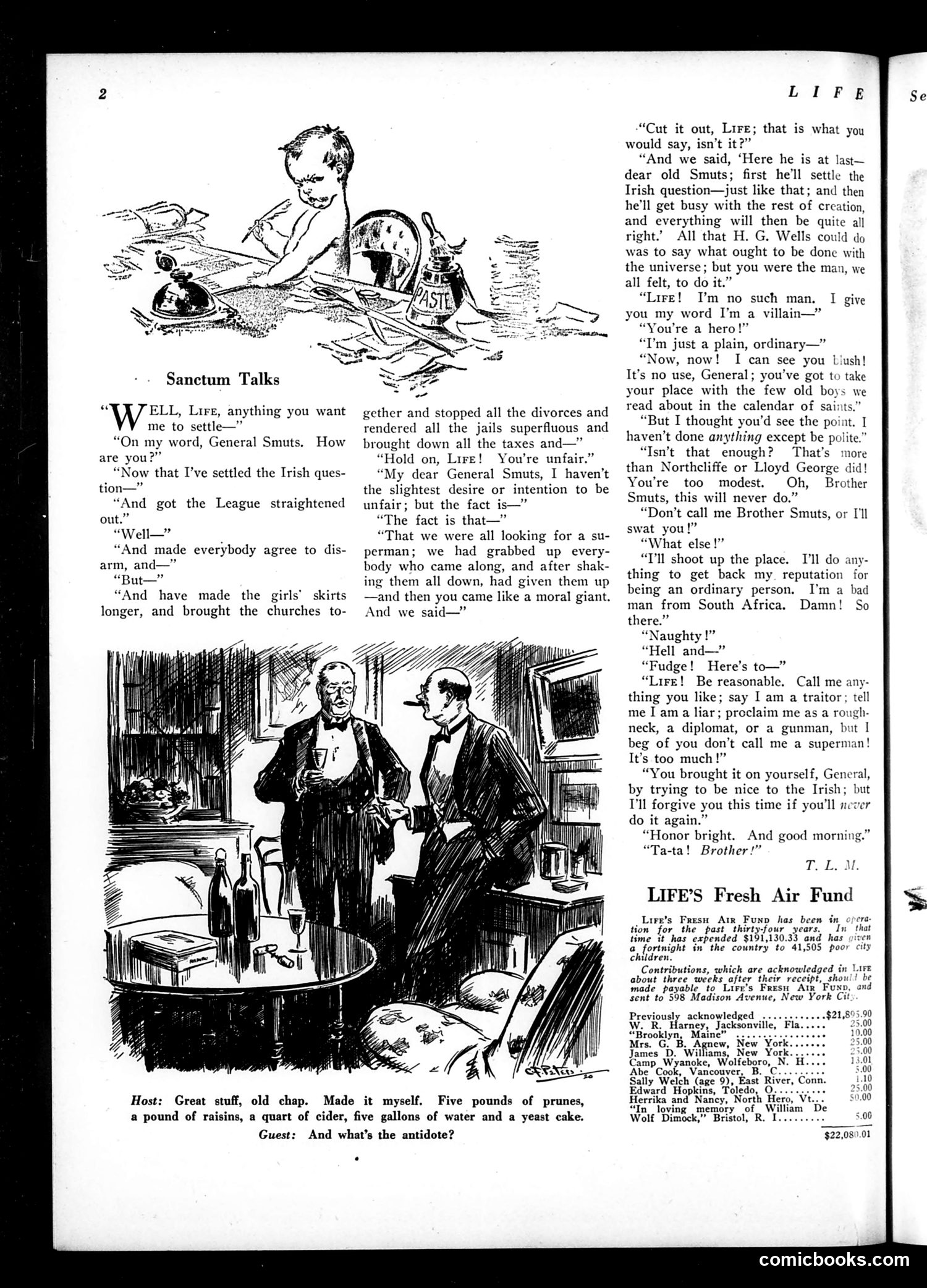
This page features a satirical dialogue between "Life" (personified) and "General Smuts," likely South African military leader Jan Smuts, who appears to have recently settled an Irish question and implemented various social reforms (longer girls' skirts, church attendance, jail reductions, tax changes). **The satire's point:** Life accuses Smuts of being a "moral giant" imposing order everywhere. Smuts defensively insists he's just an ordinary person from South Africa, not a hero or reformer—he's simply cleaned up problems he found. The humor lies in the disconnect: his sweeping reforms (divorces, jails, taxes, social standards) are presented as routine problem-solving, yet Life treats them as grandiose moral crusading. The cartoon mocks either Smuts's false modesty or Life magazine's exaggeration of his influence.
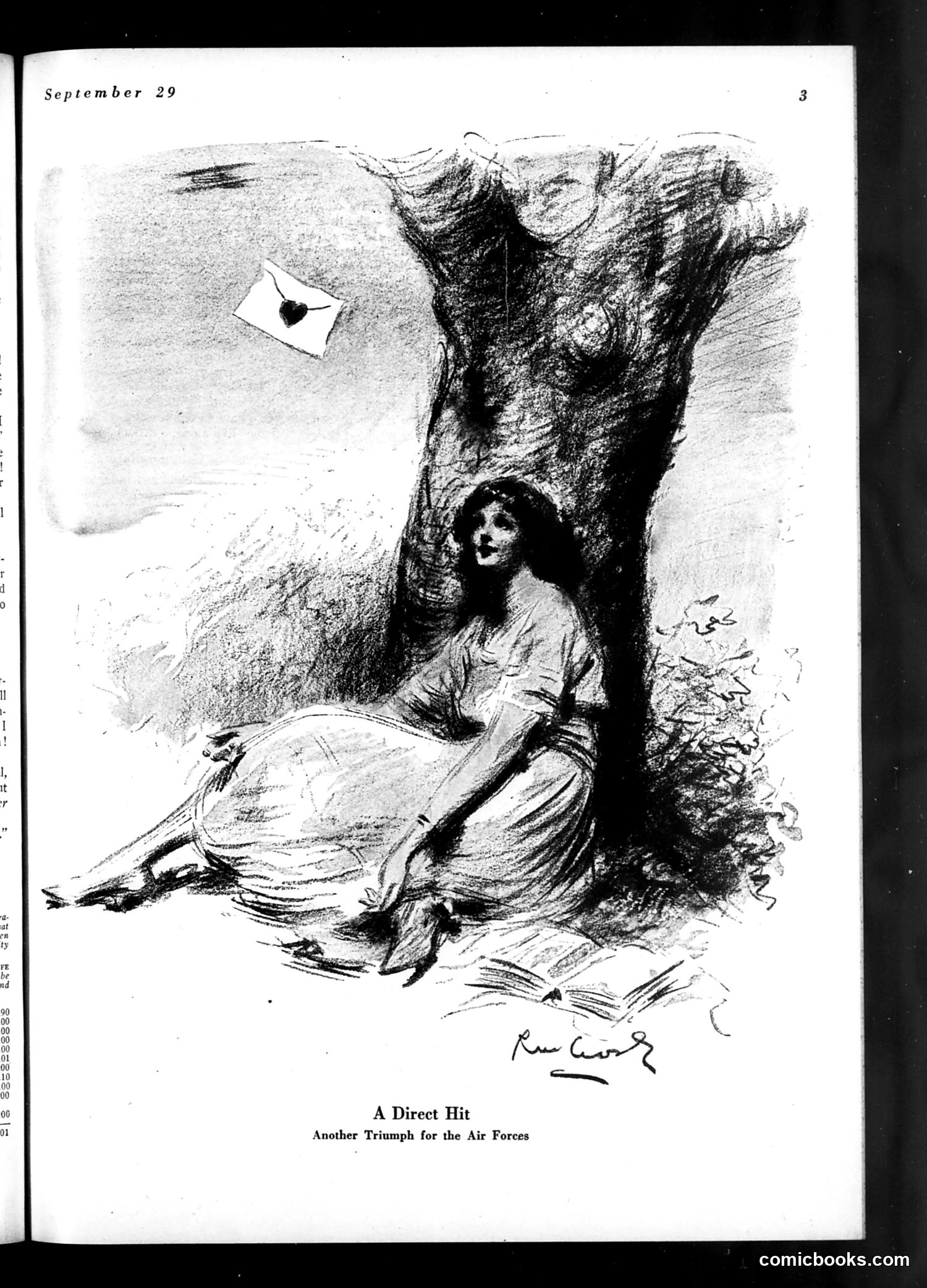
This WWI-era illustration depicts a woman sheltering beneath a large tree, looking upward with concern at an envelope marked with a heart—likely a love letter or personal correspondence. The caption suggests this is satirical commentary on aerial warfare's impacts on the home front. The joke appears to rely on dark humor: the woman receives a "direct hit" in the form of romantic correspondence (the heart-marked envelope) rather than an actual bomb. This plays on anxieties about air raids during World War I, when civilian bombardment was still relatively novel and feared. The phrase "triumph for the Air Forces" ironically celebrates what is merely an emotional or romantic moment, mocking wartime propaganda that celebrated military victories while civilians endured bombing campaigns and separation from loved ones.
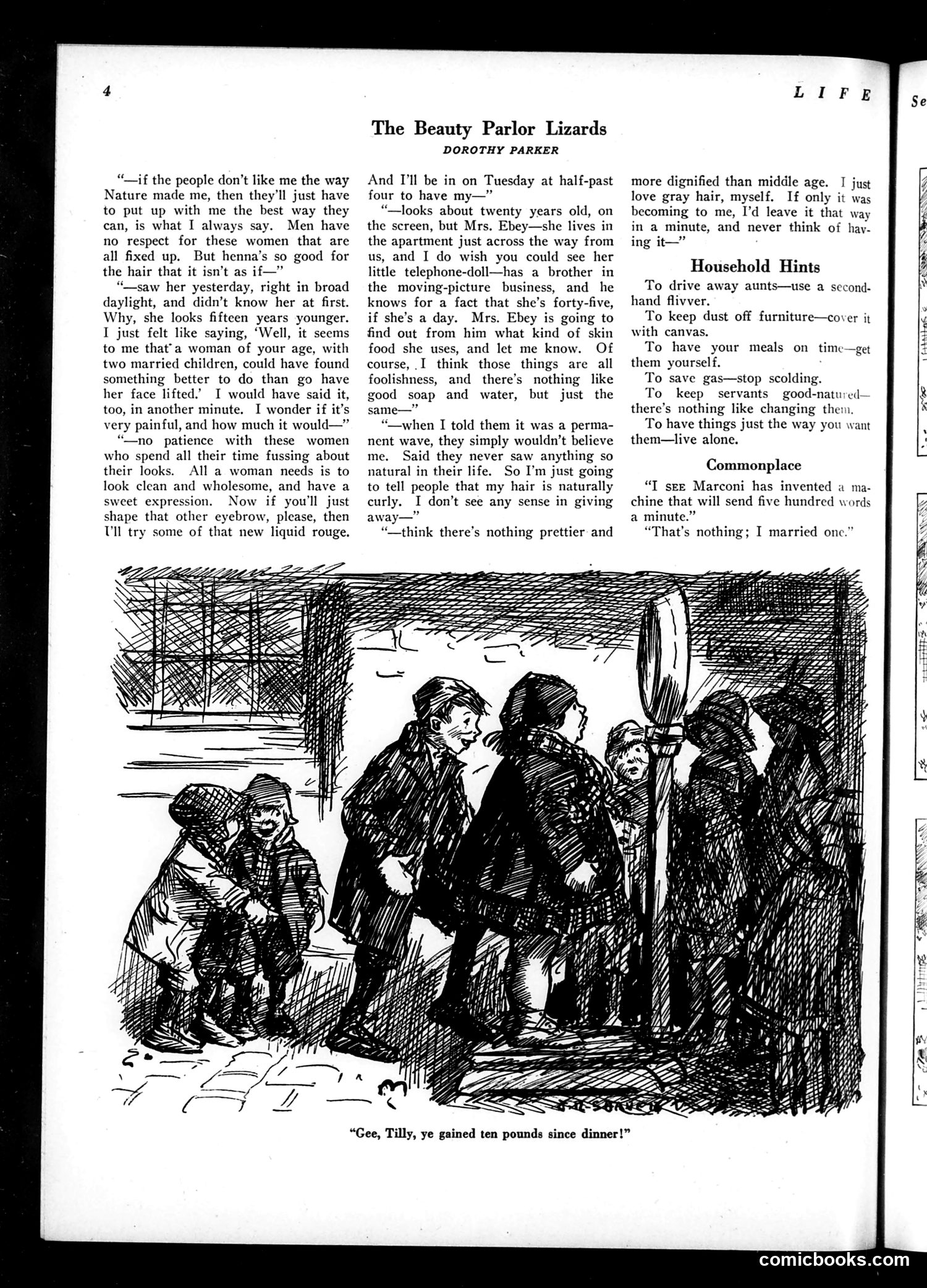
This page contains two distinct sections: **"The Beauty Parlor Lizards" by Dorothy Parker** is a humorous essay satirizing women's obsession with cosmetic treatments and the beauty industry. Parker mocks the vanity of women who spend excessive time and money on appearance while ironically praising natural beauty. The tone is witty social commentary on 1920s-30s consumer culture and feminine vanity. **The cartoon below** depicts what appears to be a street scene with working-class figures. The caption reads "Gee, Tilly, ye gained ten pounds since dinner!" This is straightforward physical humor—a joke about someone's weight gain, typical of era comedy. The page represents Life magazine's blend of sophisticated satirical writing alongside accessible visual gags, reflecting the magazine's appeal to educated urban readers during the interwar period.
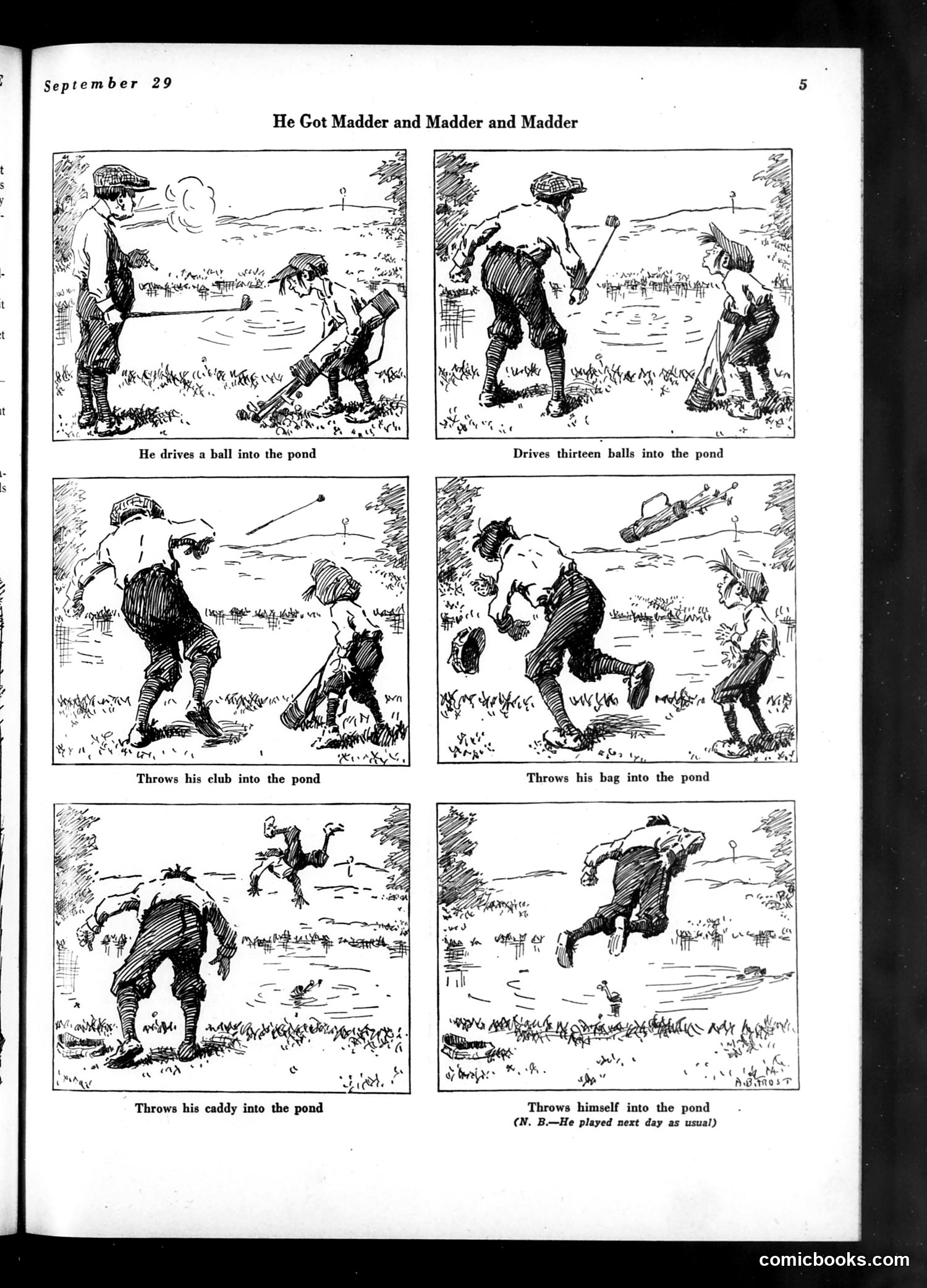
This is a humorous sequential comic strip showing a golfer's escalating frustration during a bad round. The narrative progresses through six panels: 1. He drives one ball into a pond 2. He drives thirteen balls into the pond 3. He throws his club into the pond 4. He throws his golf bag into the pond 5. He throws his caddy into the pond 6. He throws himself into the pond The joke is a classic escalation of rage—each failure compounds his anger until he loses all self-control and literally jumps in himself. The final caption's note ("He played next day as usual") provides ironic commentary: despite this complete meltdown, golfers compulsively return to the frustrating sport. This satirizes the obsessive, sometimes irrational dedication of golf enthusiasts to a game that regularly defeats them.
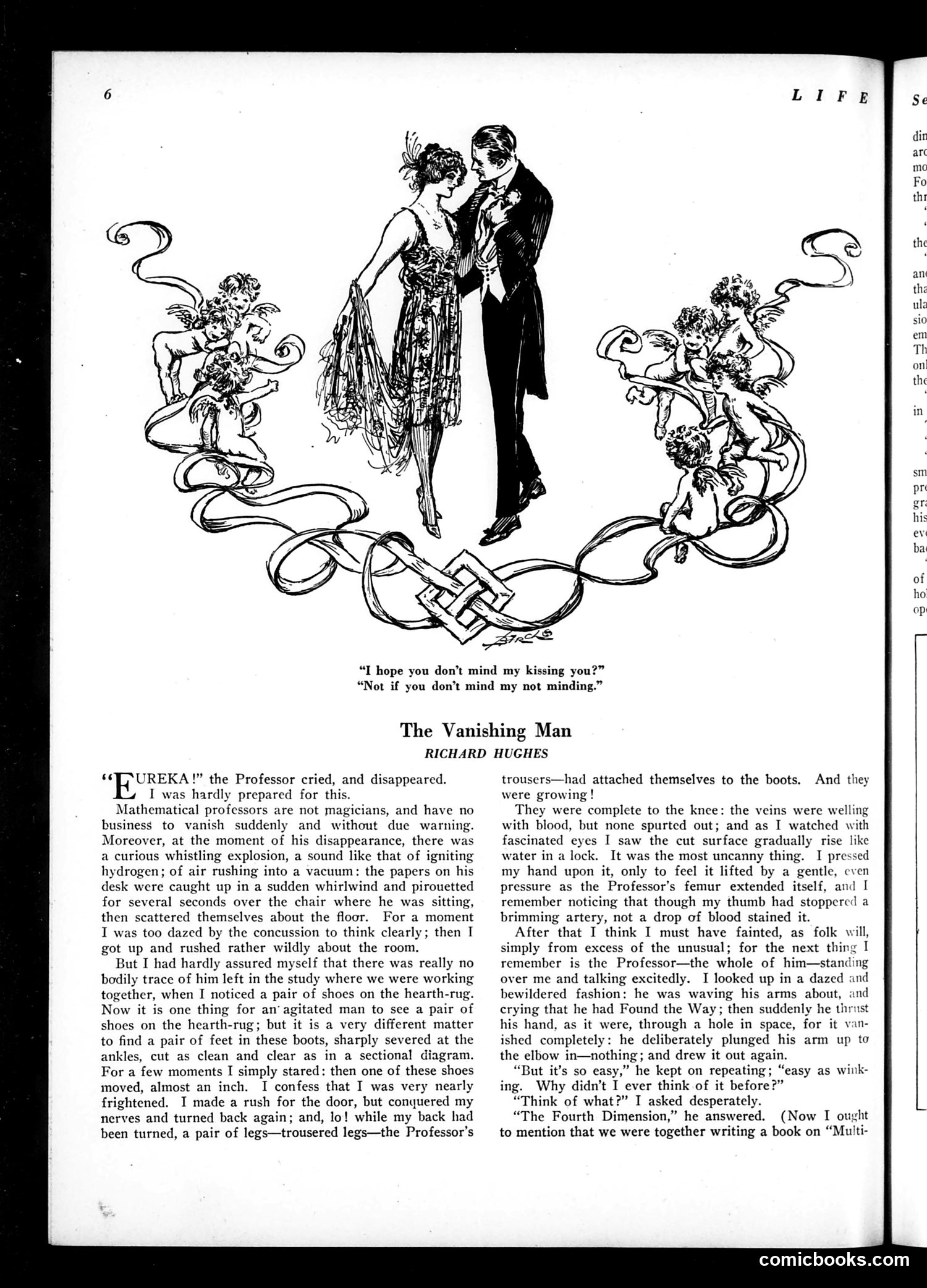
This page presents a short story rather than political satire. The illustration depicts a couple in formal evening wear (she in a beaded dress, he in a tuxedo) surrounded by cherubs and decorative swags—a romantic framing device common to 1920s-era Life magazine. The story itself concerns a mathematics professor who mysteriously disappears, leaving only his trousers behind in his study. The narrator describes the bizarre discovery: the Professor's legs are cleanly severed at the ankles, with his severed feet still in his boots. This appears to be a fantastical fiction piece exploring impossible or supernatural disappearance—playing on the "magician's vanishing act" concept—rather than social or political commentary. The dialogue quoted ("I hope you don't mind my kissing you?") suggests romantic comedy elements.
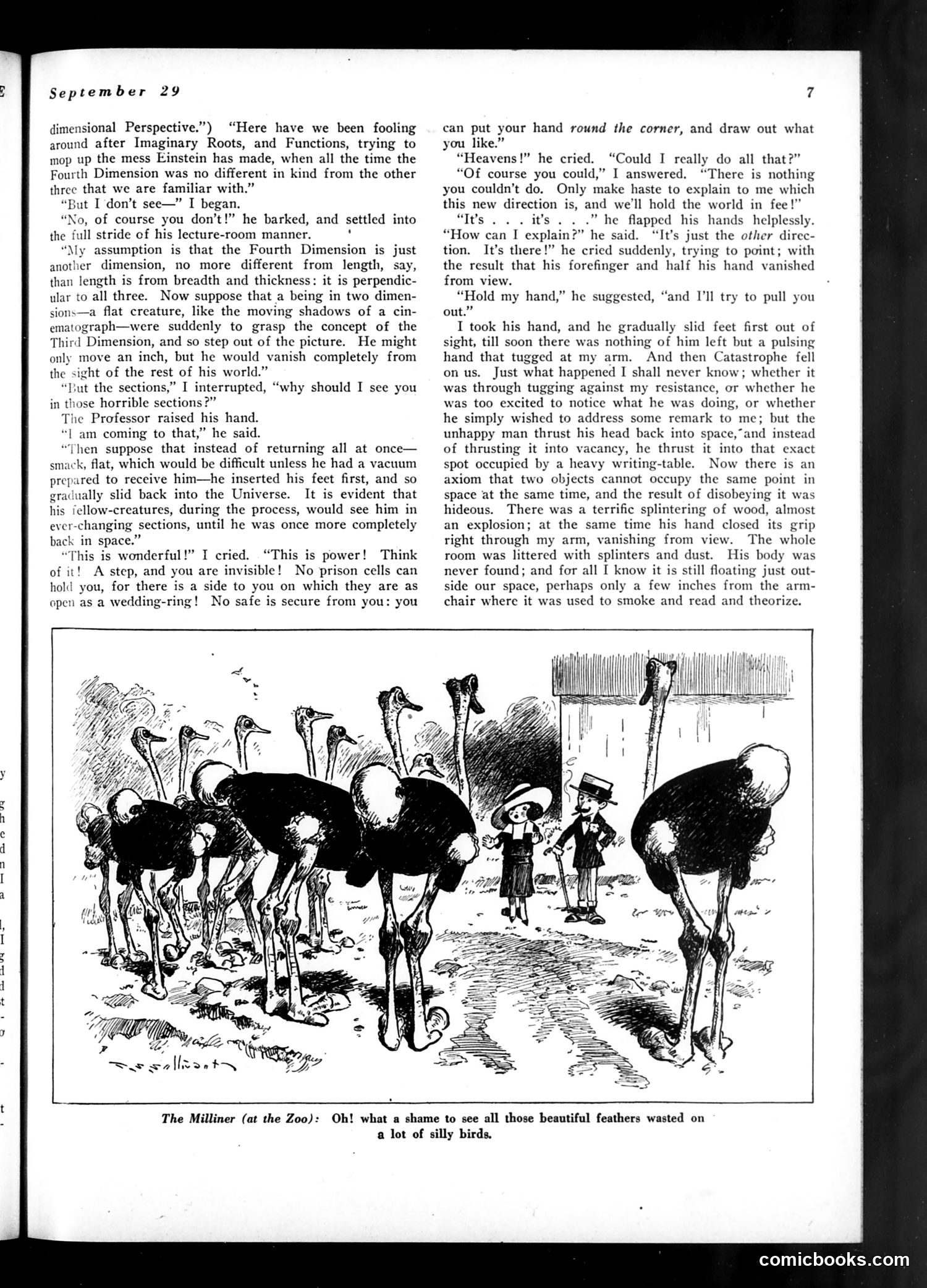
This cartoon satirizes women's fashion, specifically the early 20th-century trend of using feathers and bird parts in women's hats. The milliner (hat-maker) observes ostriches at the zoo, admiring their plumage while lamenting it's "wasted on a lot of silly birds." The joke targets the absurdity of the fashion industry's demand for exotic feathers—women wore elaborate feathered hats as status symbols, driving demand for ostrich plumes and other bird materials. The cartoon criticizes both the wasteful practice and the vanity it represents, suggesting feathers would be "better used" adorning fashionable hats rather than the birds themselves. This reflects growing early-1900s conservation concerns about bird populations being decimated for the millinery trade.
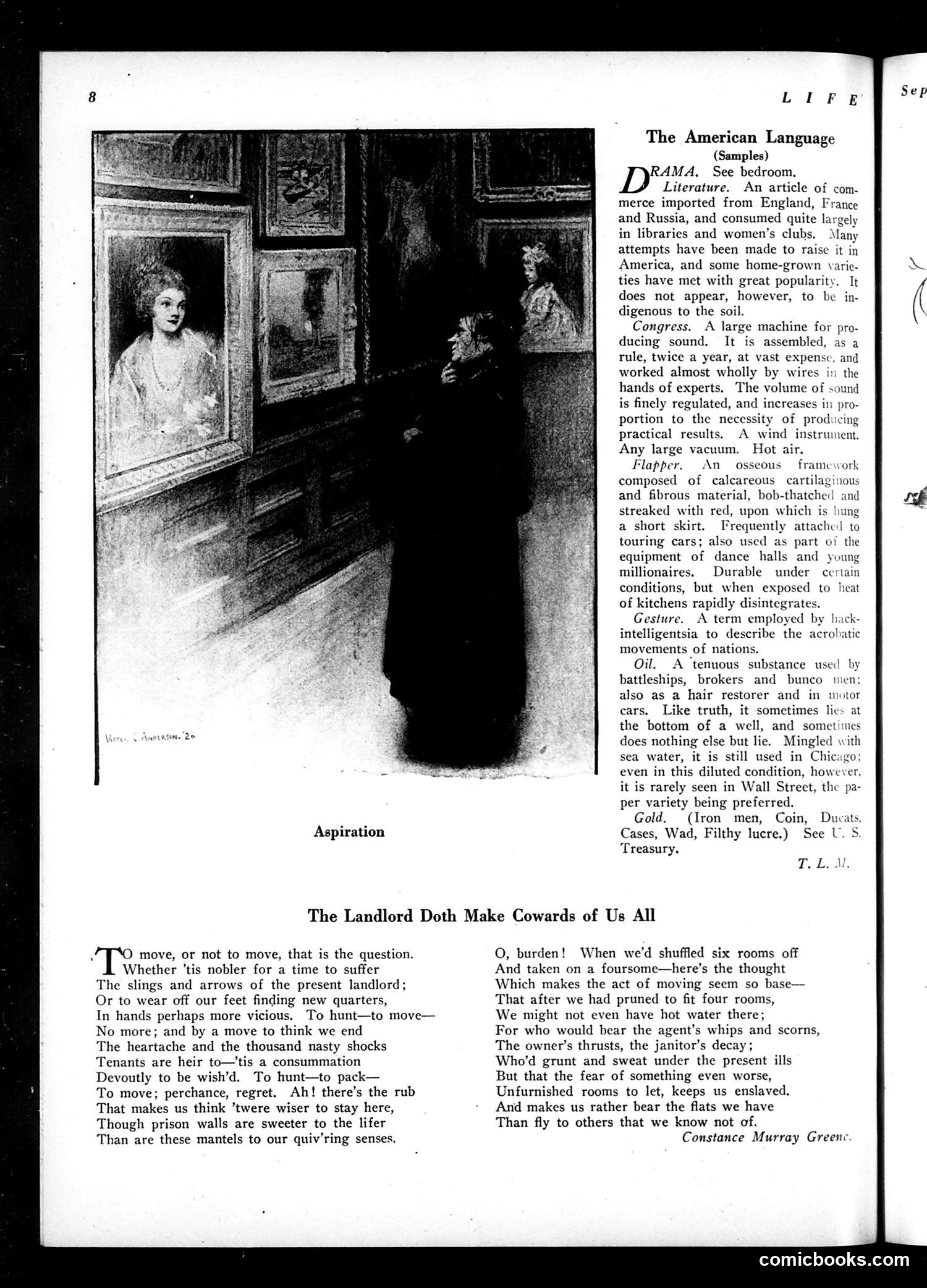
The image shows a photograph titled "Aspiration" depicting two figures: a woman at a window looking outward, and a man in shadow below. The composition suggests longing or yearning. The page also contains "The American Language (Samples)" — definitions of colloquial terms like "Drama," "Congress," "Flapper," and "Oil" — and a poem titled "The Landlord Doth Make Cowards of Us All" by Constance Murray Greene. The poem satirizes landlords and tenant hardships: complaints about moving, maintenance issues, cold rooms, and poor living conditions. The satire critiques both landlord indifference and tenants' resignation to accepting poor housing rather than confronting exploitation. Without a date visible, the precise historical context remains unclear.
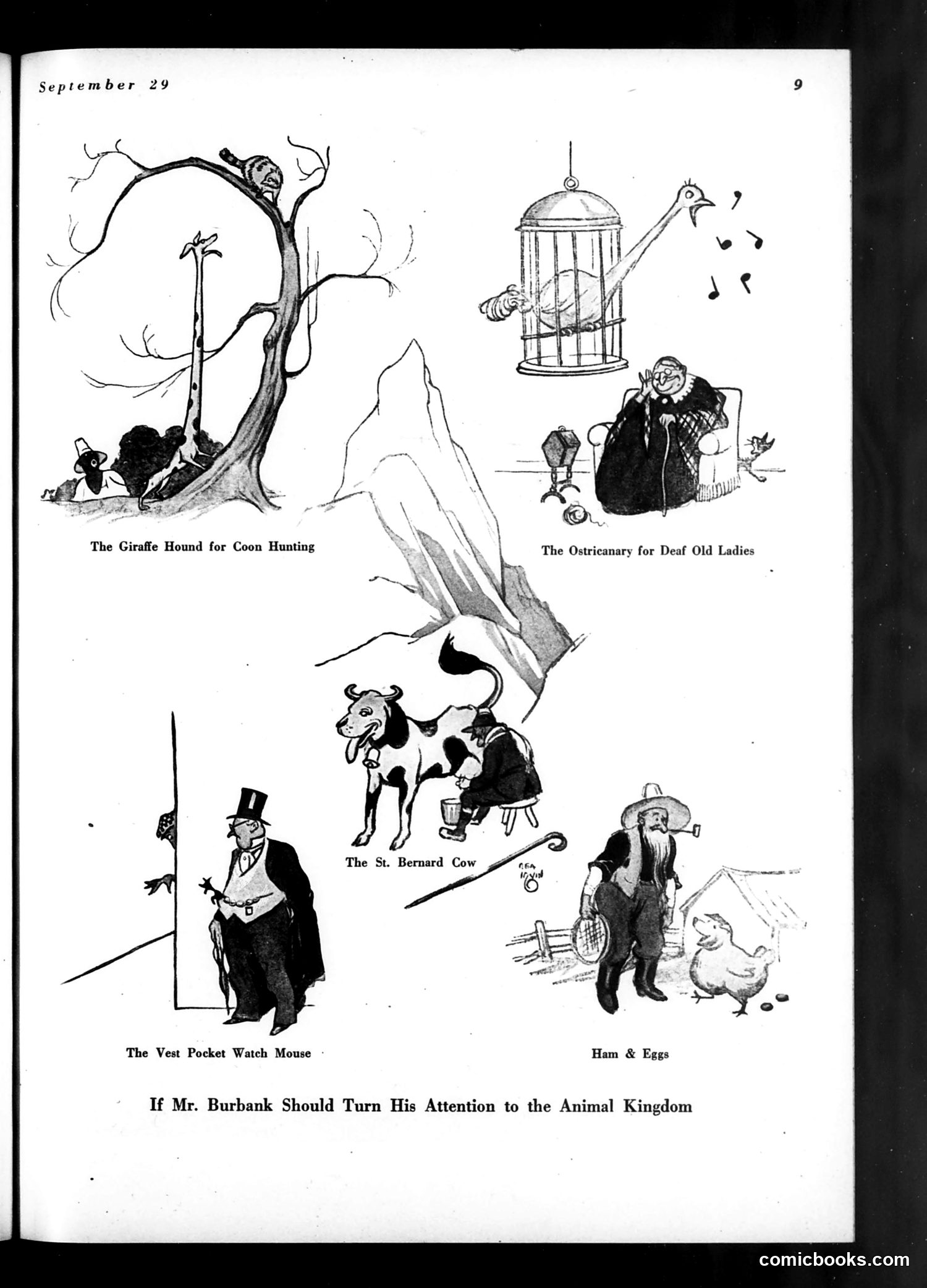
This page presents five satirical animal-based inventions under the heading "If Mr. Burbank Should Turn His Attention to the Animal Kingdom." The cartoons mock Luther Burbank, the famous horticulturist known for plant breeding, by imagining absurd hybrid animals he might create: - **The Giraffe Hound for Coon Hunting**: A giraffe-dog hybrid with an impossibly long neck - **The Ostricenary for Deaf Old Ladies**: An ostrich in a cage as a hearing aid - **The St. Bernard Cow**: A cow-dog hybrid being milked - **The Vest Pocket Watch Mouse**: A tiny mouse serving as a pocket watch - **Ham & Eggs**: A pig-chicken hybrid combination The satire mocks both Burbank's fame and the era's enthusiasm for "scientific" animal and plant improvement through selective breeding.
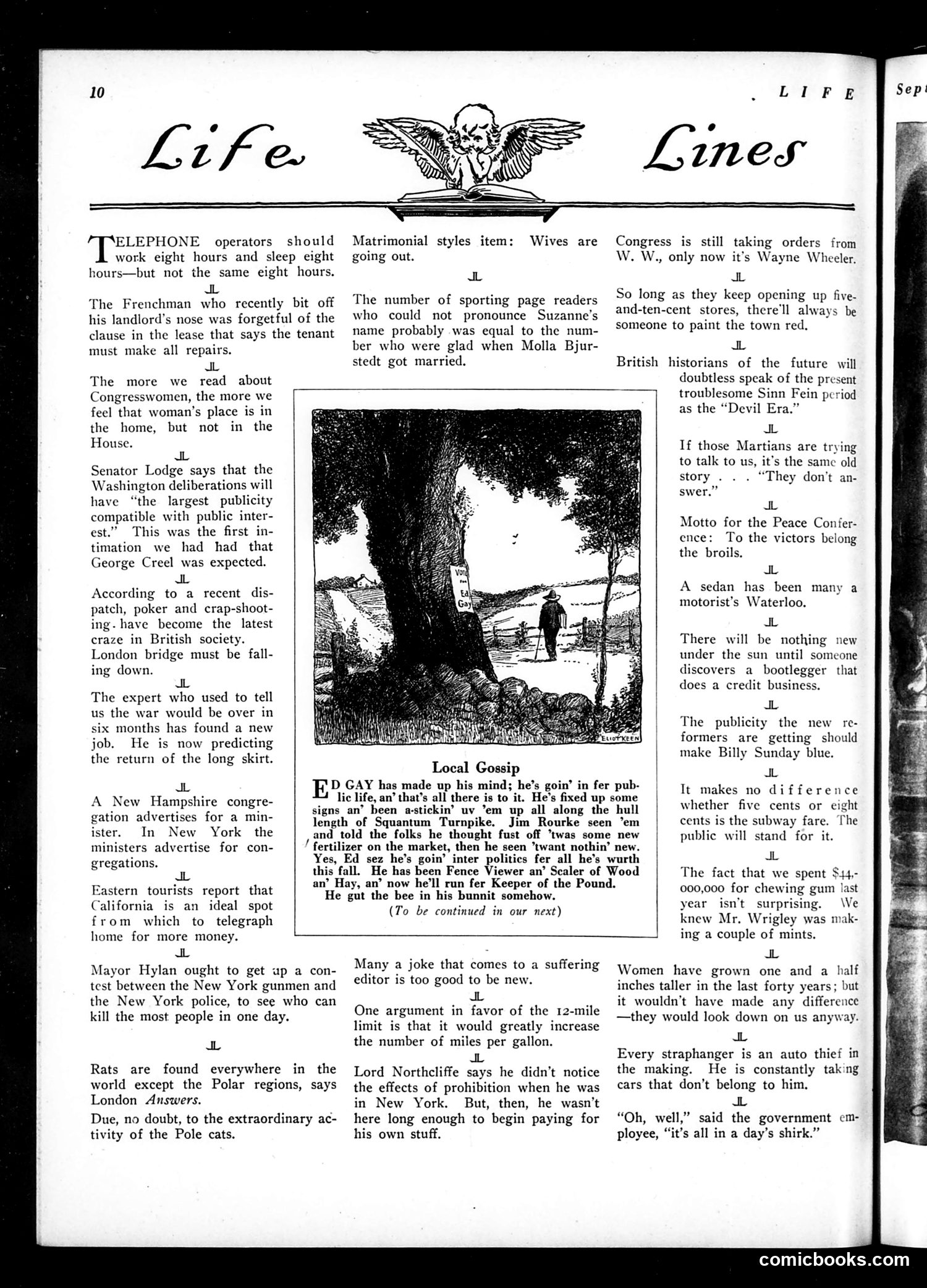
This page contains a satirical gossip column titled "Life Lines" with brief jokes and observations rather than a political cartoon. The content mocks various targets: telephone operators' work hours, a French tenant disputing lease terms, Congressional women's place in politics, Senator Lodge's publicity claims, London's infrastructure problems, and fashion trends like the "long skirt's" return. A central illustration shows a rural scene with a large tree, likely accompanying the "Local Gossip" section featuring "Ed Gay," who apparently plans political involvement and has opinions about Squantum Turnpike and fertilizer markets. The humor relies on topical references—Prohibition, auto theft, women's height increase, and government employees—that would resonate with contemporary readers but require historical context for modern understanding.
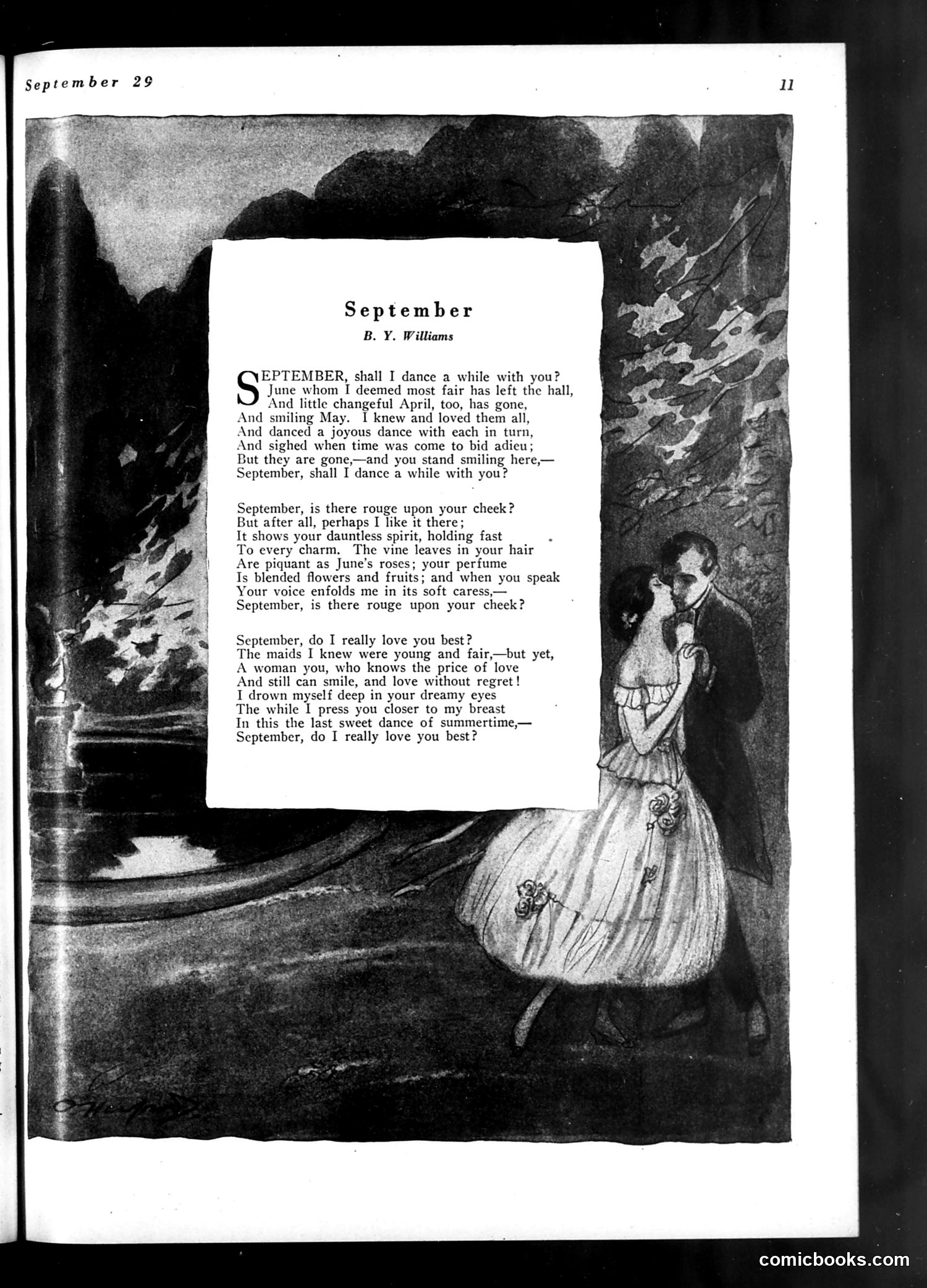
This page presents "September," a romantic poem by B.Y. Williams, rather than political satire. The text addresses September as a personified month, asking if the speaker can dance with it one final time before summer ends. The poem reflects on departed months (June, April, May) and celebrates September's beauty—describing rouge on cheeks, vineyard hair, and floral perfume. The accompanying illustration shows a woman in an elegant dress gazing upward in a romantic, melancholic pose, positioned within a dark, moody landscape. The artwork matches the poem's romantic and nostalgic tone, depicting the personification of the season as feminine and desirable. This is purely literary/artistic content with no political commentary or satire.
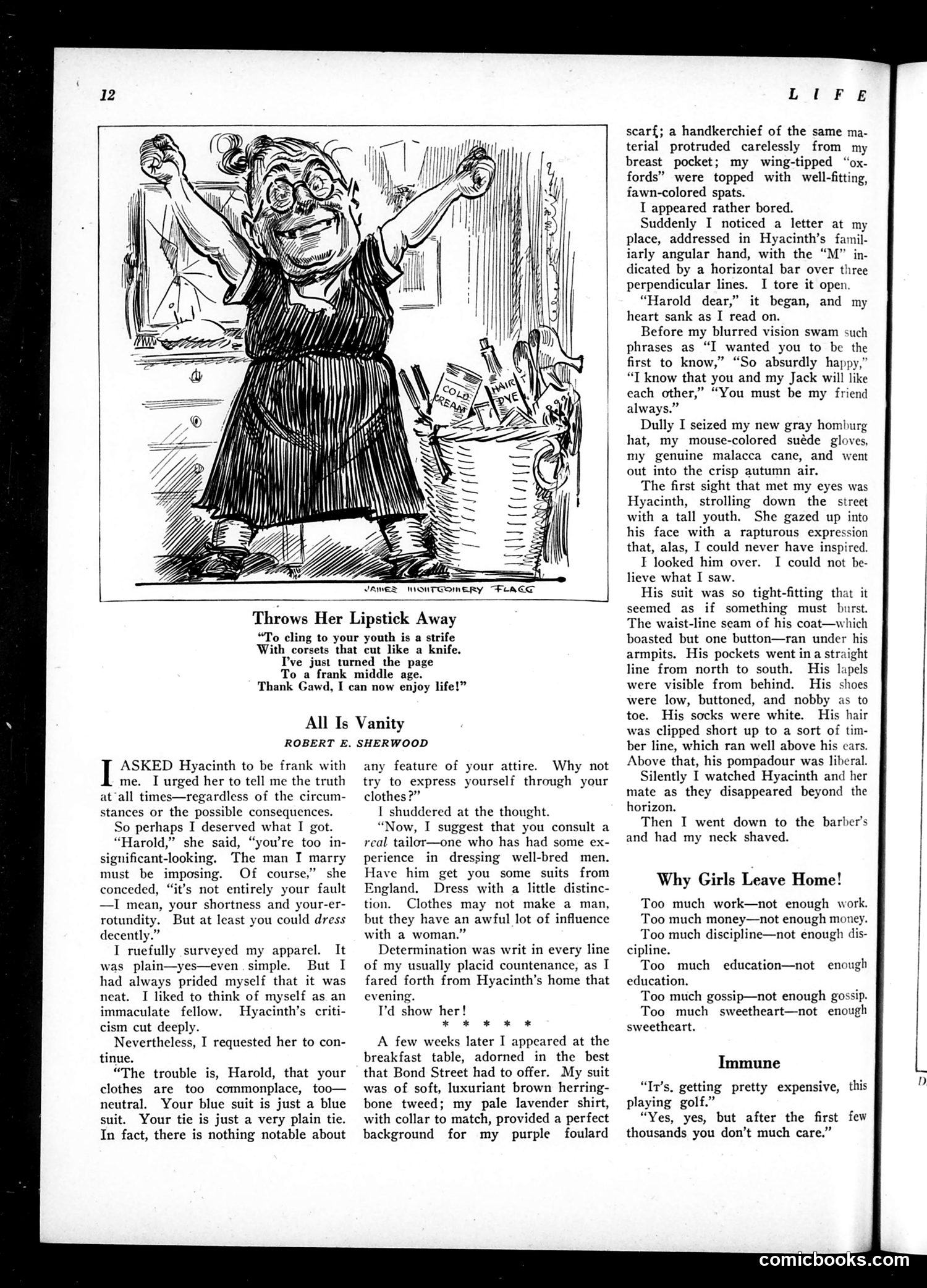
**The Cartoon "Throws Her Lipstick Away":** The illustration by James Montgomery Flagg depicts a woman discarding cosmetics and fashion items into a trash bin. The accompanying verse mocks women abandoning youth pursuits—"corsets that cut like a knife"—upon reaching middle age, suggesting they've given up on appearance and vanity. **The Article "All Is Vanity":** Robert E. Sherwood's piece humorously criticizes a man (Harold) for his drab, ill-fitting wardrobe. The satire targets masculine indifference to fashion and grooming, contrasting with the cartoon's female-focused critique. Together, the content satirizes *both* genders' vanity (or lack thereof) through different lenses—women's abandonment of beauty standards versus men's stubborn disregard for proper dress.
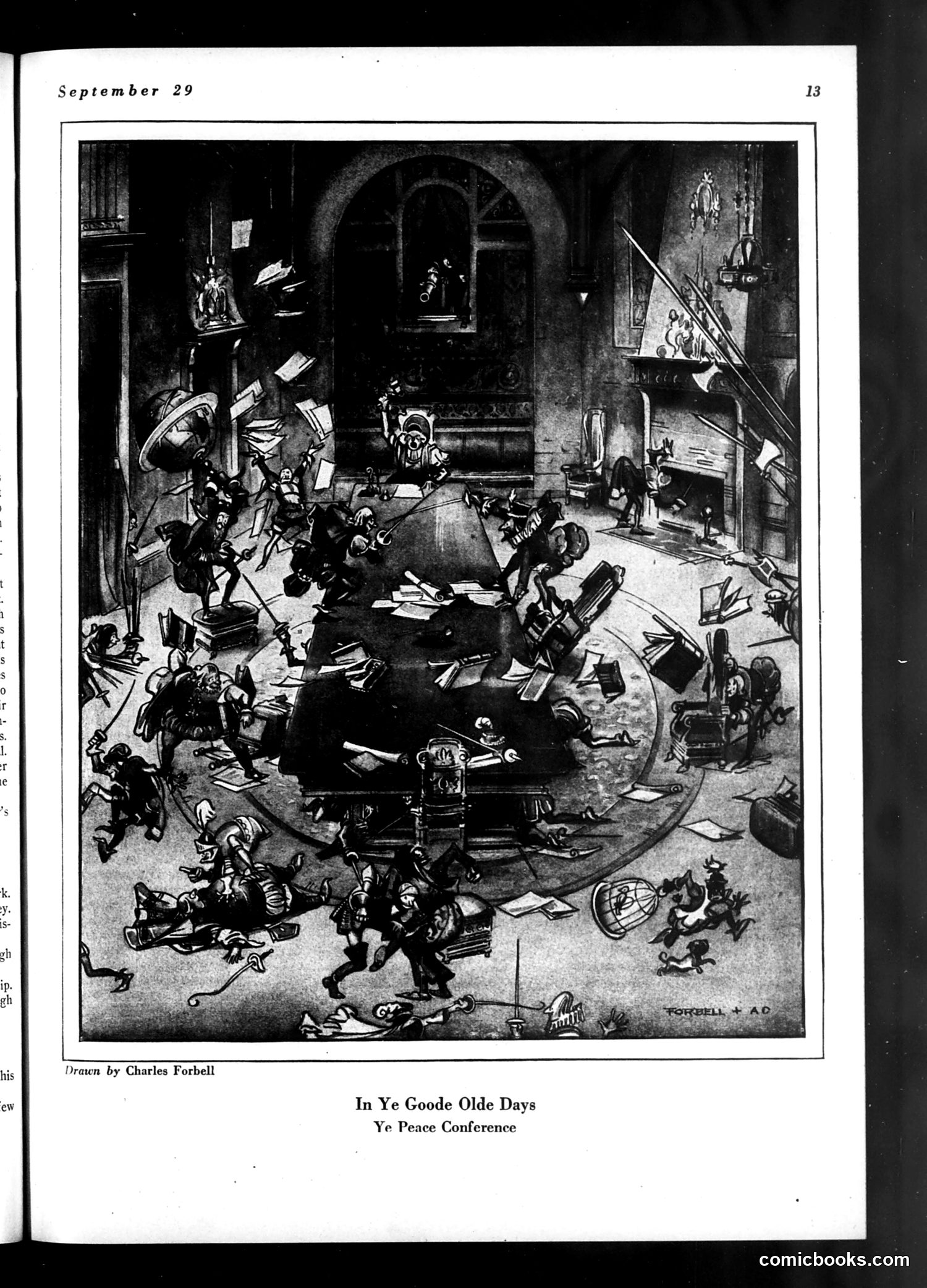
This Charles Forbell cartoon satirizes a peace conference by depicting it as chaotic medieval chaos. The drawing shows figures in period costume engaged in violent conflict—fighting with weapons, throwing objects, and generally causing mayhem in what appears to be a grand hall or palace setting. The satire's point is clear: the cartoon mocks the notion that historical "peace conferences" were any more orderly or successful than contemporary ones. By setting the scene in "ye goode olde days" (medieval times), Forbell suggests that peace conferences—whether historical or modern—devolve into disorder and violence rather than achieving genuine peace. It's a cynical commentary on the futility of diplomatic negotiations.
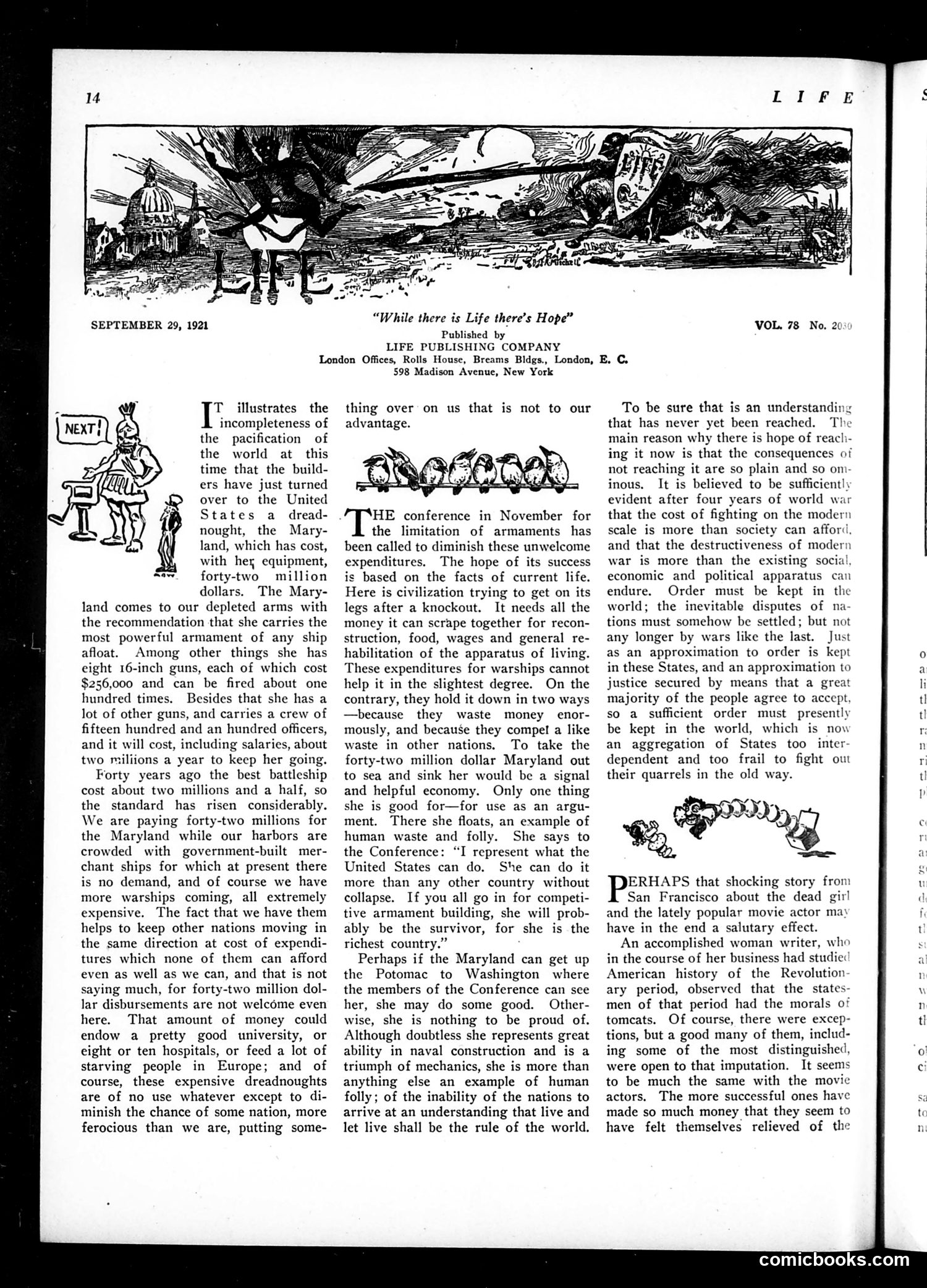
The page critiques American military spending, specifically the USS Maryland battleship. The left cartoon shows a figure labeled "NEXT!" in militaristic dress, satirizing how new warships keep coming despite their enormous expense (forty million dollars mentioned). The text argues that spending on such dreadnoughts is wasteful when that money could fund universities, hospitals, or aid starving Europeans. The Maryland is presented as an example of nations' competitive arms-building—the Conference on Limitation of Armaments (referenced for November) aimed to reduce such expenditures. The satire targets post-WWI military excess: why build expensive warships when peace negotiations and domestic needs should take priority?
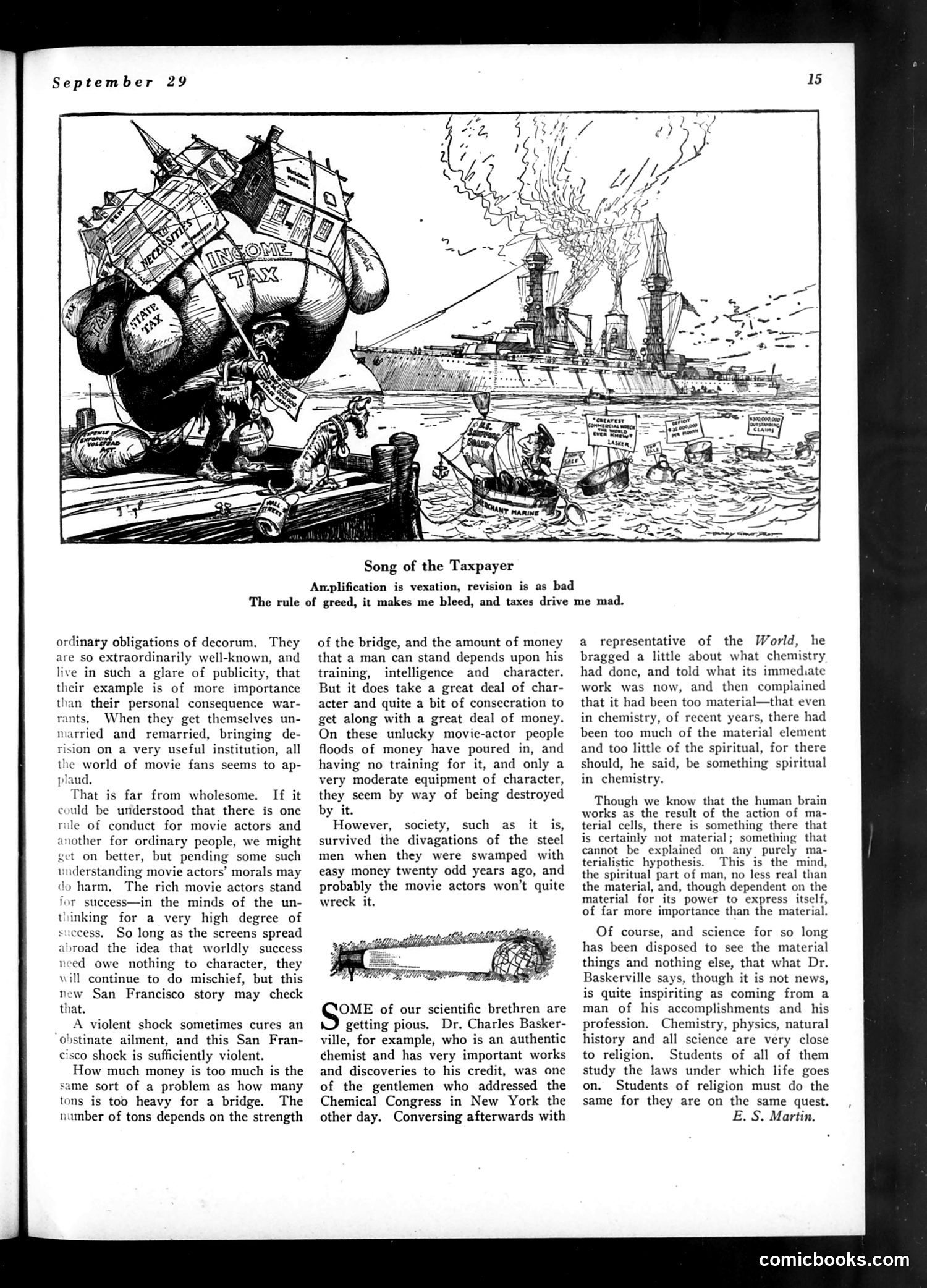
The cartoon depicts an overloaded figure (representing the American taxpayer) staggering under enormous burdens labeled with taxes and government obligations, while a warship and military personnel appear in the background. The title and subtitle express taxpayer frustration: "Amplification is vexation, revision is as bad / The rule of greed, it makes me bleed, and taxes drive me mad." This is anti-tax satire, likely from the World War I era or its immediate aftermath, when military spending and tax burdens increased dramatically. The cartoon criticizes government fiscal policy as excessive and parasitic. The military imagery suggests the artist associates heavy taxation with war spending and military expansion. The accompanying article shifts to criticizing movie actors' moral behavior and excessive wealth—a separate but related concern about societal excess and greed during this prosperous period.
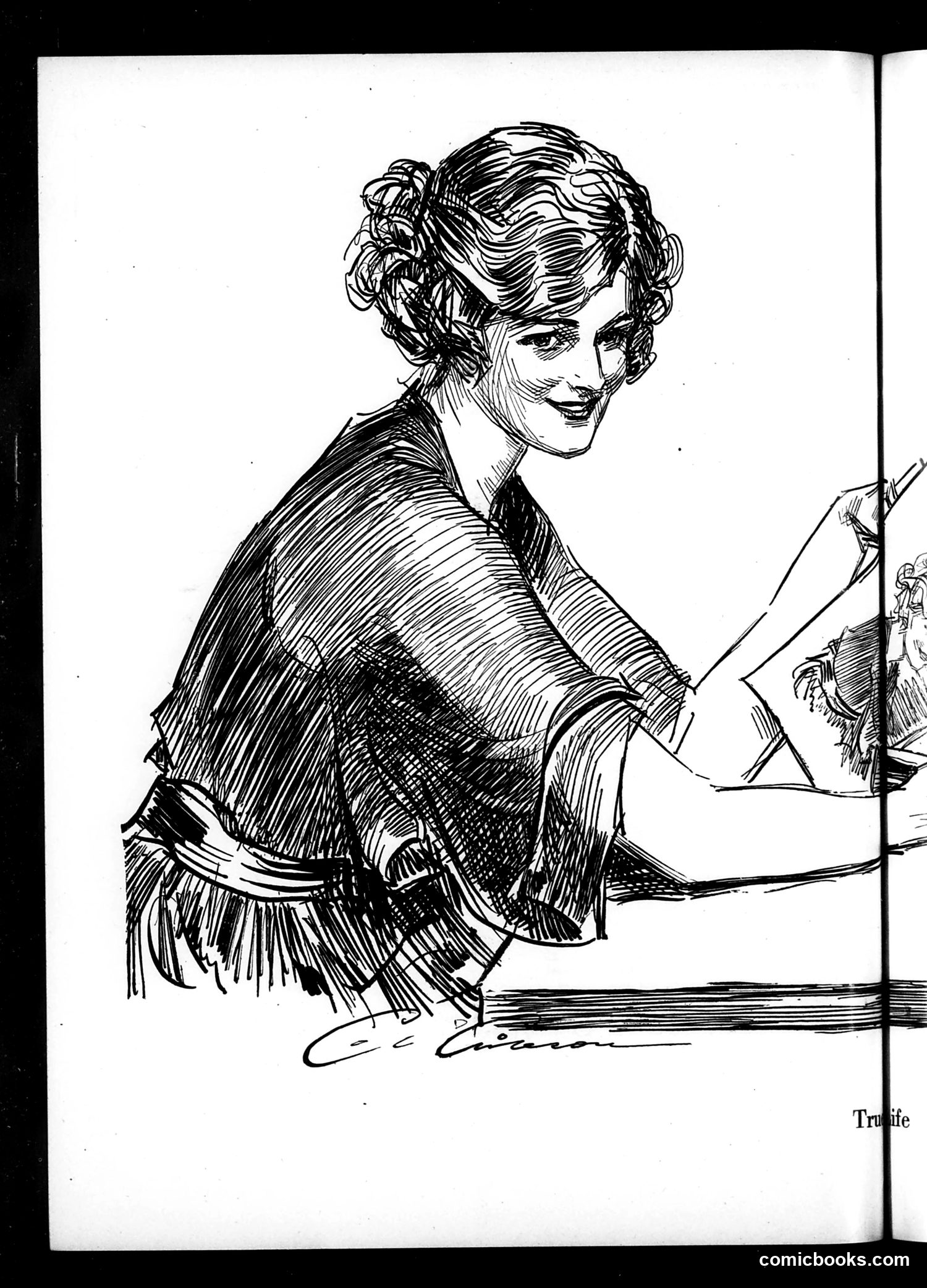
This is a pen-and-ink illustration signed by "Truffite" showing a fashionably dressed woman in 1920s-style clothing, viewed from behind as she looks over her shoulder with a knowing smile. She wears a draped garment with decorative fringe and holds what appears to be a mirror or reflective object. The drawing appears to be a **fashion or society illustration** rather than political satire. The signature at the bottom right reads "Truffite," likely the artist's name. The style and subject matter suggest this is typical of *Life* magazine's entertainment and lifestyle content—elegant, witty social commentary targeting urban, affluent readers familiar with contemporary fashion and manners rather than political commentary.
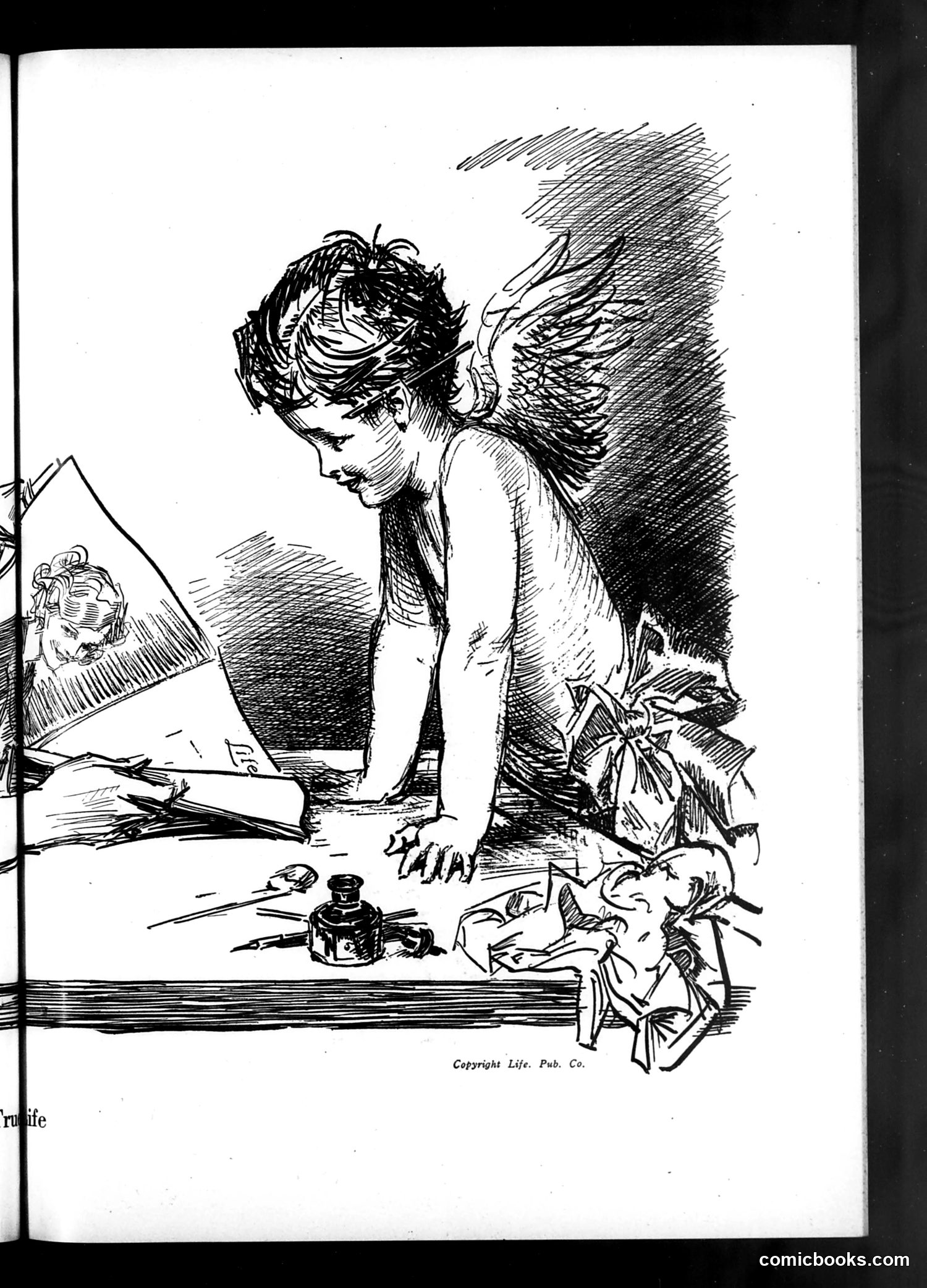
This is a pen-and-ink illustration from *Life* magazine showing a young woman at a desk, appearing to write or draw. She has her hair styled up, typical of early 20th-century fashion, and wears a simple dress. The desk contains writing implements, an inkwell, and scattered papers or materials. The artwork itself is unmarked by visible satirical captions or labels identifying specific figures or political references. Without additional context or text explaining the cartoon's intent, it appears to be either a general illustration about women's creative or clerical work, or possibly commentary on women's education and professional pursuits—common *Life* magazine themes of that era. The specific satirical point remains unclear from the image alone.
This page contains theater reviews satirizing three popular plays. The critic mocks **"Tarzan of the Apes"** for its absurd premise: an English baby raised by an ape (played in "Bert Williams make-up"—referencing a blackface comedian) in an African jungle. The reviewer finds the plot so ridiculous it's initially entertaining but eventually tedious, comparing the experience to "freezing to death." **"The Blue Lagoon"** receives similar criticism—shipwrecked youths raised in the jungle by an Irish sailor who won't stop talking. The critic sarcastically suggests distributing poisonous berries to audience members so they can sleep through it. **"Only 38"** is defended against criticism as wholesome entertainment featuring sentimental family moments and Mr. Sanborn's folksy charm. The small decorative illustrations (ape, boat, floral dividers) are typical period magazine ornamentation. The overall tone exemplifies Life's satirical approach to theatrical criticism—witty, exaggerated mockery of implausible plots and overwrought performances.
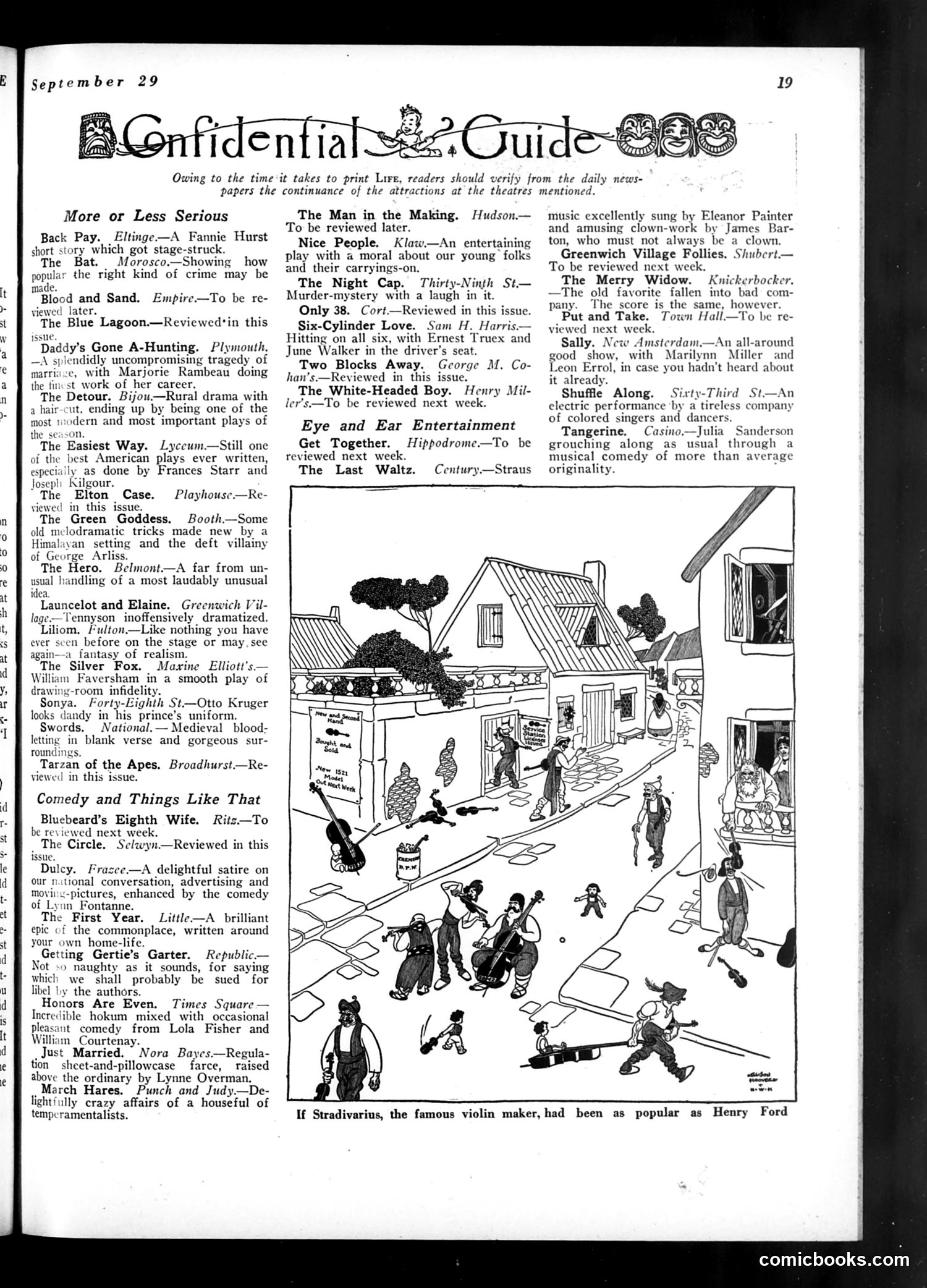
This is a theater review page from *Life* magazine (September 29, likely 1921, based on the shows listed). The left column contains brief reviews of Broadway productions organized by genre—serious dramas, comedies, and musical entertainments. The large illustration depicts a street scene, likely meant as humorous commentary on urban life or theater-going culture. The caption reads: "If Stradivarius, the famous violin maker, had been as popular as Henry Ford"—a joke comparing a master craftsman to the mass-production industrialist. The sketch shows a crowded, chaotic street with numerous figures and activities, suggesting what excessive popularity might look like. This is primarily **informational content** (theater listings) rather than political satire. The humor is social commentary about American consumer culture and celebrity, contrasting fine artisanal craftsmanship with mass-market popularity. No specific political figures or events are referenced.
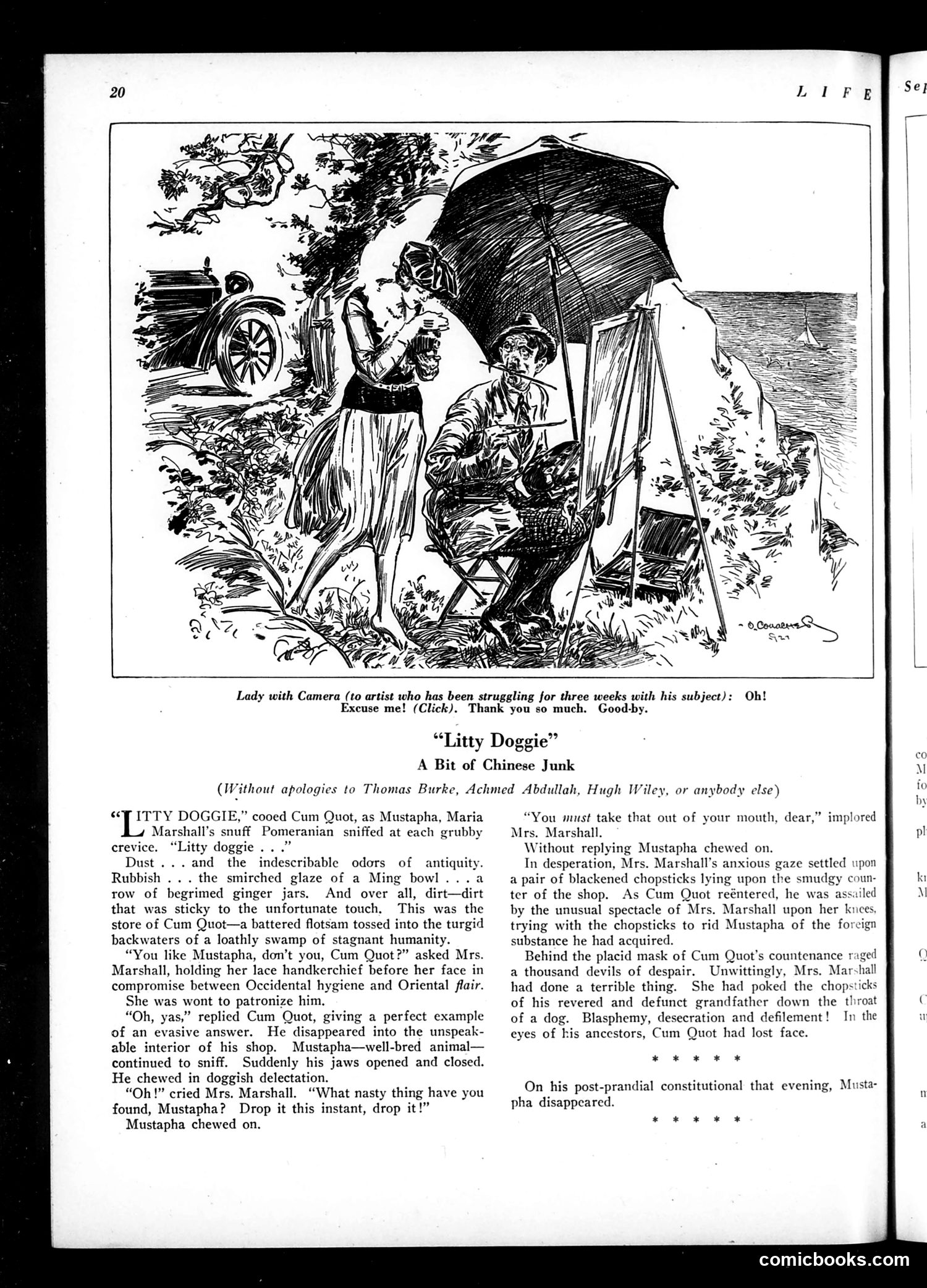
This is a short story (not a political cartoon) satirizing early 20th-century racial and cultural stereotypes. The narrative mocks Western attitudes toward Chinese immigrants and Asian culture. **The setup:** Mrs. Marshall, a wealthy Western woman, visits Cum Quot's antique shop with her Pomeranian dog, Mustapha. She patronizes him while maintaining "Occidental hygiene" standards despite the shop's filth. **The "joke":** The dog swallows chopsticks belonging to Cum Quot's deceased grandfather—sacred objects in Chinese ancestor veneration. Mrs. Marshall, oblivious to cultural significance, uses the chopsticks to retrieve the item from the dog's throat, committing what Cum Quot views as blasphemy. **The satire:** The story mocks Western ignorance of Asian customs and unconscious disrespect, while also presenting Cum Quot through reductive stereotypes (broken English, exoticized setting). The dark ending—Mustapha's disappearance—suggests revenge, playing into period fears about "inscrutable" Asians. The piece satirizes both Western arrogance and relies on the very stereotypes it seemingly critiques.
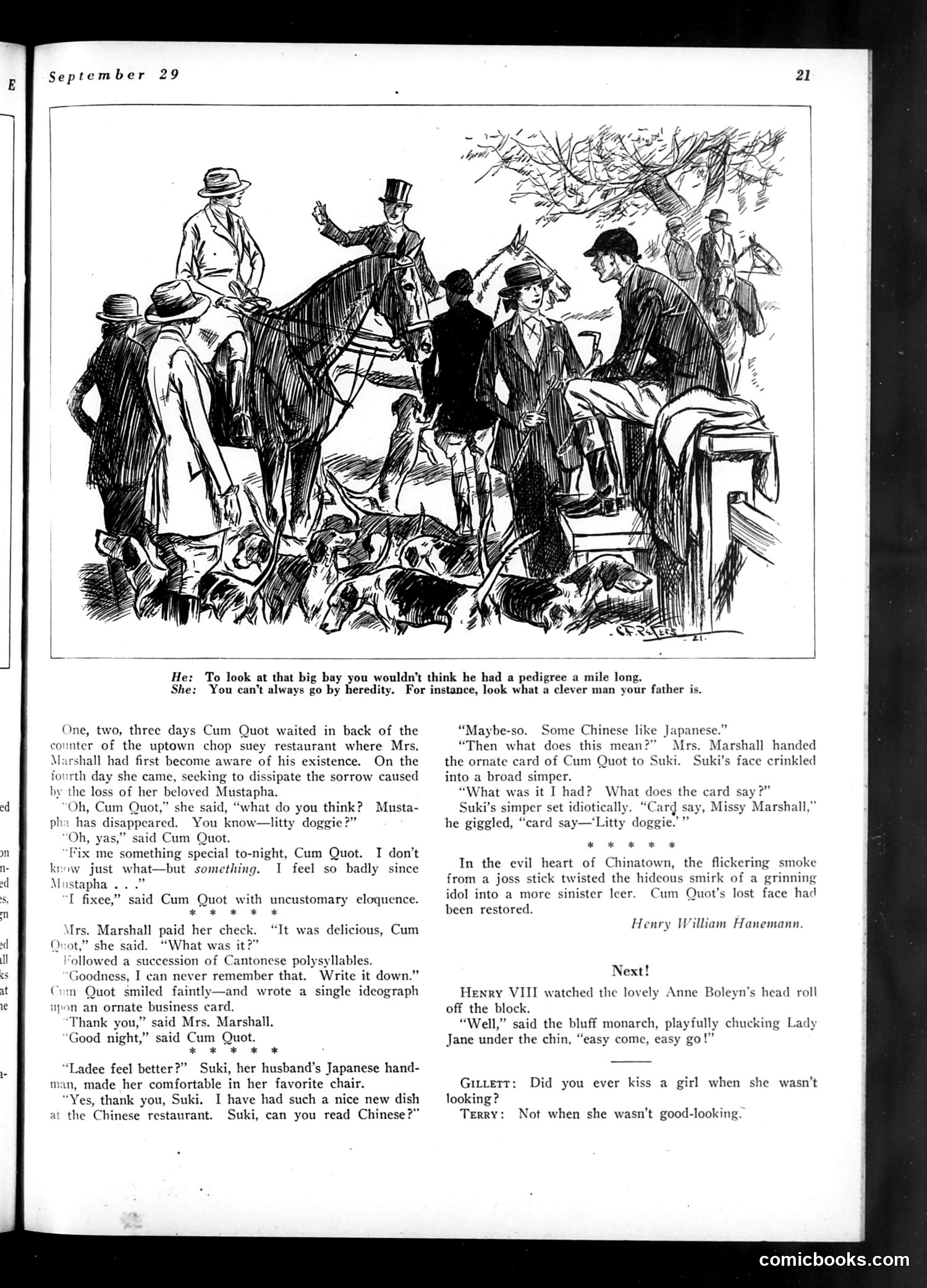
This page contains two distinct satirical pieces: **"Cum Quot" Story**: A racist "joke" playing on anti-Chinese stereotypes. A wealthy American widow, Mrs. Marshall, loses her dog "Mustapha" and visits a Chinese restaurant owner seeking comfort food. Cum Quot serves her dog meat (implied by the punchline), then gives her a card she cannot read. Her Japanese servant translates it as saying "Litty doggie"—revealing she unknowingly ate her own pet. The humor relies on depicting Chinese people as deceptive, untrustworthy, and cruel, while mocking the Chinese language as incomprehensible to white Americans. **Historical Context**: This reflects early 20th-century American xenophobia and widespread "Yellow Peril" anxieties about Asian immigrants. The story's morality is inverted—Cum Quot "restores his lost face" through deception rather than facing consequences. **Other Content**: A brief Henry VIII joke and a flirtation joke at page bottom, typical period humor. The entire piece is offensive by modern standards, exemplifying how mainstream publications normalized racist caricatures.
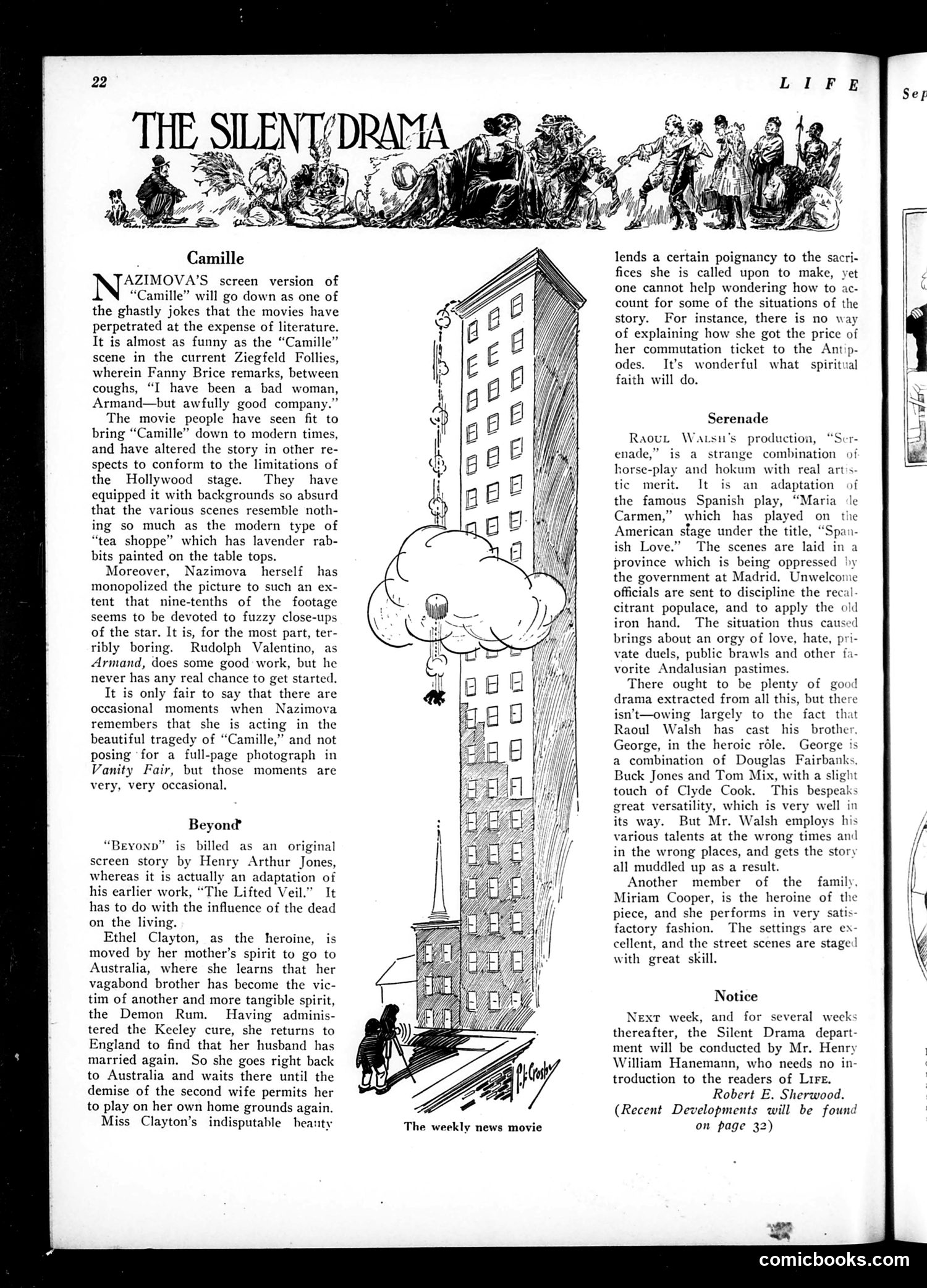
This page contains three film reviews from Life's "Silent Drama" column, critiquing recent movie releases: **"Camille"**: The reviewer savagely mocks Nazimova's screen adaptation, calling it "one of the ghastly jokes" perpetrated on literature. The film was modernized and fills with absurd "tea shoppe" sets. Nazimova dominates through excessive close-ups, leaving co-star Rudolph Valentino unable to develop his role. The tone is dismissive and cutting. **"Beyond"**: Ethically problematic—it's marketed as original but actually adapts an earlier play. The review mocks its plot implausibilities (how did the heroine afford her ticket?) and credits supernatural explanations for everything. **"Serenade"**: A Spanish-set drama mixing "horse-play and hokum." The reviewer praises artistic merit but faults director Raoul Walsh for casting his brother George in the lead—mixing disparate actor styles (Fairbanks, Tom Mix, Clyde Cook)—creating an incoherent result, though sister Miriam Cooper performs adequately. Throughout, Life's critics emphasize cinema's technical and storytelling failures rather than literary merit.
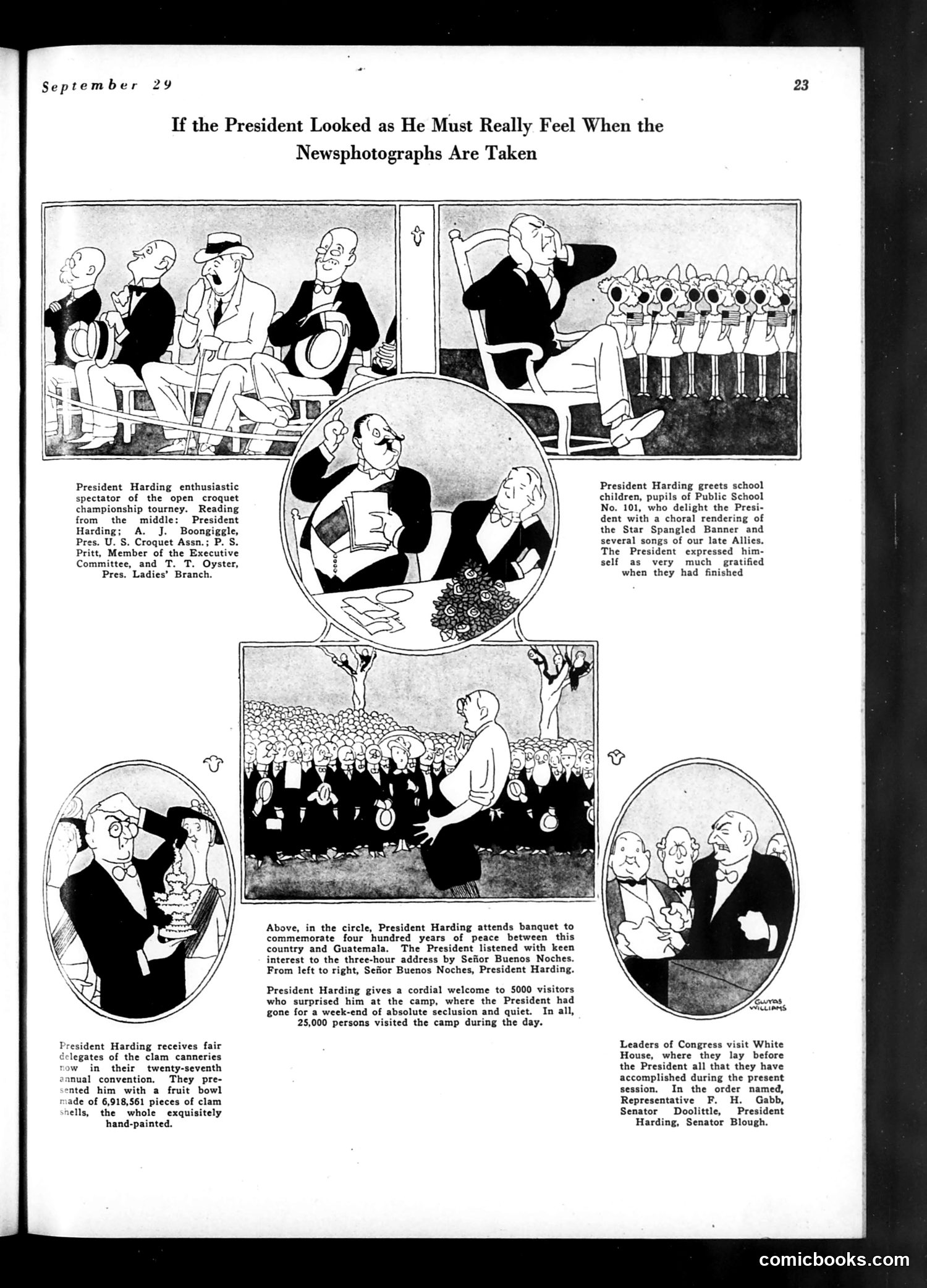
This Life magazine page satirizes President Warren G. Harding's public persona versus his likely private feelings. The title promises to show "how he must really feel" during official photographs—implying a gap between his public composure and genuine emotions. The cartoons depict Harding attending tedious official functions: croquet tournaments, clam cannery conventions, school children's performances, a three-hour Guatemalan peace banquet, surprise camp visits by 25,000 people, and Congressional meetings. Each caption emphasizes the event's mundane or exhausting nature. The satire suggests Harding found these mandatory public duties boring or burdensome, despite maintaining a gracious public facade. The exaggerated details—6.9 million hand-painted clam shells, a three-hour speech—mock the absurdity and tedium of ceremonial presidency. This reflects broader 1920s-era criticism of Harding as disengaged and preferring leisure to serious governance.
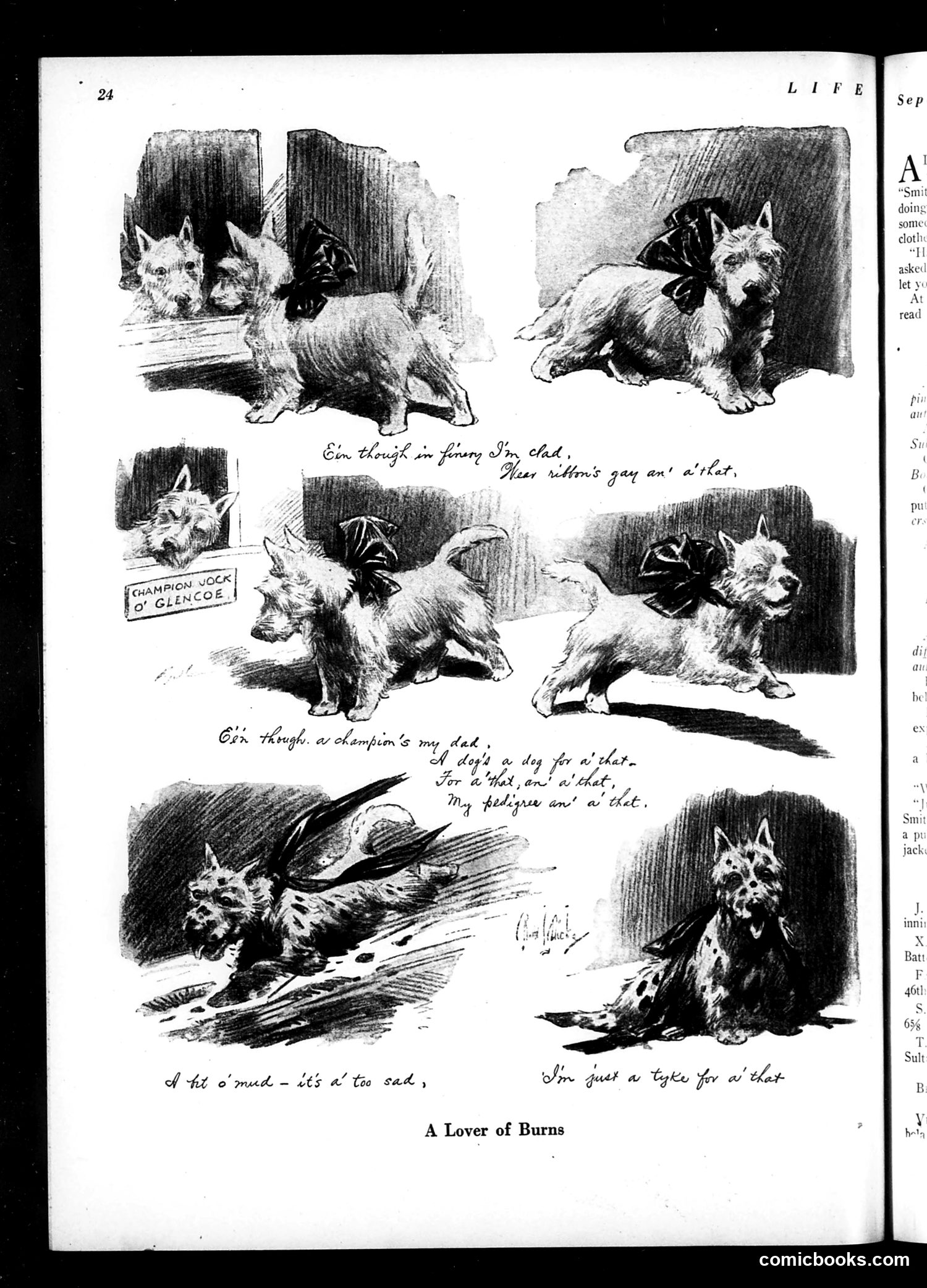
This page features multiple sketches of Scottish Terriers (or similar breeds) wearing tartan bows, illustrating a poem in Scottish dialect. The title references Robert Burns, Scotland's national poet, famous for romantic and rustic verse. The cartoon satirizes sentimental Scottish romanticism—a popular cultural affectation of the era. Each dog illustration pairs with lines of mock-heroic doggerel mimicking Burns's style, treating mundane canine behavior (fighting, mating, wandering) as weighty subjects worthy of poetic treatment. The "Champion Jock o' Glencoe" label on one sketch suggests mock-noble ancestry. The satire targets both Burns enthusiasts who treated his work with excessive reverence and the broader Victorian fashion for romanticized Scottishness. By applying grandiose Burns-style poetry to ordinary dogs in tartan costume, Life mocks the pretentiousness of this cultural trend.
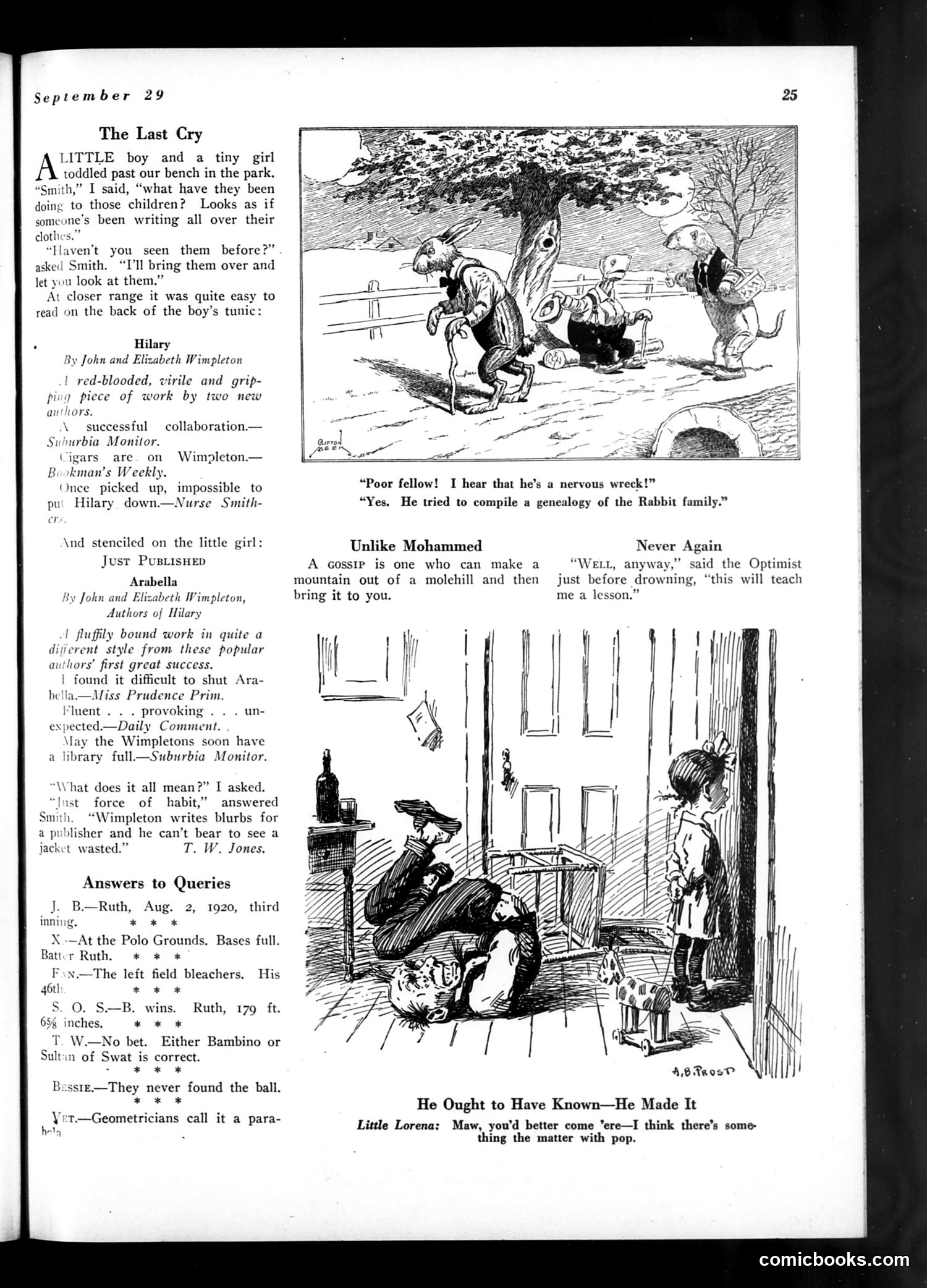
This September 1920 *Life* magazine page contains several short humorous pieces: **"The Last Cry"** satirizes aggressive book marketing. Two children have book advertisements literally written on their clothing—they've become walking billboards for the fictional authors "John and Elizabeth Wimpleton." The joke: a publisher so eager to promote books he can't resist turning children into advertisements. The final line reveals the absurdity: the publisher writes blurbs (promotional quotes) on *everything*, even wasting them on book jackets. **"Unlike Mohammed"** is a one-line quip defining gossip as someone who exaggerates small issues into major drama. **"Never Again"** presents dark humor: an optimist drowning finds a "lesson" in the experience, suggesting naïve positivity even in catastrophe. The remaining cartoons use similar quick-joke formats typical of *Life's* satirical style—domestic comedy and social observation rendered in simple drawings with punchy punchlines.
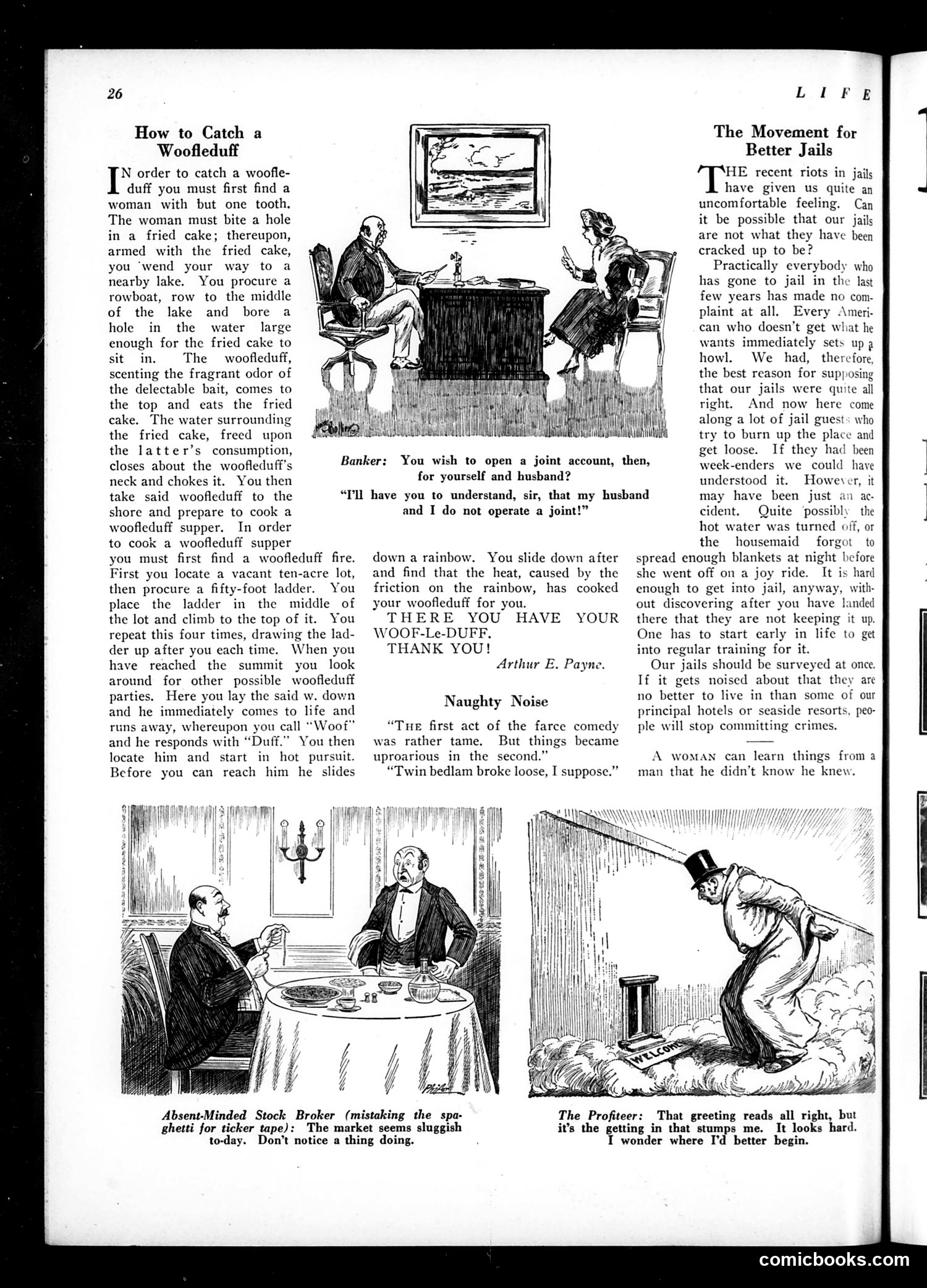
This page contains satirical humor typical of early 20th-century Life magazine: **"How to Catch a Woofleduff"** is absurdist nonsense—a deliberately ridiculous "instruction" for catching a fictional creature through increasingly impossible steps (finding a one-toothed woman, boring holes in water, sliding down rainbows). The humor relies on the reader recognizing the absurdity; there is no actual "woofleduff." **"Absent-Minded Stock Broker"** depicts a financial professional mistaking spaghetti for ticker tape, satirizing Wall Street distraction during sluggish market conditions. **"The Banker and Joint Account"** shows a wife refusing joint finances with her husband—social commentary on marital property rights and women's financial independence. **"The Movement for Better Jails"** critiques recent jail riots sarcastically, suggesting authorities should improve conditions or criminals will stop committing crimes. The remaining shorts are brief comedic observations on theater noise and gender relations. All employ dry wit targeting contemporary social and economic issues.
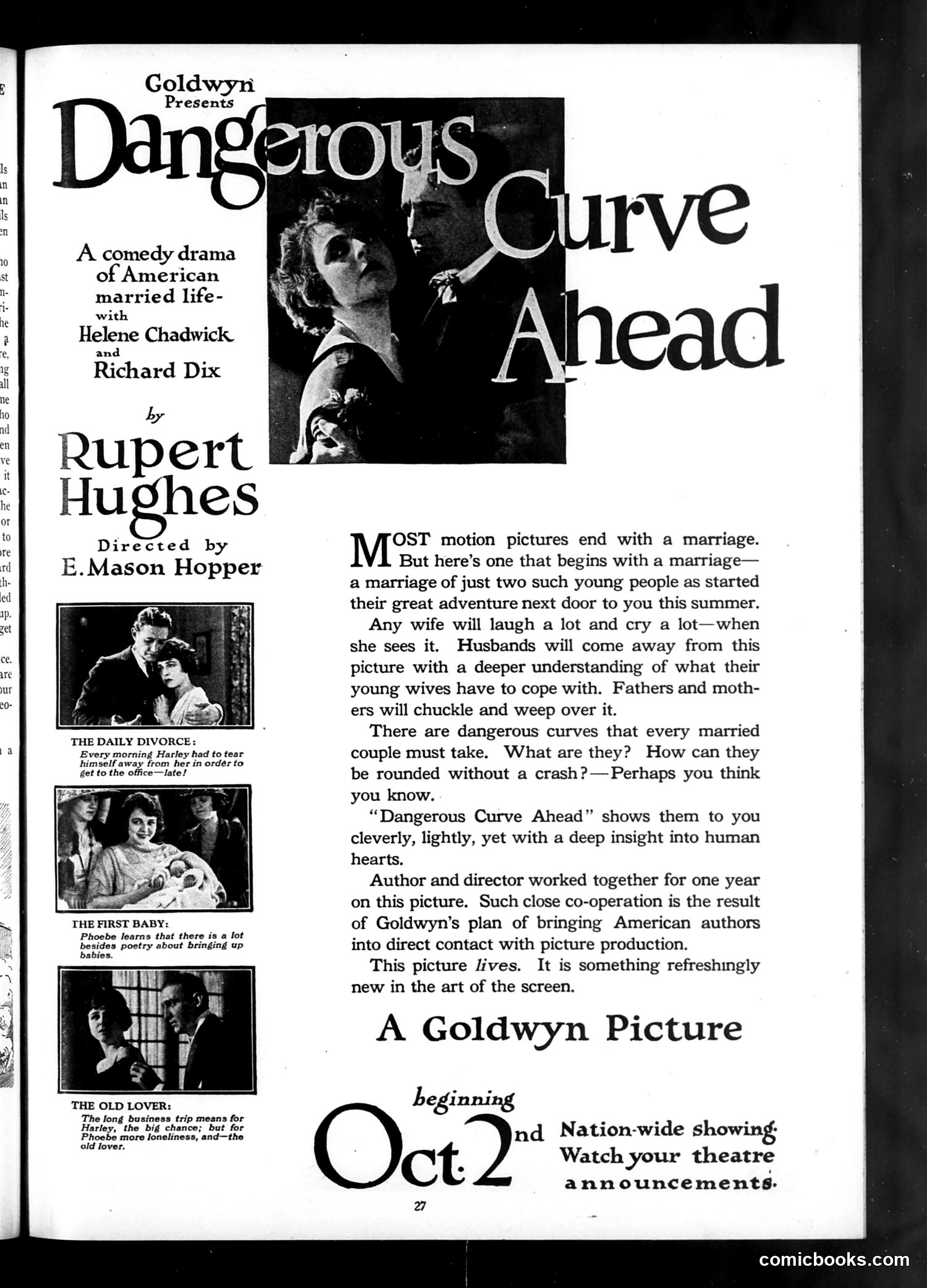
This is a Goldwyn Pictures advertisement for a 1921 silent film about married life. The "dangerous curves" metaphor refers to the emotional and relational challenges young couples face—not literal hazards. The film depicts three domestic scenarios shown in the small photographs: marital routine ("The Daily Divorce"), the arrival of children ("The First Baby"), and temptation during separation ("The Old Lover"). These represent the common strains on marriages. The advertisement's pitch appeals to different audiences: wives will find emotional resonance, husbands will gain empathy for their spouses' burdens, and parents will recognize universal family struggles. The copy emphasizes the film's supposedly innovative realism—that it "lives"—distinguishing it from typical escapist cinema. This reflects 1920s attitudes about marriage as requiring navigation of predictable crises, presented here as entertainment and moral instruction.
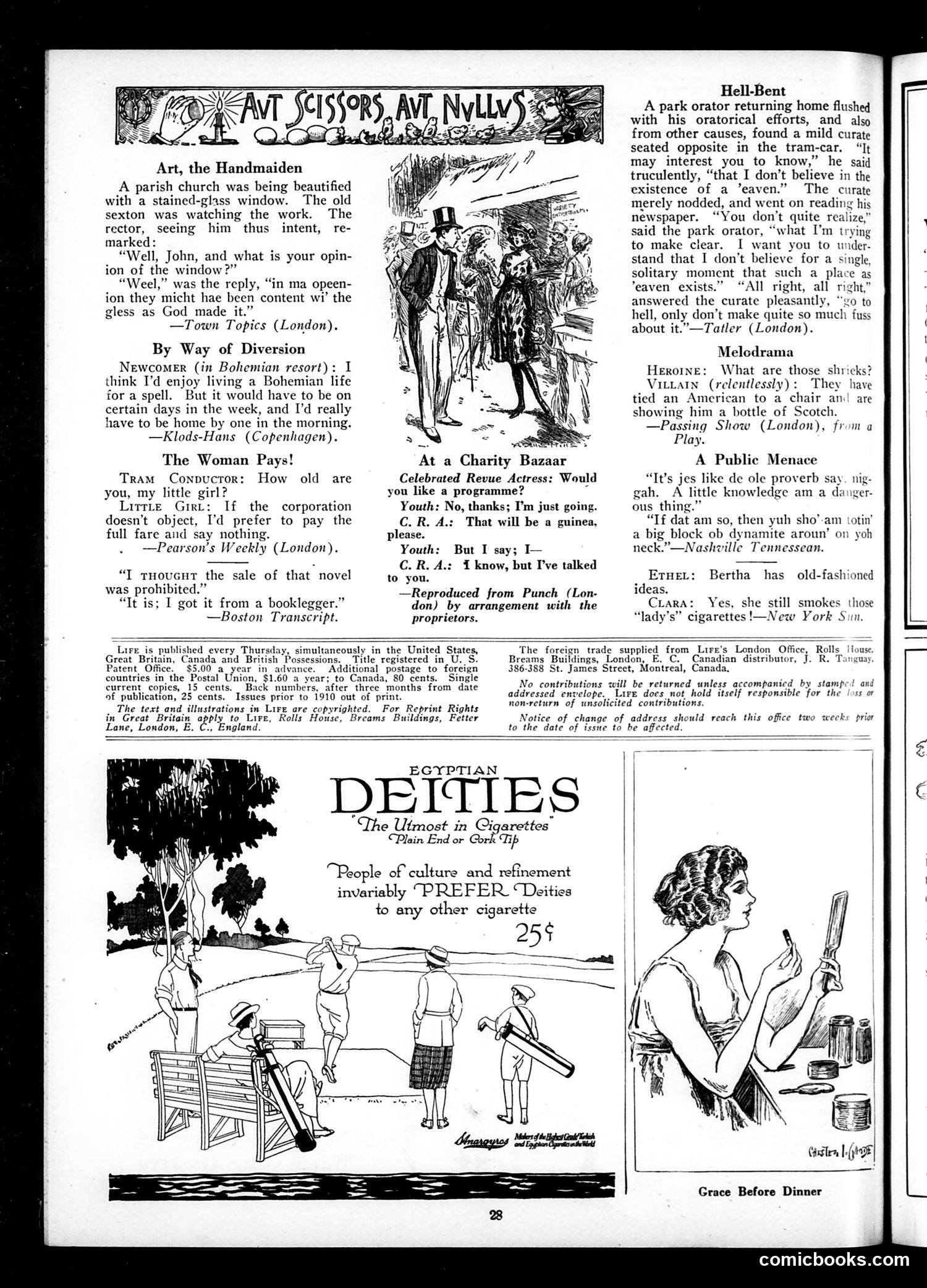
This page contains several brief satirical anecdotes typical of early 20th-century humor magazines, plus a cigarette advertisement. **The jokes mock:** - Religious hypocrisy ("Hell-Bent"): A drunk park orator harangues a curate about disbelieving in heaven; the curate's calm response—essentially "fine, just be quiet about it"—deflates the speaker's self-importance. - Gender and class expectations ("The Woman Pays"): A tram conductor assumes a working-class girl can't afford full fare; she corrects him, suggesting corporations' paternalism is insulting. - Pretension ("By Way of Diversion"): A tourist wants "Bohemian life" but only on weekends, needing to be home by 1 AM—mocking dilettantism. **The advertisement** for Egyptian Deities cigarettes (25¢) uses orientalist imagery and claims cultural sophistication appeals to refined people. The page reflects period attitudes: casual ethnic stereotyping (the "Nashville Tennessean" item uses period dialect), gender assumptions, and class humor. These brief items were *Life* magazine's trademark format—quick, punchy social commentary.
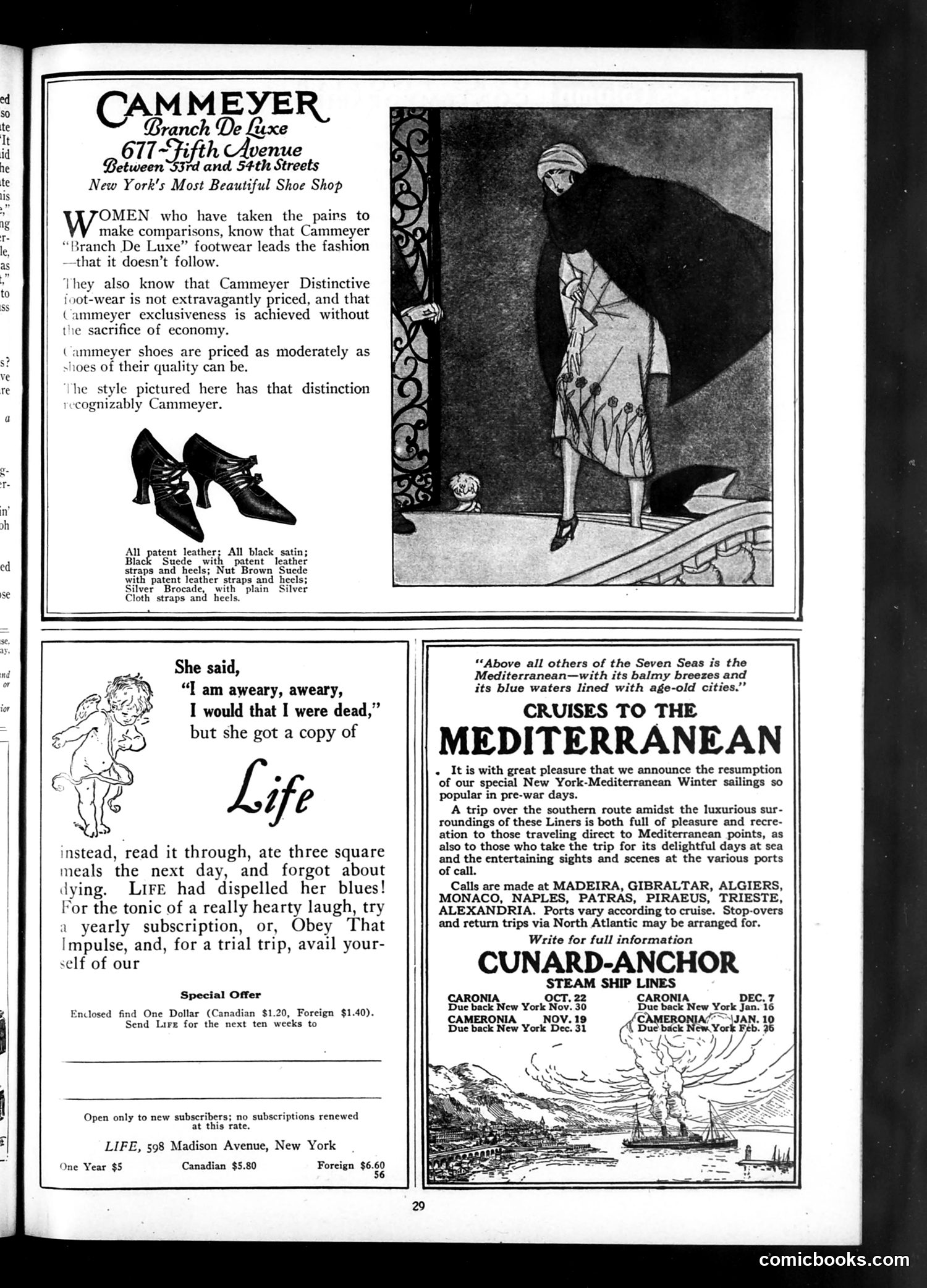
This page consists primarily of **advertisements** rather than editorial cartoons or satire. The top ad promotes **Cammeyer shoes** from their Fifth Avenue boutique, emphasizing fashionable exclusivity at moderate prices—targeting women concerned with style and value. The middle ad uses mild humor to promote **Life magazine itself** as a cure for depression. A woman contemplating suicide supposedly recovers after reading Life, eating meals, and laughing—positioning the magazine as therapeutic entertainment. The bottom ad announces the **resumption of Cunard-Anchor cruise service** to the Mediterranean post-WWI, marketing luxury ocean travel to Mediterranean ports like Naples and Alexandria. This reflects post-war economic recovery and the resumption of leisure travel. All three ads target affluent readers with disposable income for shoes, magazine subscriptions, and expensive vacations—reflecting the prosperous 1920s era when this Life issue was published.
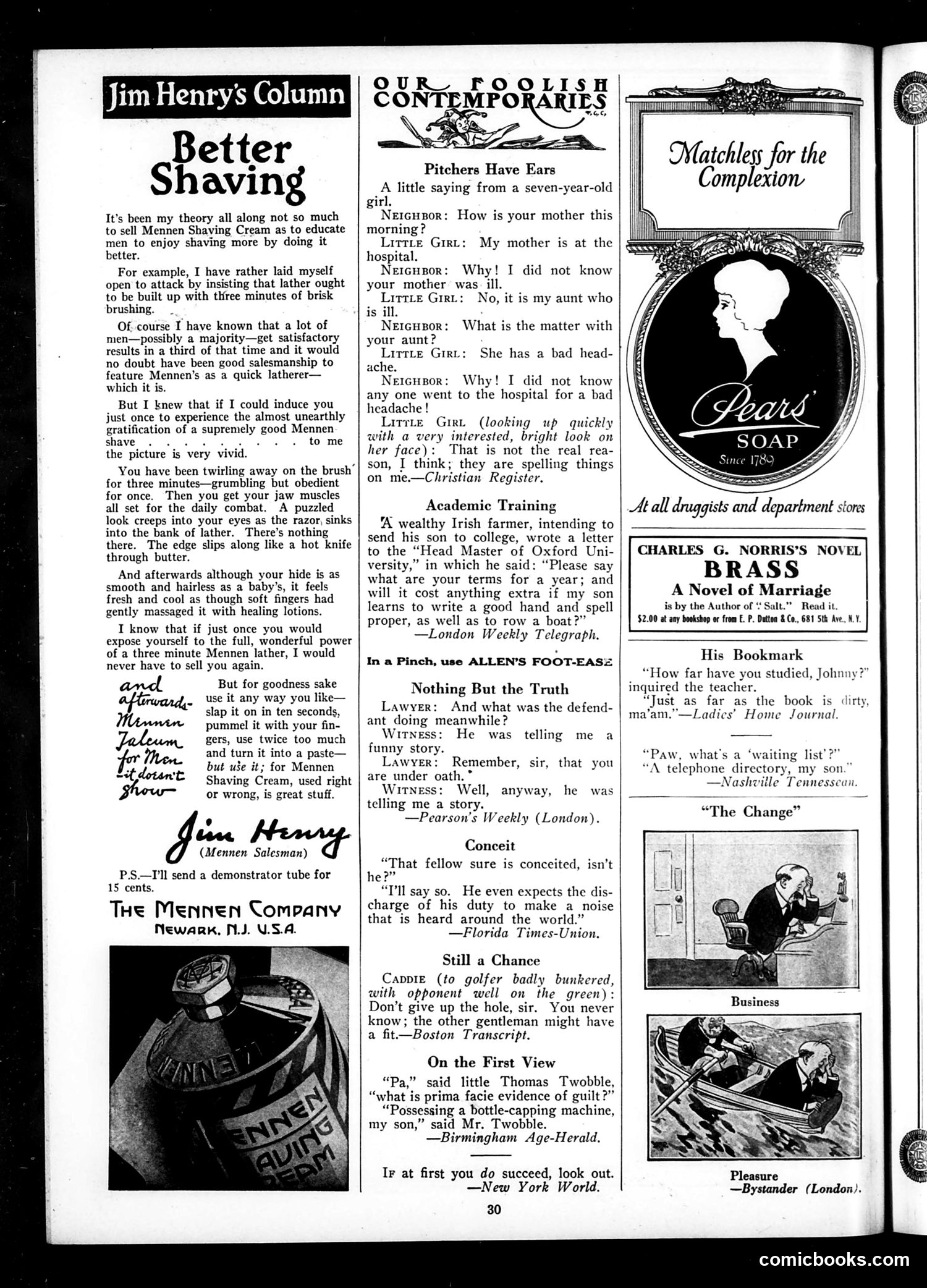
This page is primarily **advertising and humor**, not political commentary. The main content includes: **Jim Henry's Column** advertises Mennen Shaving Cream by emphasizing the superiority of a three-minute lather preparation, positioning the product as promoting better shaving technique rather than speed. **"Our Foolish Contemporaries"** section contains brief humorous anecdotes: - "Pitchers Have Ears": A child's innocent misunderstanding about hospital visits - "Academic Training": An Irish farmer naïvely asking if Oxford charges extra for handwriting lessons - Several other short jokes about lawyers, conceited men, golfers, and bottle-capping machines These jokes rely on wordplay, misunderstandings, and gentle satire of human folly rather than political targets. The Pears Soap advertisement features a silhouette profile. The page represents typical early 20th-century magazine humor—light, domestic, and consumer-focused—with no apparent political content or significant historical references requiring modern context.
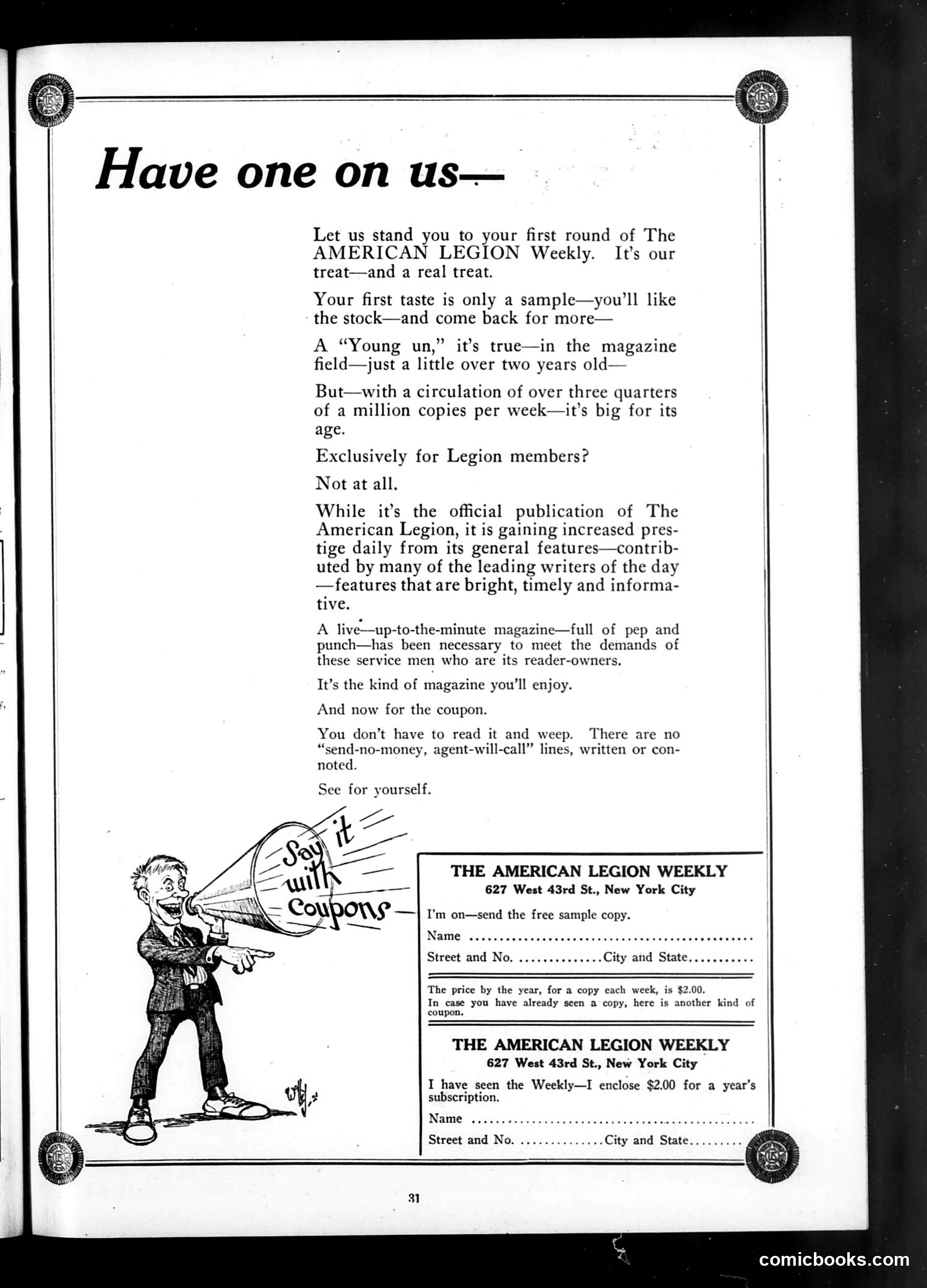
This is primarily an advertisement for *The American Legion Weekly*, a magazine launched by the American Legion (a veterans' organization founded after WWI). The page uses satirical humor typical of *Life* magazine to promote the publication. The cartoon depicts a cheerful man with a megaphone shouting "Say it with Coupons"—a play on the popular 1920s slogan "Say it with Flowers." This playful reference humorously invites readers to try the magazine. The ad emphasizes that despite being only two years old, the publication has massive circulation (750,000+ copies weekly) and appeals to general audiences, not just Legion members. It highlights contributions from "leading writers" and positions the magazine as lively and relevant for returning servicemen. The tone is folksy and welcoming—"Have one on us"—treating the magazine subscription like a friendly drink offer, which adds to the satirical charm. Two subscription coupons are provided for interested readers.
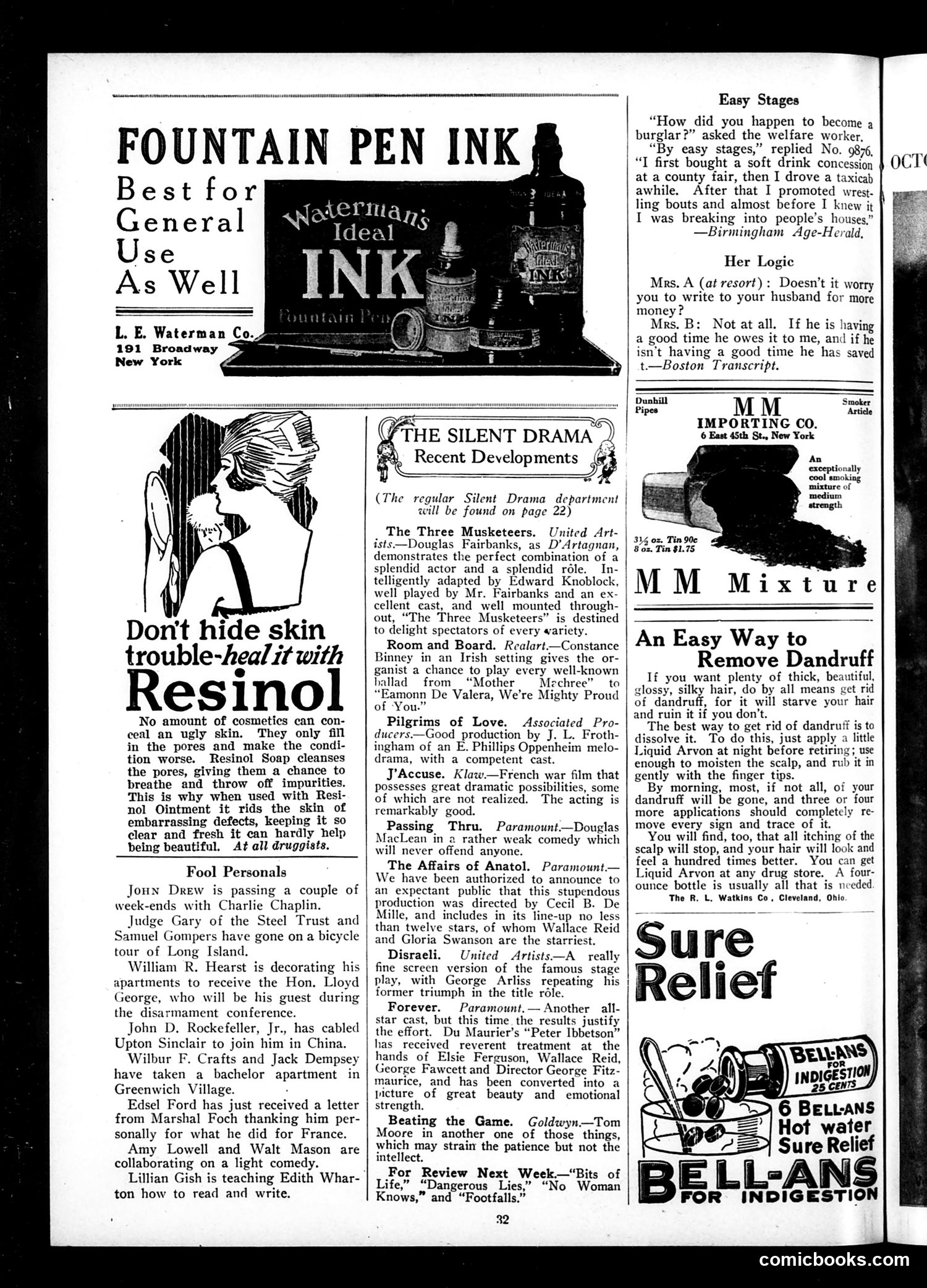
This page is primarily **advertising and entertainment coverage**, not political satire. The "Fool Personals" section presents **absurdist fake gossip** mocking prominent real figures of the era—John D. Rockefeller Jr., William Randolph Hearst, Judge Gary (Steel Trust), and others. The humor works by pairing these powerful, serious men in ridiculous scenarios (a bicycle tour, inviting radical Upton Sinclair to China, teaching literacy to famous writers). It's gentle satire on wealth and influence rather than biting political commentary. The page also includes product advertisements (Resinol soap, Waterman ink, Bellans digestive aid) and film reviews for silent movies, typical of *Life* magazine's mixed content format during this period (appears to be early 1920s based on film titles). The cartoon illustration shows a woman's profile—likely advertising Resinol's skincare claims about treating "embarrassing defects."