
Life, 1921-09-29 · page 9 of 34
Life — September 29, 1921 — page 9: what you’re looking at
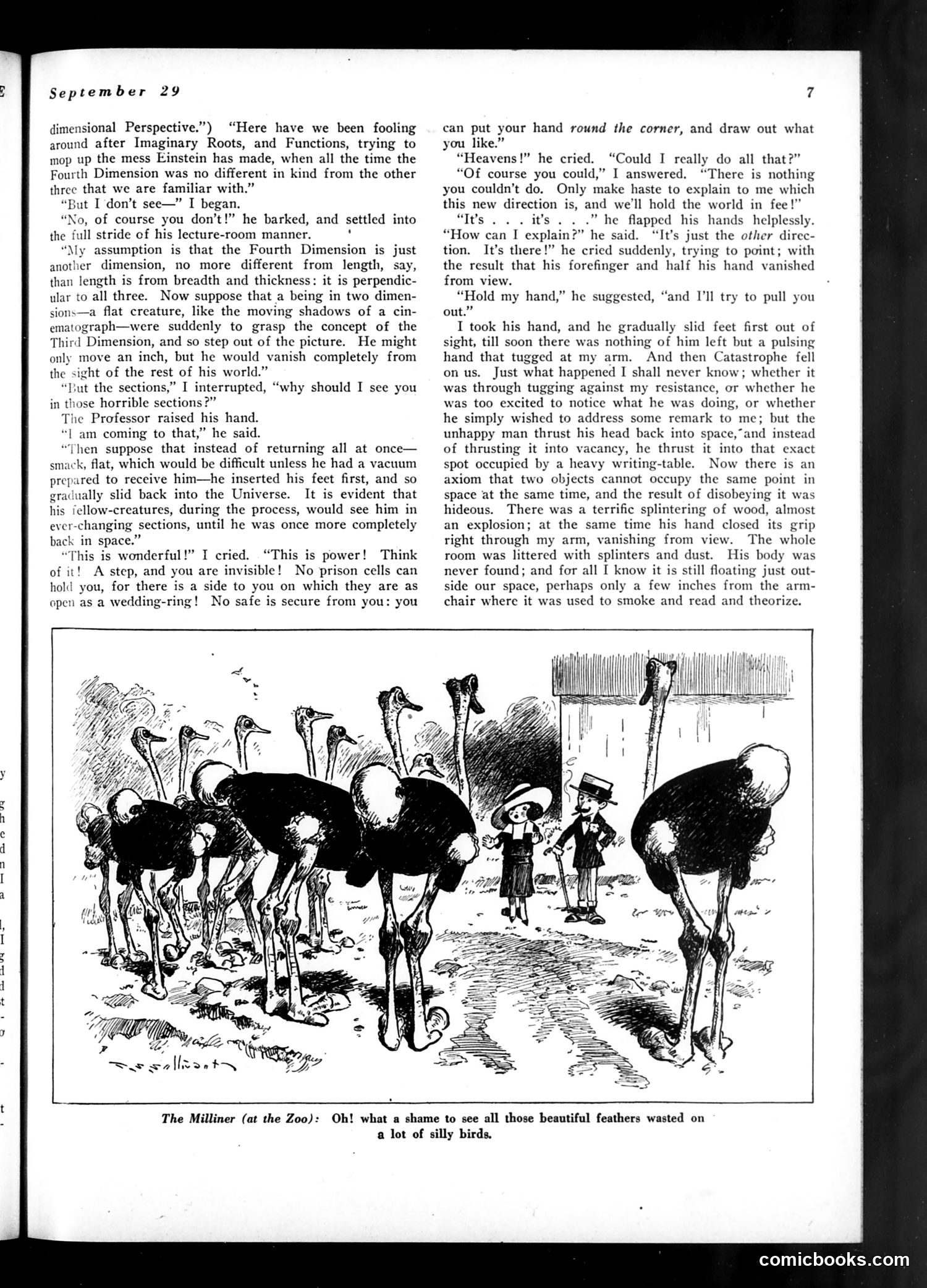
What you’re looking at
This cartoon satirizes women's fashion, specifically the early 20th-century trend of using feathers and bird parts in women's hats. The milliner (hat-maker) observes ostriches at the zoo, admiring their plumage while lamenting it's "wasted on a lot of silly birds." The joke targets the absurdity of the fashion industry's demand for exotic feathers—women wore elaborate feathered hats as status symbols, driving demand for ostrich plumes and other bird materials. The cartoon criticizes both the wasteful practice and the vanity it represents, suggesting feathers would be "better used" adorning fashionable hats rather than the birds themselves. This reflects growing early-1900s conservation concerns about bird populations being decimated for the millinery trade.
📄 Transcribed text from this page (OCR, searchable)
Machine-transcribed from the original scan — historical spelling and the odd misread are preserved.
September 29 dimensional Perspective.”) “Here have we been fooling around after Imaginary Roots, and Functions, trying to mop up the mess Einstein has made, when all the time the Fourth Dimension was no different in kind from the other three that we are familiar with.” “But I don’t see—” I began. ‘o, of course you don’t!” he barked, and settled into the full stride of his lecture-room manner. ‘ ly assumption is that the Fourth Dimension is just another dimension, no more different from length, say, than length is from breadth and thickness: it is perpendic- ular to all three. Now suppose that a being in two dimen- sions—a flat creature, like the moving shadows of a cin- ematograph—were suddenly to grasp the concept of the Third Dimension, and so step out of the picture. He might only move an inch, but he would vanish completely from the sight of the rest of his world.” “But the sections,” I interrupted, “ in those horrible sections?” The Professor raised his hand. am coming to that,” he said. “Then suppose that instead of returning all at once— smack, flat, which would be difficult unless he had a vacuum prepared to receive him—he inserted his feet first, and so gradually slid back into the Universe. It is evident that his fellow-creatures, during the process, would see him in ever-changing sections, until he was once more completely back in space.” “This is wonderful!” I cried. “This is power! Think of it! A step, and you are invisible! No prison cells can hold you, for there is a side to you on which they are as open as a wedding-ring! No safe is secure from you: you why should I see you 7 can put your hand round the corner, and draw out what you like.” “Heavens!” he cried. “Could I really do all that?” “Of course you could,” I answered. “There is nothing you couldn’t do. Only make haste to explain to me which this new direction is, and we'll hold the world in fee!” “It's... it’s. . .” he flapped his hands helplessly. “How can I explain?” he said. “It’s just the other direc- tion. It’s there!” he cried suddenly, trying to point; with the result that his forefinger and half his hand vanished from view. “Hold my hand,” he suggested, out.” I took his hand, and he gradually slid feet first out of sight, till soon there was nothing of him left but a pulsing hand that tugged at my arm. And then Catastrophe fell on us. Just what happened I shall never know; whether it was through tugging against my resistance, or whether he was too excited to notice what he doing, or whether he simply wished to address some remark to me; but the unhappy man thrust his head back into space,“and instead of thrusting it into vacancy, he thrust it into that exact spot occupied by a heavy writing-table. Now there is an axiom that two objects cannot occupy the same point in space at the same time, and the result of disobeying it was hideous. There was a terrific splintering of wood, almost an explosion; at the same time his hand closed its grip right through my arm, vanishing from view. The whole room was littered with splinters and dust. His body was never found; and for all I know it is still floating just out- side our space, perhaps only a few inches from the arm- chair where it was used to smoke and read and theorize. “and I'll try to pull you Pras a mes salleontn ay), The Milliner (at the Zoo): Oh! what a shame to see all those beautiful feathers wasted on a lot of silly birds. comicbooks.com