
Life, 1921-09-29 · page 8 of 34
Life — September 29, 1921 — page 8: what you’re looking at
What you’re looking at
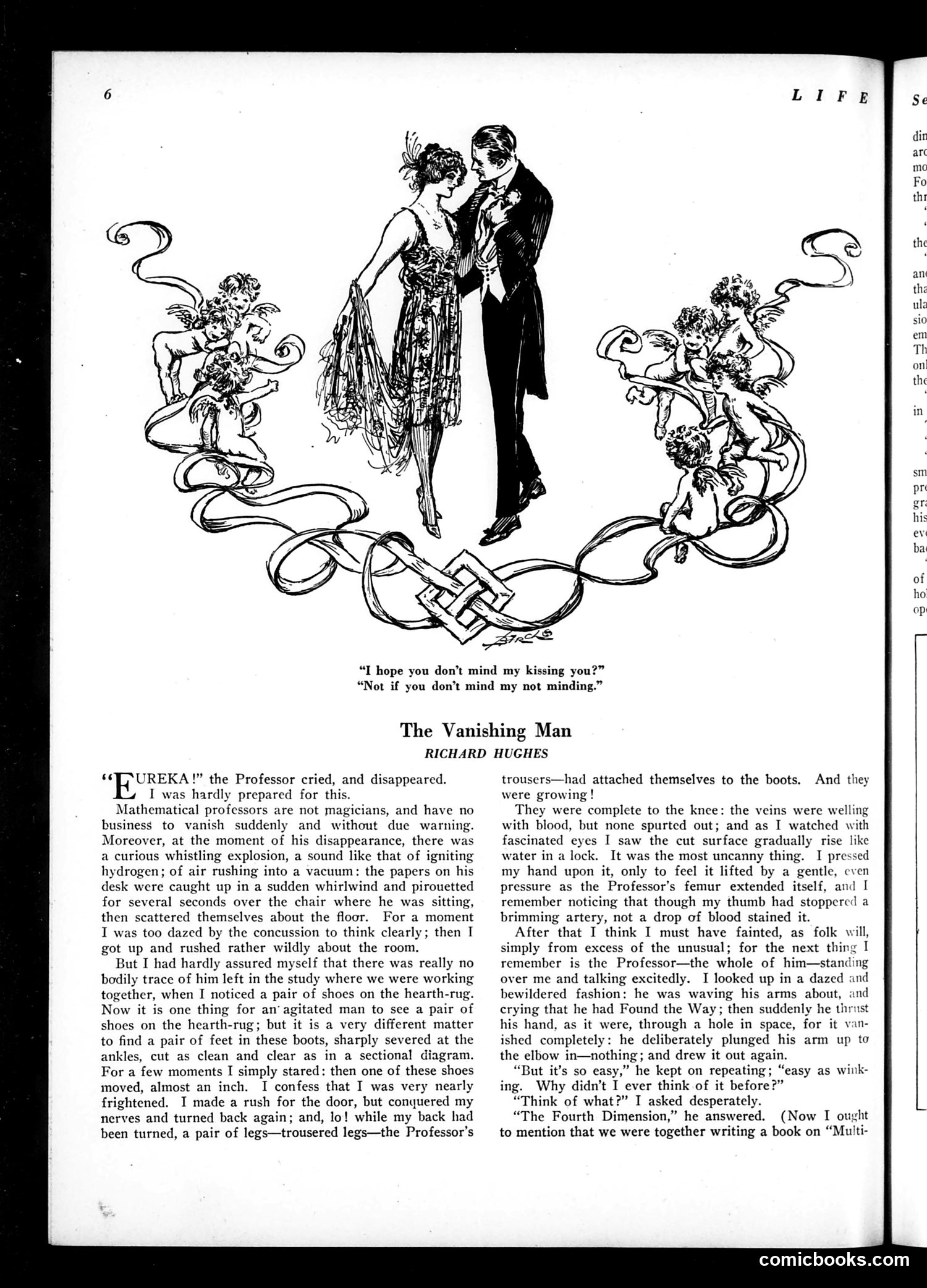
This page presents a short story rather than political satire. The illustration depicts a couple in formal evening wear (she in a beaded dress, he in a tuxedo) surrounded by cherubs and decorative swags—a romantic framing device common to 1920s-era Life magazine. The story itself concerns a mathematics professor who mysteriously disappears, leaving only his trousers behind in his study. The narrator describes the bizarre discovery: the Professor's legs are cleanly severed at the ankles, with his severed feet still in his boots. This appears to be a fantastical fiction piece exploring impossible or supernatural disappearance—playing on the "magician's vanishing act" concept—rather than social or political commentary. The dialogue quoted ("I hope you don't mind my kissing you?") suggests romantic comedy elements.
📄 Transcribed text from this page (OCR, searchable)
Machine-transcribed from the original scan — historical spelling and the odd misread are preserved.
“I hope you don’t mind my kissing you?” “Not if you don’t mind my not minding.” The Vanishing Man RICHARD HUGHES a ERAT the Professor cried, and disappeared. I was hardly prepared for this. Mathematical professors are not magicians, and have no business to vanish suddenly and without due warning. Moreover, at the moment of his disappearance, there was a curious whistling explosion, a sound like that of igniting hydrogen; of air rushing into a vacuum: the papers on his desk were caught up in a sudden whirlwind and pirouetted for several seconds over the chair where he was sitting, then scattered themselves about the floor. For a moment I was too dazed by the concussion to think clearly; then I got up and rushed rather wildly about the room. But I had hardly assured myself that there was really no bodily trace of him left in the study where we were working together, when I noticed a pair of shoes on the hearth-rug. Now it is one thing for an’ agitated man to see a pair of shoes on the hearth-rug; but it is a very different matter to find a pair of feet in these boots, sharply severed at the ankles, cut as clean and clear as in a sectional diagram. For a few moments I simply stared: then one of these shoes moved, almost an inch. I confess that I was very nearly frightened. I made a rush for the door, but conquered my nerves and turned back again; and, lo! while my back had been turned, a pair of legs—trousered legs—the Professor's trousers—had attached themselves to the boots. And they were growing! They were complete to the knee: the veins were welling with blood, but none spurted out; and as I watched with fascinated eyes I saw the cut surface gradually rise like water in a lock. It was the most uncanny thing. I pressed my hand upon it, only to feel it lifted by a gentle, even pressure as the Professor’s femur extended itself, and I remember noticing that though my thumb had stoppered a brimming artery, not a drop of blood stained it. After that I think I must have fainted, as folk will, simply from excess of the unusual; for the next thing I remember is the Professor—the whole of him—standing over me and talking excitedly. I looked up in a dazed and bewildered fashion: he was waving his arms about, and crying that he had Found the Way; then suddenly he thrust his hand, as it were, through a hole in space, for it van- ished completely: he deliberately plunged his arm up to the elbow in—nothing; and drew it out again. “But it’s so easy,” he kept on repeating; “easy as wink- ing. Why didn’t I ever think of it before?” “Think of what?” I asked desperately. “The Fourth Dimension,” he answered. (Now I ought to mention that we were together writing a book on “Multi- comicbooks.com the an the ule sio em Th on! the in