
Life, 1921-09-29 · page 14 of 34
Life — September 29, 1921 — page 14: what you’re looking at
What you’re looking at
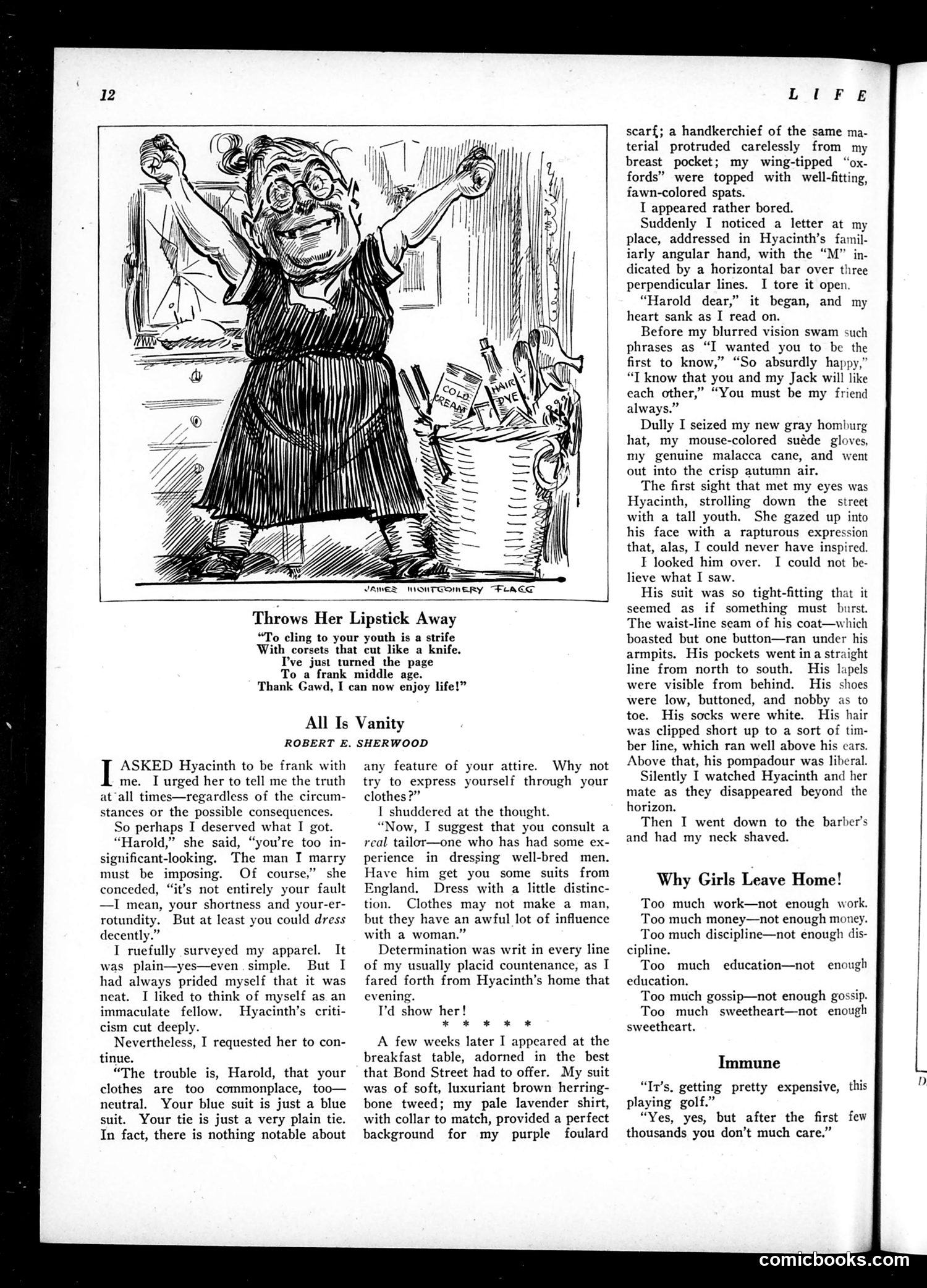
**The Cartoon "Throws Her Lipstick Away":** The illustration by James Montgomery Flagg depicts a woman discarding cosmetics and fashion items into a trash bin. The accompanying verse mocks women abandoning youth pursuits—"corsets that cut like a knife"—upon reaching middle age, suggesting they've given up on appearance and vanity. **The Article "All Is Vanity":** Robert E. Sherwood's piece humorously criticizes a man (Harold) for his drab, ill-fitting wardrobe. The satire targets masculine indifference to fashion and grooming, contrasting with the cartoon's female-focused critique. Together, the content satirizes *both* genders' vanity (or lack thereof) through different lenses—women's abandonment of beauty standards versus men's stubborn disregard for proper dress.
📄 Transcribed text from this page (OCR, searchable)
Machine-transcribed from the original scan — historical spelling and the odd misread are preserved.
YAMES MONTGOMERY FLAGS Throws Her Lipstick Away “To cling to your youth is a strife With corsets that cut like a knife. I’ve just turned the page To a frank middle age. Thank Gawd, I can now enjoy life!” All Is Vanity ROBERT E. SHERWOOD ASKED Hyacinth to be frank with me. I urged her to tell me the truth at’all times—regardless of the circum- stances or the possible consequences. So perhaps I deserved what I got. “Harold,” she said, “you’re too in- significant-looking. The man I marry must be imposing. Of course,” she conceded, “it’s not entirely your fault —I mean, your shortness and your-er- rotundity. But at least you could dress decently.” I ruefully surveyed my apparel. It was plain—yes—even simple. But I had always prided myself that it was neat. I liked to think of myself as an immaculate fellow. Hyacinth’s criti- cism cut deeply. Nevertheless, I requested her to con- tinue. “The trouble is, Harold, that your clothes are too commonplace, too— neutral. Your blue suit is just a blue suit. Your tie is just a very plain tie. In fact, there is nothing notable about any feature of your attire. Why not try to express yourself through your clothes?” 1 shuddered at the thought. “Now, I suggest that you consult a real tailor—one who has had some ex- perience in dressing well-bred men. Have him get you some suits from England. Dress with a little distinc- tion. Clothes may not make a man, but they have an awful lot of influence with a woman.” Determination was writ in every line of my usually placid countenance, as I fared forth from Hyacinth’s home that evening. I'd show her! * * * * * A few weeks later I appeared at the breakfast table, adorned in the best that Bond Street had to offer. My suit was of soft, luxuriant brown herring- bone tweed; my pale lavender shirt, with collar to match, provided a perfect background for my purple foulard LIFE scarf; a handkerchief of the same ma- terial protruded carelessly from my breast pocket; my wing-tipped “ox- fords” were topped with well-fitting, fawn-colored spats. I appeared rather bored. Suddenly I noticed a letter at my place, addressed in Hyacinth’s famil- iarly angular hand, with the “M” dicated by a horizontal bar over three perpendicular lines. I tore it open. “Harold dear,” it began, and my heart sank as I read on. Before my blurred vision swam such phrases as “I wanted you to be the first to know,” “So absurdly happy,” “T know that you and my Jack will like each other,” “You must be my friend always.” Dully I seized my new gray homburg hat, my mouse-colored suéde gloves, my genuine malacca cane, and went out into the crisp autumn air. The first sight that met my eyes was Hyacinth, strolling down the street with a tall youth. She gazed up into his face with a rapturous expression that, alas, I could never have inspired. T looked him over. I could not be- lieve what I saw. His suit was so tight-fitting that it seemed as if something must burst. The waist-line seam of his coat—which boasted but one button—ran under his armpits. His pockets went ina straight line from north to south. His lapels were visible from behind. His shoes were low, buttoned, and nobby as to toe. His socks were white. His hair was clipped short up to a sort of tim- ber line, which ran well above his ears. Above that, his pompadour was liberal. Silently I watched Hyacinth and her mate as they disappeared beyond the horizon. Then I went down to the barber's and had my neck shaved. Why Girls Leave Home! Too much work—not enough work. Too much money—not enough money. Too much discipline—not enough dis- cipline. Too much education—not enough education. Too much gossip—not enough gossip. Too much sweetheart—not enough sweetheart. Immune “Tr’s. getting pretty expensive, this playing golf.” “Yes, yes, but after the first few thousands you don’t much care.” comicbooks.com