
Life, 1921-09-29 · page 17 of 34
Life — September 29, 1921 — page 17: what you’re looking at
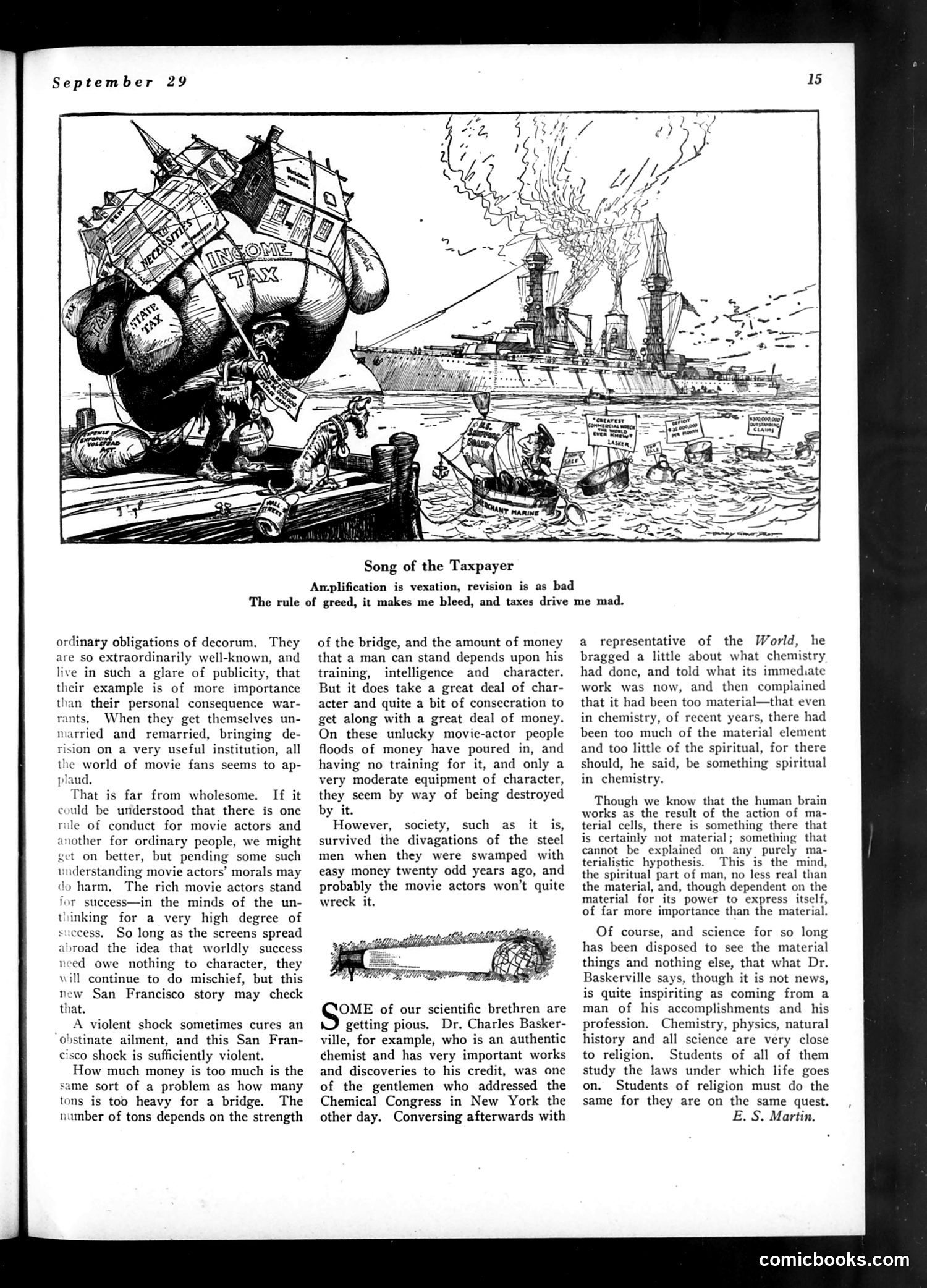
What you’re looking at
The cartoon depicts an overloaded figure (representing the American taxpayer) staggering under enormous burdens labeled with taxes and government obligations, while a warship and military personnel appear in the background. The title and subtitle express taxpayer frustration: "Amplification is vexation, revision is as bad / The rule of greed, it makes me bleed, and taxes drive me mad." This is anti-tax satire, likely from the World War I era or its immediate aftermath, when military spending and tax burdens increased dramatically. The cartoon criticizes government fiscal policy as excessive and parasitic. The military imagery suggests the artist associates heavy taxation with war spending and military expansion. The accompanying article shifts to criticizing movie actors' moral behavior and excessive wealth—a separate but related concern about societal excess and greed during this prosperous period.
📄 Transcribed text from this page (OCR, searchable)
Machine-transcribed from the original scan — historical spelling and the odd misread are preserved.
September 29 Song of the Taxpayer Amplification is vexation, revision is as bad The rule of greed, it makes me bleed, and taxes drive me mad. ordinary obligations of decorum. They are so extraordinarily well-known, and live in such a glare of publicity, that their example is of more importance than their personal consequence war- rants. When they get themselves un- married and remarried, bringing de- rision on a very useful institution, all the world of movie fans seems to ap- plaud. That is far from wholesome. If it could be understood that there is one rule of conduct for movie actors and another for ordinary people, we might get on better, but pending some such understanding movie actors’ morals may do harm, The rich movie actors stand jor success—in the minds of the un- tiinking for a very high degree of success. So long as the screens spread abroad the idea that worldly success need owe nothing to character, they will continue to do mischief, but this new San Francisco story may check that. A violent shock sometimes cures an obstinate ailment, and this San Fran- cisco shock is sufficiently violent. How much money is too much is the same sort of a problem as how many tons is too heavy for a bridge. The number of tons depends on the strength of the bridge, and the amount of money that a man can stand depends upon his training, intelligence and character. But it does take a great deal of char- acter and quite a bit of consecration to get along with a great deal of money. On these unlucky movie-actor people floods of money have poured in, and having no training for it, and only a very moderate equipment of character, they seem by way of being destroyed by it. However, society, such as it is, survived the divagations of the steel men when they were swamped with easy money twenty odd years ago, and probably the movie actors won’t quite wreck it. OME of our scientific brethren are getting pious. Dr. Charles Basker- ville, for example, who is an authentic chemist and has very important works and discoveries to his credit, was one of the gentlemen who addressed the Chemical Congress in New York the other day. Conversing afterwards with a representative of the World, he bragged a little about what chemistry had done, and told what its immediate work was now, and then complained that it had been too material—that even in chemistry, of recent years, there had been too much of the material element and too little of the spiritual, for there should, he said, be something spiritual in chemistry. Though we know that the human brain works as the result of the action of ma- terial cells, there is something there that is certainly not material; something that cannot be explained on any purely ma- terialistic hypothesis. This is the mind, the spiritual part of man, no less real than the material, and, though dependent on the material for its power to express itself, of far more importance than the material. Of course, and science for so long has been disposed to see the material things and nothing else, that what Dr. Baskerville though it is not news, is quite inspiriting as coming from a man of his accomplishments and his profession. Chemistry, physics, natural history and all science are very close to religion. Students of all of them study the laws under which life goes on. Students of religion must do the same for they are on the same quest. E. S. Martin. comicbooks.com