
Life, 1921-09-29 · page 20 of 34
Life — September 29, 1921 — page 20: what you’re looking at
What you’re looking at
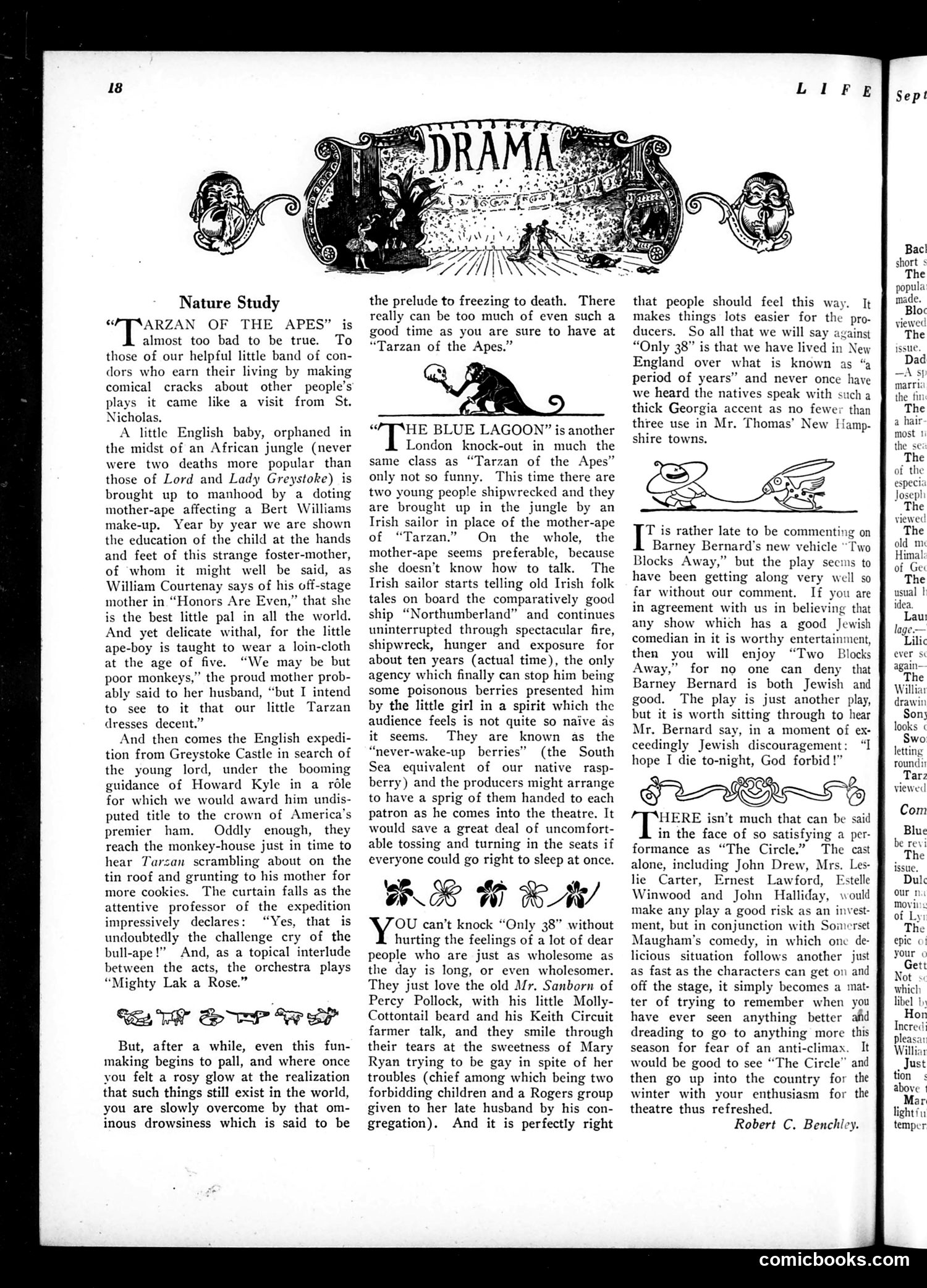
This page contains theater reviews satirizing three popular plays. The critic mocks **"Tarzan of the Apes"** for its absurd premise: an English baby raised by an ape (played in "Bert Williams make-up"—referencing a blackface comedian) in an African jungle. The reviewer finds the plot so ridiculous it's initially entertaining but eventually tedious, comparing the experience to "freezing to death." **"The Blue Lagoon"** receives similar criticism—shipwrecked youths raised in the jungle by an Irish sailor who won't stop talking. The critic sarcastically suggests distributing poisonous berries to audience members so they can sleep through it. **"Only 38"** is defended against criticism as wholesome entertainment featuring sentimental family moments and Mr. Sanborn's folksy charm. The small decorative illustrations (ape, boat, floral dividers) are typical period magazine ornamentation. The overall tone exemplifies Life's satirical approach to theatrical criticism—witty, exaggerated mockery of implausible plots and overwrought performances.
📄 Transcribed text from this page (OCR, searchable)
Machine-transcribed from the original scan — historical spelling and the odd misread are preserved.
Nature Study 6 ARZAN OF THE APES” is almost too bad to be true. To those of our helpful little band of con- dors who earn their living by making comical cracks about other people’s plays it came like a visit from St. Nicholas. A little English baby, orphaned in the midst of an African jungle (never were two deaths more popular than those of Lord and Lady Greystoke) is brought up to manhood by a doting mother-ape affecting a Bert Williams make-up. Year by year we are shown the education of the child at the hands and feet of this strange foster-mother, of whom it might well be said, as William Courtenay says of his off-stage mother in “Honors Are Even,” that she is the best little pal in all the world. And yet delicate withal, for the little ape-boy is taught to wear a loin-cloth at the age of five. “We may be but poor monkeys,” the proud mother prob- ably said to her husband, “but I intend to see to it that our little Tarzan dresses decent.” And then comes the English expedi- tion from Greystoke Castle in search of the young lord, under the booming guidance of Howard Kyle in a role for which we would award him undis- puted title to the crown of America’s premier ham. Oddly enough, they reach the monkey-house just in time to hear Tarsan scrambling about on the tin roof and grunting to his mother for more cookies. The curtain falls as the attentive professor of the expedition impressively declares: “Yes, that is undoubtedly the challenge cry of the bull-ape!” And, as a topical interlude between the acts, the orchestra plays “Mighty Lak a Rose.” SEZ ae Ww SP But, after a while, even this fun- making begins to pall, and where once you felt a rosy glow at the realization that such things still exist in the world, you are slowly overcome by that om- inous drowsiness which is said to be the prelude to freezing to death. There really can be too much of even such a good time as you are sure to have at “Tarzan of the Apes.” “ HE BLUE LAGOON?” is another London knock-out in much the same class as “Tarzan of the Apes” only not so funny. This time there are two young people shipwrecked and they are brought up in the jungle by an Irish sailor in place of the mother-ape of “Tarzan.” On the whole, the mother-ape seems preferable, because she doesn’t know how to talk. The Irish sailor starts telling old Irish folk tales on board the comparatively good ship “Northumberland” and continues uninterrupted through spectacular fire, shipwreck, hunger and exposure for about ten years (actual time), the only agency which finally can stop him being some poisonous berries presented him by the little girl in a spirit which the audience feels is not quite so naive as it seems. They are known as the “never-wake-up berries” (the South Sea equivalent of our native rasp- berry) and the producers might arrange to have a sprig of them handed to each patron as he comes into the theatre. It would save a great deal of uncomfort- able tossing and turning in the seats if everyone could go right to sleep at once. RE WT EW OU can’t knock “Only 38” without hurting the feelings of a lot of dear people who are just as wholesome as the day is long, or even wholesomer. They just love the old Mr. Sanborn of Percy Pollock, with his little Molly- Cottontail beard and his Keith Circuit farmer talk, and they smile through their tears at the sweetness of Mary Ryan trying to be gay in spite of her troubles (chief among which being two forbidding children and a Rogers group given to her late husband by his con- gregation). And it is perfectly right that people should feel this way. It makes things lots easier for the pro- ducers. So all that we will say against “Only 38” is that we have lived in New England over what is known as “a period of years” and never once have we heard the natives speak with such a thick Georgia accent as no fewer than three use in Mr. Thomas’ New Iamp- shire towns. T is rather late to be commenting on Barney Bernard's new vehicle “Two Blocks Away,” but the play secms to have been getting along very well so far without our comment. If you are in agreement with us in believing that any show which has a good Jewish comedian in it is worthy entertainment, then you will enjoy “Two Blocks Away,” for no one can deny that Barney Bernard is both Jewish and good. The play is just another play, but it is worth sitting through to hear Mr. Bernard say, in a moment of ex- ceedingly Jewish discouragement: “I hope I die to-night, God forbid!” SEFAVR I HERE isn’t much that can be said in the face of so satisfying a per- formance as “The Circle.” The cast alone, including John Drew, Mrs. Les- lie Carter, Ernest Lawford, Estelle Winwood and John Halliday, would make any play a good risk as an invest- ment, but in conjunction with Soaerset Maugham’s comedy, in which one de- licious situation follows another just as fast as the characters can get on and off the stage, it simply becomes a mat- ter of trying to remember when you have ever seen anything better afd dreading to go to anything more this season for fear of an anti-climax. It would be good to see “The Circle” and then go up into the country for the winter with your enthusiasm for the theatre thus refreshed. Robert C. Benchiley. Sep! Bac! short s The popula made. Blox viewec The issue. Dad -A 5 marti the fir The a hair most 1 the se The of the especi Josep! The viewed The old me Himal: of Gee The usual | idea. Law letting roundit Tarz viewed Com Blue be revi The issue. Duk our 4 Movil of Ly The epic 0! your o Gett Not whicl libel by Hon Tncredi lightiu temper comicbooks.com