
Life, 1921-09-29 · page 16 of 34
Life — September 29, 1921 — page 16: what you’re looking at
What you’re looking at
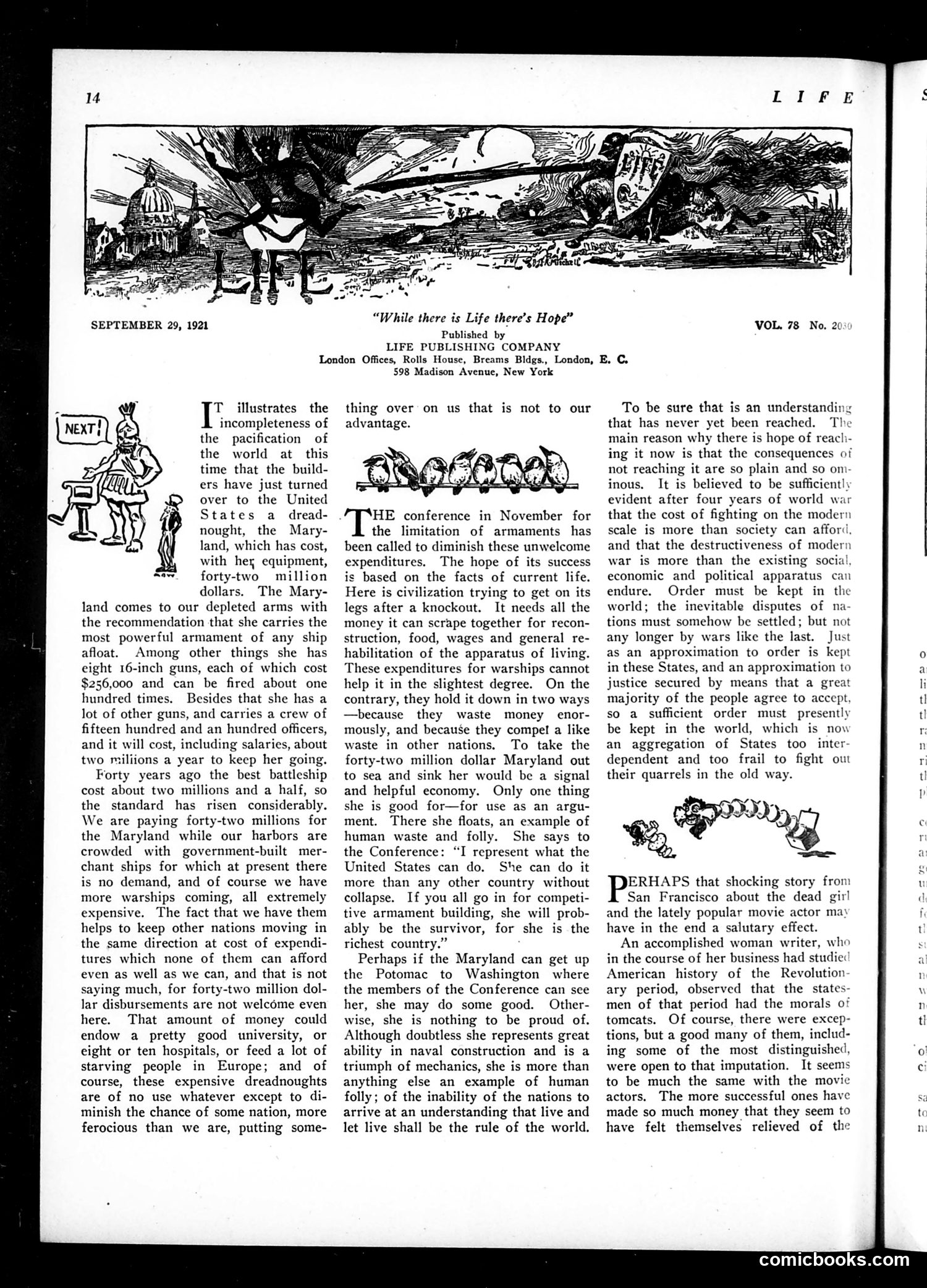
The page critiques American military spending, specifically the USS Maryland battleship. The left cartoon shows a figure labeled "NEXT!" in militaristic dress, satirizing how new warships keep coming despite their enormous expense (forty million dollars mentioned). The text argues that spending on such dreadnoughts is wasteful when that money could fund universities, hospitals, or aid starving Europeans. The Maryland is presented as an example of nations' competitive arms-building—the Conference on Limitation of Armaments (referenced for November) aimed to reduce such expenditures. The satire targets post-WWI military excess: why build expensive warships when peace negotiations and domestic needs should take priority?
📄 Transcribed text from this page (OCR, searchable)
Machine-transcribed from the original scan — historical spelling and the odd misread are preserved.
SEPTEMBER 29, 1921 “While there is Life there’s Hope” Published by LIFE PUBLISHING COMPANY VOL. 78 No. 2030 London Offices, Rolls House, Breams Bldgs., London, E. C. T illustrates the incompleteness of the pacification of the world at this time that the build- ers have just turned over to the United States a dread- nought, the Mary- land, which has cost, with hey equipment, forty-two million dollars. The Mary- land comes to our depleted arms with the recommendation that she carries the most powerful armament of any ship afloat. Among other things she has eight 16-inch guns, each of which cost $256,000 and can be fired about one hundred times. Besides that she has a lot of other guns, and carries a crew of fifteen hundred and an hundred officers, and it will cost, including salaries, about two miliions a year to keep her going. Forty years ago the best battleship cost about two millions and a half, so the standard has risen considerably. We are paying forty-two millions for the Maryland while our harbors are crowded with government-built mer- chant ships for which at present there is no demand, and of course we have more warships coming, all extremely expensive. The fact that we have them helps to keep other nations moving in the same direction at cost of expendi- tures which none of them can afford even as well as we can, and that is not saying much, for forty-two million dol- lar disbursements are not welcome even here. That amount of money could endow a pretty good university, or eight or ten hospitals, or feed a lot of starving people in Europe; and of course, these expensive dreadnoughts are of no use whatever except to di- minish the chance of some nation, more ferocious than we are, putting some- 598 Madison Avenue, New York thing over on us that is not to our advantage. HE conference in November for the limitation of armaments has been called to diminish these unwelcome expenditures. The hope of its success is based on the facts of current life. Here is civilization trying to get on its legs after a knockout. It needs all the money it can scrape together for recon- struction, food, wages and general re- habilitation of the apparatus of living. These expenditures for warships cannot help it in the slightest degree. On the contrary, they hold it down in two ways —because they waste money enor- mously, and because they compel a like waste in other nations. To take the forty-two million dollar Maryland out to sea and sink her would be a signal and helpful economy. Only one thing she is good for—for use as an argu- ment. There she floats, an example of human waste and folly. She says to the Conference: “I represent what the United States can do. She can do it more than any other country without collapse. If you all go in for competi- tive armament building, she will prob- ably be the survivor, for she is the richest country.” Perhaps if the Maryland can get up the Potomac to Washington where the members of the Conference can see her, she may do some good. Other- wise, she is nothing to be proud of. Although doubtless she represents great ability in naval construction and is a triumph of mechanics, she is more than anything else an example of human folly; of the inability of the nations to arrive at an understanding that live and let live shall be the rule of the world. To be sure that is an understanding that has never yet been reached. The main reason why there is hope of reac ing it now is that the consequences of not reaching it are so plain and so om- inous. It is believed to be sufficientl; evident after four years of world war that the cost of fighting on the modern scale is more than society can afford, and that the destructiveness of modern war is more than the existing so economic and political apparatus can endure. Order must be kept in the world; the inevitable disputes of na- tions must somehow be settled; but not any longer by wars like the last. Just as an approximation to order is kept in these States, and an approximation to justice secured by means that a great majority of the people agree to accept, so a sufficient order must presently be kept in the world, which is now an aggregation of States too inter- dependent and too frail to fight out their quarrels in the old way. 7 ERHAPS that shocking story from San Francisco about the dead gir! and the lately popular movie actor may have in the end a salutary effect. An accomplished woman writer, who in the course of her business had studie American history of the Revolution- ary period, observed that the states- men of that period had the morals of tomcats. Of course, there were excep- tions, but a good many of them, includ- ing some of the most distinguished, were open to that imputation. It seems to be much the same with the movie actors. The more successful ones have made so much money that they seem to have felt themselves relieved of the comicbooks.com ra