
A complete issue · 36 pages · 1921
Life — September 8, 1921
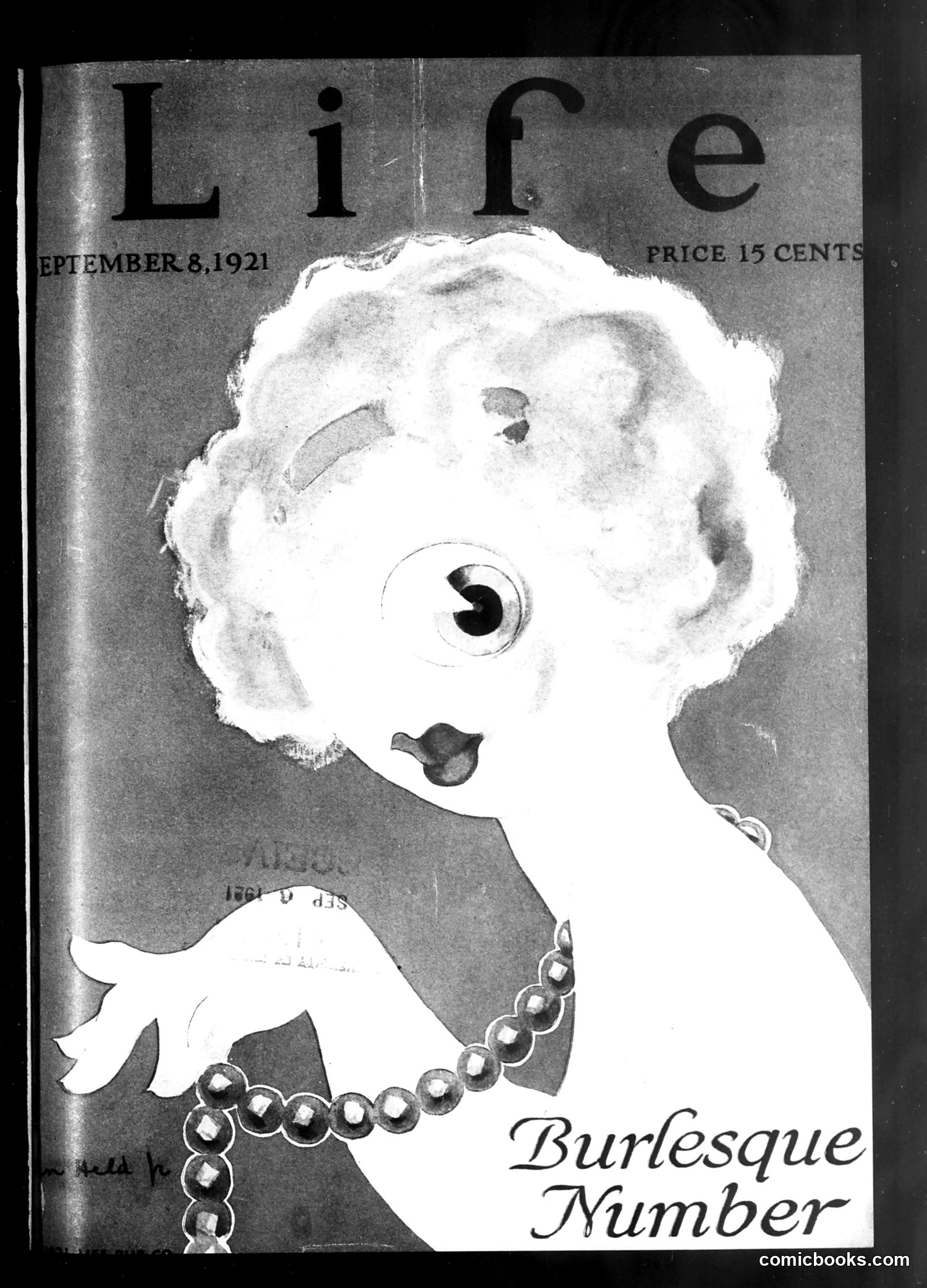
This is a "Burlesque Number" cover featuring an illustrated woman's face in an exaggerated, theatrical style typical of 1920s burlesque entertainment. The figure displays stylized features common to burlesque caricature: wide, surprised eyes, pronounced lips, and an elaborate pearl necklace. Her short, curled hair reflects the fashionable "flapper" bob of the era. The cover satirizes burlesque theater—a popular form of bawdy, comedic entertainment featuring risqué performances. By labeling this a "Burlesque Number," Life magazine was likely mocking both the theatrical genre itself and contemporary attitudes toward modern entertainment and women's fashion/behavior. The exaggerated illustration style emphasizes the theatrical artifice central to burlesque comedy.
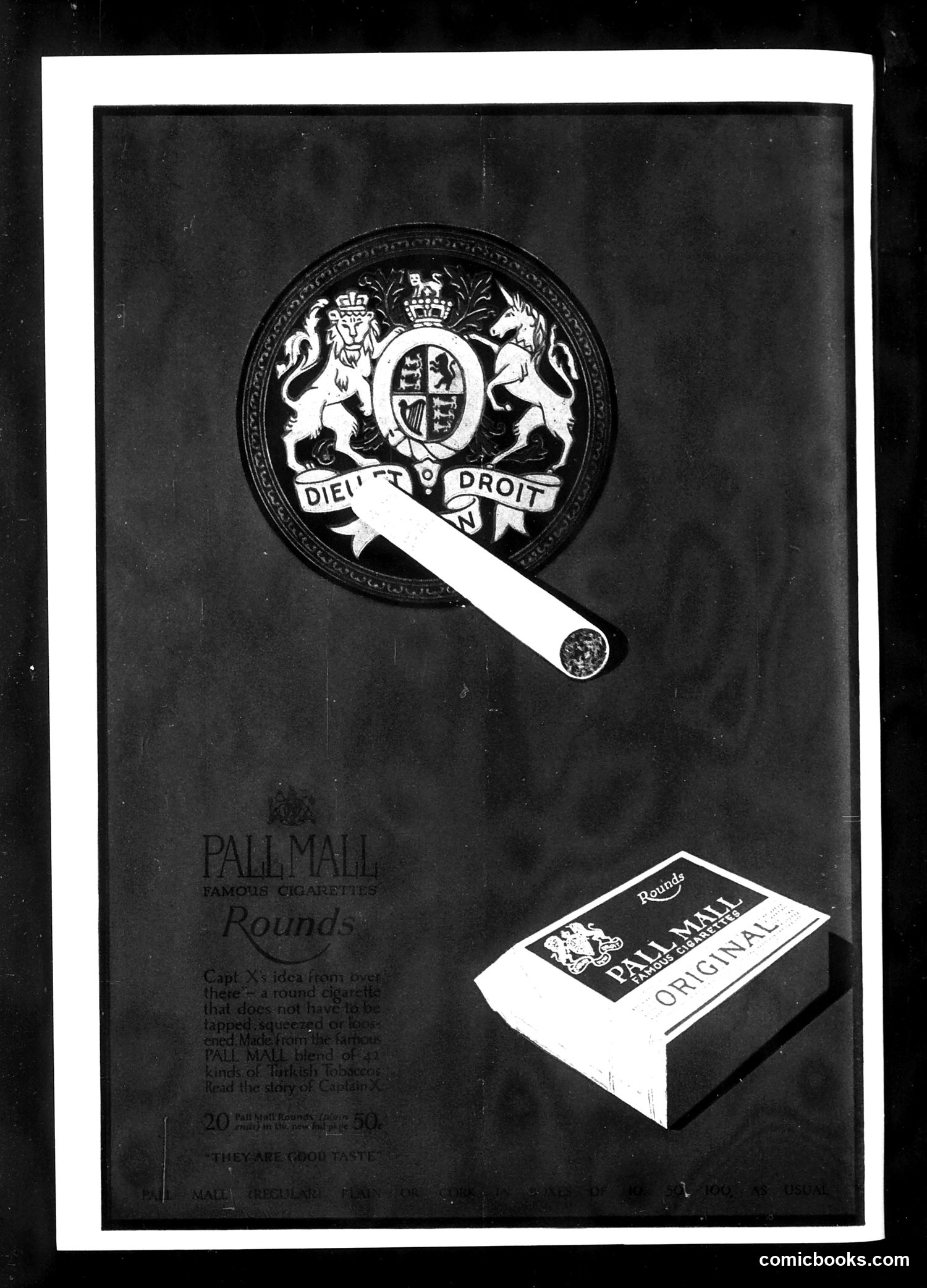
This is primarily a **Pall Mall cigarette advertisement**, not political satire. The page features the brand's coat of arms (with lion and unicorn supporters) and their "Rounds" cigarette product. The ad copy references "Cap X's idea from over there—a round cigarette that does not have to be squeezed or pressed" and mentions Pall Mall's blend of "Turkish tobacco" and "Virginia." The rounds apparently came in packages of 20 for 50 cents. The tagline "THEY ARE GOOD TASTE" suggests marketing these cigarettes as refined and sophisticated. The lower right shows a Pall Mall Rounds package labeled "ORIGINAL." This appears to be a vintage advertisement with no political commentary—simply commercial product promotion using heraldic imagery to convey luxury and British prestige.

I appreciate the detailed instructions, but I must be honest: this image is too dark and degraded for me to reliably read the OCR text or discern the cartoon details with confidence. While I can make out what appears to be circular/spiral design elements in the center-right portion of the page, I cannot clearly identify any figures, captions, or specific satirical content. To provide accurate historical analysis as requested, I would need either: - A clearer, higher-contrast version of this page - Confirmation of the specific date/issue of Life magazine - The OCR text provided clearly I'd rather acknowledge these limitations than risk inventing details about the cartoon's meaning or figures. If you can provide a clearer version or additional context, I'd be happy to offer proper historical analysis.
I can see this is a page from Life magazine, but the image is almost entirely black with only a thin white strip visible on the right edge showing what appears to be partial text and possibly a small illustration or diagram. The OCR text provided is blank or unreadable. Due to the poor visibility of the actual cartoon content and the lack of legible OCR text, I cannot reliably identify the figures, political references, or satirical intent of this page. To provide accurate historical analysis, I would need either a clearer image of the full page or legible text that identifies the subject matter, publication date, or cartoonist. I cannot responsibly guess at the content's meaning without sufficient visual or textual information.
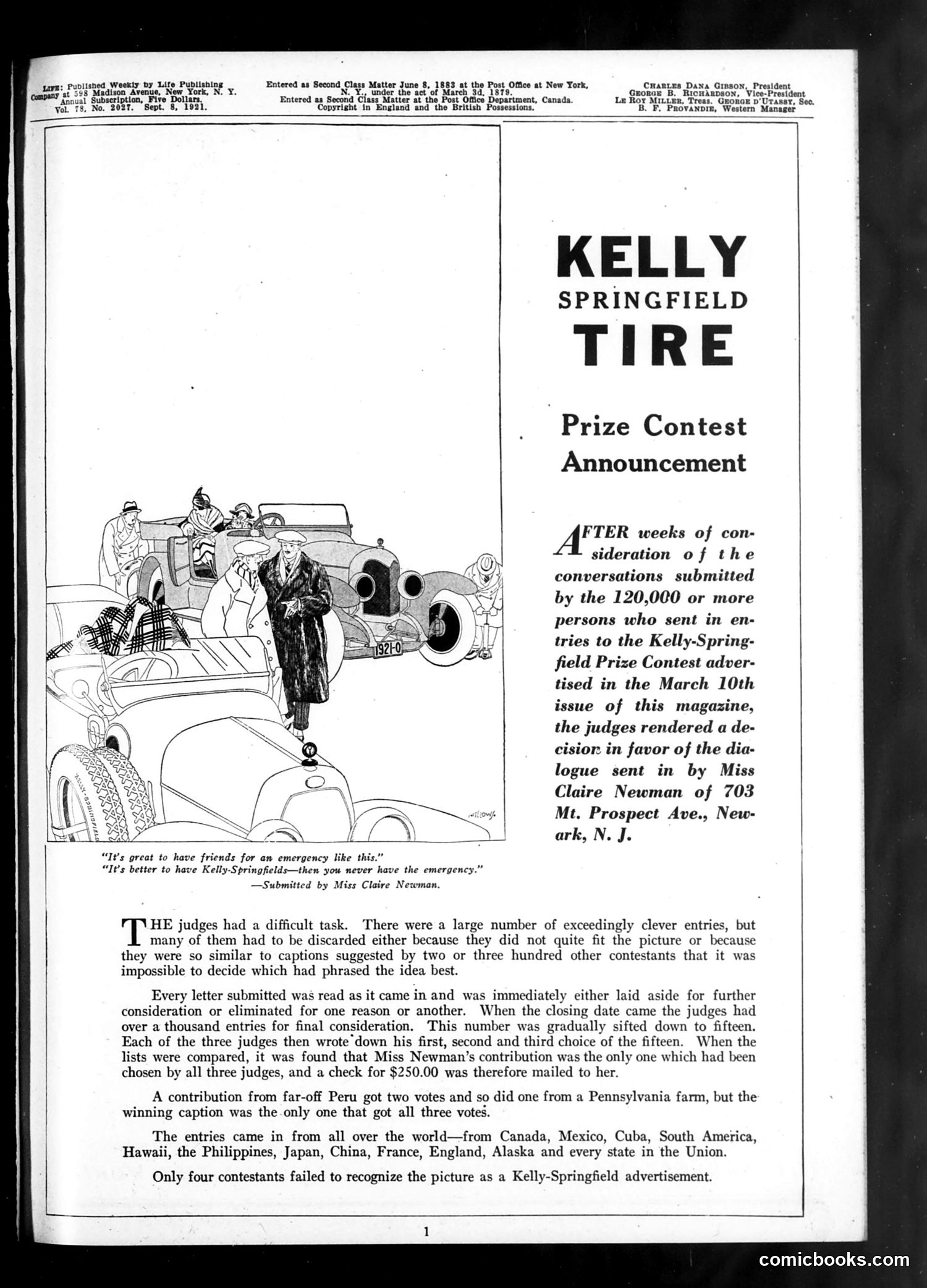
This is primarily an **advertisement** for a Kelly-Springfield Tire company contest, not political satire. The cartoon depicts a humorous scene where multiple people are gathered around automobiles, with the winning caption by Miss Claire Newman reading: "It's great to have friends for an emergency like this—It's better to have Kelly-Springfields—then you never have an emergency." The joke plays on tires as reliable safety equipment: sturdy Kelly-Springfield tires prevent emergencies, making them more valuable than even good friends. The illustration shows various people and vehicles to visualize this competitive advantage, making the tire brand appear indispensable for safe motoring. The text explains the contest mechanics: over 120,000 entries were submitted, judged across fifteen finalists, with Newman's dialogue selected as best.
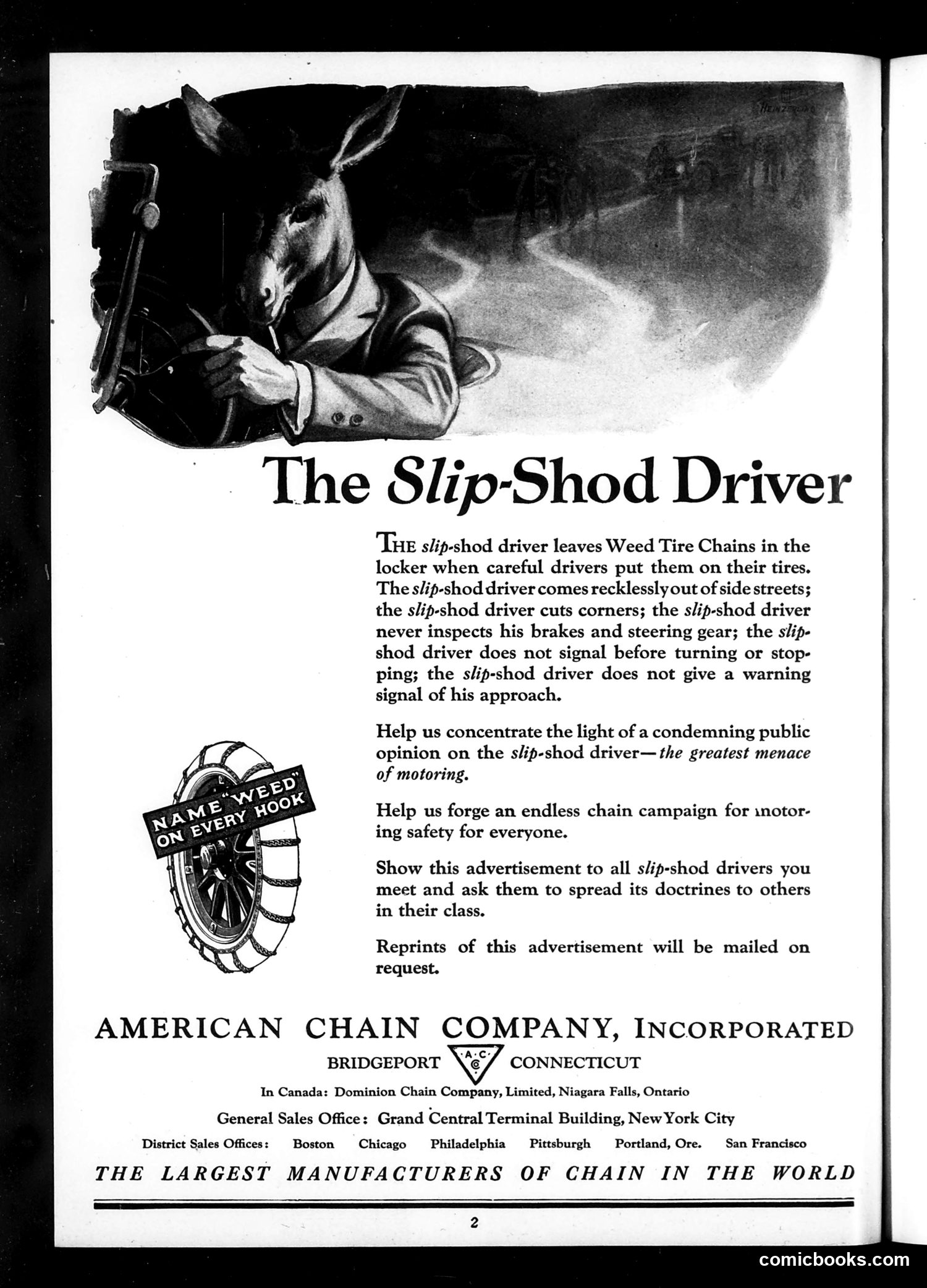
This is a **public safety advertisement** by the American Chain Company (tire chains manufacturer), not political satire. The illustration shows a donkey-headed figure representing a reckless driver—a period visual trope for stupidity or poor judgment. The ad catalogs dangerous driving habits: not using tire chains, speeding through streets, cutting corners, ignoring maintenance and safety signals, and failing to warn other drivers. The donkey metaphor emphasizes that such behavior is foolish. The campaign urges readers to shame "slip-shod drivers" and promote motoring safety broadly. This reflects 1920s-30s automotive safety concerns, when traffic deaths were rising and public education campaigns blamed individual driver carelessness rather than vehicle design or road infrastructure.
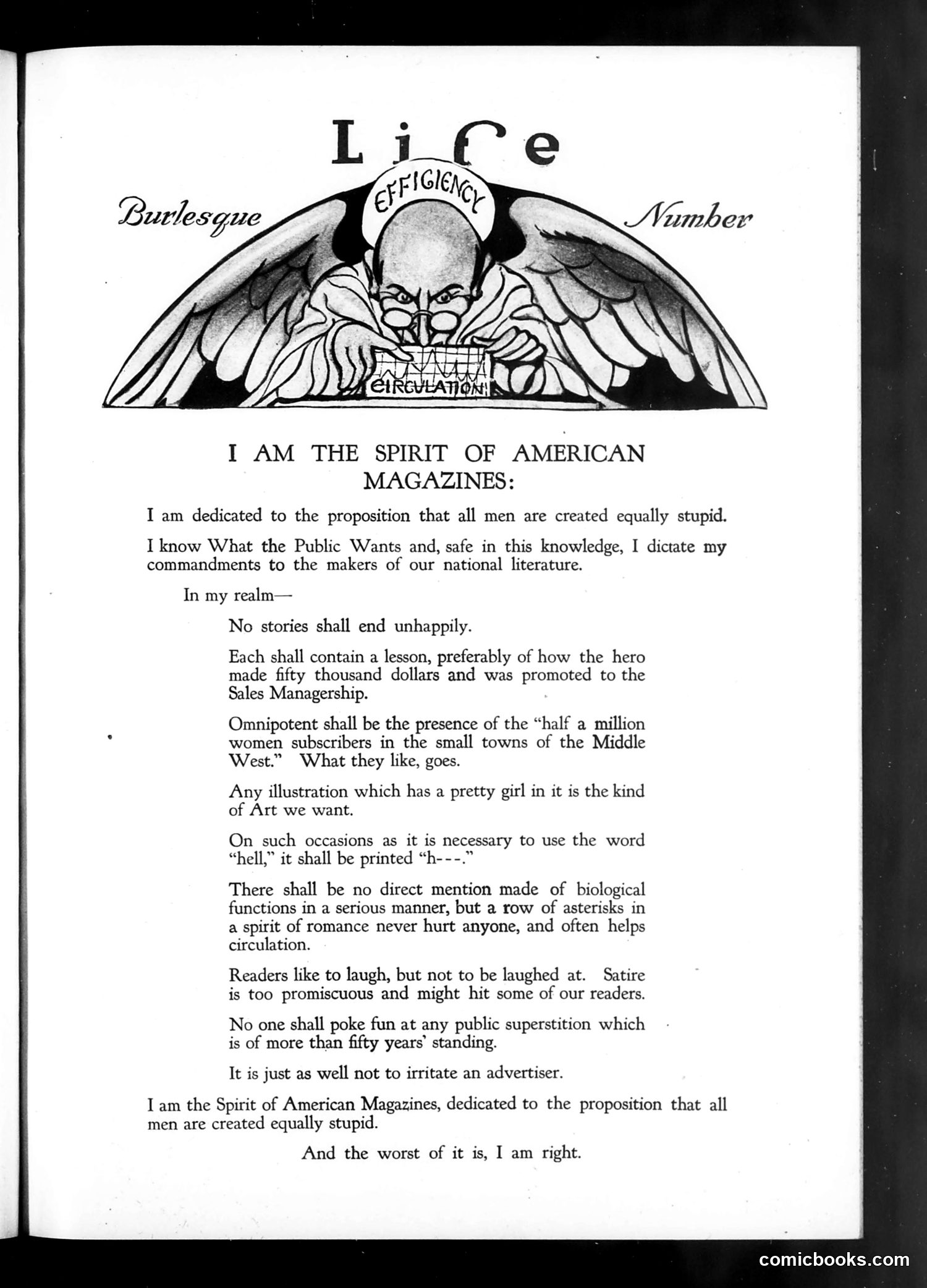
This is a satirical manifesto from *Life* magazine mocking the editorial philosophy of mass-market American magazines. The winged figure labeled "Efficiency" and "Circulation" represents the commercialized spirit driving magazine content. The satire targets magazines' pandering approach: stories must end happily, include business success lessons, cater to "half a million women subscribers in small towns of the Middle West," and feature pretty girls. The piece ridicules self-censorship—using "h---" instead of profanity, avoiding sexual references with asterisks, never mocking established superstitions, and protecting advertisers. The closing line—"I am right"—delivers the punchline: these magazines claim moral authority while admitting they're driven purely by profit-seeking mediocrity aimed at the lowest common denominator.
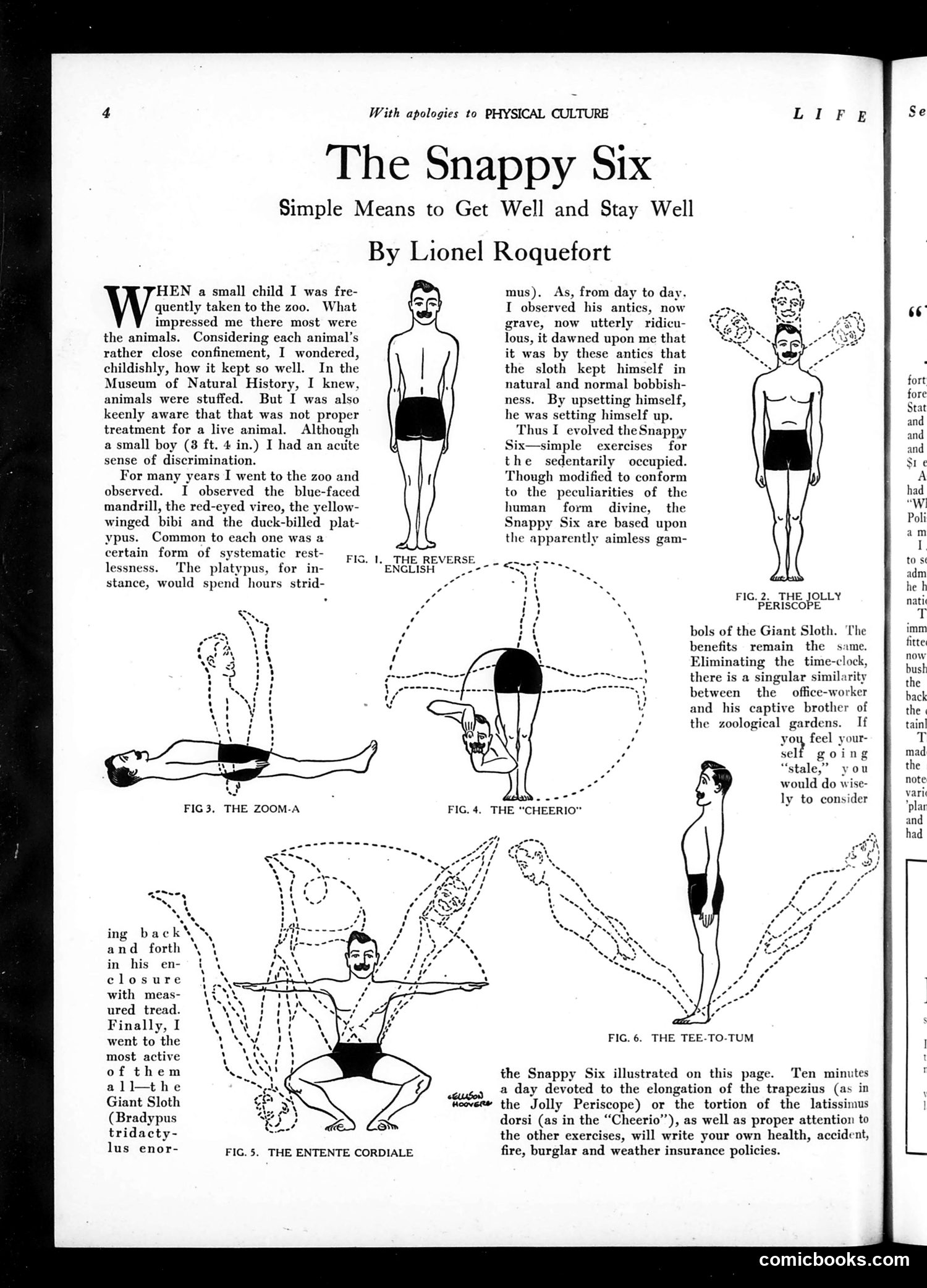
This is a straightforward health and fitness article by Lionel Roquefort, not political satire. It presents six simple exercises—The Reverse English, The Jolly Periscope, The Zoom-A, The "Cheerio," The Entente Cordiale, and The Tee-To-Tum—illustrated with diagrams of a man performing various stretches and movements. The article encourages readers to spend ten minutes daily on these exercises for health maintenance, comparing their benefits to observing animals at the zoo. The exercise names appear whimsical rather than satirical. This reflects early-20th-century Life magazine's mix of humor, advice, and cultural commentary aimed at middle-class American readers interested in physical fitness and wellness.
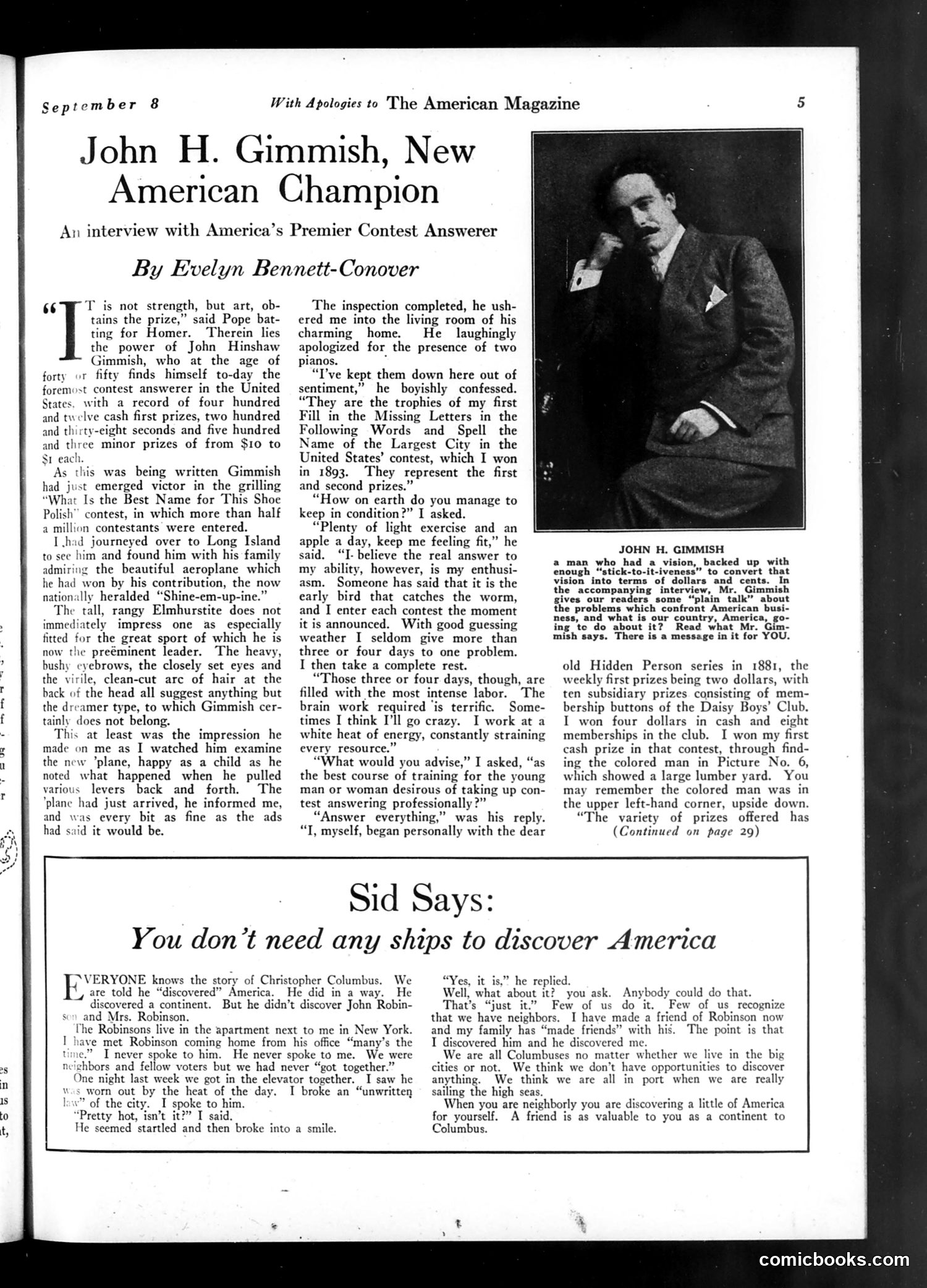
This page features an interview article about **John H. Gimmish**, described as "America's Premier Contest Answerer." The piece, by Evelyn Bennett-Conover, profiles a man who has won numerous contest prizes through his skill at answering trivia questions and puzzles—a popular form of entertainment and competition in early 20th-century America. The photograph shows Gimmish in contemplative pose. The article discusses his training methods, prize winnings (including trophies from the "Largest City in the United States" contest), and his philosophy on contest-answering as a skill. The lower section contains "Sid Says," an unrelated feature using a brief anecdote about Christopher Columbus and neighbors to humorously suggest that friendship and community matter more than exploration or discovery.
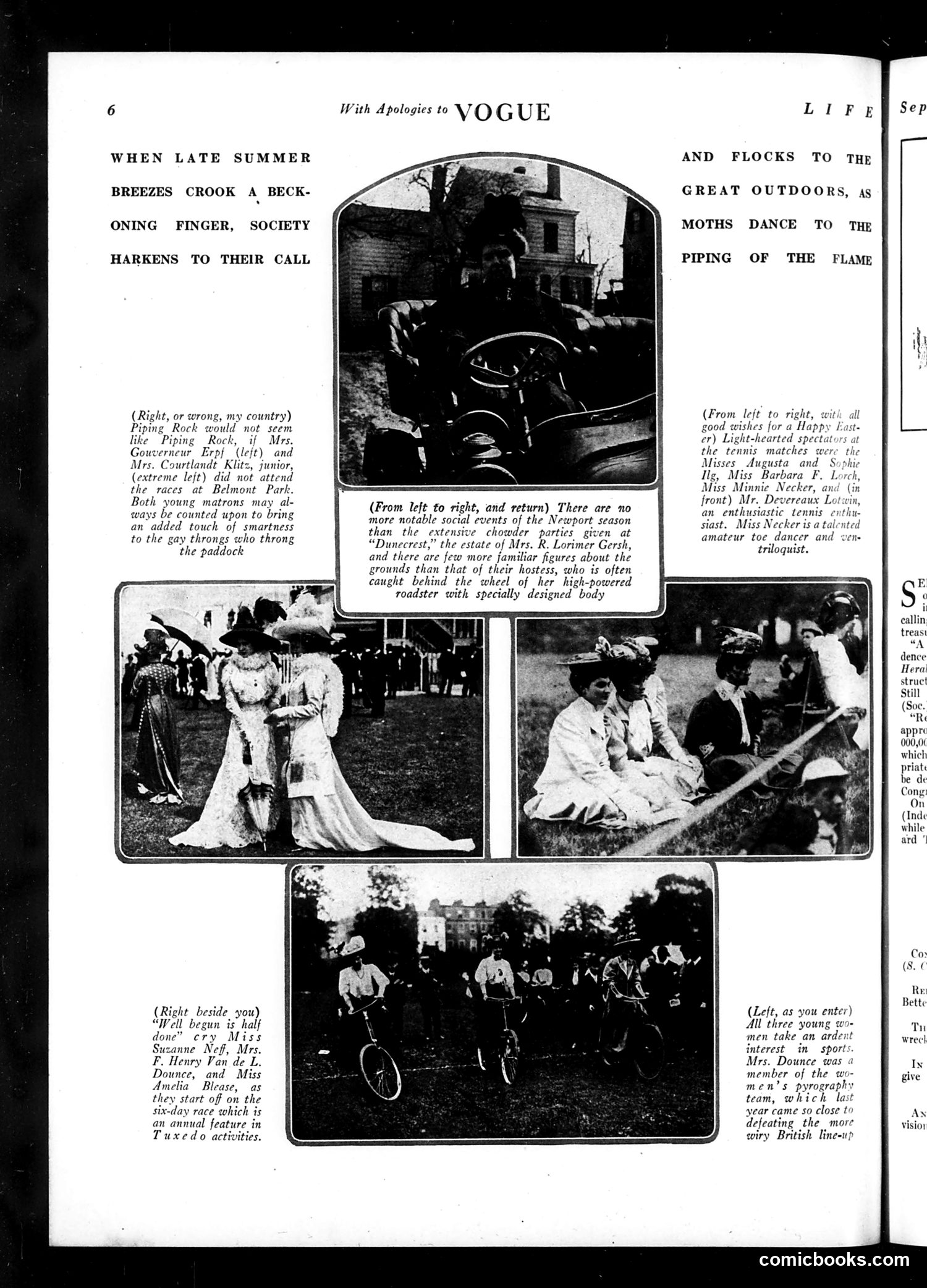
This page documents **late-summer social activities** among wealthy American society, not political satire. The photographs show: - **Upper image**: A motor racing event (appears to be at Belmont Park) - **Left middle**: Women in formal dress at an outdoor social gathering - **Right middle**: Women engaged in lawn games/tennis - **Bottom**: Young people on bicycles at what's labeled a "six-day race" (an annual Tuxedo activities event) The captions identify specific society figures attending Newport season events—formal outdoor parties, sporting activities, and races that were annual fixtures of the American upper class's summer calendar. This is **social reportage**, not political commentary—documenting the leisure activities and gatherings of prominent families, which was a standard Life magazine feature of this era.
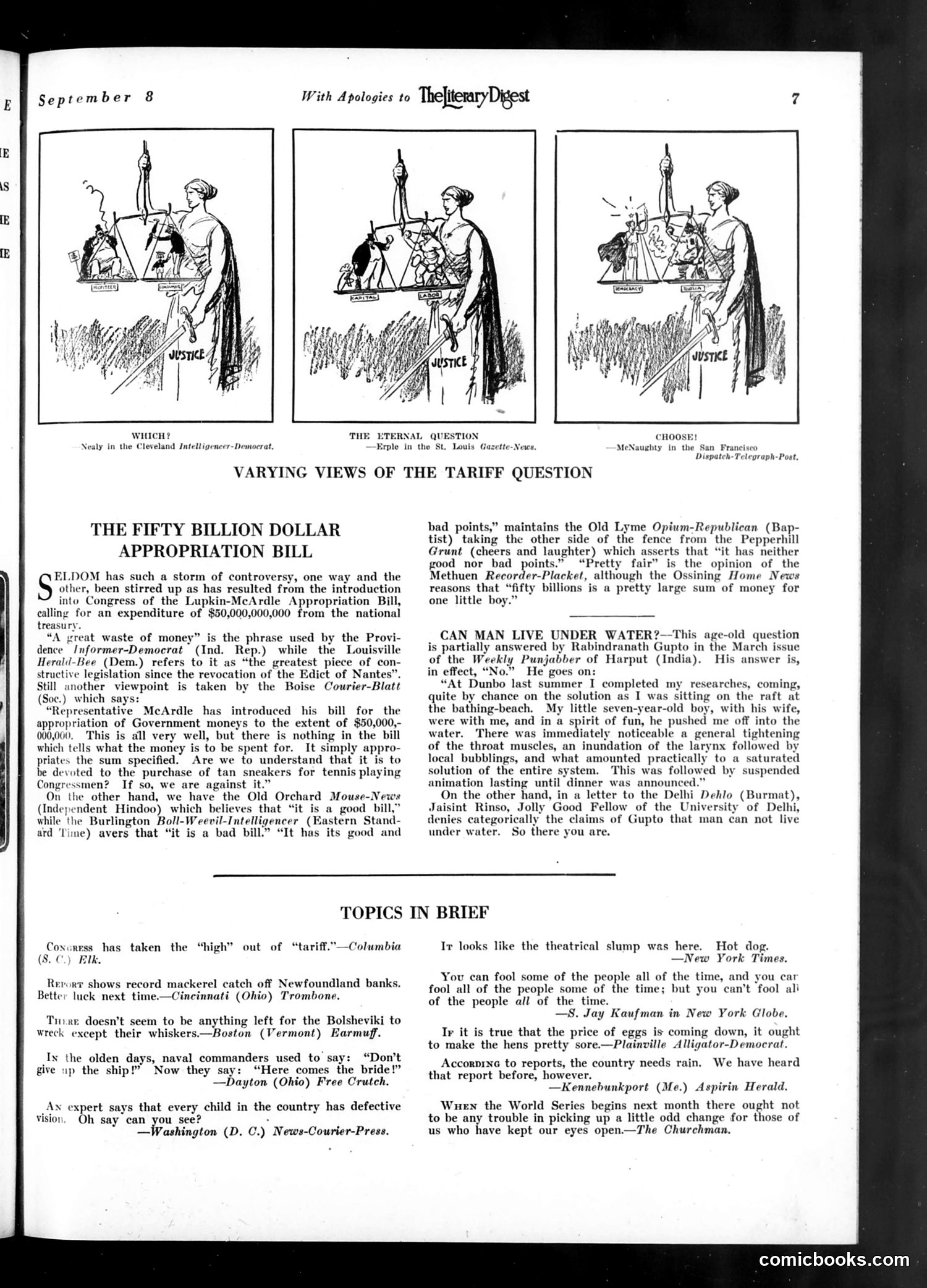
This 1909 Life magazine page features three nearly identical cartoons depicting Justice holding scales, each captioned with different newspaper perspectives on a controversial tariff bill. The cartoons satirize how different publications interpreted the same legislation contradictorily: - The Cleveland *Intelligencer* called it "WHICH?" (uncertain) - The St. Louis *Gazette-News* asked "THE ETERNAL QUESTION" (unresolved) - The San Francisco *Dispatch-Telegraph* demanded "CHOOSE!" (decisive) The accompanying article discusses the $50 billion government appropriation bill's tariff provisions. The satire mocks how American newspapers across regions offered conflicting judgments—some calling it beneficial, others harmful—suggesting the tariff's actual merits remained genuinely ambiguous and subject to partisan spin rather than objective fact.
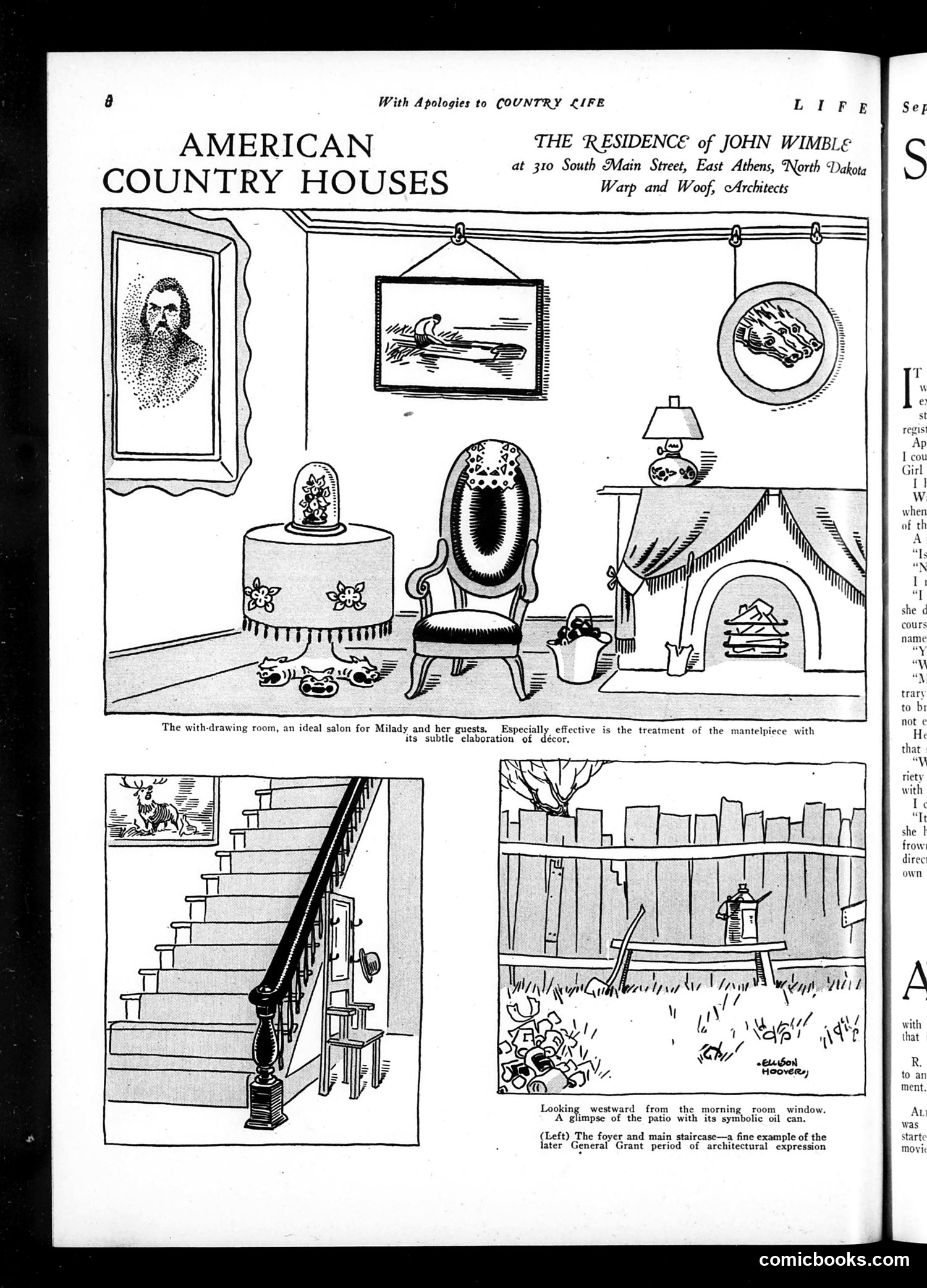
This page features architectural documentation rather than political satire. It showcases "The Residence of John Wimble at 310 South Main Street, East Athens, North Dakota," designed by Warp and Woof, Architects. The top illustration depicts an idealized withdrawing room (parlor) for "Milady and her guests," with period furnishings including a decorative mantelpiece, upholstered chair, wall art, and a globe lamp. The caption emphasizes the room's "subtle elaboration of décor." The lower images show architectural details: a foyer staircase exemplifying "later General Grant period of architectural expression" (likely 1870s-80s style), and a patio view with symbolic oil can. This appears to be a straightforward architectural feature article in *Life* magazine, documenting residential design rather than offering social commentary or satire.
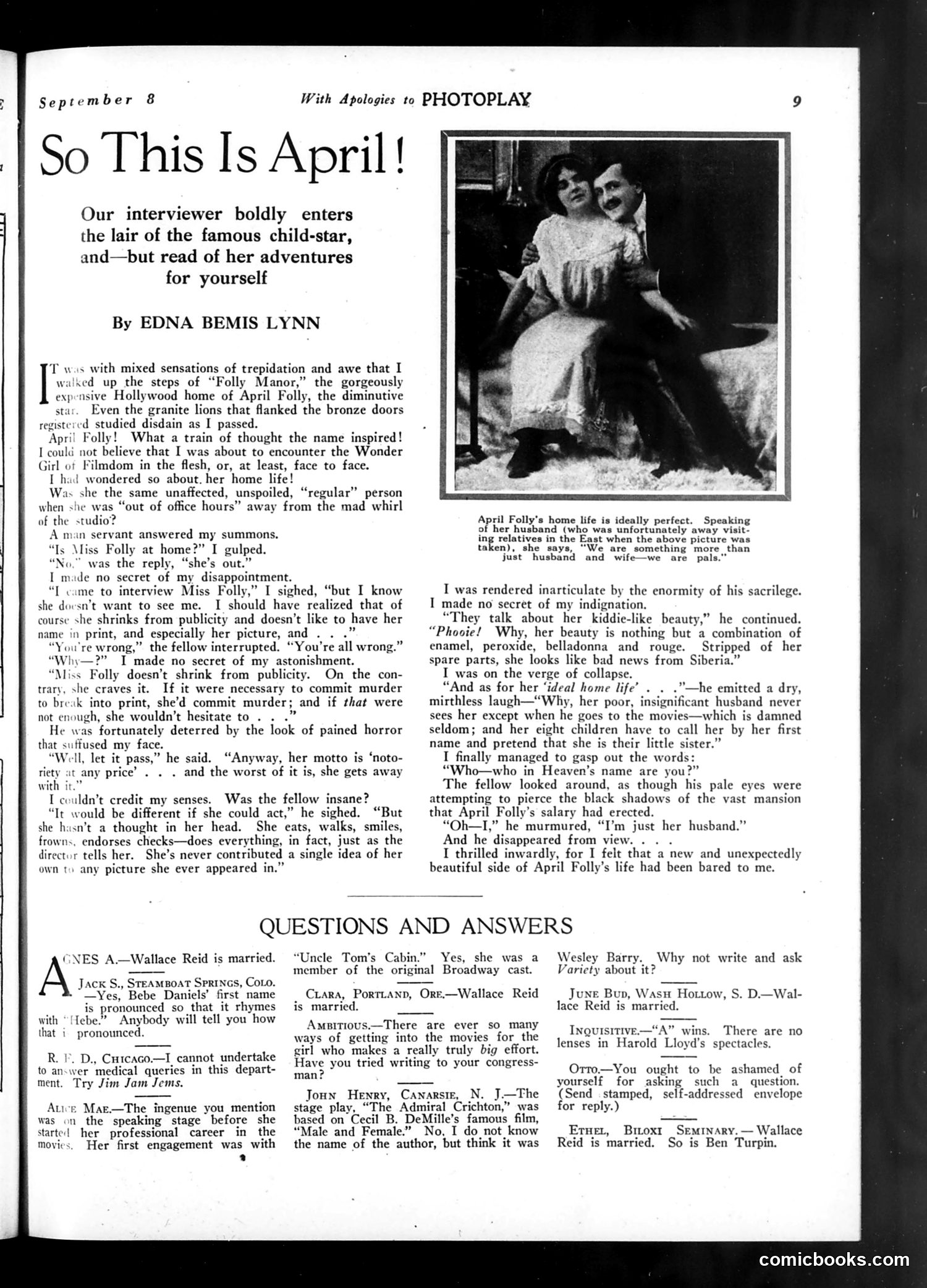
This page features an interview with **April Folly**, a famous child actress of the silent film era. The article by Edna Bemis Lynn describes visiting Folly's luxurious Hollywood home ("Folly Manor"), where the interviewer encountered her husband and attempted to interview the star herself. The photograph shows a man and woman in what appears to be a domestic scene. The article humorously documents the interviewer's failed attempt to actually meet April Folly, who was apparently unavailable. The Q&A section below addresses reader questions about various actors' marital status and career details. The satire targets both the mystique surrounding child stars and Hollywood's publicity machinery—suggesting that even visiting a celebrity's home doesn't guarantee access to the celebrity themselves.
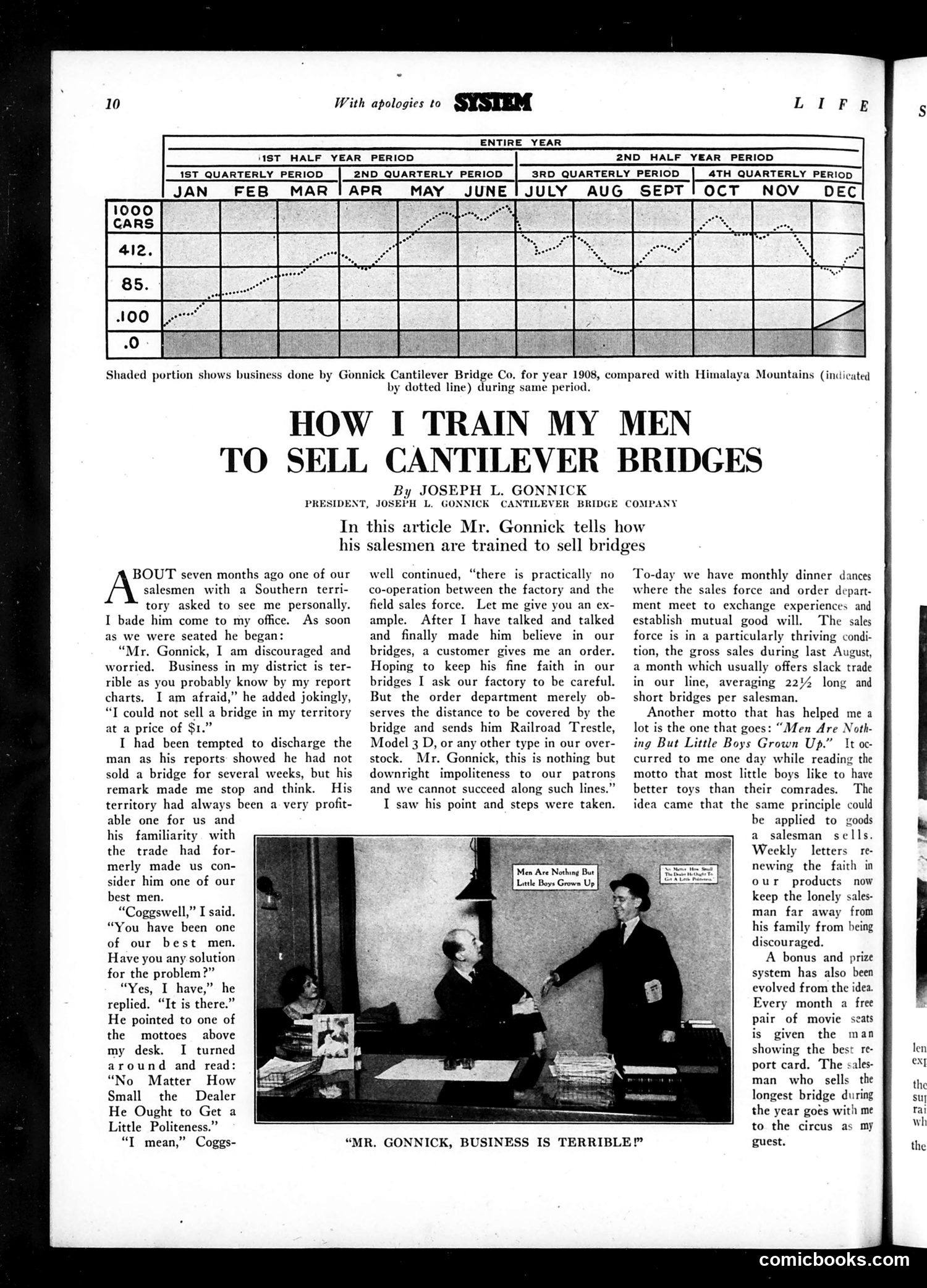
This page from *Life* magazine presents an article titled "How I Train My Men to Sell Cantilever Bridges" by Joseph L. Gonnick, president of the Joseph L. Gonnick Cantilever Bridge Company. The article appears to be **satirical business advice** rather than a political cartoon. Gonnick describes training salesmen to sell bridges—with the implicit joke being that bridges are major infrastructure projects that shouldn't be sold like ordinary consumer goods. The motto referenced, "No Matter How Small the Dealer / He Ought to Get a Little Politeness," suggests absurdist sales techniques. The photograph shows two men in business discussion, captioned "Mr. Gonnick, Business is Terrible!"—likely emphasizing the humor of bridge-selling as a comedic business scenario during this era. The accompanying chart tracks sales data, treating bridge sales like standard commercial metrics.
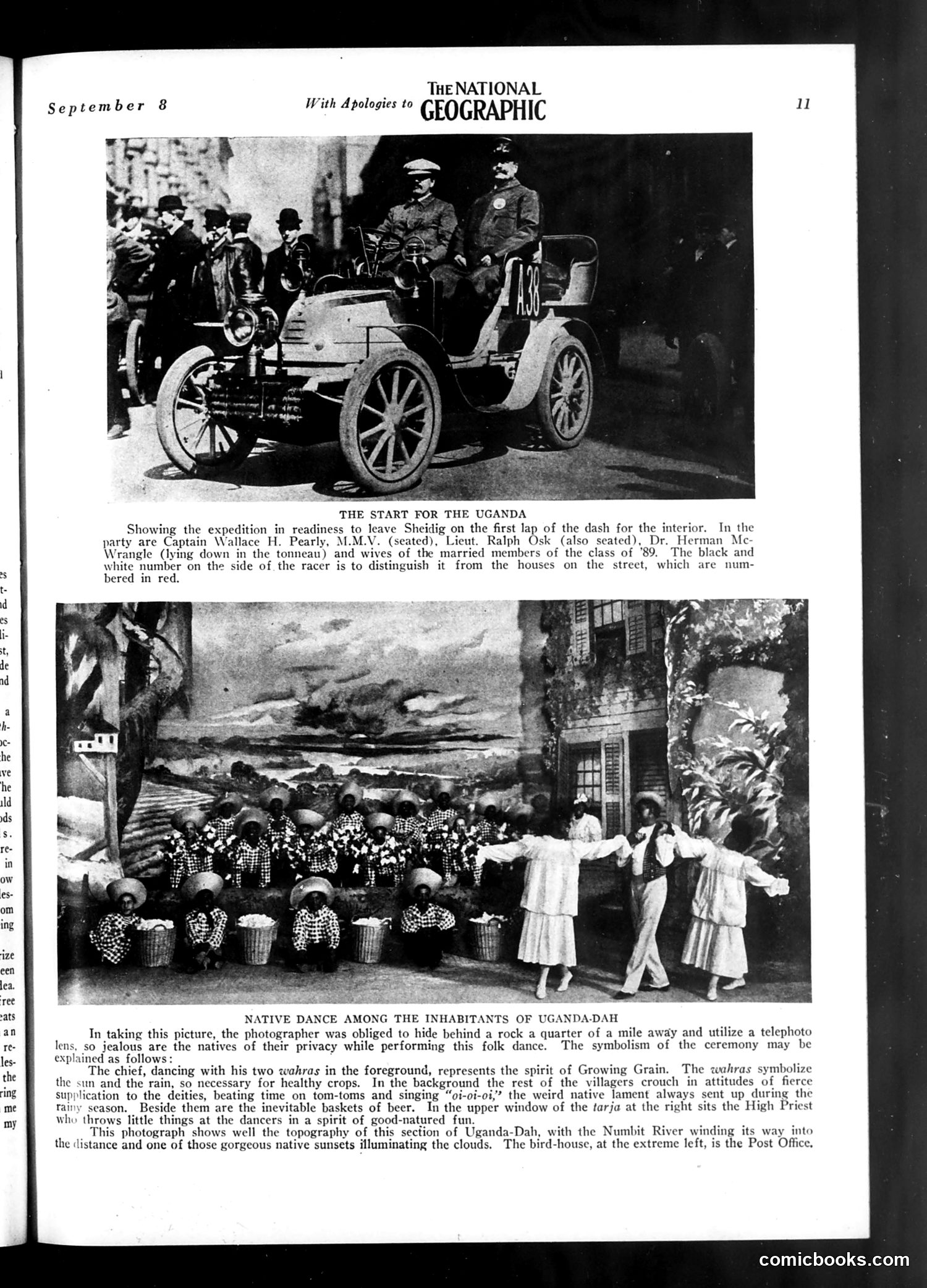
This is **not a political cartoon** but rather a **travel/expedition documentary** from *National Geographic* (the masthead reads "With Apologies to The National Geographic"). The page shows two photographs: 1. **Top image**: "The Start for the Uganda" — an early automobile expedition departing Shelby with passengers including Captain Wallace H. Pearly and Lieutenant Ralph Osk, among others. 2. **Bottom image**: "Native Dance Among the Inhabitants of Uganda-dah" — depicts local people performing a traditional dance, with anthropological notes explaining the symbolism (growing grain, sun, rain, etc.). The "apologies" in the header suggests this is satirizing *National Geographic's* earnest ethnographic documentation style, though the actual content appears straightforward rather than satirical.
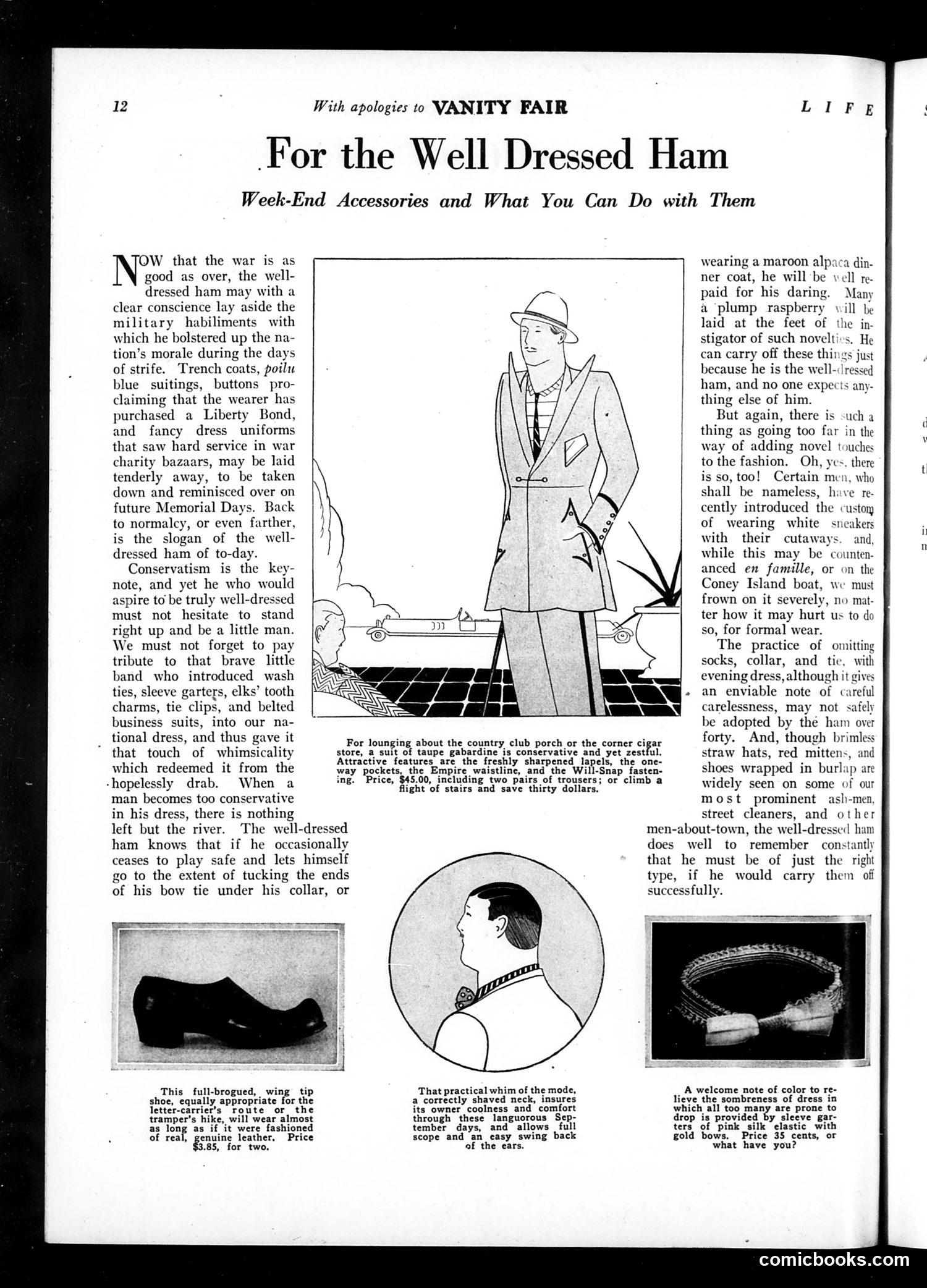
This page satirizes post-WWI men's fashion through the persona of "the well-dressed ham"—slang for a showy dresser or attention-seeker. The article mocks excessive peacocking, arguing that wartime sacrifice should eliminate frivolous fashion accessories (fancy ties, cufflinks, colored socks). The main illustration shows an exaggerated dandy in an overcoat, depicted with theatrical absurdity. Supporting images showcase impractical accessories: fancy shoes, decorative neckties, and colored garters. The satire targets wealthy men flaunting wartime-era finery while others sacrificed. It advocates "conservatism" in dress as a patriotic duty. The term "ham" reinforces the ridicule—these fashionable men are performing vanity rather than demonstrating genuine character. The piece advocates practical, understated masculinity over theatrical self-display.
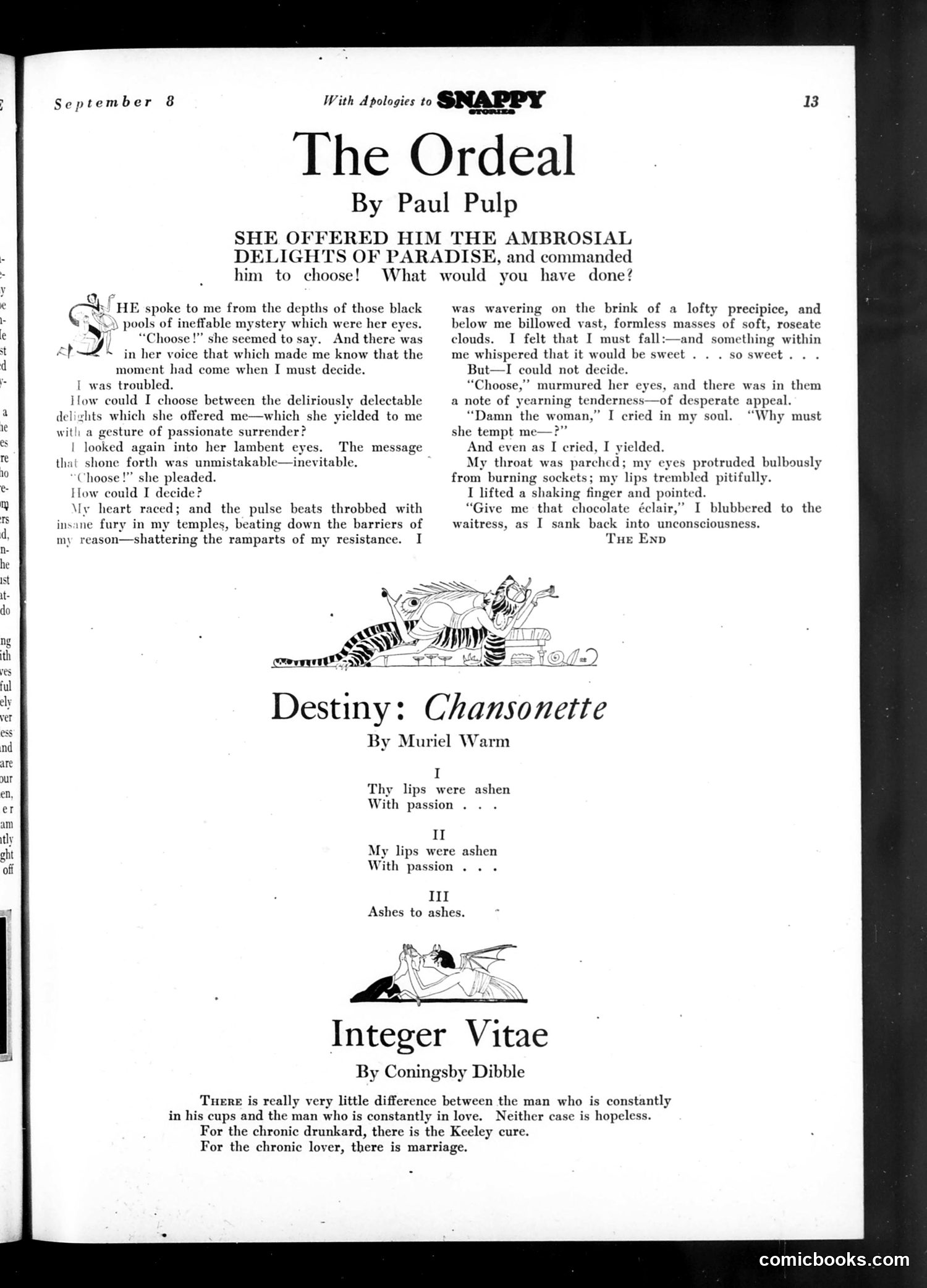
This piece mocks the overwrought romantic fiction popular in early 20th-century magazines. The narrator builds elaborate tension—describing a woman's "lambent eyes," a precipice, clouds, and desperate yearning—only to reveal the "choice" is selecting a chocolate éclair from a waitress. The satire targets two things: (1) the absurd melodrama of pulp fiction, where trivial moments are described in grandiose, pseudo-poetic language, and (2) the gap between literary pretension and mundane reality. The punchline works because readers expect a morally significant or romantic decision, but get dessert. The page also includes "Destiny: Chansonette" (mocking pretentious poetry) and "Integer Vitae" (a joke equating chronic drunkenness with chronic love-sickness, both "cured" by marriage or the Keeley cure). Together, they form a comedic critique of sentimental popular literature.
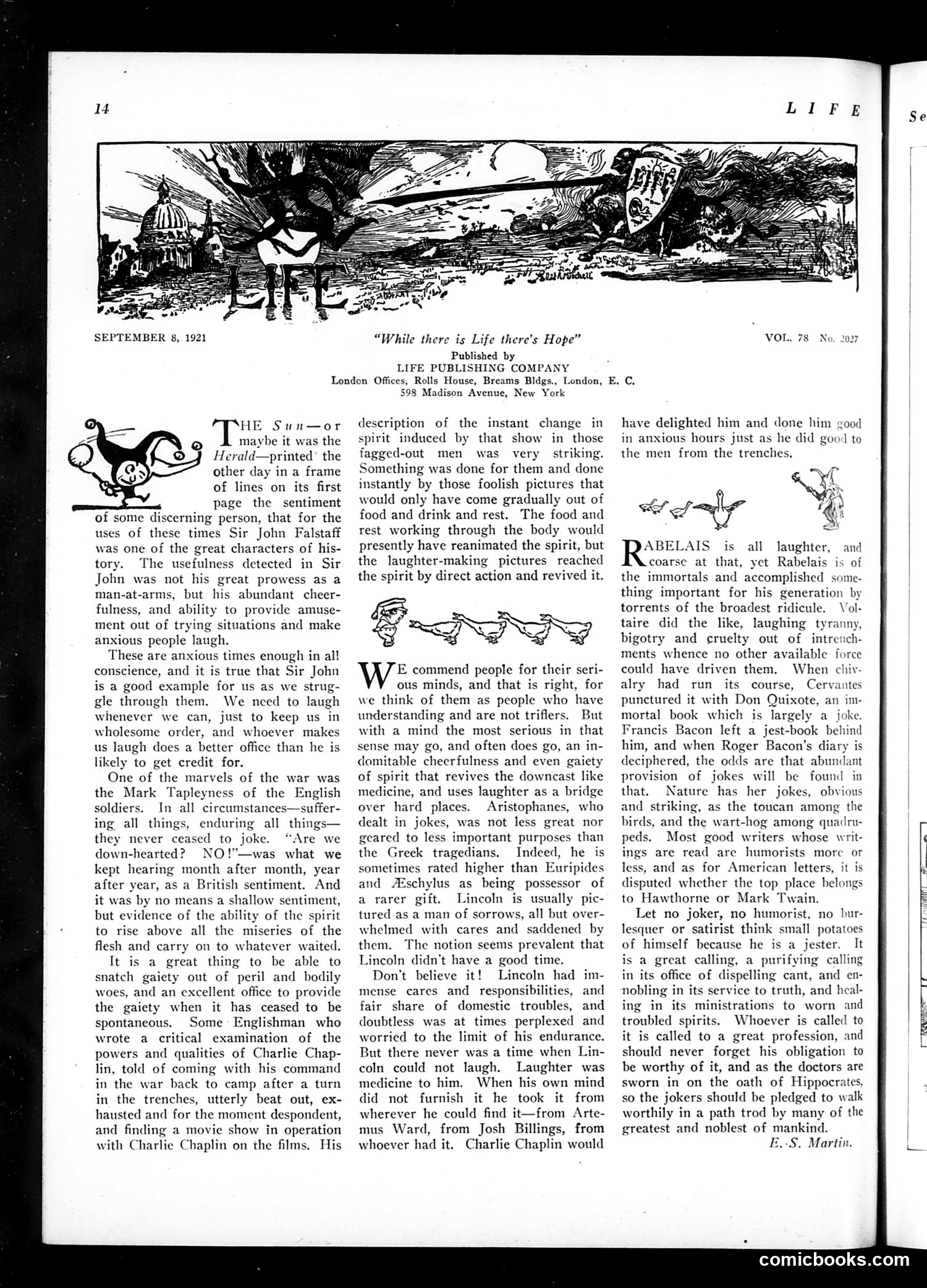
This page argues that humor and laughter are essential medicine during anxious times. The masthead illustration depicts a pastoral landscape with a setting sun, symbolizing hope amid uncertainty (likely post-WWI anxiety). The editorial praises **Sir John Falstaff** (Shakespeare's comic character) as a model for his "abundant cheerfulness" in difficult circumstances. It references English soldiers' famous wartime motto "Are we down-hearted? NO!"—crediting their jokes with sustaining morale. The author argues that **Charlie Chaplin's** films had immediate, profound effects on exhausted troops that food and rest couldn't match, demonstrating laughter's direct spiritual power. The piece then elevates humor philosophically, citing **Lincoln** as someone who used jokes (from humorists like Artemus Ward and Josh Billings) as medicine for his burdens, and comparing comic playwrights like **Aristophanes** to tragic dramatists as equally important. The core message: serious minds needn't exclude gaiety; humor serves vital psychological and moral purposes.
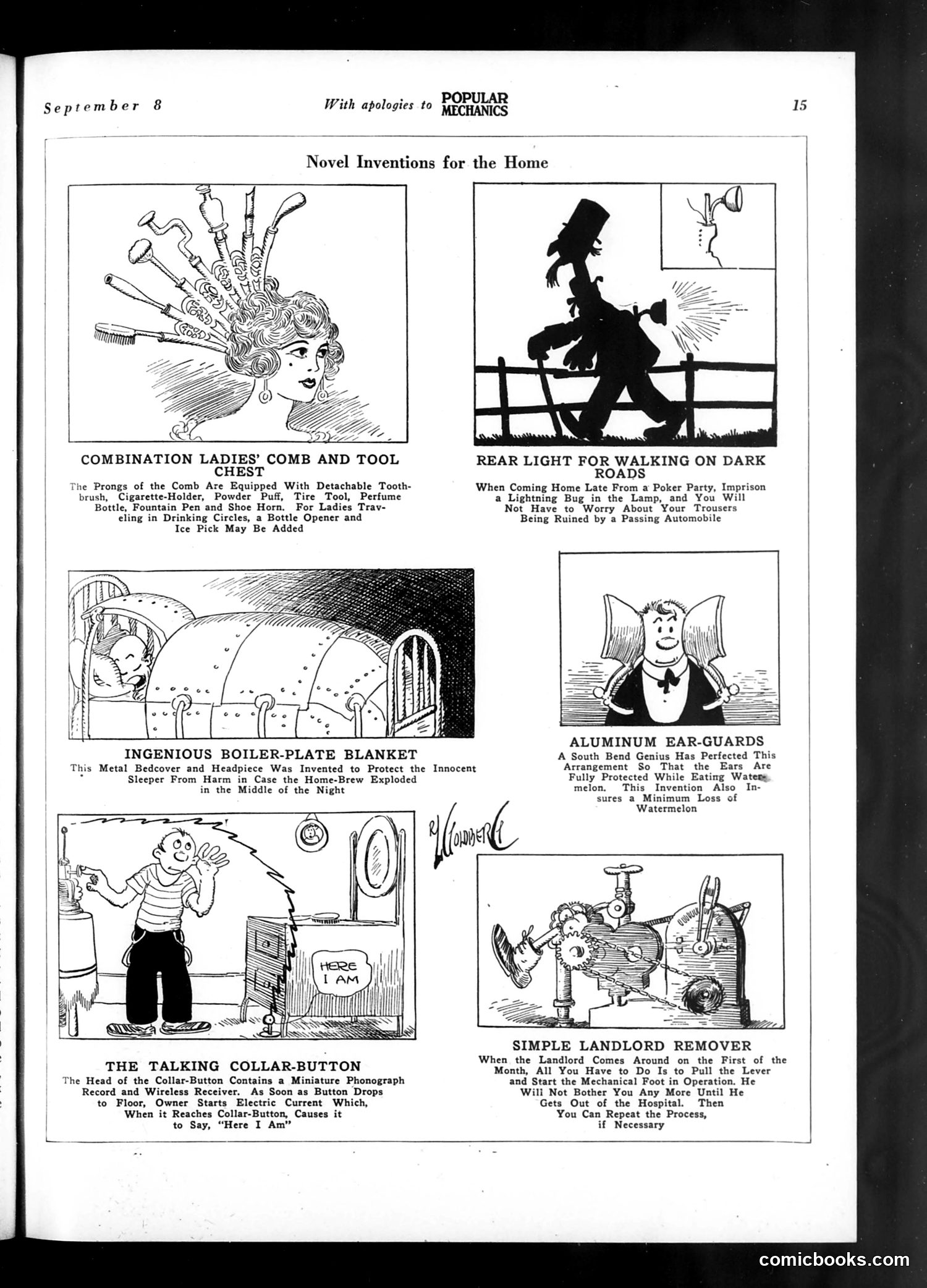
This is a **satirical humor page** from Life magazine featuring six absurd fictional inventions, all presented as solutions to everyday annoyances of the 1920s era. The jokes rely on exaggeration and impracticality: - A **ladies' comb with detachable tools** (cigarette holder, tire tool, ice pick) mocks women's purses and the era's expectation that women carry everything - A **lightning-bug rear light** for drunk poker players satirizes Prohibition-era drinking and men's carelessness - An **ear-guard for watermelon eating** plays on messy eating - A **boiler-plate blanket** references Prohibition's dangerous homemade alcohol ("home-brew") that could explode - A **talking collar-button** is pure nonsense—a phonograph in a button - A **mechanical foot to kick out landlords** jokes about eviction and rent collection The overall satire targets 1920s social anxieties: Prohibition, women's changing roles, drinking culture, poverty, and domestic mishaps. The humor assumes readers recognize these as deliberately impractical "solutions" to real problems.
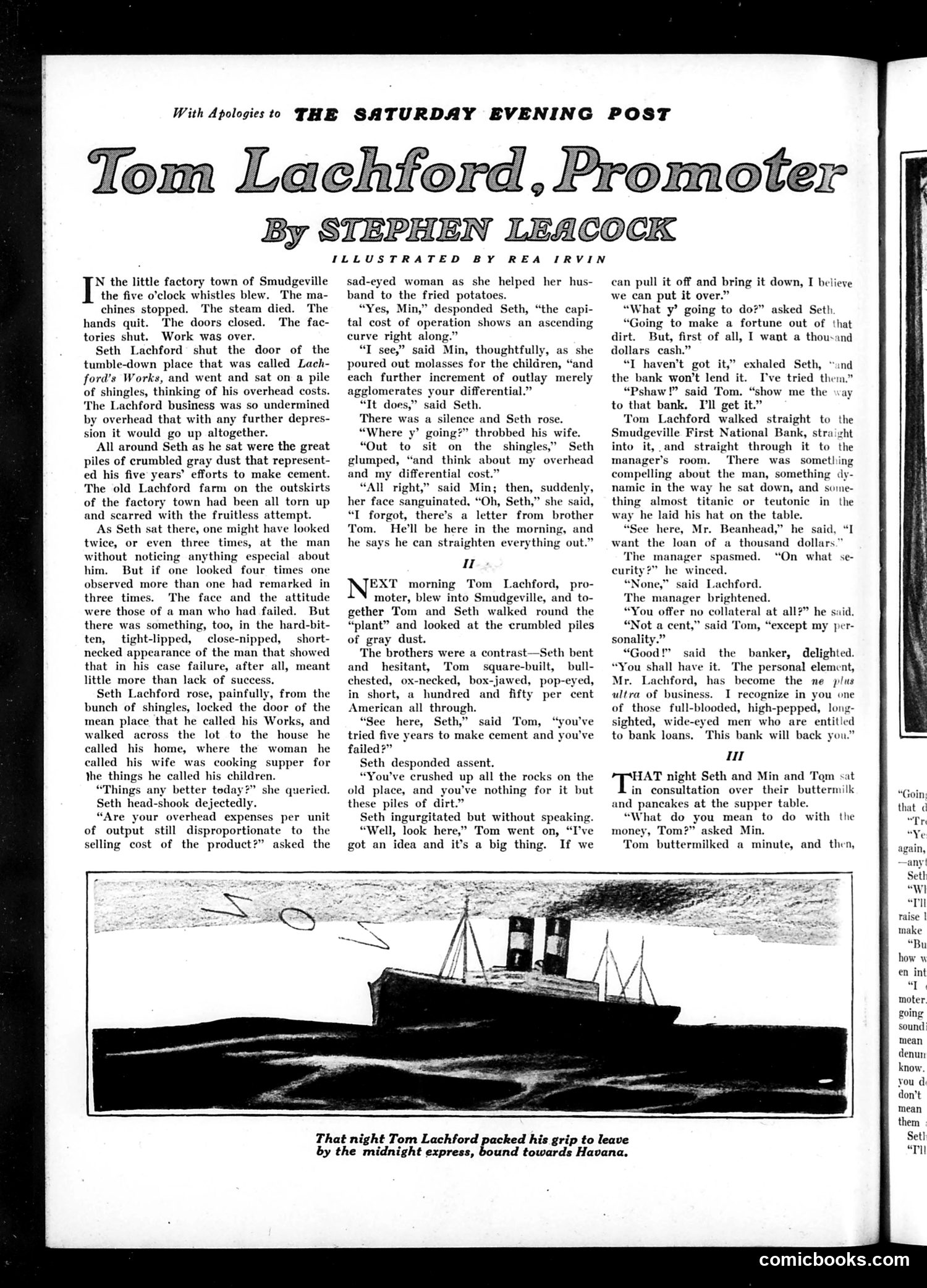
This is a satirical short story (not a political cartoon) by Stephen Leacock mocking American business culture and the "promoter" archetype. **The setup**: Seth Lachford, a failed cement manufacturer in a small factory town, represents the struggling everyman businessman weighed down by overhead costs and failed ventures. His brother Tom represents the quintessential American "promoter"—a confident, fast-talking businessman who arrives with grandiose schemes to profit from failure. **The satire's point**: Leacock ridicules both the jargon-heavy language of business ("differential costs," "agglomerates") and the American faith that any problem can be solved by a charismatic promoter with a "big idea." The illustration of a ship (likely heading to Havana, suggesting escape or fraud) hints that Tom's scheme may involve deception rather than legitimate business. The story mocks American entrepreneurial optimism and the gap between genuine productive work and speculative promotion.
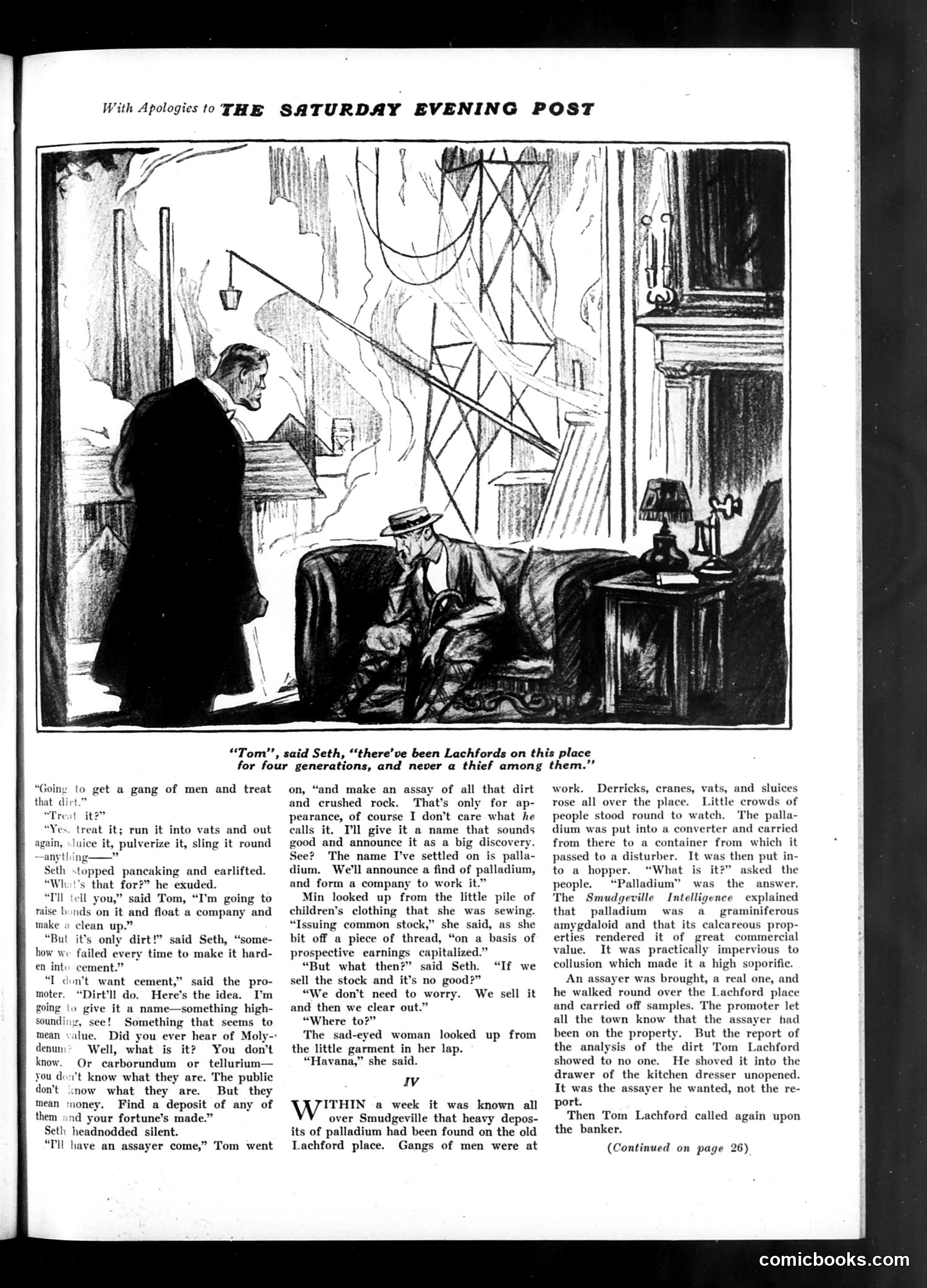
This is a satirical story (not a political cartoon) mocking early 20th-century mining stock schemes and financial fraud. A smooth-talking promoter convinces a farmer named Seth to let him "develop" worthless dirt on the Lachford property by claiming it contains palladium (a valuable metal). The con works by: naming the worthless material something scientific-sounding, hiring a legitimate assayer for appearances (ignoring his actual findings), forming a company, issuing stock to gullible townspeople, and planning to flee to Havana before the fraud is exposed. The satire targets both the con artists' cynical disregard for honest work (Seth's family has owned the land for four generations) and the public's gullibility—townspeople accept pseudo-scientific jargon without questioning what "palladium" actually is. This reflects real historical mining stock frauds that were epidemic in America during the early 1900s.
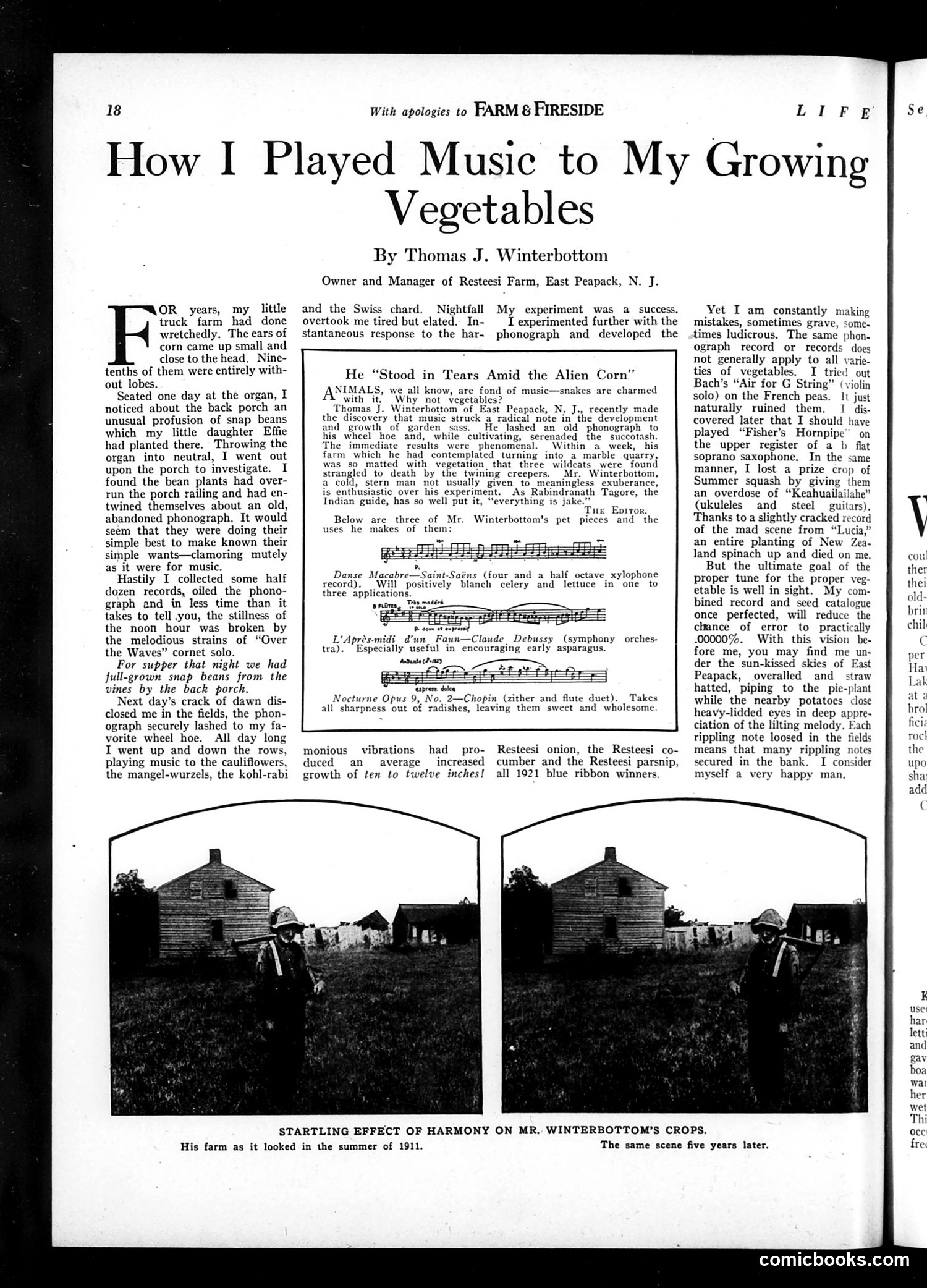
This is a humorous satirical article mocking the early-20th-century pseudoscience of "plant music therapy." Thomas J. Winterbottom claims that playing music to his vegetables dramatically improved their growth—beans grew "full-grown" overnight, and onions achieved a "ten to twelve inches" increase. The satire lies in the absurd specificity: Winterbottom prescribes particular classical pieces for different vegetables (Debussy for asparagus, Chopin for radishes), complete with musical notation. He recounts comic failures—Bach ruined French peas but "Fisher's Hornpipe" on soprano saxophone supposedly worked instead. The photographs showing his farm in 1911 and "five years later" are presented as "proof," adding to the deadpan mockery. The page parodies both agricultural advice columns and the credulous pseudoscientific fads that circulated in popular magazines of this era. The target isn't Winterbottom specifically but rather readers' susceptibility to implausible farming claims and the magazine's own tendency toward publishing dubious "scientific" advice dressed in authoritative language.
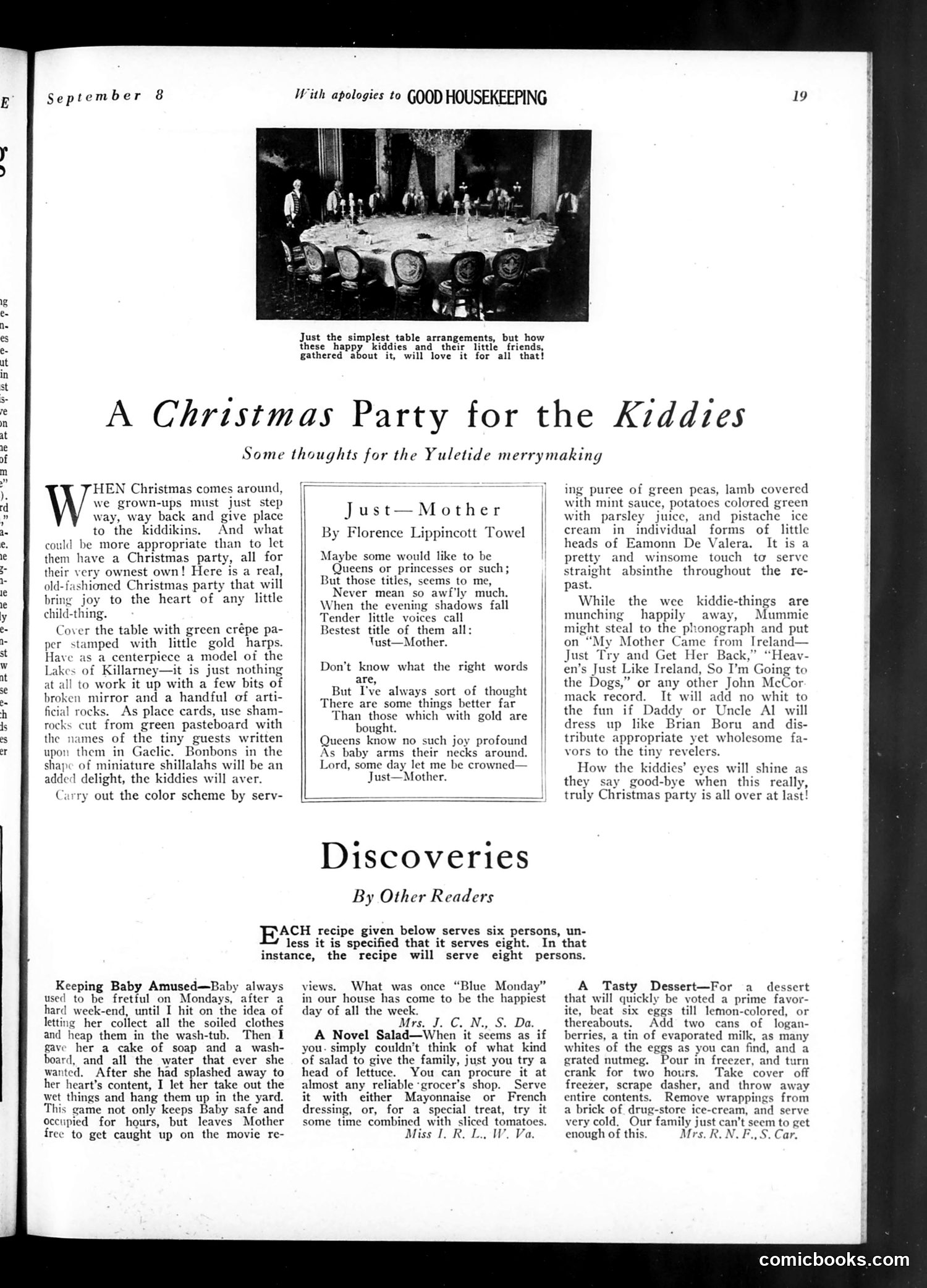
This page satirizes Irish-American domestic culture of the 1920s-30s by presenting an absurdly elaborate children's Christmas party with heavy Irish theming. The satire works through exaggeration: The table decoration scheme—green crêpe paper with gold harps, a model of Killarney Lakes, Gaelic place cards, and shillelagh-shaped bonbons—treats Irish iconography as comically overwrought for a children's party. The menu features dishes shaped like Eamonn de Valera (Irish political figure), and suggested phonograph records are all Irish-themed John McCormack songs, including deliberately malapropistic titles like "Heaven's Just Like Ireland, So I'm Going to the Dogs." The satire mocks how Irish-American families performed their ethnicity through elaborate, kitschy displays, treating genuine cultural identity as decorative excess. By presenting this as earnest homemaking advice (parodying "Good Housekeeping"), Life's editors highlight the disconnect between sincere ethnic pride and its sometimes ridiculous material expressions.
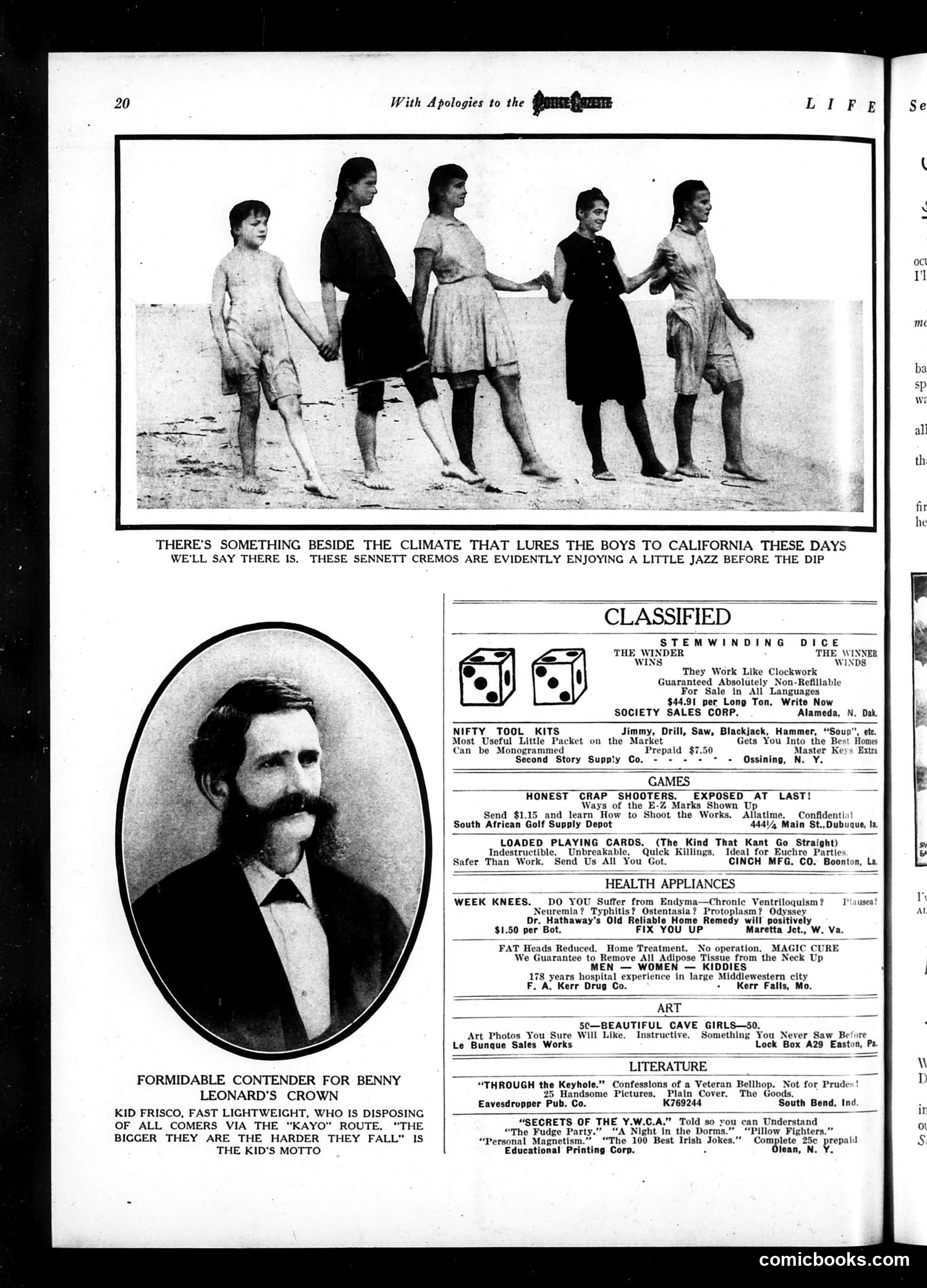
This page juxtaposes legitimate editorial content with satirical "classified ads" mocking fraudulent schemes common in the era. **Top image**: Children at a California beach, captioned as "Sennett Cremos" (likely Keystone Cops-style comedy extras from Mack Sennett's film studio) enjoying "jazz" before swimming—a gentle joke about California's attractions for young people. **Portrait**: "Kid Frisco," a boxer challenging Benny Leonard's lightweight championship, using the boxing phrase "the bigger they are, the harder they fall." **Fake classifieds**: The bulk of the page saririzes mail-order scams targeting gullible readers—rigged dice, burglary tools ("Second Story Supply Co."), loaded cards, dubious medical "cures," pornographic photos, and sexually suggestive literature ("Secrets of the Y.W.C.A."). The satire targets both the fraudsters and the desperate people seeking quick fixes, hidden knowledge, or illicit materials. This reflects Life's role as social commentary on American consumer culture and its exploitation of human weakness and desire.
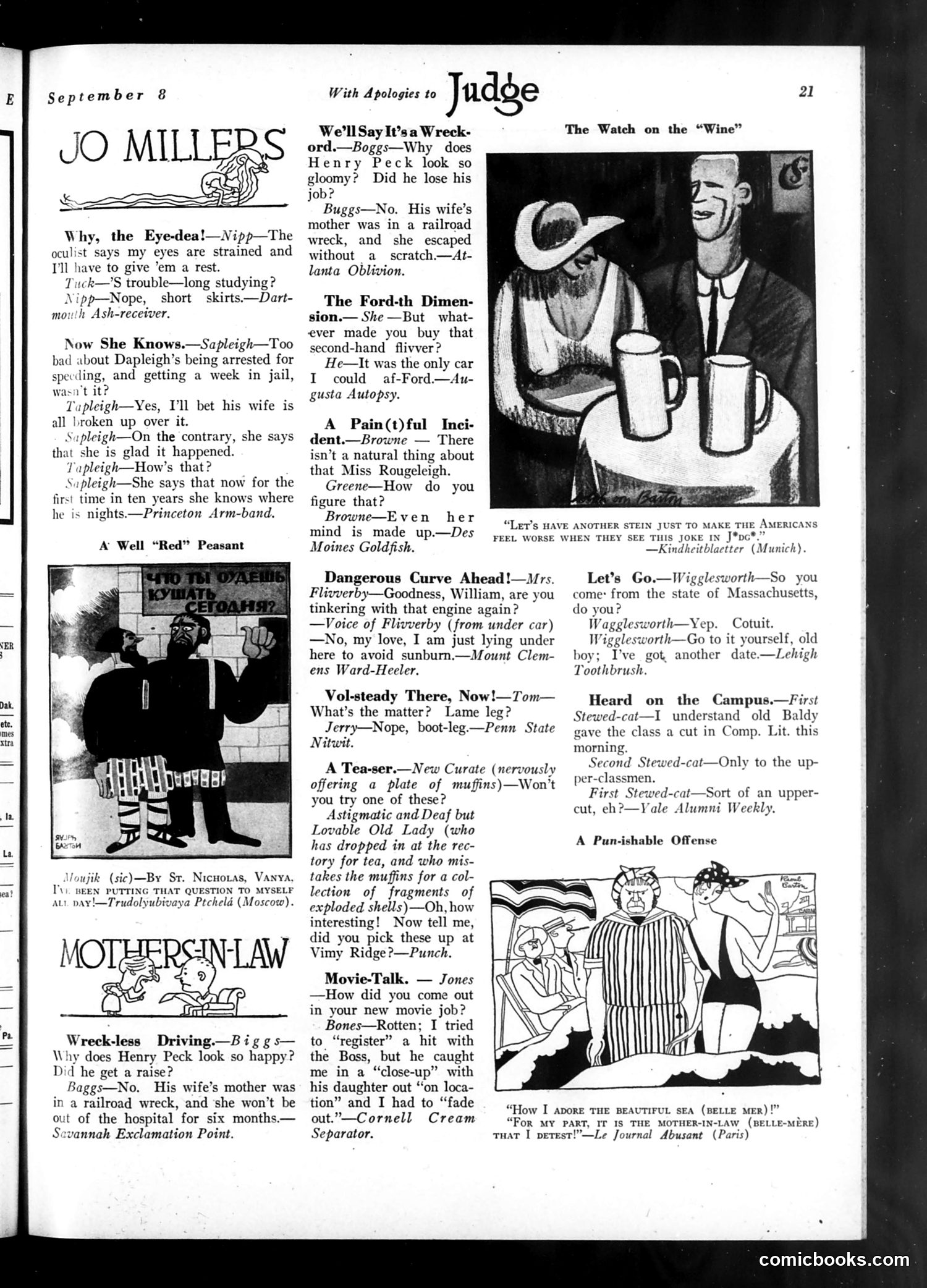
This page from *Life* magazine (September 8, appears to be 1920s era) is a collection of short humorous jokes and cartoons typical of the period. **Key themes:** - **Domestic humor**: Jokes about wives, mothers-in-law, and marriage troubles dominate. One recurring joke: a man is happy because his wife's mother was in a wreck and will be hospitalized for months—a dark joke about in-law friction. - **Automobile culture**: Multiple jokes reference "flivvers" (cheap cars like Model Ts), Fords, and reckless driving—reflecting the novelty and social impact of mass-produced automobiles. - **Prohibition-era references**: A "boot-leg" joke alludes to illegal alcohol during Prohibition. - **Wordplay and puns**: The humor relies heavily on homophones and double meanings ("af-Ford," "Belle Mer/Belle-Mère"). - **Campus/youth culture**: References to Yale and Penn State suggest collegiate humor. The cartoons use simple line drawings to illustrate these brief, pun-driven jokes—standard *Life* magazine fare for middle-class readers seeking lighthearted domestic and social satire.
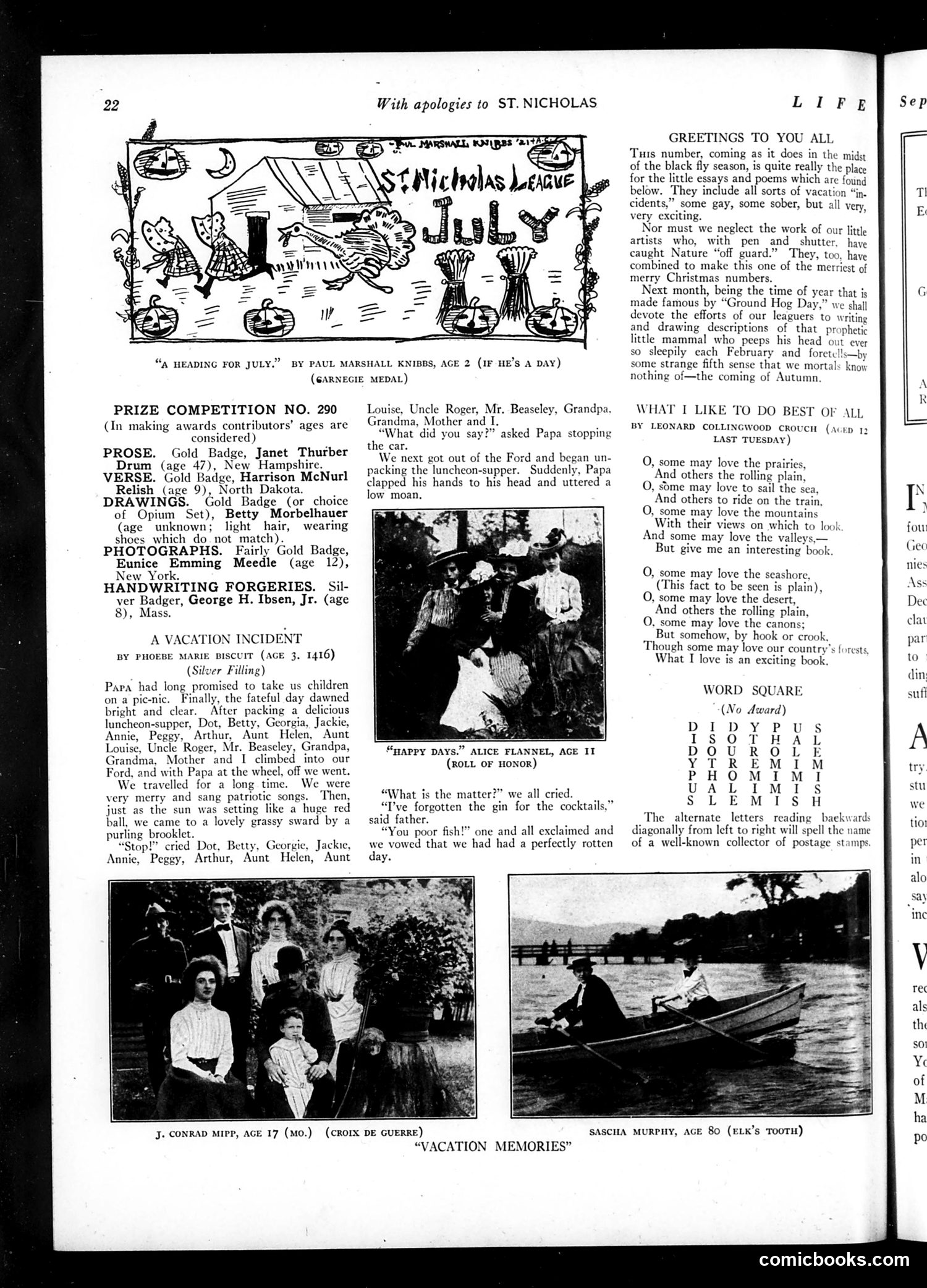
This is a satirical parody of *St. Nicholas* magazine, a prestigious children's publication. Life's joke is presenting deliberately terrible contributions supposedly from "child" writers—whose listed ages (2, 3, 80) expose the fraud. The humor targets post-Prohibition excess: in "Happy Days," a father's vacation is ruined because he forgot gin for cocktails—absurd for a family outing, but reflects 1920s adult drinking culture. The drawing "A Heading for July" is intentionally childish scribbling. Life mocks both the pretentiousness of children's literary competitions and contemporary adult obsessions bleeding into family life. The word puzzle and vacation stories maintain the fake-earnest tone. Photos of real people labeled as prize-winners complete the satire of contests awarding recognition for mediocrity. It's gentle mockery of literary competitions and changing social norms around family activities.
This page from *Life* magazine (September 8, date unclear but context suggests early 1920s) is primarily **editorial and contents pages**, not cartoons. The satire is textual rather than visual. The main satirical pieces mock: 1. **Russian political confusion**: The "Moldavia plebiscite" section ridicules Soviet governance through absurdist humor—inventing nonsensical crises (a lease clause about mice causing peasant revolt) to parody the chaotic, confusing reports emerging from post-revolutionary Russia. 2. **New York Times unreliability on Russia**: *Life* directly attacks the *Times* for contradictory reporting on Lenin and Trotsky's relationship, sarcastically treating journalistic incompetence as "a blow at democratic institutions." 3. **Chinese politics**: The final article discusses real tensions between Chinese liberals and radicals following the Manchu dynasty's 1912 overthrow, referencing actual figures like Chang Kai and Yuan Shao. The humor relies on absurdism and direct editorial mockery rather than visual caricature. For modern readers, the Soviet section requires knowing that *Life* was satirizing widespread American confusion about Bolshevism.
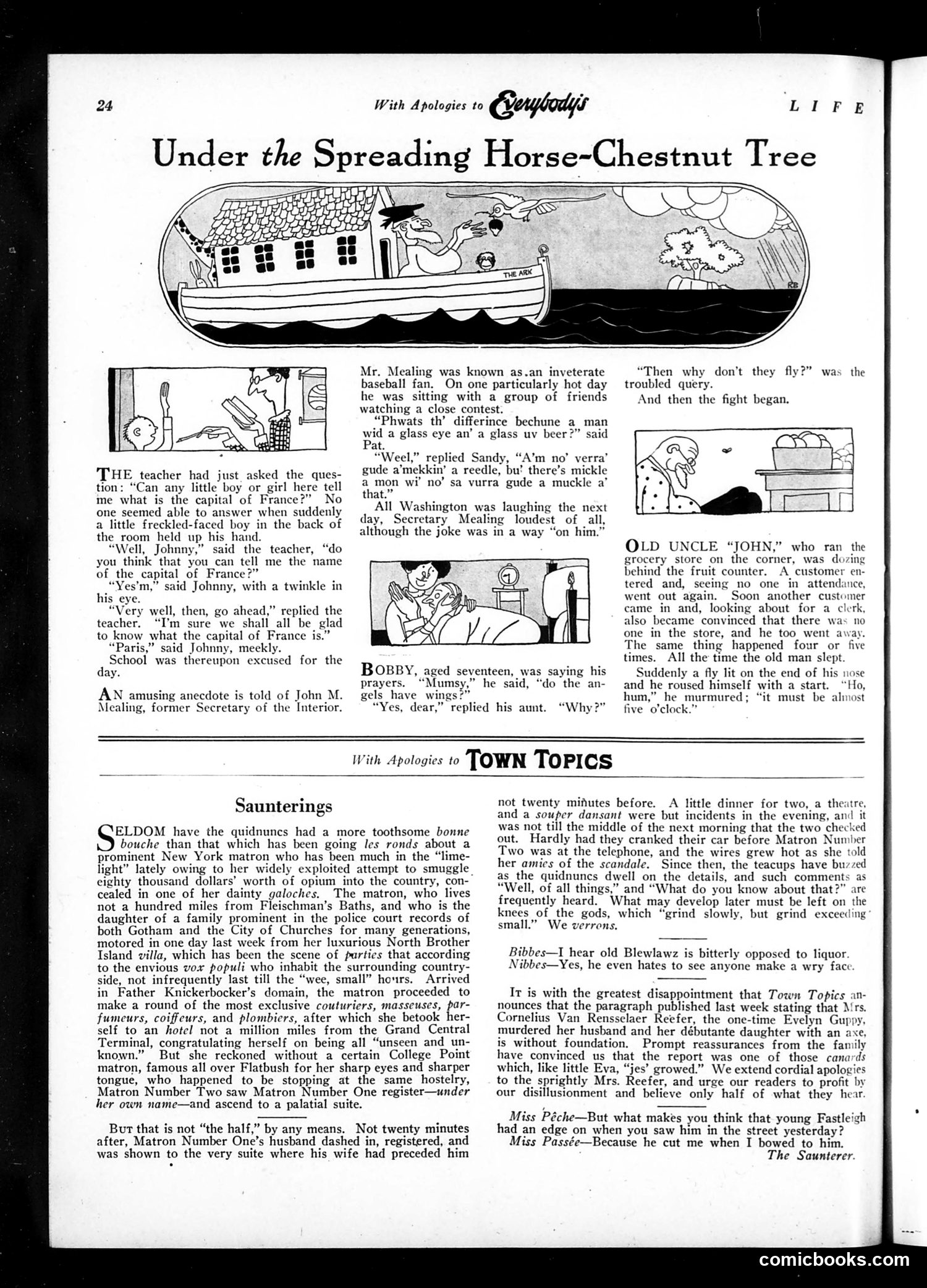
This page from *Life* magazine contains three separate humorous anecdotes: 1. **"Under the Spreading Horse-Chestnut Tree"**: A parody title referencing Longfellow's "Village Blacksmith." It collects brief jokes: a teacher's student correctly answers "Paris" as France's capital; Secretary of the Interior John M. Mealing laughs at a joke "on him" involving dialect humor about glass eyes and beer; a sleeping store owner only wakes when a fly lands on his nose. 2. **"Saunterings" section**: Gossip-style commentary on wealthy New Yorkers. It satirizes a prominent matron who attempted smuggling opium in a shoe, frequents exclusive beauty services, and stays at hotels—with the scandal being that her husband registered at the same suite shortly after her. The humor relies on wordplay, ironic twists, and satirizing upper-class scandal. The references assume readers knew about actual New York social figures and locations (Flatbush, North Brother Island). The tone is typical of 1910s-era *Life*: mocking pretension and hypocrisy among the wealthy.
This is a **vintage automobile advertisement**, not political satire. It promotes the Templar car to affluent, discriminating buyers who consider themselves above-average. The advertisement's core argument: mass-market car makers design for "average" people, so superior individuals need a superior car—Templar. It emphasizes the car's exclusive 18-43 H.P. motor, durability (100,000-mile records), fuel economy (26.66 miles per gallon), maneuverability, and sporty performance. The pitch flatters potential buyers as "different," "exceptional," and possessing "higher tastes" than ordinary consumers. Pricing ($2,385–$3,185) positions Templar as premium but not luxury-tier. This reflects 1920s marketing strategy: positioning a middle-class product as exclusive by appealing to consumers' self-image and social aspirations. The Templar Motors Company was based in Cleveland and marketed performance vehicles during the early automotive era.
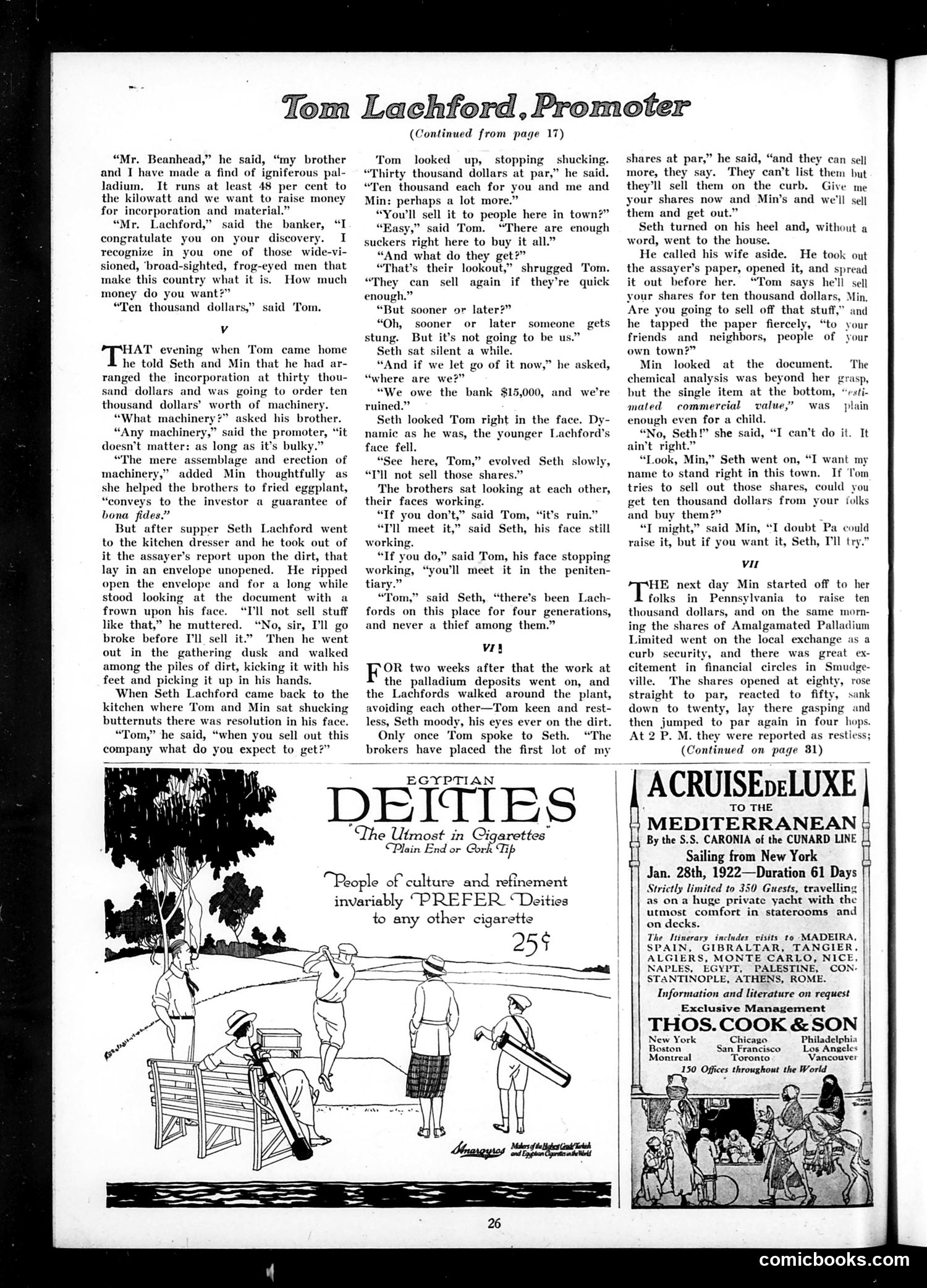
This page presents a serialized story about **Tom Lachford, a stock promoter**, satirizing early 20th-century financial fraud and the "get-rich-quick" schemes that victimized ordinary Americans. **The Setup:** Tom arranges incorporation of a worthless palladium deposit, securing $30,000 from a banker by projecting confidence and acquiring bulk machinery—which serves no purpose except to look legitimate to investors. **The Conflict:** Seth (Tom's brother) discovers the assayer's report shows the deposit is worthless. Despite facing financial ruin, Seth refuses to defraud "people of your church"—the local community who would buy shares. He won't become a thief. **The Satire:** The joke targets both Tom's cynical amorality ("They can sell again if they're quick enough") and the ease with which financial con men manipulate bankers and investors through performative legitimacy—machinery, incorporation papers, and smooth talk replacing actual value. The story critiques the era's loosely-regulated securities markets and the moral bankruptcy of promoters who enriched themselves at ordinary people's expense.
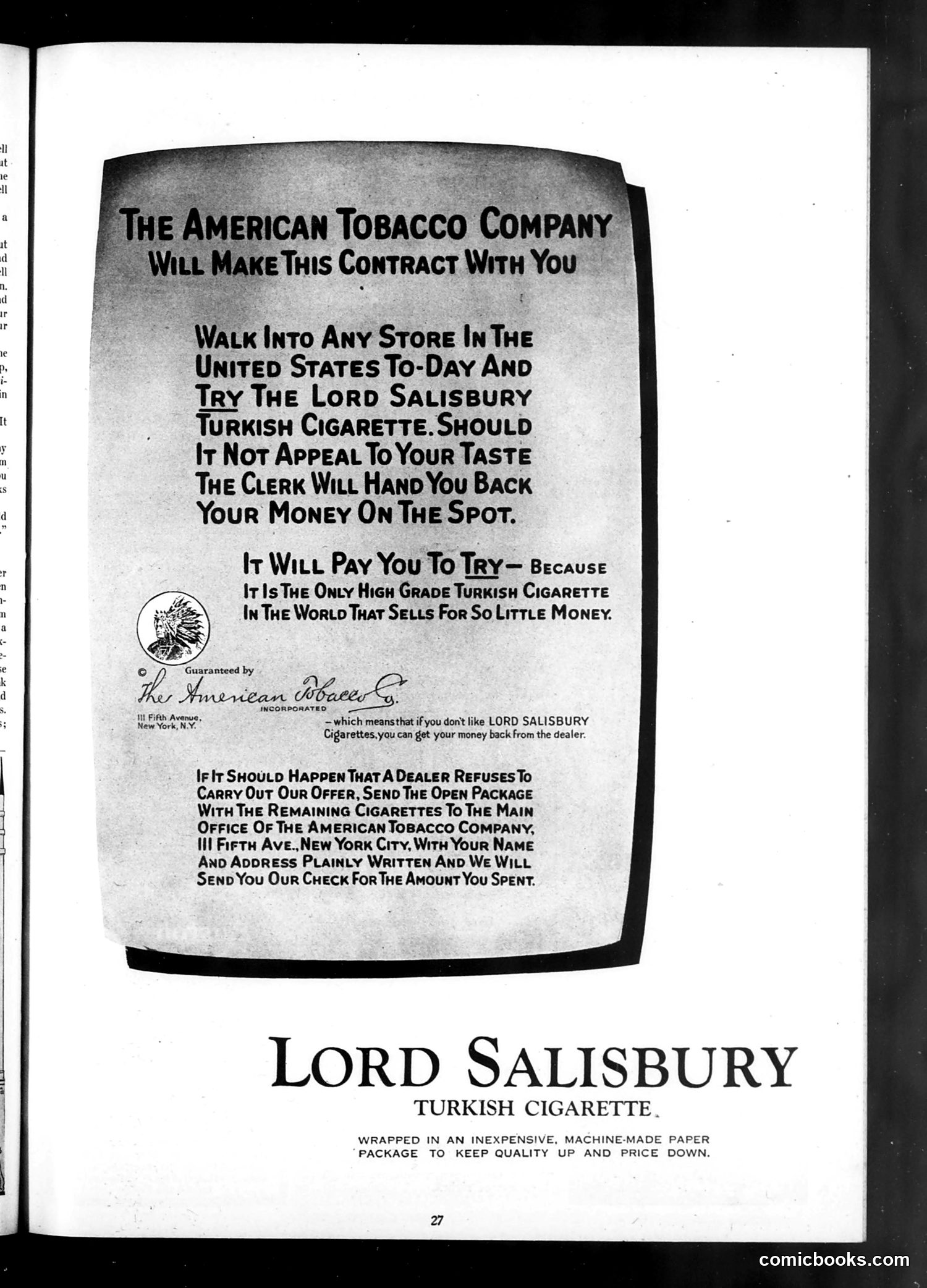
This is a straightforward cigarette advertisement, not satire. The American Tobacco Company promotes "Lord Salisbury" Turkish cigarettes by offering an unconditional money-back guarantee—a bold marketing tactic for the era. The advertisement claims the product is "the only high grade Turkish cigarette in the world that sells for so little money." It encourages consumers to test the cigarettes risk-free: walk into any store, try them, and if unsatisfied, the clerk will immediately refund your money. If a dealer refuses, customers can mail the remaining cigarettes to the company's New York headquarters for reimbursement. The "Lord Salisbury" name references the British Prime Minister, likely chosen to suggest sophistication and quality. The appeal emphasizes affordability combined with quality—a competitive positioning strategy in the cigarette market of this period.
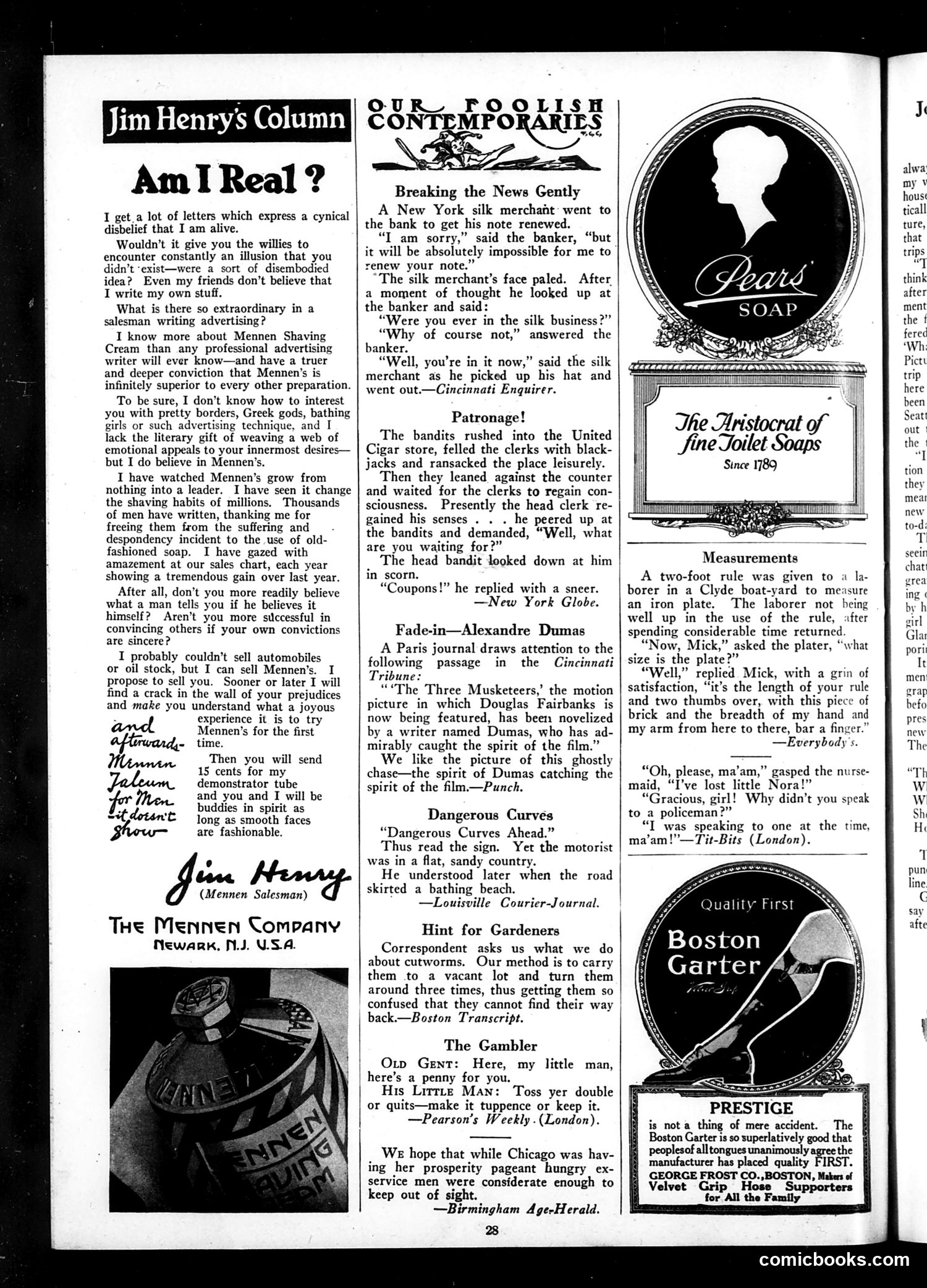
This page contains **Jim Henry's column** ("Am I Real?"), where Henry—a Mennen shaving cream salesman—defends his authenticity as an advertising writer. He argues that his genuine belief in the product's superiority makes his pitch more persuasive than typical advertising techniques using "pretty borders, Greek gods, bathing girls." The column is essentially meta-advertising: Henry sells Mennen's by claiming sincere conviction beats flashy marketing. The page also features several **brief humorous anecdotes** (typical of Life's satirical content): - A silk merchant who tells his banker "you're in it now" after being refused credit - Bandits demanding "coupons" as reward from a cigar store robbery - A joke about catching the "spirit" of Dumas in novelizing *Three Musketeers* - Motorists encountering "dangerous curves" near a bathing beach These jokes rely on wordplay and ironic reversals common to early 20th-century humor. The page also contains period product advertisements for Pears Soap and Boston Garter.
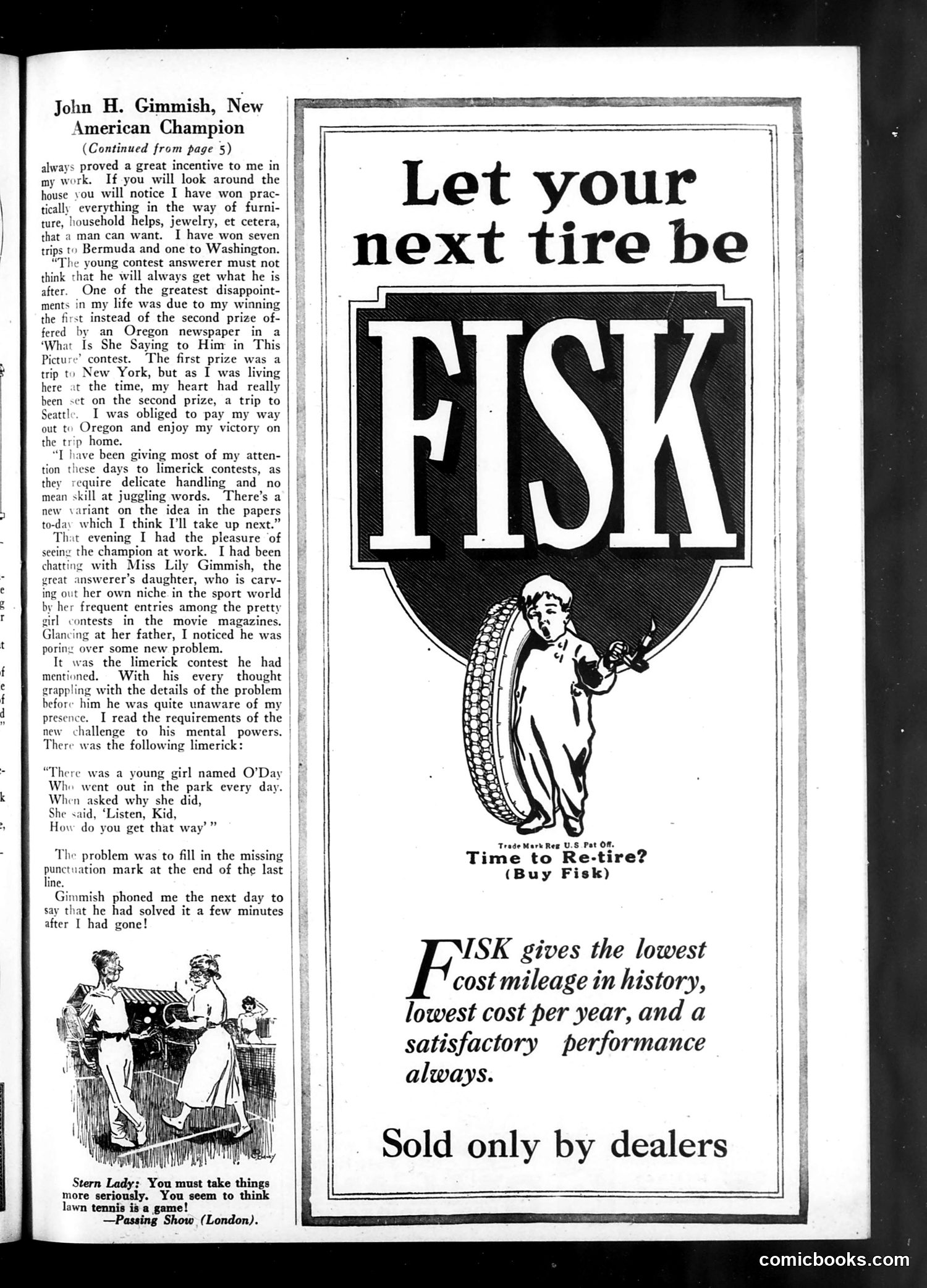
**Left Column - "John H. Gimmish" Story:** This satirizes the early 20th-century craze of newspaper and magazine contests. "Gimmish" is a fictional character who obsessively enters competitions for prizes—furniture, trips, jewelry—winning so frequently he's become a professional contestant. The satire mocks both the contest-addiction culture and the absurdity of contest design itself. The limerick puzzle shown exemplifies this: contestants must fill in missing punctuation. This reflects actual popular word puzzles and riddles that magazines used to boost circulation and reader engagement. **Right Column:** A full-page advertisement for Fisk tires, featuring a cherub-like figure hoisting a large tire. The wordplay "Time to Re-tire?" puns on both tire replacement and retirement. The ad emphasizes Fisk's cost-efficiency—a selling point during an era when automobiles were becoming mainstream consumer goods. **Overall Context:** This page captures early 1900s American consumer culture: the proliferation of contests as marketing tools and the growing importance of automobile ownership and maintenance.
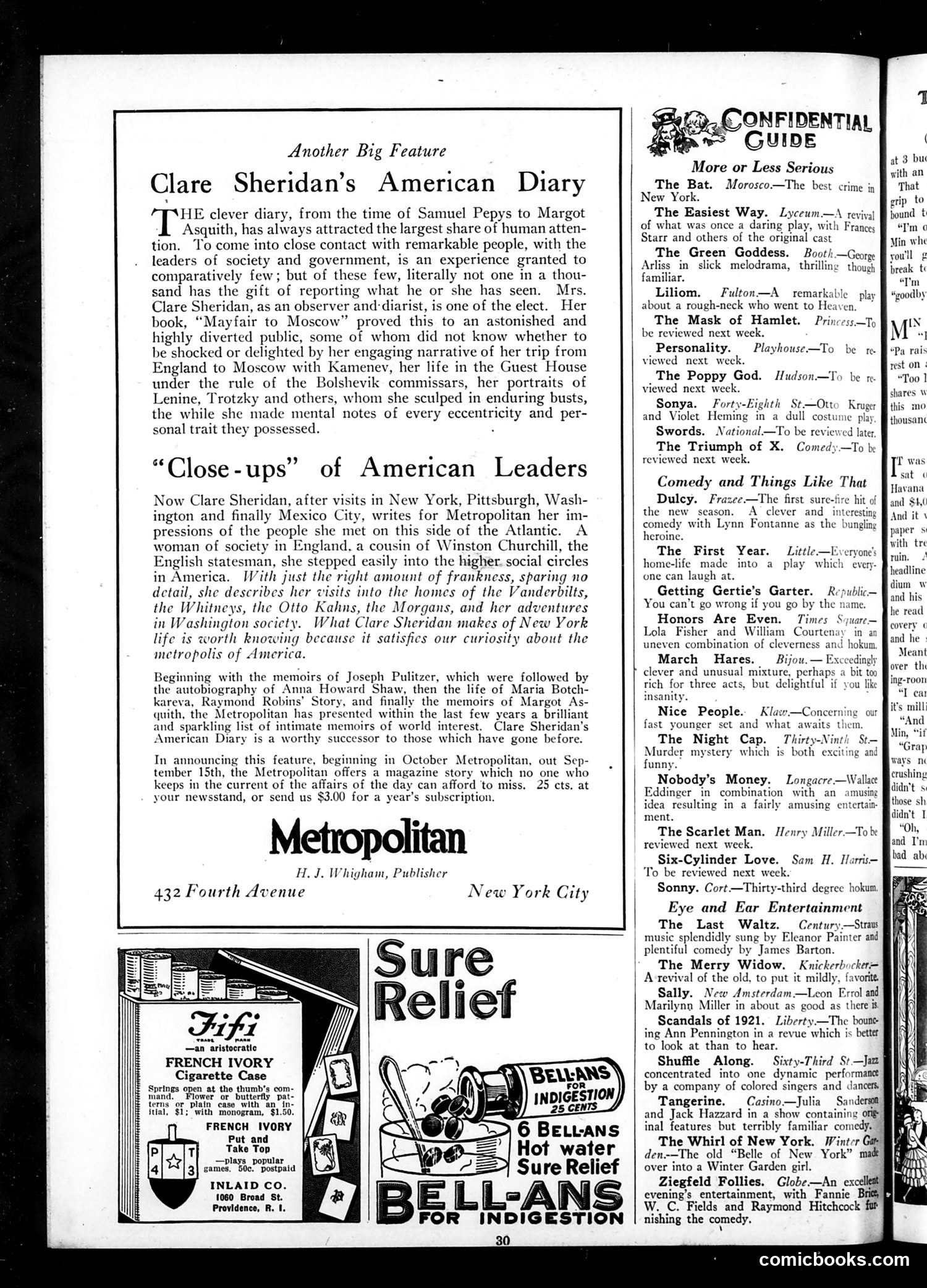
This page announces Clare Sheridan's serialized memoir **"American Diary"** for *Metropolitan* magazine. Sheridan was a British socialite and sculptor (cousin of Winston Churchill) who had previously published "Mayfair to Moscow," documenting her visits to Soviet leaders Lenin and Trotsky. The advertisement promotes her upcoming observations of America's elite—visits to the Vanderbilts, Whitneys, Kahns, and Morgans, plus Washington society figures. The appeal is voyeuristic: readers gain "close-ups" of prominent Americans through an outsider's candid perspective. The page reflects 1920s fascination with intimate celebrity memoirs and insider social commentary. The *Confidential Guide* section reviews current Broadway plays, while advertisements for French Ivory cigarette cases and Bellans digestive tablets target the magazine's affluent readership. This is primarily **promotional content and entertainment listings** rather than satire or political commentary.
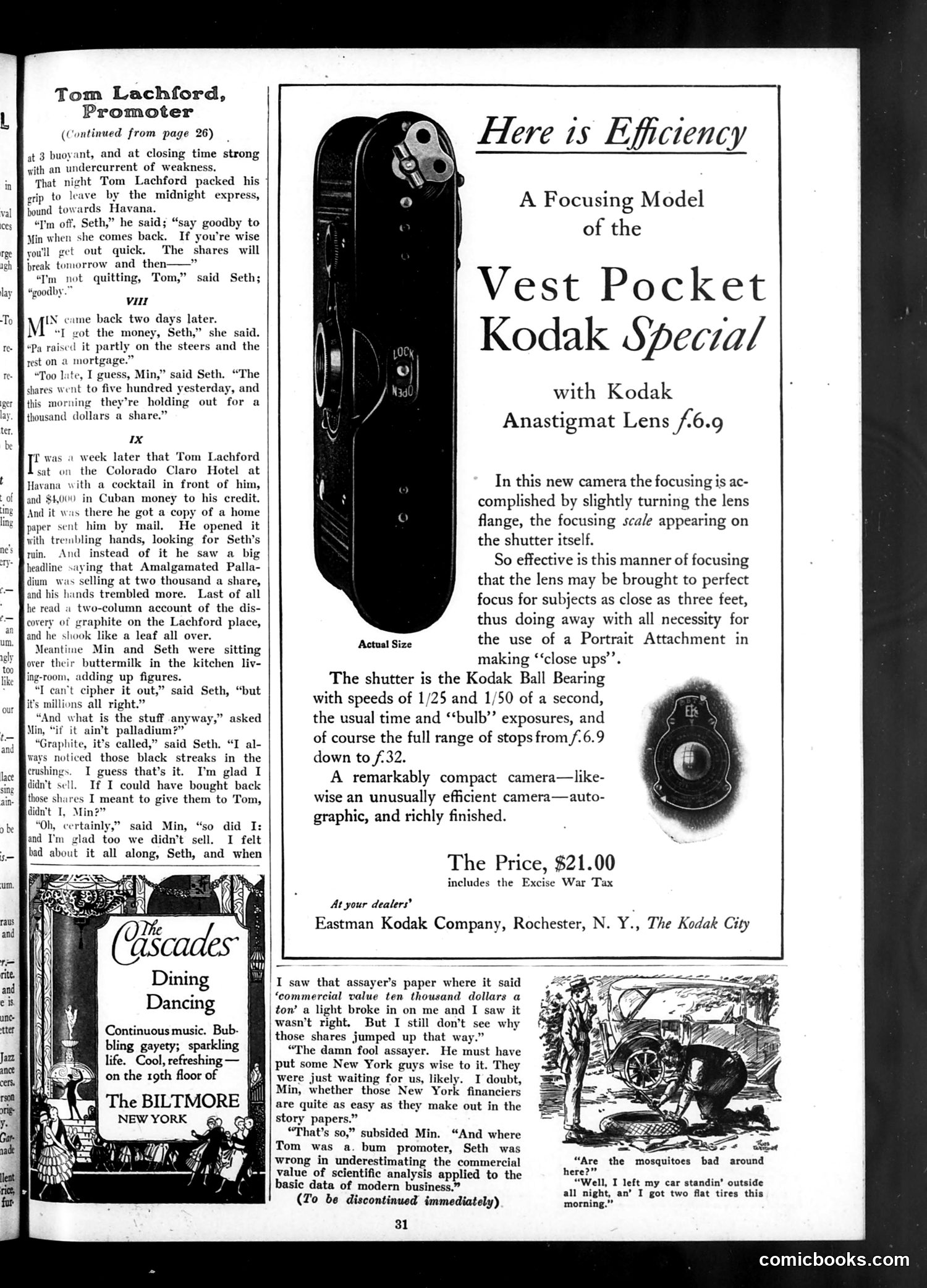
This page contains a serialized story ("Tom Lachford, Promoter," continued from an earlier installment) alongside period advertising. The narrative depicts a classic stock-market scheme: promoter Tom Lachford convinces investors Seth and Min to buy shares in what appears to be a failing venture. Tom absconds to Cuba with insider knowledge. When graphite is discovered on the property, the stock soars, enriching the naive investors who nearly lost everything. The satire targets both the con artist (Lachford) and the gullible public's susceptibility to get-rich-quick schemes. The story's conclusion moralizes that scientific analysis—here, professional assaying—has legitimate commercial value, distinguishing honest business from fraudulent promotion. The page also contains a full-page Kodak camera advertisement for the "Vest Pocket Kodak Special" ($21.00), touting its efficiency and focusing capability—typical commercial content mixed with editorial matter in 1920s magazines.
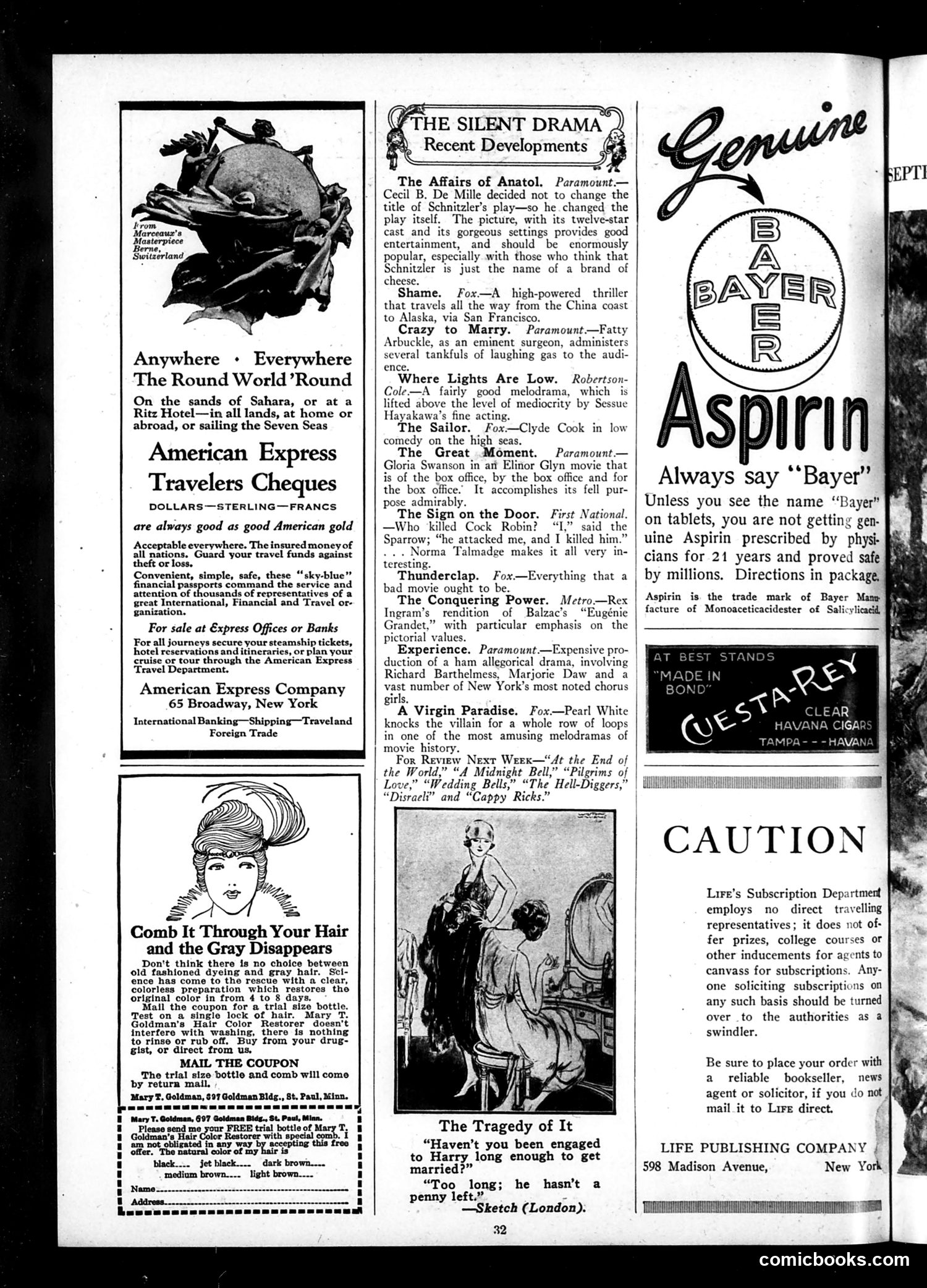
This page is primarily **advertising and entertainment content**, not political satire. The left side features ads for American Express Traveler's Cheques (emphasizing global accessibility) and Mary T. Goldman's Hair Color Restorer (promoting a product to conceal gray hair). The hair dye ad reflects **early 20th-century beauty standards** promoting youth and appearance conformity. The center column, titled "The Silent Drama: Recent Developments," is a **film review section** covering contemporary silent movies—including works by Fattty Arbuckle, Gloria Swanson, and Norma Talmadge. The reviews are tongue-in-cheek critiques (e.g., mocking a Schnitzler adaptation that changes the source material). The right side advertises Bayer Aspirin and Cuesta Rey cigars, plus a caution notice warning readers about subscription scams. There is **no discernible political cartoon** on this page; it's a typical magazine issue mixing advertisements, film reviews, and consumer notices.