
Life, 1921-09-08 · page 18 of 36
Life — September 8, 1921 — page 18: what you’re looking at
What you’re looking at
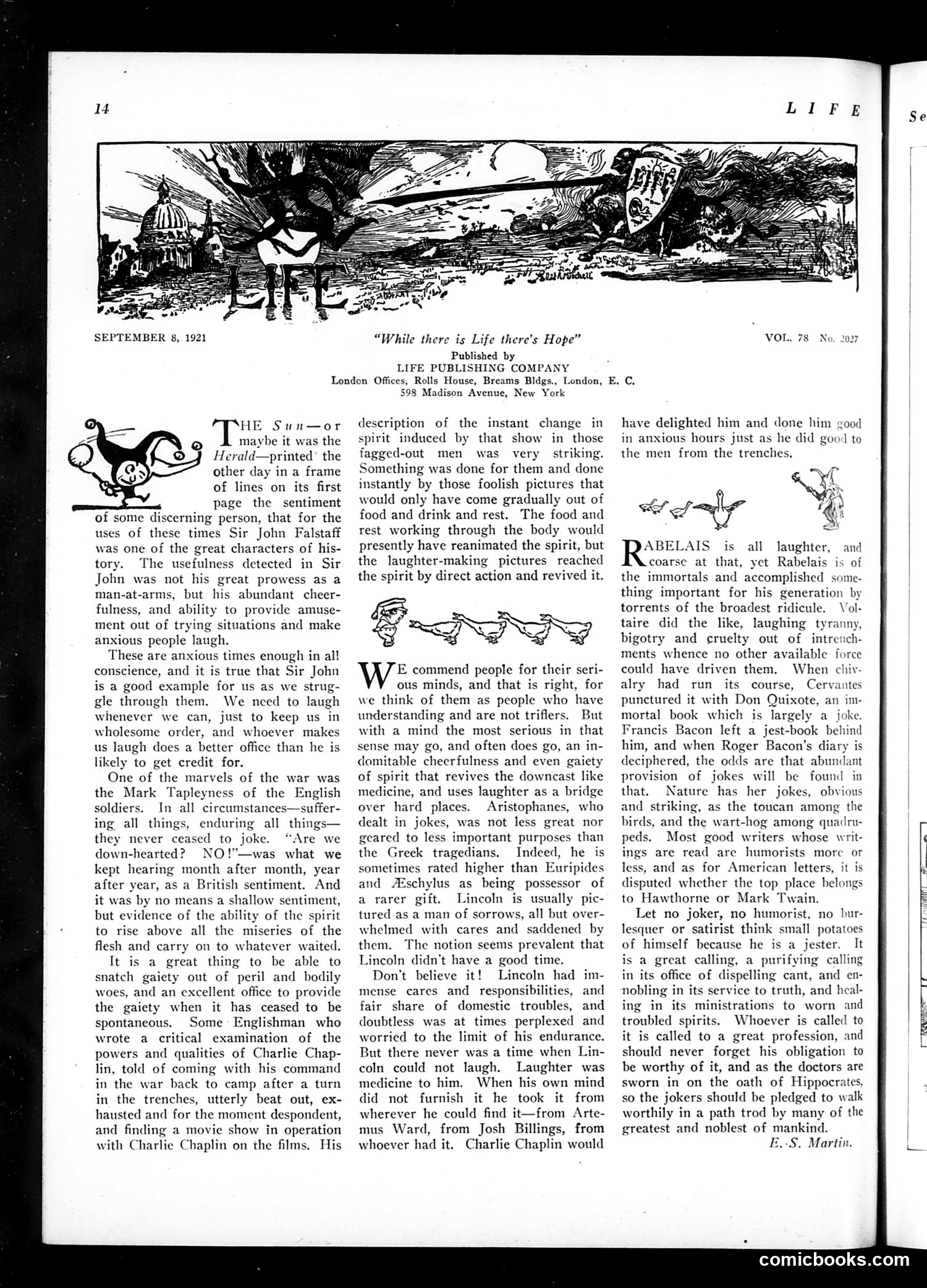
This page argues that humor and laughter are essential medicine during anxious times. The masthead illustration depicts a pastoral landscape with a setting sun, symbolizing hope amid uncertainty (likely post-WWI anxiety). The editorial praises **Sir John Falstaff** (Shakespeare's comic character) as a model for his "abundant cheerfulness" in difficult circumstances. It references English soldiers' famous wartime motto "Are we down-hearted? NO!"—crediting their jokes with sustaining morale. The author argues that **Charlie Chaplin's** films had immediate, profound effects on exhausted troops that food and rest couldn't match, demonstrating laughter's direct spiritual power. The piece then elevates humor philosophically, citing **Lincoln** as someone who used jokes (from humorists like Artemus Ward and Josh Billings) as medicine for his burdens, and comparing comic playwrights like **Aristophanes** to tragic dramatists as equally important. The core message: serious minds needn't exclude gaiety; humor serves vital psychological and moral purposes.
📄 Transcribed text from this page (OCR, searchable)
Machine-transcribed from the original scan — historical spelling and the odd misread are preserved.
SEPTEMBER 8, 1921 ae 3y05' (9% “While there is Life there's Hope” Published by LIFE PUBLISHING COMPANY London Offices, Rolls House, Breams Bldgs., London, E. C, HE Sun—or maybe it was the Herald—printed’ the other day in a frame of lines on its first page the sentiment of some discerning person, that for the uses of these times Sir John Falstaff was one of the great characters of his- tory. The usefulness detected in Sir John was not his great prowess as a man-at-arms, but his abundant cheer- fulness, and ability to provide amuse- ment out of trying situations and make anxious people laugh. These are anxious times enough in all conscience, and it is true that Sir John is a good example for us as we strug- gle through them. We need to laugh whenever we can, just to keep us in wholesome order, and whoever makes us laugh does a better office than he is likely to get credit for. One of the marvels of the war was the Mark Tapleyness of the English soldiers. In all circumstances—suffer- ing all things, enduring all things— they never ceased to joke. “Are we down-hearted? NO!’—was what we kept hearing month after month, year after year, as a British sentiment. And it was by no means a shallow sentiment, but evidence of the ability of the spirit to rise above all the miseries of the flesh and carry on to whatever waited. It is a great thing to be able to snatch gaiety out of peril and bodily woes, and an excellent office to provide the gaiety when it has ceased to be spontaneous. Some Englishman who wrote a critical examination of the powers and qualities of Charlie Chap- lin, told of coming with his command in the war back to camp after a turn in the trenches, utterly beat out, ex- hausted and for the moment despondent, and finding a movie show in operation with Charlie Chaplin on the films, His 598 Madison Avenue, New York description of the instant change in spirit induced by that show in those fagged-out men was very striking. Something was done for them and done instantly by those foolish pictures that would only have come gradually out of food and drink and rest. The food and rest working through the body would presently have reanimated the spirit, but the laughter-making pictures reached the spirit by direct action and revived it. E commend people for their seri- ous minds, and that is right, for we think of them as people who have understanding and are not triflers. But with a mind the most serious in that sense may go, and often does go, an in- domitable cheerfulness and even gaiety of spirit that revives the downcast like medicine, and uses laughter as a bridge over hard places. Aristophanes, who dealt in jokes, was not less great nor geared to less important purposes than the Greek tragedians. Indeed, he is sometimes rated higher than ripides and AEschylus as being possessor of a rarer gift. Lincoln is usually pic- tured as a man of sorrows, all but over- whelmed with cares and saddened by them. The notion seems prevalent that Lincoln didn’t have a good time. Don’t believe it! Lincoln had im- mense cares and responsibilities, and fair share of domestic troubles, and doubtless was at times perplexed and worried to the limit of his endurance. But there never was a time when Lin- coln could not laugh. Laughter was medicine to him. When his own mind did not furnish it he took it from wherever he could find it—from Arte- mus Ward, from Josh Billings, from whoever had it. Charlie Chaplin would have delighted him and done him good in anxious hours just as he did good to the men from the trenches. ht of ABELAIS is all laughter, and coarse at that, yet Rabelais is of the immortals and accomplished some- thing important for his generation by torrents of the broadest ridicule. Vol- taire did the like, laughing tyranny, bigotry and cruelty out of intre: ments whence no other available force could have driven them. When c alry had run its course, Cervantes punctured it with Don Quixote, an im- mortal book which is largely a joke Francis Bacon left a jest-book behind him, and when Roger Bacon's diar deciphered, the odds are that abundant provision of jokes will be found in that. Nature has her jokes, obvious and striking, as the toucan among the birds, and the wart-hog among quadru- peds. Most good writers whose writ- ings are read are humorists more or less, and as for American letters, it is disputed whether the top place belongs to Hawthorne or Mark Twain. Let no joker, no humorist, no bur- lesquer or satirist think small potatoes of himself because he is a jester. It is a great calling, a purifying calling in its office of dispelling cant, and en- nobling in its service to truth, and heal- ing in its ministrations to worn and troubled spirits. Whoever is called to it is called to a great profession, and should never forget his obligation to be worthy of it, and as the doctors are sworn in on the oath of Hippocrates, so the jokers should be pledged to walk worthily in a path trod by many of the greatest and noblest of mankind. S. Martin. comicbooks.com