
Life, 1921-09-08 · page 21 of 36
Life — September 8, 1921 — page 21: what you’re looking at
What you’re looking at
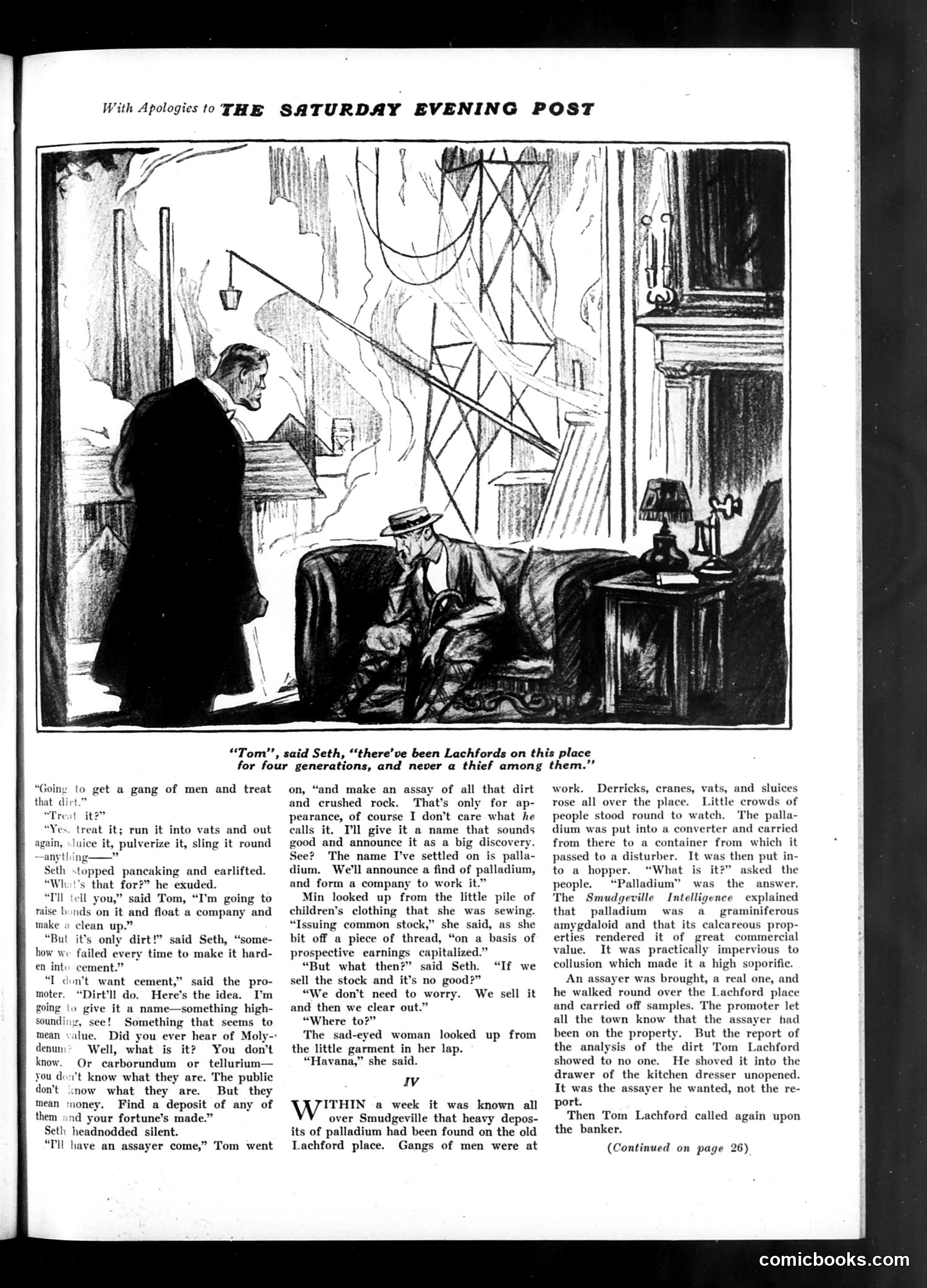
This is a satirical story (not a political cartoon) mocking early 20th-century mining stock schemes and financial fraud. A smooth-talking promoter convinces a farmer named Seth to let him "develop" worthless dirt on the Lachford property by claiming it contains palladium (a valuable metal). The con works by: naming the worthless material something scientific-sounding, hiring a legitimate assayer for appearances (ignoring his actual findings), forming a company, issuing stock to gullible townspeople, and planning to flee to Havana before the fraud is exposed. The satire targets both the con artists' cynical disregard for honest work (Seth's family has owned the land for four generations) and the public's gullibility—townspeople accept pseudo-scientific jargon without questioning what "palladium" actually is. This reflects real historical mining stock frauds that were epidemic in America during the early 1900s.
📄 Transcribed text from this page (OCR, searchable)
Machine-transcribed from the original scan — historical spelling and the odd misread are preserved.
With Apologies to THE SATURDAY EVENING POST “Tom’’, said Seth, “‘there’ve been Lachfords on this place for four generations, and never a thief among “Going to get a gang of men and treat that dirt.” es, treat it; run it into vats and out in, sluice it, pulverize it, sling it round anything——” Seth stopped pancaking and earlifted. “Who's that for?” he exuded. “TIL tell you,” said Tom, “I'm going to raise bonds on it and float a company and make » clean up.” “But it’s only dirt!” said Seth, “some- how we failed every time to make it hard- en inte cement.” “I don’t want cement,” said the pro- moter. “Dirt'll do. Here’s the idea. I’m going \o give it a name—something high- sounding, see! Something that seems to mean value. denun Well, what is it? You don’t know. Or carborundum or tellurium— you don’t know what they are. The public don’t now what they are. But they mean money. Find a deposit of any of them und your fortune’s made.” Seth headnodded silent. “Tl have an assayer come,” Tom went Did you ever hear of Moly-: on, “and make an assay of all that dirt and crushed rock. That's only for ap- pearance, of course I don’t care what he calls it. Tl give it a name that sounds good and announce it as a big discovery. See? The name I’ve settled on is palla- dium. We'll announce a find of palladium, and form a company to work it.” in looked up from the little pile of children’s clothing that she was sewing. “Issuing common stock,” she said, a bit off a piece of thread, “on a basis prospective earnings capitalized.” “But what then?” said Seth. sell the stock and it’s no good?” “We don’t need to worry. We sell it and then we clear out.” “Where to?” The sad-eyed woman looked up from the little garment in her lap. “Havana,” she said. Iv ITHIN a week it was known all over Smudgeville that heavy depos- its of palladium had been found on the old Lachford place. Gangs of men were at “If we them.” work. Derricks, cranes, vats, and sluices rose all over the place. Little crowds of people stood round to watch. The palla- dium was put into a converter and carried from there to a container from which it passed to a disturber. It was then put in- to a hopper. “What is it?” asked the people. “Palladium” was the answer. The Smudgeville Intelligence explained that palladium was a graminiferous amygdaloid and that its calcareous prop- erties rendered it of great commercial value. It was practically impervious to collusion which made it a high soporific. An assayer was brought, a real one, and he walked round over the Lachford place and carried off samples. The promoter let all the town know that the assayer had been on the property. But the report of the analysis of the dirt Tom chford showed to no one. He shoved it into the drawer of the kitchen dresser unopened. It was the assayer he wanted, not the re- port. Then Tom Lachford called again upon the banker. (Continued on page 26) comicbooks.com