
Life, 1921-09-08 · page 27 of 36
Life — September 8, 1921 — page 27: what you’re looking at
What you’re looking at
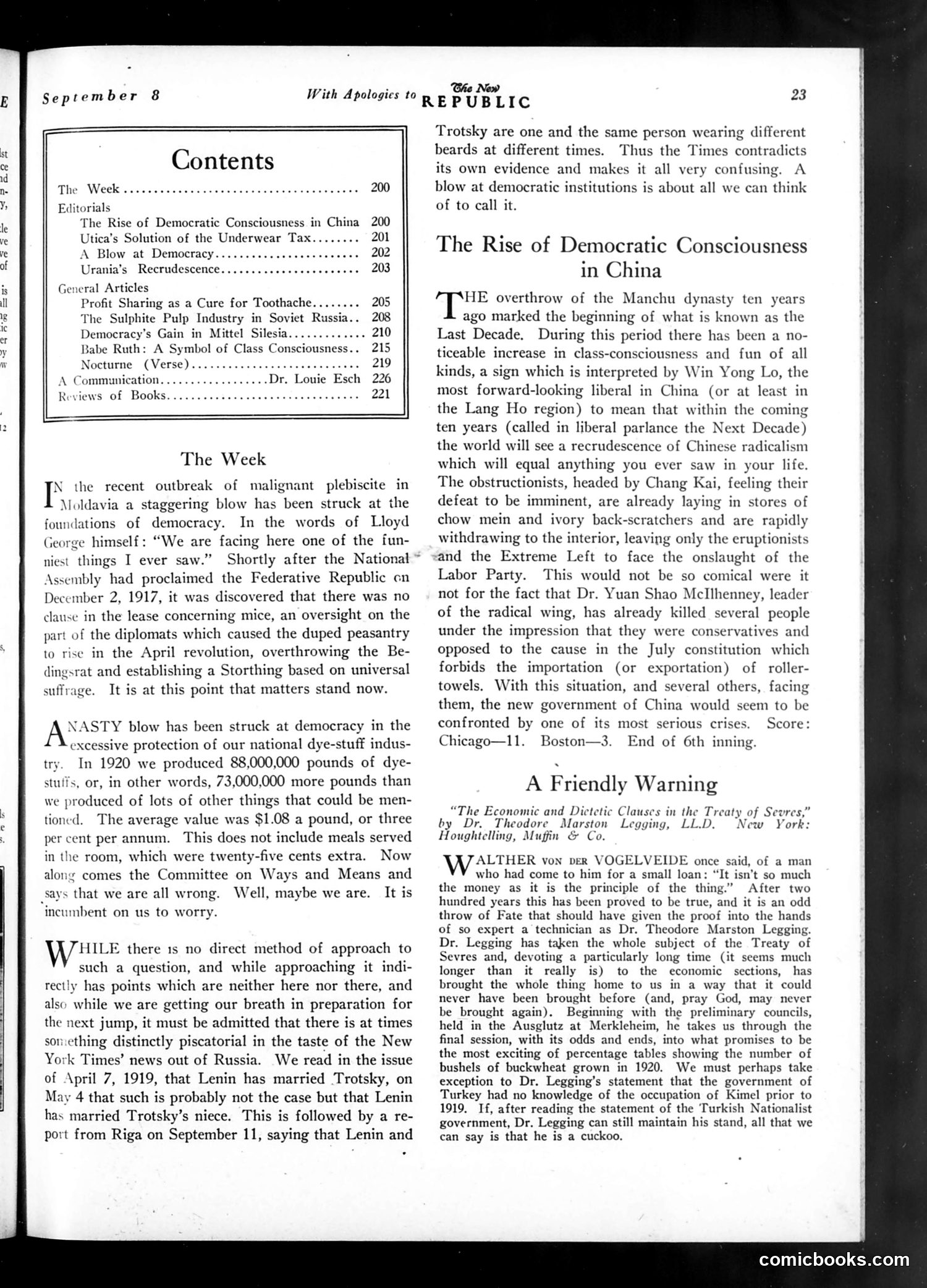
This page from *Life* magazine (September 8, date unclear but context suggests early 1920s) is primarily **editorial and contents pages**, not cartoons. The satire is textual rather than visual. The main satirical pieces mock: 1. **Russian political confusion**: The "Moldavia plebiscite" section ridicules Soviet governance through absurdist humor—inventing nonsensical crises (a lease clause about mice causing peasant revolt) to parody the chaotic, confusing reports emerging from post-revolutionary Russia. 2. **New York Times unreliability on Russia**: *Life* directly attacks the *Times* for contradictory reporting on Lenin and Trotsky's relationship, sarcastically treating journalistic incompetence as "a blow at democratic institutions." 3. **Chinese politics**: The final article discusses real tensions between Chinese liberals and radicals following the Manchu dynasty's 1912 overthrow, referencing actual figures like Chang Kai and Yuan Shao. The humor relies on absurdism and direct editorial mockery rather than visual caricature. For modern readers, the Soviet section requires knowing that *Life* was satirizing widespread American confusion about Bolshevism.
📄 Transcribed text from this page (OCR, searchable)
Machine-transcribed from the original scan — historical spelling and the odd misread are preserved.
September 8 Contents The Week Editorials The Rise of Democratic Consciousness in China 200 Utica’s Solution of the Underwear Tax 201 A Blow at Democracy... . 202 Urania’s Recrudescence.. + 203 General Articles Profit Sharing as a Cure for Toothache 205 The Sulphite Pulp Industry in Soviet Russia.. 208 Democracy’s Gain in Mittel Silesia 210 3abe Ruth: A Symbol of Class Consciousness.. 215 Nocturne (Verse).. 219 A Communication. Dr. Louie Esch 226 Reviews of Books. . 221 The Week N the recent outbreak of malignant plebiscite in Moldavia a staggering blow has been struck at the foundations of democracy. In the words of Lloyd George himself: “We are facing here one of the fun- niest things I ever saw.” Assembly had proclaimed the Federative Republic on December 2, 1917, it was discovered that there was no clause in the lease concerning mice, an oversight on the part of the diplomats which caused the duped peasantry to rise in the April revolution, overthrowing the Be- dingsrat and establishing a Storthing based on universal suffrage. It is at this point that matters stand now. NASTY blow has been struck at democracy in the excessive protection of our national dye-stuff indus- try. In 1920 we produced 88,000,000 pounds of dye- stulis, or, in other words, 73,000,000 more pounds than we produced of lots of other things that could be men- tioned. The average value was $1.08 a pound, or three per cent per annum. This does not include meals served in the room, which were twenty-five cents extra. Now along comes the Committee on Ways and Means and says that we are all wrong. Well, maybe we are. It is ‘incumbent on us to worry. HILE there 1s no direct method of approach to such a question, and while approaching it indi- rectly has points which are neither here nor there, and also while we are getting our breath in preparation for the next jump, it must be admitted that there is at times soniething distinctly piscatorial in the taste of the New York Times’ news out of Russia. We read in the issue of April 7, 1919, that Lenin has married Trotsky, on May 4 that such is probably not the case but that Lenin has married Trotsky’s niece. This is followed by a re- port from Riga on September 11, saying that Lenin and Shortly after the National ~ With Apologies t0 p p one Ic Trotsky are one and the same person wearing differe beards at different times. Thus the Times contradicts its own evidence and makes it all very confusing. A blow at democratic institutions is about all we can think of to call it. The Rise of Democratic Consciousness in China HE overthrow of the Manchu dynasty ten years ago marked the beginning of what is known as the Last Decade. During this period there has been a no- ticeable increase in class-consciousness and fun of all kinds, a sign which is interpreted by Win Yong Lo, the most forward-looking liberal in China (or at least in the Lang Ho region) to mean that within the coming ten years (called in liberal parlance the Next Decade) the world will see a recrudescence of Chinese radicalism which will equal anything you ever saw in your life. The obstructionists, headed by Chang Kai, feeling their defeat to be imminent, are already laying in stores of chow mein and ivory back-scratchers and are rapidly withdrawing to the interior, leaving only the eruptionists and the Extreme Left to face the onslaught of the Labor Party. This would not be so comical were it not for the fact that Dr. Yuan Shao Mcllhenney, leader of the radical wing, has already killed several people under the impression that they were conservatives and opposed to the cause in the July constitution which forbids the importation (or exportation) of roller- towels. With this situation, and several others, facing them, the new government of China would seem to be confronted by one of its most serious crises. Chicago—11. Boston—3. Score: End of 6th inning. A Friendly Warning “The Economic and Dietetic Clauses in the Treaty of Sevr by Dr. Theodore Marston York: Houghtelling, Mugin & Co. ALTHER von ver VOGELVEIDE once said, of a man who had come to him for a small loan: “It isn’t so much the money as it is the principle of the thing.” After two hundred years this has been proved to be true, and it is an odd throw of Fate that should have given the proof into the hands of so expert a technician as Dr. Theodore Marston Legging. Dr. Legging has taken the whole subject of the Treaty of Sevres and, devoting a particularly long time (it seems much longer than it really is) to the economic sections, has brought the whole thing home to us in a way that it could never have been brought before (and, pray God, may never be brought again). Beginning with the preliminary councils, held in the Ausglutz at Merkleheim, he takes us through the final session, with its odds and ends, into what promises to be the most exciting of percentage tables showing the number of bushels of buckwheat grown in 1920. We must perhaps take exception to Dr. Legging’s statement that the government of Turkey had no knowledge of the occupation of Kimel prior to 1919. If, after reading the statement of the Turkish Nationalist government, Dr. Legging can still maintain his stand, all that we can say is that he is a cuckoo. Legging, LL.D. New comicbooks.com