
Life, 1921-09-08 · page 22 of 36
Life — September 8, 1921 — page 22: what you’re looking at
What you’re looking at
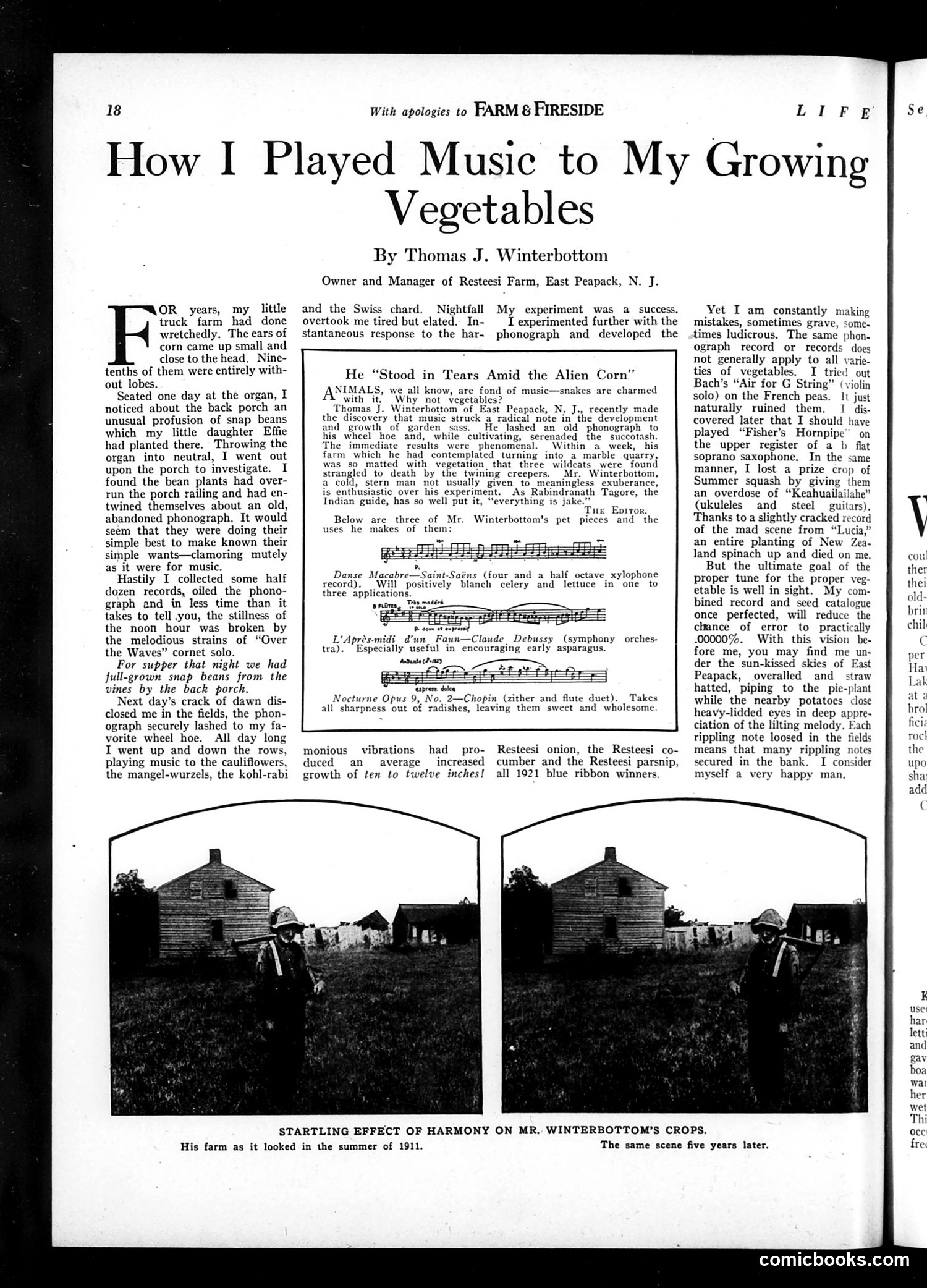
This is a humorous satirical article mocking the early-20th-century pseudoscience of "plant music therapy." Thomas J. Winterbottom claims that playing music to his vegetables dramatically improved their growth—beans grew "full-grown" overnight, and onions achieved a "ten to twelve inches" increase. The satire lies in the absurd specificity: Winterbottom prescribes particular classical pieces for different vegetables (Debussy for asparagus, Chopin for radishes), complete with musical notation. He recounts comic failures—Bach ruined French peas but "Fisher's Hornpipe" on soprano saxophone supposedly worked instead. The photographs showing his farm in 1911 and "five years later" are presented as "proof," adding to the deadpan mockery. The page parodies both agricultural advice columns and the credulous pseudoscientific fads that circulated in popular magazines of this era. The target isn't Winterbottom specifically but rather readers' susceptibility to implausible farming claims and the magazine's own tendency toward publishing dubious "scientific" advice dressed in authoritative language.
📄 Transcribed text from this page (OCR, searchable)
Machine-transcribed from the original scan — historical spelling and the odd misread are preserved.
18 With apologies to FARM & FIRESIDE LIFE: How I Played Music to My Growing Vegetables OR years, my little truck farm had done wretchedly. The ears of corn came up small and close to the head, Nine- tenths of them were entirely with- out lobes. Seated one day at the organ, I noticed about the back porch an unusual profusion of snap beans which my little daughter Effie had planted there. Throwing the organ into neutral, I went out upon the porch to investigate. I found the bean plants had over- run the porch railing and had en- twined themselves about an old, abandoned phonograph. It would seem that they were doing their simple best to make known their simple wants—clamoring mutely as it were for music. Hastily I collected some half dozen records, oiled the phono- graph and in less time than it takes to tell .you, the stillness of the noon hour was broken by the melodious strains of “Over the Waves” cornet solo. For supper that night we had full-grown snap beans from the vines by the back porch. Next day’s crack of dawn dis- closed me in the fields, the phon- ograph securely lashed to my fa- vorite wheel hoe. All day long I went up and down the rows, playing music to the cauliflowers, the mangel-wurzels, the kohl-rabi By Thomas J. Winterbottom Owner and Manager of Resteesi Farm, East Peapack, N. J. and the Swiss chard. Nightfall overtook me tired but elated. In- stantaneous response to the har- My experiment was a success. I experimented further with the phonograph and developed the He “Stood in Tears Amid the Alien Corn” MALS, with it. Why not Thomas Winterbottom of the discovery that music struck a and growth of garden his whcel hoe an The immediate re: farm which he had were was so matted with vegetation a cold, 0 is enthusiastic ov experi Indian guide, has so well put it, hree of Mr. of them: Below aré uses he mak Winterbottom’s pet we all know, are fond of music—snakes are charmed Vegetables? st Peapack, J., recently made radical note in the development fe lashed an old phonograph to while cultivating, serenaded phenome: ntemplated turning into a marble quarry, ge that three wildcats Strangled to death. by the twining creepers. Mr. the succotash. Within a, week, his were found Winterbottom, ningless exuberance, s Rabindranath Tagore, the “everything is jak Tue Epitor. pieces and. the E- om. ereeeeens Danse Macabre—. ai record). Will positively blanch three applications. -Saéns (four and a half octave xylophone celery and lettuce in one to L’Aprés-midi d’un_ Faun Claude Debussy (symphony orches- tra). "Especially useful in encouraging early asparagus. as Nocturne Opus 9, No. —Chopin (zither and flute duet). Takes all sharpness out of radishes, leaving them sweet and wholesome. monious vibrations had pro- duced an average increased growth of ten to twelve inches! Resteesi onion, the Resteesi co- cumber and the Resteesi parsnip, all 1921 blue ribbon winners. Yet I am constantly making mistakes, sometimes grave, some- times ludicrous. The same phon- ograph record or records does not generally apply to all varie- ties of vegetables. I trie Bach’s “Air for G String’ solo) on the French peas. naturally ruined them. I dis- covered later that I should have played “Fisher’s Hornpipe” on the upper register of a b flat soprano saxophone. In the same manner, I lost a prize crop of Summer squash by giving them an overdose of “Keahuailailahe” (ukuleles and steel guitars), Thanks to a slightly cracked record of the mad scene from “Lucia,” an entire planting of New Zea- land spinach up and died on me. But the ultimate goal of the proper tune for the proper veg- etable is well in sight. My com- bined record and seed catalogue once perfected, will reduce the chance of error to practically 00000%. With this vision be- fore me, you may find me un- der the sun-kissed skies of East Peapack, overalled and straw hatted, piping to the pie-plant while the nearby potatoes close heavy-lidded eyes in deep appre- ciation of the lilting melody. Each rippling note loosed in the fields means that many rippling notes secured in the bank. I consider myself a very happy man, STARTLING EFFECT OF HARMONY ON MR. WINTERBOTTOM’S CROPS. His farm as it looked in the summer of 1911. The same scene five years later. cou! ther thei old- brit chil C per Ha Lak at ¢ bro ficis rocl the upo sha add ( I use har lett and comicbooks.com