
Life, 1921-09-08 · page 20 of 36
Life — September 8, 1921 — page 20: what you’re looking at
What you’re looking at
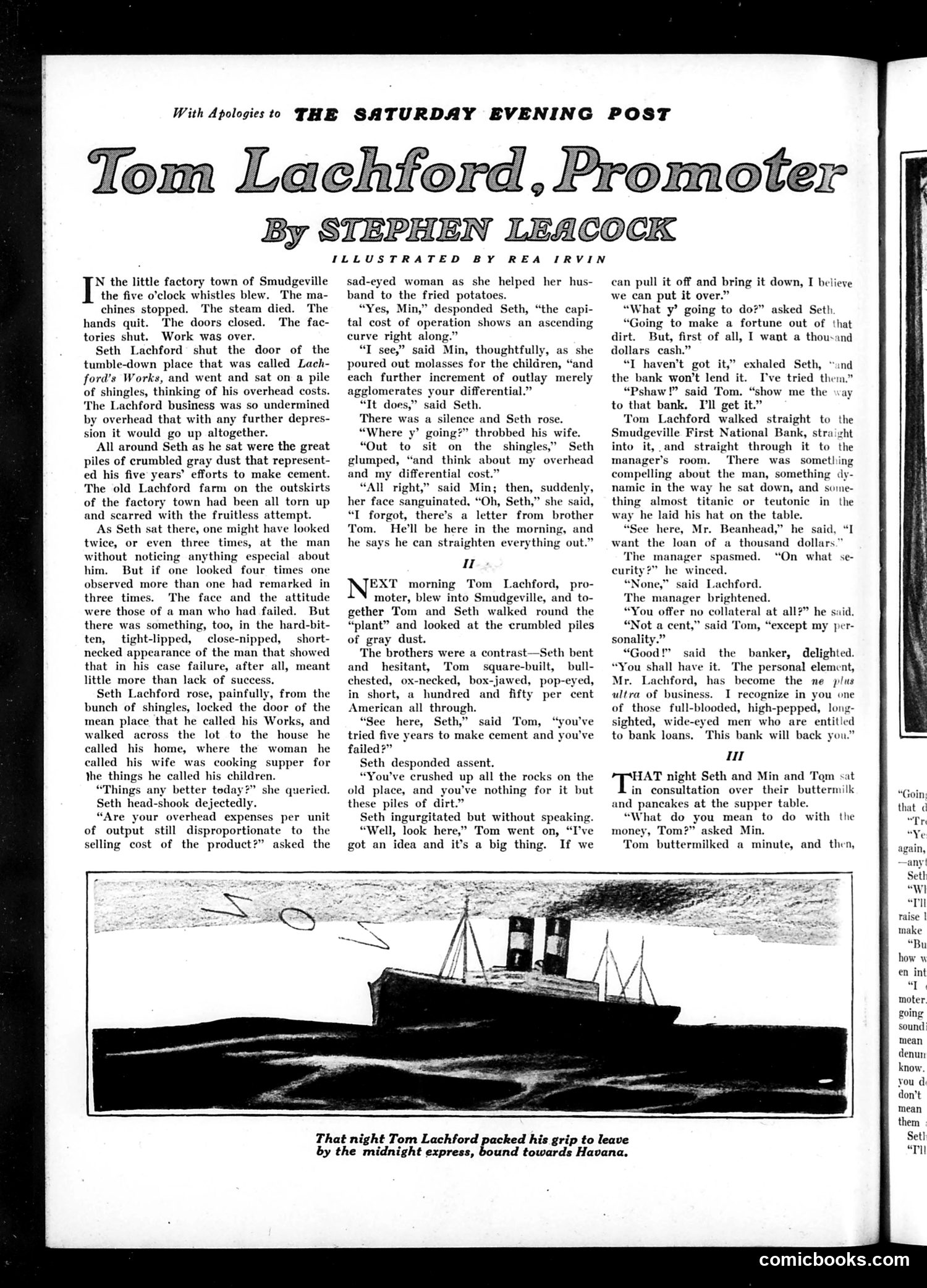
This is a satirical short story (not a political cartoon) by Stephen Leacock mocking American business culture and the "promoter" archetype. **The setup**: Seth Lachford, a failed cement manufacturer in a small factory town, represents the struggling everyman businessman weighed down by overhead costs and failed ventures. His brother Tom represents the quintessential American "promoter"—a confident, fast-talking businessman who arrives with grandiose schemes to profit from failure. **The satire's point**: Leacock ridicules both the jargon-heavy language of business ("differential costs," "agglomerates") and the American faith that any problem can be solved by a charismatic promoter with a "big idea." The illustration of a ship (likely heading to Havana, suggesting escape or fraud) hints that Tom's scheme may involve deception rather than legitimate business. The story mocks American entrepreneurial optimism and the gap between genuine productive work and speculative promotion.
📄 Transcribed text from this page (OCR, searchable)
Machine-transcribed from the original scan — historical spelling and the odd misread are preserved.
With Apologies to THE SATURDAY EVENING POST By STEPHEN LEACOCK N the little factory town of Smudgeville the five o’clock whistles blew. The ma- chines stopped. The steam died. The hands quit. The doors closed. The fac- tories shut. Work was over. Seth Lachford shut the door of the tumble-down place that was called Lach- ford’s Works, and went and sat on a pile of shingles, thinking of his overhead costs. ‘The Lachford business was so undermined by overhead that with any further depres- sion it would go up altogether. All around Seth as he sat were the great piles of crumbled gray dust that represent- ed his five years’ efforts to make cement. The old Lachford farm on the outskirts of the factory town had been all torn up and scarred with the fruitless attempt. As Seth sat there, one might have looked twice, or even three times, at the man without noticing anything especial about him. But if one looked four times one observed more than one had remarked in three times. The face and the attitude were those of a man who had failed. But there was something, too, in the hard-bit- ht-lipped, close-nipped, _ short- necked appearance of the man that showed that in his se failure, after all, meant little more than lack of success. Seth Lachford rose, painfully, from the bunch of shingles, locked the door of the mean place that he called his Works, and walked across the lot to the house he called his home, where the woman he called his wife was cooking supper for the things he called his children. “Things any better today?” she queried. Seth head-shook dejectedly. “Are your overhead expenses per unit of output still disproportionate to the selling cost of the product?” asked the ILLUSTRATED BY REA sad-eyed woman as she helped her hus- band to the fried potatoes. “Yes, Min,” desponded Seth, “the capi- tal cost of operation shows an ascending curve right along.” “T see,” said Min, thoughtfully, as she poured out molasses for the children, “and each further increment of outlay merely agglomerates your differential.” lence and Seth ros “Where y’ going?” throbbed his wife. “Out to sit on the shingles,” Seth glumped, “and think about my overhead and my differential cost.” “All right,” said Min; then, suddenly, her face sanguinated, “Oh, Seth,” she said, “I forgot, there’s a letter from brother Tom. He'll be here in the morning, and he says he can straighten everything out.” eg EXT morning Tom Lachford, pro- moter, blew into Smudgeville, and to- gether Tom and Seth walked round the “plant” and looked at the crumbled piles of gray dust. The brothers were a contrast—Seth bent and hesitant, Tom square-built, bull- chested, ox-necked, box-jawed, pop-eyed, in short, a hundred and fifty per cent American all through. “See here, Seth,” said Tom, “you've tried five years to make cement and you've failed?” Seth desponded assent. “You've crushed up all the rocks on the old pla and you've nothing for it but these piles of dirt.” Seth ingurgitated but without speaking. “Well, look here,” Tom went on, “I’ve got an idea and it’s a big thing. If we IRVIN can pull it off and bring it down, I believe we can put it over.” “What y’ going to do?” asked Seth “Going to make a fortune out of that dirt. But, first of all, I want a thousand dollars cash.” “I haven't got it,” exhaled Seth, “und the bank won’t lend it. I've tried them.” “Pshaw!” said Tom. “show me the way to that bank. I'll get it. Tom Lachford walked straight to the Smudgeville First National Bank, straight into it,.and straight through it to the manager's room. There was something compelling about the man, something dy- namic in the way he sat down, and some- thing almost t ¢ or teutonie in the way he laid his hat on the table. e here, Mr. Beanhead,” he said, “I want the loan of a thousand dollars.” The manager spasmed. “On what se- curity?” he winced. said Lachford. The manager brightened. “You offer no collateral at all?” he said. “Not a cent,” said Tom, “except my per- sonality.” “Good!” said the banker, delighted. “You shall have it. The personal element, Mr. Lachford, has become the ne plus ultra of business. I recognize in you one of those full-blooded, high-pepped, long- sighted, wide-eyed men who are entitled to bank loans. This bank will back you.” ir Tut night Seth and Min and Tom sat in consultation over their buttermilk and pancakes at the supper table. “What do you mean to do with the money, Tom?” asked Min. Tom buttermilked a minute, and then, That night Tom Lachford pocked his grip to leave by the midnight express, und towards Havana, , make “Bu how vw en int moter going sound mean denun know. you d don't mean them Set! TH comicbooks.com