
A complete issue · 34 pages · 1921
Life — July 21, 1921
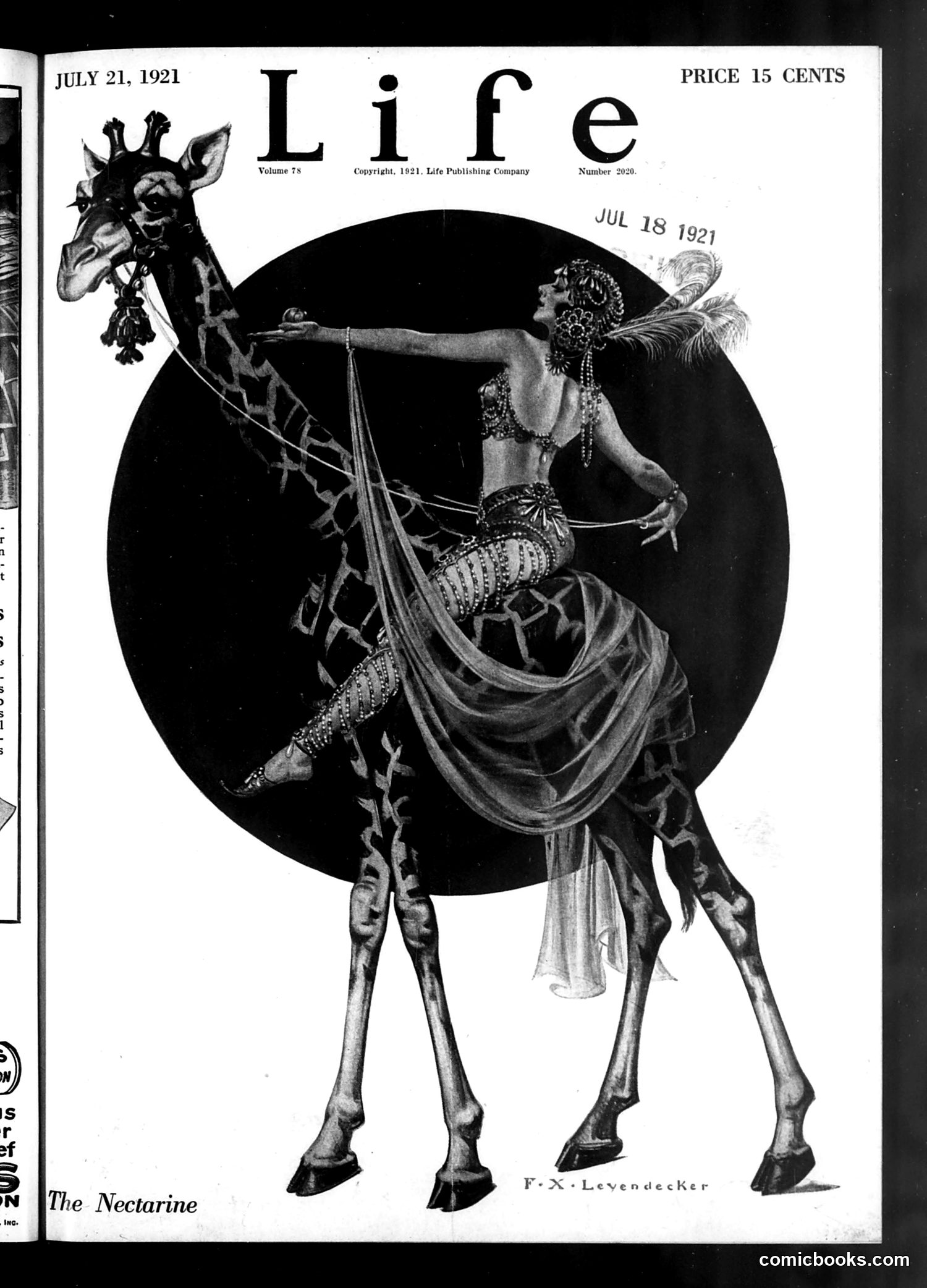
This Life magazine cover from July 1921, illustrated by F.X. Levendecker, depicts a woman in exotic costume riding a giraffe. The title "The Nectarine" appears at bottom. The image appears to be decorative rather than explicitly political satire—it's a whimsical illustration combining sensuality (the scantily-clad woman), exoticism (the giraffe, ornate beads and fabrics), and surrealism (riding the animal). This reflects 1920s fascination with "exotic" themes and the Jazz Age's embrace of bold, unconventional imagery. Without additional article text, the specific satirical or social commentary remains unclear, though the juxtaposition of a fashionable woman with an exotic animal likely comments on contemporary attitudes toward luxury, adventure, or sexual liberation during the Roaring Twenties.
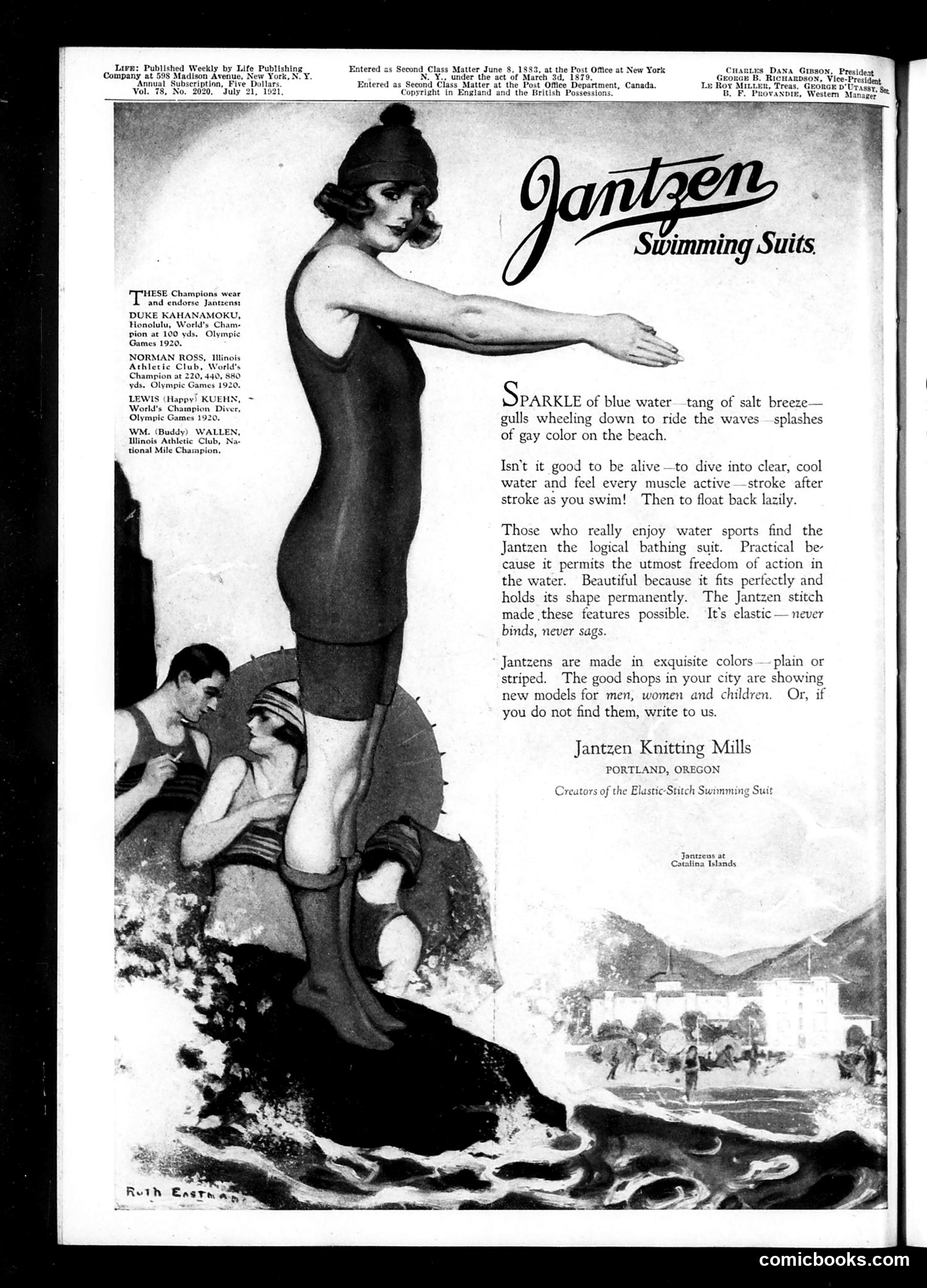
This page is primarily a **product advertisement**, not political satire. It promotes Jantzen brand swimming suits manufactured in Portland, Oregon. The ad features an elegantly posed woman in a one-piece bathing suit, with smaller figures below showing children in Jantzen swimwear. The left column lists celebrity endorsers—Olympic champions and athletic record-holders like Duke Kahanamoku and Norman Ross—lending prestige to the product. The marketing copy emphasizes the suit's practical features: elastic construction allowing freedom of movement, permanent shape retention, and availability in various colors and styles. The text suggests visiting local shops or writing directly to the manufacturer if unavailable. This represents 1920s-era consumer advertising leveraging athletic celebrity endorsements.
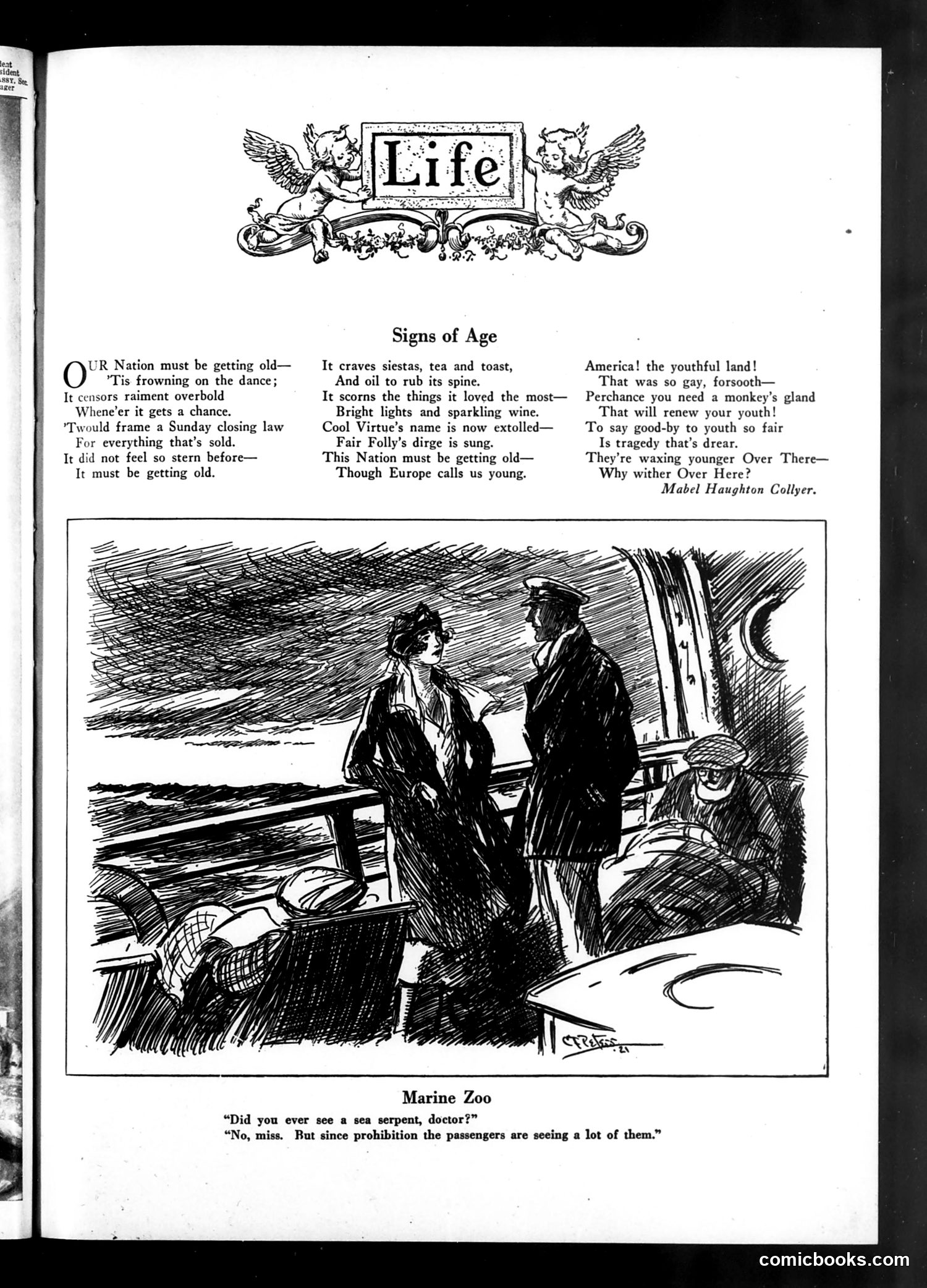
This page contains a satirical poem titled "Signs of Age" by Mabel Haughton Collyer, critiquing America's perceived decline. The poem contrasts the nation's youthful ideals with present realities—censorship, blue laws, lost virtue, and European perceptions of American aging. The cartoon "Marine Zoo" features a doctor and woman on a ship discussing sea serpents. The joke relies on double meaning: "passengers are seeing a lot of them" likely refers to both literal sea creatures and passengers experiencing hallucinations or drunkenness (possibly from Prohibition-era alcohol or stress). The satirical point appears to target either maritime oddities, public intoxication, or psychological strain among travelers during this era. Both pieces express concern about American society's moral and cultural trajectory.
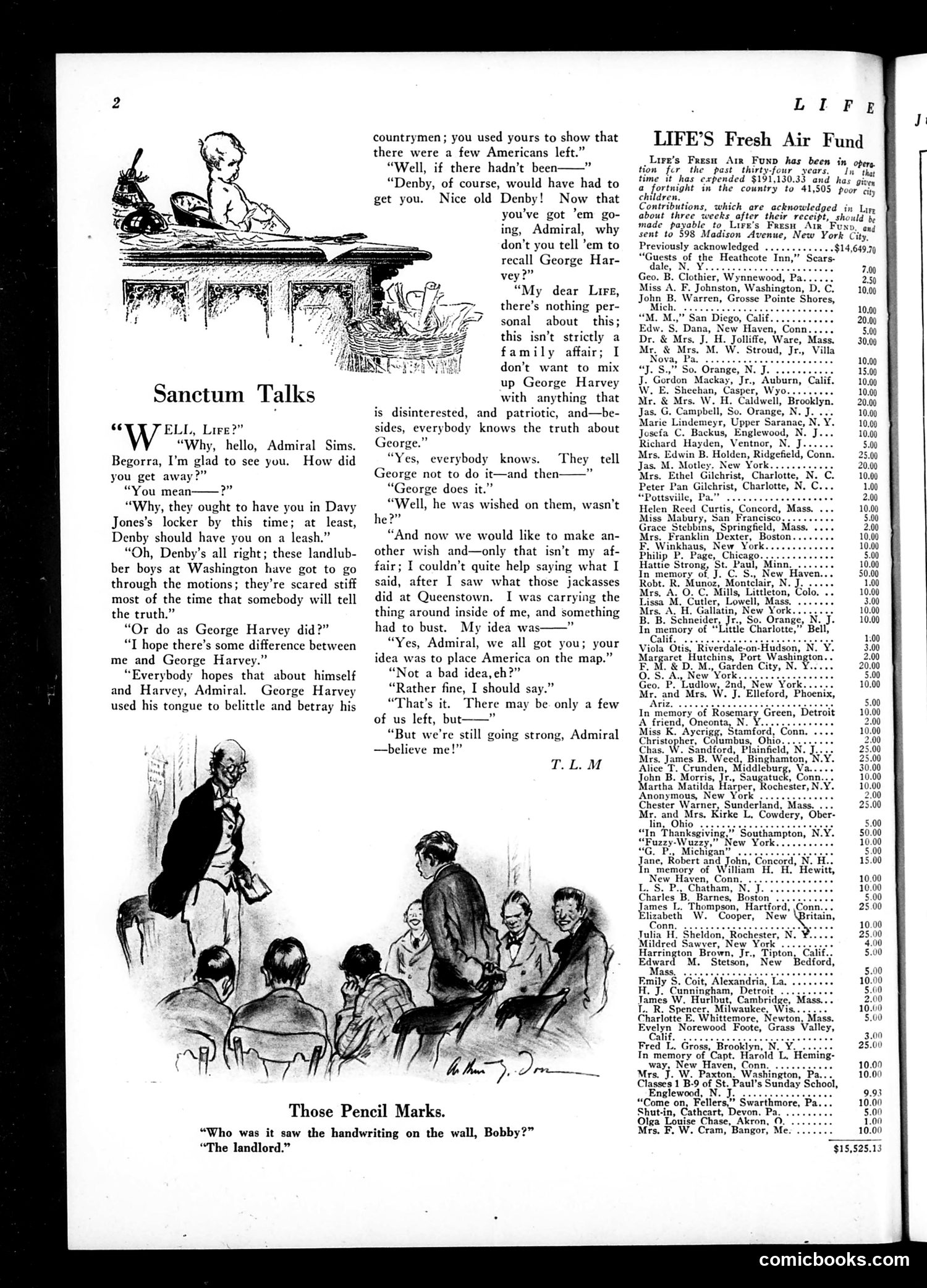
This page features "Sanctum Talks," Life magazine's editorial cartoon section. The dialogue between "Admiral Sims" and an unnamed interlocutor satirizes American patriotism during what appears to be World War I or the immediate postwar period. The satire targets George Harvey, a prominent political figure, for his inconsistent patriotism. The cartoon critiques Harvey's willingness to use patriotic rhetoric selectively—supporting America's war efforts while allegedly profiting from them or avoiding personal sacrifice. The joke hinges on the hypocrisy of public figures who "belittle and betray" patriotism through their actions while claiming patriotic motives. The right side lists donors to "Life's Fresh Air Fund," a charitable initiative, providing the page's practical content.
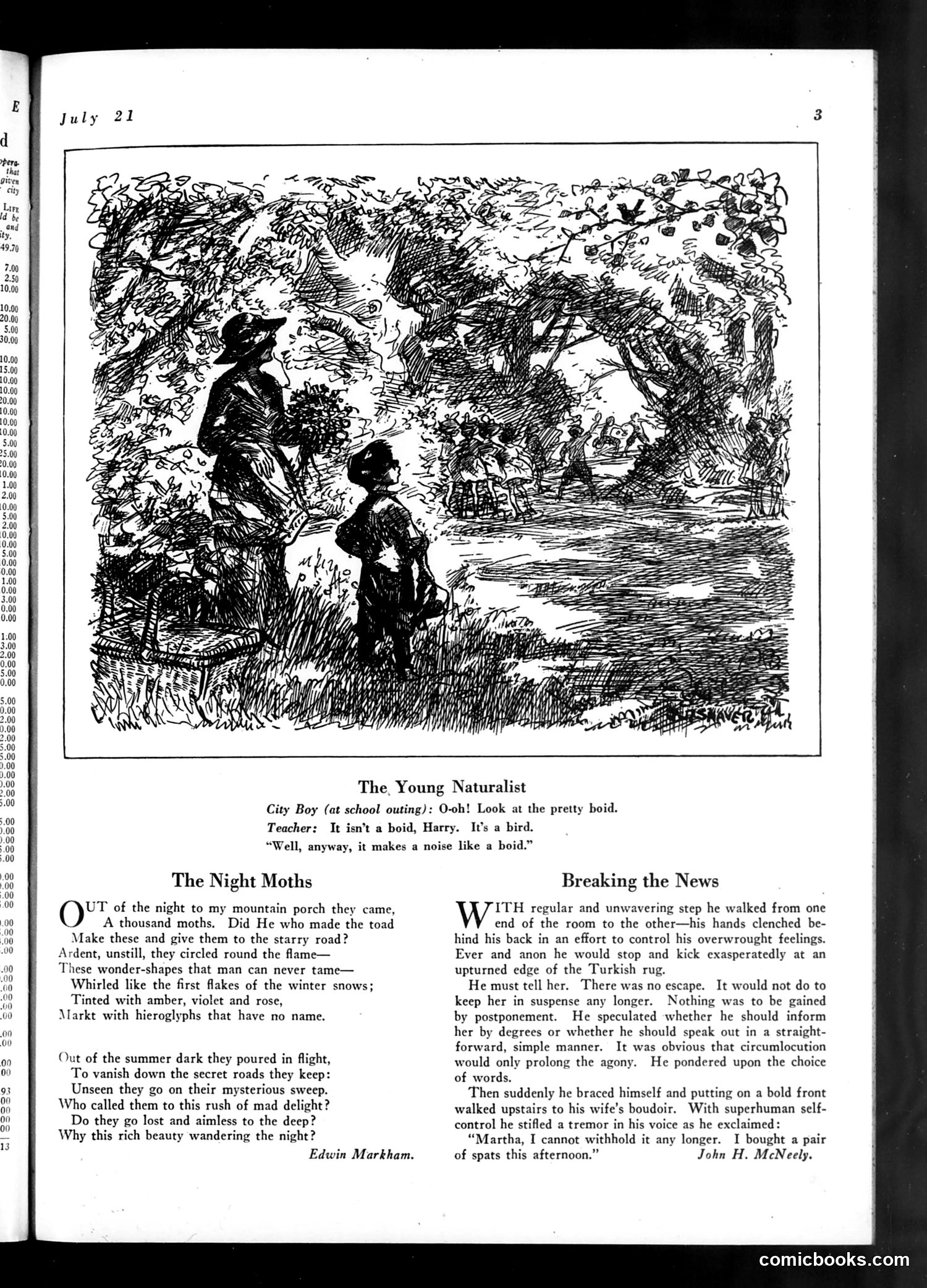
This page contains three separate pieces of content: **"The Young Naturalist"** (top): A humorous cartoon showing a schoolboy pointing out something in nature to his teacher. The joke relies on a child's literal misinterpretation—the boy calls a bird a "bold" when the teacher corrects him that it's not a "bold" but makes noise "like a boid." This appears to be simple wordplay humor about a child's mispronunciation or misunderstanding of natural terminology. **"The Night Moths"** (bottom left): A poem by Edwin Markham about moths emerging at night, using them metaphorically to explore themes of mystery and natural beauty. **"Breaking the News"** (bottom right): A short story by John H. McNulty about a man struggling with how to tell his wife difficult news, depicting his internal conflict and anxiety about the conversation. The page represents typical *Life* magazine content: mix of visual humor, poetry, and fiction for middle-class readers.
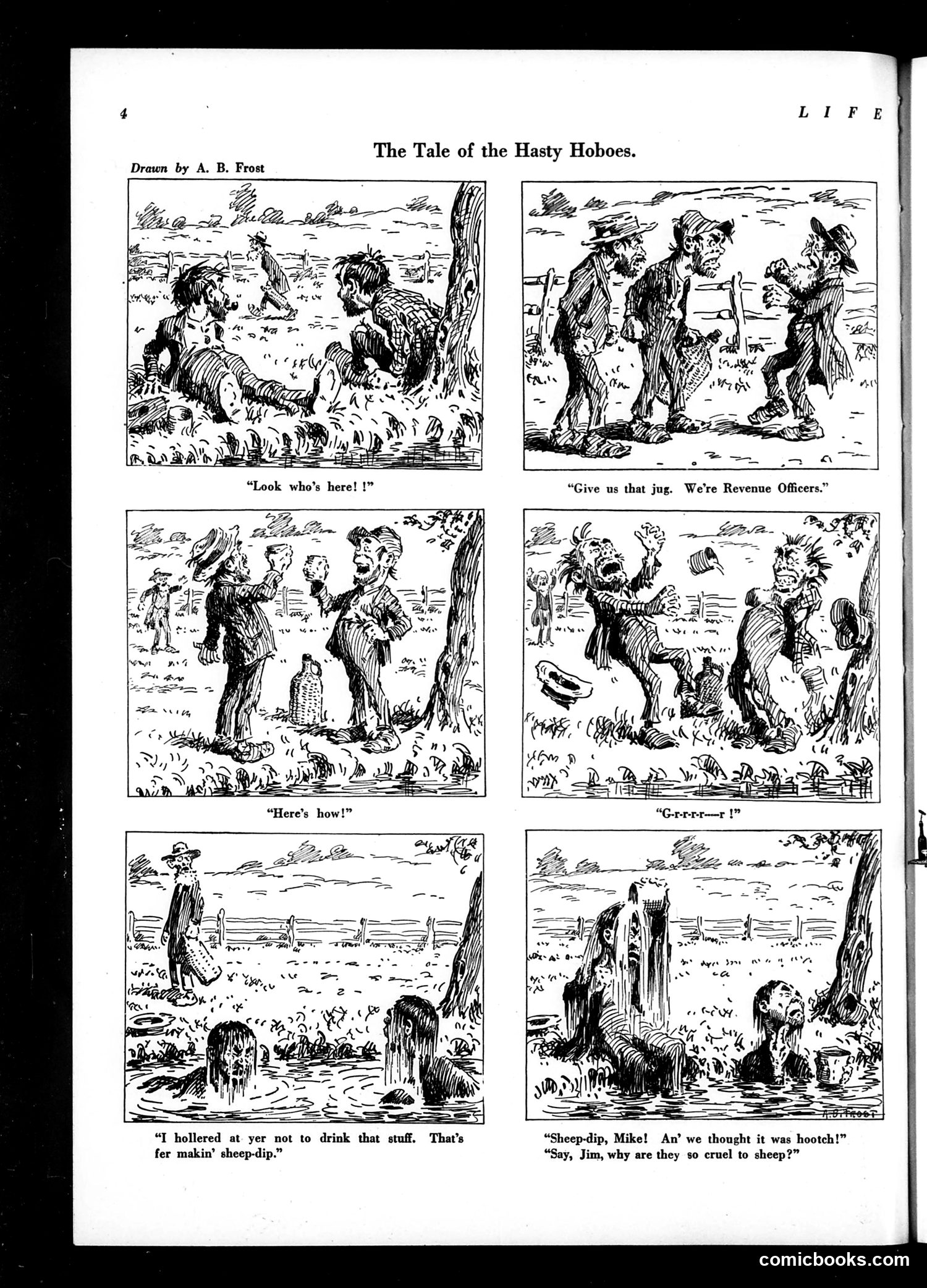
This comic strip by A. B. Frost depicts a humorous encounter between two homeless men and revenue officers (tax collectors). The narrative follows their misadventure: the hoboes discover what they believe is a jug of alcohol ("hooch"), attempt to hide it from approaching authorities, and ultimately end up in a river or stream during the confusion. The final panels reveal the "jug" contained sheep-dip—a toxic pesticide used to treat sheep—explaining why the revenue officers seem cruel and the hoboes' desperate situation becomes absurdly darker. The satire likely mocks Prohibition-era enforcement and the desperation of poor drifters during this period. The joke relies on visual comedy and the escalating mishaps typical of early 20th-century newspaper comics.
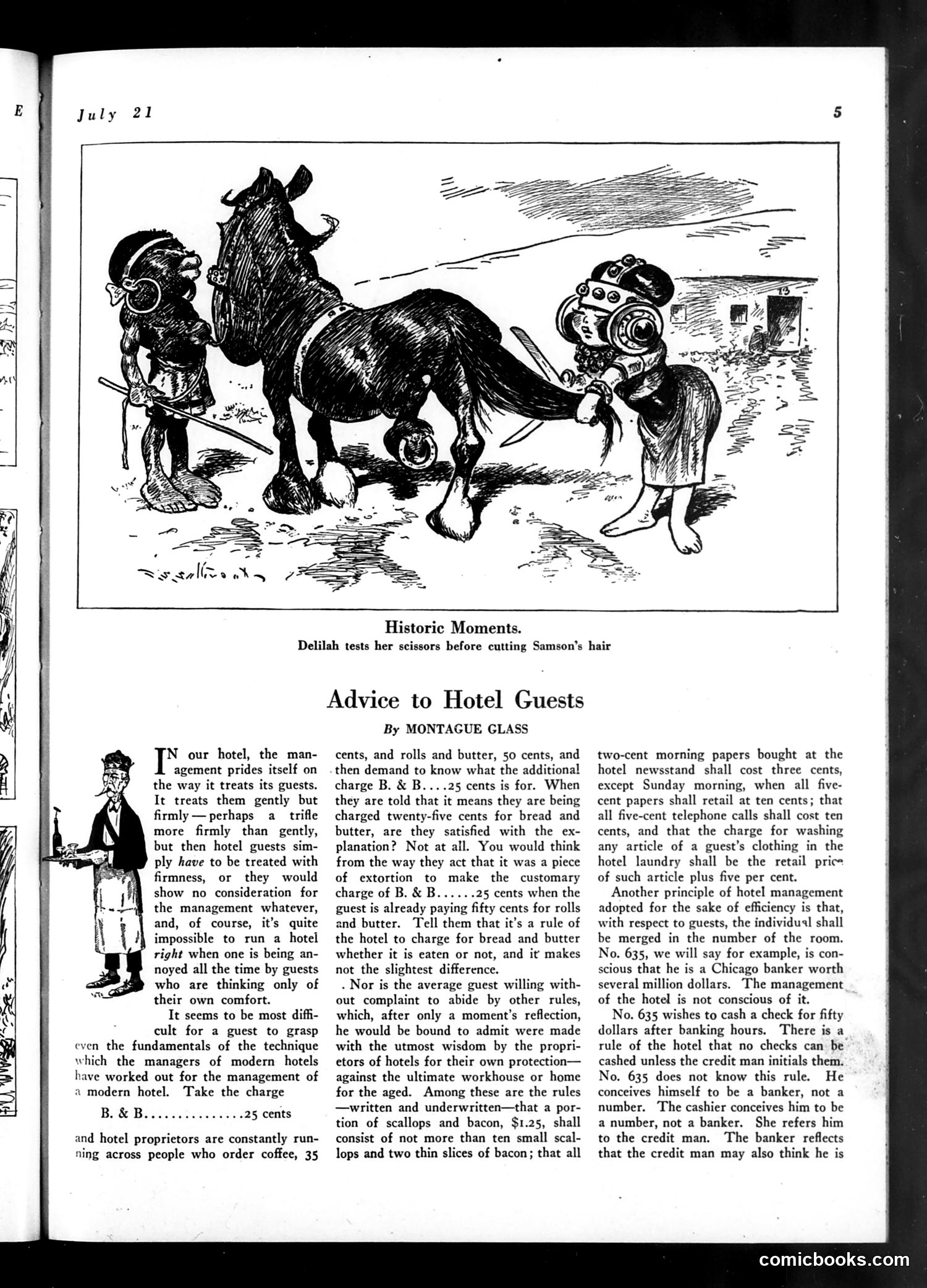
The top cartoon, titled "Historic Moments," depicts a biblical scene: Delilah testing scissors before cutting Samson's hair. The image shows two figures in caricatured style (appearing to represent people from a non-Western culture) with a horse, playing on the Samson and Delilah narrative from the Book of Judges. The article below, "Advice to Hotel Guests" by Montague Glass, is satirical commentary on hotel management practices. It critiques how hotels impose various charges on guests—for bread, butter, rolls, and other items—arguing these fees are excessive and lack transparency. The piece mocks the bureaucratic rules hotels hide behind to justify nickel-and-diming customers, using specific examples like the "B. & B." (bed and breakfast) charge of 25 cents to illustrate the absurdity of hospitality industry pricing.
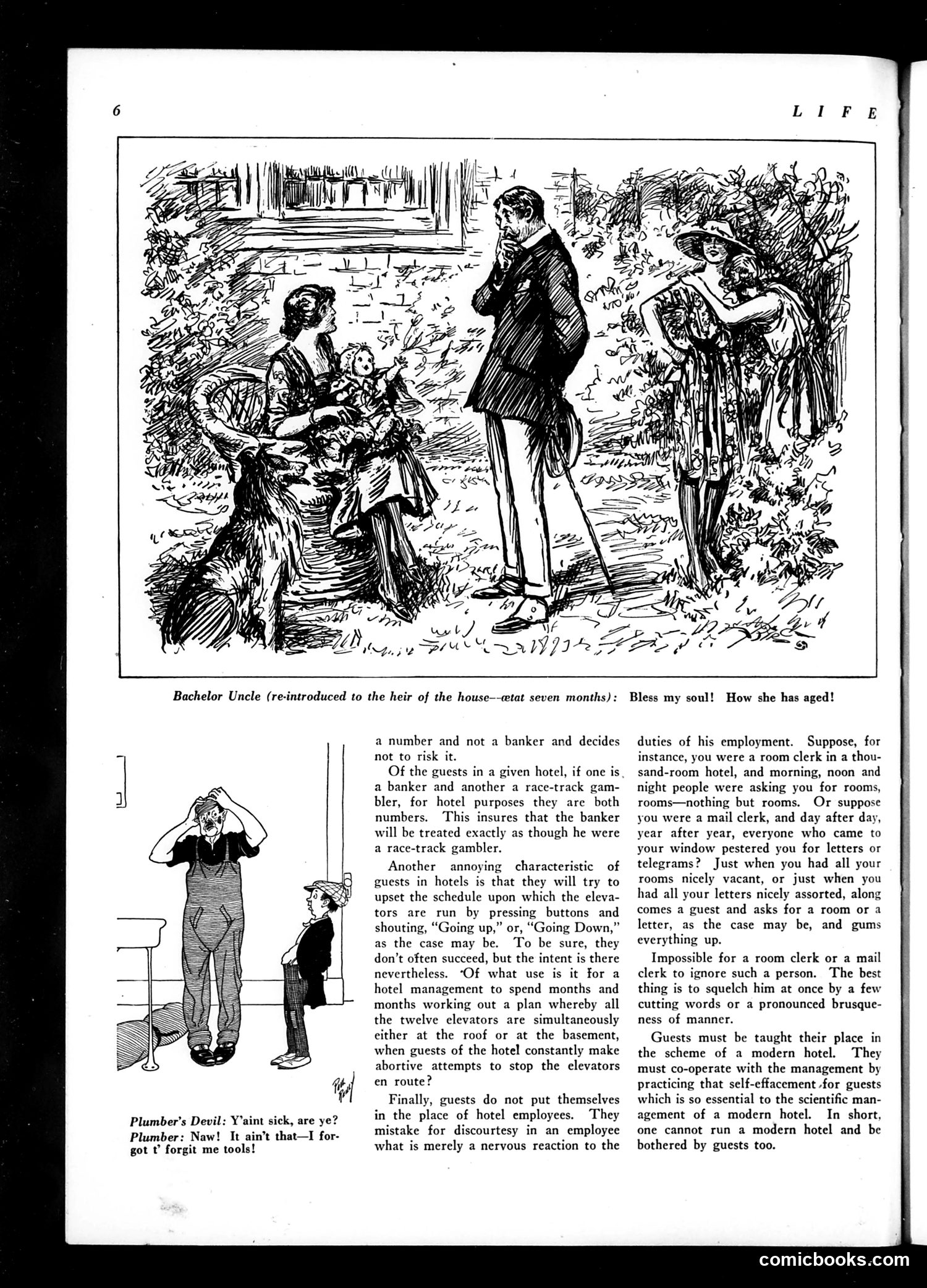
This page contains two satirical cartoons about hotel behavior and a prose article on guest conduct. **Top cartoon**: Titled "Bachelor Uncle (re-introduced to the heir of the house—a year seven months)," depicts an older gentleman startled by how much a child has aged during his absence, exclaiming "Bless my soul! How she has aged!" **Bottom cartoon**: "Plumber's Devil" shows a young boy in an elevator shaft, with dialogue: "Y'ain't sick, are ye?" / "Naw! It ain't that—I forgot me tools!" The accompanying article humorously critiques modern hotel guests' inconsiderate behavior: pestering staff for room requests, attempting to manipulate elevator schedules, and generally failing to respect hotel employees. The satire suggests guests should learn their proper place and cooperate with management for efficient hotel operations.
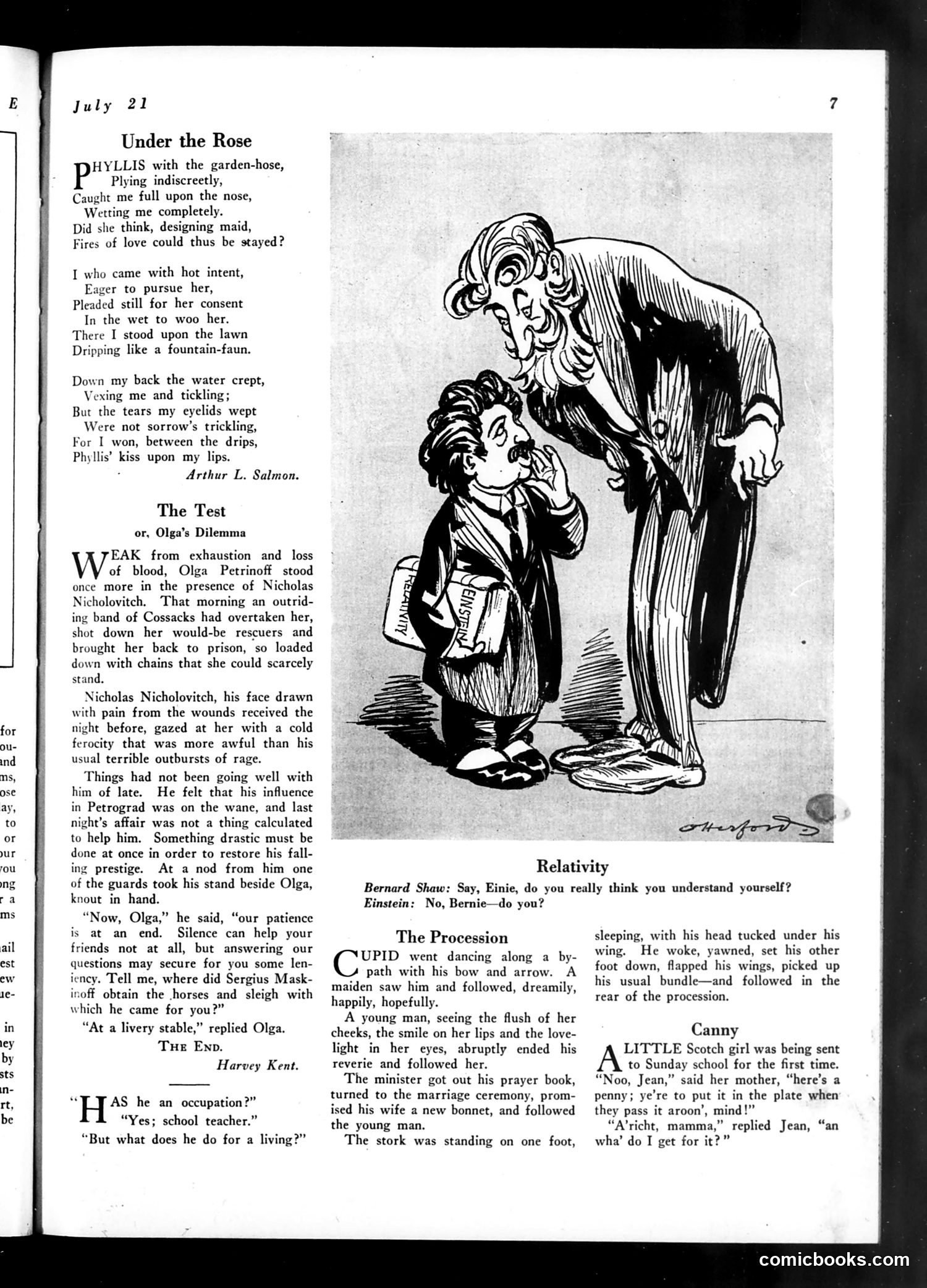
This cartoon depicts a conversation between two figures labeled "Bernard Shaw" and "Einstein." Shaw asks Einstein, "Say, Einie, do you really think you understand yourself?" Einstein replies, "No, Bernie—do you?" The satire plays on Einstein's then-famous theory of relativity, which was still relatively new to public consciousness and widely considered incomprehensibly complex. The joke is that even Einstein himself—the theory's originator—can't fully understand his own work. By pairing him with George Bernard Shaw (the celebrated Irish playwright and wit), Life magazine humorously suggests that even brilliant minds struggle with self-knowledge, a philosophical paradox that complements the scientific one.
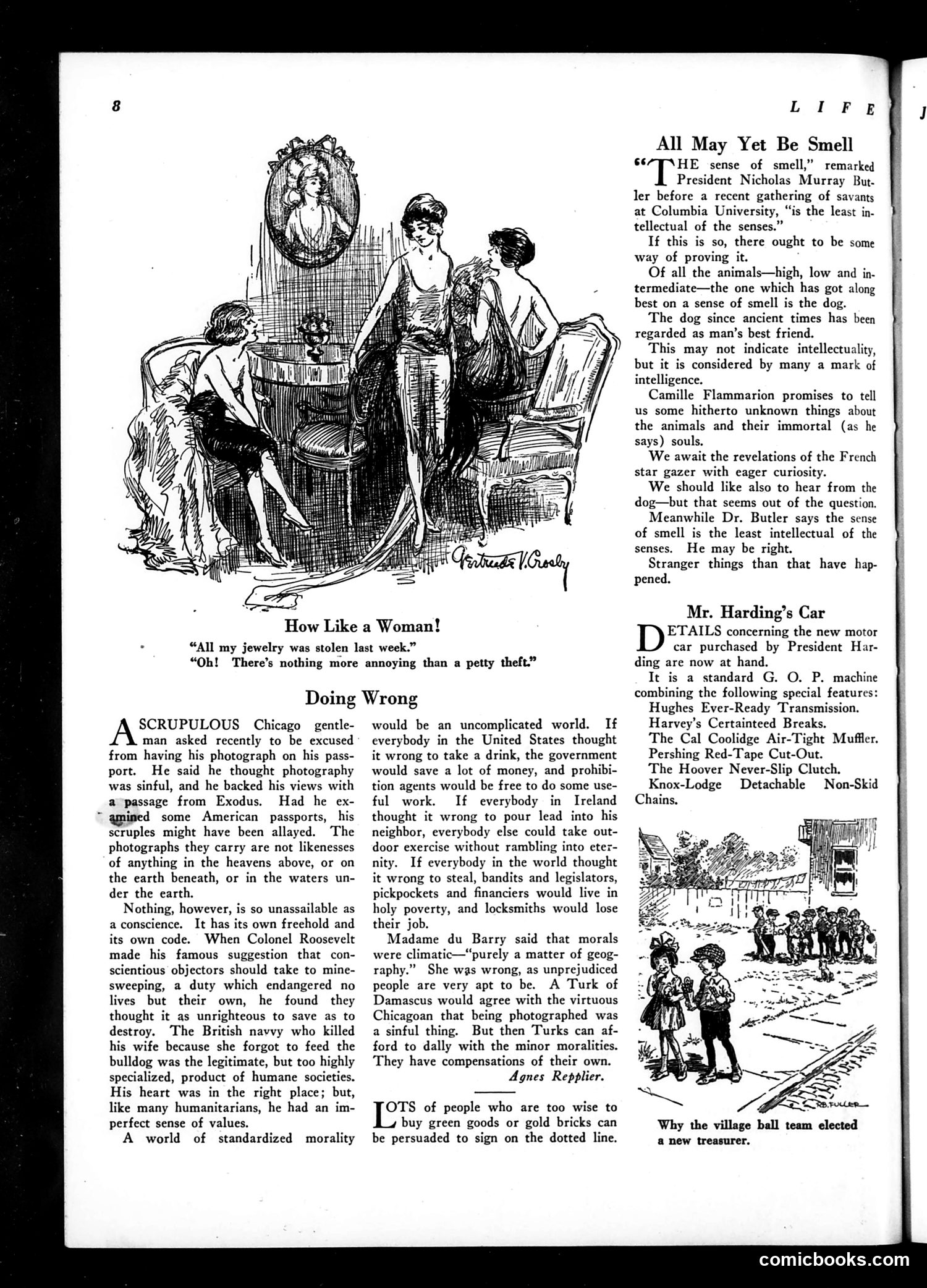
The main illustration depicts a woman complaining to three other women about stolen jewelry, with one responding dismissively: "Oh! There's nothing more annoying than a petty theft." The satire mocks women's perceived priorities and values. The cartoon suggests that women obsess over trivial matters (jewelry theft) while claiming moral superiority. The title "How Like a Woman!" emphasizes the stereotype that women are emotionally driven and preoccupied with material possessions rather than substantive concerns. This reflects early 20th-century gender stereotypes common in Life magazine's satirical humor—portraying women as shallow, vain, and prone to exaggeration over minor personal losses. The joke relies on dismissing women's concerns as inherently petty.
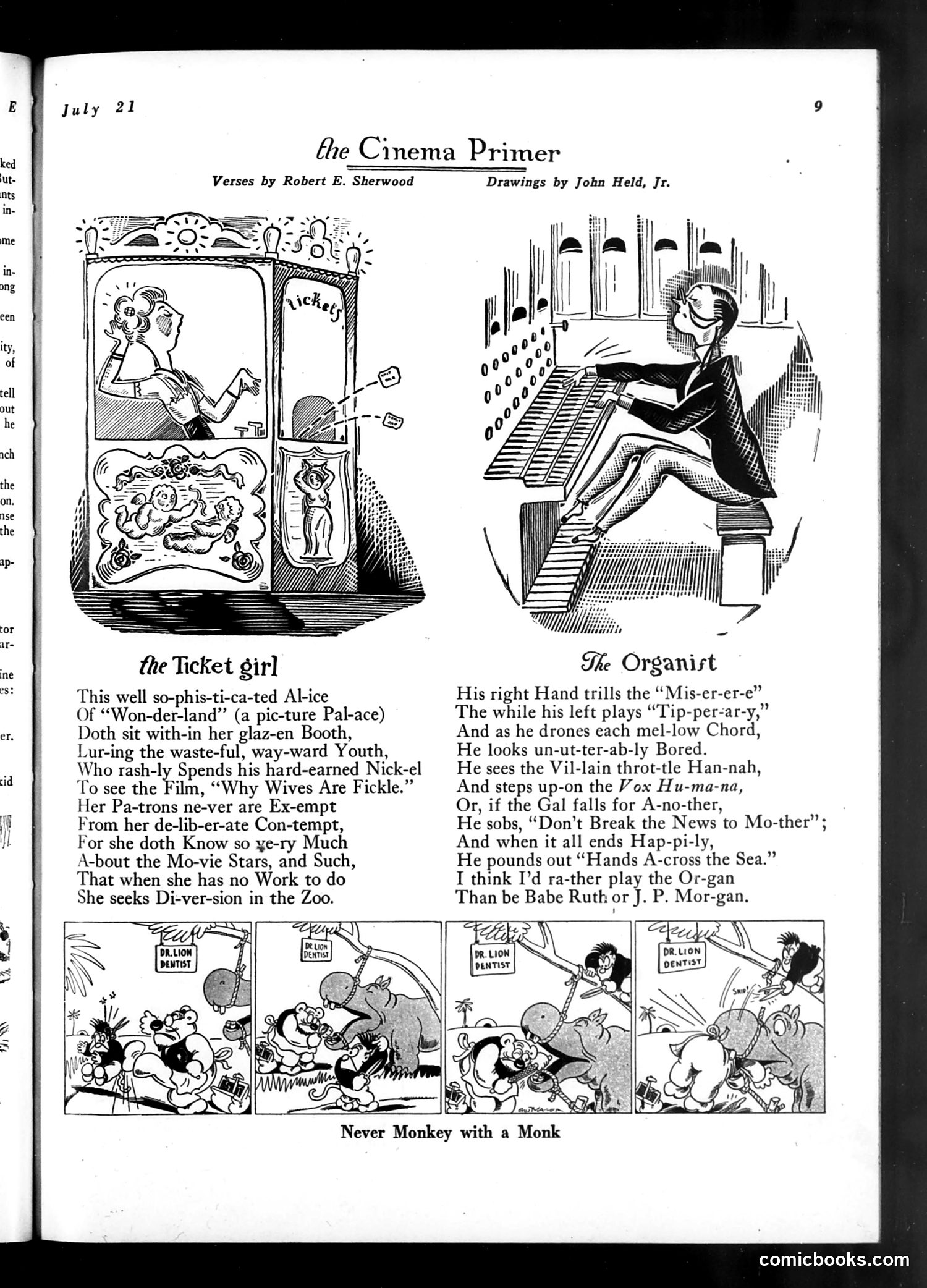
This page satirizes early cinema culture through two illustrated verses by Robert E. Sherwood with drawings by John Held, Jr. **"The Ticket Girl"** mocks the stereotypical cinema usherette (Alice) who works in a movie theater booth. The verse puns on her name and position, suggesting she's distracted and directionless, seeking entertainment at the zoo rather than taking her job seriously. **"The Organist"** jokes about the cinema organist who accompanies silent films. It depicts how he struggles through dramatic moments—playing predictable chords while the plot becomes melodramatic—and suggests he'd rather be famous jazz musician J.P. Morgan or baseball star Babe Ruth. The bottom comic strip, "Never Monkey with a Monk," appears unrelated wordplay humor involving a monkey and a dentist.
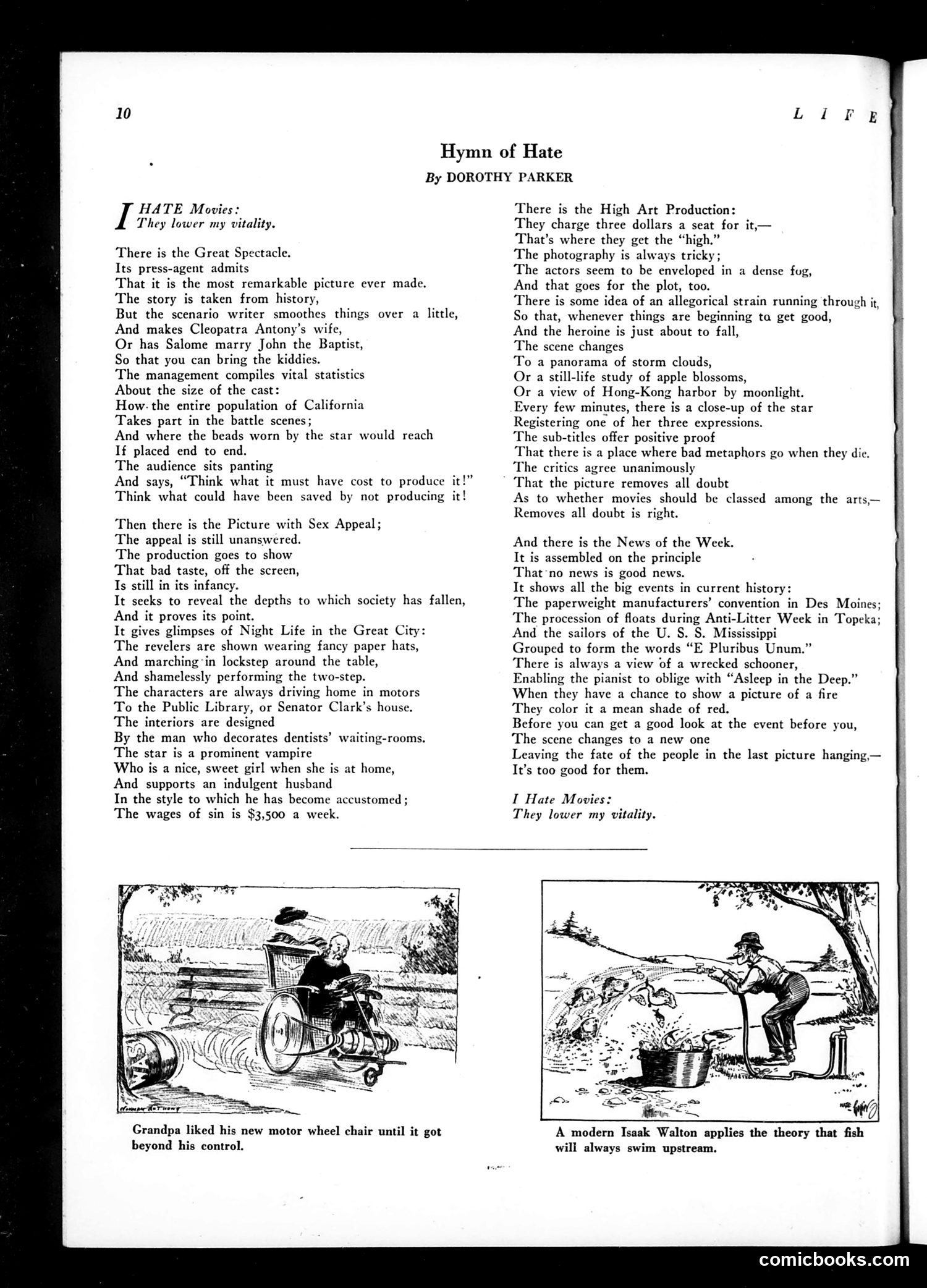
This page presents Parker's satirical poem attacking Hollywood cinema of the era. The poem mocks: **The industry's pretensions**: Expensive productions charging high ticket prices ($3) while delivering poor quality and contrived plots. **Formulaic filmmaking**: Scripts that interrupt dramatic moments with scene changes to exotic locations (Hong Kong, storm clouds) whenever tension builds—a common editing technique to maintain audience interest. **Production absurdities**: Vast resources spent on casting entire California populations for battle scenes, yet the result still showcases bad taste and predictable storytelling. **The "News of the Week" segment**: A filler feature with deliberately bland content ("no news is good news"), meant to pad the program. The two cartoons below use visual humor to mock outdated ideas: a grandfather losing control of a motorized wheelchair, and a fishing scene referencing Isaac Walton's classical fishing theories applied absurdly to modern situations.
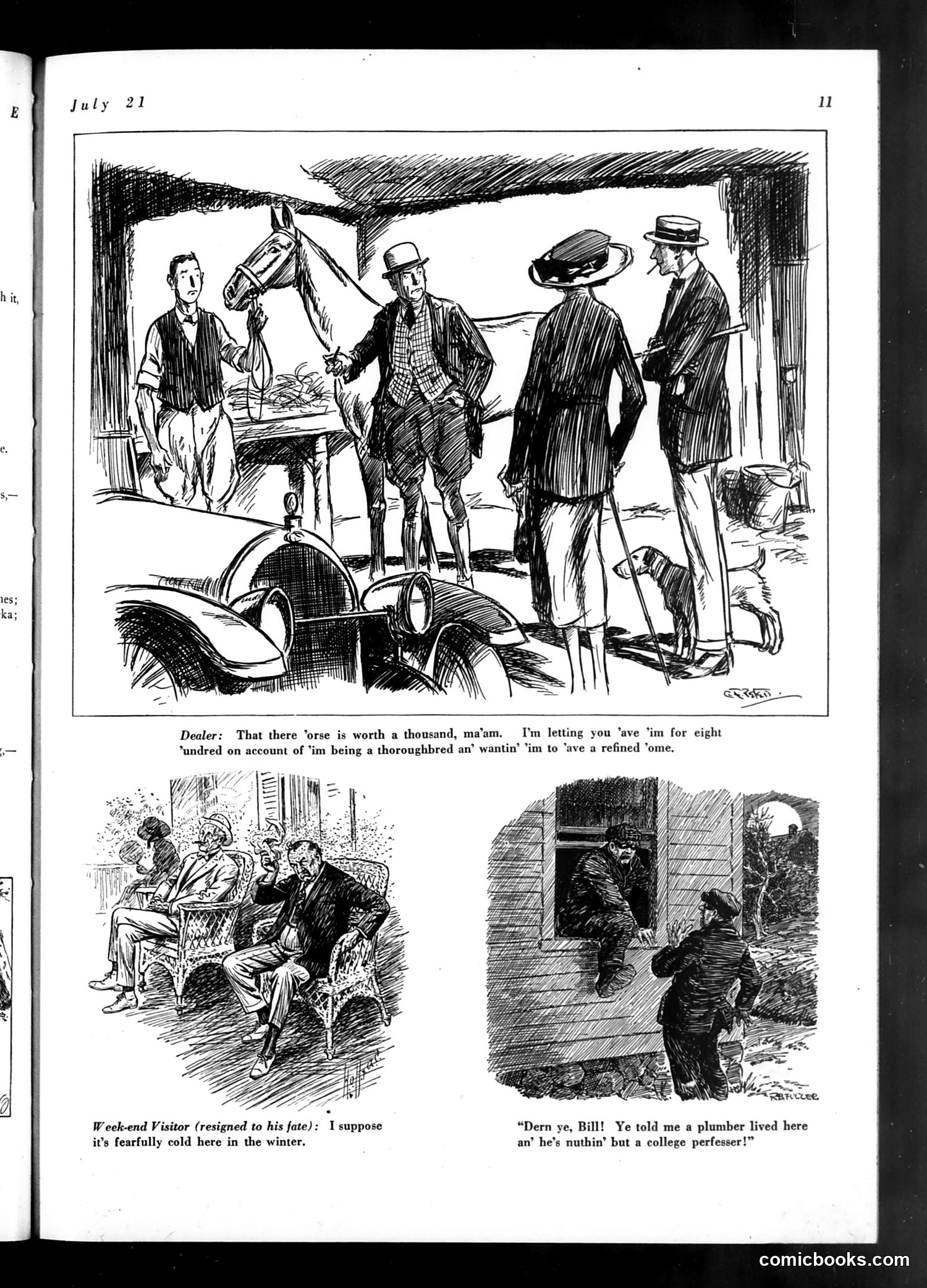
This page contains three satirical cartoons about class distinctions and social pretense in early 20th-century America. **Top cartoon**: A horse dealer negotiates with wealthy gentlemen, claiming a "thoroughbred" horse is worth a thousand dollars and pretending to let them purchase it cheaply to get a "refined" owner—obvious sales manipulation targeting the wealthy. **Bottom left**: A weekend visitor complains about winter cold to hosts, suggesting they're unprepared or their home is inadequate—satirizing complaints from privileged guests. **Bottom right**: Two characters discuss a supposed "college professor" who is actually "nothin' but a plumber"—mocking social pretense and false credentials or misleading claims about occupations and status. The unifying theme: exposing fraud, class anxiety, and the gap between appearance and reality in American society.
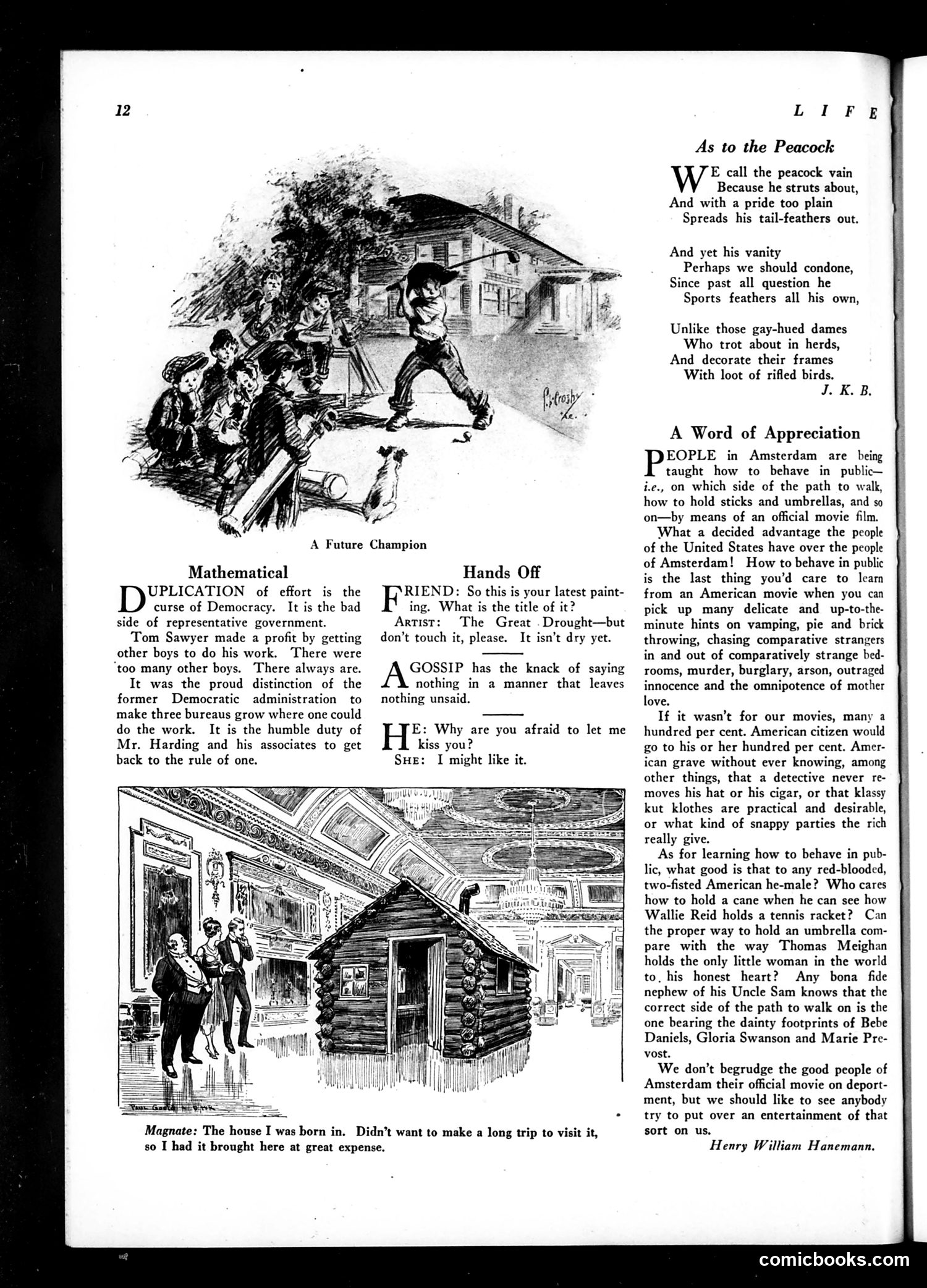
This cartoon depicts **Tom Sawyer** (the fictional Mark Twain character) getting other boys to do his work—a direct political satire on **Representative government inefficiency**. The text explicitly states this was "the proud distinction of the former Democratic administration" under what appears to be a recent Democratic president. The satire's point: Democratic leaders supposedly duplicated effort by having multiple workers do one job, rather than efficiently delegating. The cartoonist suggests the new (presumably Republican) administration should restore proper hierarchy where one leader assigns work—implying the previous Democratic approach was wasteful and disorganized. The humor relies on readers recognizing the Tom Sawyer reference to American literature, making the political critique more memorable and biting.
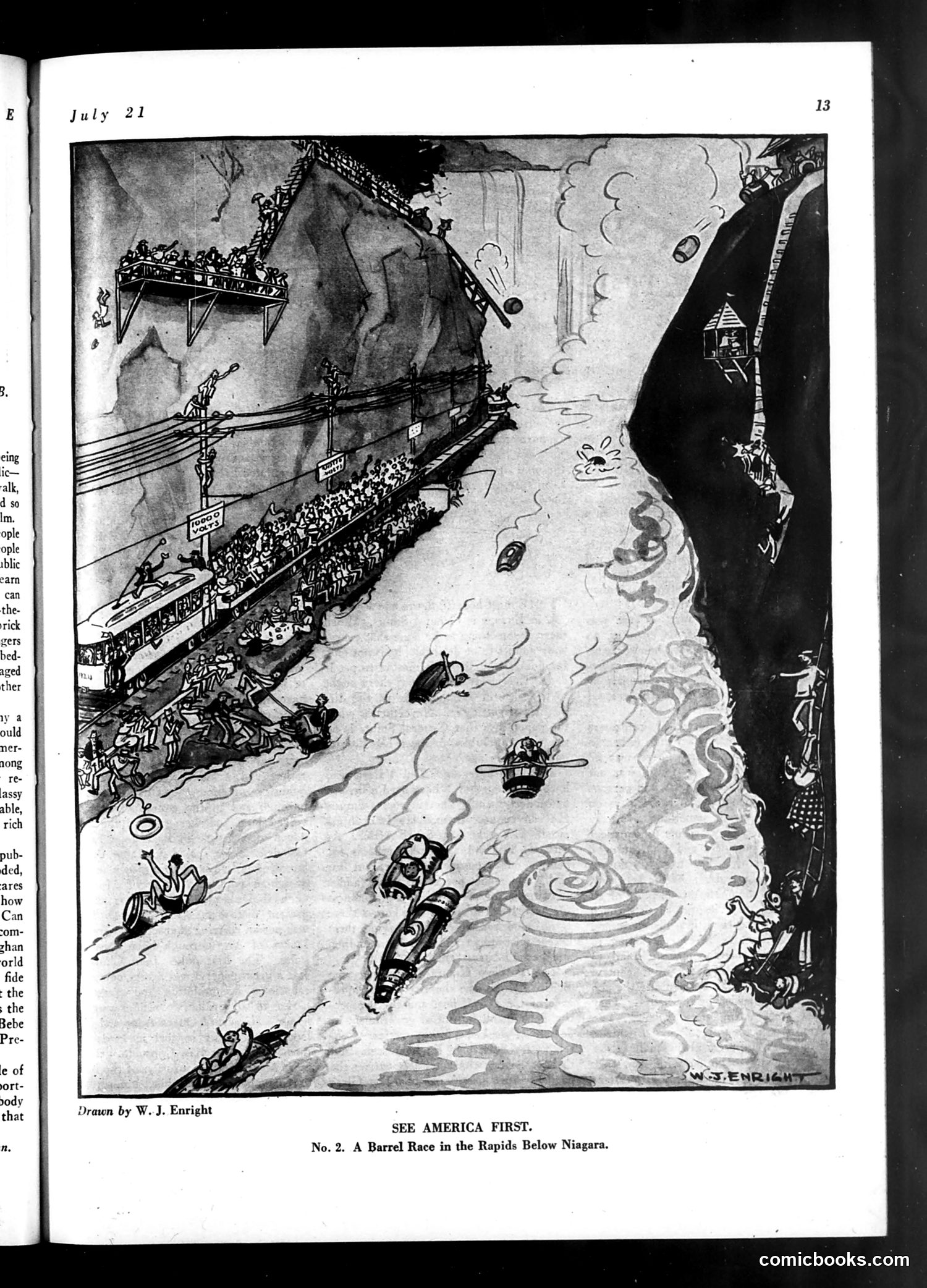
This satirical cartoon by W.J. Enright depicts a dangerous tourist attraction at Niagara Falls' rapids. The title "See America First" appears to mock the contemporary "See America First" travel movement, which encouraged Americans to visit domestic destinations rather than Europe. The cartoon shows tourists in barrels being sent through treacherous rapids—a literal death-trap presented as entertainment. This is likely referencing the actual phenomenon of daredevils going over Niagara Falls in barrels, a real stunt that occurred in this era. The satire criticizes both the recklessness of such dangerous attractions and the absurdity of promoting them as patriotic tourism. The image suggests that domestic "attractions" can be as perilous as they are thrilling, mocking the enthusiasm of the "See America First" campaign.
This page contains an editorial article rather than political cartoons. The text discusses European politics and British society, with particular focus on **General Smuts** (a South African political/military figure) as a "hopeful figure" in post-WWI Europe. The article critiques English reformers and intellectuals who it claims are out of touch with practical governance. It references **De Valera** and Irish independence negotiations, suggesting Smuts might help broker peace between competing factions. The piece also satirizes contemporary English high society, mocking wealthy socialites and their "house-parties" for superficiality while claiming they lack genuine character needed to run the country effectively. Small decorative illustrations accompany the text but aren't primary satirical cartoons—they're ornamental flourishes typical of 1920s magazine design.
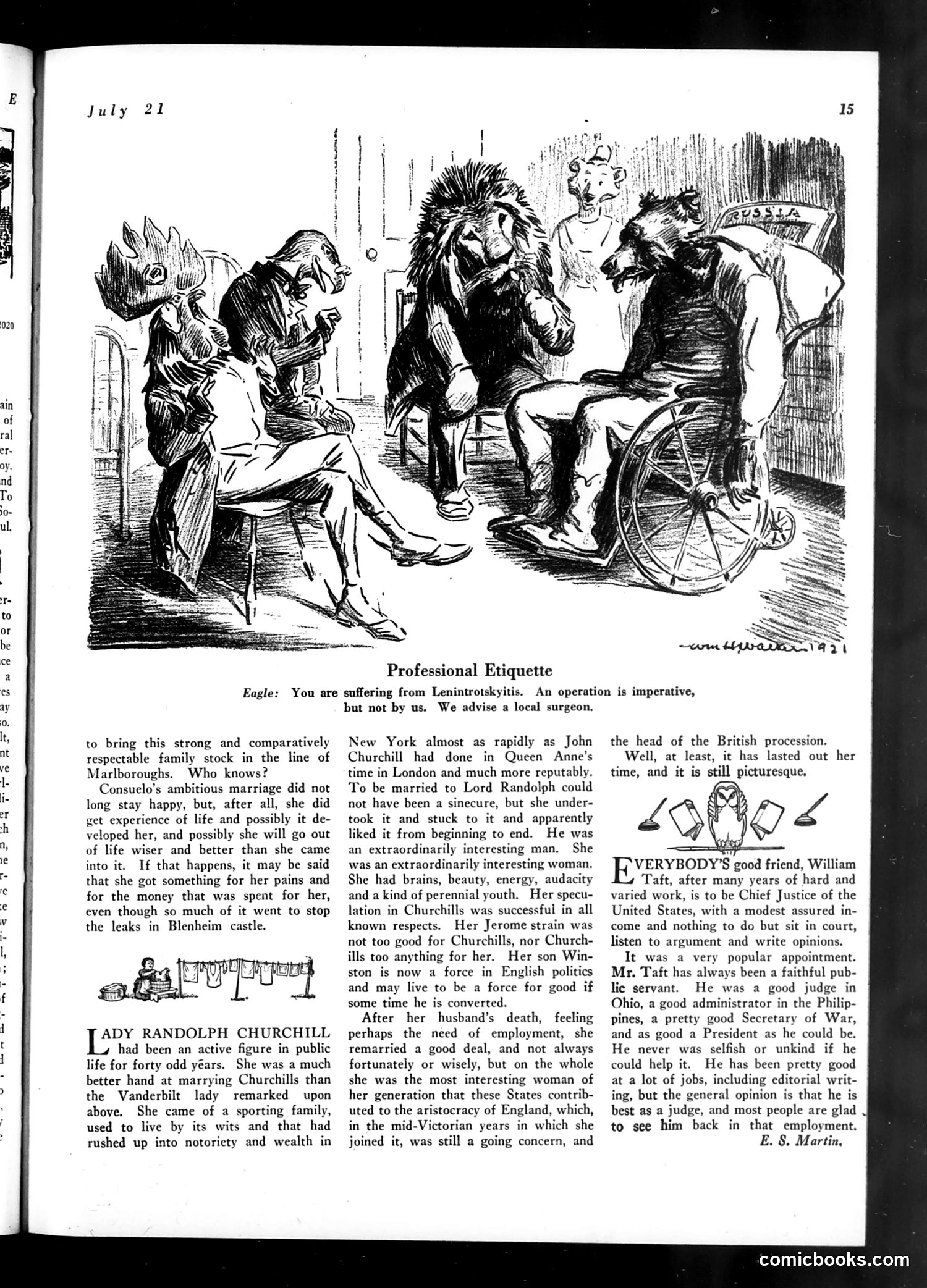
This cartoon satirizes diplomatic tensions between the Soviet Union and the West. Two figures with animal heads (an eagle and a bear, representing America and Russia respectively) sit across from each other with a woman between them. The eagle tells the bear it's suffering from "Leninrotskeyitis" (a disease named after Soviet leaders Lenin and Trotsky) and needs surgery—but advises consulting "a local surgeon" rather than permitting American intervention. The joke mocks the absurdity of the early Soviet state while poking fun at Western reluctance to directly confront Bolshevism. The title "Professional Etiquette" suggests the powers are observing diplomatic niceties even while regarding each other as diseased threats. The cartoon likely dates to the early 1920s, when anti-Bolshevik sentiment was high but direct Western military intervention in Russia had already failed.
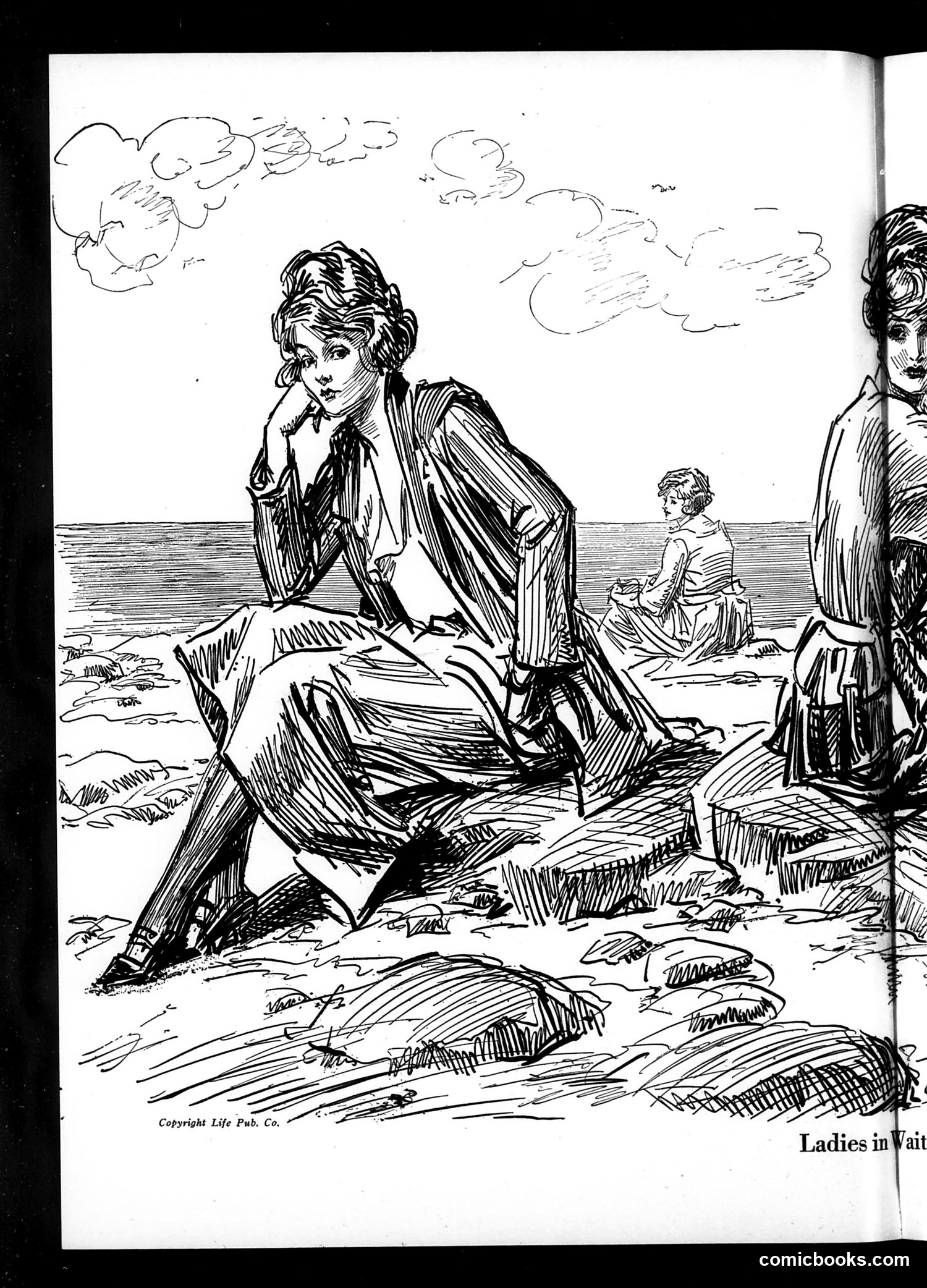
This pen-and-ink illustration depicts fashionably dressed women waiting on a beach, likely from the early 20th century based on the clothing styles and art technique. The title "Ladies in Wait" appears to be a play on words—possibly referencing "ladies in waiting" (royal attendants) or satirizing the idle leisure of upper-class women. The central figure sits pensively on the sand in an elegant coat and dress, while others wait nearby. The beach setting and posed attitudes suggest commentary on leisure culture, possibly mocking the aimlessness or dependent status of society women. The detailed cross-hatching and expressive linework are characteristic of Life's satirical illustration style during its early decades as a humor and commentary magazine.
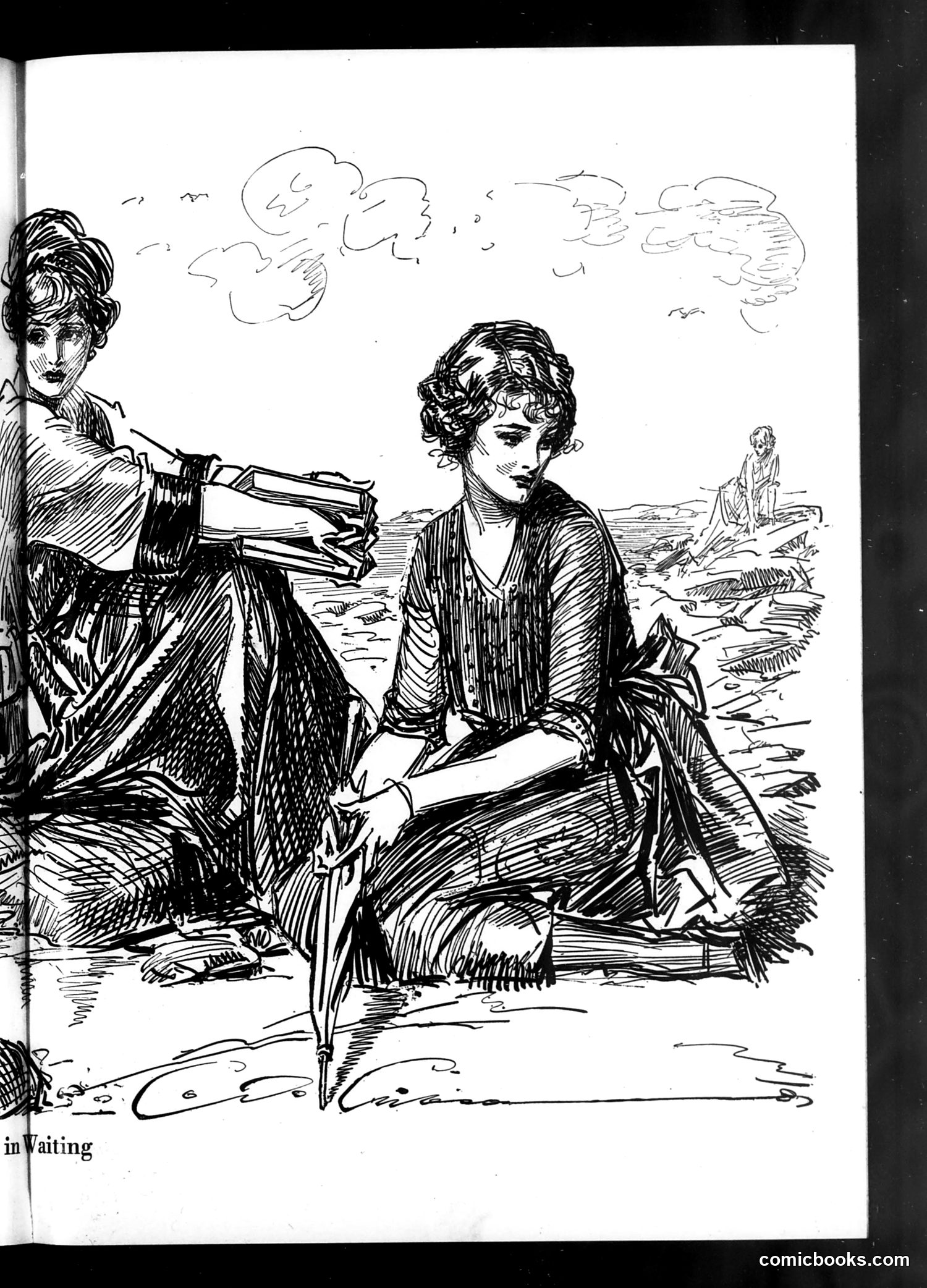
This pen-and-ink illustration depicts two fashionably dressed women in an idyllic seaside setting, titled "In Waiting." The women wear early 20th-century clothing with elaborate hairstyles characteristic of the Gibson Girl era. One woman sits while the other reclines, both appearing relaxed and contemplative against a beach landscape with a distant figure visible. The satire appears to comment on women's leisure and social status during this period—likely mocking the idle waiting and passivity expected of upper-class women. The romanticized seaside setting contrasts with the women's somewhat detached expressions, suggesting commentary on the constraints of feminine domesticity and waiting for romantic or social advancement. The illustration's refined style mimics popular period fashion imagery while subtly critiquing the women's dependent social position.
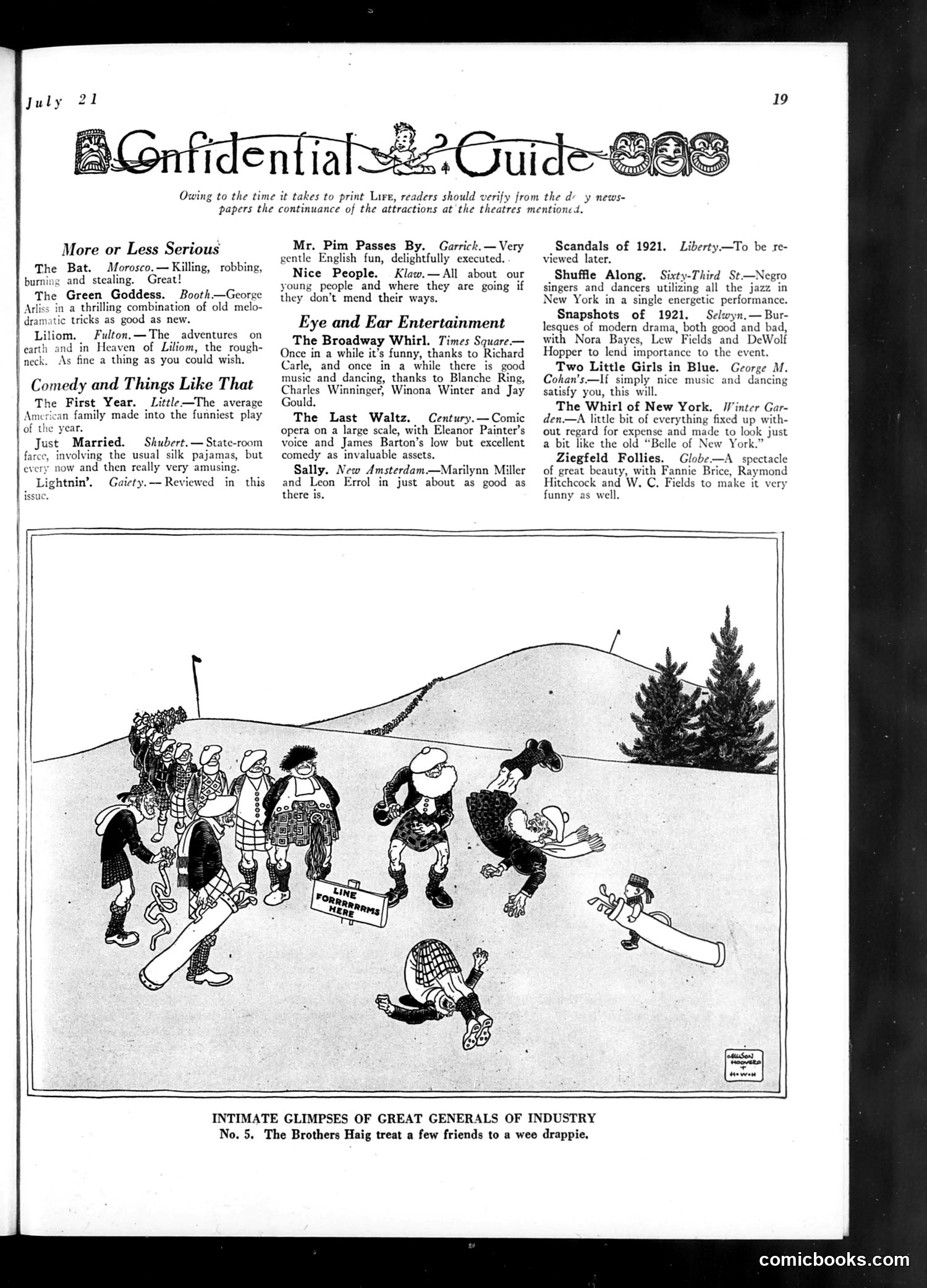
This page from *Life* magazine (July 21) contains theater reviews and a satirical cartoon about the "Brothers Haig." **The Cartoon:** The image shows caricatured figures on a snowy hillside labeled "Intimate Glimpses of Great Generals of Industry, No. 5." The caption reads "The Brothers Haig treat a few friends to a wee drappie" (Scottish slang for a small drink). The satire appears to mock wealthy industrialists—likely the Haig brothers—for their extravagant leisure activities and casual entertainment of associates. The "wee drappie" reference is ironic, suggesting these powerful businessmen engage in apparently modest pleasures while actually living lavishly. This was typical 1921 *Life* magazine satire: poking fun at the wealthy and powerful through exaggeration and gentle mockery of their social pretensions. The surrounding text reviews current Broadway shows, positioning entertainment and social commentary as the magazine's primary content.
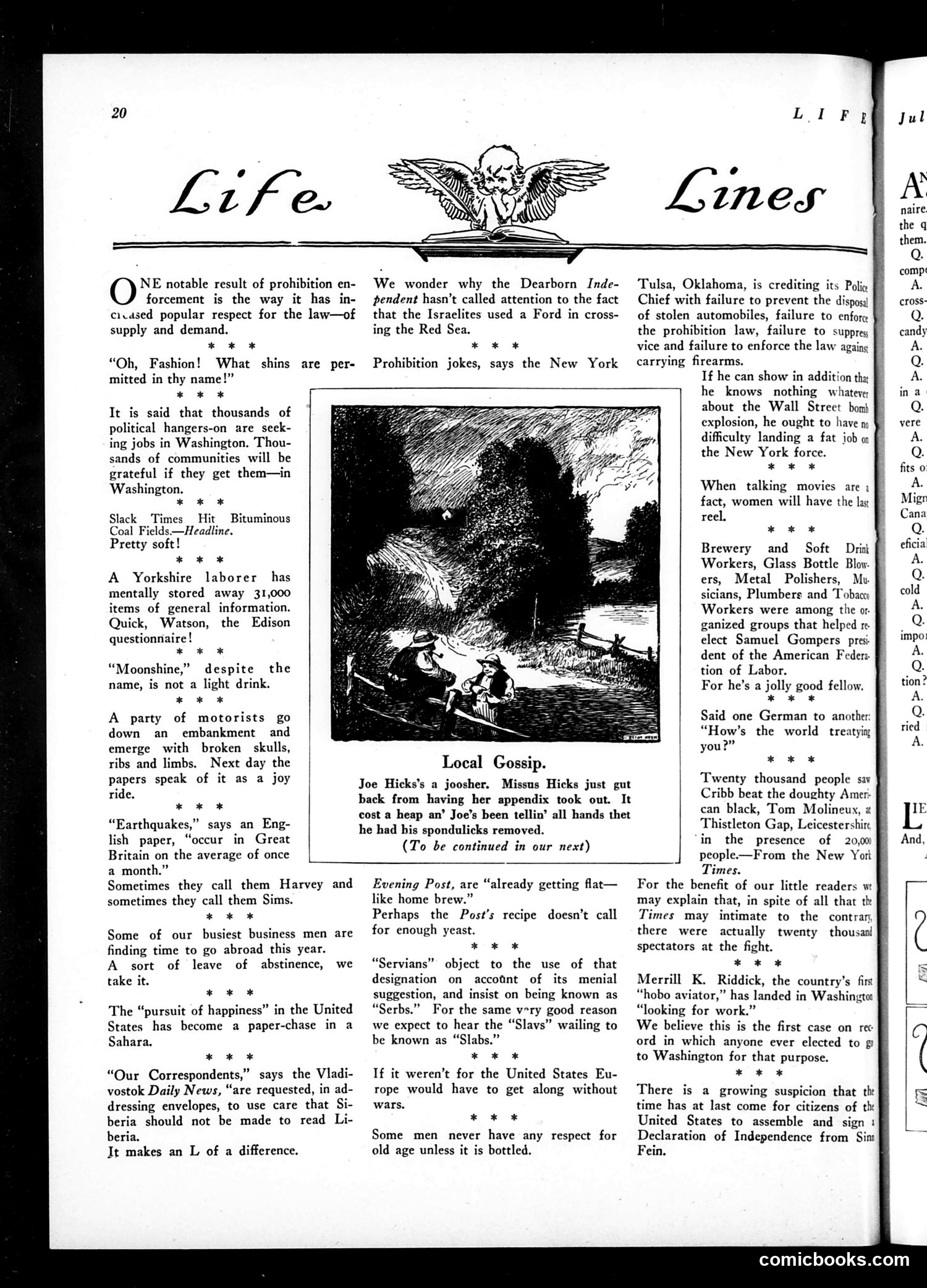
This page from *Life* magazine contains satirical commentary on 1920s American social issues. The central cartoon depicts motorists crashed at an embankment—the joke being that newspapers sensationalize such accidents as "joy rides," mocking media exaggeration. The text includes brief satirical quips mocking Prohibition's ineffectiveness ("increased popular respect for the law—of supply and demand"), anti-Semitic stereotyping (the Dearborn Independent reference suggests Henry Ford's antisemitic publication), and workplace humor. Notable targets include: jobless politicians seeking Washington positions; the coal industry; outdated customs; and the absurdity of Prohibition enforcement in cities like Tulsa. The "Local Gossip" section contains vernacular humor about ordinary people. A reference to "Cribb beat the doughty American black, Tom Molineux" appears to reference a historical boxing match, though context is unclear from this excerpt alone. Overall, the page reflects *Life*'s role as a satirical weekly critiquing contemporary American politics, culture, and society during the Prohibition era.
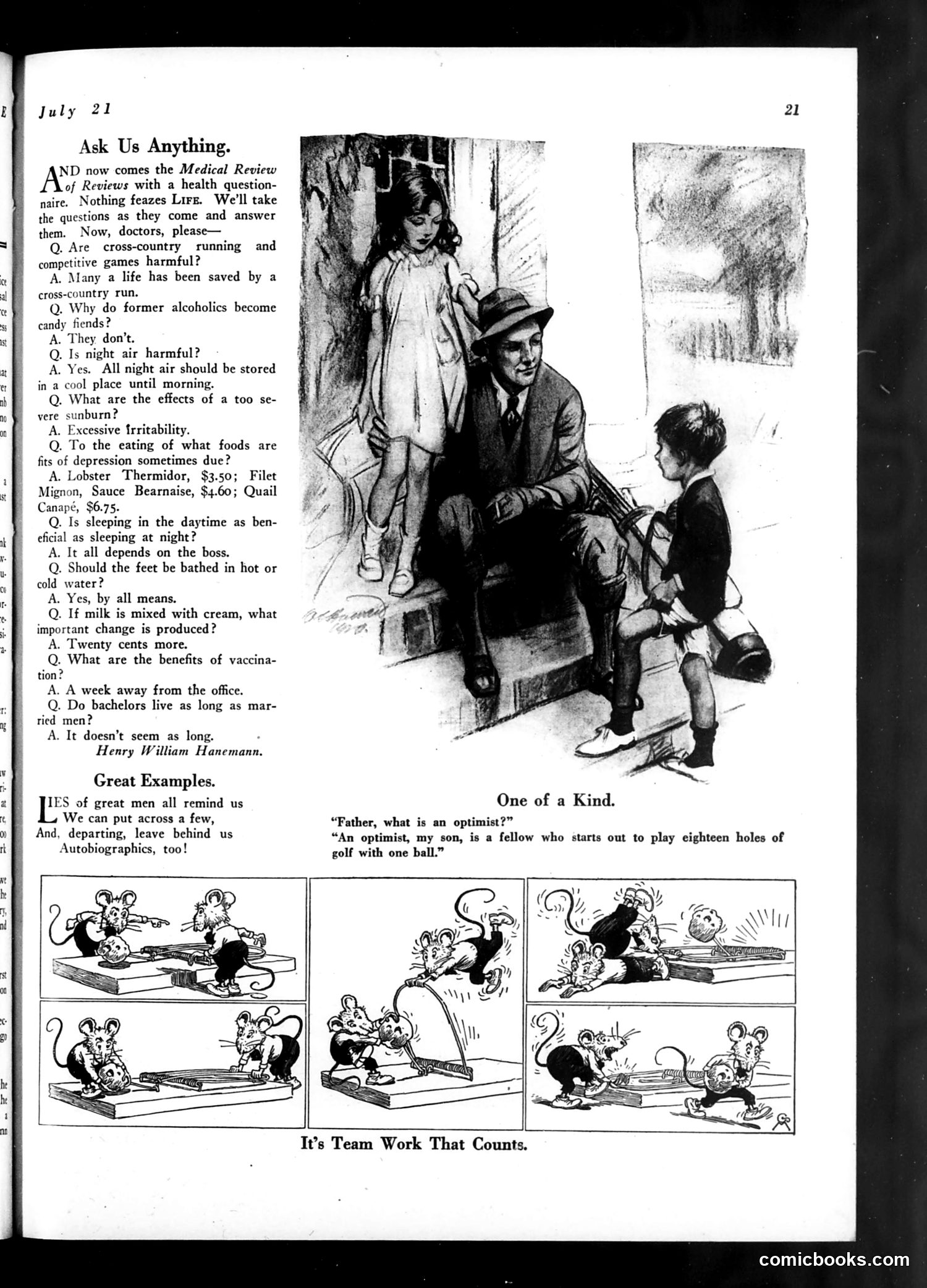
**"Ask Us Anything"** is a mock advice column satirizing medical/health "expertise." Life's joke is that the answers are deliberately absurd or mercenary: night air should be "stored in a cool place until morning" (nonsense), depression from expensive foods like Lobster Thermidor (implying wealth causes sadness), and vaccination's benefit is "a week away from the office" (mocking employers' practices). **"One of a Kind"** is a golf joke about optimism — a man starting 18 holes with only one ball is optimistic he won't lose it, a humorous definition by contrast. **"It's Team Work That Counts"** (cartoon with mice) illustrates cooperation through sequential comic panels showing mice working together, likely promoting workplace or social collaboration. The page overall mocks contemporary attitudes toward health advice, materialism, and workplace culture through absurdist humor typical of Life's satirical style.
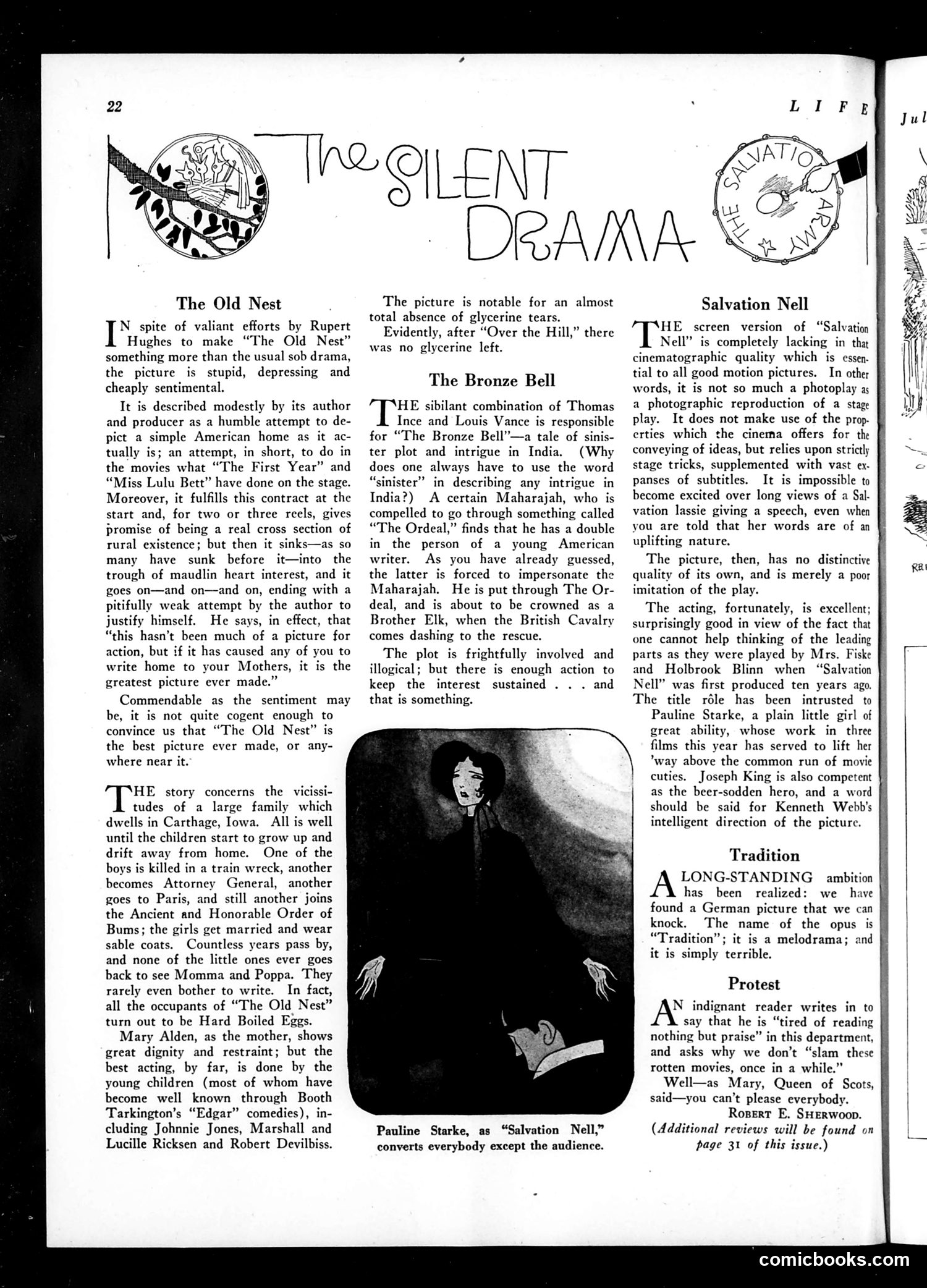
This page contains three film reviews from Life magazine's movie criticism section. The critic dismisses three contemporary silent films: **"The Old Nest"** — A melodrama about an Iowa family whose children abandon their parents. The reviewer mocks its manipulative sentimentality, noting the director's apologetic claim that if it makes viewers write home to their mothers, it's "the greatest picture ever made." The critic sarcastically references a competing film ("Over the Hill") by joking that all available glycerine tears were used there first. **"The Bronze Bell"** — An exotic adventure set in India involving mistaken identity and imperial intrigue. The reviewer finds the plot illogical but admits the action maintains interest. **"Salvation Nell"** — The critic faults this stage adaptation for failing to use cinema's visual storytelling capabilities, relying instead on subtitles and static shots of a Salvation Army character delivering speeches. The photograph shows actress Pauline Starke as "Salvation Nell," illustrating the static, theatrical staging the reviewer criticizes.
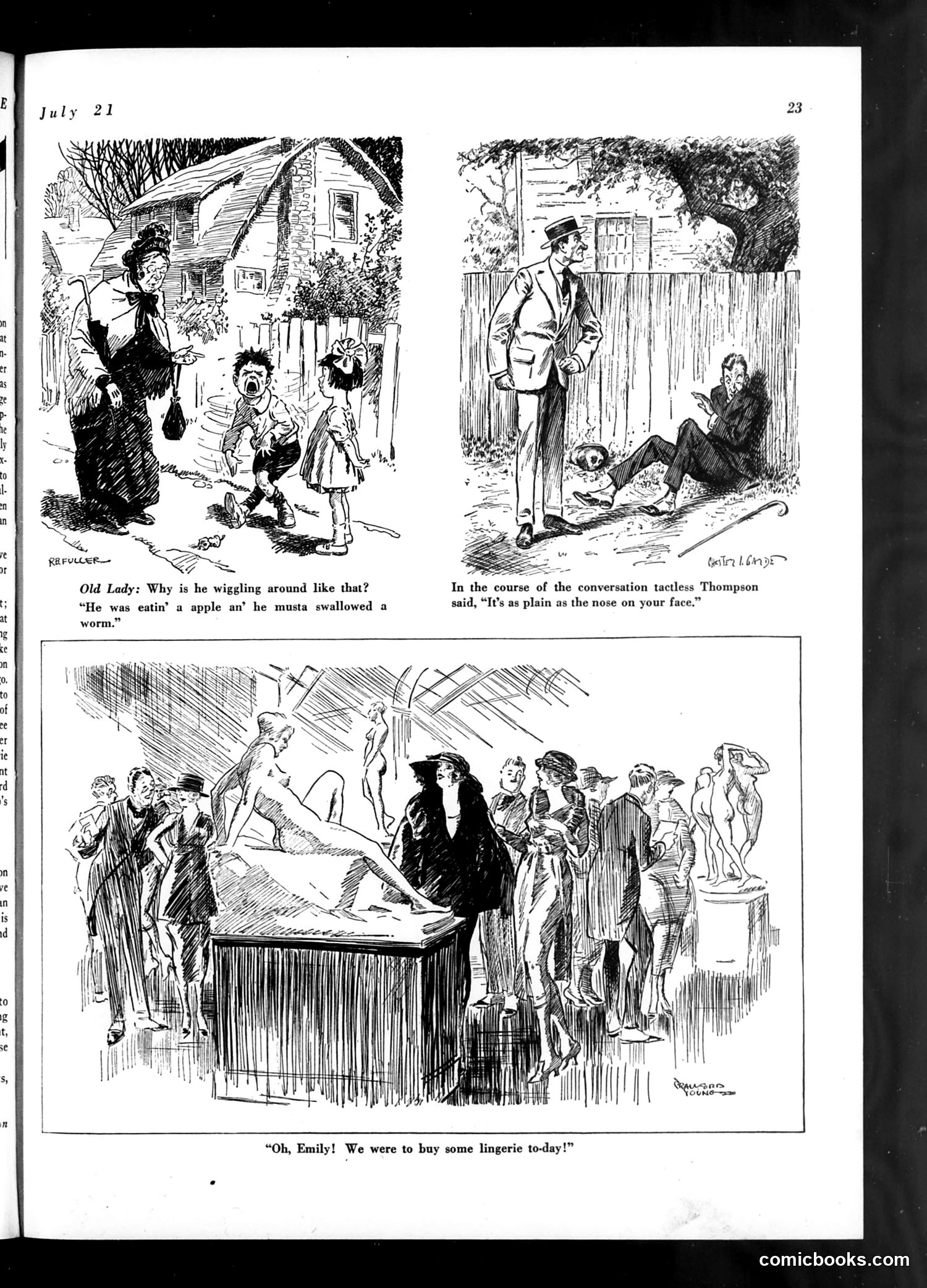
This page contains three unrelated jokes typical of early 20th-century American humor magazines: **Top left**: An old lady explains a child's wiggling by saying he swallowed a worm while eating an apple—a common folk explanation for fidgeting children. **Top right**: A man named Thompson is told his face is as plain as his nose, an insulting remark disguised as casual conversation. **Bottom**: Two women encounter a classical art exhibition or anatomy display. One exclaims they were supposed to be shopping for lingerie instead, creating humor through the juxtaposition of nude sculptures with ladies' undergarments shopping. The joke relies on Victorian-era modesty and the contrast between high art and everyday commerce. The cartoons mock social conventions and contain mild, family-friendly humor typical of the era.
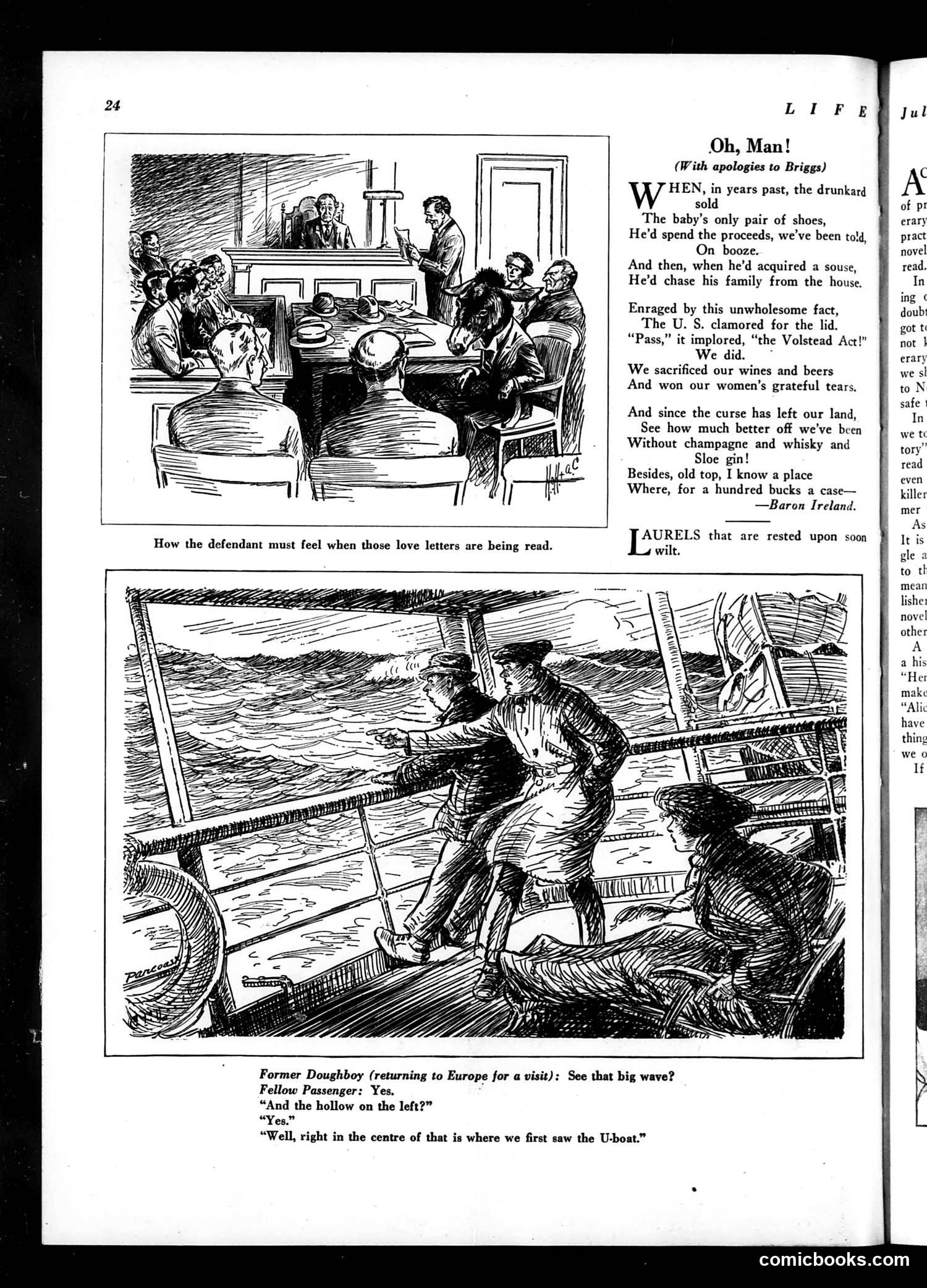
**Top Cartoon**: This satirizes Prohibition's failure. The poem mocks the 1920 Volstead Act, which banned alcohol. The irony: Americans claimed prohibition would eliminate poverty and domestic violence (the "drunken father selling his baby's shoes" scenario), yet the speaker reveals they've simply replaced legal drinking with illegal speakeasies ("I know a place / Where, for a hundred bucks a case"). The crowded bar scene illustrates that Prohibition created black-market drinking culture rather than eliminating alcohol consumption. **Bottom Cartoon**: A war veteran describes spotting a German U-boat (submarine) during WWI, but uses comically exaggerated geographic markers ("the big wave," "the hollow on the left") to describe its location. This satirizes how war stories become increasingly embellished and absurd over time—the veteran's precise recollection seems dubious given the vague nautical reference points. Both pieces mock American hypocrisy and unreliable memory.
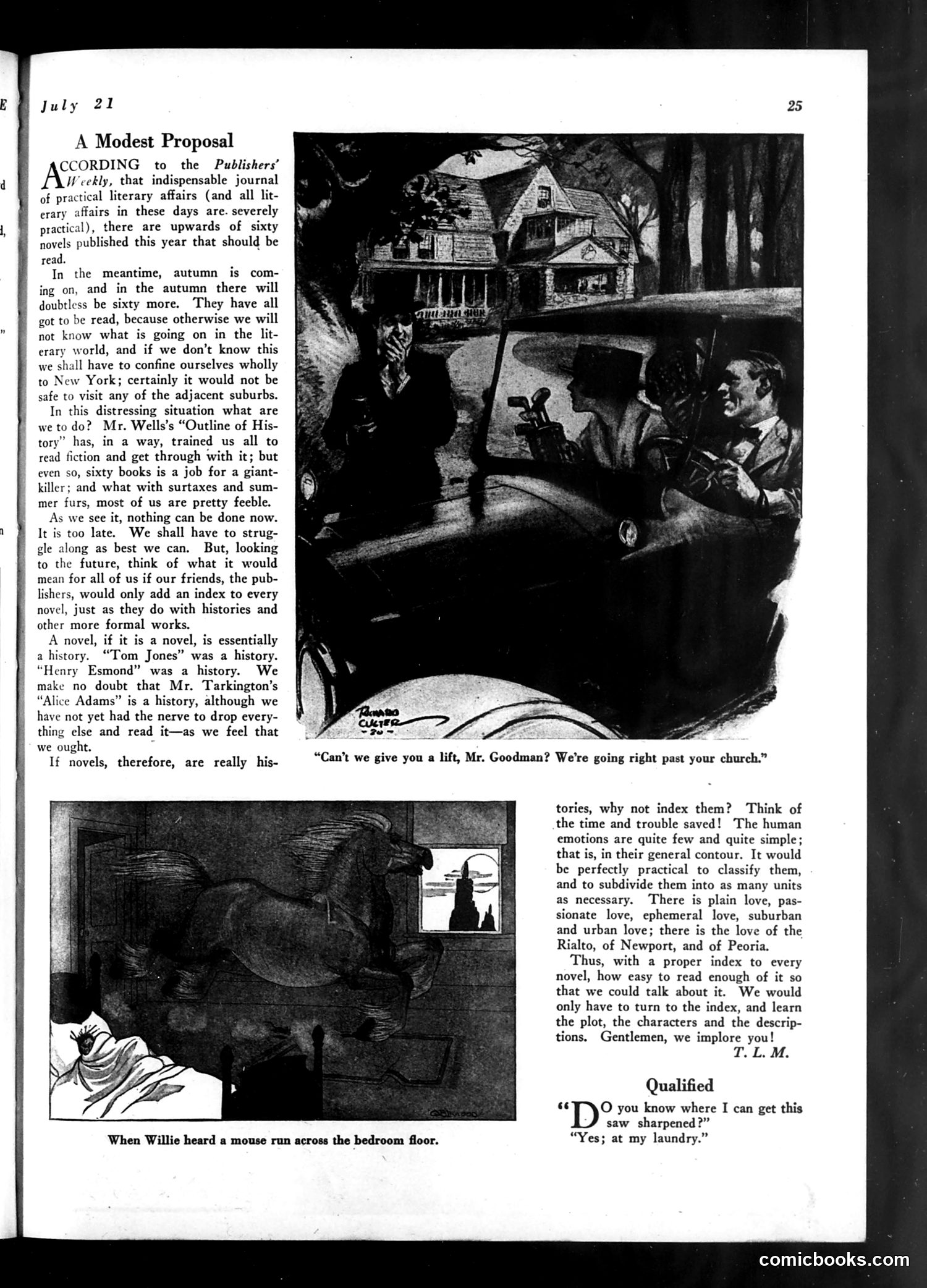
**"A Modest Proposal"** is satirical commentary on the publishing industry's overproduction of novels. The author (T.L.M.) ironically proposes that publishers add indexes to novels—treating them like reference books—so readers can skip through them and just look up plot summaries, characters, and emotional content without actually reading. The satire mocks both reader laziness and publisher excess: with 60+ novels annually demanding attention, readers are overwhelmed. By suggesting novels be indexed by emotion type ("plain love," "suburban love," etc.), the piece ridicules the formulaic nature of popular fiction while highlighting the impracticality of keeping up with literary output. The two illustrations are unrelated light humor: the first shows a car near a church with the caption about giving "a life"; the second depicts someone startled by a mouse in the bedroom. These are separate comic pieces, not connected to the main essay.
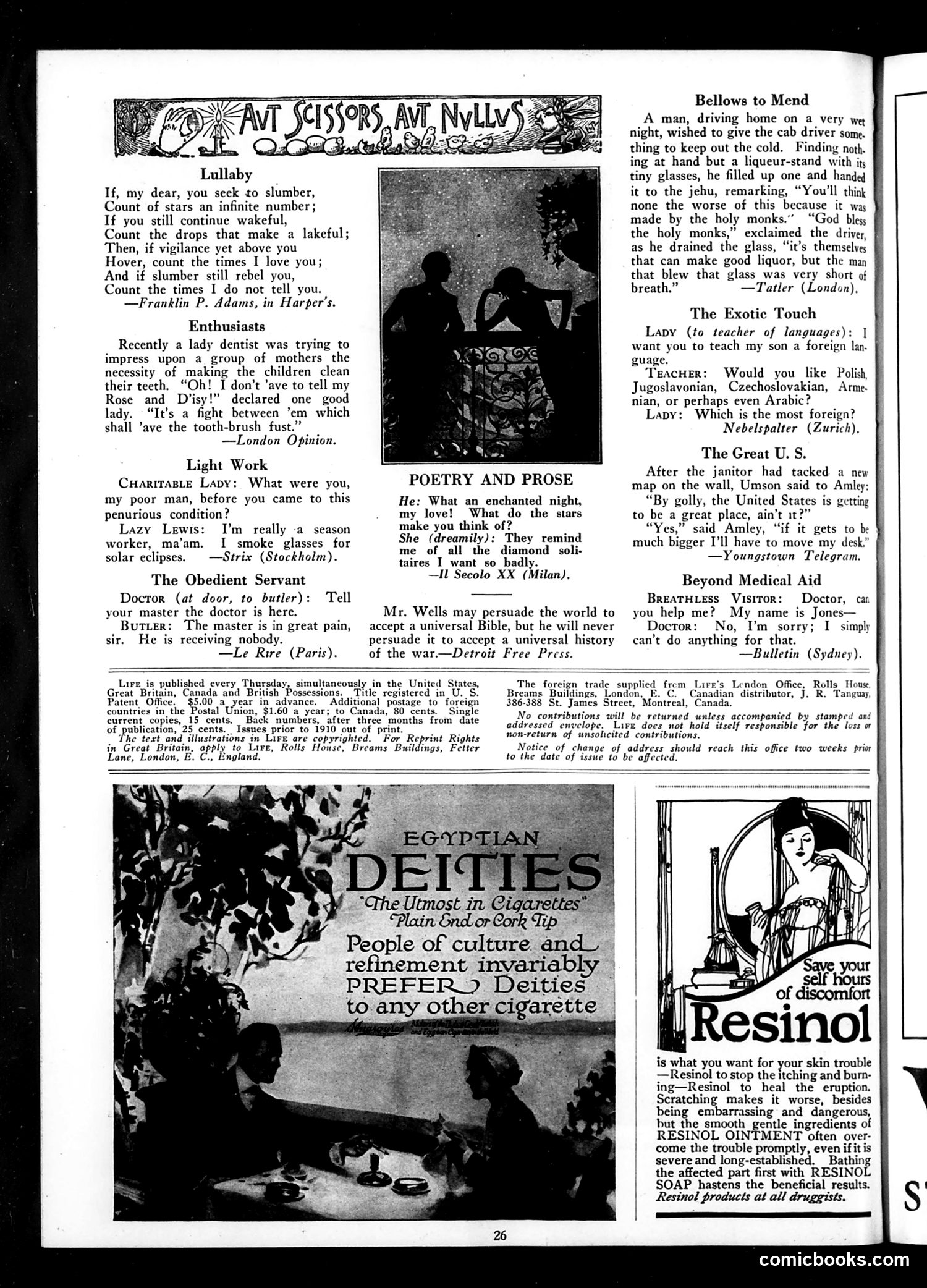
This page collects humorous short anecdotes and jokes from various international publications, presented without political cartoons. The humor reflects early 20th-century sensibilities: **Key jokes include:** - A romantic poem about counting to fall asleep, ending with the punchline that a lover stops counting declarations of love - British working-class humor about a dentist promoting teeth-brushing; children fight over toothbrush access - A "season worker" who smokes glasses for solar eclipse viewing—absurdist humor about unemployment - A doctor unable to see patients because his butler protects him - A woman's romantic reverie interrupted by materialistic thoughts of diamond rings - A cab driver praising monks' liqueur-making while insulting the glassblower's weak breath The overall tone is gentle satire of romance, class distinctions, and human nature. The page includes period advertisements (Egyptian Deities cigarettes, Resinol ointment) and masthead information indicating Life's international scope and weekly publication schedule.
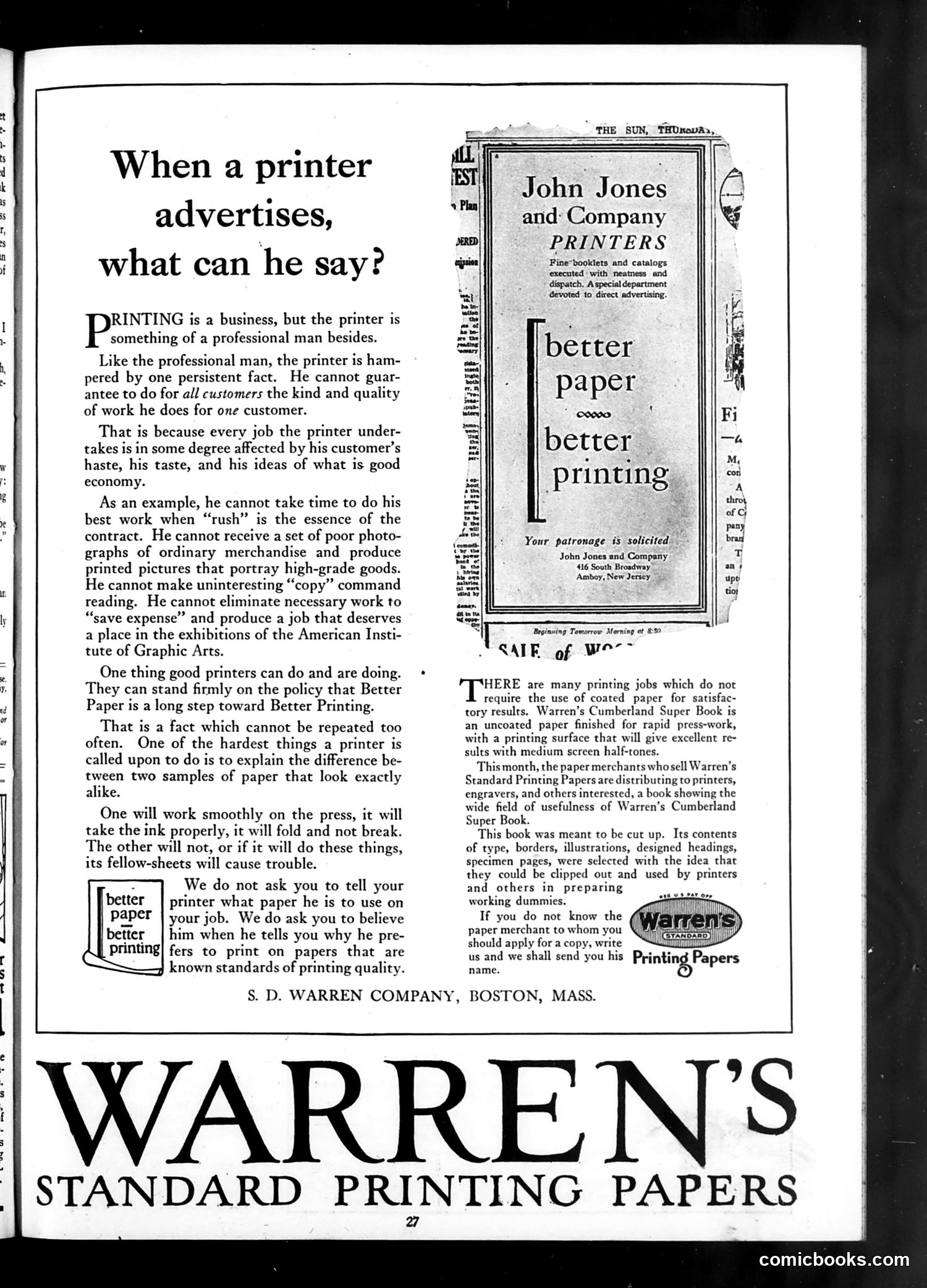
This page is **primarily advertising**, not satire or political commentary. It's a trade advertisement for Warren's Standard Printing Papers, presented as an editorial-style article in *Life* magazine. The main content argues that printers, as professionals, cannot guarantee uniform quality across all jobs because customer demands (rushing, poor photographs, cost-cutting) affect outcomes. The solution promoted is using better paper—specifically Warren's products—as a step toward "Better Printing." The accompanying John Jones and Company printer's advertisement (top right) reinforces this message with the slogan "better paper / better printing." **For modern readers**: This represents early 20th-century B2B marketing disguised as editorial content—a practice common in trade publications. The argument essentially positions quality paper as a professional standard that printers should insist upon, protecting their reputation despite customer pressures. There is no political satire or cartoon here; it's straightforward industry advertising.
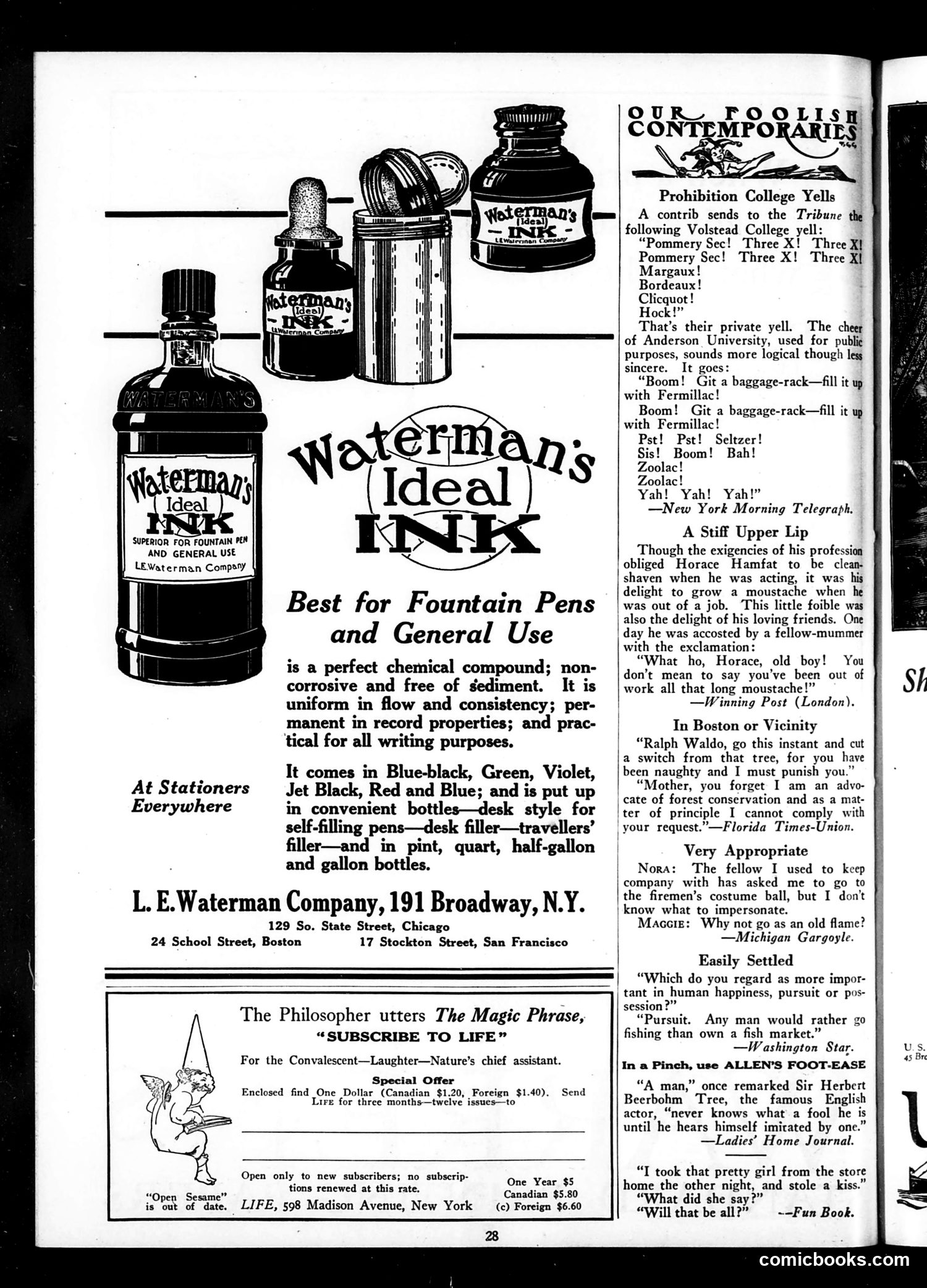
This page is primarily **advertising and humorous filler**, typical of Life magazine's format. The main advertisement promotes **Waterman's Ideal Ink** for fountain pens, showing various bottle sizes and listing available colors and retailers. The right column contains **"Our Foolish Contemporaries"**—satirical humor pieces mocking Prohibition-era college culture. The "Prohibition College Yells" section jokes about how colleges substituted references to champagne brands (Pommery, Bordeaux, Clicquot) and fake chemical names (Fermillac) in their cheers, replacing actual alcohol references with coded language to comply with the Volstead Act (Prohibition law). Below are miscellaneous humorous anecdotes about actors, parenting, relationships, and wordplay—typical period humor with no specific political targets. The page also includes a self-promotion for Life magazine subscriptions with a "Philosopher" character urging readers to "Subscribe to Life." The content reflects 1920s American culture during Prohibition, when coded references to alcohol became common social humor.
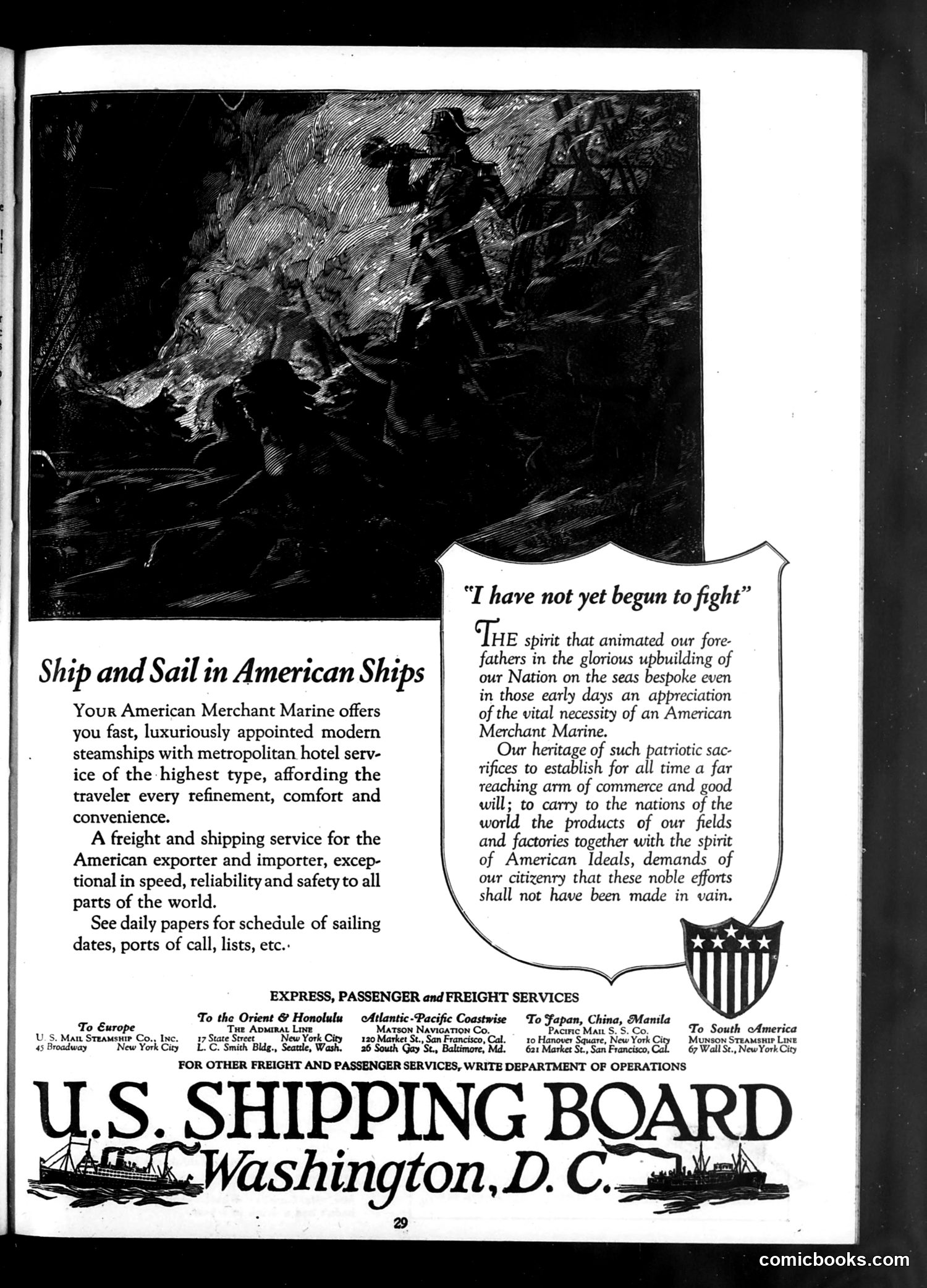
This is primarily an **advertisement for American shipping services**, not political satire. The page promotes the U.S. Shipping Board's merchant marine operations. The dark engraving at top appears to depict a **historical naval battle scene**, likely meant to evoke Revolutionary War or early American maritime heroism. The quoted phrase—"I have not yet begun to fight"—is attributed to John Paul Jones, the Revolutionary naval commander, establishing a patriotic historical reference. The advertisement uses this patriotic imagery strategically: it frames American commercial shipping as a continuation of the founders' legacy, arguing that maintaining a strong merchant marine serves both economic and nationalist purposes. The rhetoric emphasizes carrying American goods and "ideals" globally. For modern readers: this represents **wartime or post-WWI patriotic marketing**, when governments actively promoted domestic shipping industries as matters of national security and pride, not merely commerce. The fusion of Revolutionary history with commercial promotion reflects early-20th-century American nationalism.
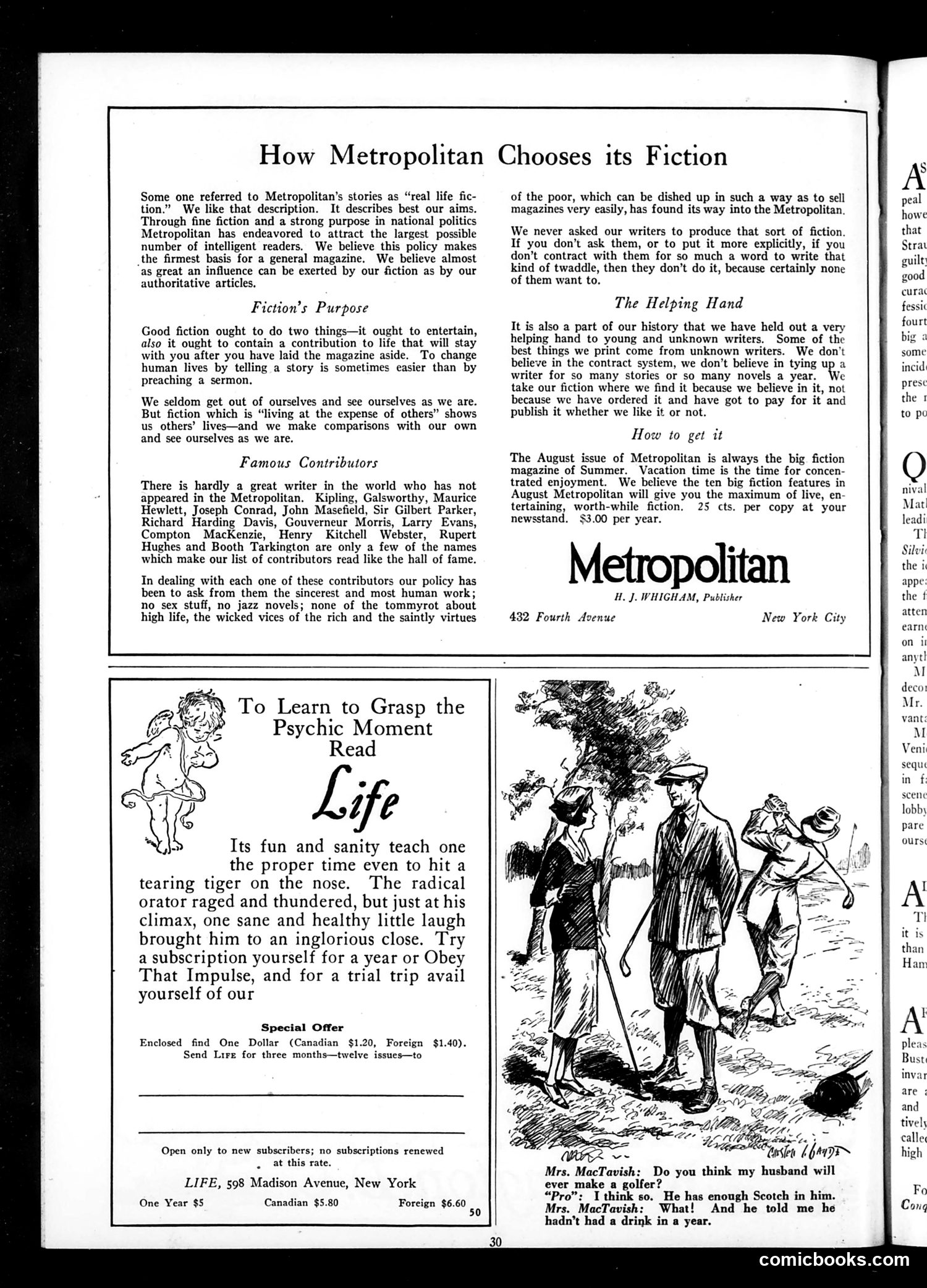
This page comprises **advertisements and publisher statements** rather than satirical cartoons with political content. The top section is Metropolitan Magazine's editorial explaining its fiction philosophy—emphasizing "real life" stories by famous writers (Kipling, Conrad, Masefield, etc.) while rejecting sensationalism about "high life" and "wicked vices of the rich." Below are two **magazine advertisements**: 1. **Life Magazine ad** (left): Promotes reading *Life* for humor and "psychic moments"—the ability to recognize proper timing for wit. References hitting "a tearing tiger on the nose" and silencing "radical orators" with laughter. This suggests *Life's* satirical purpose: using humor as social commentary. 2. **Metropolitan Magazine ad** (right): An illustration by (appears to be) John Held Jr. showing two men and a woman, with dialogue about golf and Scotch whisky—typical period humor about leisure activities and drinking (pre-Prohibition era). The joke is genteel rather than political. Neither contains identifiable political caricature or historical reference requiring modern context explanation.
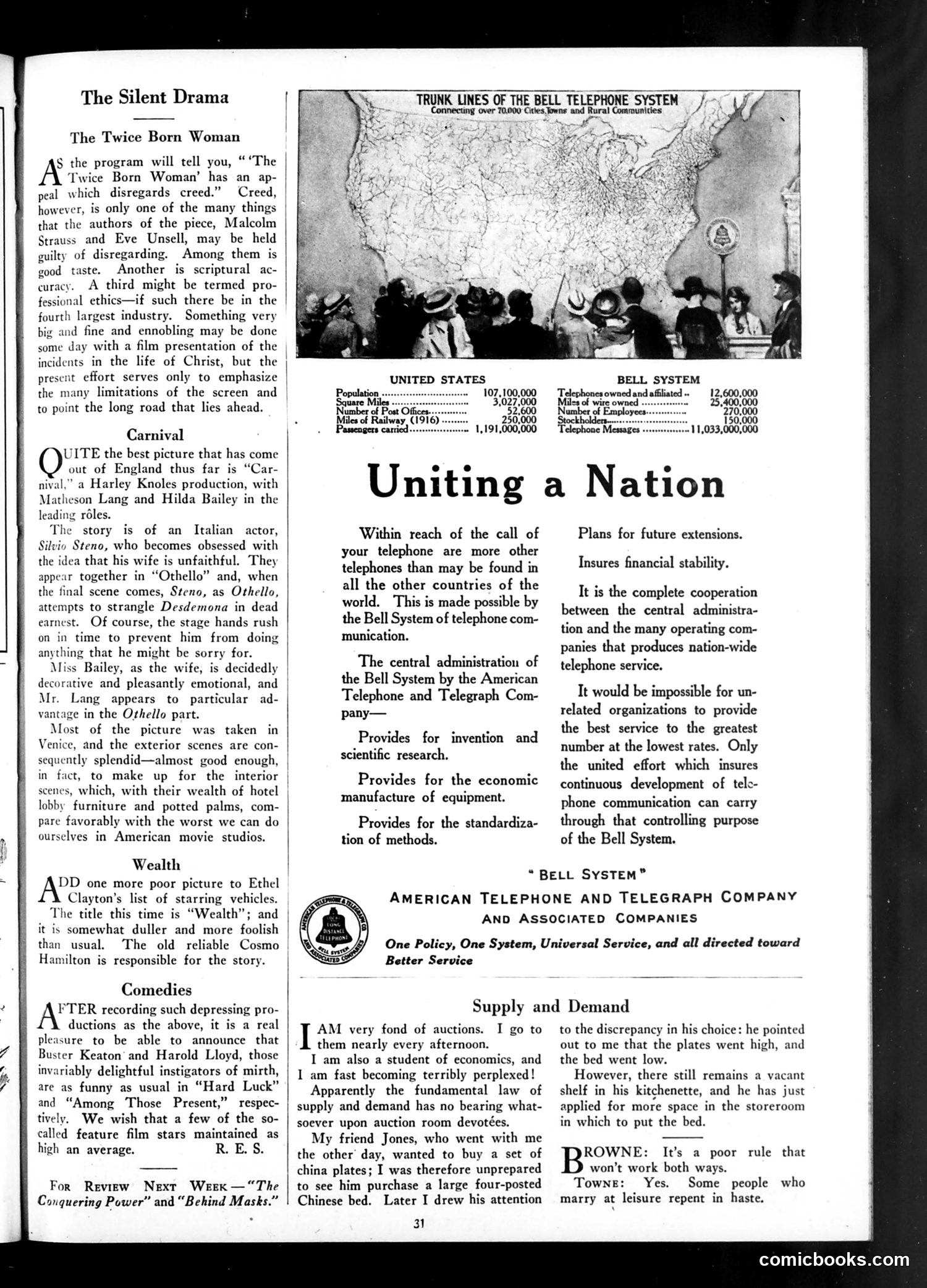
This page contains film reviews (left column) and a Bell Telephone System advertisement (right side). **Film Reviews:** Critics evaluate recent movies—"The Twice Born Woman" (dismissed for poor taste and scriptural inaccuracy in depicting Christ), "Carnival" (praised as England's best recent film, featuring an actor playing Othello who nearly strangles his co-star), "Wealth" (criticized as dull), and brief praise for comedies by Keaton and Lloyd. **Bell Advertisement:** The large ad features a map showing Bell's trunk telephone lines and argues that the Bell System's centralized administration enables superior nationwide service. It emphasizes standardization, research, and cooperation between central management and regional companies as essential to providing affordable, universal telephone access—a monopoly argument disguised as civic infrastructure messaging. The juxtaposition is notable: entertainment criticism adjacent to corporate propaganda celebrating unified, centralized control.
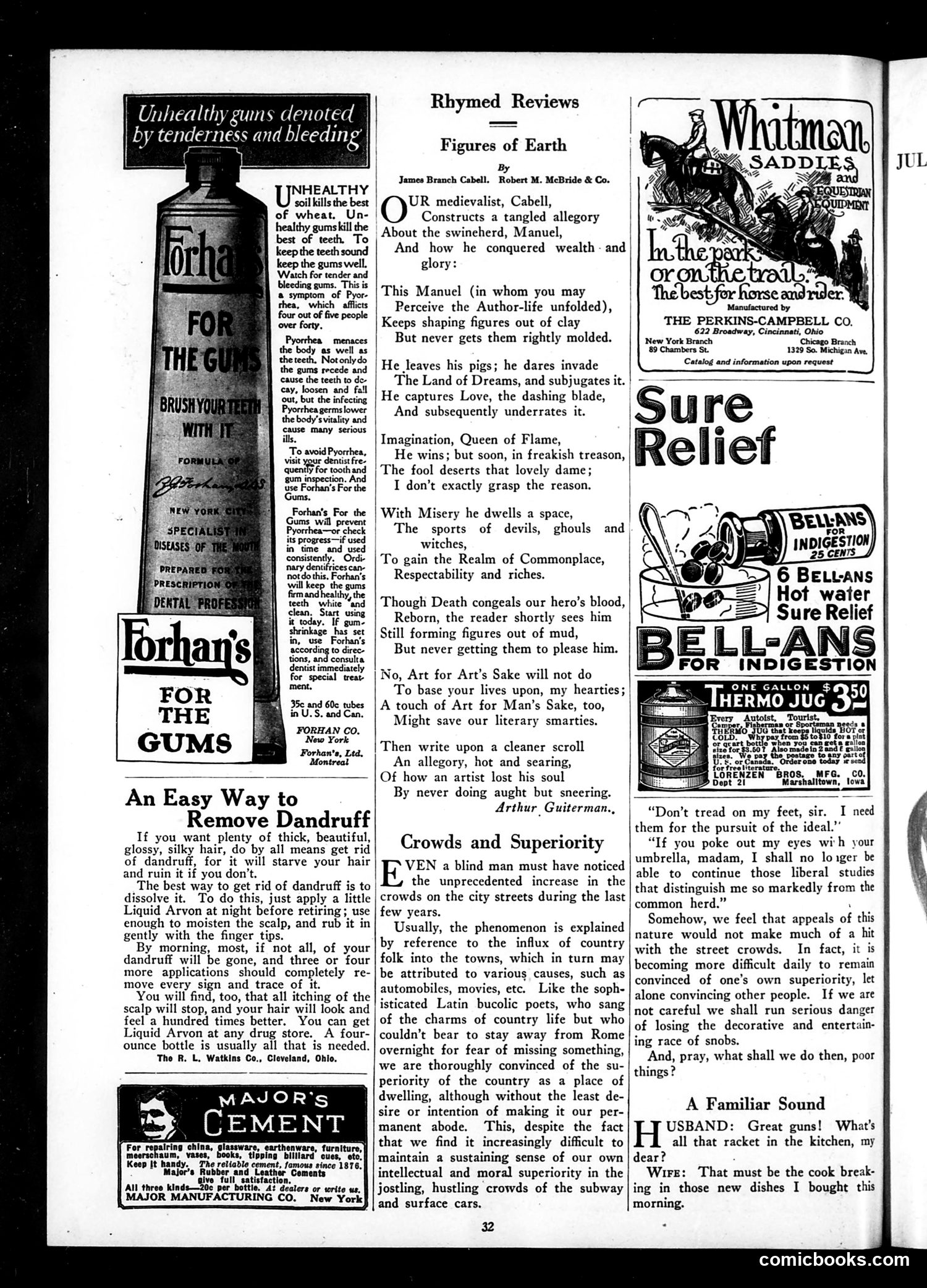
This page combines advertisements with literary and social commentary typical of early 20th-century Life magazine. **Advertisements:** The left side features tooth and hair-care products (Forhan's toothpaste for gum disease, Liquid Arvon dandruff treatment, Mayor's Cement) using pseudo-medical language to market hygiene products—common in this era before FDA regulations. **Literary Content:** Arthur Guiterman's rhymed review critiques James Branch Cabell's novel *Figures of Earth*, satirizing the protagonist Manuel as an artist figure who endlessly reshapes clay but never perfects his creations. The review suggests Cabell prioritizes aesthetic sneering over meaningful artistic purpose. **Social Satire:** "Crowds and Superiority" observes increased urban street crowds, attributing this partly to rural migration. It satirizes educated people who romanticize country life while remaining unable to leave cities—a commentary on class pretension and the tension between rural and urban values during America's industrialization period. The page reflects Jazz Age anxieties about art, modernity, and social mobility.