
Life, 1921-07-21 · page 7 of 34
Life — July 21, 1921 — page 7: what you’re looking at
What you’re looking at
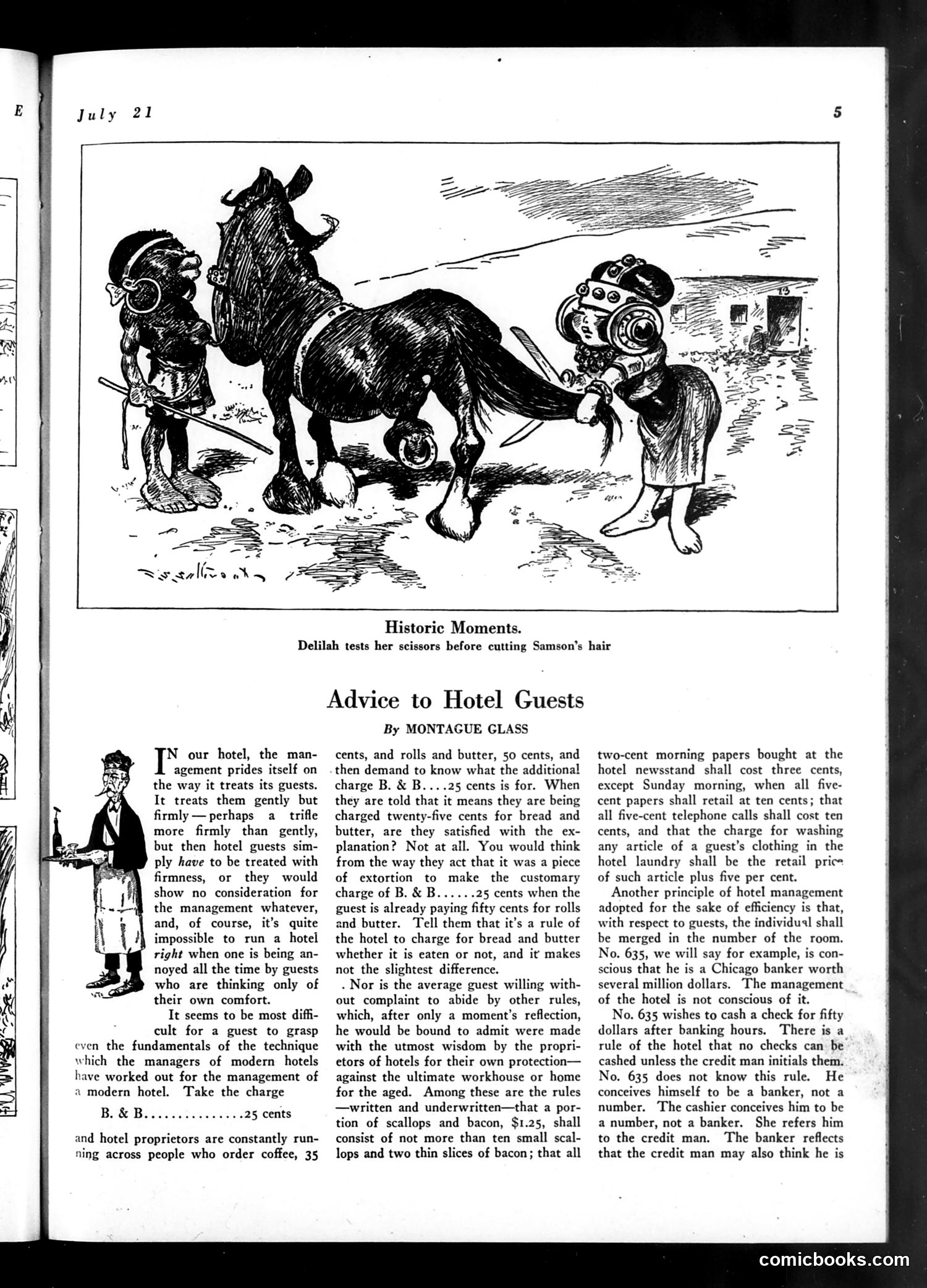
The top cartoon, titled "Historic Moments," depicts a biblical scene: Delilah testing scissors before cutting Samson's hair. The image shows two figures in caricatured style (appearing to represent people from a non-Western culture) with a horse, playing on the Samson and Delilah narrative from the Book of Judges. The article below, "Advice to Hotel Guests" by Montague Glass, is satirical commentary on hotel management practices. It critiques how hotels impose various charges on guests—for bread, butter, rolls, and other items—arguing these fees are excessive and lack transparency. The piece mocks the bureaucratic rules hotels hide behind to justify nickel-and-diming customers, using specific examples like the "B. & B." (bed and breakfast) charge of 25 cents to illustrate the absurdity of hospitality industry pricing.
📄 Transcribed text from this page (OCR, searchable)
Machine-transcribed from the original scan — historical spelling and the odd misread are preserved.
Historic Moments. Delilah tests her scissors before cutting Samson’s hair N our hotel, the man- agement prides itself on the way it treats its guests. It treats them gently but firmly— perhaps a_ trifle more firmly than gently, but then hotel guests sim- ply have to be treated with firmness, or they would show no consideration for the management whatever, and, of course, it’s quite impossible to run a_ hotel ' right when one is being an- noyed all the time by guests who are thinking only of their own comfort. It seems to be most diffi- cult for a guest to grasp even the fundamentals of the technique which the managers of modern hotels have worked out for the management of « modern hotel. Take the charge 25 cents and hotel proprietors are constantly run- ning across people who order coffee, 35 Advice to Hotel Guests By MONTAGUE GLASS cents, and rolls and butter, 50 cents, and then demand to know what the additional charge B. & B....25 cents is for. When they are told that it means they are being charged twenty-five cents for bread and butter, are they satisfied with the ex- planation? Not at all. You would think from the way they act that it was a piece of extortion to make the customary charge of B. & B 25 cents when the guest is already paying fifty cents for rolls and butter. Tell them that it’s a rule of the hotel to charge for bread and butter whether it is eaten or not, and it makes not the slightest difference. - Nor is the average guest willing with- out complaint to abide by other rules, which, after only a moment's reflection, he would be bound to admit were made with the utmost wisdom by the propri- etors of hotels for their own protection— against the ultimate workhouse or home for the aged. Among these are the rules —written and underwritten—that a por- tion of scallops and bacon, $1.25, shall consist of not more than ten small scal- lops and two thin slices of bacon; that all two-cent morning papers bought at the hotel newsstand shall cost three cents, except Sunday morning, when all five- cent papers shall retail at ten cents; that all five-cent telephone calls shall cost ten cents, and that the charge for washing any article of a guest’s clothing in the hotel laundry shall be the retail price of such article plus five per cent. Another principle of hotel management adopted for the sake of efficiency is that, with respect to guests, the individual shall be merged in the number of the room. No. 635, we will say for example, is con- scious that he is a Chicago banker worth several million dollars. The management of the hotel is not conscious of it. No. 635 wishes to cash a check for fifty dollars after banking hours. There is a rule of the hotel that no checks can be cashed unless the credit man initials them. No. 635 does not know this rule. He conceives himself to be a banker, not a number. The cashier conceives him to be a number, not a banker. She refers him to the credit man. The banker reflects that the credit man may also think he is comicbooks.com