
Life, 1921-07-21 · page 12 of 34
Life — July 21, 1921 — page 12: what you’re looking at
What you’re looking at
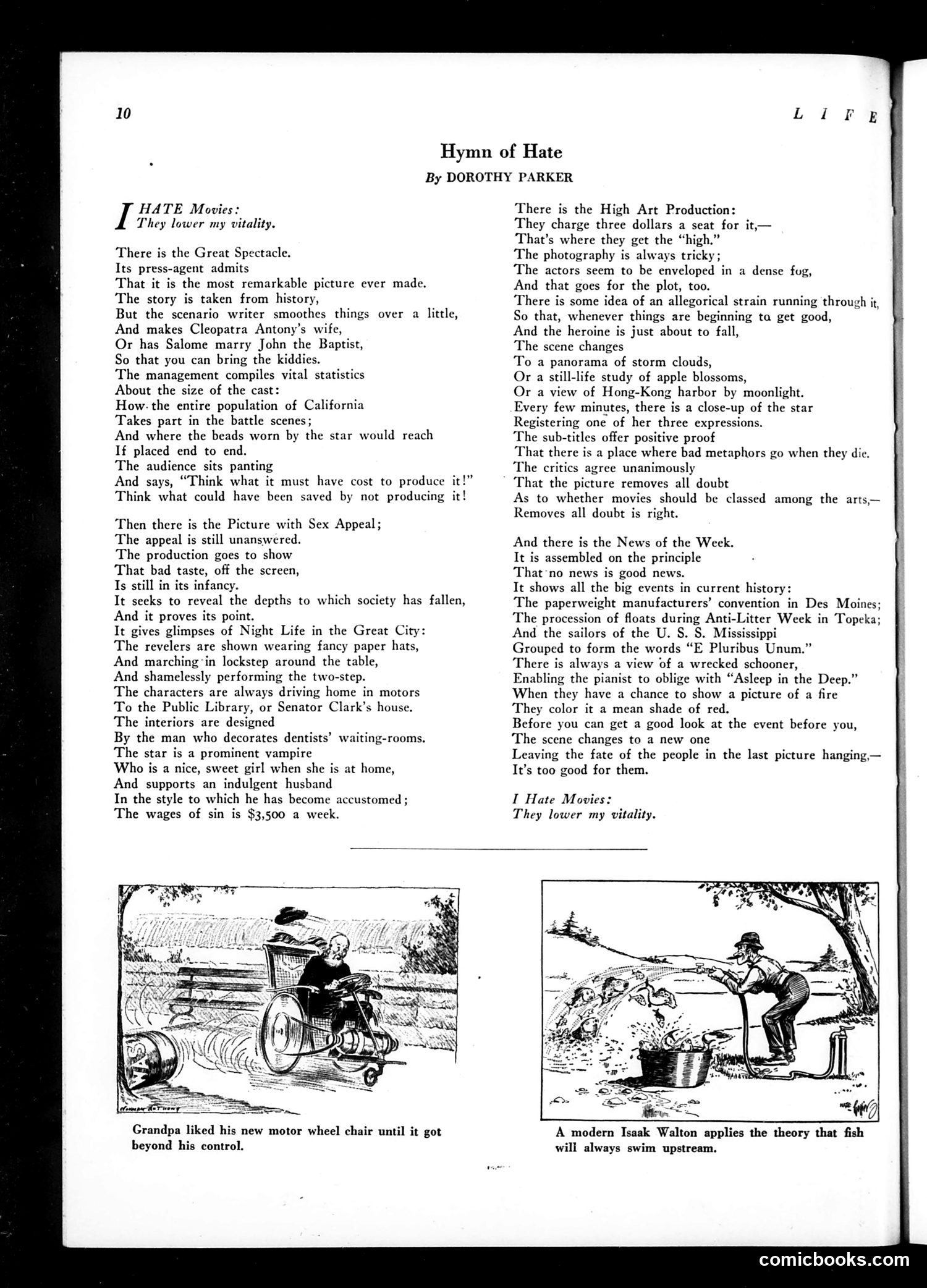
This page presents Parker's satirical poem attacking Hollywood cinema of the era. The poem mocks: **The industry's pretensions**: Expensive productions charging high ticket prices ($3) while delivering poor quality and contrived plots. **Formulaic filmmaking**: Scripts that interrupt dramatic moments with scene changes to exotic locations (Hong Kong, storm clouds) whenever tension builds—a common editing technique to maintain audience interest. **Production absurdities**: Vast resources spent on casting entire California populations for battle scenes, yet the result still showcases bad taste and predictable storytelling. **The "News of the Week" segment**: A filler feature with deliberately bland content ("no news is good news"), meant to pad the program. The two cartoons below use visual humor to mock outdated ideas: a grandfather losing control of a motorized wheelchair, and a fishing scene referencing Isaac Walton's classical fishing theories applied absurdly to modern situations.
📄 Transcribed text from this page (OCR, searchable)
Machine-transcribed from the original scan — historical spelling and the odd misread are preserved.
Hymn of Hate By DOROTHY PARKER HATE Movies: They lower my vitality. There is the Great Spectacle. Its press-agent admits That it is the most remarkable picture ever made. The story is taken from history, But the scenario writer smoothes things over a little, And makes Cleopatra Antony’s wife, Or has Salome marry John the Baptist, So that you can bring the kiddies. The management compiles vital statistics About the size of the cast: How. the entire population of California Takes part in the battle scenes; And where the beads worn by the star would reach If placed end to end. The audience sits panting And says, “Think what it must have cost to produce it!” Think what could have been saved by not producing it! Then there is the Picture with Sex Appeal; The appeal is still unanswered. The production goes to show That bad taste, off the screen, Is still in its infancy. It seeks to reveal the depths to which society has fallen, And it proves its point. It gives glimpses of Night Life in the Great City: The revelers are shown wearing fancy paper hats, And marching‘in lockstep around the table, And shamelessly performing the two-step. The characters are always driving home in motors To the Public Library, or Senator Clark's house. The interiors are designed By the man who decorates dentists’ waiting-rooms. The star is a prominent vampire Who is a nice, sweet girl when she is at home, And supports an indulgent husband In the style to which he has become accustomed ; The wages of sin is $3,500 a week. There is the High Art Production: They charge three dollars a seat for it,— That’s where they get the “high.” The photography is always tricky; The actors seem to be enveloped in a dense fog, And that goes for the plot, too. There is some idea of an allegorical strain running through it, So that, whenever things are beginning ta get good, And the heroine is just about to fall, The scene changes To a panorama of storm clouds, Or a still-life study of apple blossoms, Or a view of Hong-Kong harbor by moonlight. Every few minutes, there is a close-up of the star Registering one of her three expressions. The sub-titles offer positive proof That there is a place where bad metaphors go when they die. The critics agree unanimously That the picture removes all doubt As to whether movies should be classed among the arts— Removes all doubt is right. And there is the News of the Week. It is assembled on the principle That'no news is good news. It shows all the big events in current history: ‘The paperweight manufacturers’ convention in Des Moines; The procession of floats during Anti-Litter Week in Topeka; And the sailors of the U. S. S. Mississippi Grouped to form the words “E Pluribus Unum.” There is always a view of a wrecked schooner, Enabling the pianist to oblige with “Asleep in the Deep.” When they have a chance to show a picture of a fire They color it a mean shade of red. Before you can get a good look at the event before you, The scene changes to a new one Leaving the fate of the people in the last picture hanging,— It’s too good for them. I Hate Movies: They lower my vitality. Grandpa liked his new motor wheel chair until it got beyond his control. A modern Isaak Walton applies the theory that fish will always swim upstream. comicbooks.com