
Life, 1921-07-21 · page 27 of 34
Life — July 21, 1921 — page 27: what you’re looking at
What you’re looking at
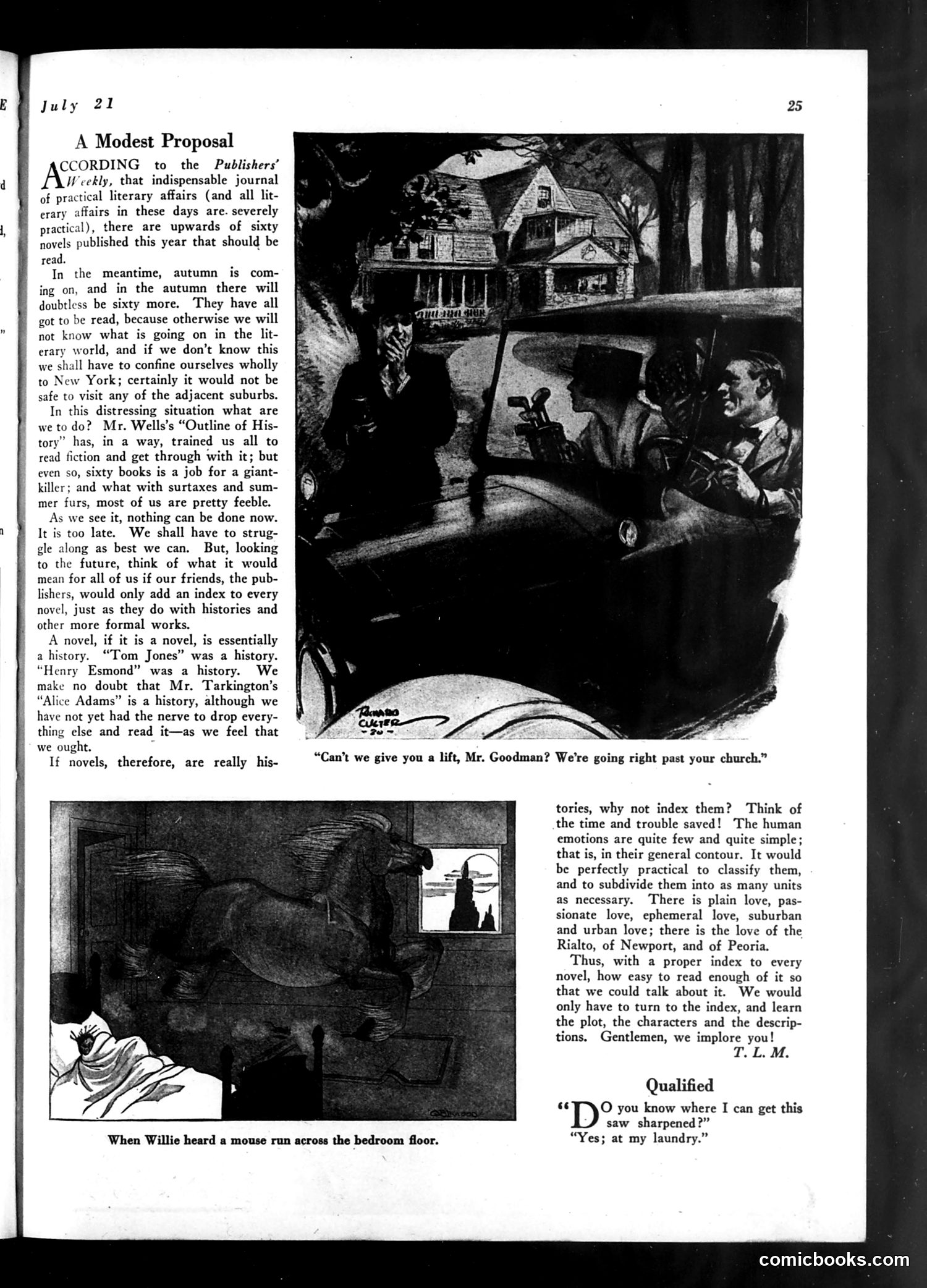
**"A Modest Proposal"** is satirical commentary on the publishing industry's overproduction of novels. The author (T.L.M.) ironically proposes that publishers add indexes to novels—treating them like reference books—so readers can skip through them and just look up plot summaries, characters, and emotional content without actually reading. The satire mocks both reader laziness and publisher excess: with 60+ novels annually demanding attention, readers are overwhelmed. By suggesting novels be indexed by emotion type ("plain love," "suburban love," etc.), the piece ridicules the formulaic nature of popular fiction while highlighting the impracticality of keeping up with literary output. The two illustrations are unrelated light humor: the first shows a car near a church with the caption about giving "a life"; the second depicts someone startled by a mouse in the bedroom. These are separate comic pieces, not connected to the main essay.
📄 Transcribed text from this page (OCR, searchable)
Machine-transcribed from the original scan — historical spelling and the odd misread are preserved.
July 21 A Modest Proposal YRDING to the Publishers’ Weekly, that indispensable journal al literary affairs (and all lit- practical), there are upwards of sixty novels published this year that should be read. In the meantime, autumn is com- ing on, and in the autumn there will doubtless be sixty more. They have all got to be read, because otherwise we will not know what is going on in the lit- erary world, and if we don’t know this all have to confine ourselves wholly to New York; certainly it would not be safe to visit any of the adjacent suburbs. In this distressing situation what are we todo? Mr. Wells’s “Outline of His- tory” has, in a way, trained us all to read fiction and get through with it; but even so, sixty books is a job for a giant- killer; and what with surtaxes and sum- mer furs, most of us are pretty feeble. As we see it, nothing can be done now. It is too late. We shall have to strug- gle along as best we can. But, looking to the future, think of what it would mean for all of us if our friends, the pub- lishers, would only add an index to every novel, just as they do with histories and other more formal works. A novel, if it is a novel, is essentially a history. “Tom Jones” was a history. “Henry Esmond” was a history. We make no doubt that Mr. Tarkington’s “Alice Adams” is a history, although we have not yet had the nerve to drop every- thing else and read it—as we feel that we ought. If novels, therefore, are really his- tories, why not index them? Think of the time and trouble saved! The human emotions are quite few and quite simple; that is, in their general contour. It would be perfectly practical to classify them, and to subdivide them into as many units as necessary. There is plain love, pas- sionate love, ephemeral love, suburban and urban love; there is the love of the Rialto, of Newport, and of Peoria. Thus, with a proper index to every novel, how easy to read enough of it so that we could talk about it. We would only have to turn to the index, and learn the plot, the characters and the descrip- tions. Gentlemen, we implore you! T. L. M. Qualified “ O you know where I can get this saw sharpened?” ‘When Willie heard a mouse run across the bedroom floor. ‘Yes; at my laundry.” comicbooks.com