
Life, 1921-07-21 · page 16 of 34
Life — July 21, 1921 — page 16: what you’re looking at
What you’re looking at
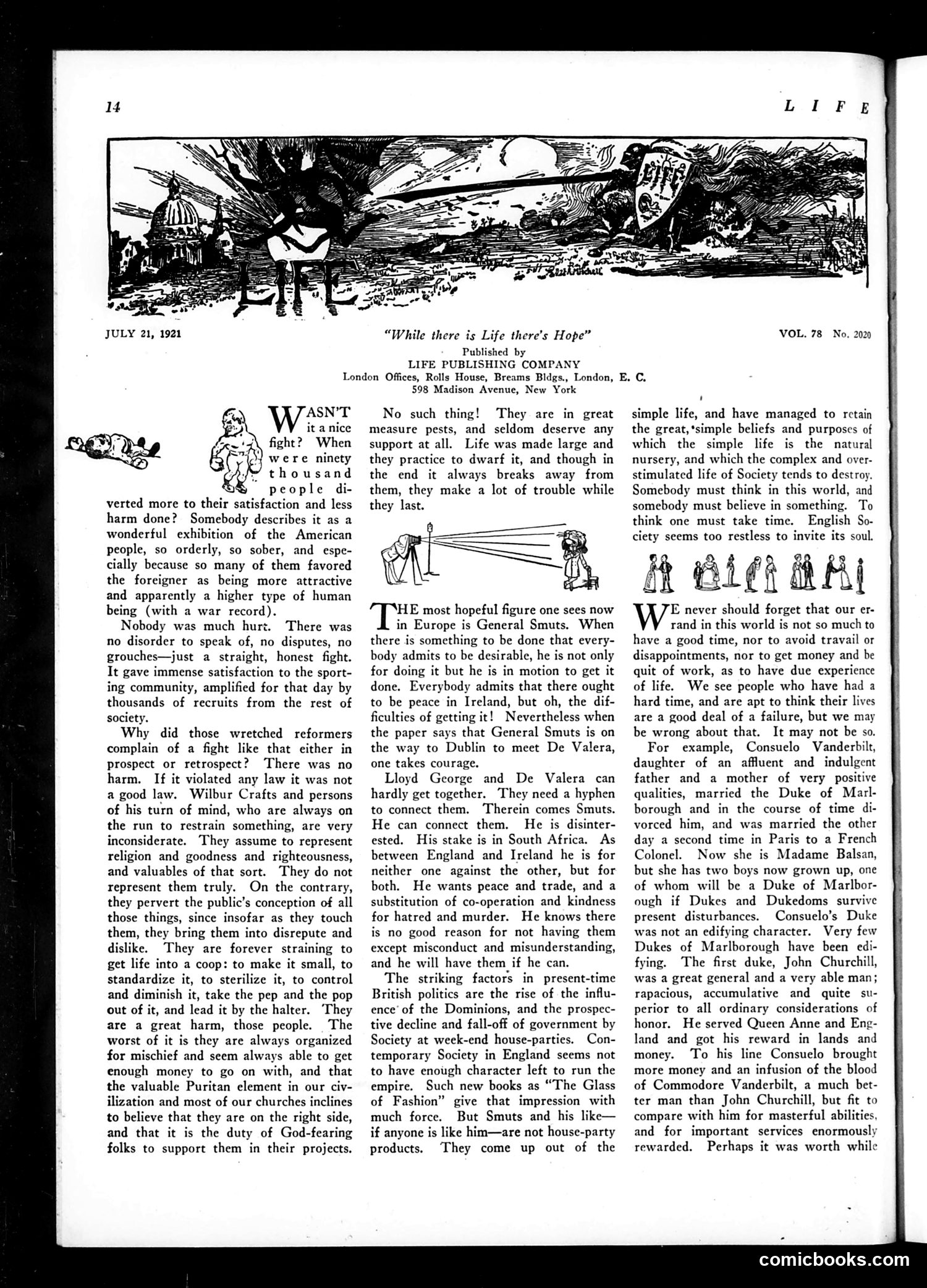
This page contains an editorial article rather than political cartoons. The text discusses European politics and British society, with particular focus on **General Smuts** (a South African political/military figure) as a "hopeful figure" in post-WWI Europe. The article critiques English reformers and intellectuals who it claims are out of touch with practical governance. It references **De Valera** and Irish independence negotiations, suggesting Smuts might help broker peace between competing factions. The piece also satirizes contemporary English high society, mocking wealthy socialites and their "house-parties" for superficiality while claiming they lack genuine character needed to run the country effectively. Small decorative illustrations accompany the text but aren't primary satirical cartoons—they're ornamental flourishes typical of 1920s magazine design.
📄 Transcribed text from this page (OCR, searchable)
Machine-transcribed from the original scan — historical spelling and the odd misread are preserved.
JULY 21, 1921 “While there is Life there's Hope” Published by LIFE PUBLISHING COMPANY VOL. 78 No. 2020 London Offices, Rolls House, Breams Bldgs., London, E. C, ASN’T B it a nice ar fight? When Bi were ninety ~ thousand ©! people di- verted more to their satisfaction and less harm done? Somebody describes it as a wonderful exhibition of the American people, so orderly, so sober, and espe- cially because so many of them favored the foreigner as being more attractive and apparently a higher type of human being (with a war record). Nobody was much hurt. There was no disorder to speak of, no disputes, no grouches—just a straight, honest fight. It gave immense satisfaction to the sport- ing community, amplified for that day by thousands of recruits from the rest of society. Why did those wretched reformers complain of a fight like that either in prospect or retrospect? There was no harm. If it violated any law it was not a good law. Wilbur Crafts and persons of his turn of mind, who are always on the run to restrain something, are very inconsiderate. They assume to represent religion and goodness and righteousness, and valuables of that sort. They do not represent them truly. On the contrary, they pervert the public’s conception of all those things, since insofar as they touch them, they bring them into disrepute and dislike. They are forever straining to get life into a coop: to make it small, to standardize it, to sterilize it, to control and diminish it, take the pep and the pop out of it, and lead it by the halter. ‘They are a great harm, those people. The worst of it is they are always organized for mischief and seem always able to get enough money to go on with, and that the valuable Puritan element in our ciy- ilization and most of our churches inclines to believe that they are on the right side, and that it is the duty of God-fearing folks to support them in their projects. 598 Madison Avenue, New York No such thing! They are in great measure pests, and seldom deserve any support at all. Life was made large and they practice to dwarf it, and though in the end it always breaks away from them, they make a lot of trouble while they last. ‘HE most hopeful figure one sees now in Europe is General Smuts. When there is something to be done that every- body admits to be desirable, he is not only for doing it but he is in motion to get it done. Everybody admits that there ought to be peace in Ireland, but oh, the dif- ficulties of getting it! Nevertheless when the paper says that General Smuts is on the way to Dublin to meet De Valera, one takes courage. Lloyd George and De Valera can hardly get together. They need a hyphen to connect them. Therein comes Smuts. He can connect them. He is disinter- ested. His stake is in South Africa. As between England and Ireland he is for neither one against the other, but for both. He wants peace and trade, and a substitution of co-operation and kindness for hatred and murder. He knows there is no good reason for not having them except misconduct and misunderstanding, and he will have them if he can. The striking factors in present-time British politics are the rise of the influ- ence’ of the Dominions, and the prospec- tive decline and fall-off of government by Society at week-end house-parties. Con- temporary Society in England seems not to have enough character left to run the empire. Such new books as “The Glass of Fashion” give that impression with much force. But Smuts and his like— if anyone is like him—are not house-party products. They come up out of the simple life, and have managed to retain the great,*simple beliefs and purposes of which the simple life is the natural nursery, and which the complex and over- stimulated life of Society tends to destroy. Somebody must think in this world, and somebody must believe in something. To think one must take time. English So- ciety seems too restless to invite its soul. eit MAl E never should forget that our er- rand in this world is not so much to have a good time, nor to avoid travail or disappointments, nor to get money and be quit of work, as to have due experience of life. We see people who have had a hard time, and are apt to think their lives are a good deal of a failure, but we may be wrong about that. It may not be so. For example, Consuelo Vanderbilt, daughter of an affluent and indulgent father and a mother of very positive qualities, married the Duke of Marl- borough and in the course of time di- vorced him, and was married the other day a second time in Paris to a French Colonel. Now she is Madame Balsan, but she has two boys now grown up, one of whom will be a Duke of Marlbor- ough if Dukes and Dukedoms survive present disturbances. Consuelo’s Duke was not an edifying character. Very few Dukes of Marlborough have been edi- fying. The first duke, John Churchill, was a great general and a very able man; rapacious, accumulative and quite su- perior to all ordinary considerations of honor. He served Queen Anne and Eng- land and got his reward in lands and money. To his line Consuelo brought more money and an infusion of the blood of Commodore Vanderbilt, a much bet- ter man than John Churchill, but fit to compare with him for masterful abilities, and for important services enormously rewarded. Perhaps it was worth while comicbooks.com