
Life, 1921-07-21 · page 10 of 34
Life — July 21, 1921 — page 10: what you’re looking at
What you’re looking at
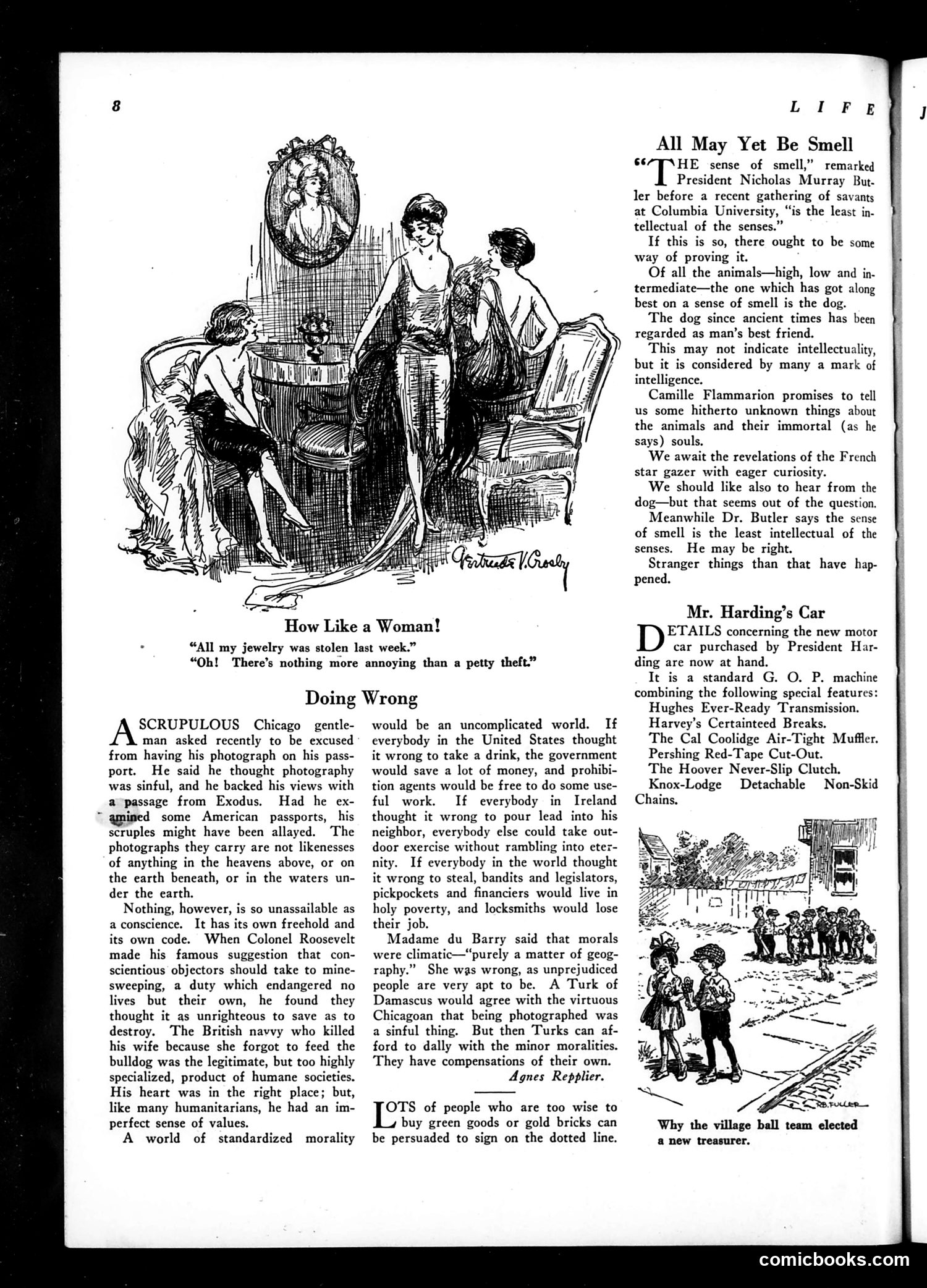
The main illustration depicts a woman complaining to three other women about stolen jewelry, with one responding dismissively: "Oh! There's nothing more annoying than a petty theft." The satire mocks women's perceived priorities and values. The cartoon suggests that women obsess over trivial matters (jewelry theft) while claiming moral superiority. The title "How Like a Woman!" emphasizes the stereotype that women are emotionally driven and preoccupied with material possessions rather than substantive concerns. This reflects early 20th-century gender stereotypes common in Life magazine's satirical humor—portraying women as shallow, vain, and prone to exaggeration over minor personal losses. The joke relies on dismissing women's concerns as inherently petty.
📄 Transcribed text from this page (OCR, searchable)
Machine-transcribed from the original scan — historical spelling and the odd misread are preserved.
How Like a Woman! “All my jewelry was stolen last week.” “Oh! There’s nothing more annoying than a petty theft.” Doing Wrong SCRUPULOUS Chicago gentle- man asked recently to be excused from having his photograph on his pass- port. He said he thought photography was sinful, and he backed his views with a passage from Exodus. Had he ex- ined some American passports, his scruples might have been allayed. The photographs they carry are not likenesses of anything in the heavens above, or on the earth beneath, or in the waters un- der the earth. Nothing, however, is so unassailable as aconscience. It has its own freehold and its own code. When Colonel Roosevelt made his famous suggestion that con- scientious objectors should take to mine- sweeping, a duty which endangered no lives but their own, he found they thought it as unrighteous to save as to destroy. The British navvy who killed his wife because she forgot to feed the bulldog was the legitimate, but too highly specialized, product of humane societies. His heart was in the right place; but, like many humanitarians, he had an im- perfect sense of values. A world of standardized morality would be an uncomplicated world. If everybody in the United States thought it wrong to take a drink, the government would save a lot of money, and prohibi- tion agents would be free to do some use- ful work. If everybody in Ireland thought it wrong to pour lead into his neighbor, everybody else could take out- door exercise without rambling into etez- nity. If everybody in the world thought it wrong to steal, bandits and legislators, pickpockets and financiers would live in holy poverty, and locksmiths would lose their job. Madame du Barry said that morals were climatic—“purely a matter of geog- raphy.” She was wrong, as unprejudiced people are very apt to be. A Turk of Damascus would agree with the virtuous Chicagoan that being photographed was a sinful thing. But then Turks can af- ford to dally with the minor moralities. ‘They have compensations of their own. Agnes Repplier. OTS of people who are too wise to buy green goods or gold bricks can be persuaded to sign on the dotted line. LIFe All May Yet Be Smell 6s HE sense of smell,” remarked President Nicholas Murray But- ler before a recent gathering of savants at Columbia University, “is the least in- tellectual of the senses.” If this is so, there ought to be some way of proving it. Of all the animals—high, low and in- termediate—the one which has got along best on a sense of smell is the dog. The dog since ancient times has been regarded as man’s best friend. This may not indicate intellectuality, but it is considered by many a mark of intelligence. Camille Flammarion promises to tell us some hitherto unknown things about the animals and their immortal (as he says) souls, We await the revelations of the French star gazer with eager curiosity. We should like also to hear from the dog—but that seems out of the question. Meanwhile Dr. Butler says the sense of smell is the least intellectual of the senses. He may be right. Stranger things than that have hap- pened. Mr. Harding’s Car ETAILS concerning the new motor car purchased by President Har- ding are now at hand. It is a standard G. O. P. machine combining the following special features: Hughes Ever-Ready Transmission. Harvey’s Certainteed Breaks. The Cal Coolidge Air-Tight Muffler. Pershing Red-Tape Cut-Out. The Hoover Never-Slip Clutch. Knox-Lodge Detachable Non-Skid Chains. a new treasurer. comicbooks.com