
Life, 1921-07-21 · page 20 of 34
Life — July 21, 1921 — page 20: what you’re looking at
A restored page from Life, 1921-07-21. Page through the whole issue in the reader above.
📄 Transcribed text from this page (OCR, searchable)
Machine-transcribed from the original scan — historical spelling and the odd misread are preserved.
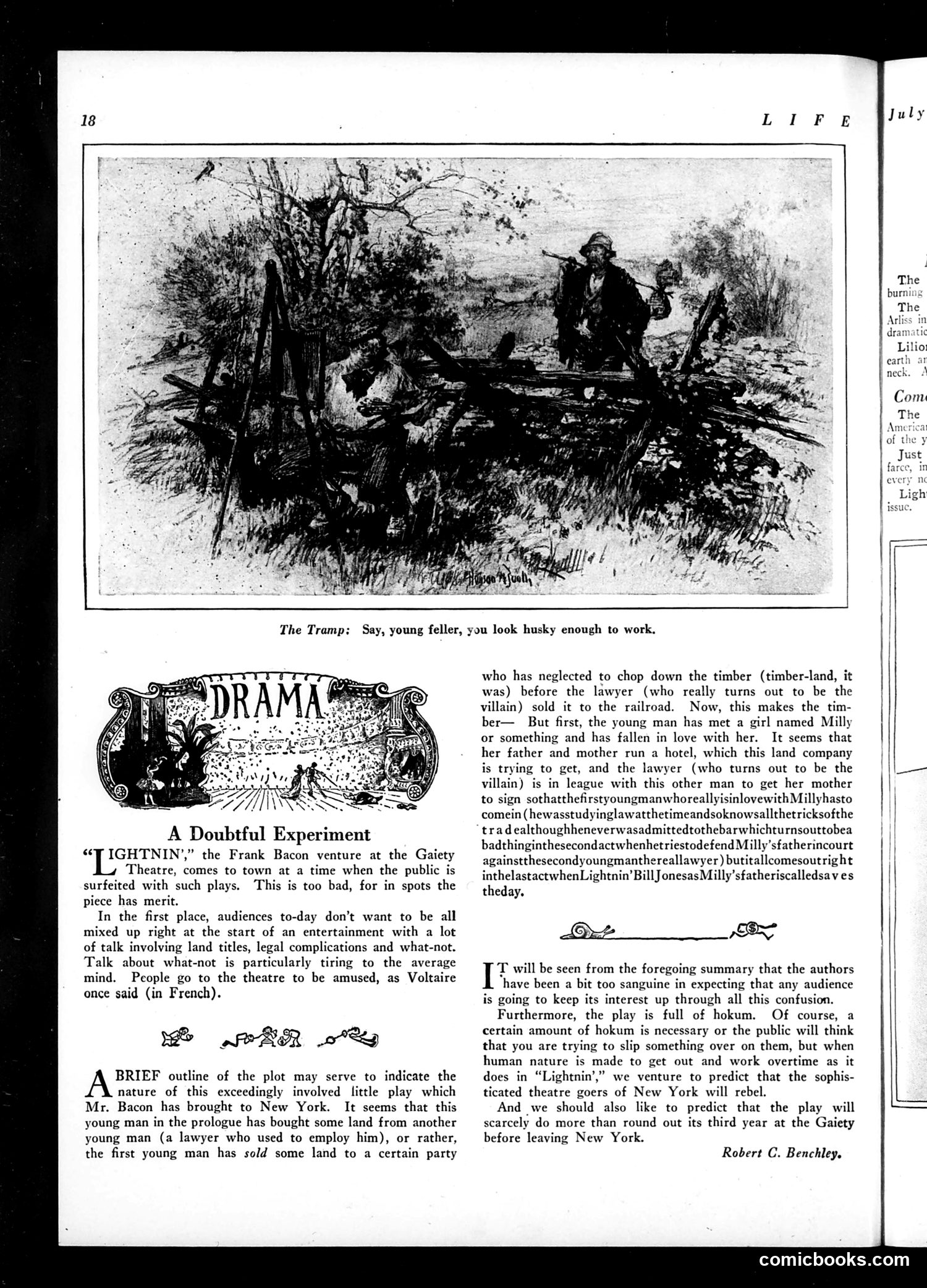
The Tramp: A Doubtful Experiment “PT IGHTNIN’,” the Frank Bacon venture at the Gaiety Theatre, comes to town at a time when the public is surfeited with such plays. piece has merit. In the first place, audiences to-day don’t want to be all mixed up right at the start of an entertainment with a lot of talk involving land titles, legal complications and what-not. Talk about what-not is particularly tiring to the average mind. People go to the theatre to be amused, as Voltaire once said (in French). > PBR 0% BRIEF outline of the plot may serve to indicate the nature of this exceedingly involved little play which Mr. Bacon has brought to New York. It seems that this young man in the prologue has bought some land from another young man (a lawyer who used to employ him), or rather, the first young man has sold some land to a certain party This is too bad, for in spots the Say, young feller, you look husky enough to work. who has neglected to chop down the timber (timber-land, it was) before the lawyer (who really turns out to be the villain) sold it to the railroad. Now, this makes the tim- ber— But first, the young man has met a girl named Milly or something and has fallen in love with her. It seems that her father and mother run a hotel, which this land company is trying to get, and the lawyer (who turns out to be the villain) is in league with this other man to get her mother to sign sothatthefirstyoungmanwhoreallyisinlovewithMillyhasto comein ( hewasstudyinglawatthetimeandsoknowsallthetricksofthe tradealthoughheneverwasadmittedtothebarwhichturnsouttobea badthinginthesecondactwhenhetriestodefend Milly’sfatherincourt againstthesecondyoungmanthereallawyer) butitallcomesoutright inthelastactwhenLightnin’ Bill J onesasMilly’sfatheriscalledsav es theday, Ot ___ 8 T will be seen from the foregoing summary that the authors have been a bit too sanguine in expecting that any audience is going to keep its interest up through all this confusion. Furthermore, the play is full of hokum. Of course, a certain amount of hokum is necessary or the public will think that you are trying to slip something over on them, but when human nature is made to get out and work overtime as it does in “Lightnin’,” we venture to predict that the sophis- ticated theatre goers of New York will rebel. And we should also like to predict that the play will scarcely do more than round out its third year at the Gaiety before leaving New York. Robert C. Benchley, comicbooks.com