
Life, 1921-07-21 · page 14 of 34
Life — July 21, 1921 — page 14: what you’re looking at
What you’re looking at
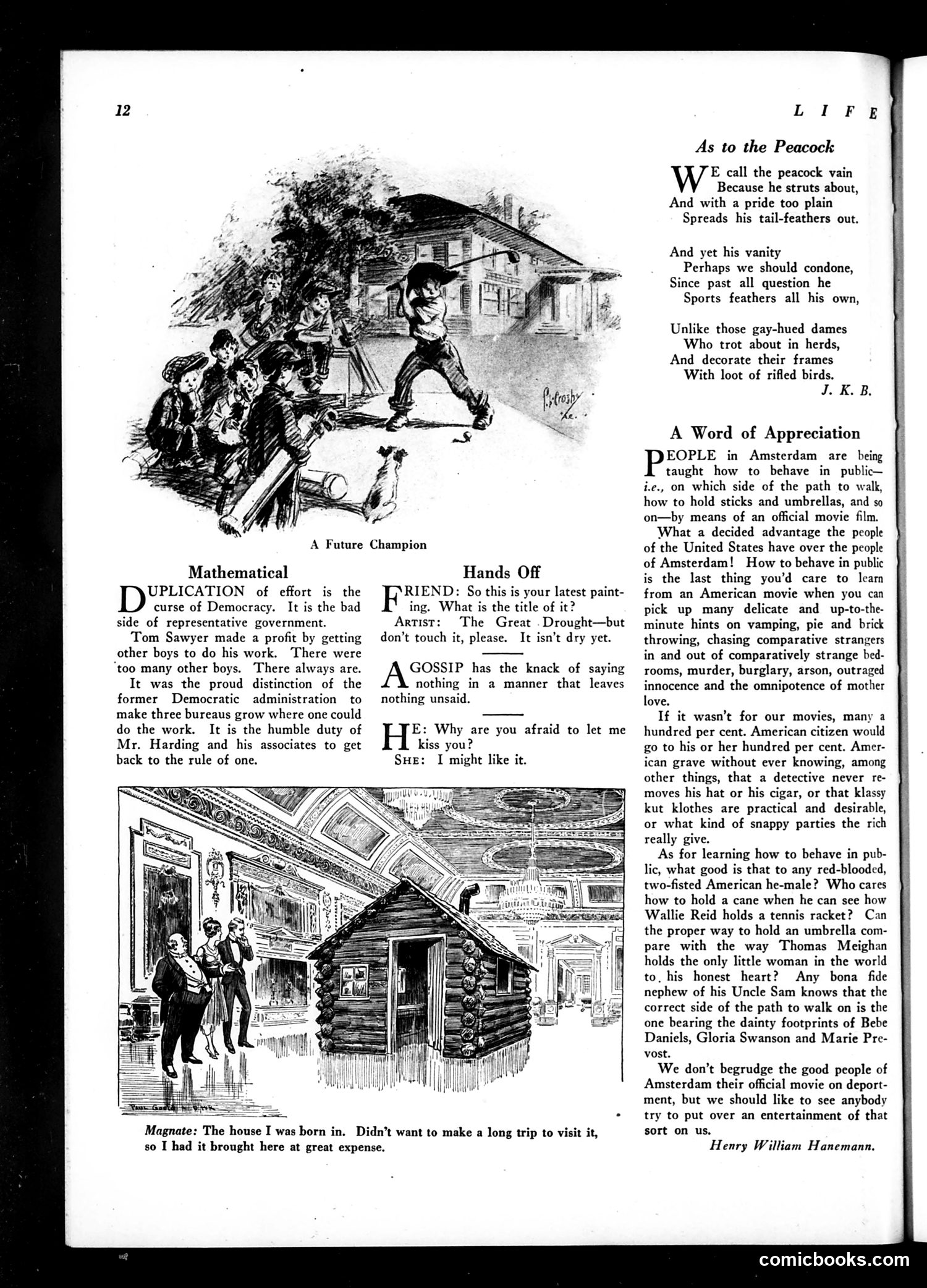
This cartoon depicts **Tom Sawyer** (the fictional Mark Twain character) getting other boys to do his work—a direct political satire on **Representative government inefficiency**. The text explicitly states this was "the proud distinction of the former Democratic administration" under what appears to be a recent Democratic president. The satire's point: Democratic leaders supposedly duplicated effort by having multiple workers do one job, rather than efficiently delegating. The cartoonist suggests the new (presumably Republican) administration should restore proper hierarchy where one leader assigns work—implying the previous Democratic approach was wasteful and disorganized. The humor relies on readers recognizing the Tom Sawyer reference to American literature, making the political critique more memorable and biting.
📄 Transcribed text from this page (OCR, searchable)
Machine-transcribed from the original scan — historical spelling and the odd misread are preserved.
A Future Champion Mathematical Deon of effort is the curse of Democracy. It is the bad side of representative government. Tom Sawyer made a profit by getting other boys to do his work. There were ‘too many other boys. There always are. It was the proud distinction of the former Democratic administration to make three bureaus grow where one could do the work. It is the humble duty of Mr. Harding and his associates to get back to the rule of one. Hands Off RIEND: So this is your latest paint- ing. What is the title of it? Artist: The Great .Drought—but don’t touch it, please. It isn’t dry yet. GOSSIP has the knack of saying nothing in a manner that leaves nothing unsaid. E: Why are you afraid to let me kiss you? Sue: I might like it. LIFegé As to the Peacock E call the peacock vain Because he struts about, And with a pride too plain Spreads his tail-feathers out. And yet his vanity Perhaps we should condone, Since past all question he Sports feathers all his own, Unlike those gay-hued dames Who trot about in herds, And decorate their frames With loot of rifled birds. J. K. B. A Word of Appreciation EOPLE in Amsterdam are being taught how to behave in public— ie., on which side of the path to walk, how to hold sticks and umbrellas, and so on—by means of an official movie film. What a decided advantage the people of the United States have over the people of Amsterdam! How to behave in public is the last thing you’d care to leam from an American movie when you can pick up many delicate and up-to-the- minute hints on vamping, pie and brick throwing, chasing comparative strangers in and out of comparatively strange bed- rooms, murder, burglary, arson, outraged innocence and the omnipotence of mother love. If it wasn’t for our movies, many a hundred per cent. American citizen would go to his or her hundred per cent. Amer- ican grave without ever knowing, among other things, that a detective never re- moves his hat or his cigar, or that klassy kut klothes are practical and desirable, or what kind of snappy parties the rich really give. As for learning how to behave in pub- lic, what good is that to any red-blooded, two-fisted American he-male? Who cares how to hold a cane when he can see how Wallie Reid holds a tennis racket? Can the proper way to hold an umbrella com- pare with the way Thomas Meighan holds the only little woman in the world to. his honest heart? Any bona fide nephew of his Uncle Sam knows that the correct side of the path to walk on is the one bearing the dainty footprints of Bebe Daniels, Gloria Swanson and Marie Pre- vost. We don’t begrudge the good people of Amsterdam their official movie on deport- ment, but we should like to see anybody try to put over an entertainment of that Magnate: The house I was born in. Didn’t want to make a long trip to visit it, so I had it brought here at great expense. sort on us, Henry William Hanemann, comicbooks.com