
Life, 1921-07-21 · page 24 of 34
Life — July 21, 1921 — page 24: what you’re looking at
What you’re looking at
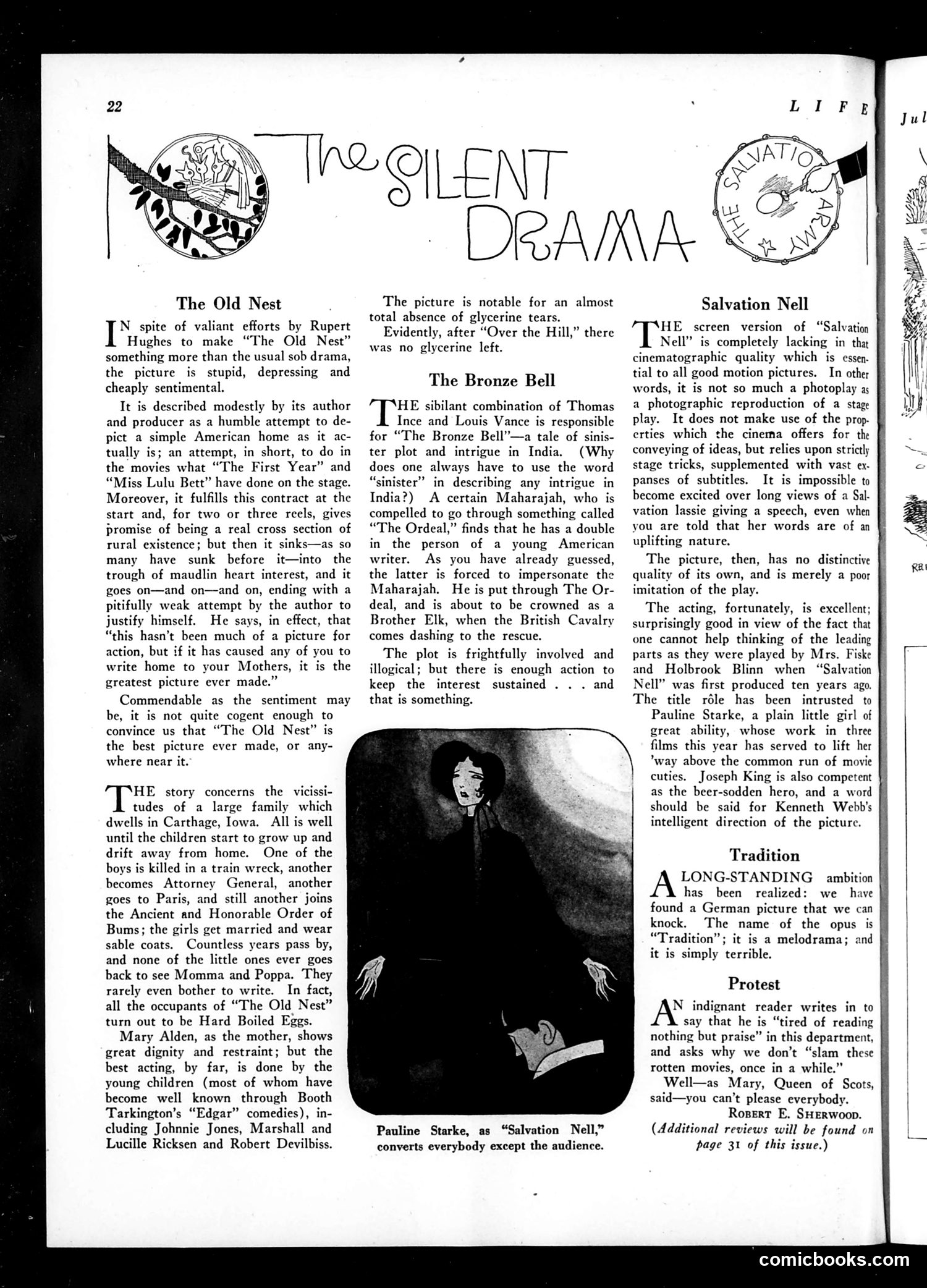
This page contains three film reviews from Life magazine's movie criticism section. The critic dismisses three contemporary silent films: **"The Old Nest"** — A melodrama about an Iowa family whose children abandon their parents. The reviewer mocks its manipulative sentimentality, noting the director's apologetic claim that if it makes viewers write home to their mothers, it's "the greatest picture ever made." The critic sarcastically references a competing film ("Over the Hill") by joking that all available glycerine tears were used there first. **"The Bronze Bell"** — An exotic adventure set in India involving mistaken identity and imperial intrigue. The reviewer finds the plot illogical but admits the action maintains interest. **"Salvation Nell"** — The critic faults this stage adaptation for failing to use cinema's visual storytelling capabilities, relying instead on subtitles and static shots of a Salvation Army character delivering speeches. The photograph shows actress Pauline Starke as "Salvation Nell," illustrating the static, theatrical staging the reviewer criticizes.
📄 Transcribed text from this page (OCR, searchable)
Machine-transcribed from the original scan — historical spelling and the odd misread are preserved.
The Old Nest N spite of valiant efforts by Rupert Hughes to make “The Old Nest” something more than the usual sob drama, the picture is stupid, depressing and cheaply sentimental. It is described modestly by its author and producer as a humble attempt to de- pict a simple American home as it ac- tually is; an attempt, in short, to do in the movies what “The First Year” and “Miss Lulu Bett” have done on the stage. Moreover, it fulfills this contract at the start and, for two or three reels, gives promise of being a real cross section of rural existence; but then it sinks—as so many have sunk before it—into the trough of maudlin heart interest, and it goes on—and on—and on, ending with a pitifully weak attempt by the author to justify himself. He says, in effect, that “this hasn’t been much of a picture for action, but if it has caused any of you to write home to your Mothers, it is the greatest picture ever made.” Commendable as the sentiment may be, it is not quite cogent enough to convince us that “The Old Nest” is the best picture ever made, or any- where near it. HE story concerns the vicissi- tudes of a large family which dwells in Carthage, Iowa. All is well until the children start to grow up and drift away from home. One of the boys is killed in a train wreck, another becomes Attorney General, another goes to Paris, and still another joins the Ancient and Honorable Order of Bums; the girls get married and wear sable coats. Countless years pass by, and none of the little ones ever goes back to see Momma and Poppa. They rarely even bother to write. In fact, all the occupants of “The Old Nest” turn out to be Hard Boiled Eggs. Mary Alden, as the mother, shows great dignity and restraint; but the best acting, by far, is done by the young children (most of whom have become well known through Booth Tarkington’s “Edgar” comedies), in- cluding Johnnie Jones, Marshall and Lucille Ricksen and Robert Devilbiss. The picture is notable for an almost total absence of glycerine tears. Evidently, after “Over the Hill,” there was no glycerine left. The Bronze Bell HE sibilant combination of Thomas Ince and Louis Vance is responsible for “The Bronze Bell”—a tale of sinis- ter plot and intrigue in India. (Why does one always have to use the word “sinister” in describing any intrigue in India?) A certain Maharajah, who is compelled to go through something called “The Ordeal,” finds that he has a double in the person of a young American writer. As you have already guessed, the latter is forced to impersonate the Maharajah. He is put through The Or- deal, and is about to be crowned as a Brother Elk, when the British Cavalry comes dashing to the rescue. The plot is frightfully involved and illogical; but there is enough action to keep the interest sustained . . . and that is something. Pauline Starke, as “Salvation Nell,” converts everybody except the audience. Salvation Nell HE screen version of “Salvation Nell” is completely lacking in that cinematographic quality which is essen. tial to all good motion pictures. In other words, it is not so much a photoplay as a photographic reproduction of a stage play. It does not make use of the prop. erties which the cinema offers for the conveying of ideas, but relies upon strictly stage tricks, supplemented with vast ex- panses of subtitles. It is impossible to become excited over long views of a Sal- vation lassie giving a speech, even when you are told that her words are of an uplifting nature. The picture, then, has no distinctive quality of its own, and is merely a poor imitation of the play. The acting, fortunately, is excellent; surprisingly good in view of the fact that one cannot help thinking of the leading parts as they were played by Mrs. Fiske and Holbrook Blinn when “Salvation Nell” was first produced ten years ago. The title réle has been intrusted to Pauline Starke, a plain little girl of great ability, whose work in three films this year has served to lift her ’way above the common run of movie | cuties. Joseph King is also competent as the beer-sodden hero, and a word should be said for Kenneth Webb's | intelligent direction of the picture. Tradition LONG-STANDING ambition has been realized: we have found a German picture that we can knock. “Tradition”; it is a melodrama; and it is simply terrible. Protest N indignant reader writes in to |) say that he is “tired of reading nothing but praise” in this department, and asks why we don’t “slam these fj rotten movies, once in a while.” Well—as Mary, Queen of Scots, said—you can’t please everybody. Rosert E. SHERWwoop. (Additional reviews will be found on page 31 of this issue.) The name of the opus is | Jul SSD ites SERS —. ——! comicbooks.com