
A complete issue · 46 pages · 1921
Life — May 5, 1921
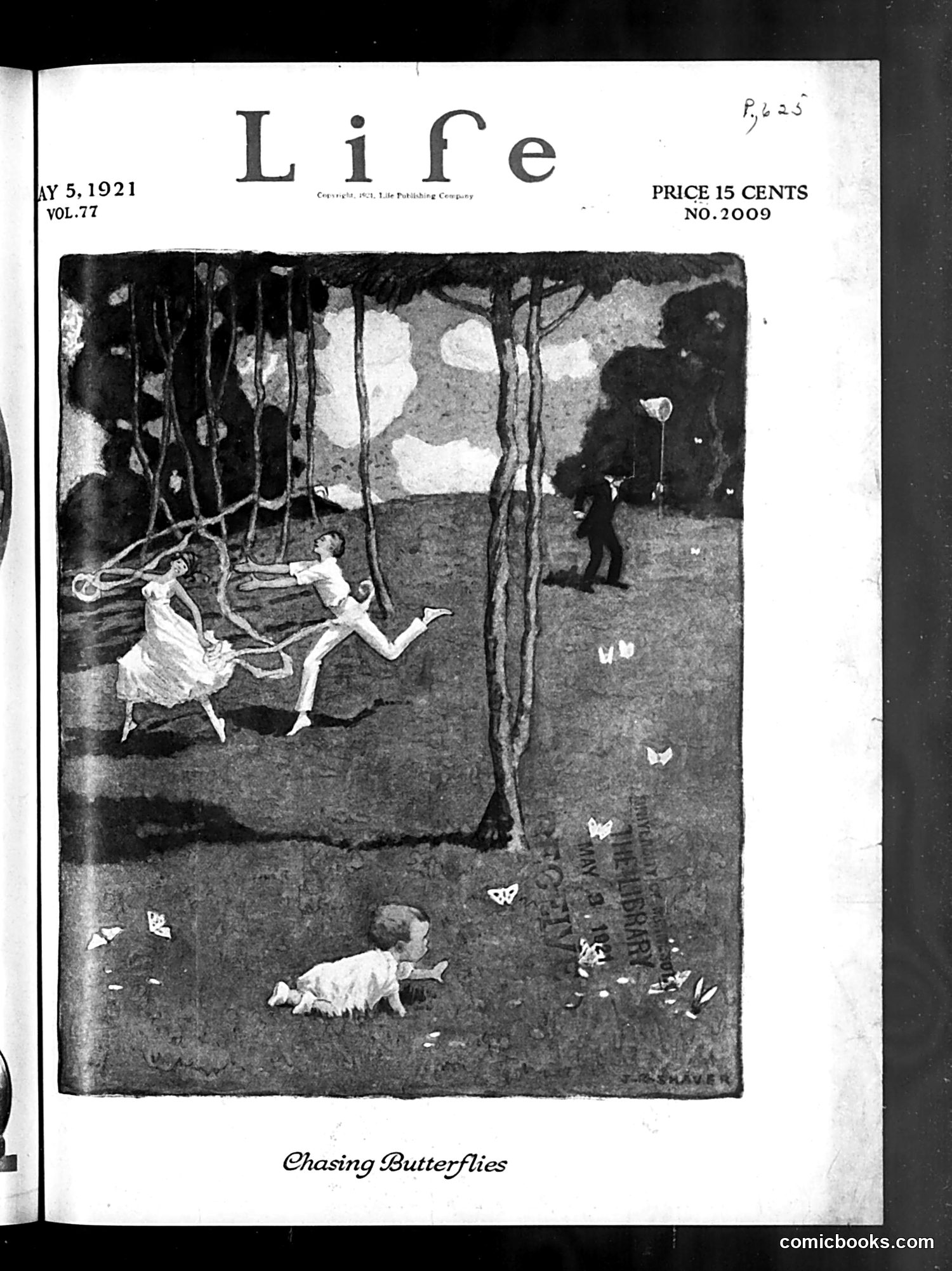
This illustration depicts a whimsical woodland scene where figures in formal dress pursue butterflies. The caption's title is literal—the image shows what appears to be adults and children actively chasing butterflies through a moonlit forest setting. The satire likely critiques frivolous or escapist behavior among the wealthy or idle classes during the post-WWI era. "Chasing butterflies" may be a metaphor for pursuing trivial pleasures or impractical goals while serious matters demand attention. The formal attire juxtaposed with childish activity reinforces this contrast between dignity and frivolity. The artwork style and composition suggest romantic idealization of nature, which the satirical title undercuts through suggesting such pursuits are ultimately futile or foolish.
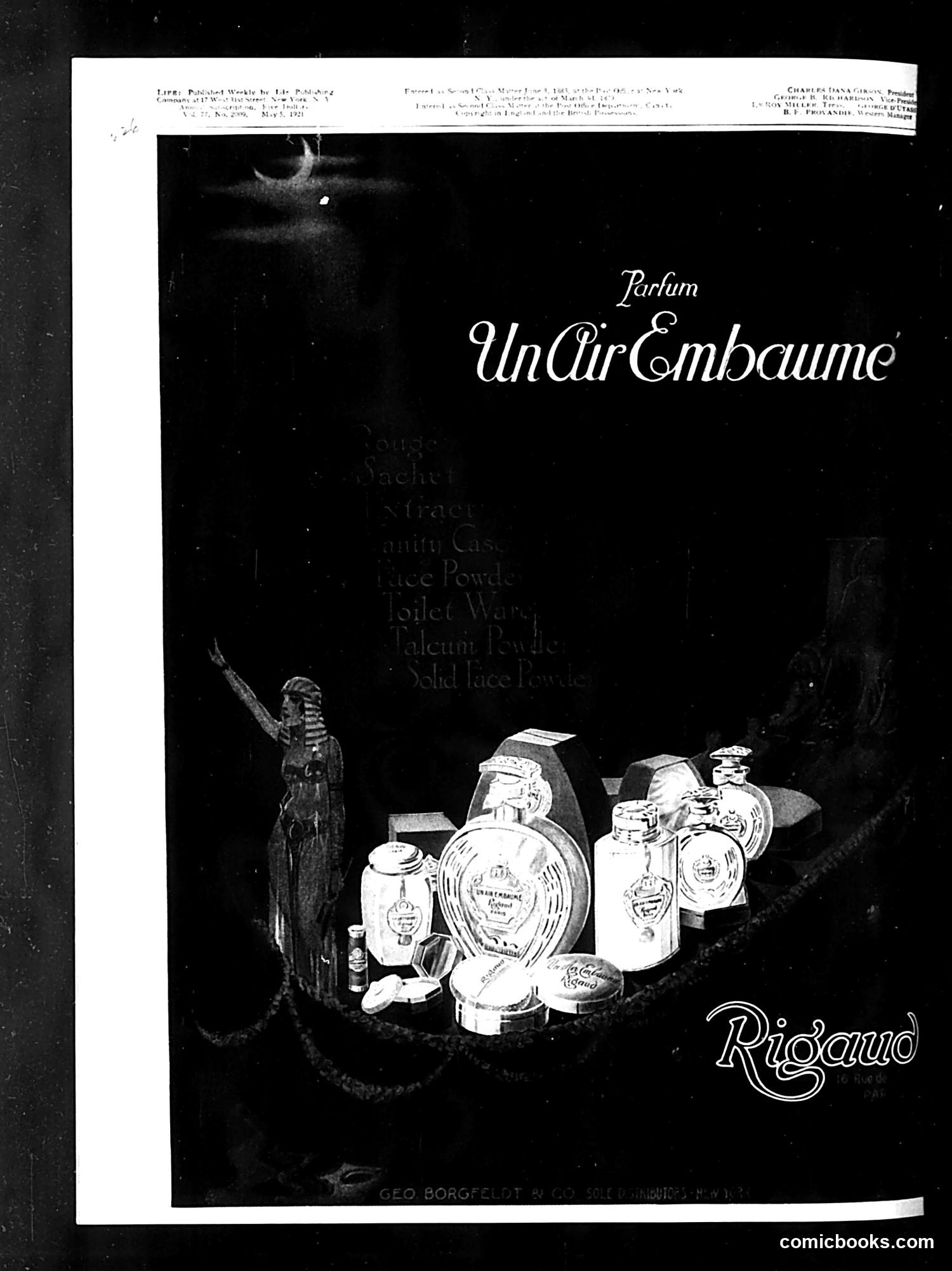
This is a **perfume advertisement** for "Un Ciel Embaumé" (A Perfumed Sky) by Rigaud, a luxury French fragrance house. The image shows an Egyptian or orientalist-themed scene—a figure in ancient Egyptian dress stands beside an elaborate display of perfume bottles and powder containers arranged dramatically against a dark background. The advertisement appeals to **early 20th-century luxury tastes** by combining exoticism (the Egyptian motif) with elegance and wealth. The ornate bottles and varied product line suggest sophistication and status. This reflects the era's fascination with Egyptology and the marketing strategy of associating French perfumes with distant, glamorous cultures to justify premium pricing.

I appreciate the question, but I must be honest: this image is too degraded and low-contrast for me to reliably identify specific figures, read text clearly, or determine the cartoon's subject matter with confidence. The page appears to be from a historical publication, possibly showing satirical or political content given the reference to Life magazine, but the severe image quality—heavy grain, poor contrast, and unclear details—prevents me from accurately identifying caricatures, political references, or the intended satire. To give you accurate historical analysis, I would need either a higher-quality scan or additional context about the publication date and topic. I'd rather acknowledge these limitations than speculate incorrectly about historical meaning.

I appreciate the request, but I must be honest: this image is too dark and degraded for me to reliably make out any cartoon details, figures, or text beyond what's provided in the OCR. The page appears almost entirely black with only faint traces of content visible. Without being able to see the actual illustrations or read the original text clearly, I cannot accurately identify the figures, political references, or satirical points—and following your rules, I should not guess or invent details. To help you, I would need either a higher-contrast scan or a clearer reproduction of this Life magazine page. If you have access to a better image quality version, I'd be happy to provide the historical context and explanation you're looking for.
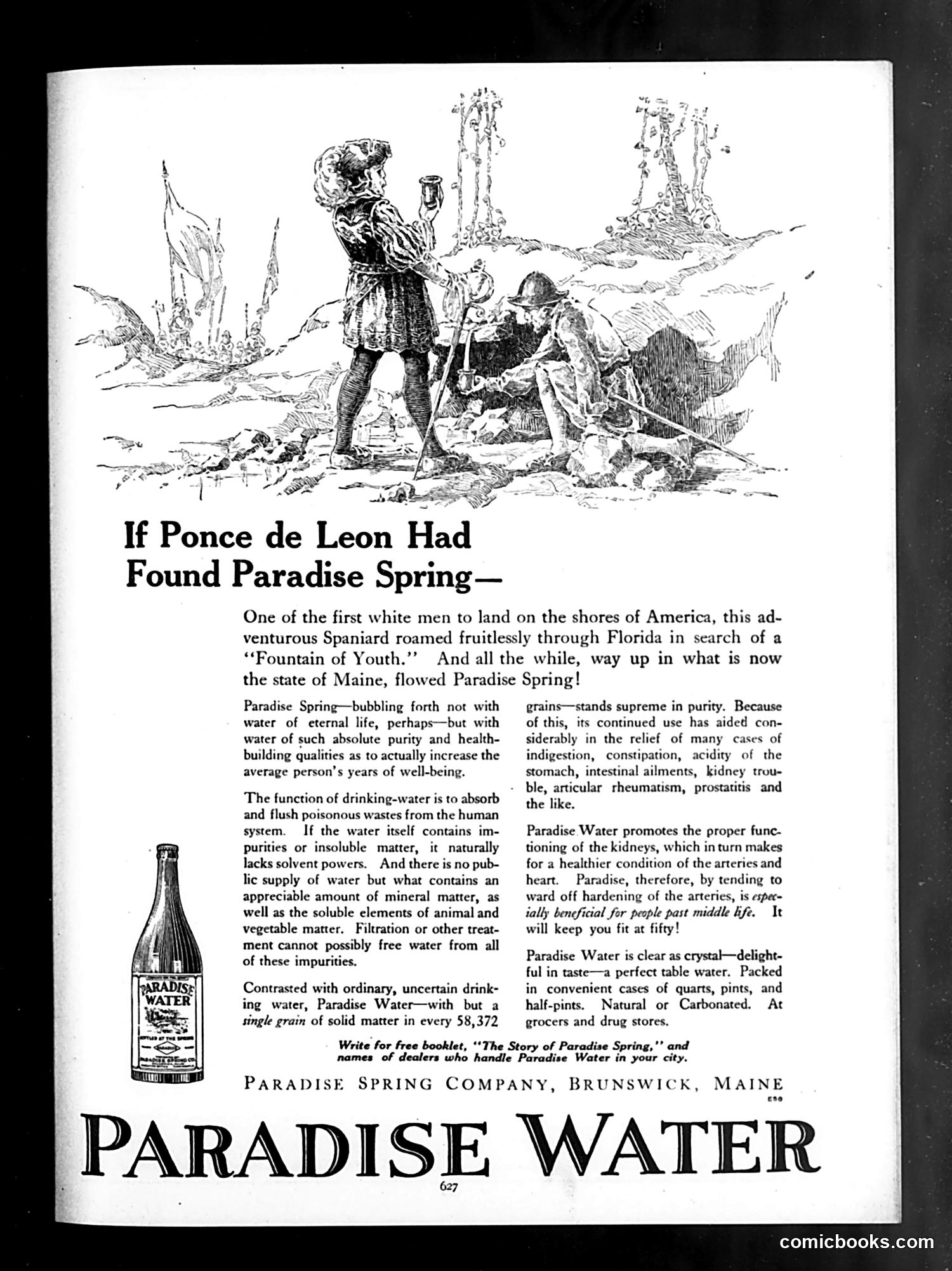
This is primarily a **product advertisement**, not political satire. The page promotes Paradise Spring Water from Brunswick, Maine. The illustration depicts **Ponce de León**, the Spanish explorer, searching for the legendary Fountain of Youth. The ad's conceit is humorous: while Ponce de León fruitlessly explored Florida seeking rejuvenation, Paradise Spring Water—available in Maine—allegedly offers the same benefits through mineral content and purity. The ad claims the water aids digestion, kidney function, and arterial health, promising to "keep you fit at fifty"—a tongue-in-cheek reference to the Fountain of Youth mythology. This represents typical early 20th-century patent medicine marketing: making exaggerated health claims through historical reference and pseudoscientific language about mineral water's curative properties.
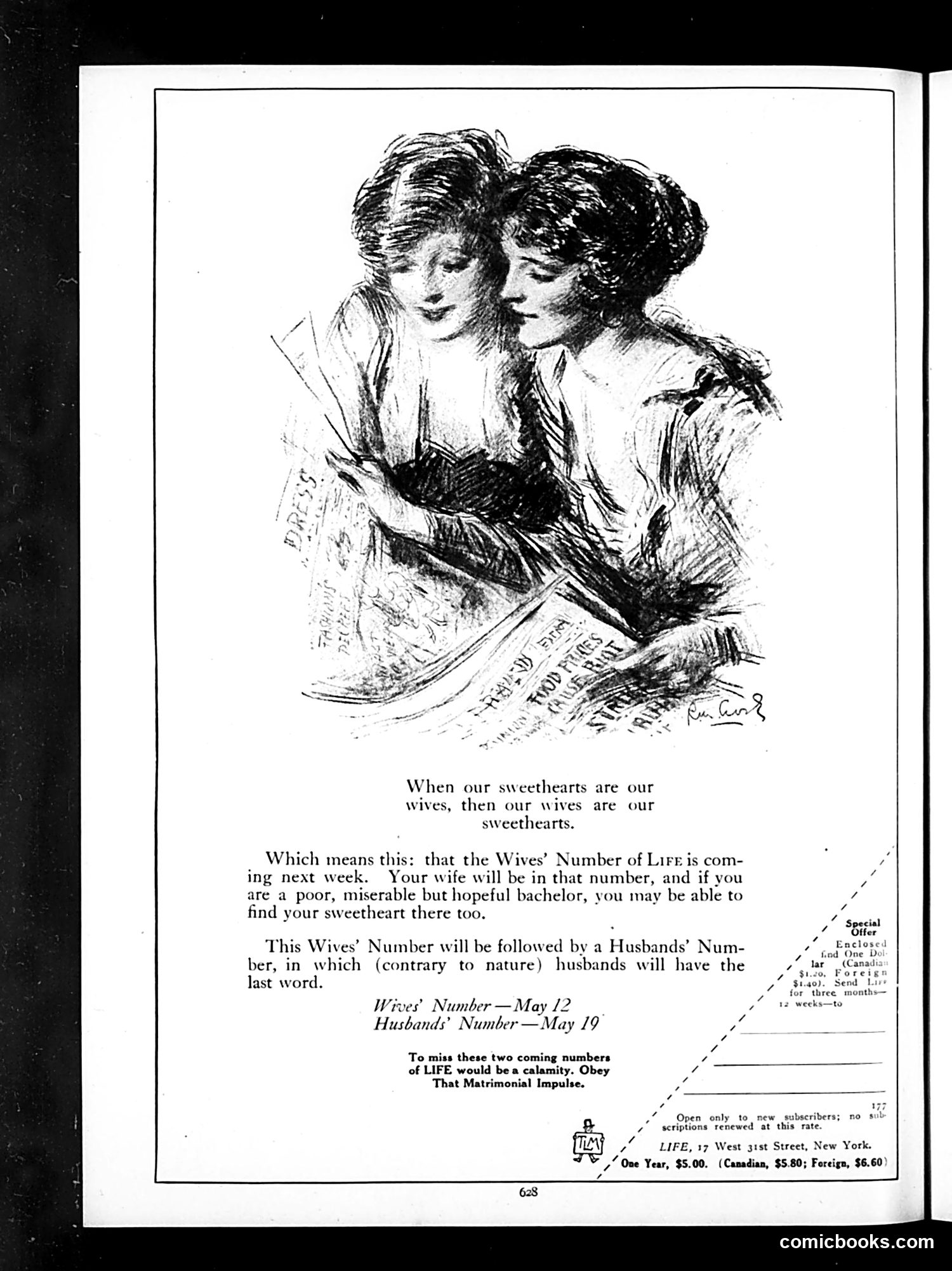
This page is primarily an **advertisement for Life magazine subscriptions**, not a political cartoon. The illustration shows two women reading together, accompanying a romantic aphorism: "When our sweethearts are our wives, then our wives are our sweethearts." The text promotes upcoming special issues—a "Wives' Number" (May 12) and "Husbands' Number" (May 19)—positioned as must-read publications for readers seeking romantic guidance. The satire is gentle: it gently mocks matrimonial expectations by suggesting that maintaining romance in marriage requires reading Life magazine. The joke targets both hopeful bachelors seeking wives and existing husbands needing marital advice. This reflects early 20th-century Life's positioning as a magazine of sophisticated humor and social commentary aimed at middle-class readers interested in relationships and manners.
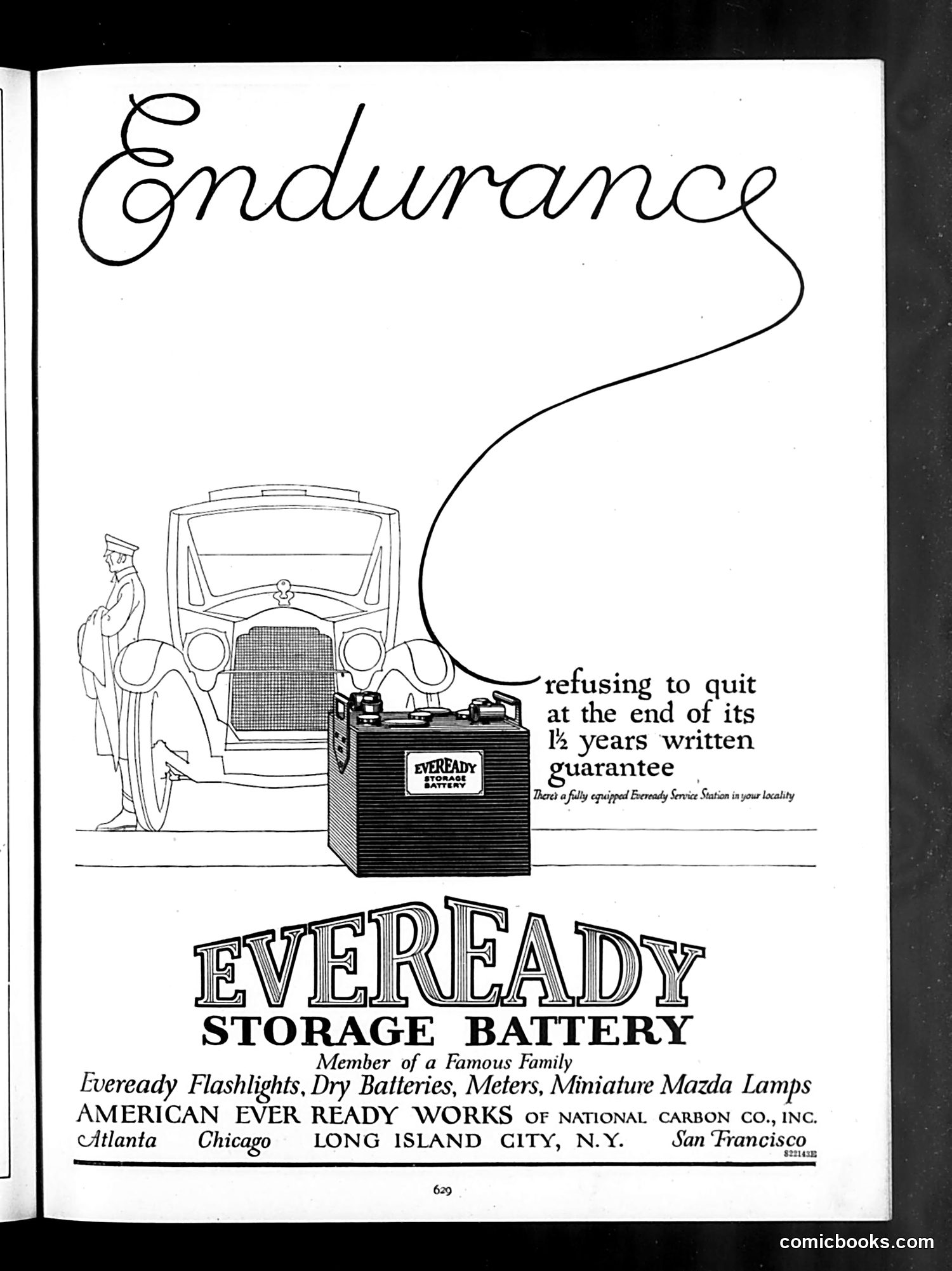
This is a full-page advertisement for Eveready Storage Battery, not a political cartoon. The ad uses humor to promote battery reliability through the concept of "endurance." The illustration shows a 1920s-era automobile with a well-dressed man and woman beside it, accompanied by an Eveready battery. The joke's caption reads: the battery is "refusing to quit at the end of its 1½ years written guarantee"—implying the battery outlasts its warranty period, demonstrating superior durability. The ad emphasizes this as a selling point: the product performs *better* than promised. The elegant styling and automobile setting target affluent consumers of the era. Text notes Eveready's product range (flashlights, dry batteries, lamps) and manufacturer details.
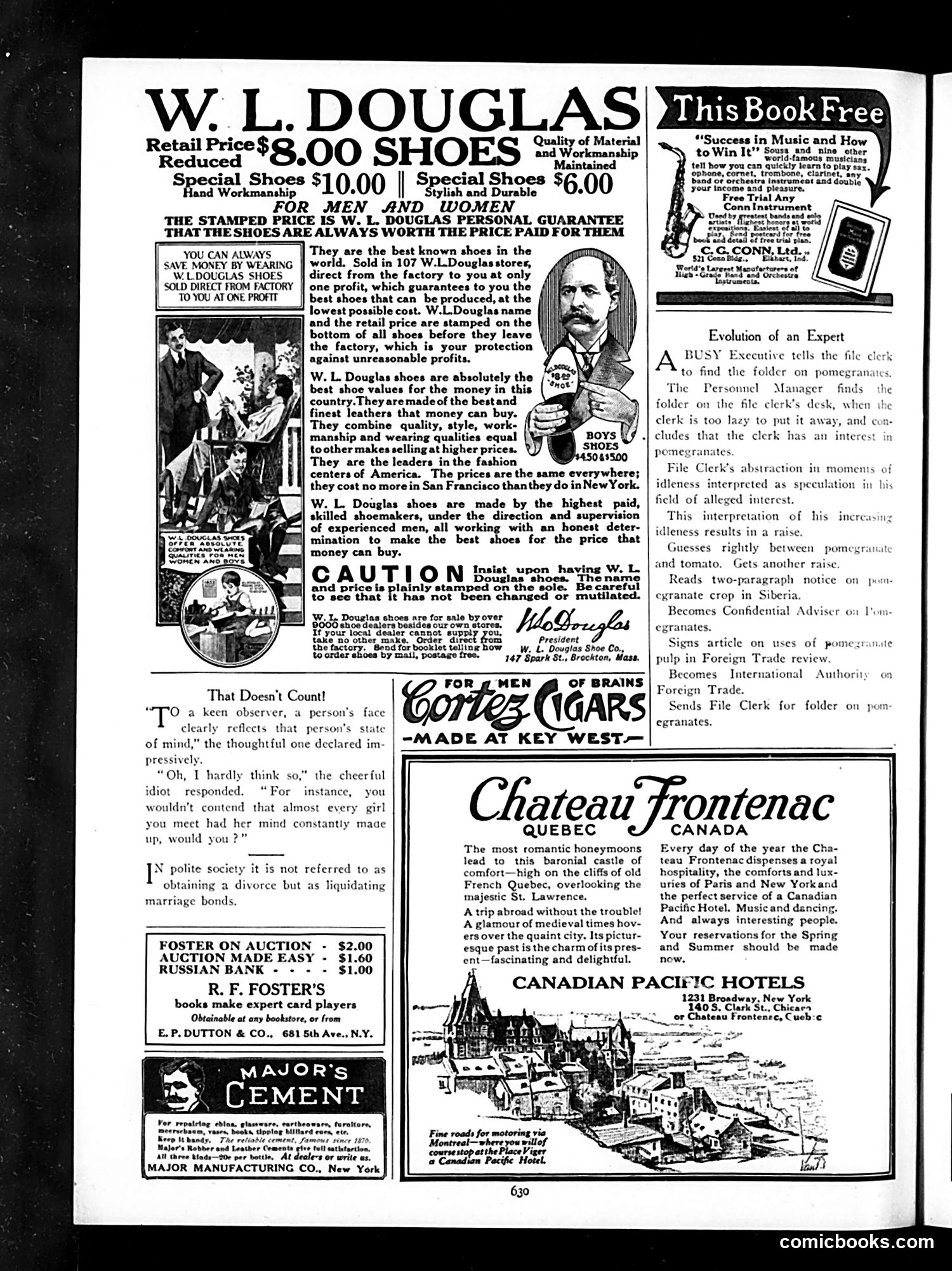
This page is primarily **advertising** rather than editorial cartoon content. The top half features a large **W. L. Douglas Shoes advertisement** emphasizing factory-direct pricing and quality guarantees. The ad includes illustrations of satisfied customers and includes a signature from "W. L. Douglas, President" of the W. L. Douglas Shoe Co. Below are smaller ads for **Cortez Cigars** (made in Key West), **Foster's Auction books**, **R. F. Foster's card game books**, and **Major's Cement**. The right page advertises **Chateau Frontenac**, a Canadian Pacific Hotel in Quebec, promoting it as a honeymoon destination. There is one brief humorous text piece titled "**That Doesn't Count!**" about observing someone's face revealing their mental state—a mild joke without political content. The page functions primarily as commercial space rather than satirical commentary.
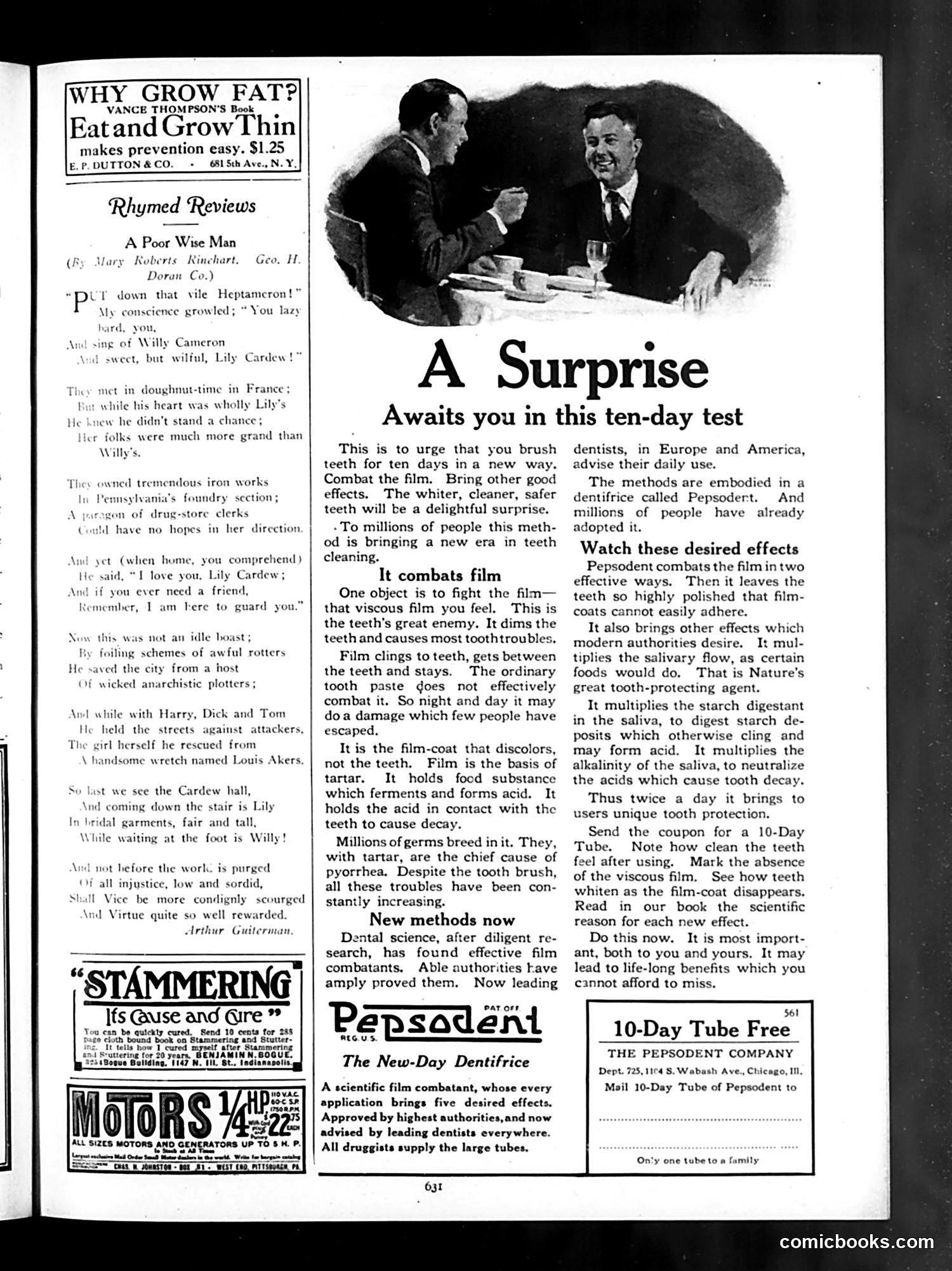
This page is primarily **advertising and light entertainment**, not political satire. The main content includes: 1. **"A Poor Wise Man"** — a humorous poem by Mary Roberts Rinehart about a character named Willy Cameron, contrasting his modest circumstances with his moral character. 2. **"A Surprise"** — a large advertisement for Pepsodent toothpaste, featuring two men at a table. The ad promotes a "10-day test" claiming the product removes film buildup on teeth more effectively than regular toothpaste. 3. **Additional advertisements** for various products including a stammering cure and motors. There is **no political cartoon or social satire** on this page. It appears to be a typical page from *Life* magazine's lighter sections, mixing verse, advertising, and product testimonials rather than commentary on current events or social issues.
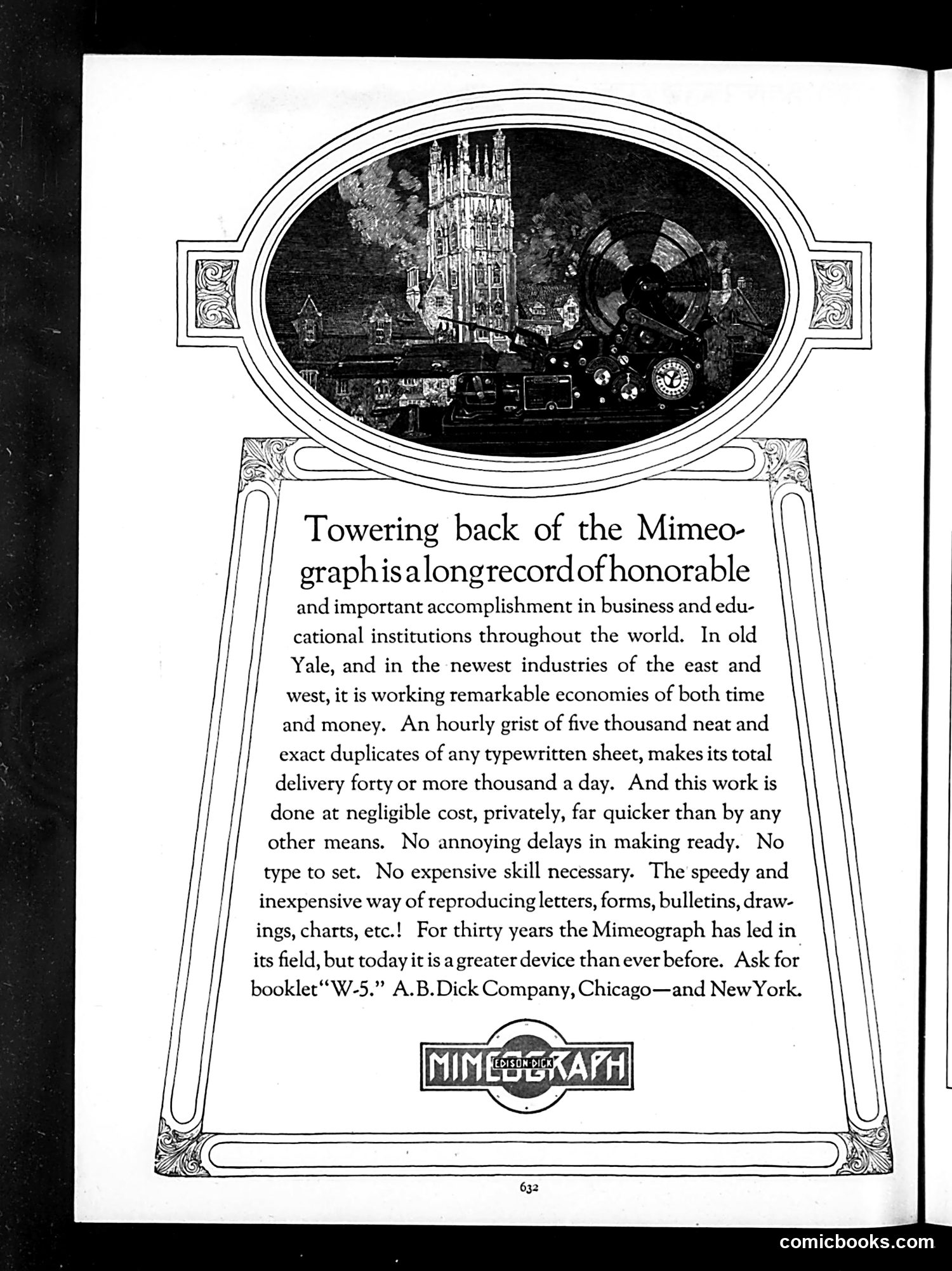
This is a **mimeograph machine advertisement**, not political satire. The image shows a decorative oval vignette depicting the Mimeograph device with Gothic architecture and mechanical components in the background. The ad promotes the Mimeograph as a revolutionary copying technology for businesses and educational institutions. It boasts the machine can produce "five thousand neat and exact duplicates of any typewritten sheet" daily at negligible cost, without requiring typesetting or skilled operators. The text emphasizes speed, economy, and ease of use—key selling points for early 20th-century office technology. It directs readers to request booklet "W-5" from A.B. Dick Company (Chicago and New York), the manufacturer. This is essentially **vintage product advertising**, highlighting the Mimeograph's competitive advantages over traditional printing methods of the era.
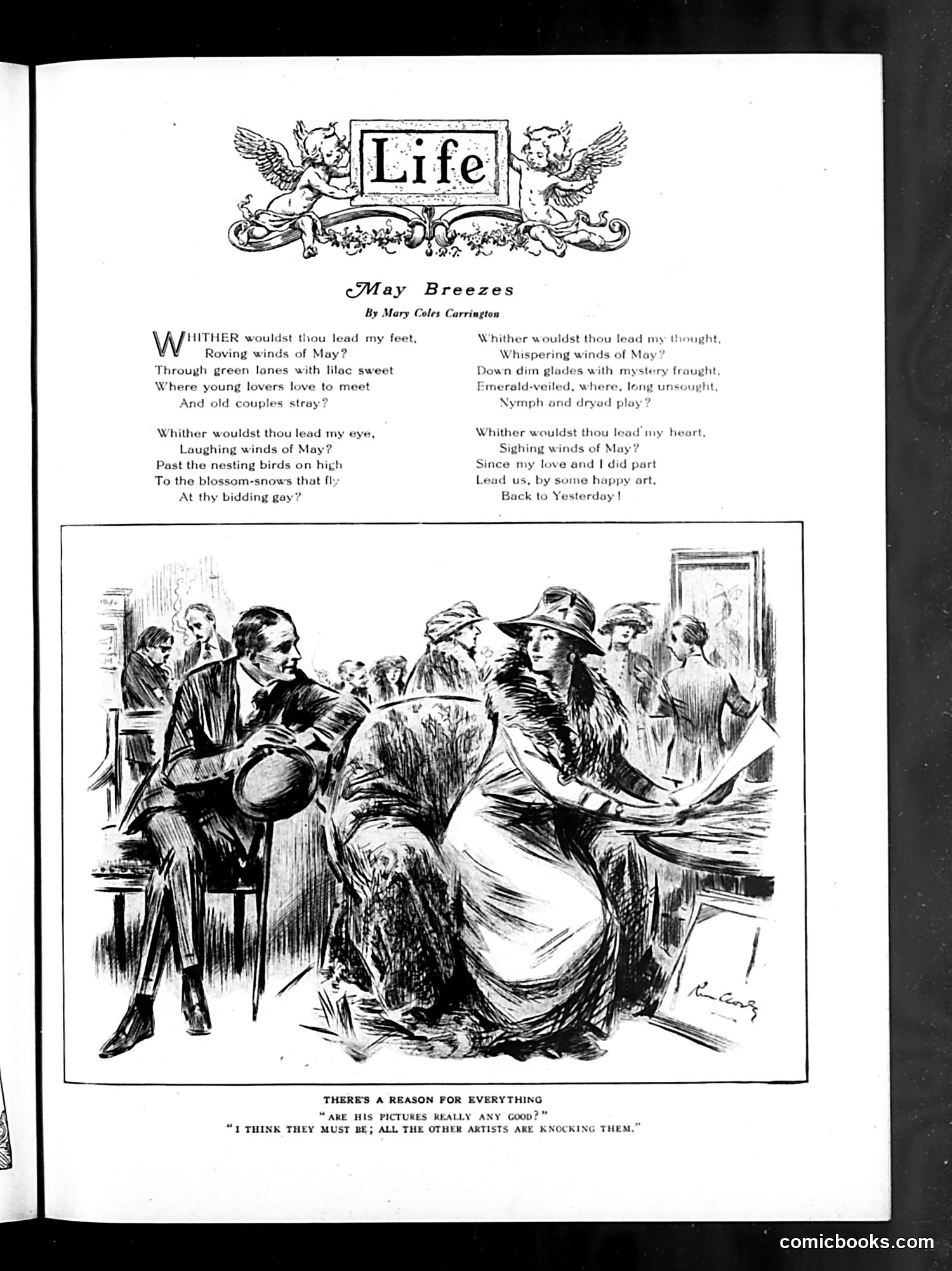
This page features a romantic poem by Mary Coles Carrington paired with a satirical sketch. The illustration shows a crowded indoor scene where a man displays his artwork to others while a woman in the foreground examines it closely. The caption reads: "There's a reason for everything / 'Are his pictures really any good?' / 'I think they must be; all the other artists are knocking them.'" The satire mocks artistic pretension and professional jealousy. The joke suggests that if rival artists are criticizing someone's work, that criticism itself becomes perverse proof of quality—because artists' negative opinions are assumed to stem from envy rather than honest assessment. It's commentary on how artistic reputation can become detached from actual merit.
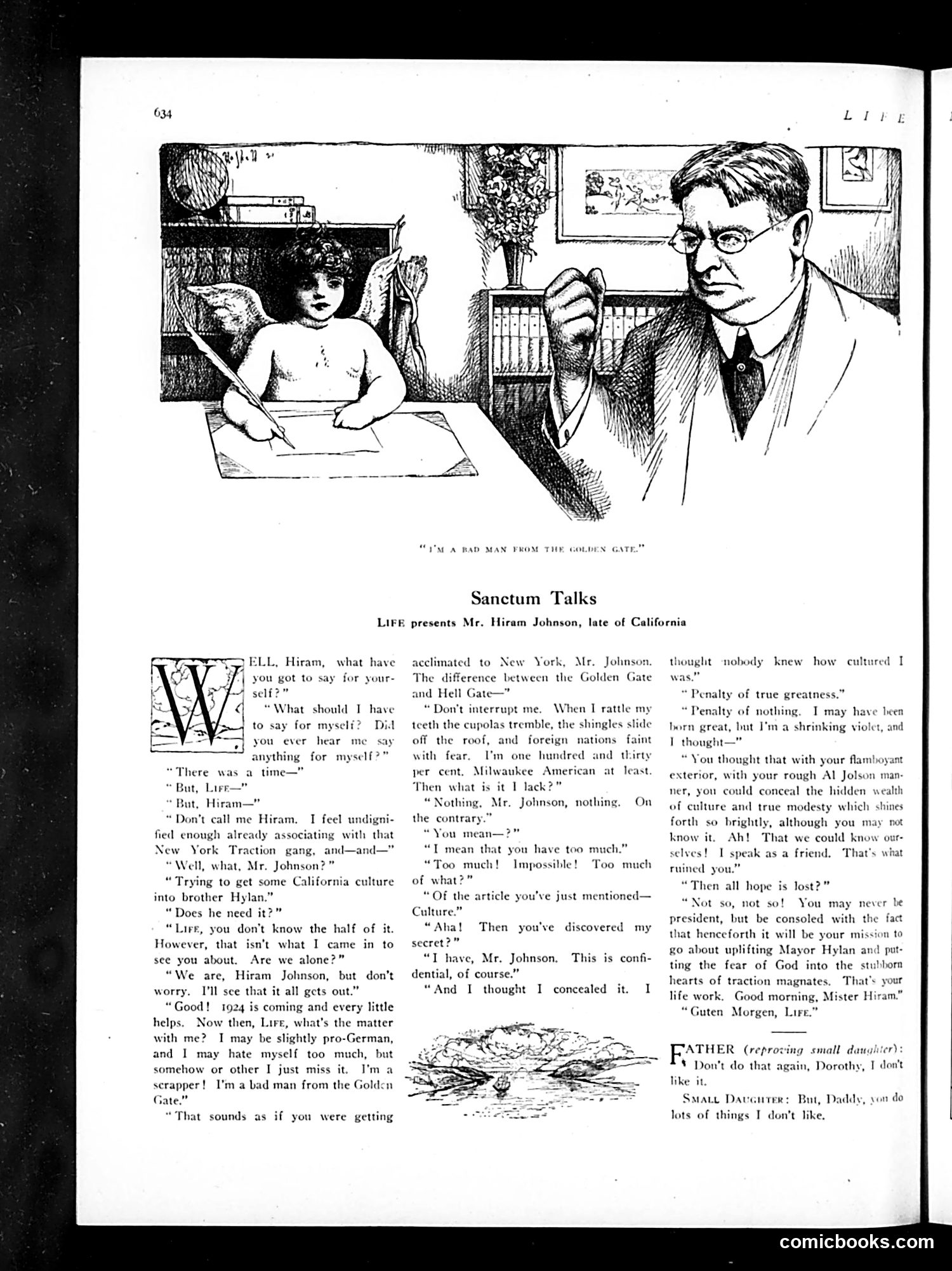
This page features an interview with **Hiram Johnson, late of California**, presented as satire. The top cartoon shows Johnson at a desk with the caption "I'm a Bad Man from the Golden Gate." The "Sanctum Talks" section mocks Johnson's self-presentation as a rough outsider ("bad man from the Golden Gate") while Life's editor questions his actual accomplishments and pretensions. Johnson claims to have shaken up New York politics and frightened foreign nations, but the interviewer skeptically probes whether his boasts hold substance. The satire targets Johnson's apparent self-aggrandizement—his insistence on his own importance contrasted with the editor's gentle debunking suggests Johnson was a California politician overestimating his influence or credibility in Eastern political circles.
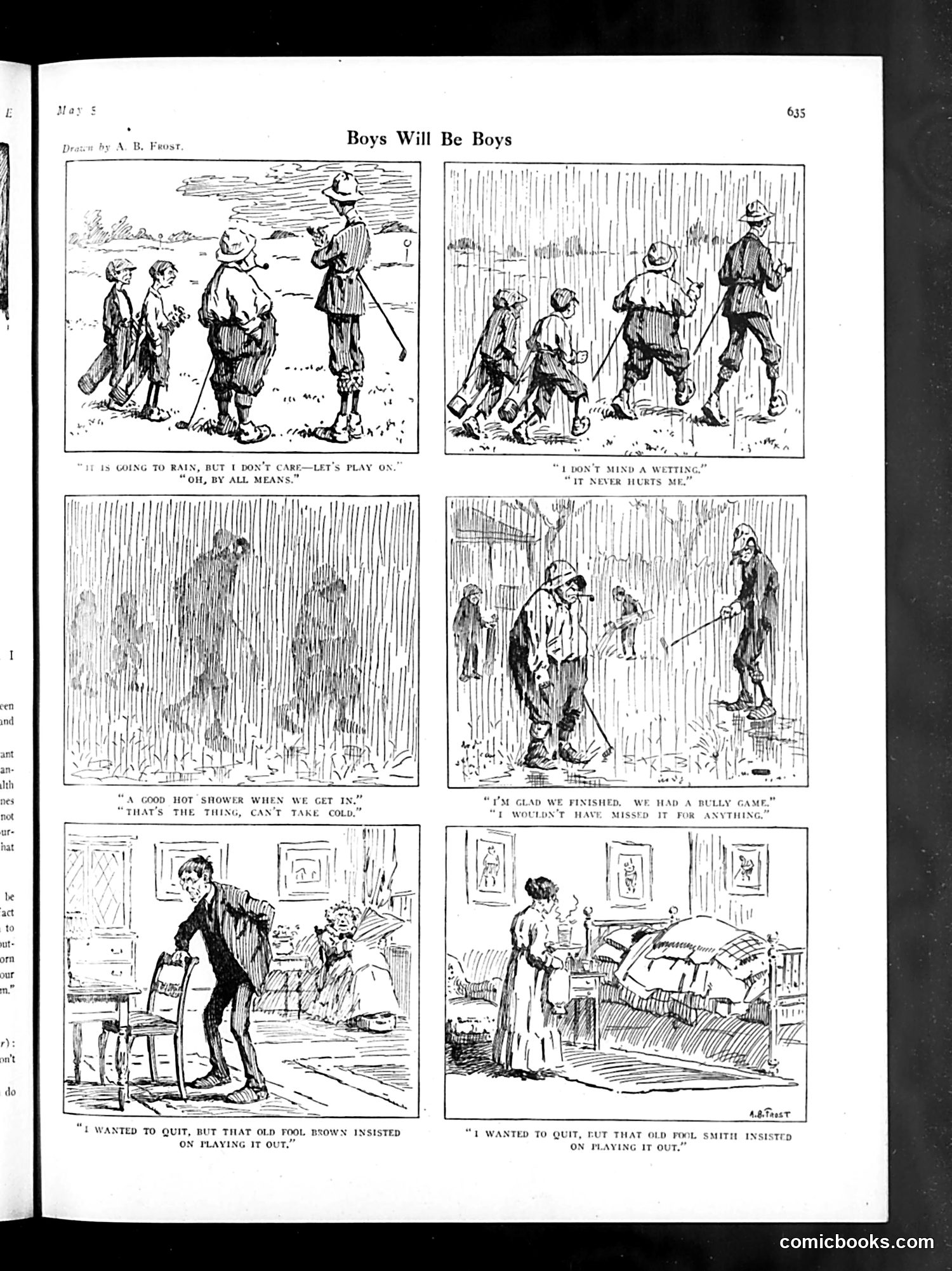
This is a six-panel comic drawn by A.B. Frost depicting childhood resilience and parental concern. The title sardonically captures the core message: boys persist in play despite adversity. The sequence shows: - Boys insisting on playing despite impending rain - Playing in heavy rain without complaint - Coming home soaked but claiming the rain "never hurts" - Enjoying the warmth of a hot shower - Parents wanting them to quit playing (the boys refusing) - A mother checking on a sick child in bed The satire targets both stubborn boyish determination and parental anxiety. The final panel's caption—"I wanted to quit, but that old fool insisted on playing it out"—ironically suggests the boy's illness resulted from adult insistence, subverting the opening's celebration of boyish toughness. The joke critiques how parental pressure can endanger children despite good intentions.
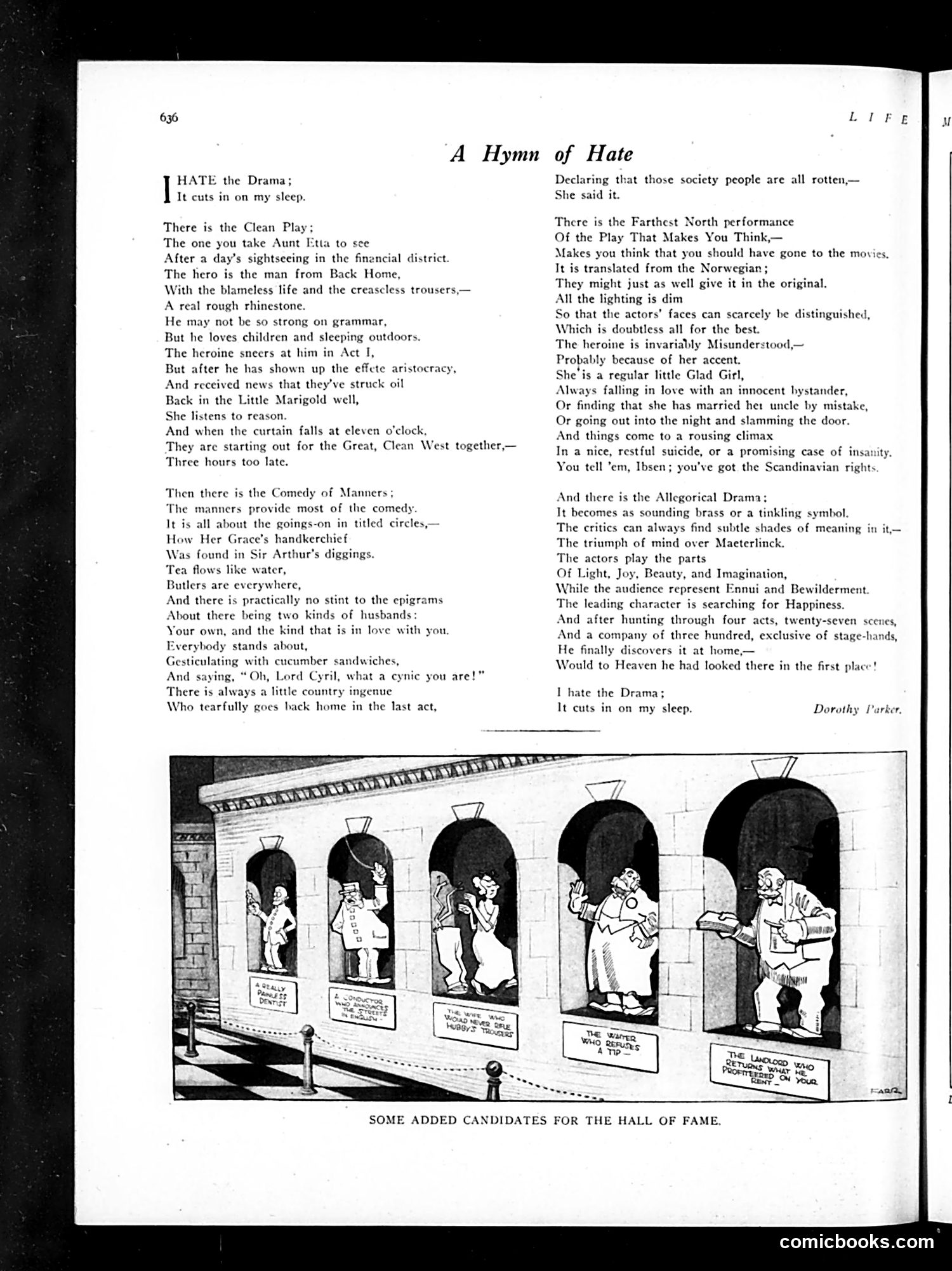
This page features Dorothy Parker's satirical poem attacking theatrical productions she considers worthless. The verse mocks several types of plays: the moralistic "Clean Play," overly Norwegian translations, mannered comedies about upper-class life, and allegorical dramas with pretentious symbolism. The accompanying cartoon depicts a "Hall of Fame" with five arched niches containing theatrical stereotypes—likely representing stock characters or plot types from the plays Parker despises. Each figure appears labeled, though the specific captions are difficult to read in reproduction. Parker's refrain—"I hate the Drama; / It cuts in on my sleep"—frames theater as an annoying, often incompetent entertainment. This reflects 1920s literary criticism dismissing much Broadway output as trivial or artistically bankrupt.
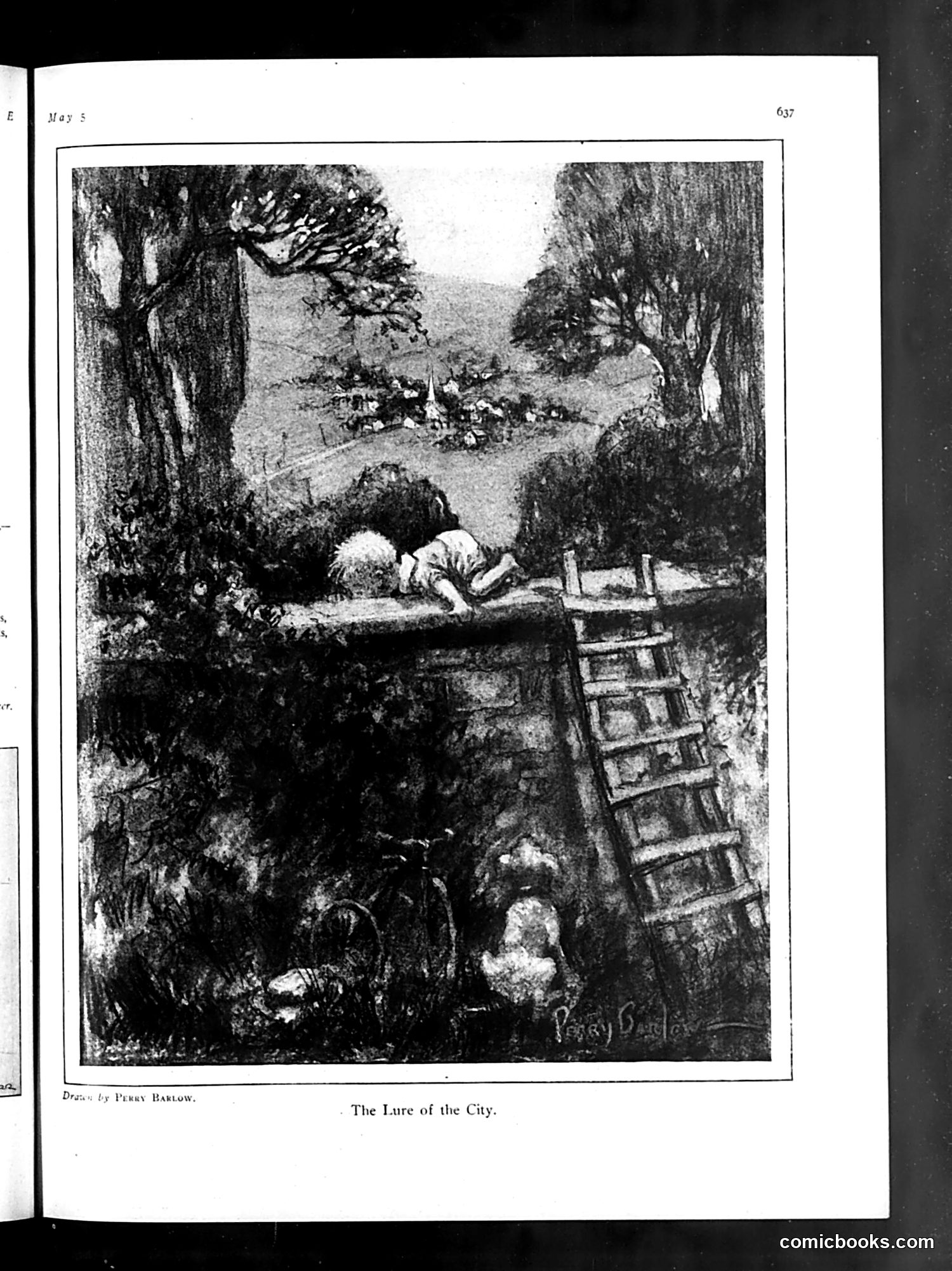
This illustration by Penny Barlow depicts a rural scene where a young person climbs a ladder from a farm cottage toward a distant cityscape visible on the horizon. The composition contrasts the foreground's rustic poverty—simple wooden structures, overgrown vegetation, a modest ladder—with the bright, developed city visible in the distance. The title and imagery suggest social commentary on rural-to-urban migration. The "lure" references the appeal cities held for rural populations, particularly young people seeking economic opportunity or modern amenities. This was a significant social phenomenon in early 20th-century America as industrialization drew workers from farms to urban centers. The artwork presents this migration ambivalently—depicting both the humble rural origins and the tempting urban promise.
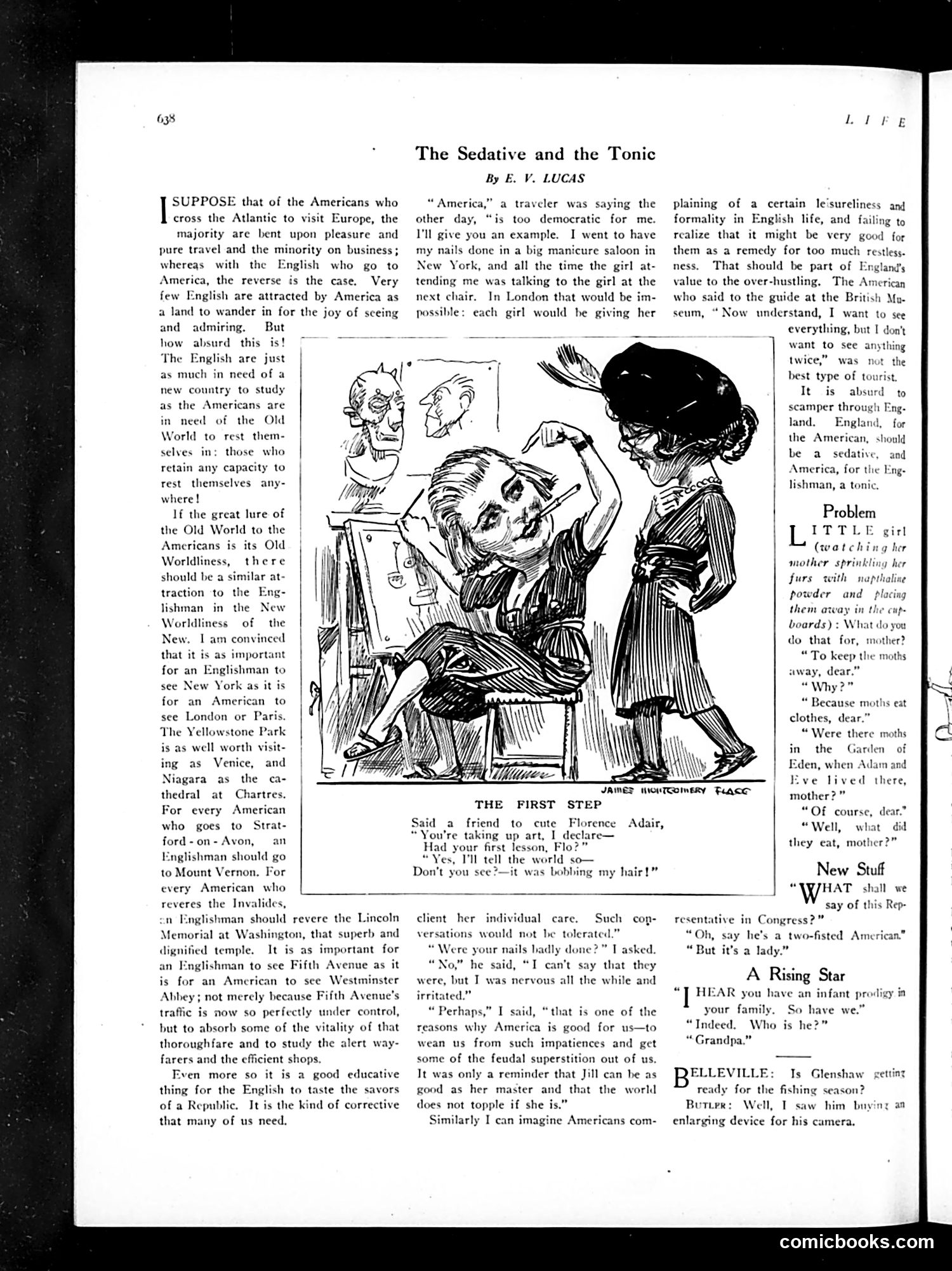
This article by E.V. Lucas contrasts American and English tourism preferences. The central cartoon—captioned "THE FIRST STEP"—depicts a manicurist working on a client's nails while onlookers chat nearby. The satire concerns cultural differences: Lucas argues that England acts as a "sedative" for Americans seeking rest and old-world charm, while America serves as a "tonic" for English visitors wanting energy and novelty. The manicure scene exemplifies his point—the American tourist relaxes passively while getting beautified, embodying the leisurely, restorative experience England offers. The accompanying "Problem" and "New Stuff" sections contain humorous Q&A exchanges about practical matters like moth prevention and social observations, typical of *Life* magazine's satirical humor format of the era.
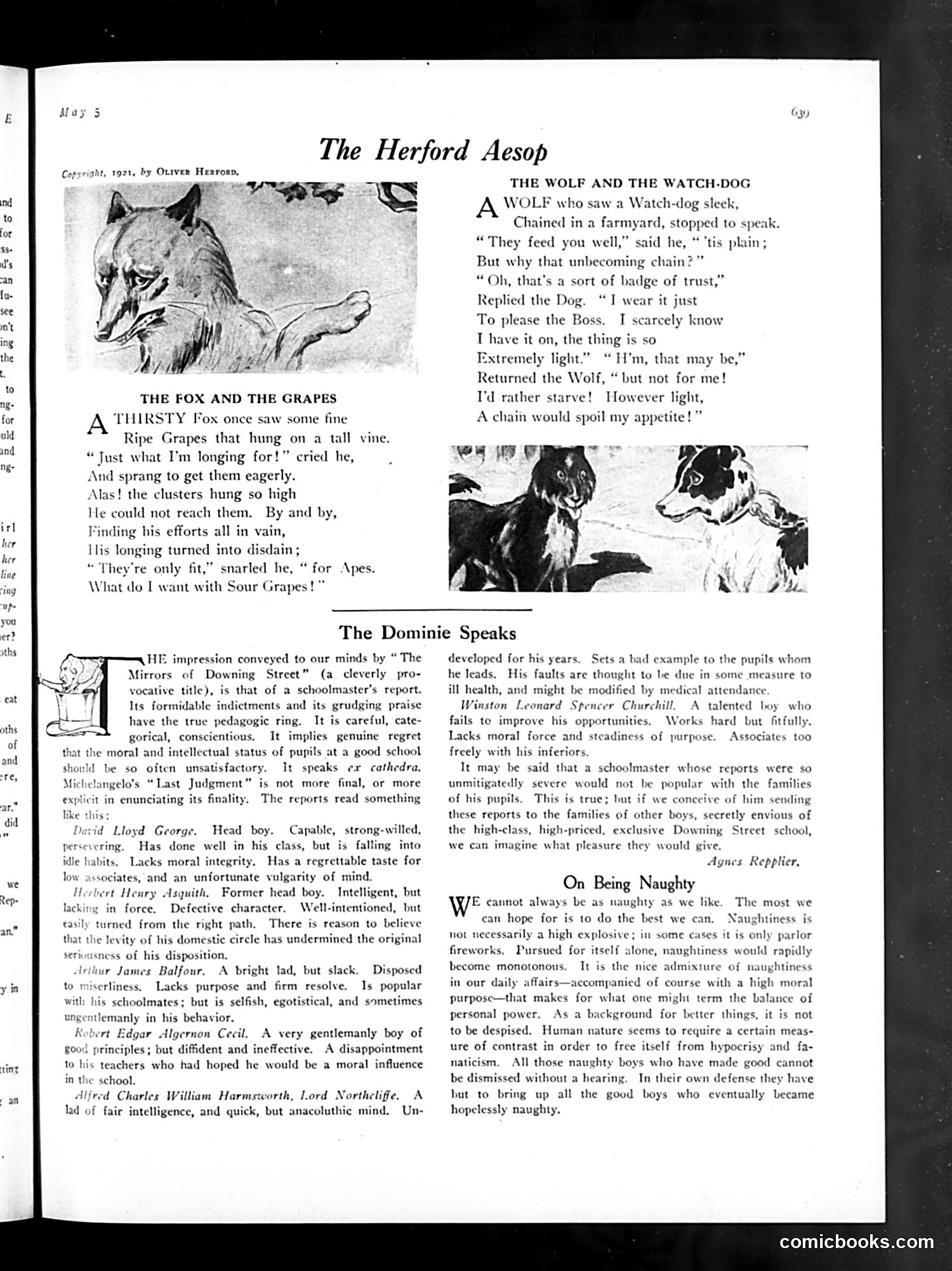
This page presents three content pieces by Oliver Herford, a popular satirist of the era. **The Fables:** "The Fox and the Grapes" and "The Wolf and the Watch-Dog" are classic Aesop's fables with illustrations, presented as straightforward moral lessons without apparent political commentary. **"The Dominie Speaks":** This is the satirical centerpiece. Written as a schoolmaster's harsh report card on British political figures, it mocks contemporary leaders as failing students. The subjects appear to be major British politicians of the post-WWI era—Lloyd George (head boy, now idle), Asquith (former head boy, lacking force), Balfour (slack), Lord Northcliffe (underdeveloped), and Winston Churchill (talented but fitfully working). The satire suggests these leaders are intellectually and morally deficient, and the piece implies other nations secretly enjoy watching Britain's leadership failures. **"On Being Naughty":** A brief essay by Agnes Repplier on the nature of mischief and moral behavior. The page combines classic fables with sharp contemporary political satire directed at Britain's post-war leadership.
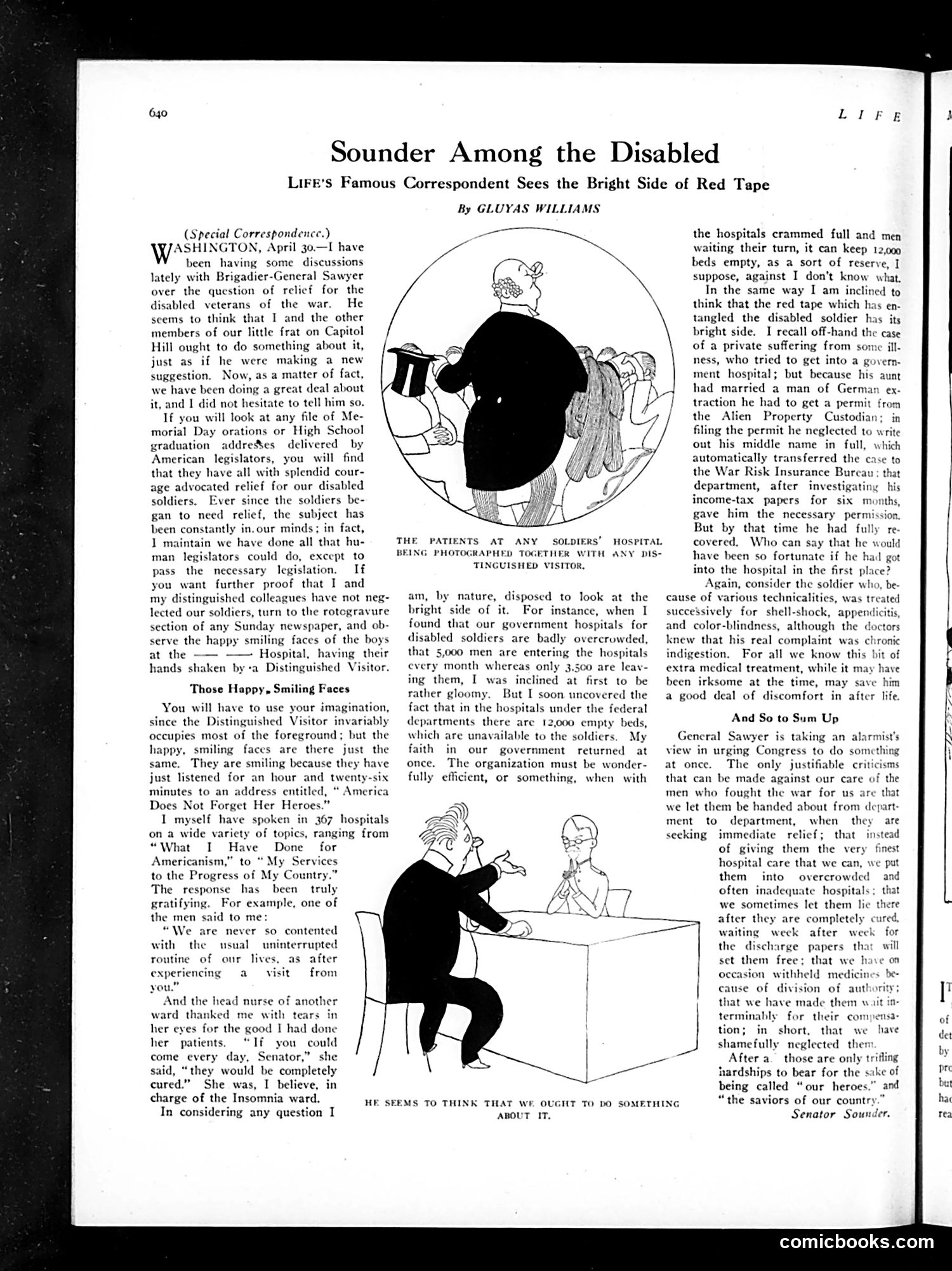
This satirical piece by Gluyas Williams mocks senators' self-congratulation about helping disabled World War I veterans while accomplishing little substantively. **The Point:** Senator Sounder (a fictional character representing generic politicians) claims legislators have done extensive work for disabled soldiers by giving speeches at hospitals and appearing in photographs—yet actual relief remains inadequate. The satire highlights the gap between performative gestures and meaningful action. **Key Targets:** - Politicians who give lengthy speeches ("America Does Not Forget Her Heroes") that comfort themselves more than patients - Bureaucratic incompetence: 12,000 empty government hospital beds while soldiers wait, and absurd red tape (requiring an Alien Property Custodian permit for a soldier's hospital admission) - "Distinguished Visitor" photo opportunities masking inaction **The Cartoons:** Show a politician shaking hands with patients (hidden behind him in the photo) and later appearing to "think" about doing something—visual representations of empty gestures. The satire exposes how legislative rhetoric substitutes for actual veteran care during the postwar period.
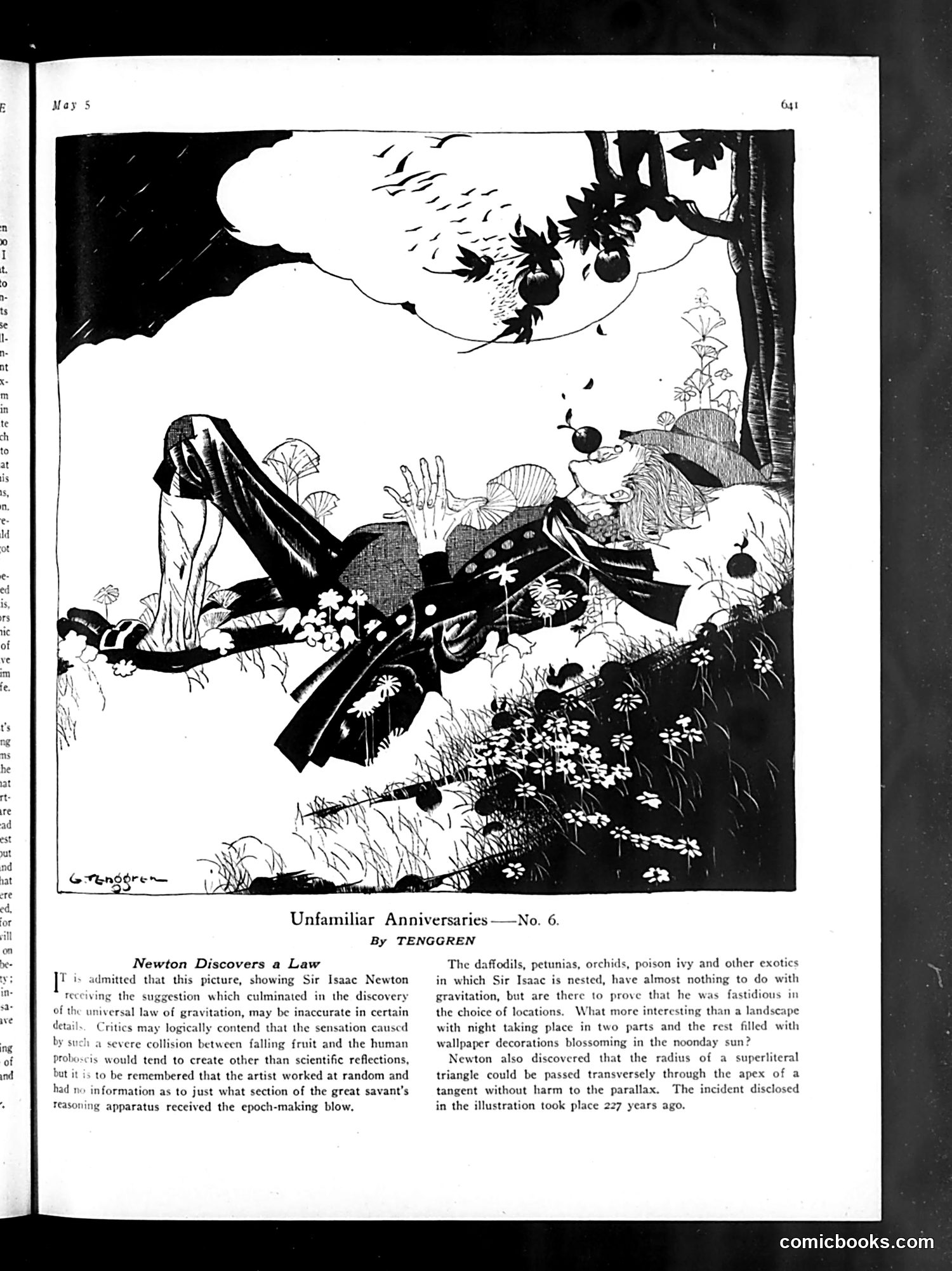
This is a humorous illustrated essay by Tenggren satirizing the famous (possibly apocryphal) story of Isaac Newton discovering gravity when an apple fell on his head. The cartoon shows Newton lounging in an ornate garden surrounded by flowers, with an apple falling from above. The satire works on multiple levels: the text absurdly claims the artist had "no information" about which part of Newton's head was hit, and it mocks the incongruity of depicting this scientific moment in a decorative, romantic garden setting with "wallpaper decorations blossoming in the noonday sun." The final paragraph becomes deliberately nonsensical, fabricating a ridiculous pseudo-scientific discovery about "superliteral triangles" and "parallax," mocking how the incident is mythologized. The joke is that the famous moment may be far less dignified and precise than history suggests—a random accident rather than scientific inspiration.
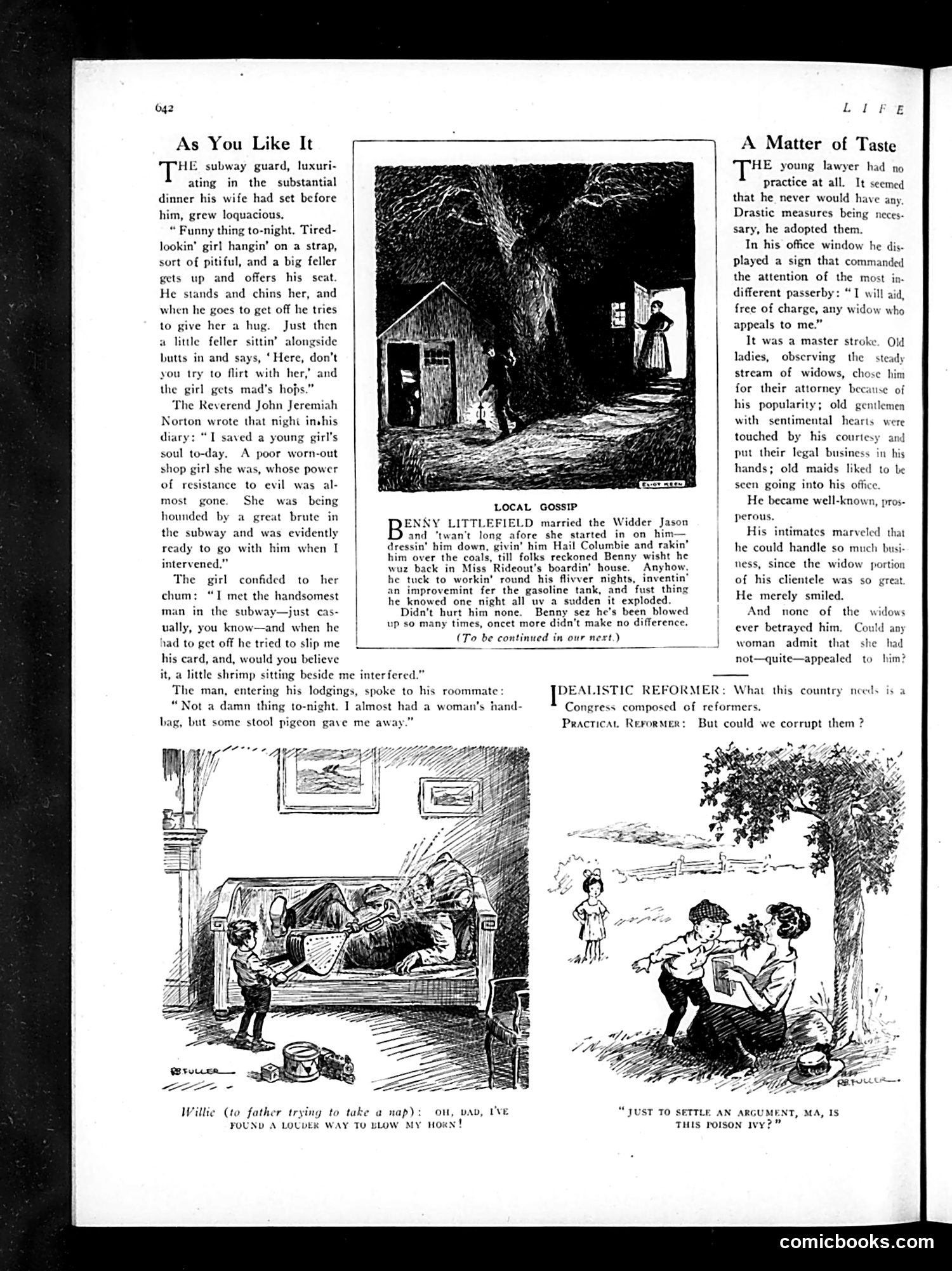
This page presents multiple satirical vignettes about perspective and self-deception: **"As You Like It"**: A single subway encounter is narrated four different ways—each narrator reinterprets the same event to flatter their self-image. The subway guard sees a kindly man, the reverend believes he "saved a soul," the girl imagines romantic interest, and a criminal thinks he nearly succeeded in solicitation. The satire mocks how people construct narratives that cast themselves favorably, regardless of objective reality. **"Local Gossip"**: A humorous rural anecdote about Benny Littlefield, whose wife nags him relentlessly. He escapes to tinker with his car engine until it explodes—which he shrugs off, having been "blowed up" repeatedly by life's disappointments. **"A Matter of Taste"**: A struggling young lawyer advertises free legal aid to widows, which attracts other clients. His intimates wonder how he handles the volume; the joke implies widows won't admit they weren't actually romantically interested, preserving the fiction that *they* appealed to *him*. The page's theme: people see what they want to see, and maintain comfortable illusions about themselves.
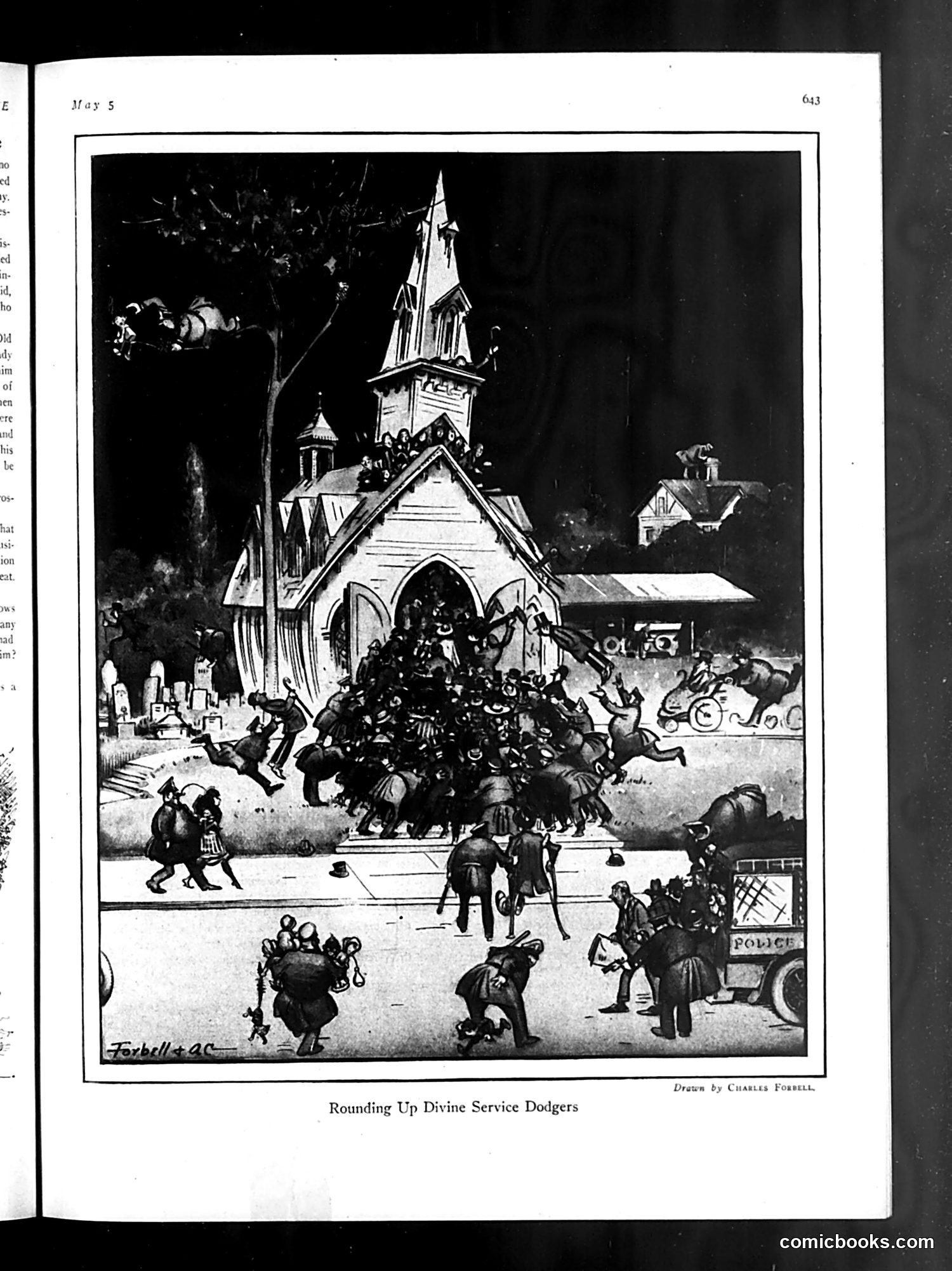
This Charles Forbell cartoon satirizes people who avoid attending church. The image shows police and authorities literally rounding up and herding a large crowd of reluctant civilians toward a church building, complete with a police wagon. The chaos suggests resistance to forced religious attendance. The satire targets those who skip Sunday services—"divine service dodgers"—by depicting their capture as a law enforcement matter. This reflects early 20th-century American social attitudes where church attendance was expected as civic/moral duty. The cartoon humorously suggests such shirkers require the same police intervention as criminals. The exaggerated scene mocks both the dodgers' behavior and society's judgment of them.
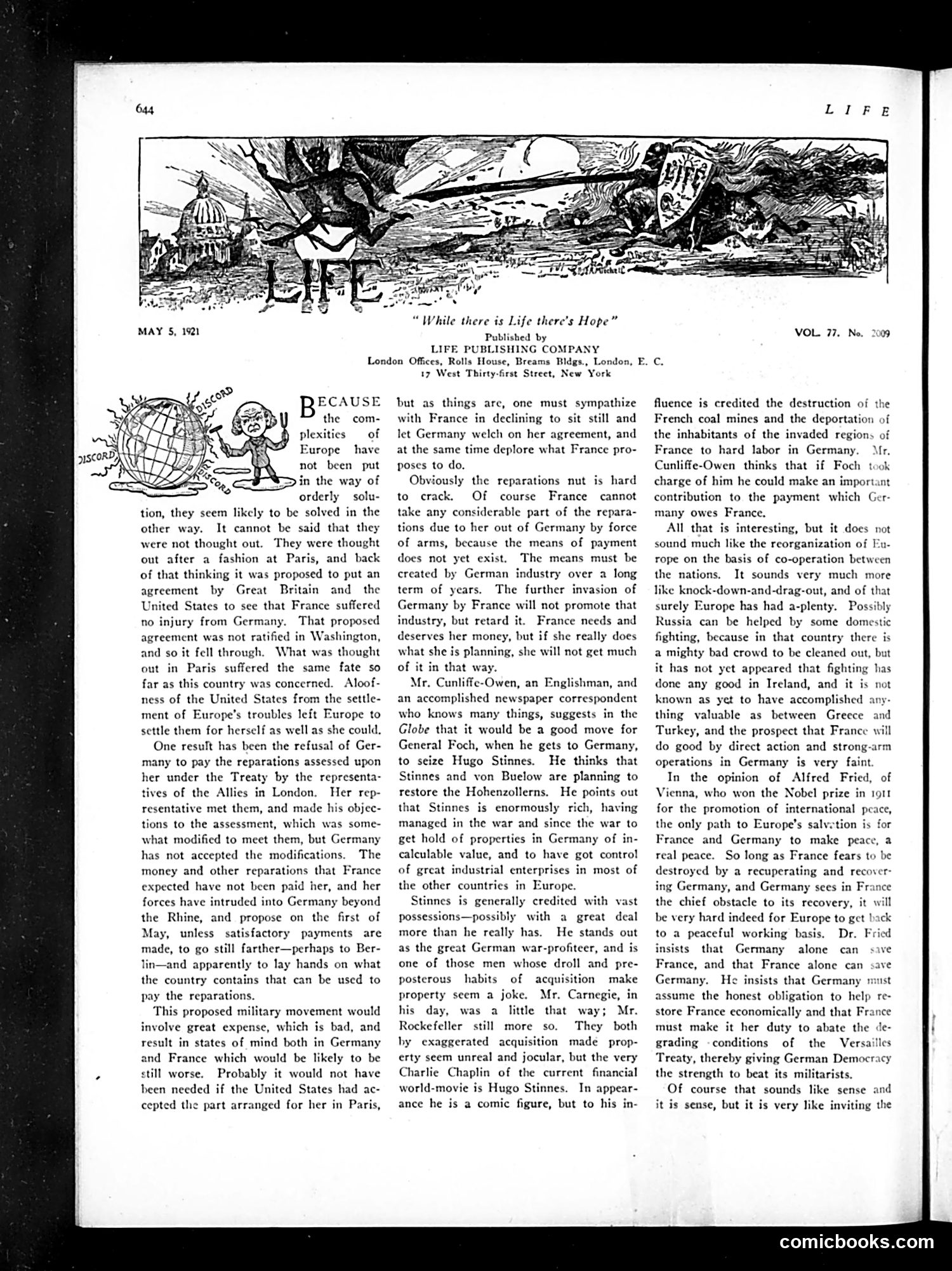
This editorial page addresses the escalating tension between France and Germany over war reparations following World War I. The author criticizes the United States' refusal to ratify the Paris Peace Treaty agreements, which left France without American backing against German non-compliance. The main point: France, justified in demanding reparations Germany refuses to pay, now threatens military occupation beyond the Rhine—potentially reaching Berlin by May 1921. However, the writer argues this will backfire economically since Germany's *industrial capacity* (not force) must generate the funds over years. The piece then critiques Hugo Stinnes, a German war profiteer who accumulated vast industrial holdings and wealth during/after the war. The comparison to Carnegie and Rockefeller suggests Stinnes's acquisition habits are so excessive they become almost absurd—a "Charlie Chaplin" figure. The implication: such wealth concentration poses political dangers (restoring the Hohenzollerns monarchy). The header's decorative cartoon appears generic allegorical imagery rather than specific caricature.
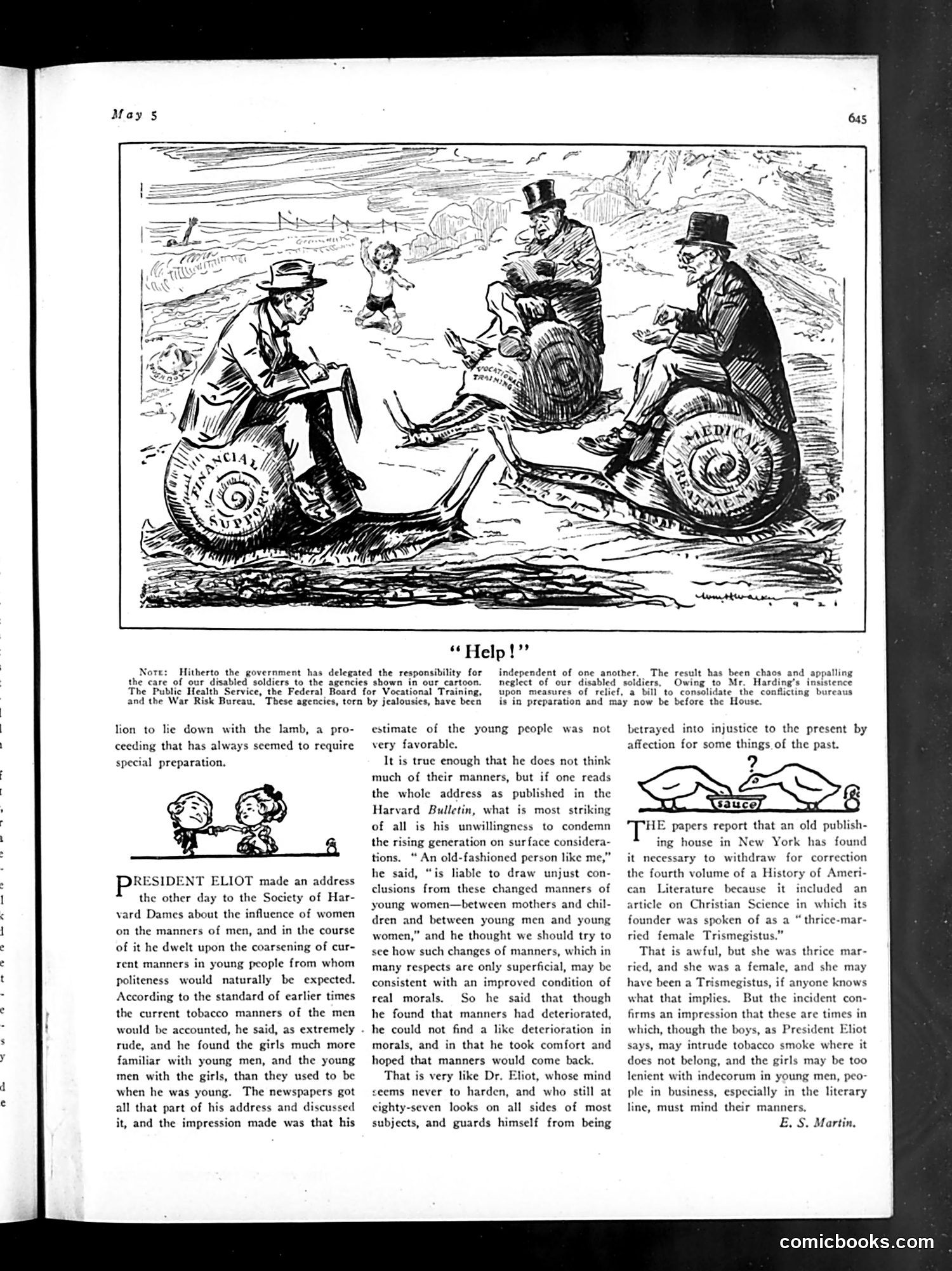
The main cartoon satirizes government bureaucratic chaos in caring for disabled WWI veterans. Four men in top hats—representing competing federal agencies (Public Health Service, Federal Board for Vocational Training, War Risk Bureau, and others)—are depicted riding on wheels labeled with these agency names. They're struggling, disorganized, and pulling in different directions while a small child ("Help!") cries out in distress between them. The satire points to overlapping jurisdictions and institutional jealousy creating "chaos and appalling neglect" of disabled soldiers. The cartoon advocates for consolidation of these conflicting bureaus into a single relief bill. It's a visual argument that fragmented government responsibility harms those it's meant to serve—here, vulnerable veterans dependent on coordinated care they cannot receive.
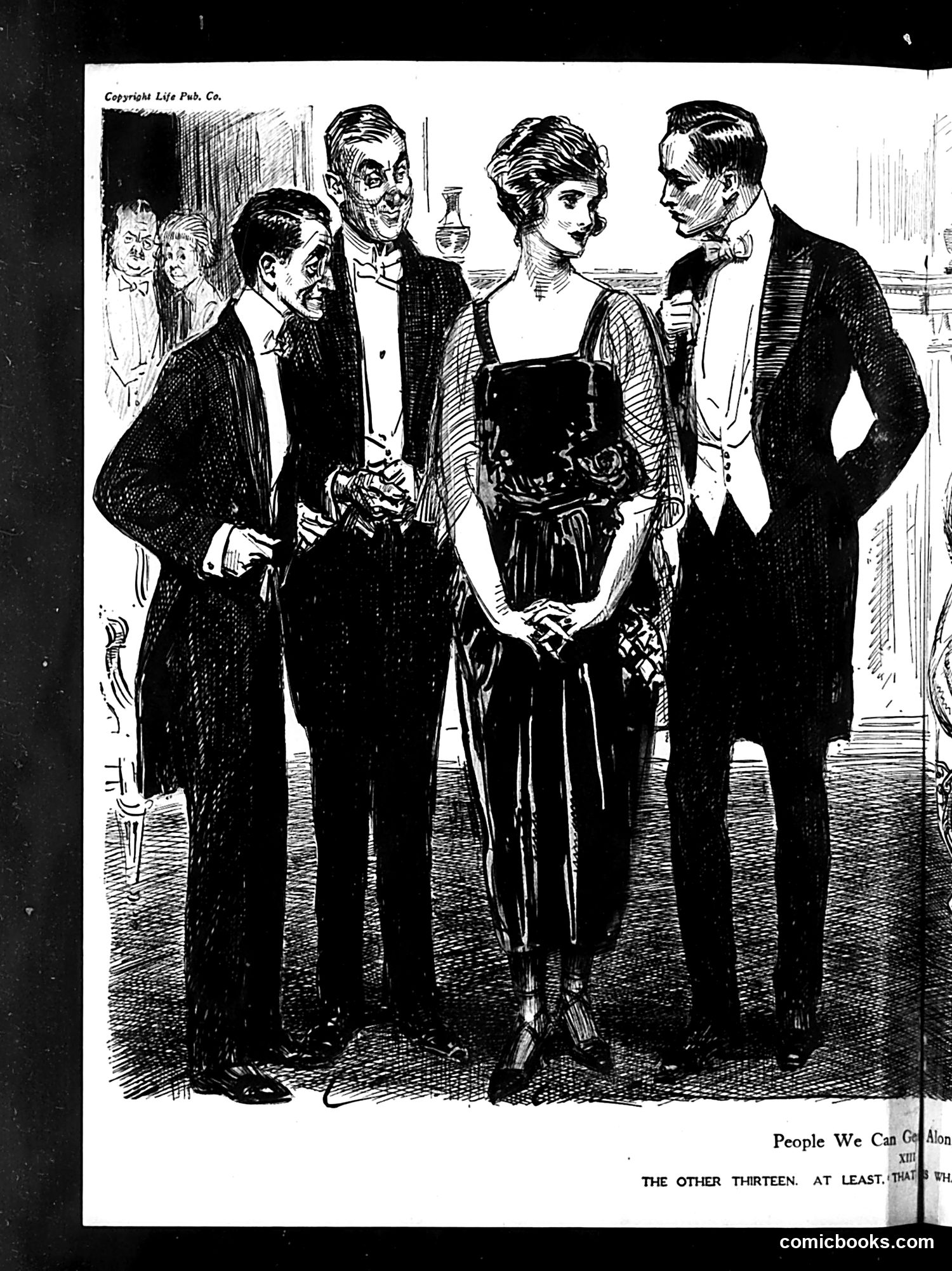
This illustration shows a formal social gathering featuring five well-dressed men in tuxedos with a woman in an evening gown at the center. The caption reads "THE OTHER THIRTEEN. AT LEAST, (THAT'S WH[AT]..." with the partial title "People We Can..." The satire appears to critique elite social circles or high society gatherings, likely suggesting the woman is one of a limited, exclusive group. The phrase "the other thirteen" implies she's being categorized or counted as part of a small, select club—possibly referencing desirable social companions or members of an exclusive circle. Without the complete text, the precise target remains unclear, but the tone suggests gentle mockery of upper-class social hierarchies and the treatment of women as interchangeable fixtures in elite gatherings.
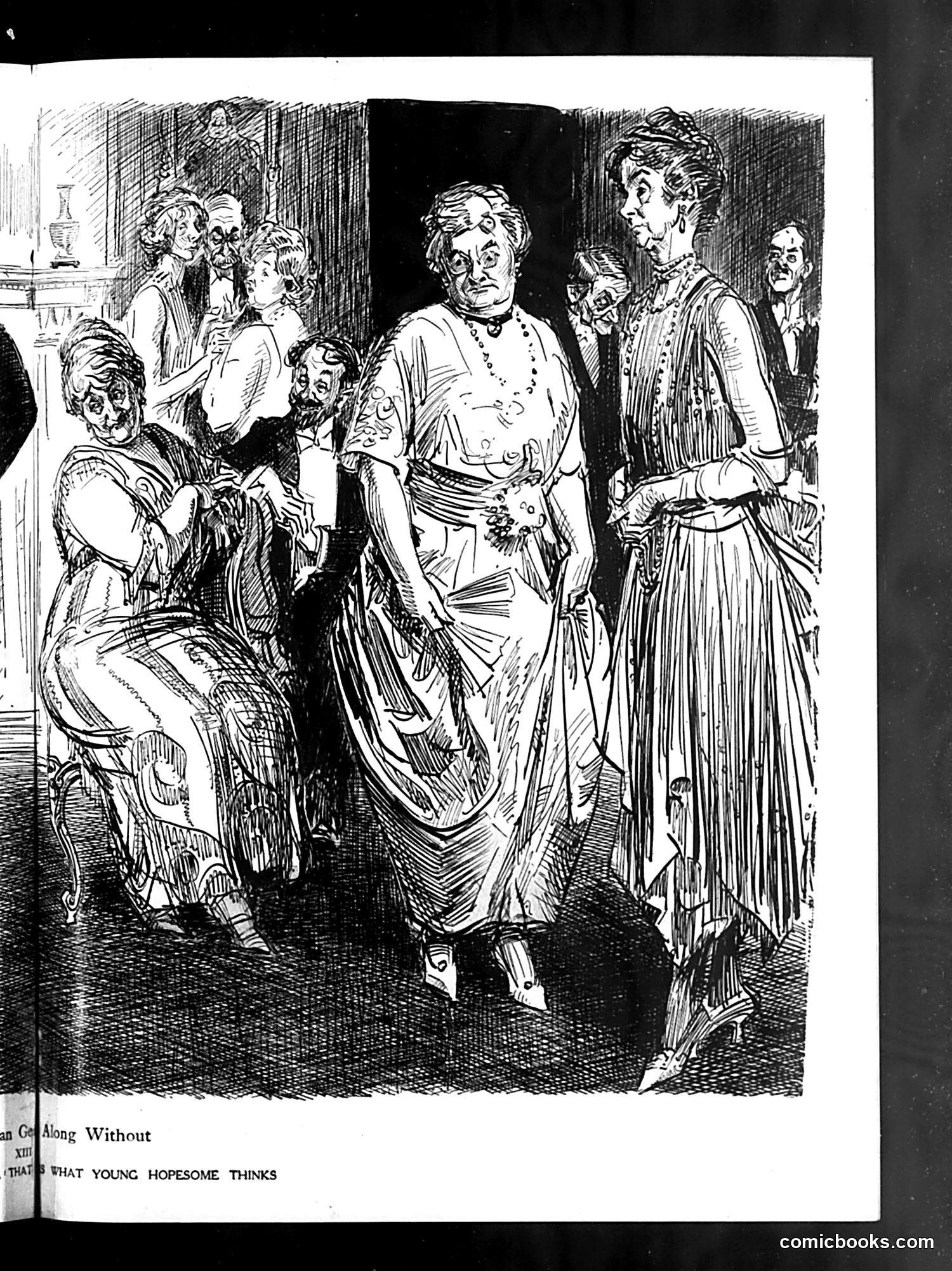
This appears to be a satirical illustration from *Life* magazine depicting a social gathering, likely from the early-to-mid 20th century based on the clothing styles and illustration technique. The caption "What Young Hopesome Thinks" suggests the cartoon mocks youthful idealism or naïveté. The scene shows well-dressed figures in what appears to be a formal or elegant setting. The satire likely contrasts what a young, optimistic person imagines about high society or adult life versus the reality depicted—perhaps suggesting pretentiousness, superficiality, or uncomfortable social dynamics among the assembled group. Without additional context about the specific publication date or "Hopesome" character, the precise social commentary remains somewhat unclear, though the tone appears mockingly critical of either youth's aspirations or high-society pretense.
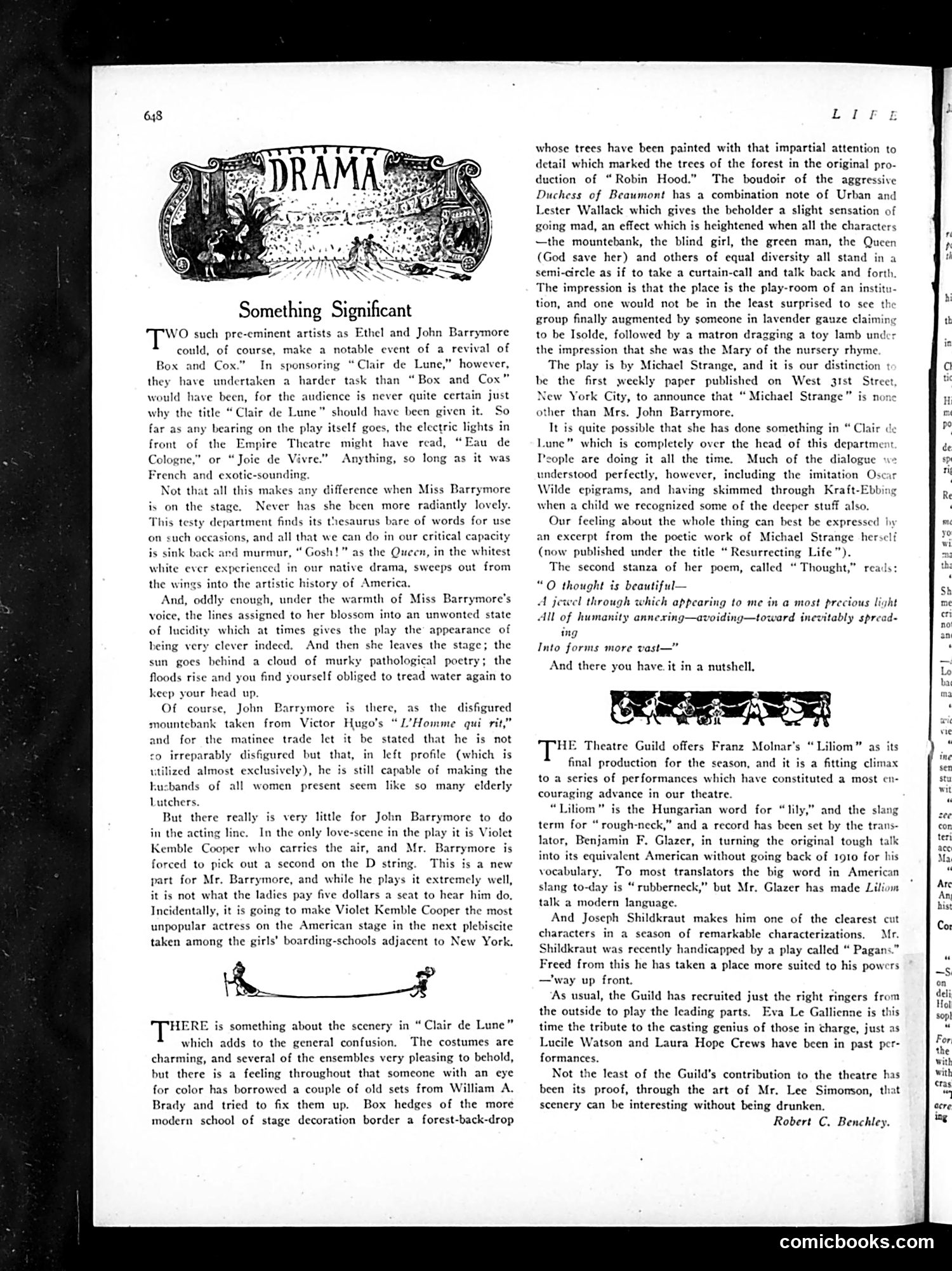
This is a theater review critiquing the Barrymore siblings' production of "Clair de Lune" at the Empire Theatre. The critic praises **Ethel Barrymore's** radiant performance as a Queen, noting she elevates mediocre material through sheer talent. However, he's harsh on the play itself—the French title appears arbitrarily chosen ("might have read 'Eau de Cologne'"), and the plot lacks substance. **John Barrymore** plays a disfigured character adapted from Victor Hugo, but the critic dismisses his role as secondary, claiming he's essentially "picking out a second" while actress Violet Kemble Cooper dominates the love scenes. The review mocks the scenery's confused aesthetic, comparing it to recycled stage sets from William Brady productions and Victorian-era "Robin Hood" backdrops. The final image—characters standing in semi-circles like an "institution" awaiting "someone in lavender gauze claiming to be Isolde"—satirizes the production's incoherent, almost absurd theatrical aesthetic.
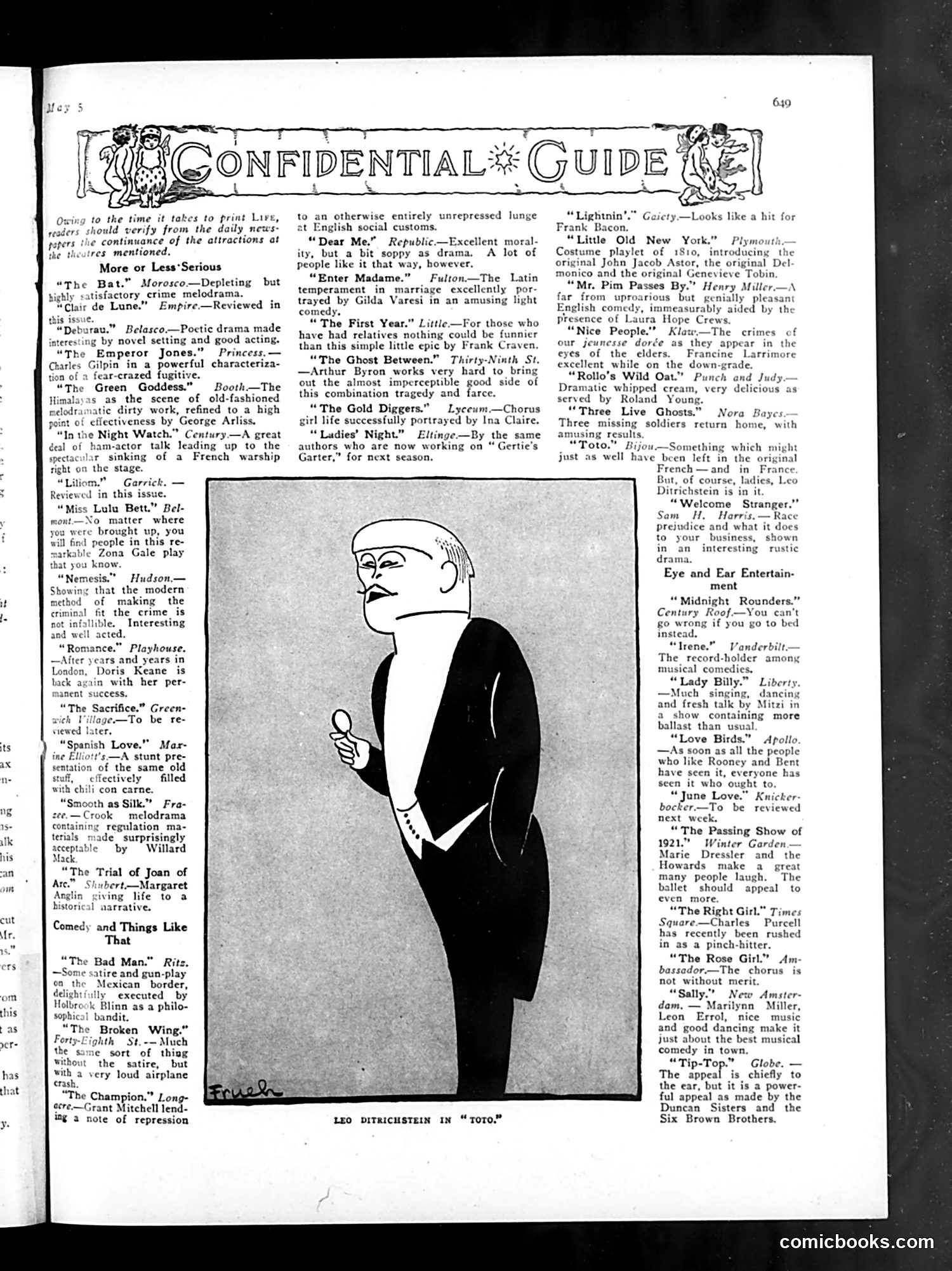
This page is primarily a theater review section titled "Confidential Guide," listing Broadway productions with brief critical assessments. The central illustration depicts **Leo Ditrichstein** in the play "Toto"—a caricature emphasizing his distinctive facial features in a theatrical pose. The reviews cover both serious dramatic productions ("The Emperor Jones," "Liliom," "Deburau") and comedies/lighter fare ("The Gold Diggers," "Nice People," "The First Year"). The tone is gossipy and informal, typical of Life's satirical voice. Key context: This appears to be from the early 1920s (references to contemporary Broadway hits). The reviews mock theatrical conventions—overwrought melodrama, sentimentality, and predictable plots—while noting performances by now-forgotten actors. The satire targets both pretentious theater and mass-appeal entertainment. The illustration functions as entertainment commentary rather than political satire, showcasing a popular performer of the era.
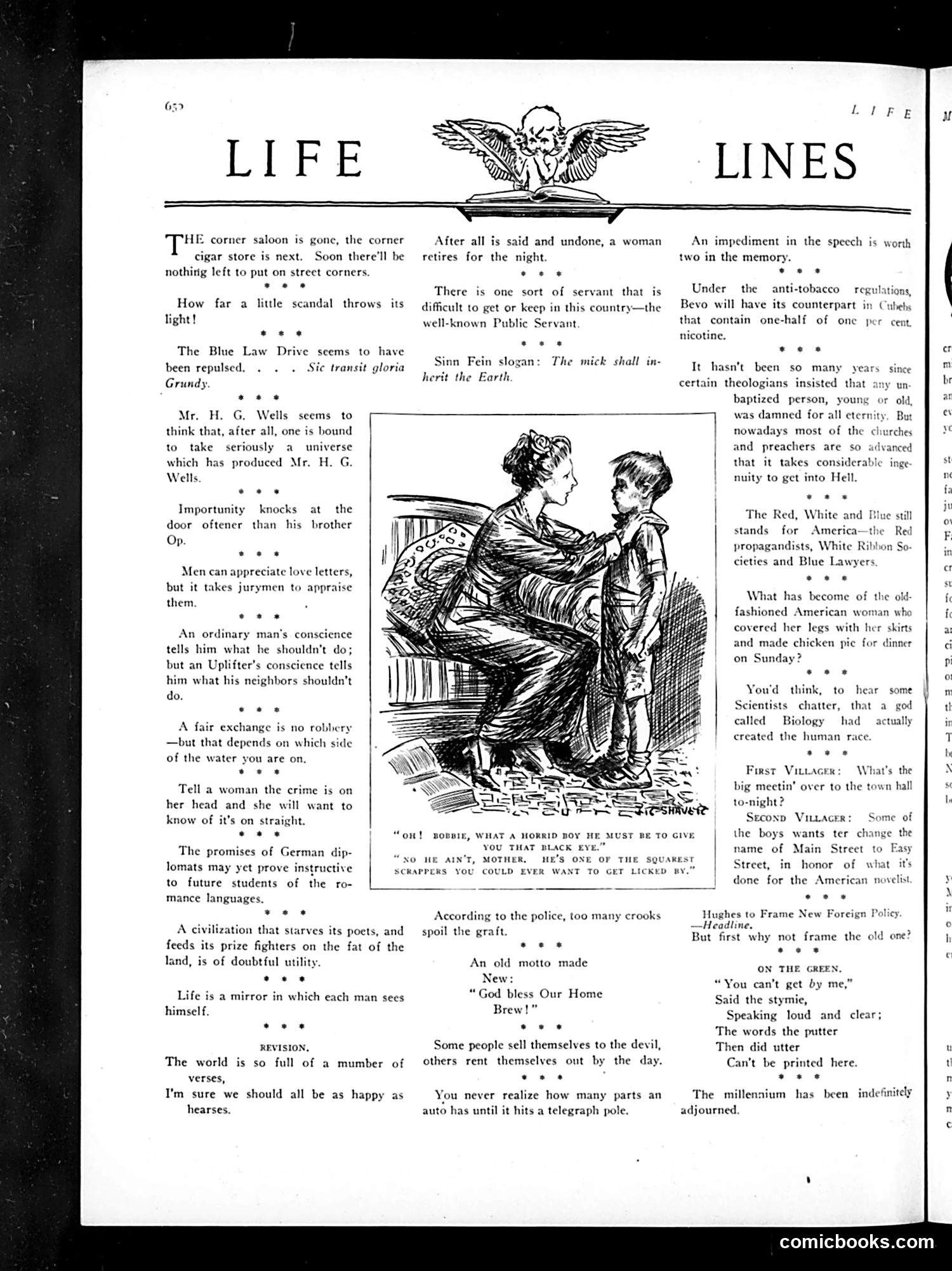
This page from Life magazine contains short humorous observations and one central cartoon mocking American social trends circa 1920s. **The Main Cartoon** depicts a mother confronting a boy about his black eye. The boy defensively claims the other boy is "one of the squarest scrappers you could ever want to get licked by"—satirizing how Americans romanticize toughness and fighting, even when it results in injury. **Key Social Satire Themes:** - **Prohibition**: References to "corner saloons" closing and "Blue Laws" (religious regulations banning alcohol) - **Women's changing roles**: Mocking outdated domesticity ("old-fashioned American woman") - **Hypocrisy**: Critiquing church doctrine on damnation and moral policing by "Uplifters" (reform-minded busybodies) - **Class commentary**: Jabs at lawyers, diplomats, and social pretension The scattered aphorisms target American materialism, superficiality, and the gap between professed values and actual behavior—Life's standard satirical approach during the Jazz Age.
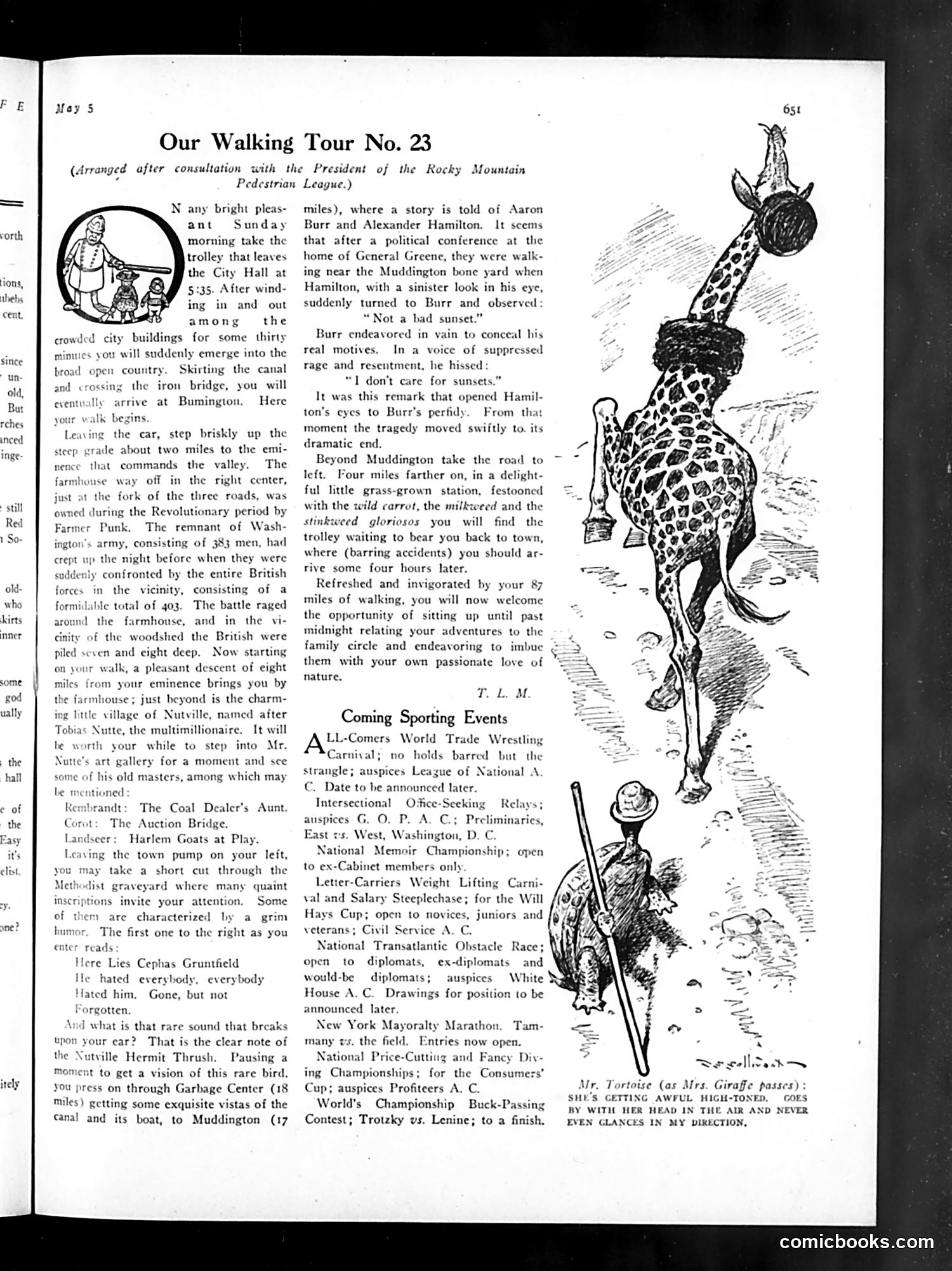
This page satirizes American tourism and leisure through mock travel writing. "Our Walking Tour No. 23" presents an absurdly elaborate 87-mile Sunday outing from a city, peppered with invented historical anecdotes (like a fabricated Burr-Hamilton encounter at a graveyard) and ridiculous local characters (multimillionaire "Tobias Nutte," the hermit thrush sighting). The accompanying cartoon of a giraffe illustrates the hyperbolic tone—suggesting the walk's implausible difficulty or the magazine's mockery of nature-appreciation enthusiasts. The "Coming Sporting Events" section continues the satire, listing deliberately absurd competitions ("Office-Seeking Relay," "Transatlantic Obstacle Race") that parody both political corruption and the era's obsession with competitive spectacles. The overall effect lampoons genteel, leisured society's romanticization of nature and history while simultaneously celebrating various questionable sports and political machinations. It's social satire aimed at upper-middle-class pretensions.
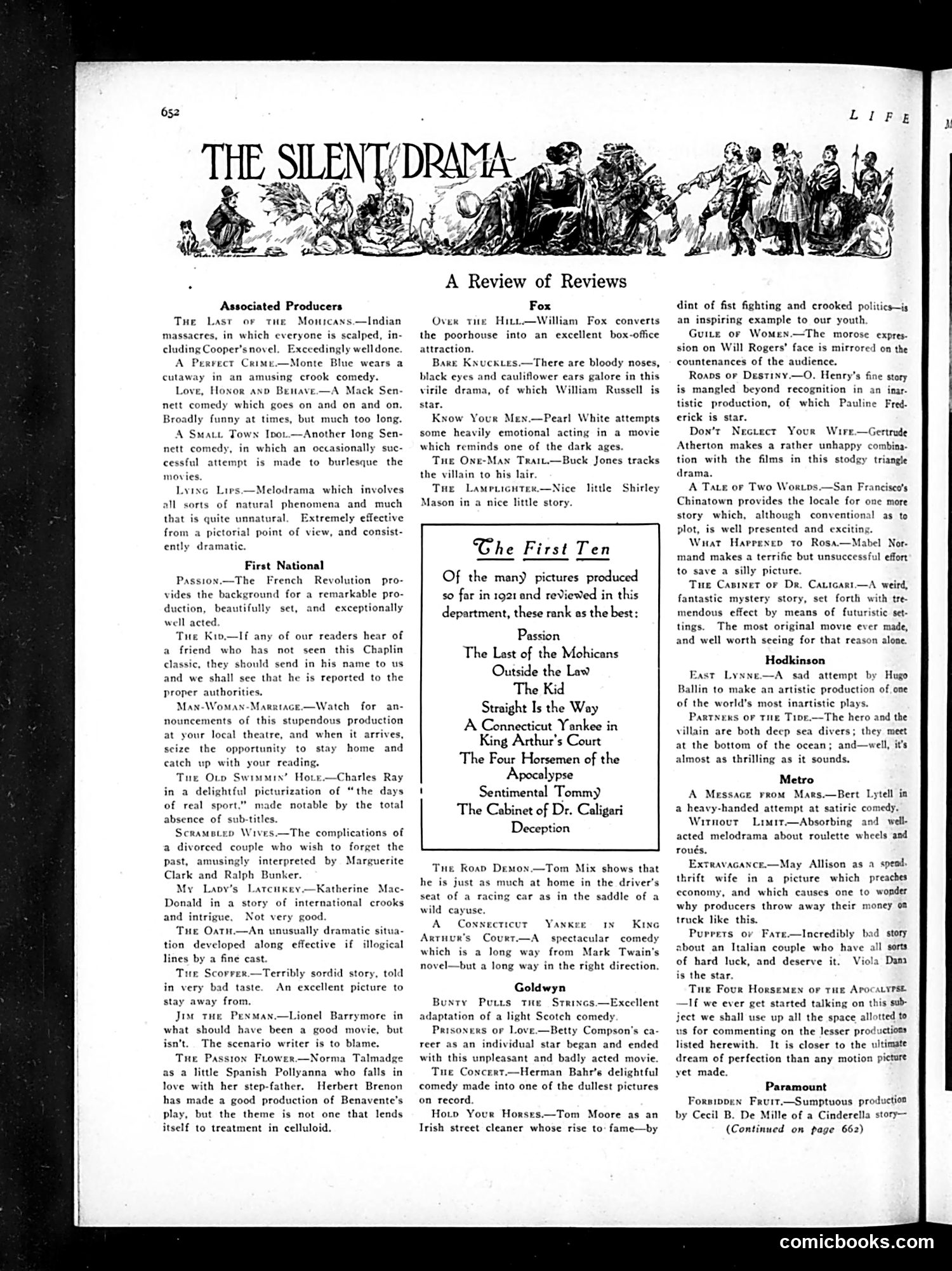
This is a film review column covering movies from major studios of 1921. The page contains no political cartoons—it's primarily text reviews of silent films from Associated Producers, First National, Fox, Metro, and Goldwyn studios. The reviews are brief, witty critiques. For example, *The Kid* (Chaplin's famous work) is praised so highly the reviewer jokes anyone who hasn't seen it should be reported to authorities. *A Small Town Idol* and *A Salty Town Idiot* are criticized as tediously long Mack Sennett comedies. *The Scorcher* is dismissed as "sordid" and worth avoiding. A highlighted box lists the ten best films of 1921 so far, including *Passion*, *The Kid*, *The Last of the Mohicans*, and *The Cabinet of Dr. Caligari*—notable films that remain historically significant. The tone is sophisticated satire aimed at theater-goers familiar with current releases and Hollywood personalities.
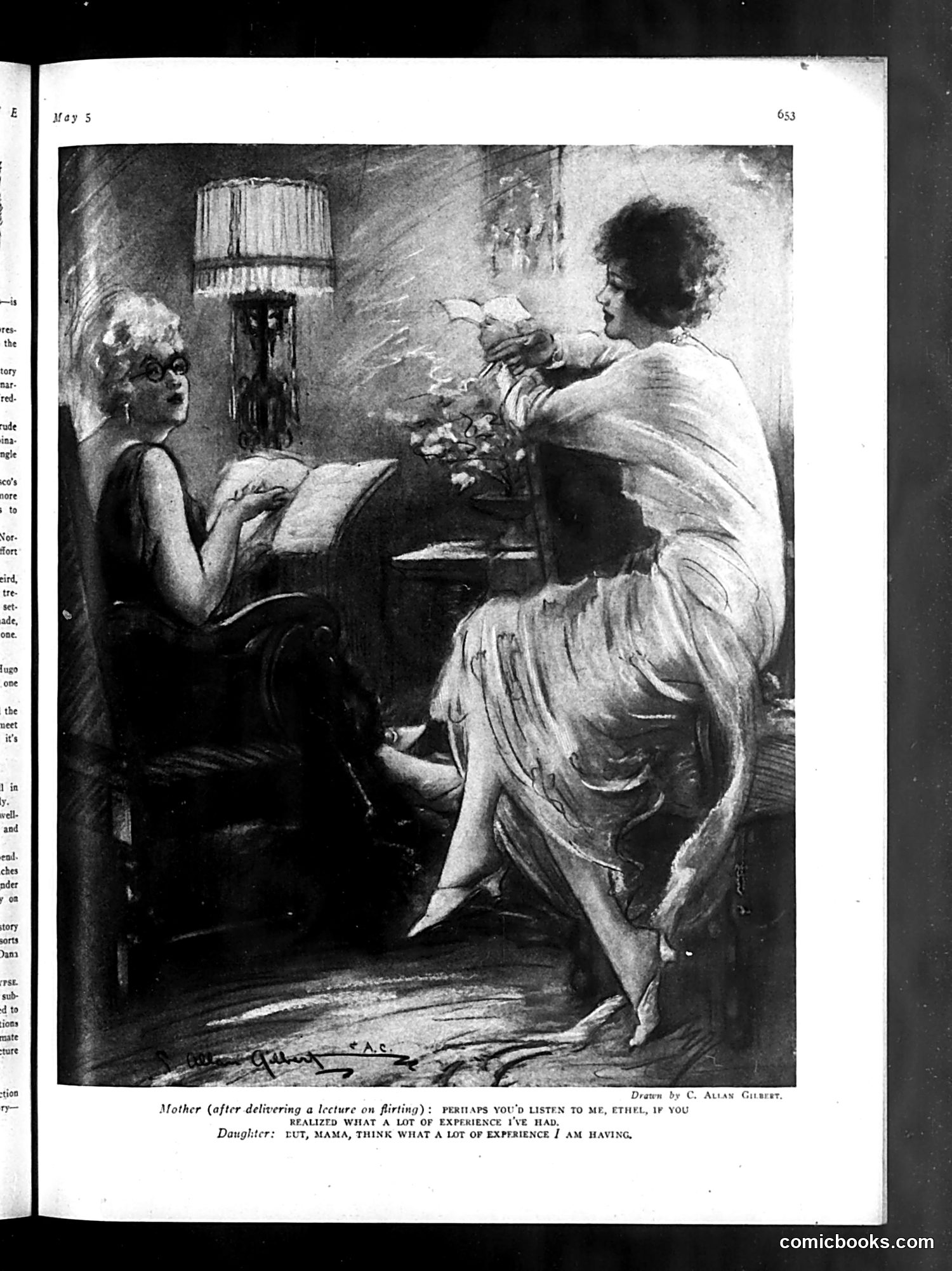
This is a satirical cartoon by C. Allan Gilbert depicting a generational clash about courtship and morality. A mother lectures her daughter Ethel about the dangers of flirting, claiming authority based on her own past experience. The daughter's response—suggesting her current flirting provides her with equivalent "experience"—is the joke's punchline. The satire targets the hypocrisy of Victorian-era mothers who cautioned daughters against behavior they themselves had engaged in. The daughter's cheek implies the mother's lecturing lacks credibility given her admitted history. The cartoon mocks both the mother's self-righteousness and the daughter's boldness in calling out this contradiction.
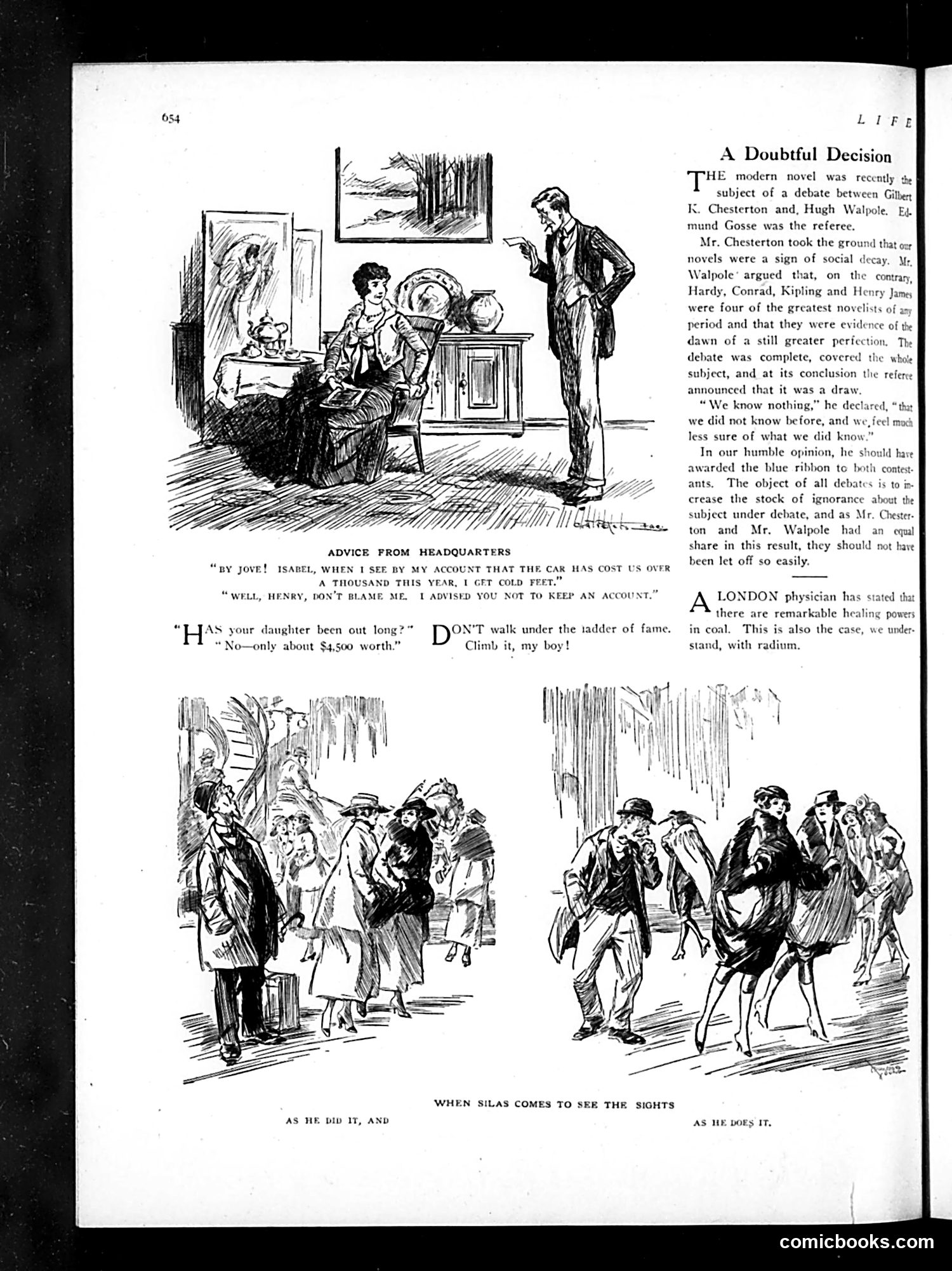
This page satirizes a recent literary debate between G.K. Chesterton and Hugh Walpole, with Edmund Gosse as referee. Chesterton argued modern novels indicated social decay; Walpole countered that Hardy, Conrad, Kipling, and Henry James proved literature was improving. The referee declared it a draw, saying the debate proved they "know nothing" and are "less sure of what we did know." Life's editors mock this outcome, arguing both debaters equally increased public ignorance about the subject, so they deserve no credit—the "blue ribbon" should go to the contestants themselves for their mutual failure to clarify anything. The page also includes unrelated humor cartoons about domestic spending and tourism, typical of the magazine's satirical format.
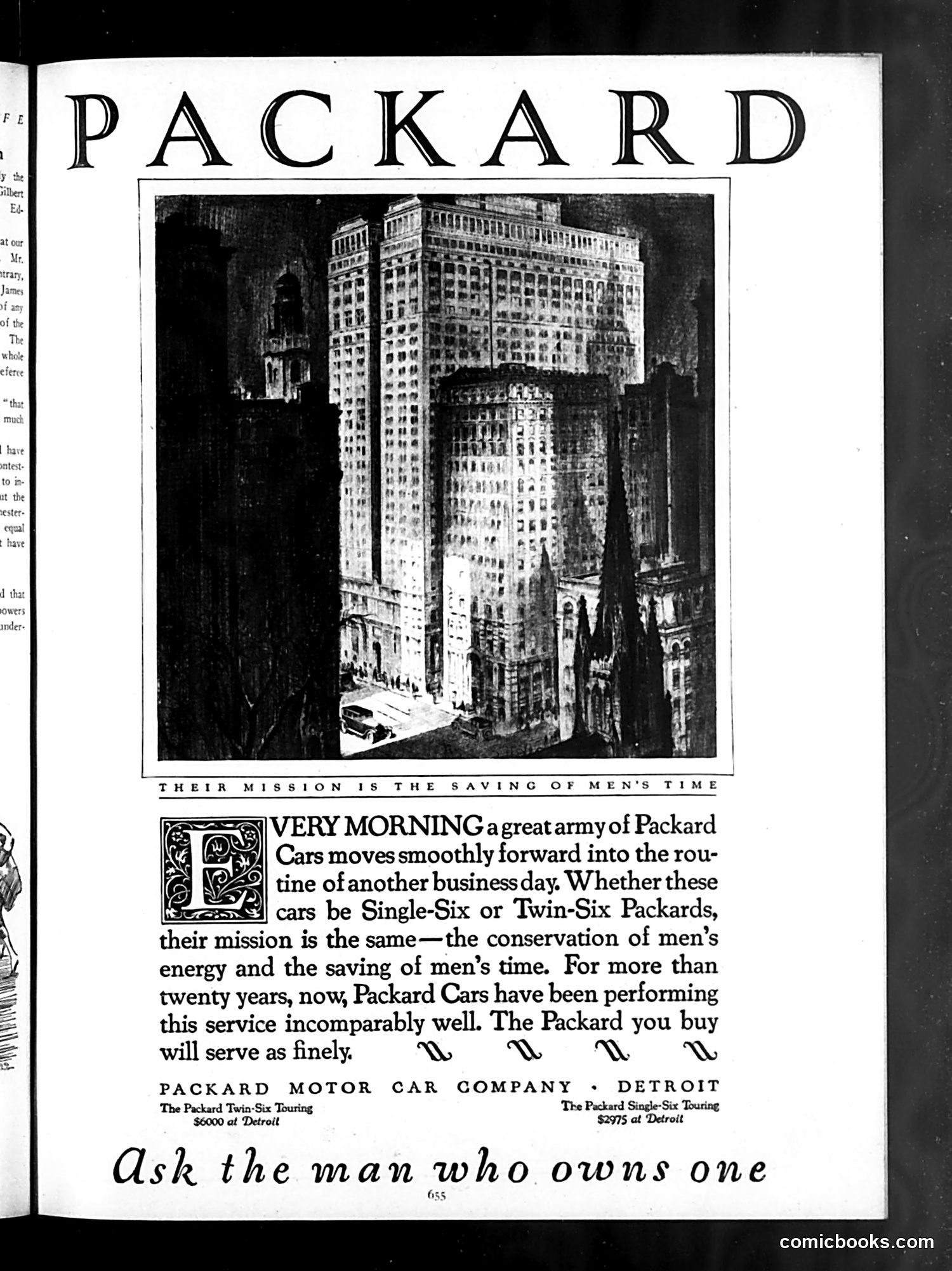
This is a **Packard automobile advertisement**, not political satire or a cartoon. The page features a dramatic nighttime photograph of Detroit's urban skyline with tall buildings and street activity, meant to illustrate modern business life. The ad's tagline—"Their mission is the saving of men's time"—positions Packard cars as essential to efficient business operations. The phrase "Ask the man who owns one" was Packard's actual advertising slogan. The text emphasizes Packard's twenty-year track record and mentions two models: the Single-Six ($6,000) and Twin-Six ($2,975). The "conservation of men's energy" appeals to early 20th-century business efficiency values—a common advertising strategy when automobiles were becoming central to commerce. There is no satirical content here; it's straightforward period advertising using urban imagery to convey modernity and productivity.
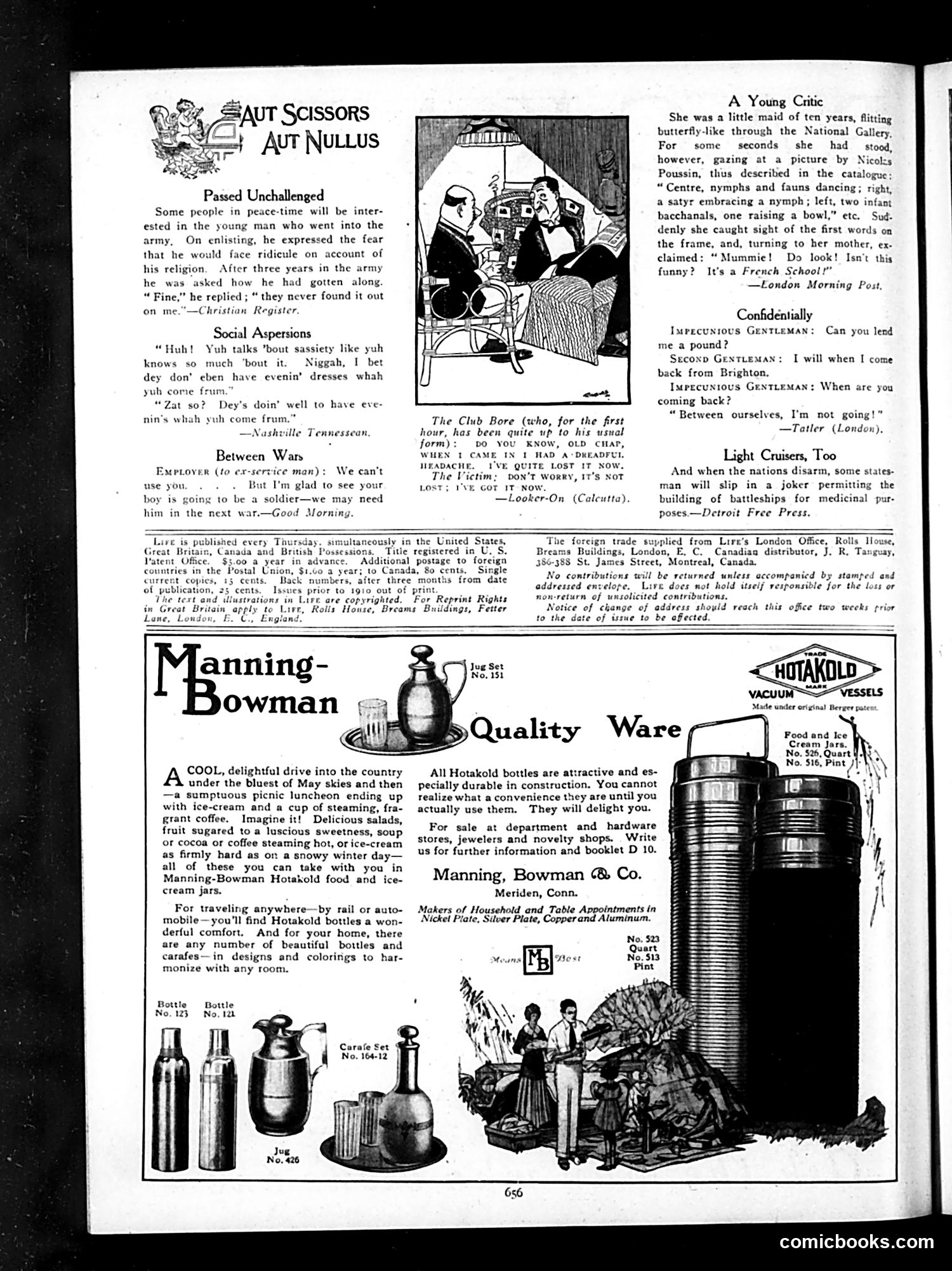
This page collects brief satirical anecdotes and jokes typical of *Life* magazine's humor format. Key items: **"Passed Unchallenged"**: A Jewish soldier served three years in the army without his religion being discovered—satirizing both religious prejudice and the soldier's successful concealment. **"Social Aspersions"**: Uses dialect humor (now offensive) to mock class pretension, with a speaker claiming their hometown lacks evening wear. **"A Young Critic"**: A ten-year-old child misreads a painting titled "French School" as humorous because it depicts nymphs and satyrs—gentle satire on innocent misinterpretation. **"The Club Bore"**: A man claims he lost his headache; the victim replies he now has it—wordplay humor. **"Light Cruisers, Too"**: Political satire suggesting nations will use medical pretexts to build battleships during disarmament negotiations—cynicism about post-WWI peace efforts. The page also contains advertising for Manning-Bowman vacuum bottles. The overall tone reflects early 20th-century American magazine humor conventions.
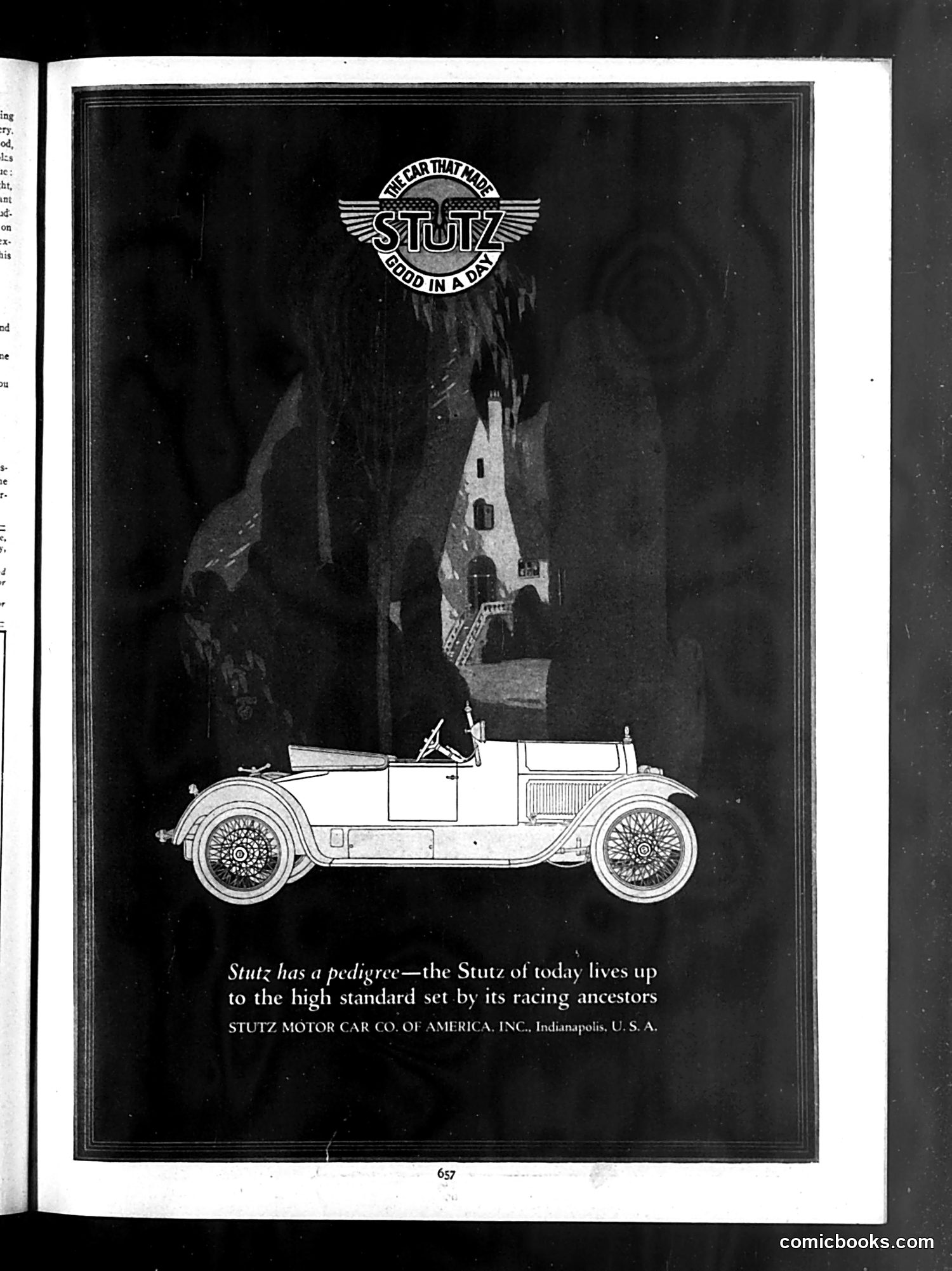
This is a vintage advertisement for Stutz automobiles, not political satire. The ad uses a metaphorical "pedigree" concept: it shows a side-profile illustration of an open-air roadster automobile positioned below a dramatic image of a medieval castle tower nestled in rocky cliffs. The copywriting plays on the double meaning of "pedigree"—both an aristocratic lineage and racing heritage. By juxtaposing the modern car with ancient architecture, Stutz claims its vehicles inherit quality and prestige from the company's successful racing history ("racing ancestors"). This marketing strategy was common in early 20th-century automobile advertising: linking mass-produced cars to historical grandeur and competitive achievement to justify premium pricing. The ad targets affluent buyers seeking status and performance credentials.
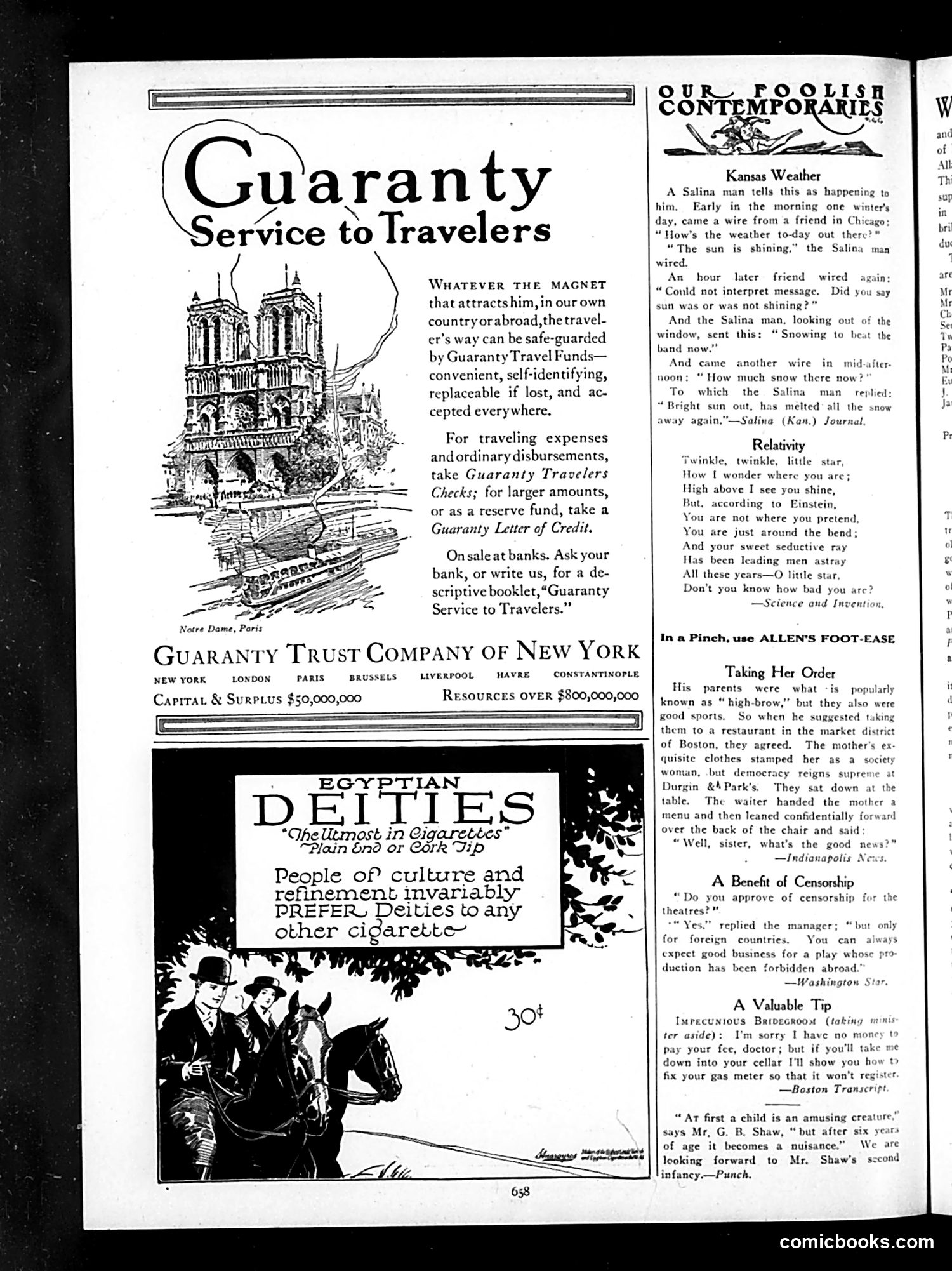
This page combines advertisements with humorous anecdotes and satirical poetry typical of Life magazine's format. **Main Content:** The page features several brief comedic pieces: 1. **"Kansas Weather"** – A humorous exchange of telegrams between a Salina man and a Chicago friend about contradictory weather reports (snow vs. sunshine), poking fun at Kansas weather's unpredictability. 2. **"Relativity"** – A satirical poem addressing Einstein's theory of relativity, using a "Twinkle, Twinkle, Little Star" parody to joke that stars aren't where they appear to be, blaming Einstein's physics for confusing people. 3. **"Taking Her Order"** – A joke about class: a high-brow Boston family takes their refined mother to a market-district restaurant, but a waiter addresses her as "sister," deflating her social pretensions. 4. **"A Benefit of Censorship"** – A theater manager admits censorship helps business for foreign plays. The **Egyptian Delfies cigarette advertisement** occupies significant space, claiming cultured people prefer this brand. The satire targets scientific modernity (Einstein), American class anxiety, and social hypocrisy rather than specific political figures.
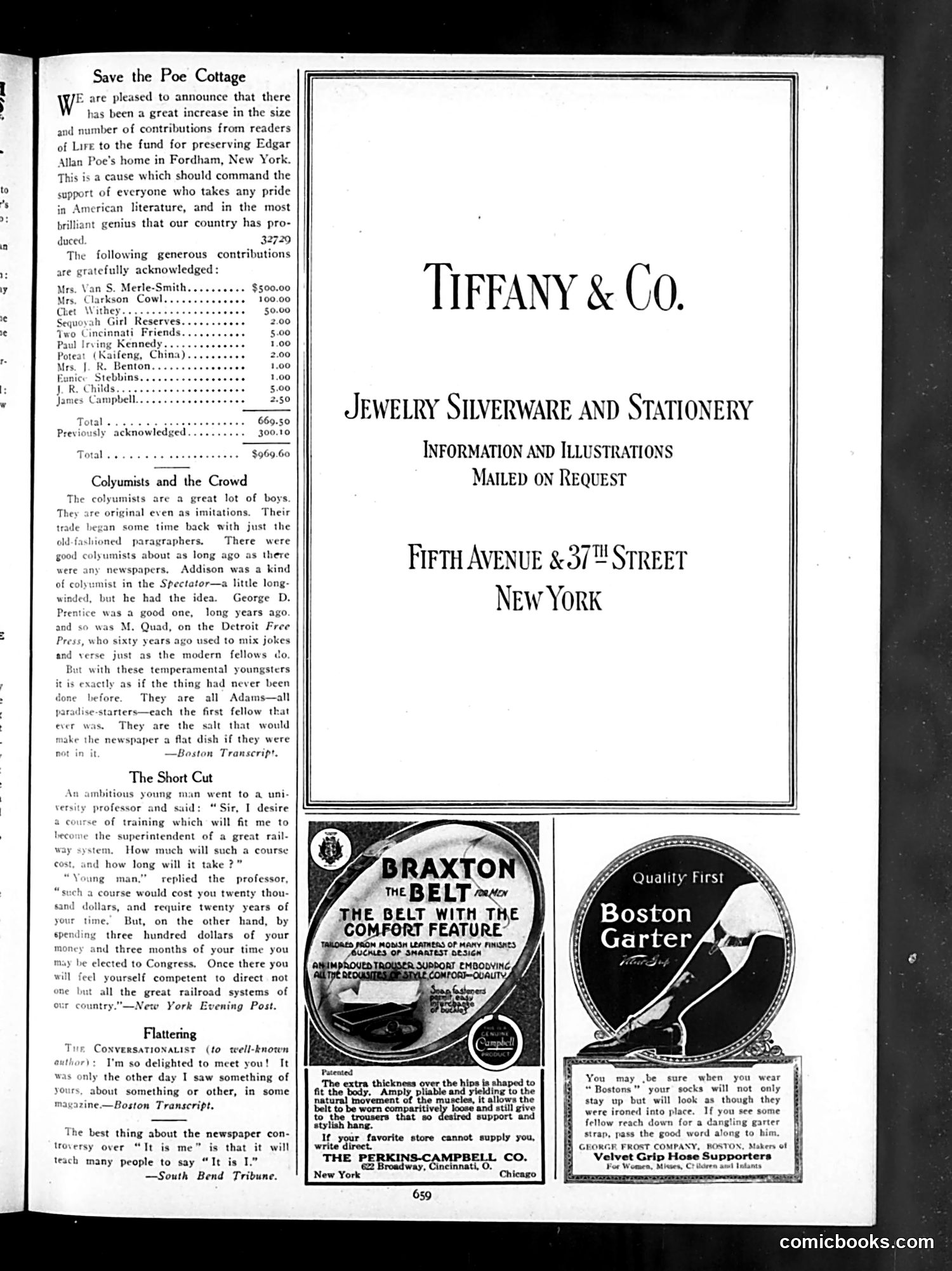
This page is primarily **advertising and announcements** rather than political satire. The main content includes: **"Save the Poe Cottage"**: A fundraising appeal to preserve Edgar Allan Poe's home in Fordham, New York, listing donor contributions. This reflects early 20th-century American literary preservation efforts. **"Colyumists and the Crowd"**: A humorous editorial piece mocking newspaper columnists as unoriginal imitators who treat themselves as pioneers. It references historical figures like Addison and George D. Prentice to contrast with modern "temperamental youngsters." **Three brief satirical items**: - "The Short Cut" jokes that Congress requires less training than railroad management - "Flattering" mocks predictable cocktail conversation - A grammar note about "It is me" vs. "It is I" **The advertisements** occupy roughly half the page, promoting Tiffany & Co., Braxton Belt, and Boston Garter products—typical early 20th-century luxury goods marketing. No specific political figures or events are referenced; this is general-interest social commentary.
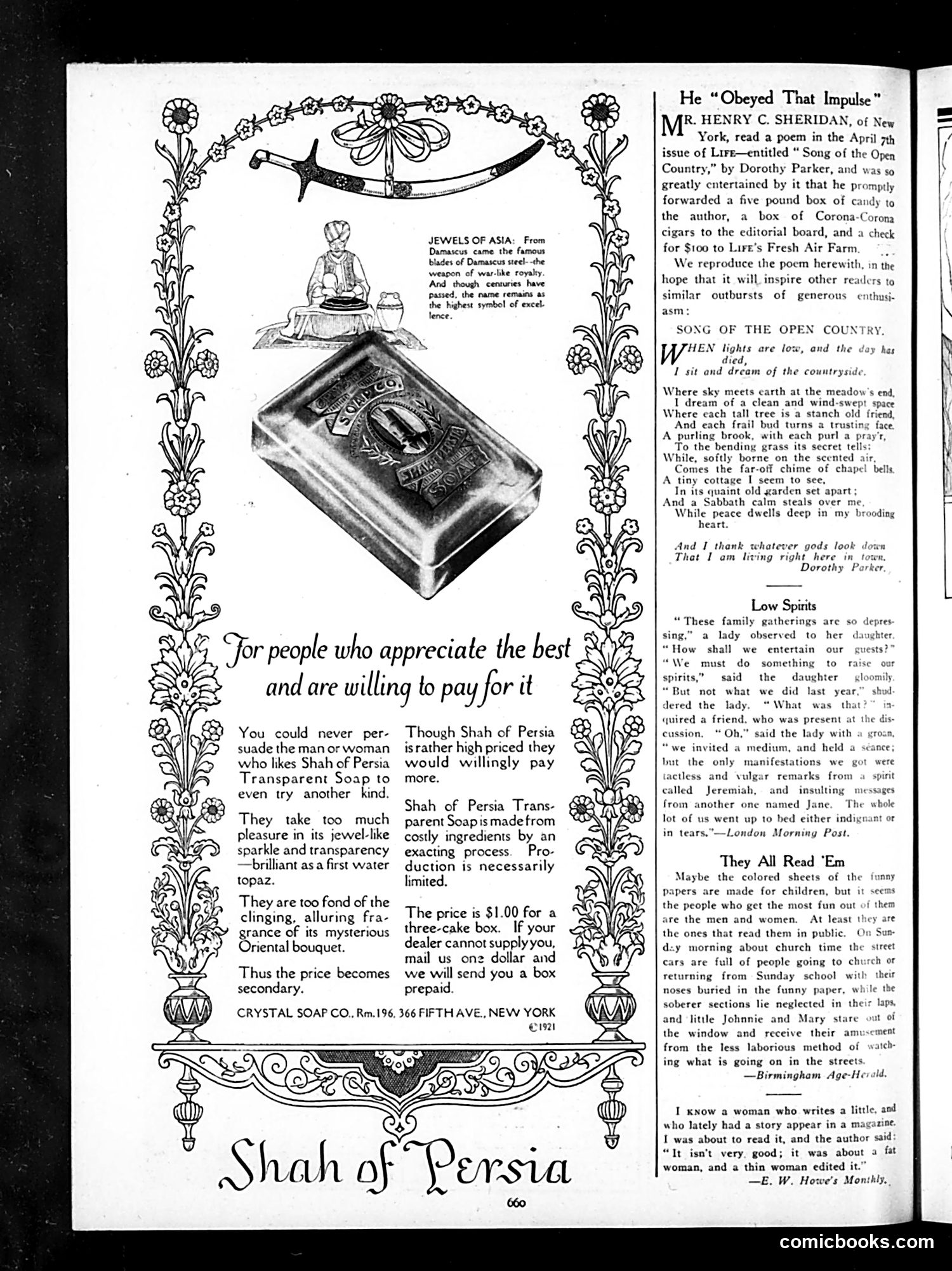
This page combines advertising with humorous editorial content. The main advertisement promotes "Shah of Persia" transparent soap, emphasizing its luxury and high price ($1.00 for three cakes). The copy argues that people who appreciate quality are willing to pay premium prices—a pitch to aspirational consumers. The editorial content includes Dorothy Parker's poem "Song of the Open Country" (presented as inspiration for reader generosity), followed by three short humor pieces. "Low Spirits" jokes about a séance gone wrong at a family gathering. "They All Read 'Em" satirizes the popularity of newspaper comic strips among all social classes, particularly adults reading them publicly on Sunday mornings. The final item mocks female writers' self-deprecation. The overall page reflects 1920s consumer culture, literary sophistication, and gentle social observation typical of *Life* magazine's satirical voice.
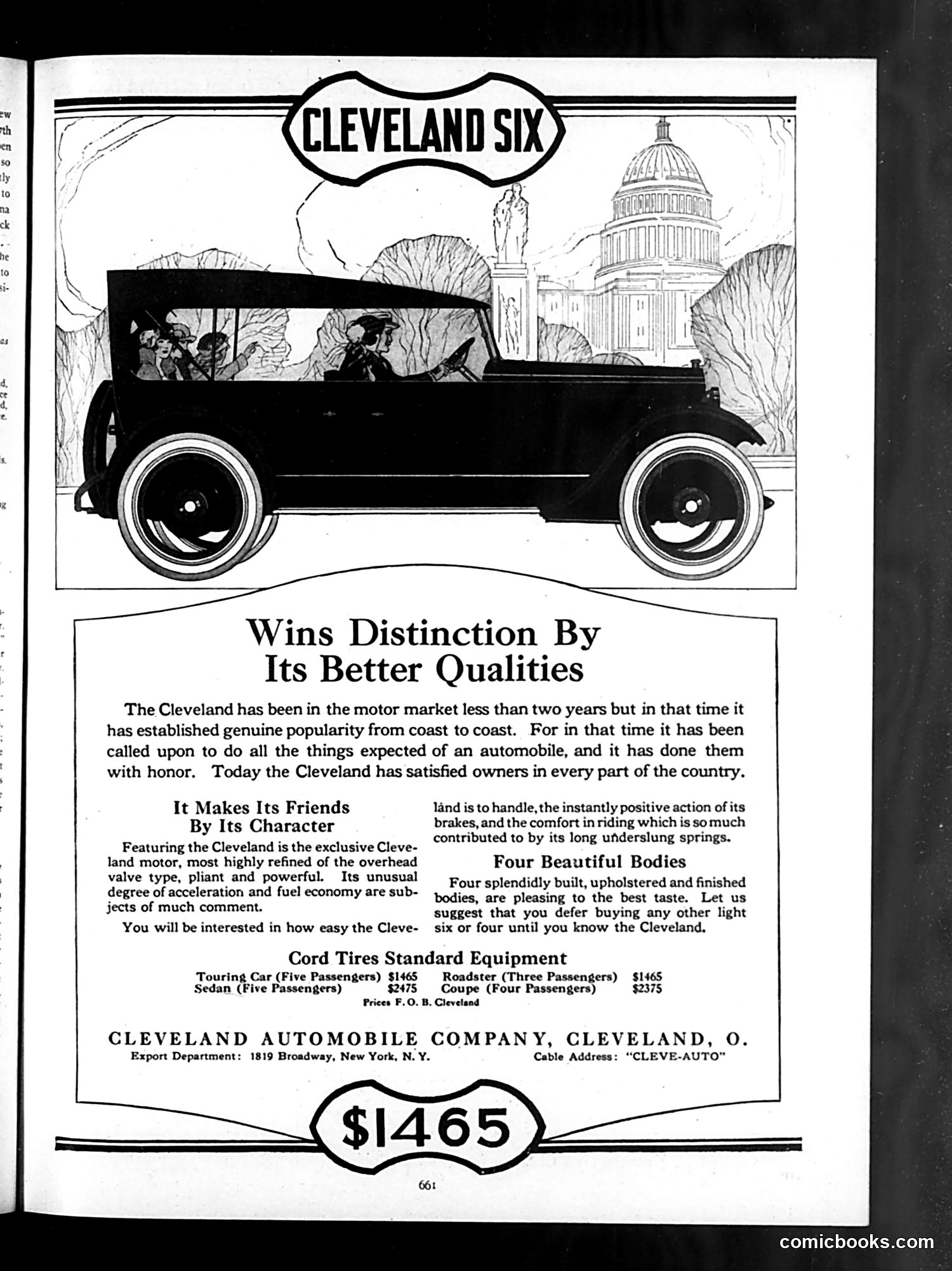
This is not a cartoon or satire—it's a straightforward automobile advertisement from Life magazine's early automotive era (likely 1910s-1920s). The Cleveland Automobile Company promotes their "Cleveland Six" model with an illustrated car positioned before the U.S. Capitol, suggesting American prestige and reliability. The ad emphasizes the car's relatively new market entry (under two years) while claiming nationwide popularity and customer satisfaction. Technical selling points include an exclusive overhead-valve motor, fuel economy, responsive brakes, and comfort features. Four body styles are offered at prices ranging from $1,465 to $2,475. The Capitol backdrop implies civic pride and American manufacturing excellence—a common advertising trope of the era positioning automobiles as symbols of national progress and achievement.
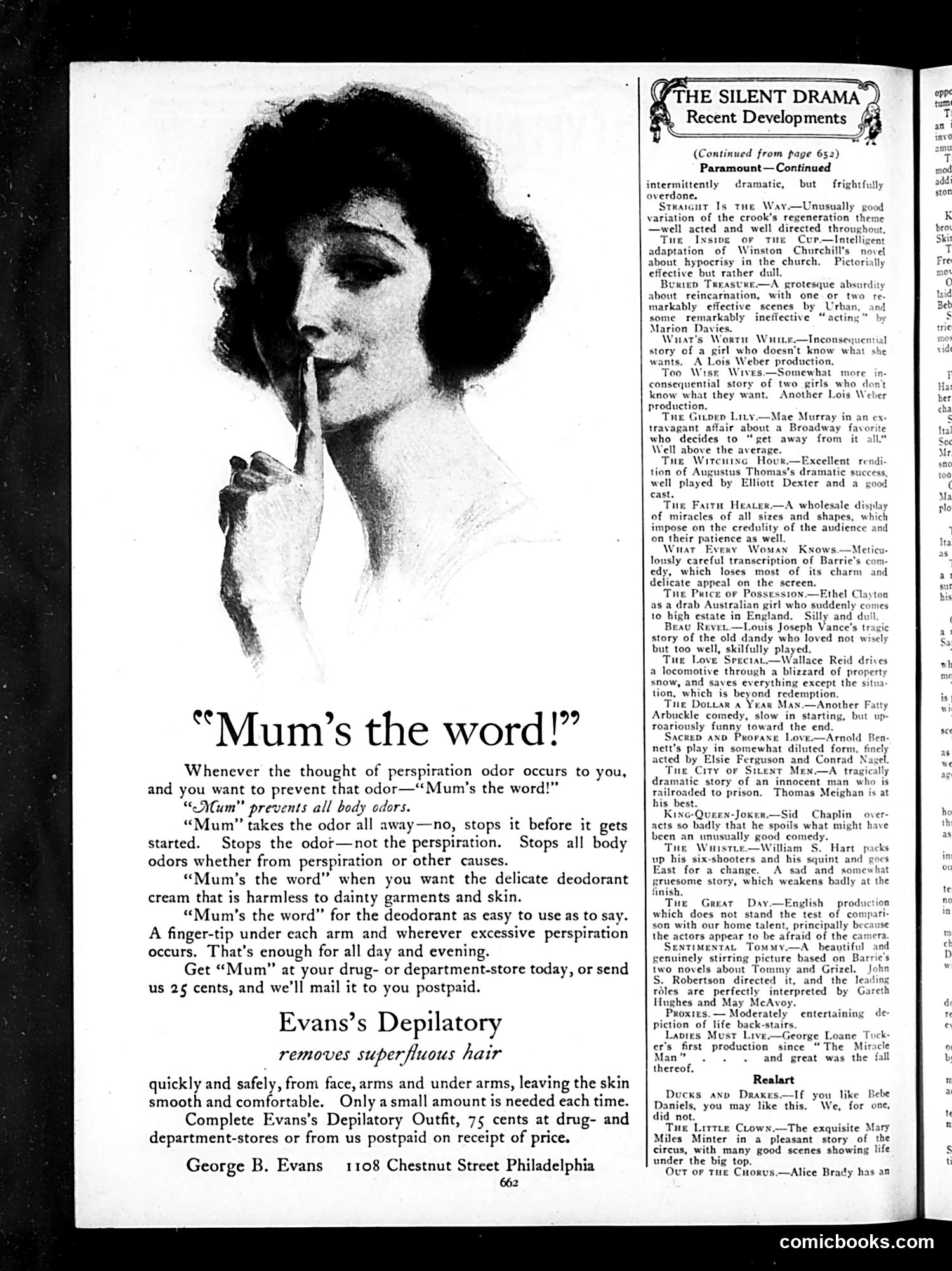
This page is primarily a **product advertisement** for "Mum" deodorant, occupying the lower two-thirds of the left column alongside reviews of silent films. The ad features a **portrait of a woman's face** (likely a celebrity endorsement, though unidentified here) and promotes "Mum" as a solution to perspiration odor. The campaign uses the pun "Mum's the word"—playing on the common phrase meaning "keep quiet"—to market the deodorant as discreet and effective for preventing body odor before it starts. The right column contains **film reviews** from *Life*'s "Silent Drama" section, critiquing contemporary movies from studios like Paramount, featuring actors such as Mae Murray, Elliott Dexter, and Fatty Arbuckle. The advertisement reflects **early 20th-century anxieties about bodily functions** and the emerging consumer culture around personal hygiene products marketed primarily to women.
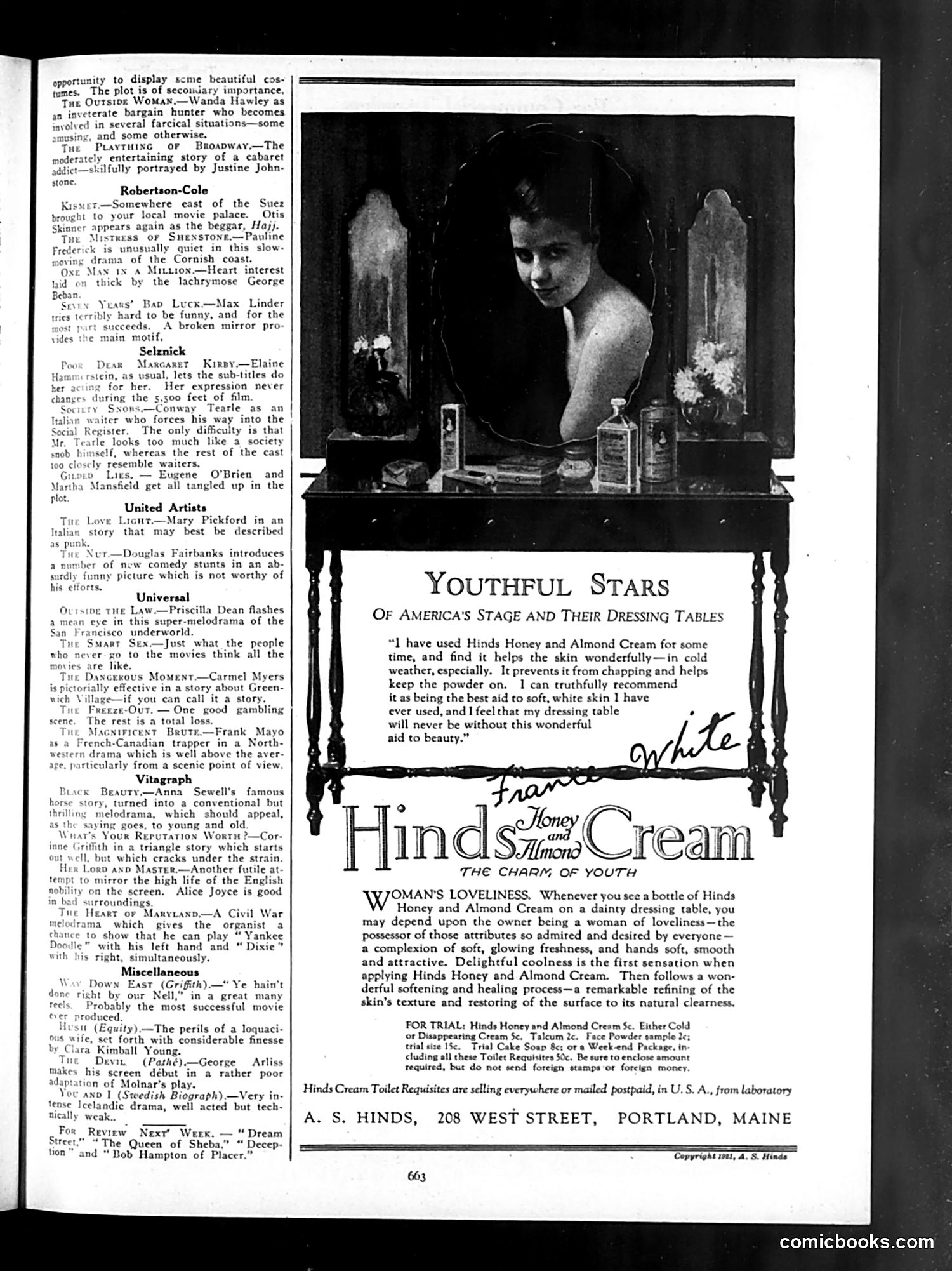
This page is primarily **advertising disguised as editorial content**. The top two-thirds contains brief film reviews of contemporary movies (1920s-era silent films), while the dominant lower section features a paid endorsement advertisement for Hinds Honey and Almond Cream beauty product. The "Youthful Stars" section presents a testimonial supposedly from an unnamed actress praising the cosmetic cream. This was standard 1920s advertising practice—celebrities (or purported celebrities) endorsed beauty products to boost sales. The signature appears to read "White" but is largely illegible, which was typical; the actual endorser's identity mattered less than the celebrity association itself. The film reviews above are genuine critical snippets of recent releases, mentioning actual stars like Mary Pickford and Douglas Fairbanks. However, their placement serves mainly to position the advertisement within seemingly credible editorial material, lending it authority. **For modern readers:** This demonstrates how early 20th-century magazines blended advertising and content seamlessly, before disclosure requirements existed.
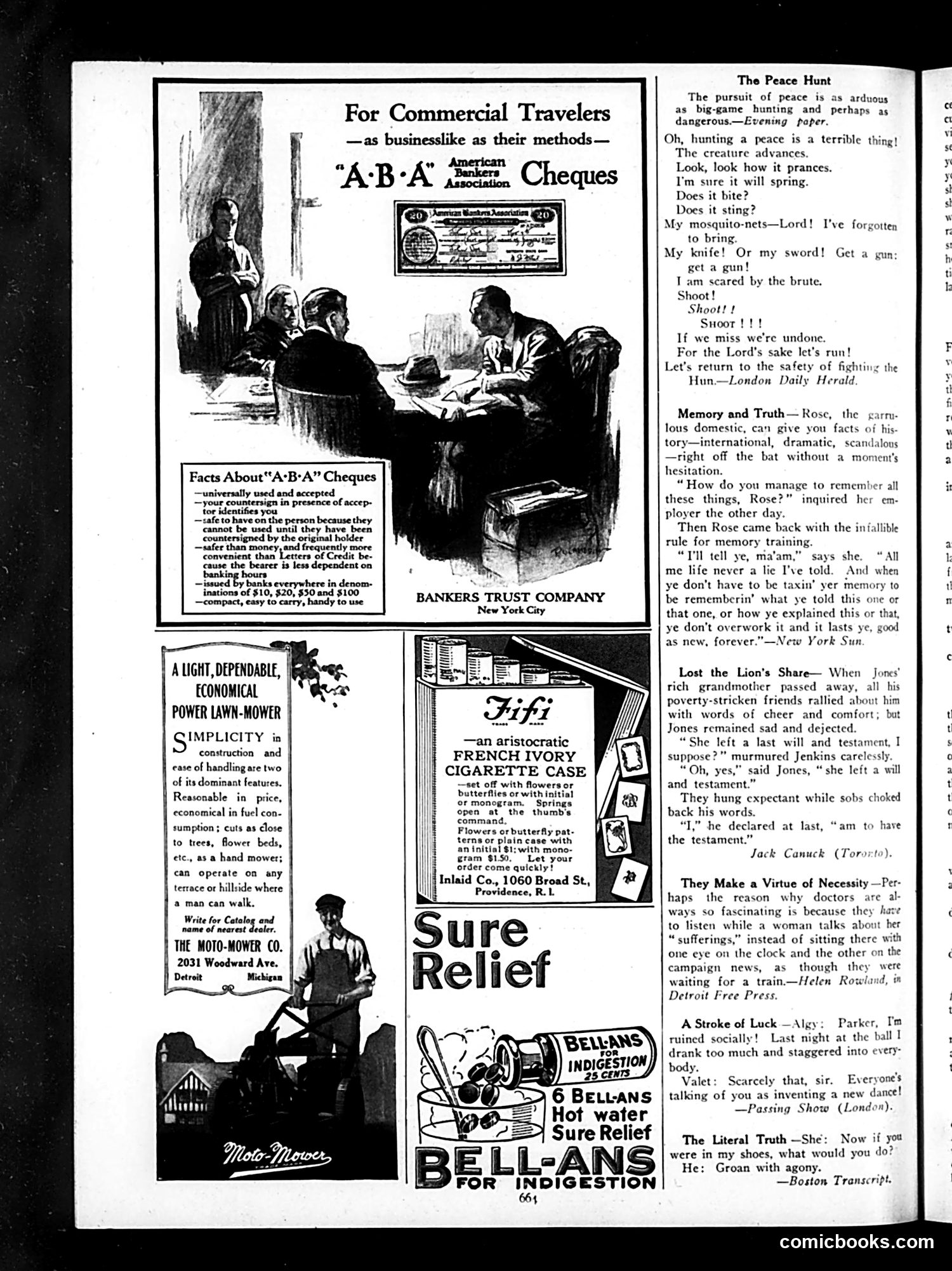
This page mixes commercial advertisements with satirical humor pieces typical of early 20th-century Life magazine. **Advertisements** dominate the upper portion: A·B·A traveler's cheques for businessmen, a Moto-Mower lawn-mower, a French ivory cigarette case, and Bellans indigestion remedy. These target affluent readers. **Satirical content** includes: "The Peace Hunt"—a poem mocking post-WWI peace negotiations as futile "hunting," comparing diplomacy to pursuing dangerous game. References to "fighting the Hun" suggest this appeared after World War I, criticizing the difficulty of achieving lasting peace. **Brief humorous anecdotes** follow, including jokes about memory, inheritance, doctors' listening habits, and social embarrassment. These are genteel, drawing-room humor typical of the era—witty observations on domestic life and social conventions rather than political satire. The page reflects Life's identity as a magazine for educated, urbane readers interested in both consumer goods and sophisticated comedy.
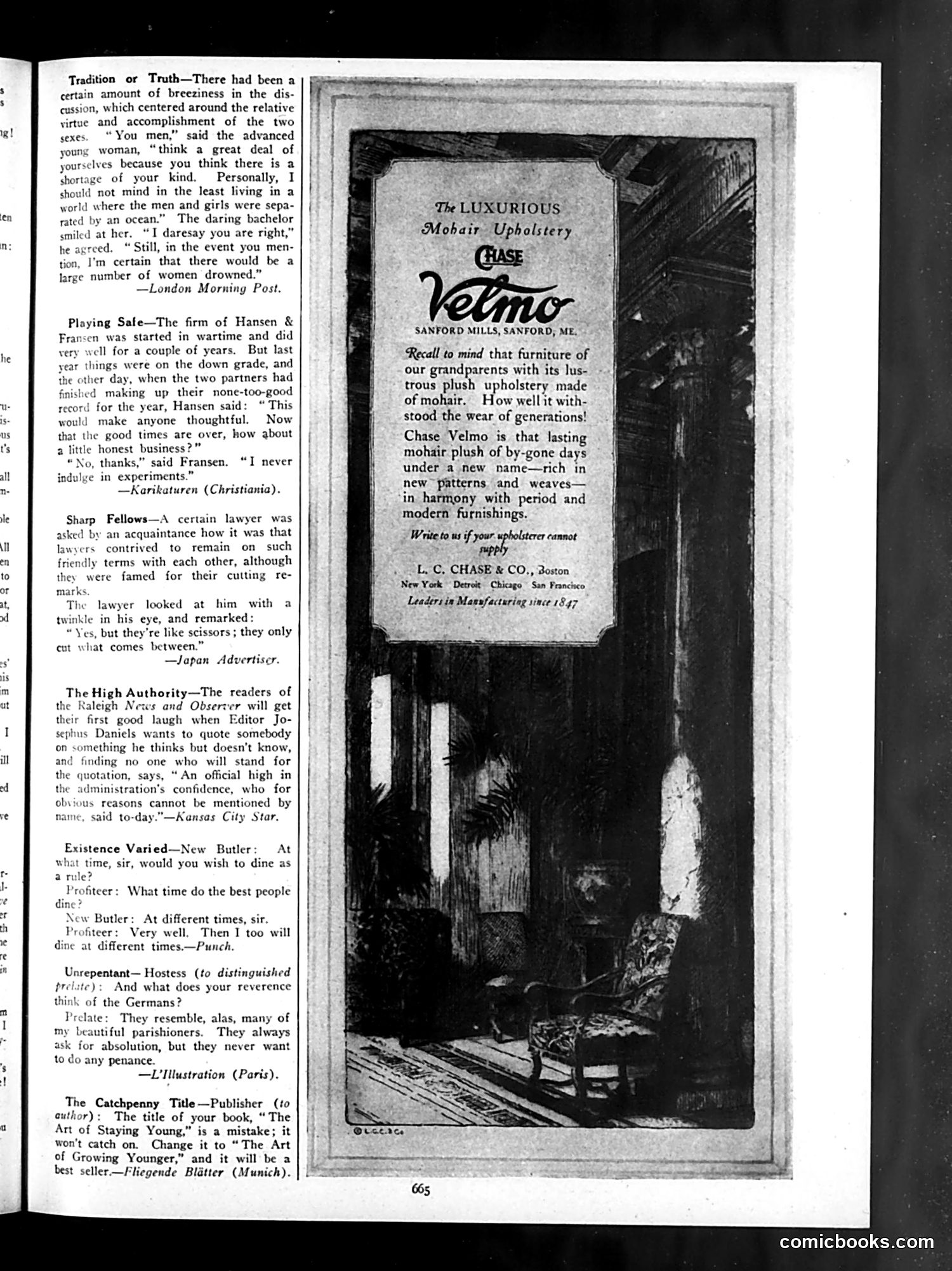
This page contains **brief humorous anecdotes** rather than political cartoons. The jokes satirize social conventions and human nature: **"Tradition or Truth"** mocks the "advanced young woman"'s feminist rhetoric about male scarcity by having a bachelor suggest women would drown trying to cross an ocean to escape men—a sexist rejoinder to her provocation. **"Playing Safe"** ridicules a business partner who admits he only succeeds through dishonesty, refusing "honest business" as too experimental. **"Sharp Fellows"** uses a lawyer's witty explanation of how lawyers stay friendly despite cutting remarks: they're like scissors that only cut what comes *between* them. **"The High Authority"** criticizes newspaper editor Josephus Daniels for attributing quotes to unnamed "official[s]" rather than taking responsibility for his own opinions. The remaining jokes target profiteers, unrepentant clergy, and publishers chasing trends. **The advertisement** promotes Chase Velmo mohair upholstery, appealing to nostalgia for durable grandmother-era furnishings now available in modern designs.
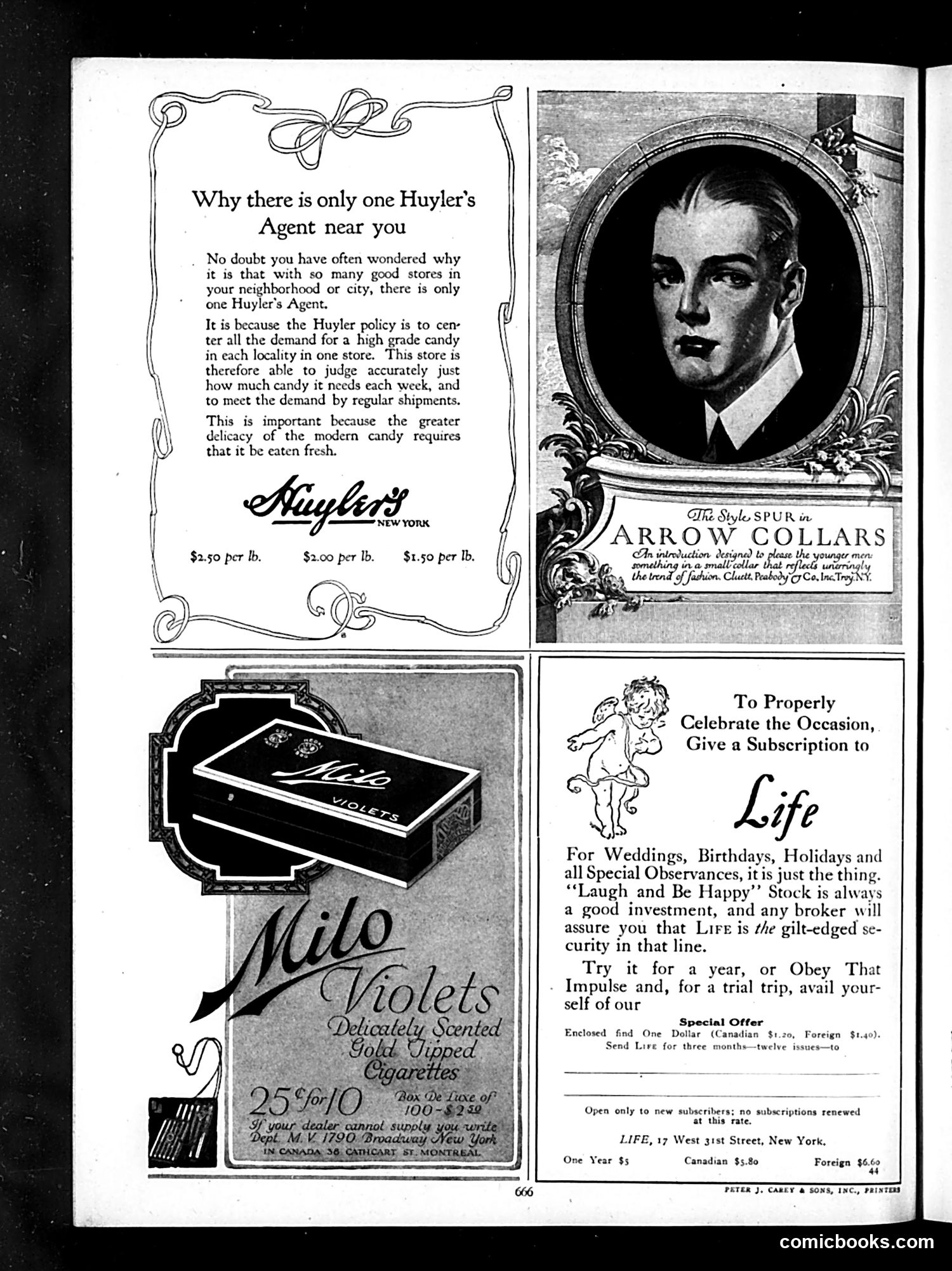
This page contains four unrelated advertisements from an early 20th-century issue of *Life* magazine—it is not a satirical cartoon but rather a commercial advertising spread. **The ads promote:** 1. **Huyler's candy** — explaining their exclusive agent distribution model for freshness 2. **Arrow Collars** — featuring a portrait of an unnamed man, selling men's formal neckwear 3. **Milo Violets cigarettes** — delicately scented, gold-tipped smokes at 25¢ per 10 4. **Life magazine subscriptions** — pitched as an ideal gift for weddings and holidays, marketed as a sound "investment" in entertainment The page illustrates typical early 1900s advertising strategies: emphasizing product freshness and exclusivity (Huyler's), masculine sophistication (Arrow), luxury indulgence (cigarettes), and *Life* magazine's own self-promotion as culturally essential. No political satire or caricature is present—this is straightforward commercial content reflecting period consumer culture.
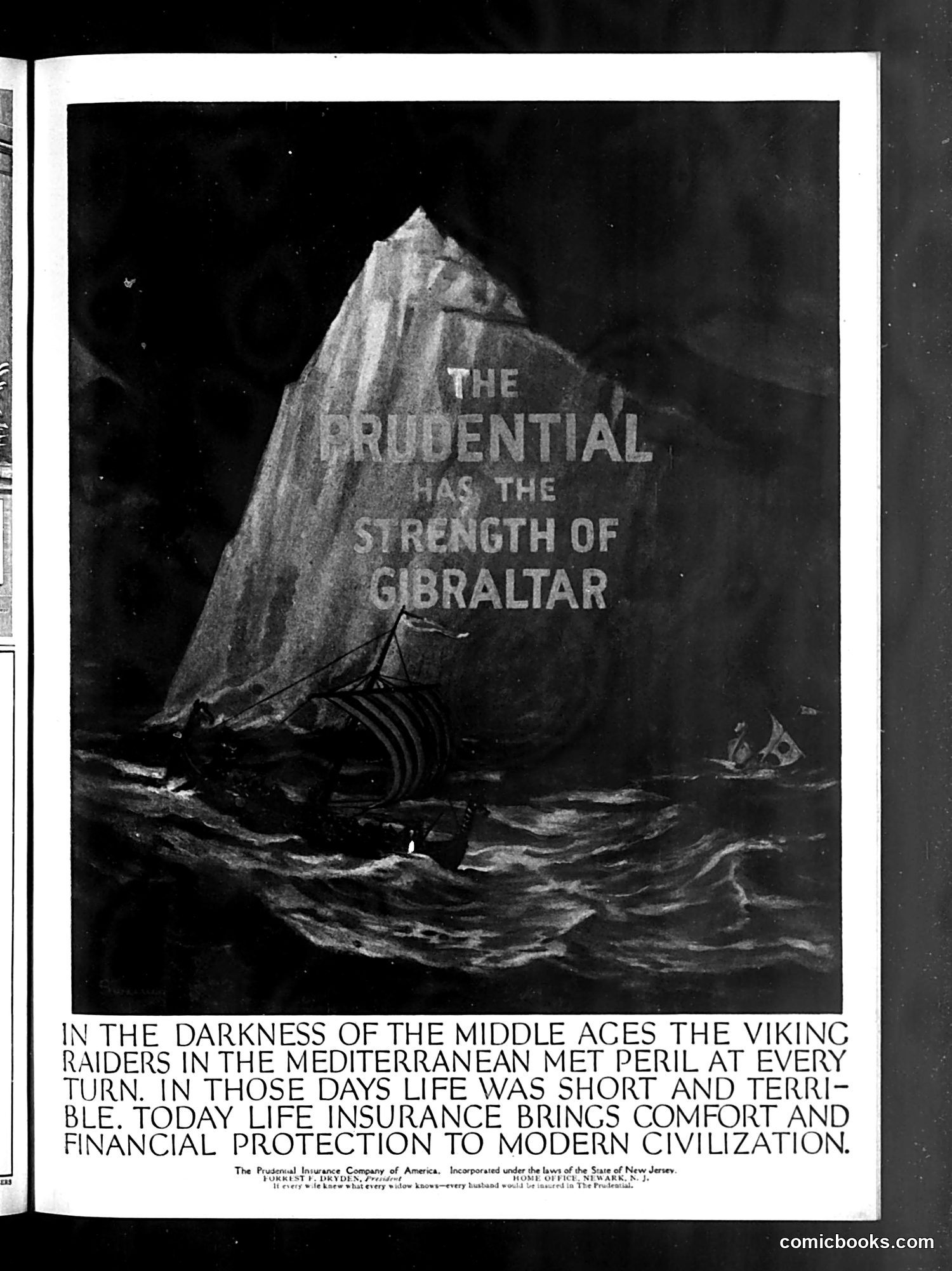
This is a **life insurance advertisement**, not satire or political commentary. The ad uses historical comparison to market modern insurance. The image depicts a Viking ship threatened by the Rock of Gibraltar during the Middle Ages. The text contrasts that era's dangers—"life was short and terrible"—with modern life's security through insurance protection. The ad's argument: just as Gibraltar represented an obstacle Vikings faced without protection, modern people face financial uncertainties. Life insurance provides the "strength" and security that civilization now offers, replacing medieval peril with contemporary financial safeguards. This reflects early-20th-century advertising strategy: romanticizing a dangerous past to emphasize present-day progress and the necessity of financial products for civilized living.
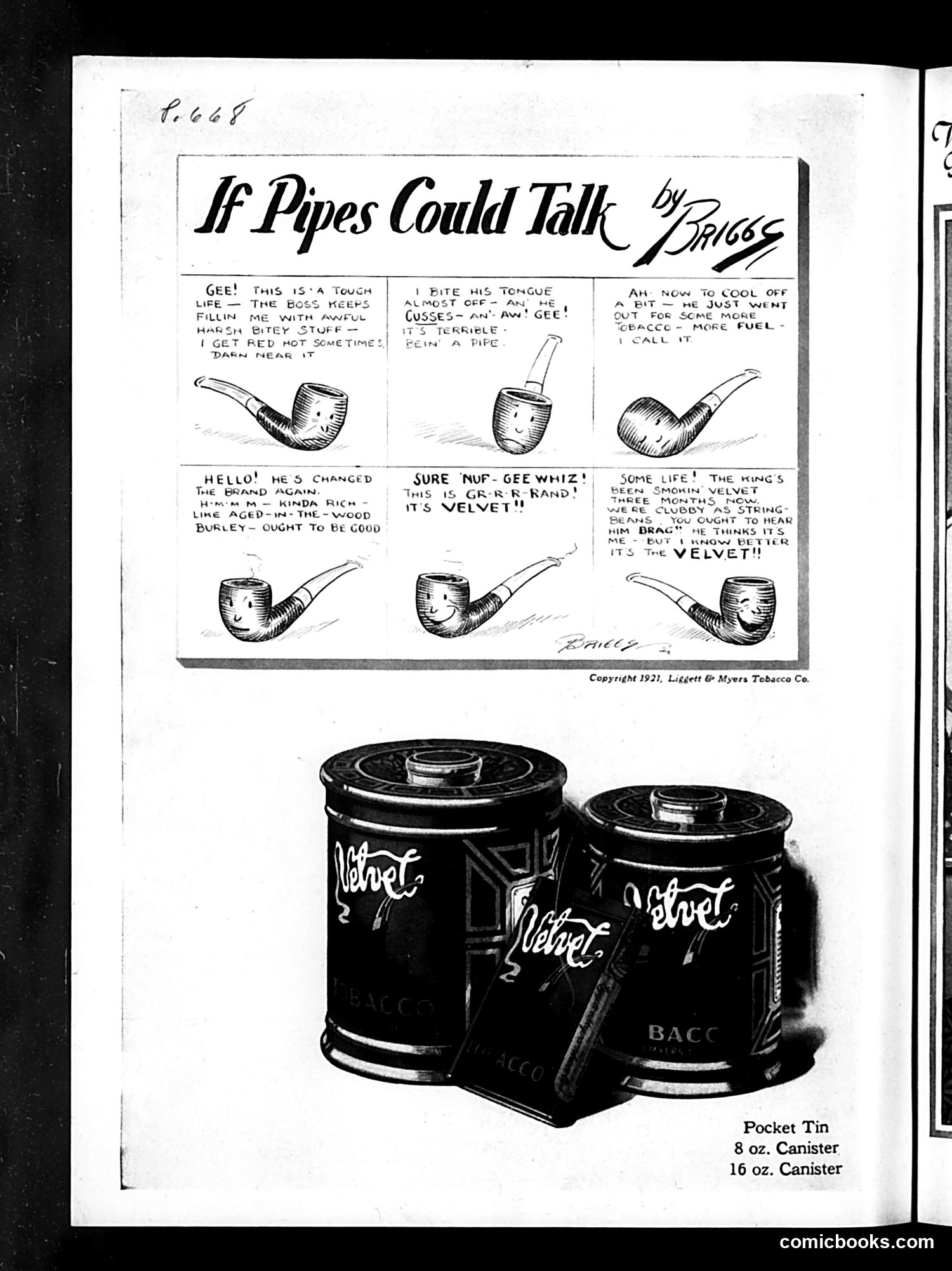
This is a humorous advertisement for Velvet brand pipe tobacco. The comic depicts personified pipes discussing their owners' smoking habits. The joke centers on a man who frequently switches tobacco brands due to harshness and irritation—he gets "red hot," bites his tongue, cusses—until trying Velvet, which he praises effusively. The satire mocks the typical smoker's brand-loyalty complaints while positioning Velvet as the superior solution. The pipes themselves become characters bonding over their shared experience of their owner's journey to "the right" tobacco. This reflects 1921 advertising conventions: using humor and personification to sell tobacco products without health disclaimers (which didn't exist then). The ad appears designed to appeal to pipe smokers by suggesting Velvet delivers smoothness competitors lack, presented through relatable workplace-style camaraderie between the pipes.