
Life, 1921-05-05 · page 27 of 46
Life — May 5, 1921 — page 27: what you’re looking at
What you’re looking at
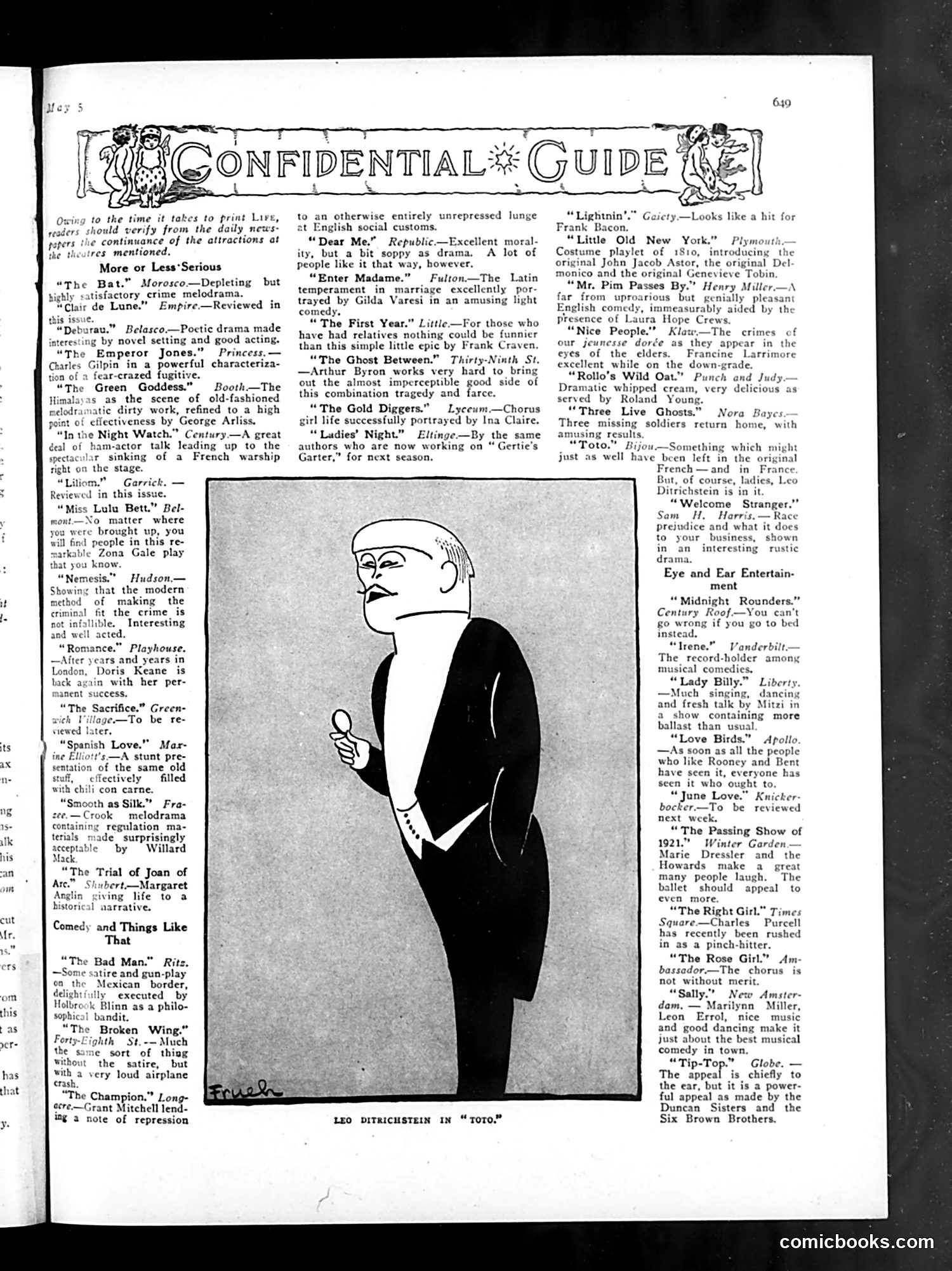
This page is primarily a theater review section titled "Confidential Guide," listing Broadway productions with brief critical assessments. The central illustration depicts **Leo Ditrichstein** in the play "Toto"—a caricature emphasizing his distinctive facial features in a theatrical pose. The reviews cover both serious dramatic productions ("The Emperor Jones," "Liliom," "Deburau") and comedies/lighter fare ("The Gold Diggers," "Nice People," "The First Year"). The tone is gossipy and informal, typical of Life's satirical voice. Key context: This appears to be from the early 1920s (references to contemporary Broadway hits). The reviews mock theatrical conventions—overwrought melodrama, sentimentality, and predictable plots—while noting performances by now-forgotten actors. The satire targets both pretentious theater and mass-appeal entertainment. The illustration functions as entertainment commentary rather than political satire, showcasing a popular performer of the era.
📄 Transcribed text from this page (OCR, searchable)
Machine-transcribed from the original scan — historical spelling and the odd misread are preserved.
3 to the time it takes to print Live, hould verify from the daily news- the continuance of the attractions at tres mentioned, More or Less*Serious “The Bat.” Morosco—Depleting but highly satisfactory crime melodrama. “Clair de Lune.” Empire —Reviewed in issue. Deburau.” Belasco.—Poetic drama made interesting by novel setting and good acting. “The Emperor Jones.” Princess. — Charles Gilpin in a powerful characteriza- of a fear-crazed fugitive. “The Green Goddess.” Booth.—The Himalayas as the scene of old-fashioned melodramatic dirty work, refined to a high of effectiveness by George Arliss. In the Night Watch.” Century.—A great deal of ham-actor talk leading up to the spectacular sinking of a French warship right on the stage. “Liliom.” — Garrick. — Reviewed in this issue. “Miss Lulu Bett.” Bel- mont—No matter where you were brought up, you 1 people in this re- le Zona Gale play t you know. “Nemesis.” Hudson— that the modern of making the fit the crime is llible. Interesting and well acted, “Romance.” Playhouse. ars and years in Lond Doris Keane is back again with her per- anent success. “The Sacrifice.” Green- wich Village—To be re- viewed later, “Spanish Love.” Maz- i "s—A stunt pre- of the same old cilectively filled chili con carne. has Silk.” Fra- melodrama ing regulation ma- ade surprisingly by = Willard “The Trial of Joan of Are.” Shubert-—Margaret iving life to a 1 narrative. Comedy and Things Like That “The Bad Man.” Ritz. S atire and gun-play Mexican border, illy executed by lolbrook Blinn as a philo- sophical bandit. “The Broken Wing.” Forty-Eighth St.-— Much ne sort of thing the satire, but very loud airplane Long- Grant Mitchell lend- ing a note of repression to an otherwise entirely unrepressed lunge = glish social customs. “Dear Me.” Republic—Excellent moral- ity, but_a bit soppy as drama. A lot of people like it that way, however. “Enter Madame. Fulton—The Latin temperament in marriage excellently por- trayed by Gilda Varesi in an amusing light comedy. “The First Year.” Little—For those who have had relatives nothing could be funnier than this simple little epic by Frank Craven, The Ghost Between.” Thirty-Ninth St. —Arthur Byron works very hard to bring out the almost imperceptible good side of this combination tragedy and farce. “The Gold Diggers.” Lyce: girl life successfully portrayed by “Ludies’ Night.” Eltinge authors who are now worki Garter,” for next season. 1.—Chorus Ina Claire. By the same z on “ Gertie's LEO DITRICHSTEIN IN “ TOTO.” “Lightnin’.” Frank Bacon. “Little Old New York.” Plymout! Costume playlet of 1810, introducing the original John Jacob Astor, the original Del monico and the original Genevieve Tobin. “Mr. Pim Passes By.” Henry Miller—A far from uproarious but genially pleasant glish comedy, immeasurably aided by th Presence of Laura He Nice People. Gaiety.—Looks like a hit for —The crimes of our jeunesse dorée as they appear in the eyes of the elders. Francine Larrir excellent while on the down-grade. “Rollo’s Wild Oat.” d Judy Dramatic whipped cream, very deliciou: served by Roland Youn Three Live Ghosts.’ Three miss using res Toto.” just as well have Nora y ig soldiers return home, with -Something which might been left in the original rench —and in France ut, of course, ladies, Leo Ditrichstein is in it “Welcome Stranger.’’ Sam H. Harris, — Race prejudice and what it does to your business, shown in an interesting r drama, Eye and Ear Entertai ment “Midnight Rounders.” Century Roof—You can't go wrong if you go to bed instead. “Trene.” The record-holder musical com “ Lady Billy Vanderbilt among dies, Libert —Much singing, dancin and fresh talk Mitzi in a ow containing more ballast than usu: Love Bird: Apollo. —As soon as all the people who like Rooney and B have seen it, everyone seen it who ht to. “June Love.” Knic bocker—To be reviewed next week. “The Passing Show of 1921.” Winter Garden Marie Dressler and the Howards make a great many people laugh. The ballet should appeal to even more. The Right Girl.” Times Square—Charles Purcell has recently been rushed in as a pinch-hitter. “The Rose Girl.” Am- bassador.—The chorus is not without merit. “Sally.” New Amster- dam, — Marilynn Miller, Leon rol, nice music and good dancing make it just about the best musical comedy in town, “Tip-Top.” Globe. — The appeal is chiefly to the ear, but it is a power- ful appeal as made by the Duncan Sisters and the Six Brown Brothers. comicbooks.com