
Life, 1921-05-05 · page 14 of 46
Life — May 5, 1921 — page 14: what you’re looking at
What you’re looking at
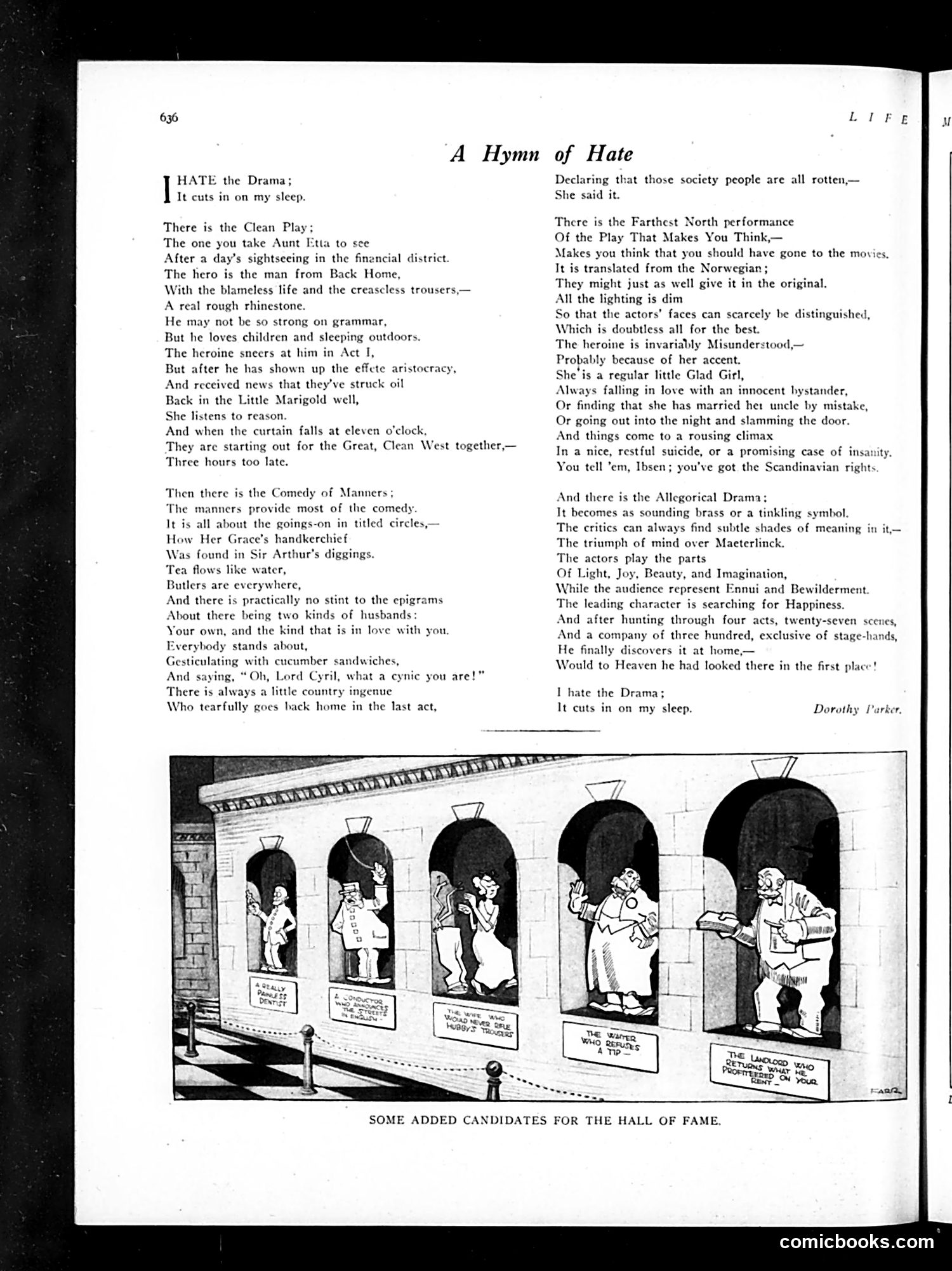
This page features Dorothy Parker's satirical poem attacking theatrical productions she considers worthless. The verse mocks several types of plays: the moralistic "Clean Play," overly Norwegian translations, mannered comedies about upper-class life, and allegorical dramas with pretentious symbolism. The accompanying cartoon depicts a "Hall of Fame" with five arched niches containing theatrical stereotypes—likely representing stock characters or plot types from the plays Parker despises. Each figure appears labeled, though the specific captions are difficult to read in reproduction. Parker's refrain—"I hate the Drama; / It cuts in on my sleep"—frames theater as an annoying, often incompetent entertainment. This reflects 1920s literary criticism dismissing much Broadway output as trivial or artistically bankrupt.
📄 Transcribed text from this page (OCR, searchable)
Machine-transcribed from the original scan — historical spelling and the odd misread are preserved.
A Hymn HATE the Drama; It cuts in on my sleep. There is the Clean Play The one you take Aunt Etta to see After a day’s sightseeing in the financial district. The hero is the man from Back Home, With the blameless life and the creascless trousers,— A real rough rhinestone. He may not be so strong on grammar, But he loves children and sleeping outdoors. The heroine sneers at him in Act I, But after he has shown up the effete aristoc And received news that they’ve struck oil Back in the Little Marigold well, She listens to reason. And when the curtain falls at eleven o'clock, They are starting out for the Great, Clean West together,— Three hours too late. Then there is the Comedy of Manners; The manners provide most of the comedy. It is all about the goings-on in titled circles, How Her Grace’s handkerchief Was found in Sir Arthur's diggings. Tea flows like water, Butlers are everywhere, And there is practically no stint to the epigrams About there being two kinds of husbands: Your own, and the kind that is in love with you. Everybody stands about, Gesticulating with cucumber sandwiches, And saying, “Oh, Lord Cyril, what a cynic you are!” There is always a little country ingenue Who tearfully goes back home in the last act, of Hate Declaring that those society people are all rotten,— She said it. There is the Farthest North performance Of the Play That Makes You Think,— Makes you think that you should have gone to the movies. It is translated from the Norwegian; They might just as well give it in the original, All the lighting is dim So that the actors’ faces can scarcely be distinguished, Which is doubtless all for the best. The heroine is invariably Misunderstood,— Probably because of her accent. She'is a regular little Glad Girl, Always falling in love with an innocent bystander, Or finding that she has married het uncle by mist: Or going out into the night and slamming the door. And things come to a rousing climax In a nice, restful suicide, or a promising case of insa You tell 'em, Ibsen; you've got the Scandinavian rights. And there is the Allegorical Drama; It becomes as sounding brass or a tinkling symbol. The critics can always find subtle shades of meaning in it— The triumph of mind over Maeterlinck. The actors play the parts Of Light, Joy, Beauty, and Imagination, While the audience represent Ennui and Bewilderment The leading character is searching for Happiness. And after hunting through four acts, twenty-seven scenes, And a company of three hundred, exclusive of stage-hands, He finally discovers it at home— Would to Heaven he had looked there in the first place! I hate the Drama; It cuts in on my sleep. Dorothy SOME ADDED CANDIDATES FOR THE HALL OF FAME. comicbooks.com