
Life, 1921-05-05 · page 18 of 46
Life — May 5, 1921 — page 18: what you’re looking at
What you’re looking at
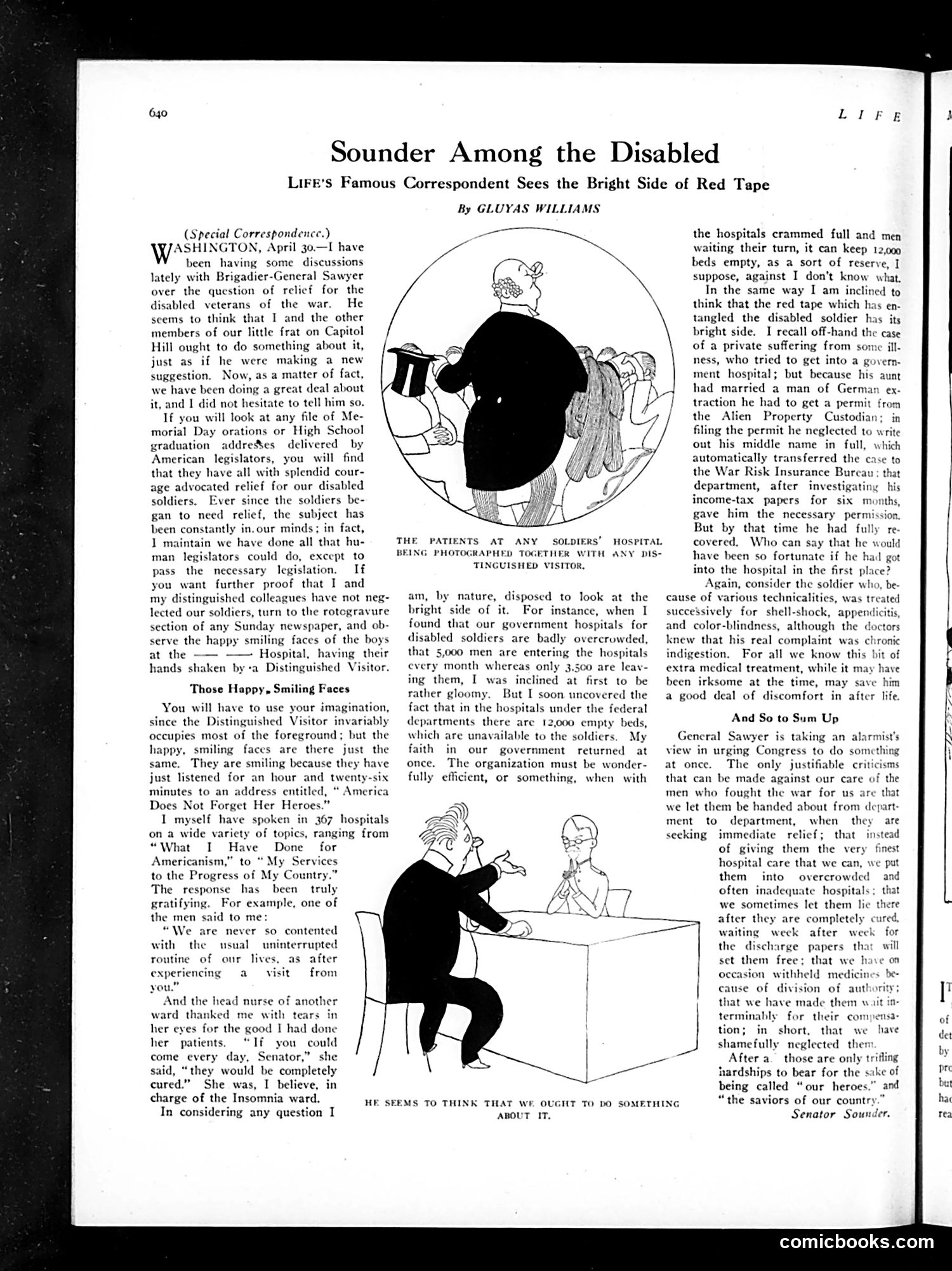
This satirical piece by Gluyas Williams mocks senators' self-congratulation about helping disabled World War I veterans while accomplishing little substantively. **The Point:** Senator Sounder (a fictional character representing generic politicians) claims legislators have done extensive work for disabled soldiers by giving speeches at hospitals and appearing in photographs—yet actual relief remains inadequate. The satire highlights the gap between performative gestures and meaningful action. **Key Targets:** - Politicians who give lengthy speeches ("America Does Not Forget Her Heroes") that comfort themselves more than patients - Bureaucratic incompetence: 12,000 empty government hospital beds while soldiers wait, and absurd red tape (requiring an Alien Property Custodian permit for a soldier's hospital admission) - "Distinguished Visitor" photo opportunities masking inaction **The Cartoons:** Show a politician shaking hands with patients (hidden behind him in the photo) and later appearing to "think" about doing something—visual representations of empty gestures. The satire exposes how legislative rhetoric substitutes for actual veteran care during the postwar period.
📄 Transcribed text from this page (OCR, searchable)
Machine-transcribed from the original scan — historical spelling and the odd misread are preserved.
Sounder Among the Disabled Lirr’s Famous Correspondent Sees the Bright Side of Red Tape (Special Corresponden ASHINGTON, April 30.—I have been having some discussions lately with Brigadier-General Sawyer over the question of relief for the disabled veterans of the war. He seems to think that I and the other members of our little frat on Capitol Hill ought to do something about it, just as if he were making a new suggestion. Now, as a matter of fact, we have been doing a great deal about it, and I did not hesitate to tell him so. If you will look at any file of Me- morial Day orations or High School graduation addreses delivered _ by American legislators, you will find that they have all with splendid cour- age advocated relief for our disabled soldiers. Ever since the soldiers be- gan to need relief, heen constantly i 1 maintain we have done all that hu- man legislators could do, except to Pp the necessary legislation. If you want further proof that I and my distinguished colleagues © not neg- lected our soldiers, turn to the rotogravure section of any Sunday newspaper, and ob- serve the happy smiling faces of the boys at the —— Hospital, having their hands shaken by +a Distinguished Visitor. Those Happy, Smiling Faces You will have to use your imagination, since the Distinguished Visitor invariably occupies most of the foreground; but the happy, smiling faces are there just the same. They are smiling because they have just listened for an hour and twenty-six minutes to an address entitled, “ America Does Not Forget Her Heroes.” I myself have spoken in 367 hospitals on a wide variety of topics, ranging from “What I Hav Done for Americanism,” to “ My Services to the Progress of My Country The response has been truly gratifying. For example, one of the men said to m “We are never so contented with the usual uninterrupted routine of our after experiencing a from you.” And the head nurse of another ward thanked me with tears her eyes for the good I had done her patients. If you could come every day, Senator,” she said, “they would be completely cured.” She was, I believe, in charge of the Insomnia ward. In considering any question I lives. as visit HE SEEMS TO THINK THAT WF By GLUYAS WILLIAMS ATIENTS AT ANY SOLDIERS’ HOSPITAL 3 PHOTOGRAPHED TOGETHER WITH ANY DIS- TINGUISHED VISITOR. am, by nature, disposed to look at the bright side of it. For instance, when I found that our government hospitals for disabled soldiers are badly overcrowded, that 5,000 men are entering the hospitals every month whereas only 3.500 are leav- ing them, I was inclined at first to be rather gloomy. But I soon uncovered the fact that in the hospitals under the federal departments there are 12,000 empty beds, which are unavailable to the soldiers. My faith in our government returned at once. The organization must be wonder- fully efficient, or something, when with ABOUT IT, OUGHT TO DO SOMETHING the hospitals crammed full and men waiting their turn, it can keep 12,000 beds empty, as a sort of reserve, I suppose, against I don’t know what, In the same way I am inclined to think that the red tape which has en- tangled the disabled soldier has its bright side. I recall off-hand case of a private suffering from some ill- ness, who tried to get into a govern- ment hospital; but because his aunt had married a man of German ex- traction he had to get a permit f the Alien Property Custodian; in filing the permit he neglected to write out his middle name in full, which automatically transferred the case to the War Risk Insurance Bureau : that department, after investigatii income-tax papers for si gave him the necessary permission. But by that time he had fully re- covered, Who can say that he would have been so fortunate if he got into the hospital in the first place? Again, consider the soldier who, be- cause of various technicalities, was treated successively for shell-shock, appendicitis, and color-blindness, although the doctors knew that his real complaint was chronic indigestion. For all we know this bit of extra medical treatment, while it may have been irksome at the time, may save hi a good deal of discomfort in after li And So to Sum Up General Sawyer is taking an alarmist’s view in urging Congress to do something at once. The only justifiable criticisms that can be made against our care the men who fought the war for us are that we let them be handed about from depart- ment to department, when th secking immediate relief; that ir of giving them the very hospital care that we can, we put them into overcrowded and often inadequate hospitals; th we sometimes let them lie there after they are completely cured, waiting week after week for the discharge papers that will set them free; that we h occasion withheld medi s bee cause of division of autho that we have made them wail terminably for their com tion; in short, that we shamefully neglected them After a. those are only trifling hardships to bear for the sake of being called “our heroes.” and “the saviors of our country.” Senator Sounder. finest have comicbooks.com