
Life, 1921-05-05 · page 23 of 46
Life — May 5, 1921 — page 23: what you’re looking at
What you’re looking at
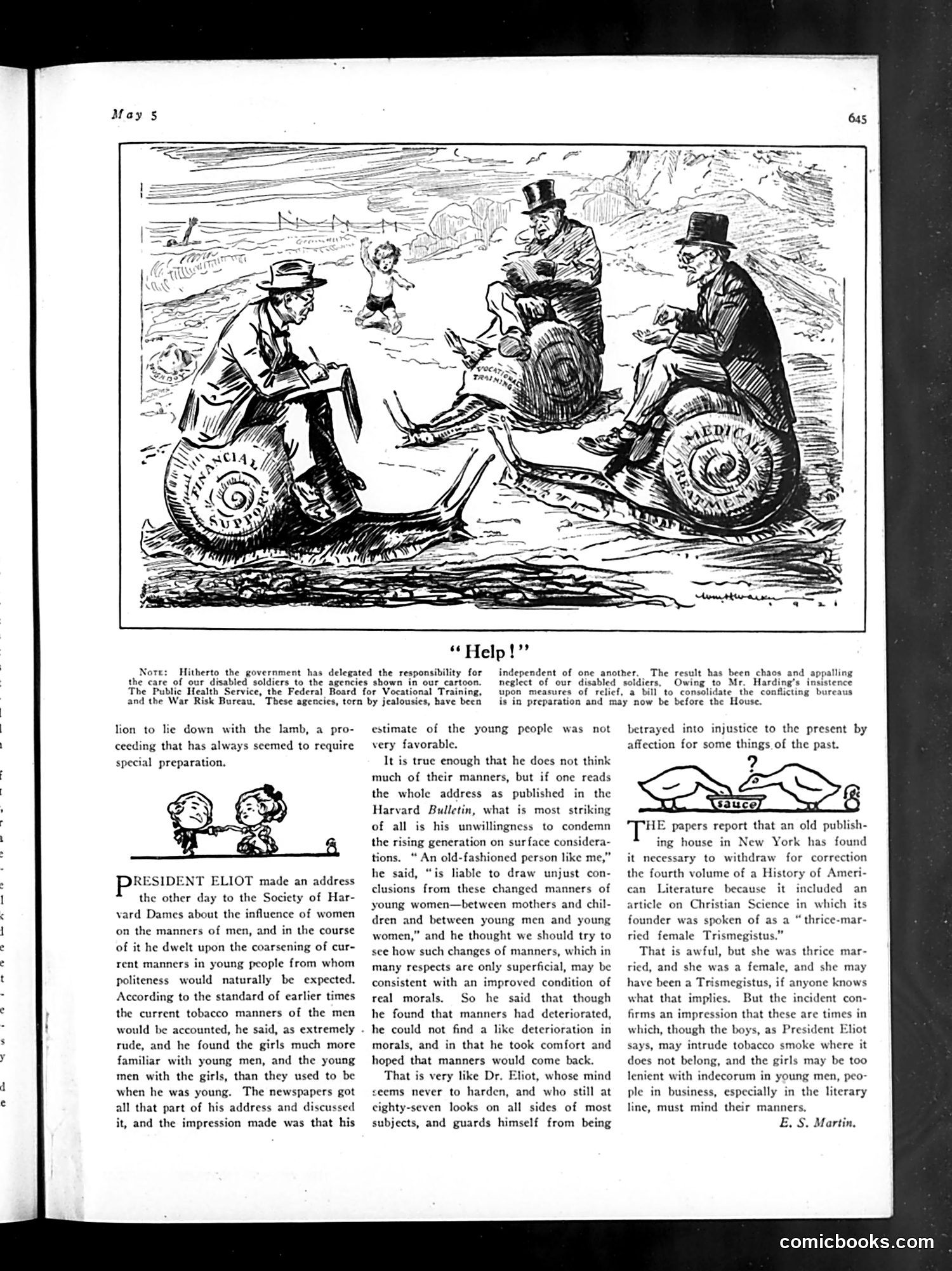
The main cartoon satirizes government bureaucratic chaos in caring for disabled WWI veterans. Four men in top hats—representing competing federal agencies (Public Health Service, Federal Board for Vocational Training, War Risk Bureau, and others)—are depicted riding on wheels labeled with these agency names. They're struggling, disorganized, and pulling in different directions while a small child ("Help!") cries out in distress between them. The satire points to overlapping jurisdictions and institutional jealousy creating "chaos and appalling neglect" of disabled soldiers. The cartoon advocates for consolidation of these conflicting bureaus into a single relief bill. It's a visual argument that fragmented government responsibility harms those it's meant to serve—here, vulnerable veterans dependent on coordinated care they cannot receive.
📄 Transcribed text from this page (OCR, searchable)
Machine-transcribed from the original scan — historical spelling and the odd misread are preserved.
Nore: and the War Risk Bureau, lion to lie down with the lamb, a pro- ceeding that has always seemed to require special preparation. RESIDE LIOT made an address the other day to the Society of Har- vard Dames about the influence of women on the manners of men, and in the course of it he dwelt upon the coarsening of cur- rent manners in young people from whom politeness would naturally be expected. According to the standard of earlier times the current tobacco manners of the men would be accounted, he said, as extremely - rude, and he found the girls much more familiar with young men, and the young men with the girls, than they used to be when he was young. The newspapers got all that part of his address and discussed it, and the impression made was that his These agencies, torn by jealousies, have been “Help!” Hitherto the government has delegated the responsibility for the care of our disabled soldiers to the agencies shown in our cartoon. The Public Health Service, the Federal Board for Vocational Training, estimate of the young people was not very favorable. It is true enough that he does not think much of their manners, but if one reads the whole address as published in the Harvard Bulletin, what is most striking of all is his unwillingness to condemn the rising generation on surface considera- tions. “An old-fashioned person like me,” he said, “is liable to draw unjust con- clusions from these changed manners of young women—between mothers and chil- dren and between young men and young women,” and he thought we should try to see how such changes of manners, which in many respects are only superficial, may be consistent with an improved condition of real morals. So he said that though he found that manners had deteriorated, he could not find a like deterioration in morals, and in that he took comfort and hoped that manners would come back. That is very like Dr. Eliot, whose mind seems never to harden, and who still at cighty-seven looks on all sides of most subjects, and guards himself from being independent of one another. neglect of our disabled soldiers, upon measures of relief, a bill to consolidate the conflicting bureaus is in preparation and may now be before the House. The result has been chaos and appalling Owing to Mr. Harding’s insistence betrayed into injustice to the present by affection for some things of the pas HE papers report that an old publish- ing house in New York has found it necessary to withdraw for correction the fourth volume of a History of Ameri- can Literature because it included an article on Christian Science in which its founder was spoken of as a “ thrice-mar- ried female Trismegistus.” That is awful, but she was thrice mar- ried, and she was a female, and she may have been a Trismegistus, if anyone knows But the incident con- firms an impression that these are times in which, though the boys, as President Eliot says, may intrude tobacco smoke where it what that implies. does not belong, and the girls may be too lenient with indecorum in young men, peo- ple in business, especially in the literary line, must mind their manners, E. S. Martin. comicbooks.com