
Life, 1921-05-05 · page 17 of 46
Life — May 5, 1921 — page 17: what you’re looking at
What you’re looking at
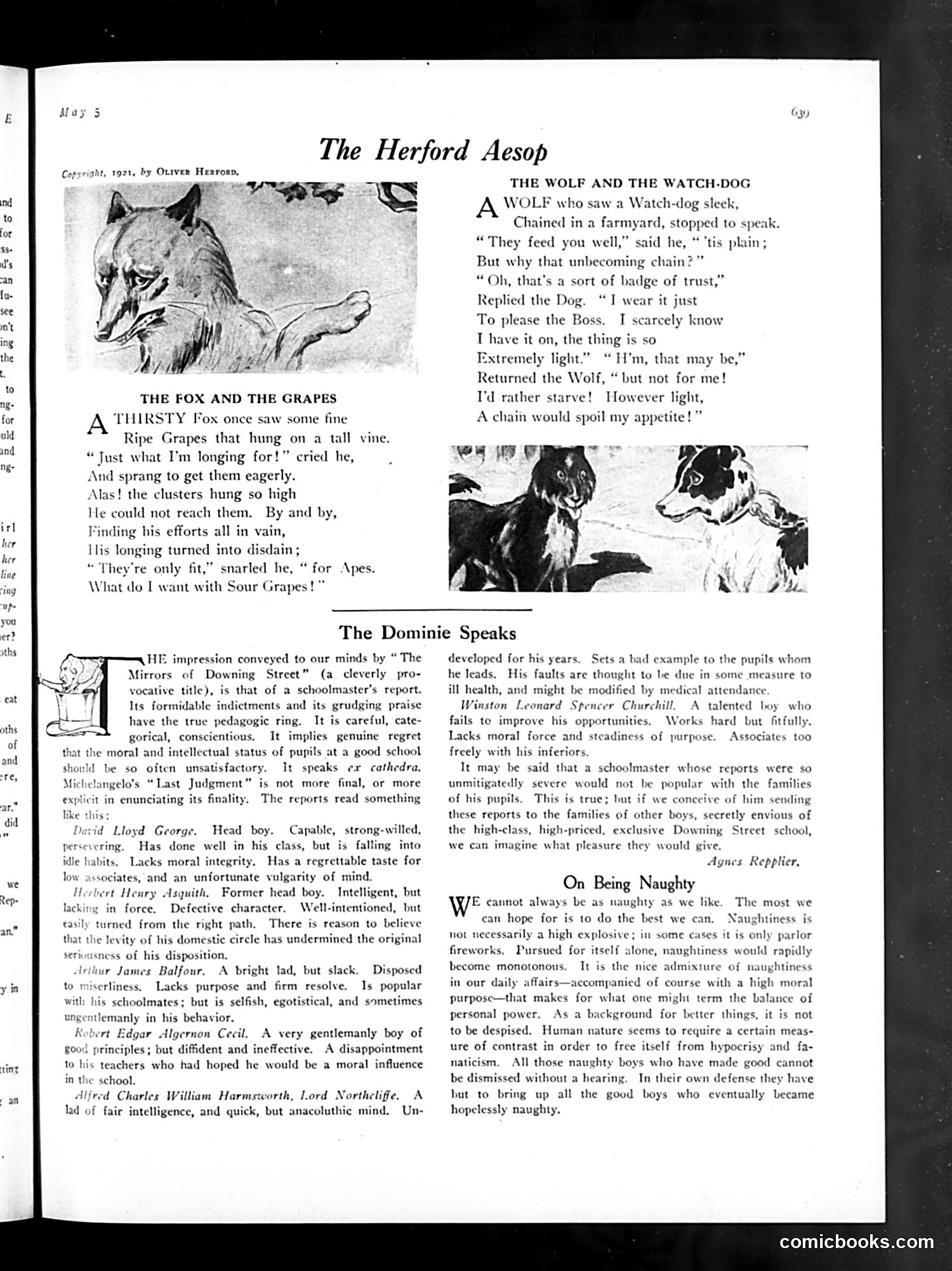
This page presents three content pieces by Oliver Herford, a popular satirist of the era. **The Fables:** "The Fox and the Grapes" and "The Wolf and the Watch-Dog" are classic Aesop's fables with illustrations, presented as straightforward moral lessons without apparent political commentary. **"The Dominie Speaks":** This is the satirical centerpiece. Written as a schoolmaster's harsh report card on British political figures, it mocks contemporary leaders as failing students. The subjects appear to be major British politicians of the post-WWI era—Lloyd George (head boy, now idle), Asquith (former head boy, lacking force), Balfour (slack), Lord Northcliffe (underdeveloped), and Winston Churchill (talented but fitfully working). The satire suggests these leaders are intellectually and morally deficient, and the piece implies other nations secretly enjoy watching Britain's leadership failures. **"On Being Naughty":** A brief essay by Agnes Repplier on the nature of mischief and moral behavior. The page combines classic fables with sharp contemporary political satire directed at Britain's post-war leadership.
📄 Transcribed text from this page (OCR, searchable)
Machine-transcribed from the original scan — historical spelling and the odd misread are preserved.
of and re, The Herford Aesop Copyright, 1921, by Ottver Herron, THE FOX AND THE GRAPES HIRSTY Fox once saw some fine Ripe Grapes that hung on a tall vine. “Just what I'm longing for!” cried he, And sprang to get them eagerly. Alas! the clusters hung so high He could not reach them. By and by, Finding his efforts all in vain, Ilis longing turned into disdain ; “They're only fit,” snarled he, “ for Apes. What do I want with Sour Grapes!” THE WOLF AND THE WATCH-DOG A WOLF who saw a Watch-dog sleek, Chained in a farmyard, stopped to speak. “They feed you well,” said he, “ ‘tis plain; But why that unbecoming chain?” “Oh, that’s a sort of badge of trust,” Replied the Dog. “I wear it just I scarcely know T have it on, the thing is so tremely light.” “ H’m, that may be,” Returned the Wolf, “ but not for me! To please the Bo I'd rather starve! Tlowever light, A chain would spoil my appetite!” The Dominie Speaks HE impression conveyed to our minds by “ The Mirrors of Downing Street” (a cleverly pro- vocative title), is that of a schoolmaster’s report. Its formidable indictments and its grudging praise have the true pedagogic ring. It is careful, cate- gorical, conscientious. It implies genuine regret that the moral and intellectual status of pupils at a good school should be so often unsatisfactory. It speaks ex cathedra, angelo’s “Last Judgment” is not more final, or more t in enunciating its finality. The reports read something is: Lloyd Georg perseverin Head boy. Capable, strong-willed, Has done well in his class, but is falling into idle habits. Lacks moral integrity. Has a regrettable taste for low associates, and an unfortunate vulgarity of mind. Herbert Henry Asquith. Former head boy. Intelligent, but lacking in force. Defective character. Well-intentioned, but tasily turned from the right path. There is reason to believe that the levity of his domestic circle has undermined the original sness of his disposition tur James Balfour. A bright lad, but slack. Disposed iserliness, Lacks purpose and firm resolve. Is popular with his schoolmates; but is selfish, egotistical, and sometimes ungentlemanly in his behavior. Kobert Edgar Algernon Cecil. A very gentlemanly boy of good principles; but diffident and ineffective. A disappointment to his teachers who had hoped he would be a moral influence in the school. 4 ‘s William Harmsworth, Lord Northcliffe. A lad of fair intelligence, and quick, but anacoluthic mind. Un- developed for his years. Sets a bad example to the pupils whom he leads. His faults are thought to be due in some measure to ill health, and might be modified by medical attendance Winston Leonard Spencer Churchill, A talented boy who fails te improve his opportunities. Works hard but fitfully. Lacks moral force and steadiness of purpose. Associates too freely with his inferiors. It may be said that a schoolmaster whose reports were so unmitigatedly severe would not be popular with the families of his pupils. This is true; but if we conceive of him sending these reports to the families of other boys, secretly envious of the high-class, high-priced, exclusive Downing Street school, we can imagine what pleasure they would give. Agnes Repplier. On Being Naughty E cannot always be as naughty as we like. The most we can hope for is to do the best we can. Naughtiness is not necessarily a high explosive; in some cases it is only parlor fireworks. Pursued for itself alone, naughtiness would rapidly become monotonous. It is the nice admixture of naughtiness in our daily affairs—accompanied of course with a high moral purposc—that makes for what one might term the balance of personal power. As a background for better things, it is not to be despised. Human nature seems to require a certain meas- ure of contrast in order to free itself from hypocrisy and fa- naticism. All those naughty boys who have made good cannot be dismissed without a hearing. In their own defense they have but to bring up all the good boys who eventually became hopelessly naughty, comicbooks.com