
Life, 1921-05-05 · page 26 of 46
Life — May 5, 1921 — page 26: what you’re looking at
What you’re looking at
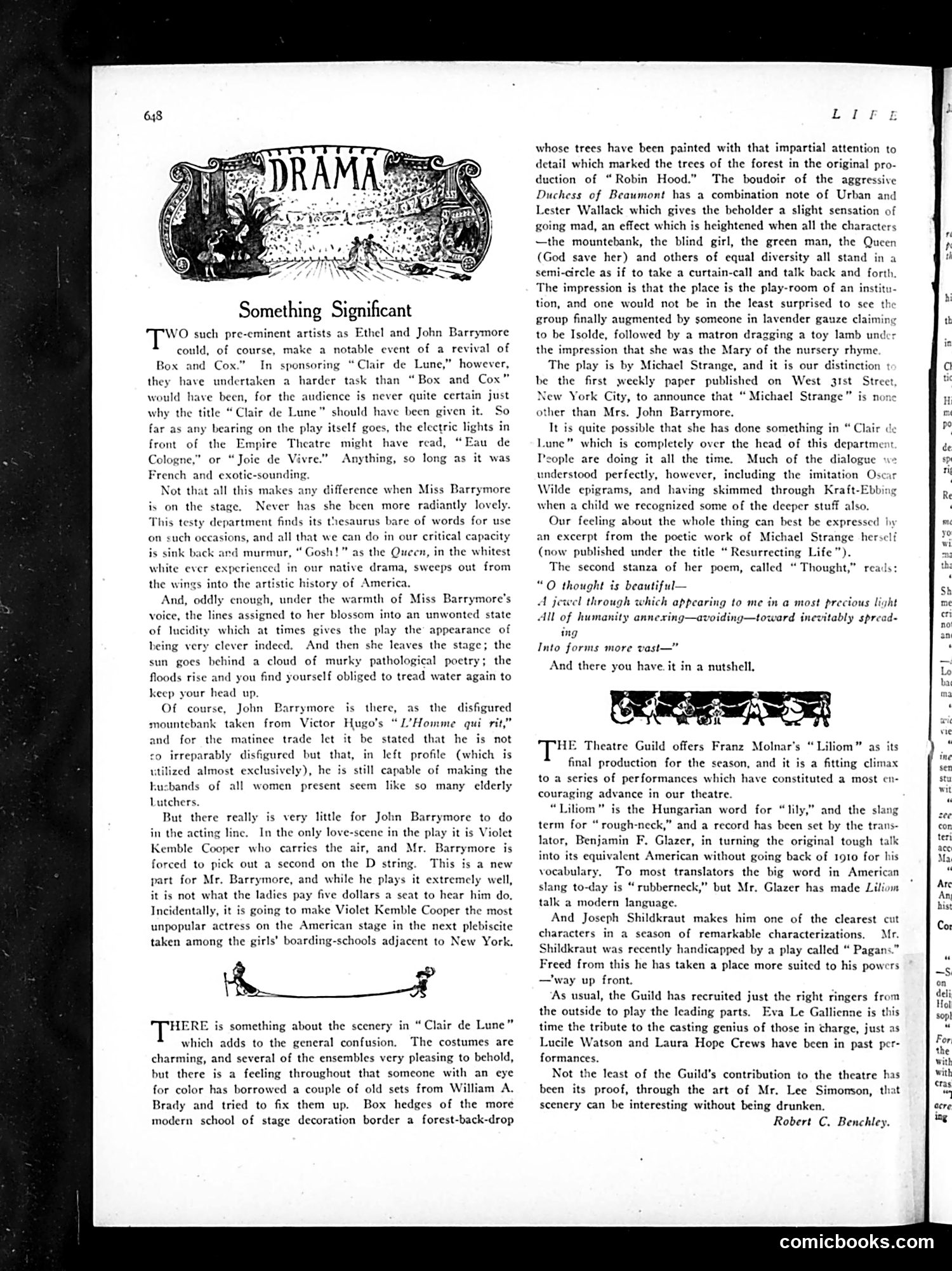
This is a theater review critiquing the Barrymore siblings' production of "Clair de Lune" at the Empire Theatre. The critic praises **Ethel Barrymore's** radiant performance as a Queen, noting she elevates mediocre material through sheer talent. However, he's harsh on the play itself—the French title appears arbitrarily chosen ("might have read 'Eau de Cologne'"), and the plot lacks substance. **John Barrymore** plays a disfigured character adapted from Victor Hugo, but the critic dismisses his role as secondary, claiming he's essentially "picking out a second" while actress Violet Kemble Cooper dominates the love scenes. The review mocks the scenery's confused aesthetic, comparing it to recycled stage sets from William Brady productions and Victorian-era "Robin Hood" backdrops. The final image—characters standing in semi-circles like an "institution" awaiting "someone in lavender gauze claiming to be Isolde"—satirizes the production's incoherent, almost absurd theatrical aesthetic.
📄 Transcribed text from this page (OCR, searchable)
Machine-transcribed from the original scan — historical spelling and the odd misread are preserved.
Something Significant WO such pre-eminent artists as Ethel and John Barrymore could, of course, make a notable event of a revival of Box and Cox.” In sponsoring “Clair de Lune,” however, they have undertaken a harder task than “Box and Cox” would e be for the audience is never quite certain just why the title “Clair de Lune” should have been given it. So far as any bearing on the play itself goes, the electric lights in front of the Empire Theatre might have read, “Eau de Cologne,” or “Joie de Vivre.” Anything, so long as it was French and exotic-sounding. Not that all this makes any difference when Miss Barrymore is on the stage. Never has she been more radiantly lovely. This testy department finds its thesaurus bare of words for use ‘on such occasions, and all that we can do in our critical capacity is sink back ard murmur, “Gosh!” as the Queen, in the whitest white ever experienced in our native drama, sweeps out from the wings into the artistic history of America. And, oddly cnough, under the warmth of Miss Barrymore's voice, the lines assigned to her blossom into an unwonted state of lucidity which at times gives the play the appearance of being very clever indeed. And then she leaves the stage; the sun goes behind a cloud of murky pathological poetry; the nd you find yourself obliged to tread water again to keep your head up. floods rise a Of course, John Barrymore is there, as the disfigured mountebank taken from Victor Hugo’s “L’Homme qui rit,” and for the matinee trade let it be stated that he is not co irreparably disfigured but that, in left profile (which is utilized almost exclusively), he still capable of making the kusbands of all women present seem like so many elderly Lutchers. But there really is very little for John Barrymore to do in the acting linc. In the only love-scene in the play it is Violet Kemble Cooper who carries the air, and Mr. Barrymore is forced to pick out a second on the D string. This is a new part for Mr. Barrymore, and while he plays it extremely well, it is not what the ladies pay five dollars a seat to hear him do. Incidentally, it is going to make Violet Kemble Cooper the most unpopular actress on the American stage in the next plebiscite taken among the girls’ boarding-schools adjacent to New York. ———— HERE is something about the scenery in “Clair de Lune” which adds to the general confusion. The costumes are charming, and several of the ensembles very pleasing to behold, but there is a feeling throughout that someone with an eye for color has borrowed a couple of old sets from William A. Brady and tried to fix them up. Box hedges of the more modern school of stage decoration border a forest-back-drop whose trees have been painted with that impartial attention to detail which marked the trees of the forest in the original pro- duction of “Robin Hood.” The boudoir of the aggressive Duchess of Beaumont has a combination note of Urban and Lester Wallack which gives the beholder a slight sensation of going mad, an effect which is heightened when all the characters —the mountebank, the blind girl, the green man, the Queen (God save her) and others of equal diversity all stand in a semi-circle as if to take a curtain-call and talk back and forth, The impression is that the place is the play-room of an institu- tion, and one would not be in the least surprised to see the group finally augmented by someone in lavender gauze claiming to be Isolde, followed by a matron dragging a toy lamb under the impression that she was the Mary of the nursery rhyme. The play is by Michael Strange, and it is our distinction + be the first weekly paper published on West 31st Street, New York City, to announce that “ Michael Strange” other than Mrs. John Barrymore. It is quite possible that she has done something in “ Clair « Lune” which is completely over the head of this department People are doing it all the time. Much of the dialogue understood perfectly, however, including the imitation Oscar Wilde epigrams, and having skimmed through Kraft-Ebt when a child we recognized some of the deeper stuff also. Our feeling about the whole thing can best be expressed hy an excerpt from the poetic work of Michael Strange her (now published under the title “ Resurrecting Life”). The second stanza of her poem, called “ Thought,” reads: “O thought is beautiful— A jewel through which appearing to me in a most precious light All of humanity annexing—avoiding—toward inevitably spread- ing Into forms more vast—" is none And there you have. it in a nutshell, HE Theatre Guild offers Franz Molnar’s “ Liliom” as its final production for the season, and it is a fitting climax to a series of performances which have constituted a most en- couraging advance in our theatre. “Liliom” is the Hungarian word for “lily,” and the sl: term for “ rough-neck,” and a record has been set by the tra lator, Benjamin F. Glazer, in turning the original tough talk into its equivalent American without going back of 1910 for h vocabulary, To most translators the big word in Ameri slang to-day is “rubberneck,” but Mr. Glazer has made Lilion talk a modern language. And Joseph Shildkraut makes him one of the clearest cut characters in a season of remarkable characterizations. Mr. Shildkraut was recently handicapped by a play called “ Pagans Freed from this he has taken a place more suited to his powers —'way up front. As usual, the Guild has recruited just the right ringers from the outside to play the leading parts. Eva Le Gallienne is this time the tribute to the casting genius of those in charge, just as Lucile Watson and Laura Hope Crews have been in past per- formances. Not the least of the Guild's contribution to the theatre has been its proof, through the art of Mr. Lee Simonson, that scenery can be interesting without being drunken. Robert C. Benchley. comicbooks.com