
Life, 1921-05-05 · page 19 of 46
Life — May 5, 1921 — page 19: what you’re looking at
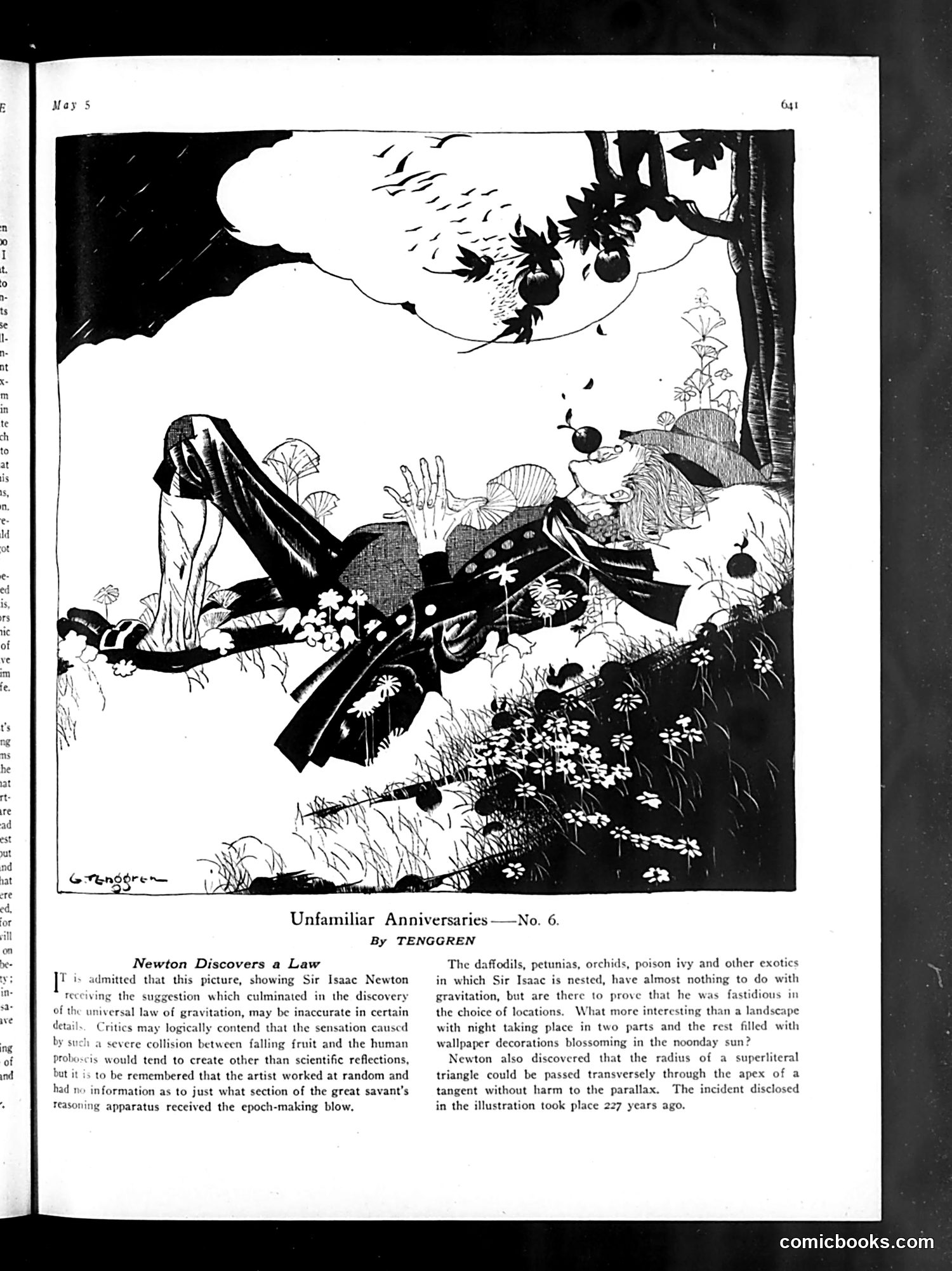
What you’re looking at
This is a humorous illustrated essay by Tenggren satirizing the famous (possibly apocryphal) story of Isaac Newton discovering gravity when an apple fell on his head. The cartoon shows Newton lounging in an ornate garden surrounded by flowers, with an apple falling from above. The satire works on multiple levels: the text absurdly claims the artist had "no information" about which part of Newton's head was hit, and it mocks the incongruity of depicting this scientific moment in a decorative, romantic garden setting with "wallpaper decorations blossoming in the noonday sun." The final paragraph becomes deliberately nonsensical, fabricating a ridiculous pseudo-scientific discovery about "superliteral triangles" and "parallax," mocking how the incident is mythologized. The joke is that the famous moment may be far less dignified and precise than history suggests—a random accident rather than scientific inspiration.
📄 Transcribed text from this page (OCR, searchable)
Machine-transcribed from the original scan — historical spelling and the odd misread are preserved.
res Tenogre — Unfamiliar Anniversaries No. 6. By TENGGREN Newton Discovers a Law admitted that this picture, showing Sir Isaac Newton receiving the suggestion which culminated in the discovery of the T i, universal law of gravitation, may be inaccurate in certain deta Critics may logically contend that the sensation caused by such a severe collision between falling fruit and the human is would tend to create other than scientific reflections, but it is to be remembered that the artist worked at random and had no information as to just what section of the great savant’s Teasoning apparatus received the epoch-making blow, probo The daffodils, petunias, orchids, poison ivy and other exotics in which Sir Isaac is nested, have almost nothing to do with gravitation, but are there to prove that he was fastidious in the choice of locations. What more interesting than a landscape with night taking place in two parts and the rest filled with wallpaper decorations blossoming in the noonday sun? Newton also discovered that the radius of a superliteral triangle could be passed transversely through the apex of a tangent without harm to the parallax. The incident disclosed in the illustration took place 227 years ago. comicbooks.com