
A complete issue · 36 pages · 1921
Life — April 14, 1921
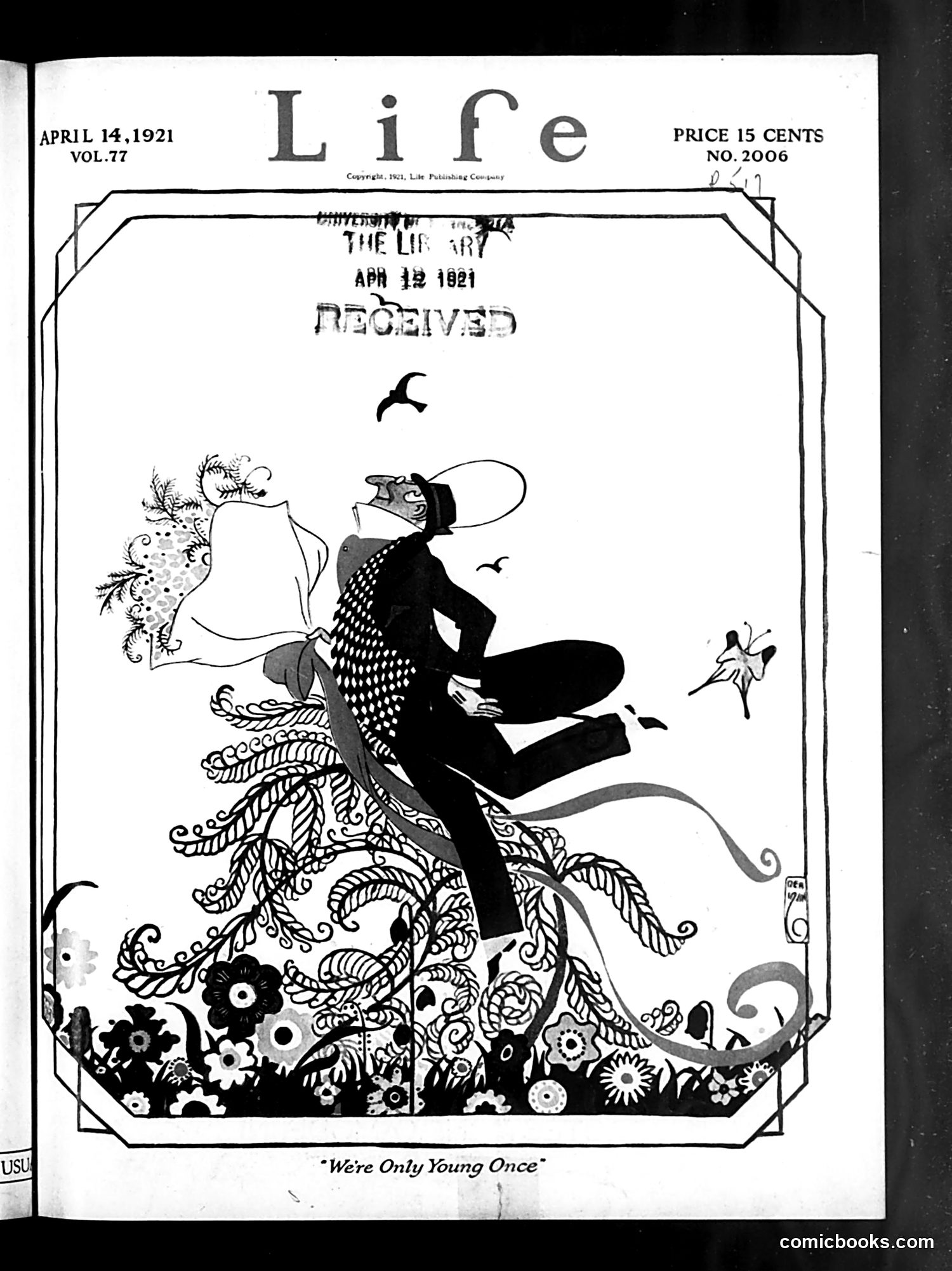
This April 14, 1921 cover illustrates the caption "We're Only Young Once." The illustration depicts a well-dressed man in a top hat riding atop an elaborate, fantastical creature—part plant, part decorative floral arrangement—that sprouts ornate leaves, vines, and blooming flowers. The figure appears carefree and youthful, gazing upward while riding this whimsical contraption. The satire likely comments on youthful exuberance, escapism, or perhaps the post-WWI era's desire to recapture lost youth and pleasure. The elaborate decorative nature of the "mount" suggests frivolous or fanciful pursuits. The overall tone appears gently mocking of attempts to reclaim youthful abandon in the early 1920s.
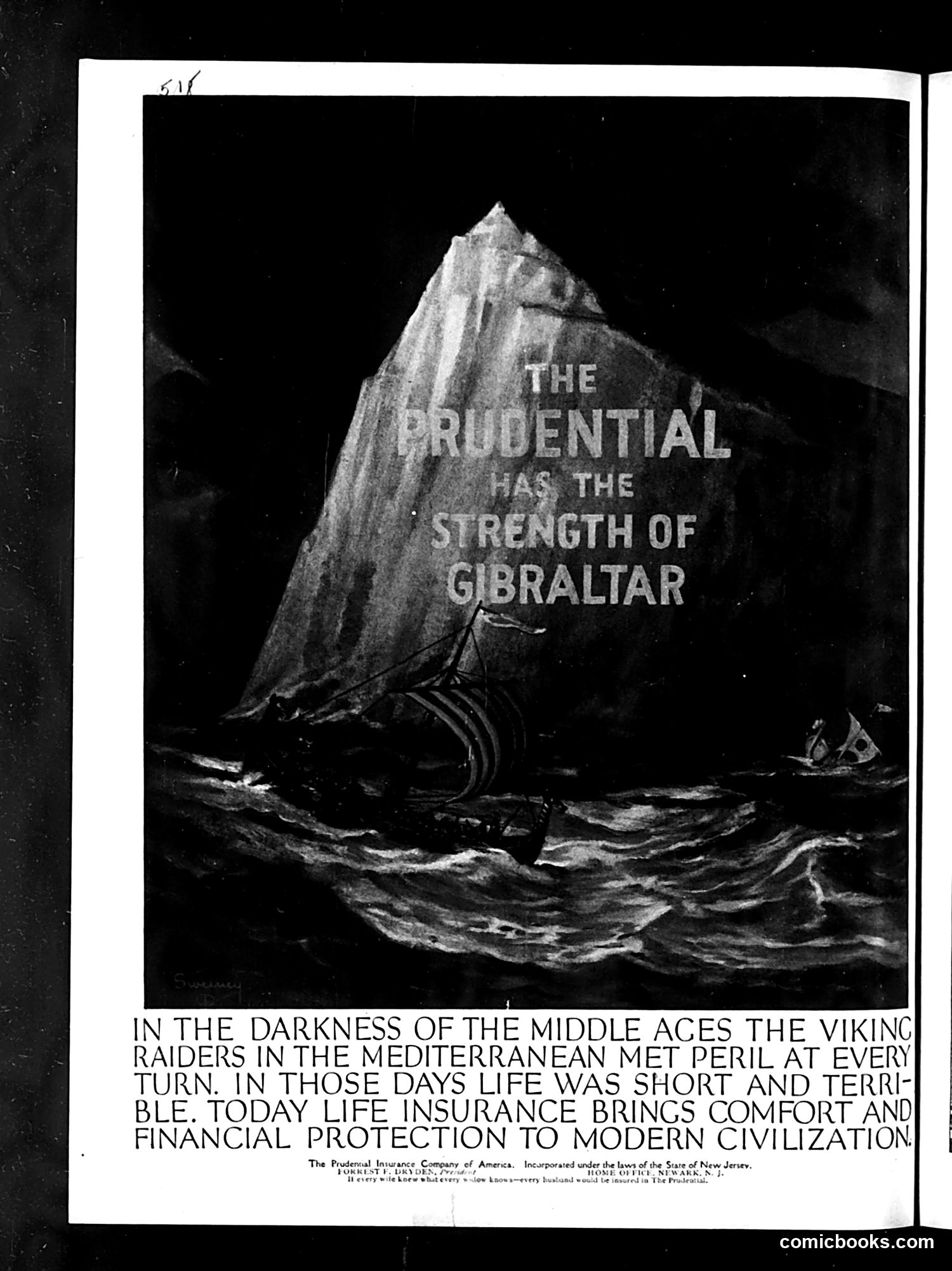
This is **advertising, not satire**. The Prudential Insurance Company uses a dramatic maritime imagery to market life insurance. The visual shows a Viking ship with billowing sail navigating stormy seas, with the Rock of Gibraltar visible in the background. The headline claims "THE PRUDENTIAL HAS THE STRENGTH OF GIBRALTAR." The body text draws a historical parallel: just as Viking raiders faced maritime perils in the Middle Ages, modern life presents dangers and uncertainties. The advertisement argues that Prudential life insurance provides the same protective strength that Gibraltar represents—stability and security. This is vintage corporate messaging using classical symbolism to suggest that the insurance company is as enduring and reliable as famous landmarks, offering "comfort and financial protection to modern civilization."
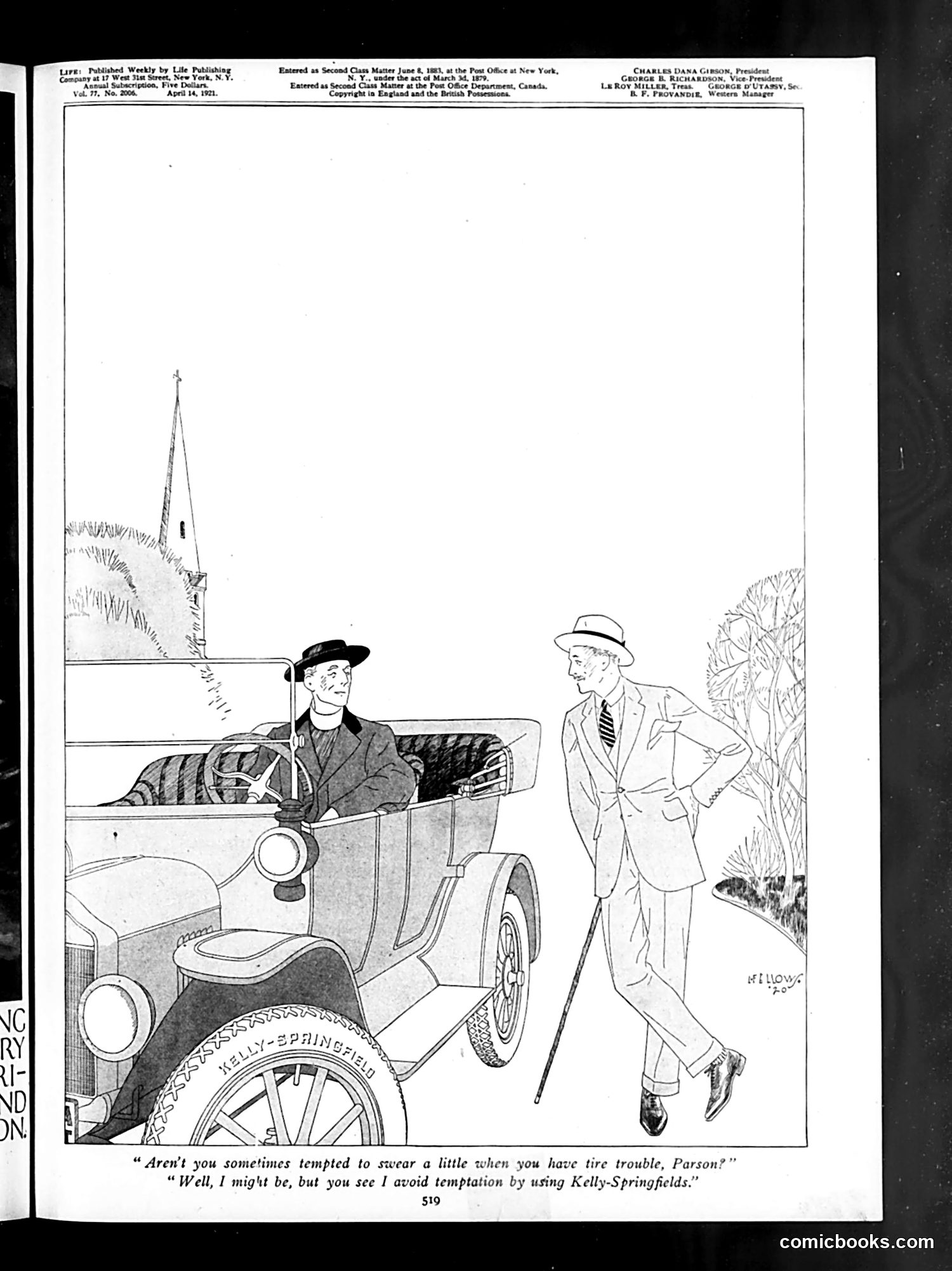
This is a **Kelly-Springfield tire advertisement disguised as humor**. Two men are depicted: one driving an old automobile, the other (labeled "Parson") standing beside it with a cane. The joke plays on the stereotype of clergy swearing when experiencing car trouble. The parson claims he avoids temptation to curse by using Kelly-Springfield tires—implying these tires are so reliable they prevent the frustration that causes profanity. The humor is gentle, relying on the incongruity of a religious figure nearly losing his composure over mechanical failure. The advertisement's message: Kelly-Springfield tires prevent problems, thus preventing the bad behavior problems cause. This represents early 20th-century advertising strategy: embedding product placement within editorial humor rather than separate ads.
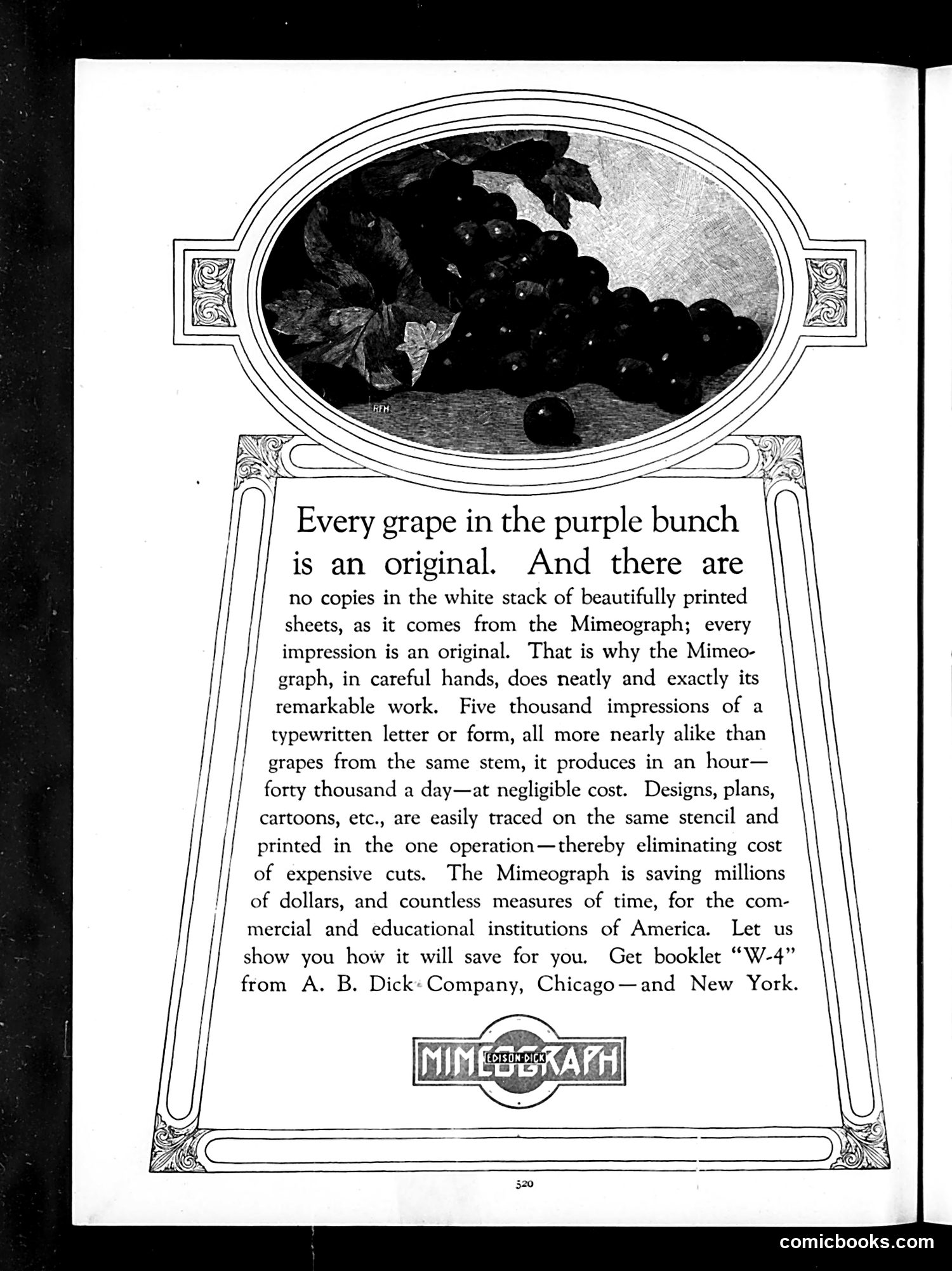
This page is **primarily an advertisement**, not satirical content. It promotes the Mimeograph machine by A.B. Dick Company of Chicago and New York. The ad uses an analogy comparing grape production to document reproduction: just as each grape in a bunch is unique, each mimeograph impression is an original (unlike copies from other methods). The accompanying photograph shows purple grapes on a vine. The advertisement emphasizes the Mimeograph's cost-effectiveness and speed—producing 40,000 copies daily at "negligible cost." It highlights applications for "commercial and educational institutions" and claims the device saves "millions of dollars" and "countless measures of time." The ad directs readers to request booklet "W-4" for more information. This is straightforward product marketing from the early-to-mid 20th century.
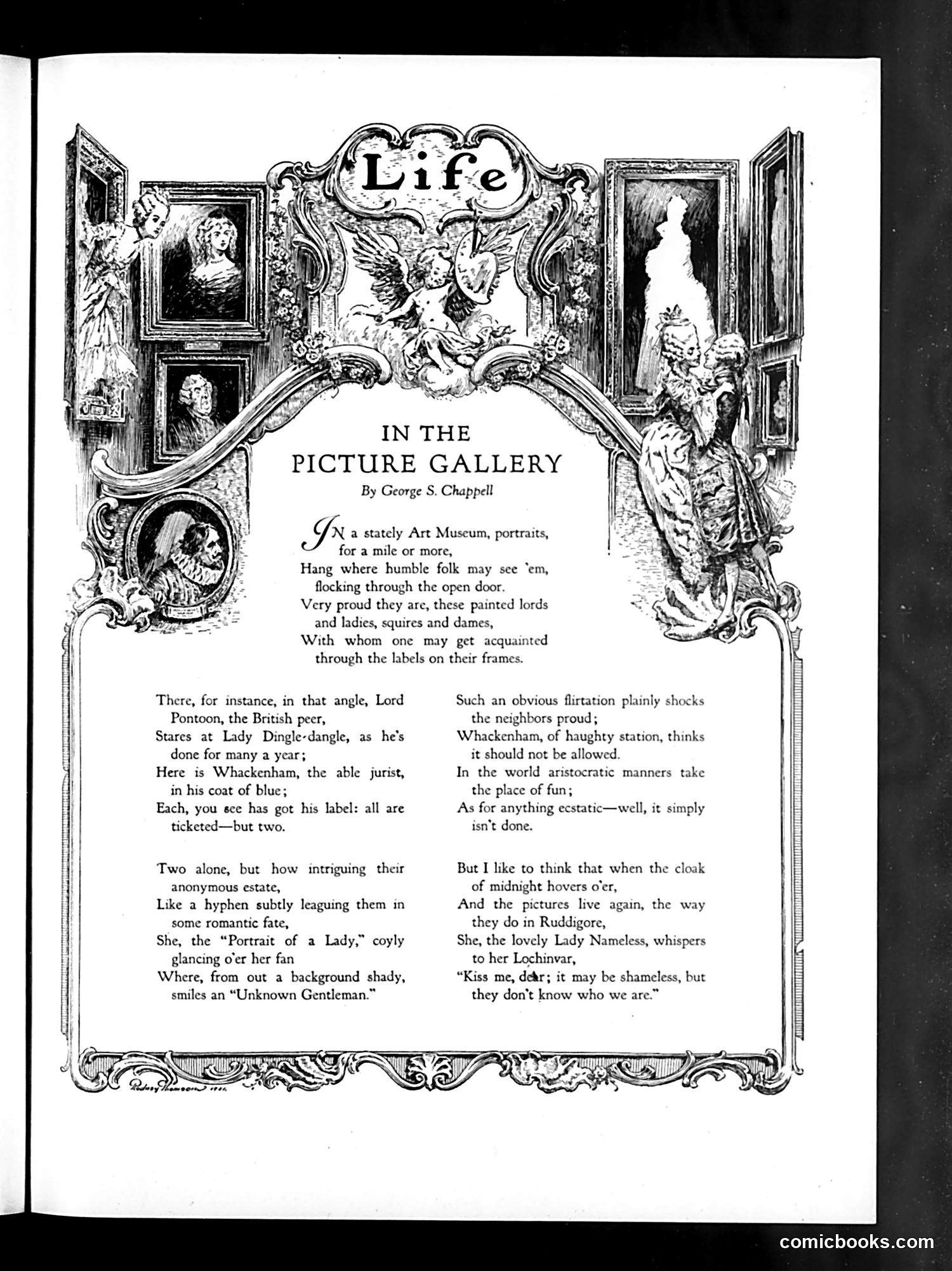
This satirical poem mocks the pretensions of wealthy art patrons in a museum setting. The verse names specific aristocratic figures—Lord Pontoon, Lady Dingle-dangle, Whackenham—who are portrayed as absurdly proud despite their questionable character. The satire targets the hypocrisy of "haughty" elites adopting refined aesthetic manners while behaving poorly in society. The poem suggests that paintings "live again" at midnight, implying the artworks are more genuine than the vain people viewing them. Lady Nameless and Lochinvar become characters in an imagined romantic scene, contrasting authentic emotion with the affected posturing of actual gallery visitors. The overall joke: art museum visitors perform sophistication while remaining fundamentally shallow and ridiculous.
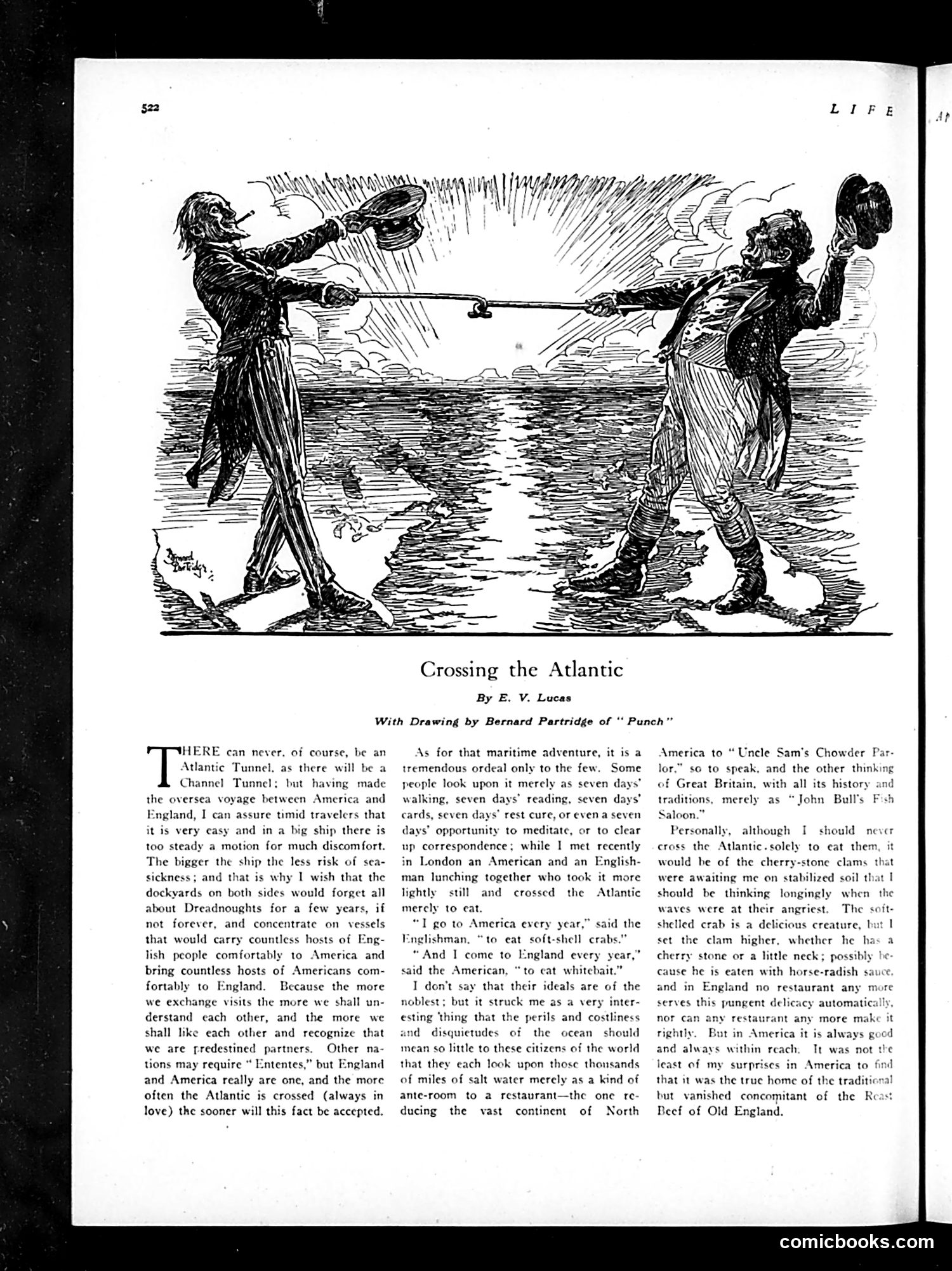
This satirical piece by E.V. Lucas (illustrated by Bernard Partridge) depicts two gentlemen engaged in a peculiar transatlantic ritual: they meet annually to dine together while suspended over the ocean. The joke centers on Anglo-American relations and stereotypical dining habits. One character travels yearly from America to England to eat soft-shell crabs; the other journeys from England to America to eat whitebait. Rather than recognizing their shared cultural bonds, they treat the Atlantic crossing as merely an opportunity for specific culinary experiences—reducing the vast continent to a restaurant. The satire gently mocks how both nations view each other: through narrow, materialistic lenses rather than genuine cultural understanding, despite their growing interdependence and need for mutual respect.
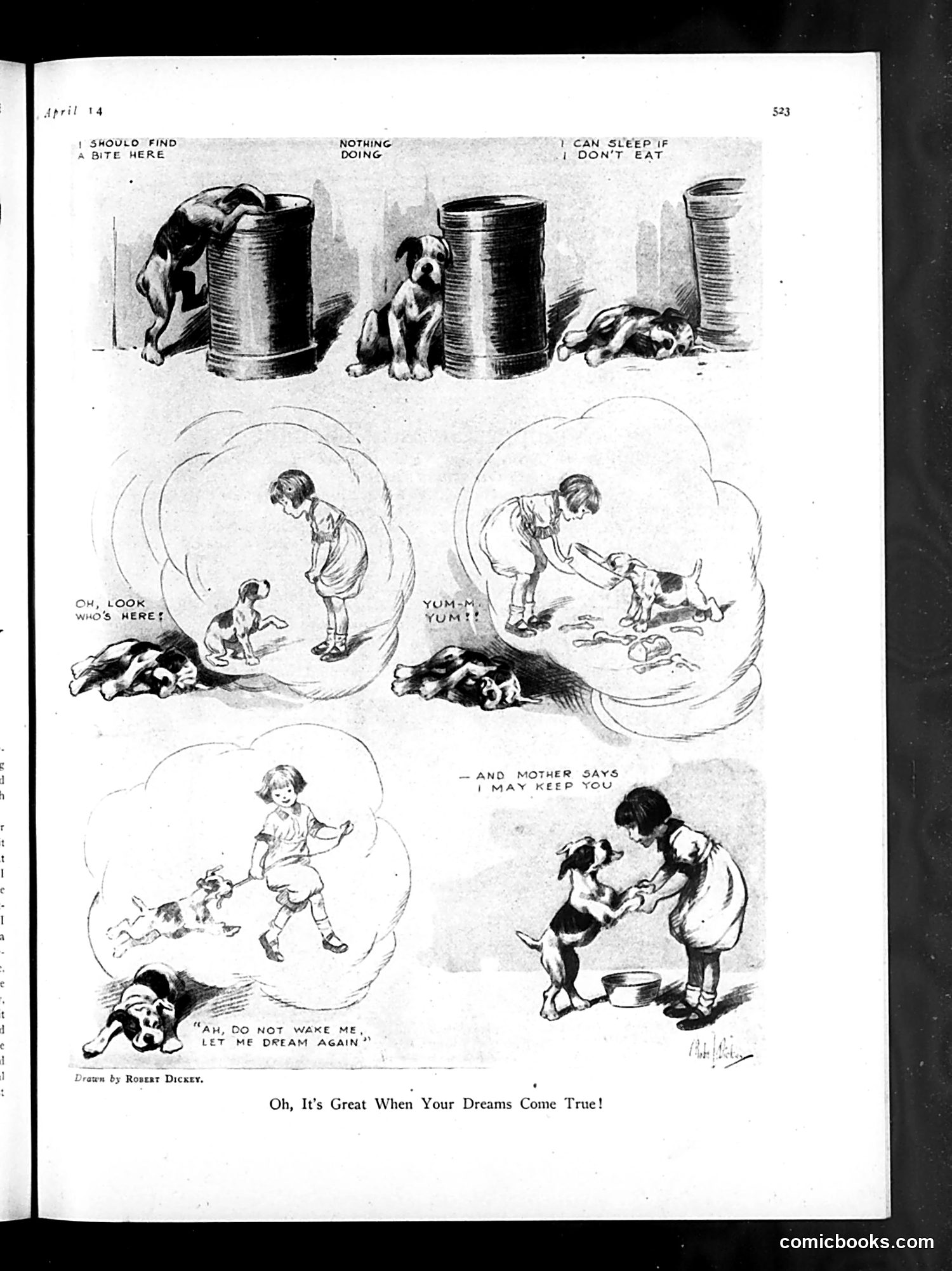
This Robert Dickey cartoon illustrates children's fantasies about finding and keeping stray dogs. The top panel shows three trash cans with dogs searching for food—establishing the grim reality of stray animals. Below, three thought-bubbles reveal children's hopeful imaginings: finding a dog ("who's here?"), playing together ("yum-m, yum!!"), and dreaming peacefully ("ah, do not wake me, let me dream again"). The final panel shows a child actually keeping a dog, with text reading "and mother says I may keep you"—the dream realized. The satire gently mocks both children's naive optimism about strays and perhaps parental indulgence. It captures early 20th-century attitudes toward urban stray animals and childhood desires, presented with sentimental humor rather than sharp critique.
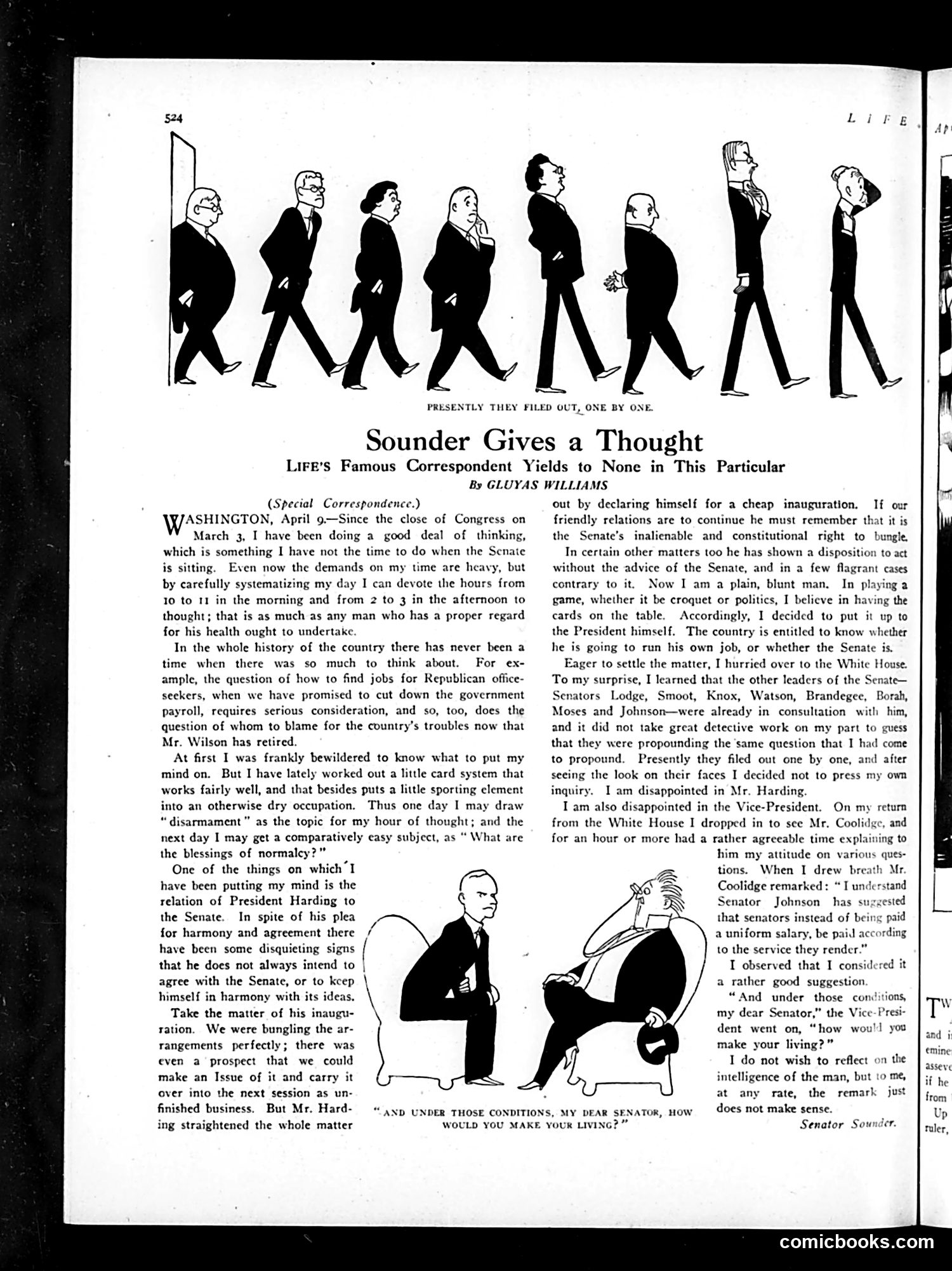
This satirical piece by Williams critiques President Harding's relationship with the Senate regarding appointments and policy decisions. The top cartoon shows eight men in suits filing out one by one—depicting senators leaving after a meeting. The main illustration shows a conversation between what appears to be Vice President Coolidge and Senator Saunders, discussing how senators should be compensated for their work. The satire targets the tension between Harding's executive authority and Senate oversight, particularly regarding job appointments and federal payroll cuts. Williams mockingly suggests senators are negotiating their own salaries while the government faces budget constraints—highlighting perceived hypocrisy and self-interested politics during the early 1920s Harding administration.
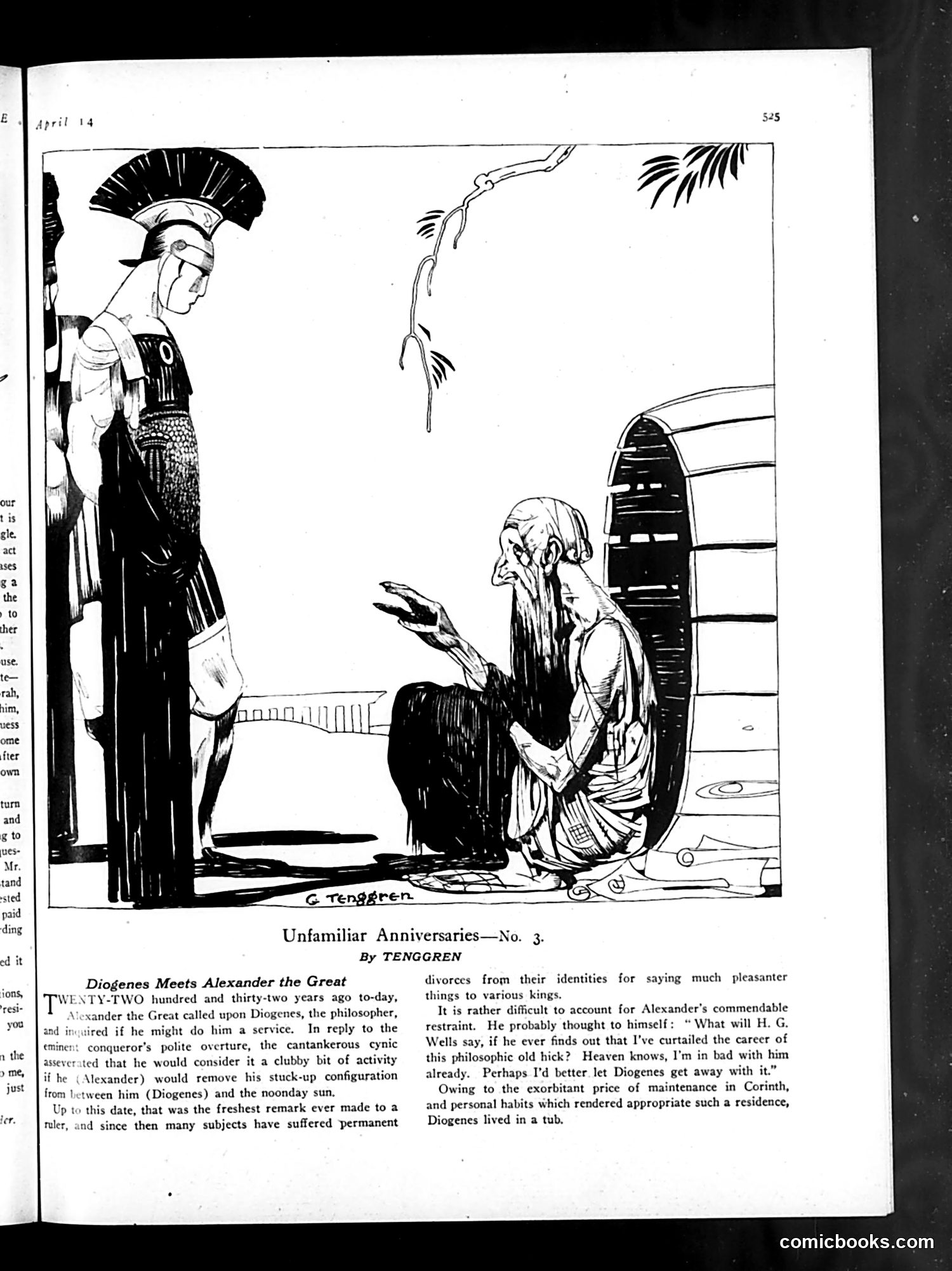
This satirical cartoon depicts the famous historical encounter between the Cynic philosopher Diogenes and Alexander the Great. According to the text, Alexander sought to grant Diogenes any wish, but the philosopher famously requested only that Alexander stop blocking his sunlight. The cartoon shows a richly dressed, imperious Alexander (left, in ornate military dress) confronting a ragged, impoverished Diogenes (right, seated near a tub). The satire highlights the contrast between worldly power and philosophical indifference to material wealth. The accompanying text elaborates that Alexander found Diogenes's bluntness refreshing, and notes that Diogenes's austere lifestyle (living in a tub) made him notably difficult to maintain as a subject, even for a great conqueror.
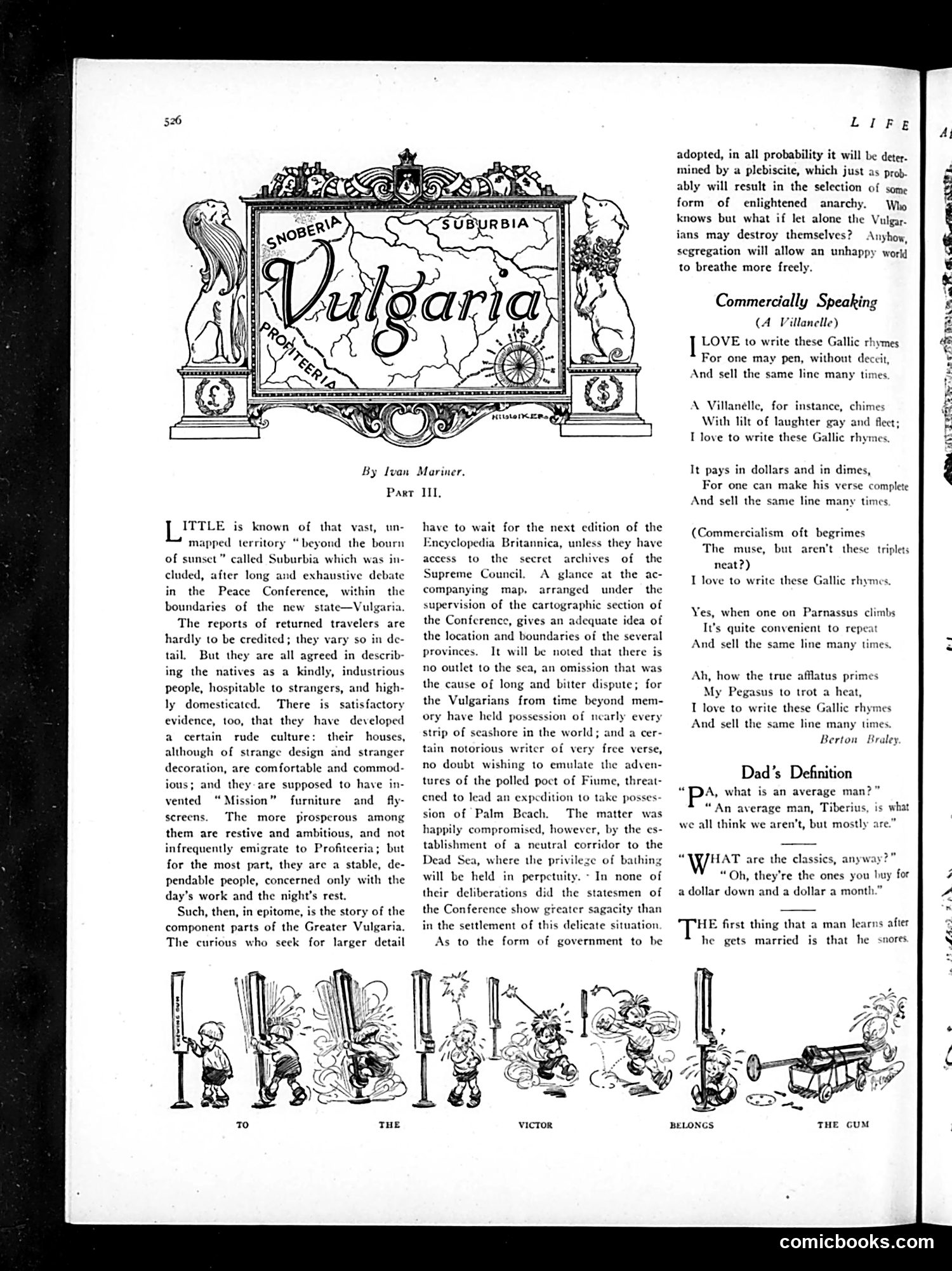
This page from *Life* magazine contains three distinct elements: 1. **"Bulgaria" article** (Part III by Jean Mariner): A geographical/travel piece about the Balkan region, describing Vulgarian natives as "kindly, industrious people" and discussing territorial disputes over seashore possession—likely referencing post-WWI Peace Conference boundary disputes. 2. **"Commercially Speaking"** (A Villanelle): A satirical poem mocking poets who write formulaic verses ("Gallic rhymes") for money, repeatedly selling "the same line many times." It critiques commercialization of art. 3. **"Dad's Definition"**: Brief humorous dialogue where a father defines "average man" and "classes" in economic terms—working-class satire about social hierarchy and financial struggle. 4. **Bottom cartoon**: A children's gum advertisement with the punchline "TO THE VICTOR BELONGS THE GUM"—a play on the phrase "to the victor belongs the spoils."
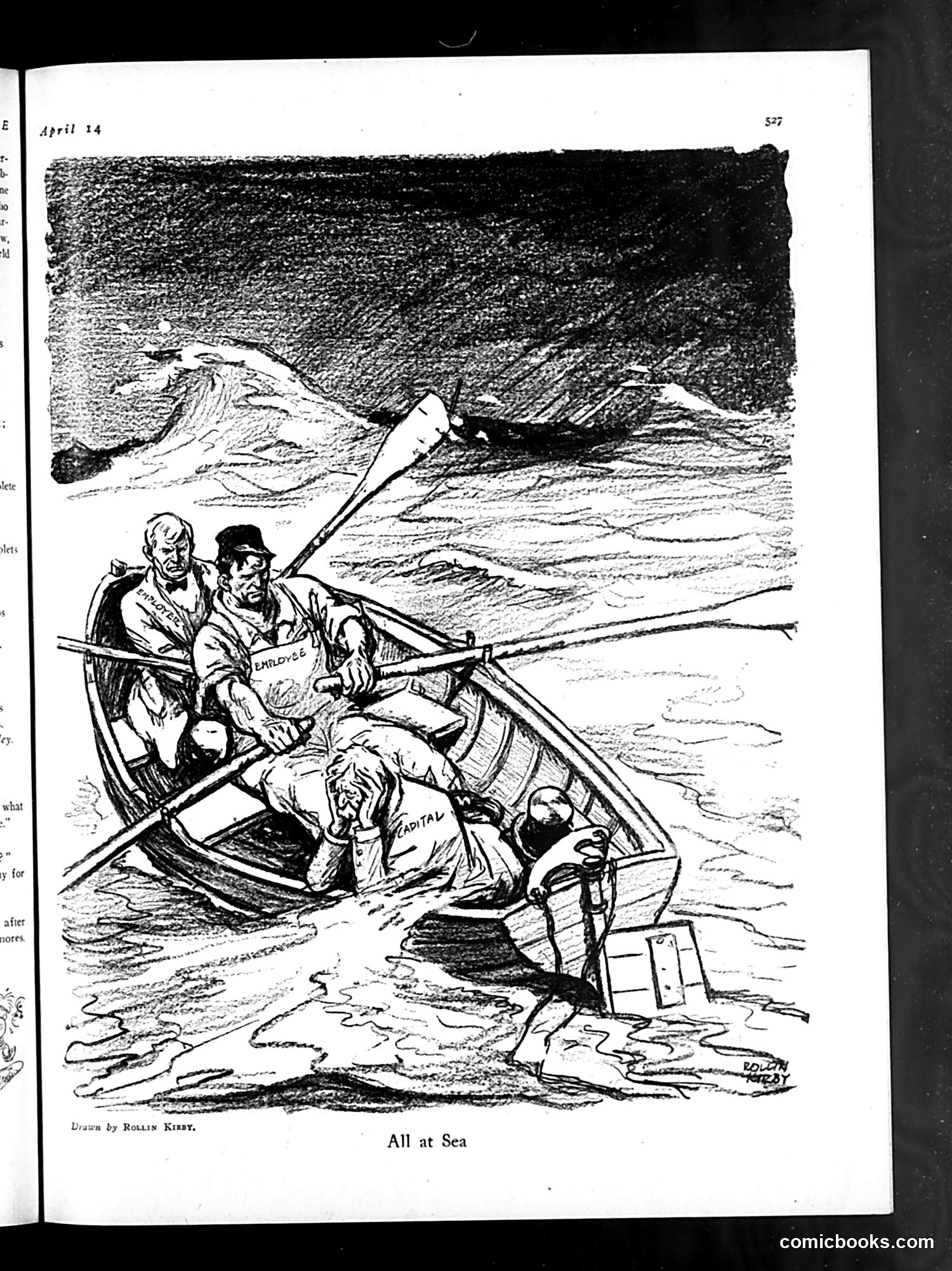
This cartoon, drawn by Rollin Kirby, depicts a boat in distress with labeled figures representing economic forces. A figure labeled "CAPITAL" sits in the boat while workers appear to be drowning or struggling in the water. The composition suggests economic inequality and crisis—capital is safely aboard while laborers are left to flounder. The date (April 14) and the dramatic maritime setting suggest this comments on an economic emergency, likely related to post-WWI economic instability or labor unrest. The satire criticizes how wealthy capitalists remain protected while working people suffer the consequences of economic turmoil. The "all at sea" title reinforces the metaphor of an economy adrift without proper direction or concern for those most vulnerable.
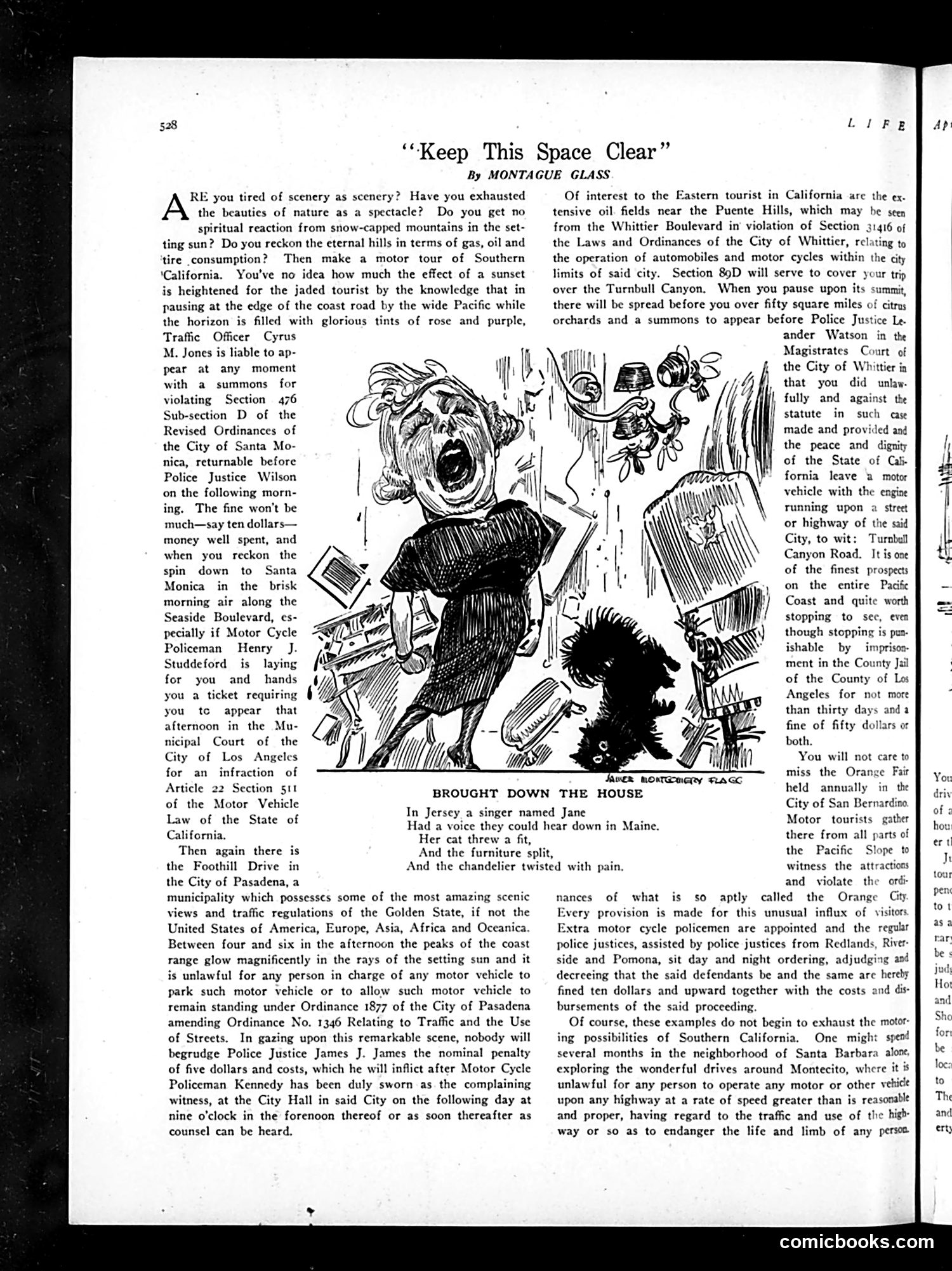
This is a satirical article by Montague Glass titled "Keep This Space Clear," critiquing reckless motor vehicle driving in Southern California. The illustration, captioned "BROUGHT DOWN THE HOUSE," depicts an exaggerated, wild-eyed driver causing chaos—furniture and objects flying, suggesting the destructive impact of dangerous driving. The article mocks speeding motorists who violate traffic laws, referencing specific California ordinances and citing Police Justice Watson's enforcement efforts in Santa Monica and Los Angeles. Glass highlights the absurdity of drivers endangering lives by speeding through residential areas and along scenic coastal drives like Turncull Canyon Road. The accompanying verse about "Jane" in Jersey humorously illustrates consequences—her reckless driving literally "brought down the house," destroying furniture. This reflects early 1900s concerns about automobile safety and the need for traffic regulation in growing cities.
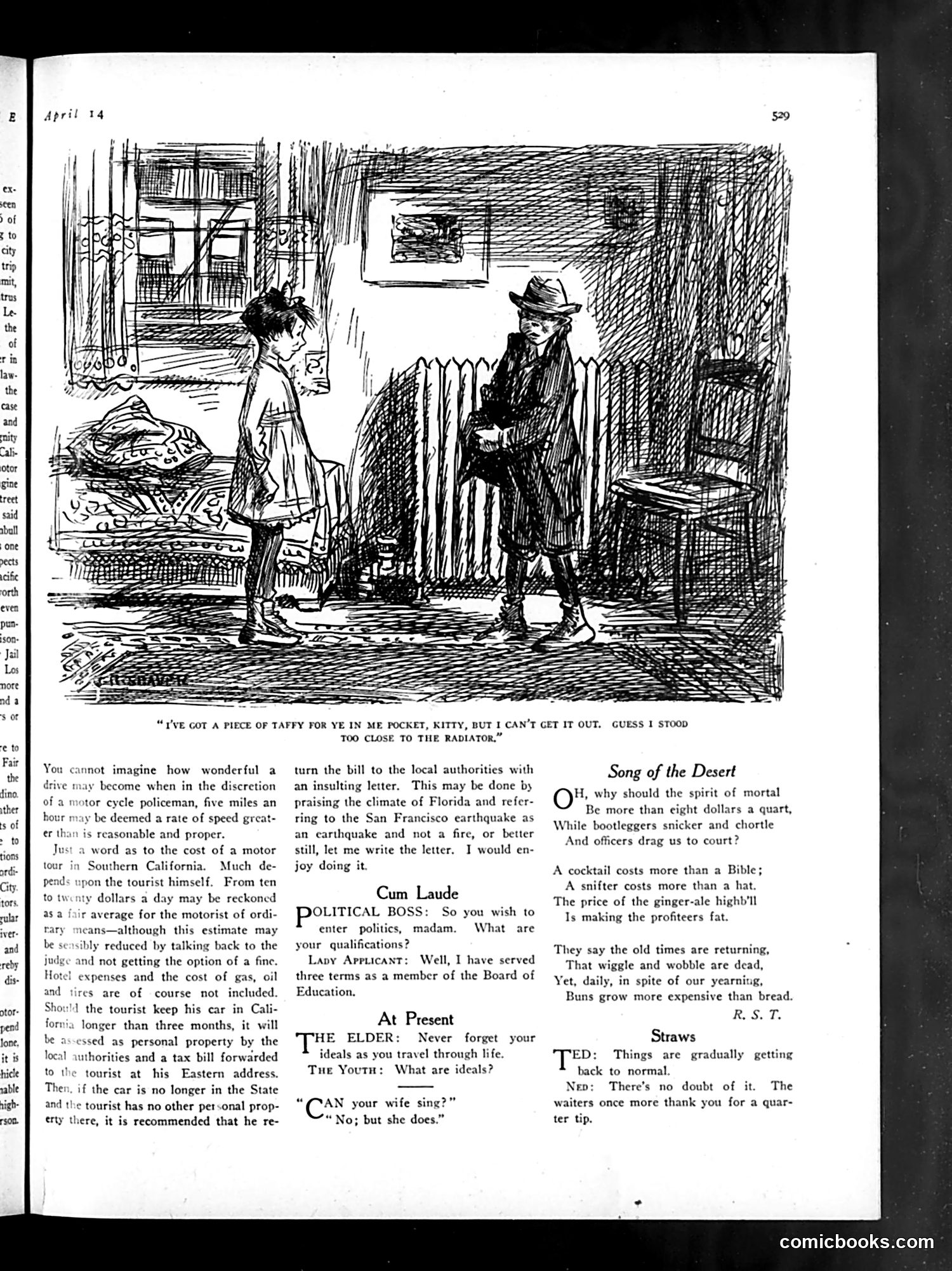
The main cartoon depicts a woman showing a man a piece of taffy near a radiator. The caption reads: "I've got a piece of taffy for ye in me pocket, Kitty, but I can't get it out. Guess I stood too close to the radiator." This is a straightforward visual gag playing on the fact that taffy becomes sticky and adheres to fabric when heated—the man's candy has literally melted into his pocket lining from standing near a heat source. The humor relies on the physical properties of the candy and the awkward situation it creates. The surrounding text includes unrelated satirical pieces on motorist expenses, political humor, and social commentary typical of Life's format.
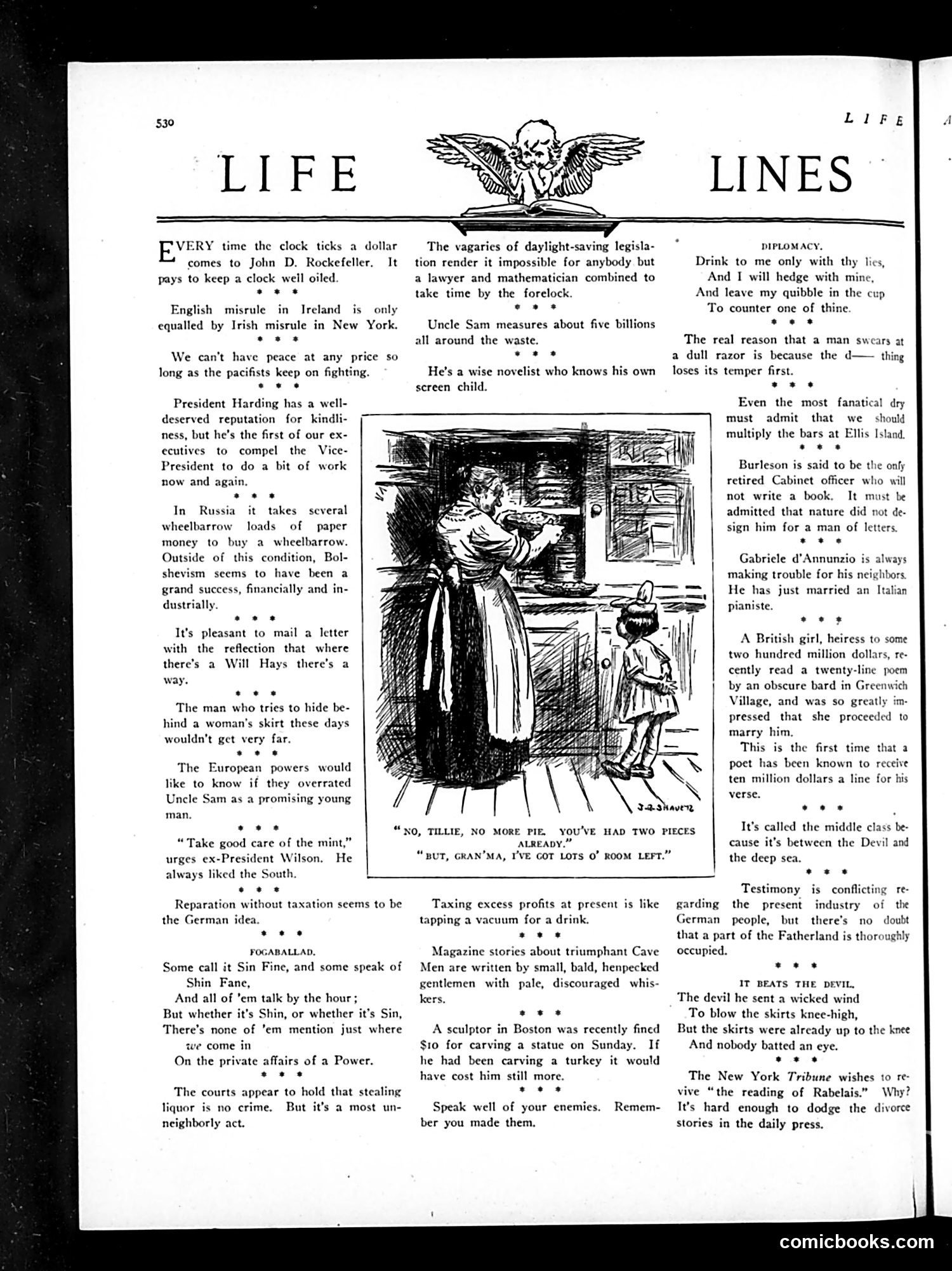
The cartoon depicts a domestic scene with a mother scolding a young child about food waste during what appears to be a period of rationing or scarcity. The caption reads: "NO, TILLIE, NO MORE PIE. YOU'VE HAD TWO PIECES ALREADY. BUT, GRAN'MA, I'VE GOT LOTS O' ROOM LEFT." This satirizes childhood entitlement and parental discipline around food consumption, likely reflecting post-WWI or Depression-era concerns about waste and proper nutrition. The grandmother figure represents older-generation values emphasizing frugality, while the child embodies modern excess. The humor targets both the child's innocent logic ("room" for dessert) and broader tensions between generations over proper household management and resource conservation during economically difficult times.
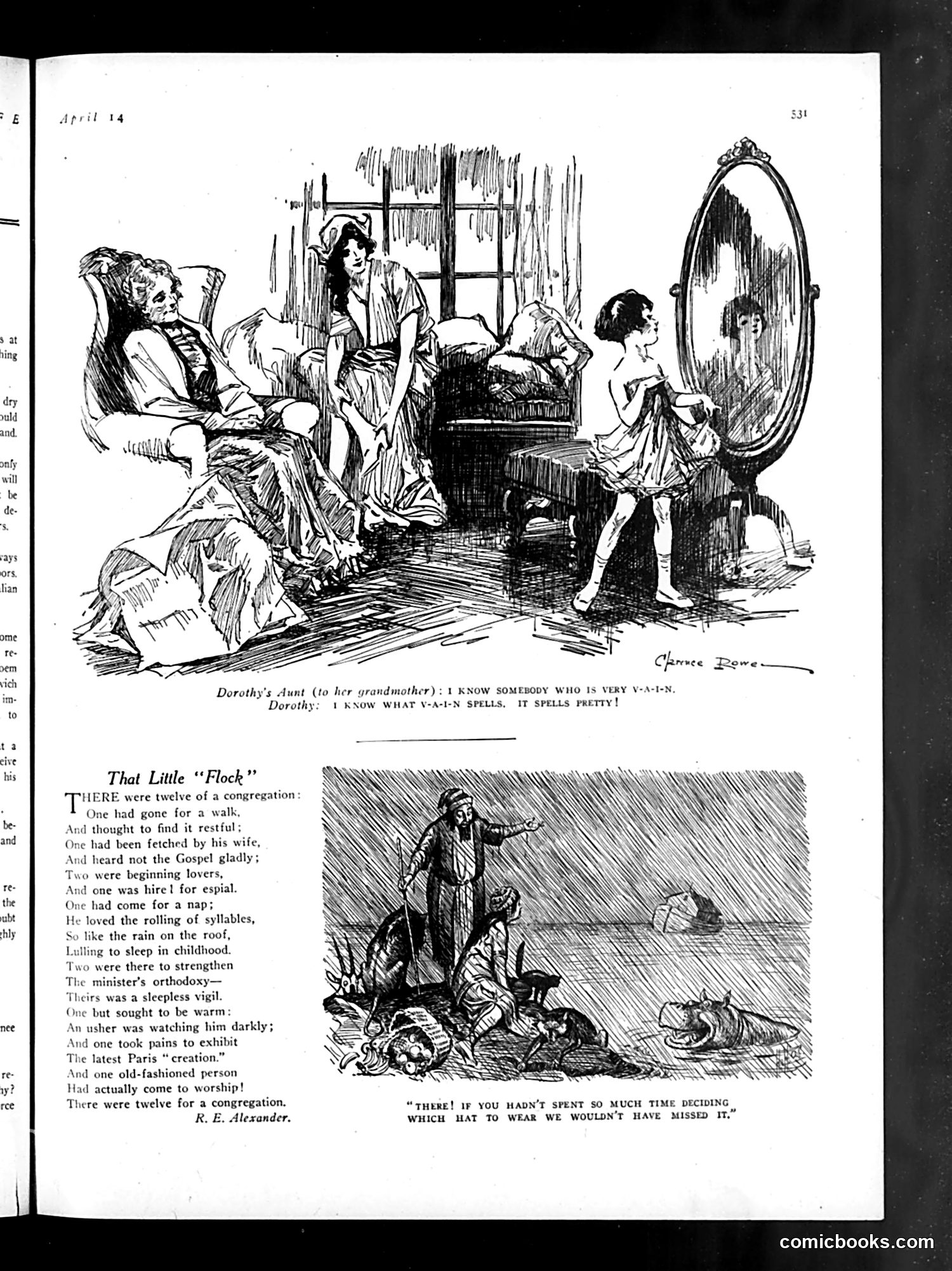
**Top Cartoon** (by Clarence Rowe): A drawing room scene showing Dorothy, a young woman, speaking to her aunt about someone who is "V-A-I-N" (spelled out). Dorothy knows "what V-A-I-N spells" and finds it "pretty"—a joke about vanity and spelling, likely poking fun at shallow, self-absorbed women concerned with appearance. **"That Little 'Flock'"** (by R.E. Alexander): A satirical poem about twelve congregation members with various shallow motivations (seeking rest, romance, warmth, fashion). The accompanying illustration shows them as sheep being herded, satirizing how people follow religion without genuine faith. The caption criticizes those who attend church primarily for social reasons rather than spiritual conviction.
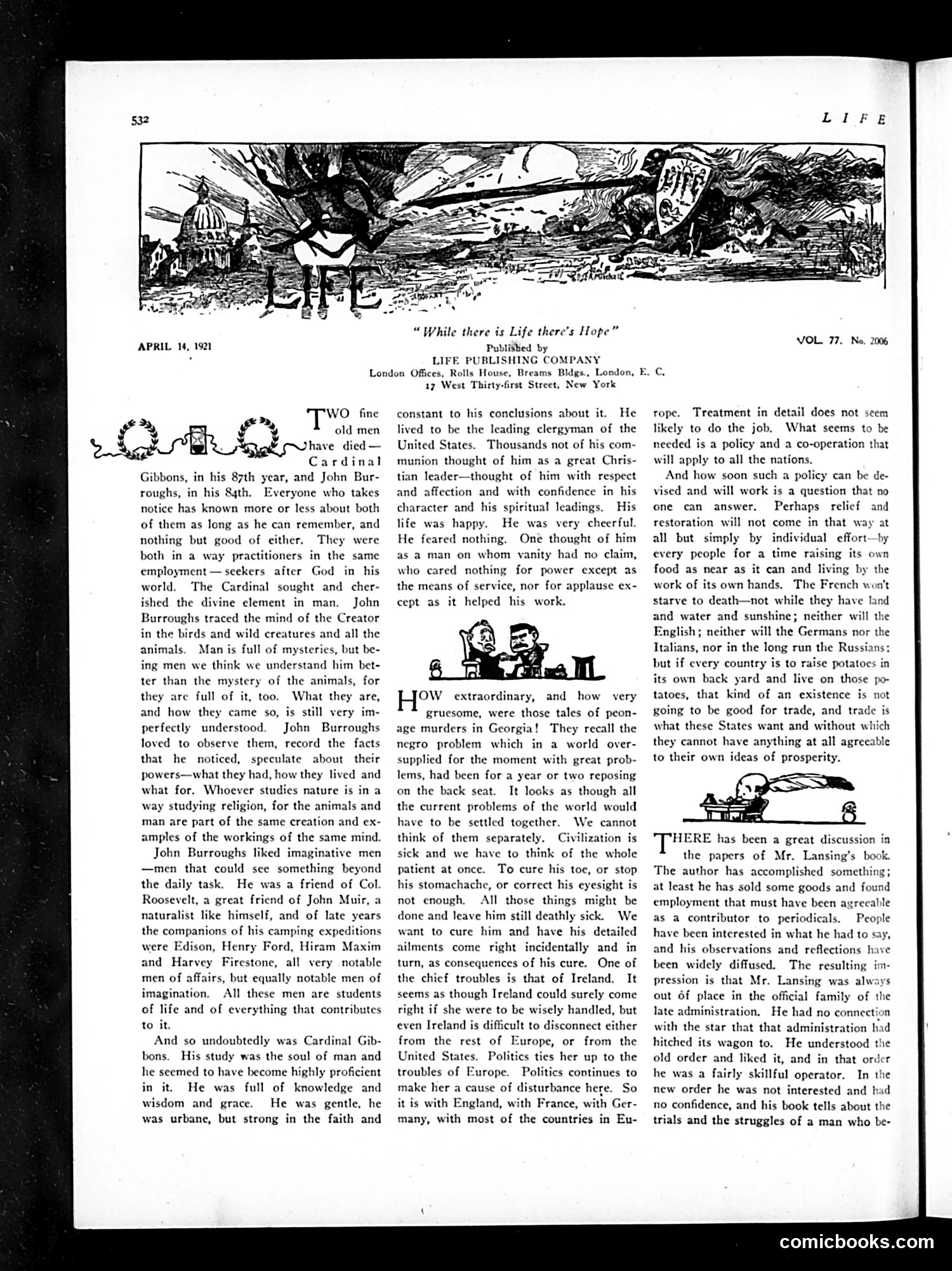
This page contains a literary essay about two deceased prominent figures (Cardinal Gibbons and John Burroughs) rather than political satire. The text praises their character and influence—Gibbons as a leading American clergyman and Burroughs as a naturalist and spiritual guide. The small decorative illustrations at page top and scattered through the text appear to be generic ornamental woodcuts rather than targeted political cartoons. The essay discusses their legacies and argues that individual moral effort and cooperation between nations could help post-WWI recovery, suggesting relief and restoration rather than punishment as policy approaches. This is primarily a commemorative essay page rather than satirical commentary.
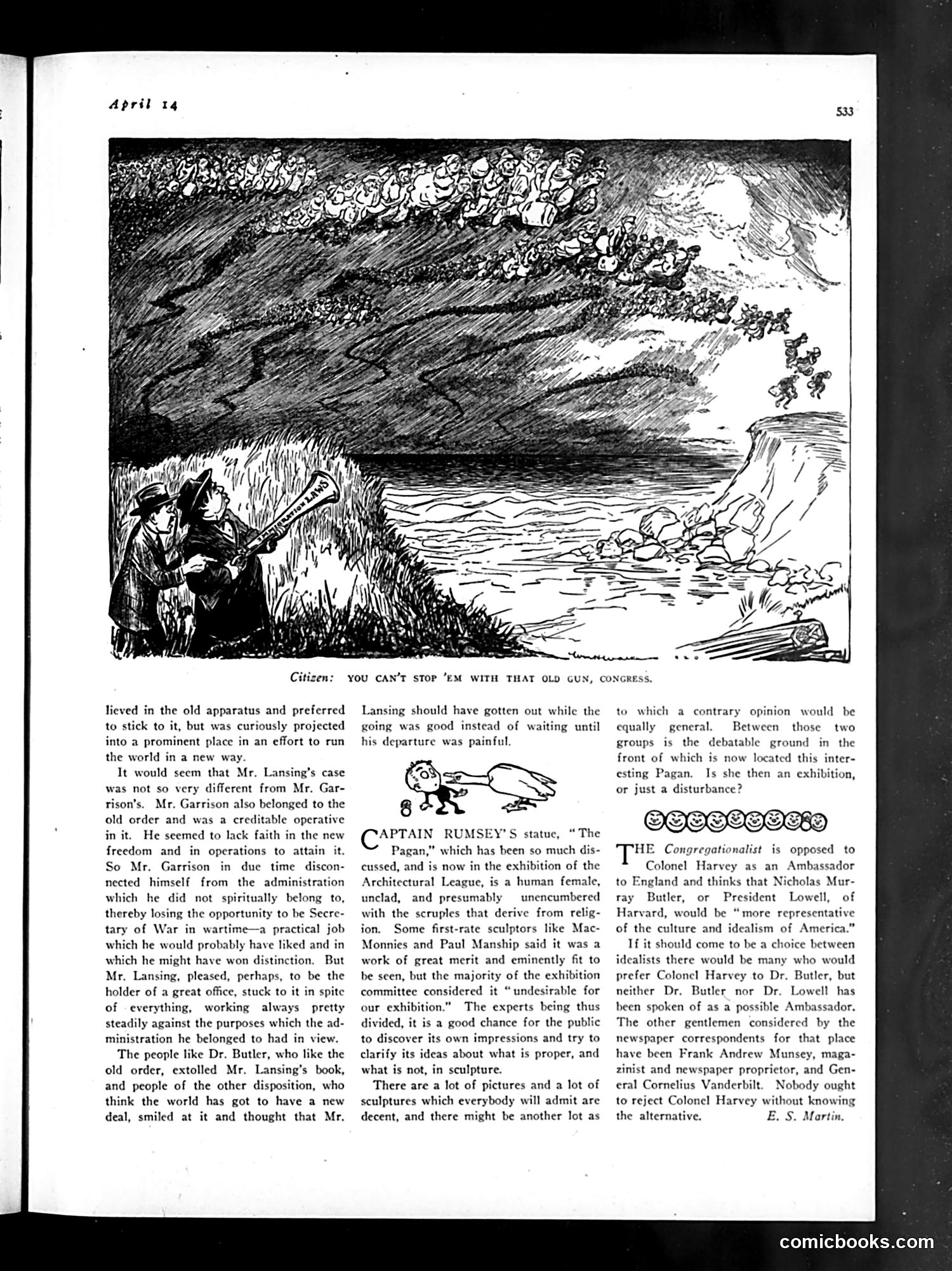
The cartoon depicts Congress as an elderly figure with an outdated gun, unable to stop a flood of people/forces surging over a cliff—likely representing new social movements or progressive changes that traditional legislative power cannot control. The accompanying text discusses Secretary of State Robert Lansing, who (like earlier Secretary of War Lindley Garrison) belonged to the "old order" but remained in Wilson's progressive administration, working against its purposes. The piece criticizes his reluctance to resign, contrasting him with idealists like Dr. Butler who openly reject modernity. A secondary item debates Captain Rumsey's nude sculpture "The Pagan" at the Architectural League—some experts call it meritorious art; others deem it "undesirable." The piece questions where society draws lines on acceptable artistic expression. Finally, commentary opposes Colonel Harvey's potential ambassadorship to England, suggesting Nicholas Murray Butler or President Lowell would better represent "American culture and idealism." The overall theme: old institutions struggle against inevitable modern change.
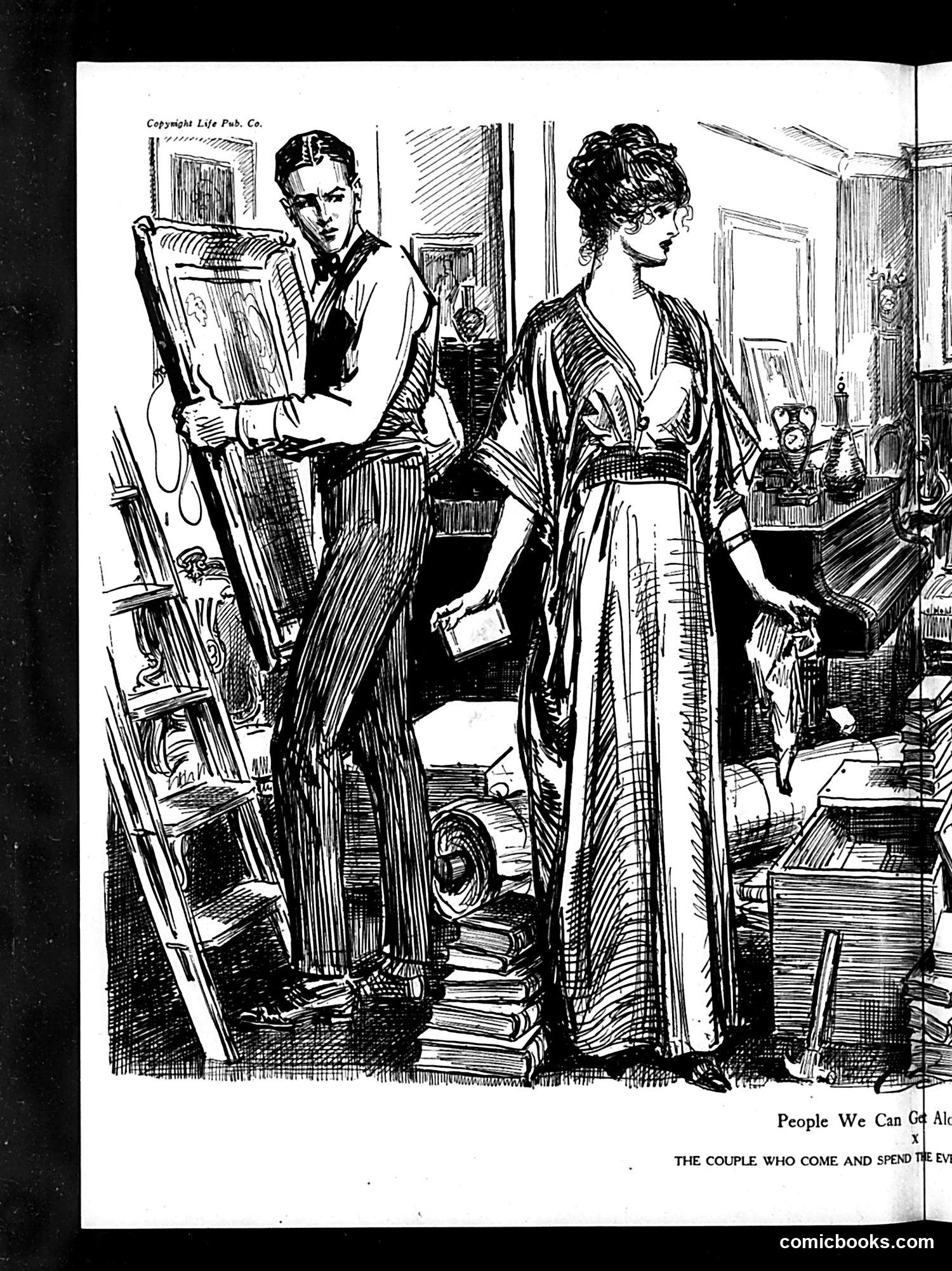
This appears to be a section header or caption page from *Life* magazine rather than a complete cartoon. The visible illustration shows a well-dressed couple in an early 20th-century interior—a man on a ladder holding artwork, and a woman in an elegant dress. The partial caption "THE COUPLE WHO COME AND SPEND THE EV[ENING]" suggests this introduces a series about social types or domestic scenarios. The OCR text is too fragmentary to determine the specific satirical point. Without the complete caption and surrounding context, I cannot confidently identify what social critique or humor was intended. This appears to be part of a larger feature on recognizable social archetypes, likely mocking upper-class or bourgeois behavior patterns that *Life*'s readers would recognize.
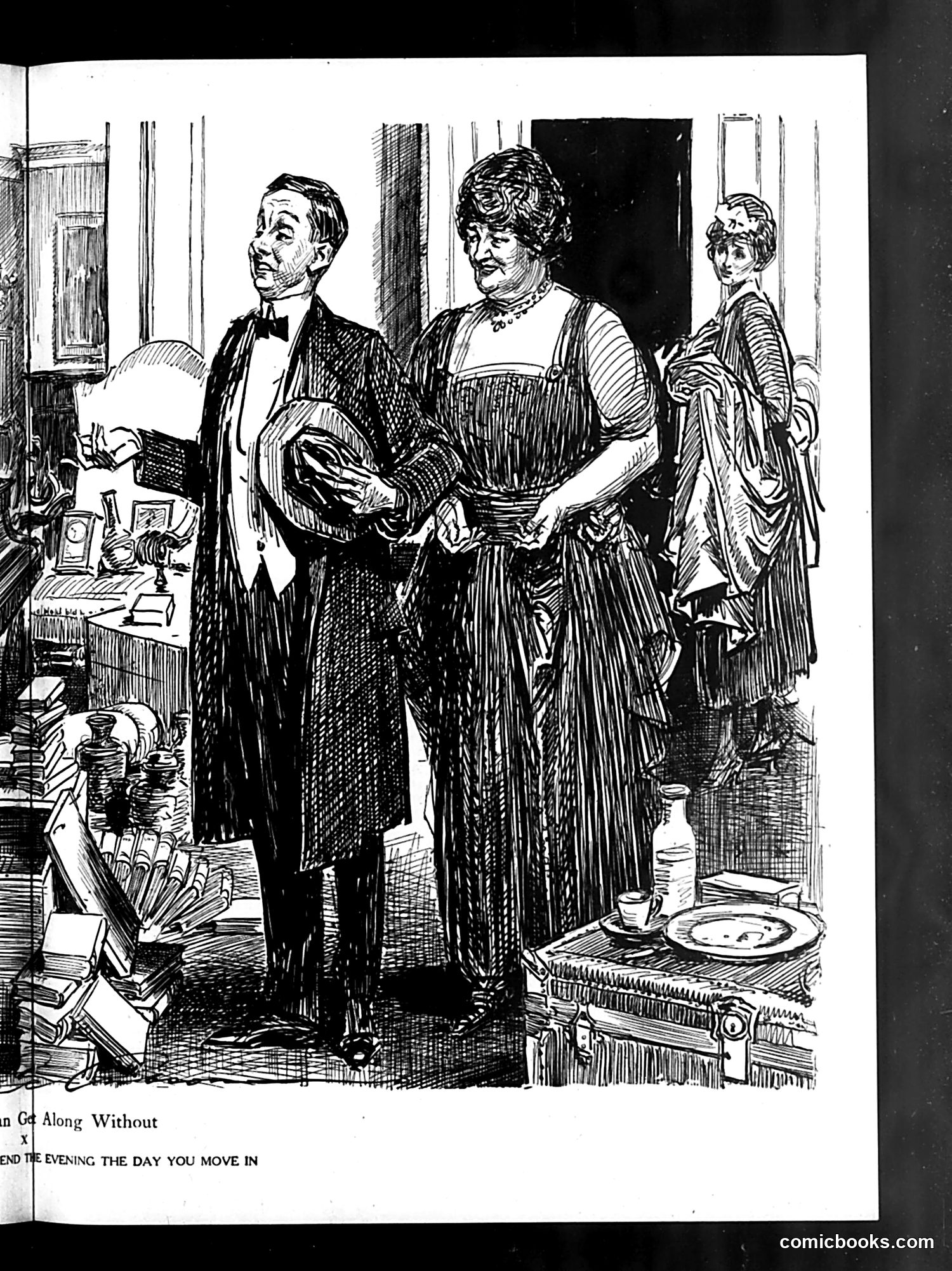
This appears to be a domestic humor illustration from Life magazine showing an interaction between a man in formal evening wear (tuxedo and bow tie) and a woman in a long dress in what looks like a parlor or sitting room. A servant or attendant is visible in the background. The partial OCR text references "the evening the day you move in," suggesting this illustrates a social situation related to moving into a new residence. The cartoon likely satirizes upper-class domestic etiquette or the awkwardness of entertaining guests on moving day—a common source of humor in early 20th-century Life magazine. Without the complete caption and full context, the specific satirical point remains unclear, though it appears to comment on Victorian-era social conventions around hospitality and proper behavior.
This is a theater/entertainment review column, not a political cartoon. The author satirizes the current circus at Madison Square Garden, using social commentary to mock both the performances and contemporary anxieties. The key satire: **depressed elephants** serve as metaphors for post-WWI malaise. The "world conditions and theatrical slump" have made even circus performers listless. The author mocks this pretentious reading, then pivots to genuine concern that performing elephants might become "red" (communist)—a topical 1920s fear. The review also ridicules Mlle. Leitzel's famous aerial act (the "Miniature Marvel of the Air"), questioning what she actually accomplishes by repeatedly casting her body over her shoulders. This deflates circus spectacle with dry logic: after all that, she simply "trips lightly to your dressing room." The tone is satirical throughout—the author critiques both overwrought circus marketing and contemporary American anxieties about unrest and "normalcy" under the current (unnamed) president.
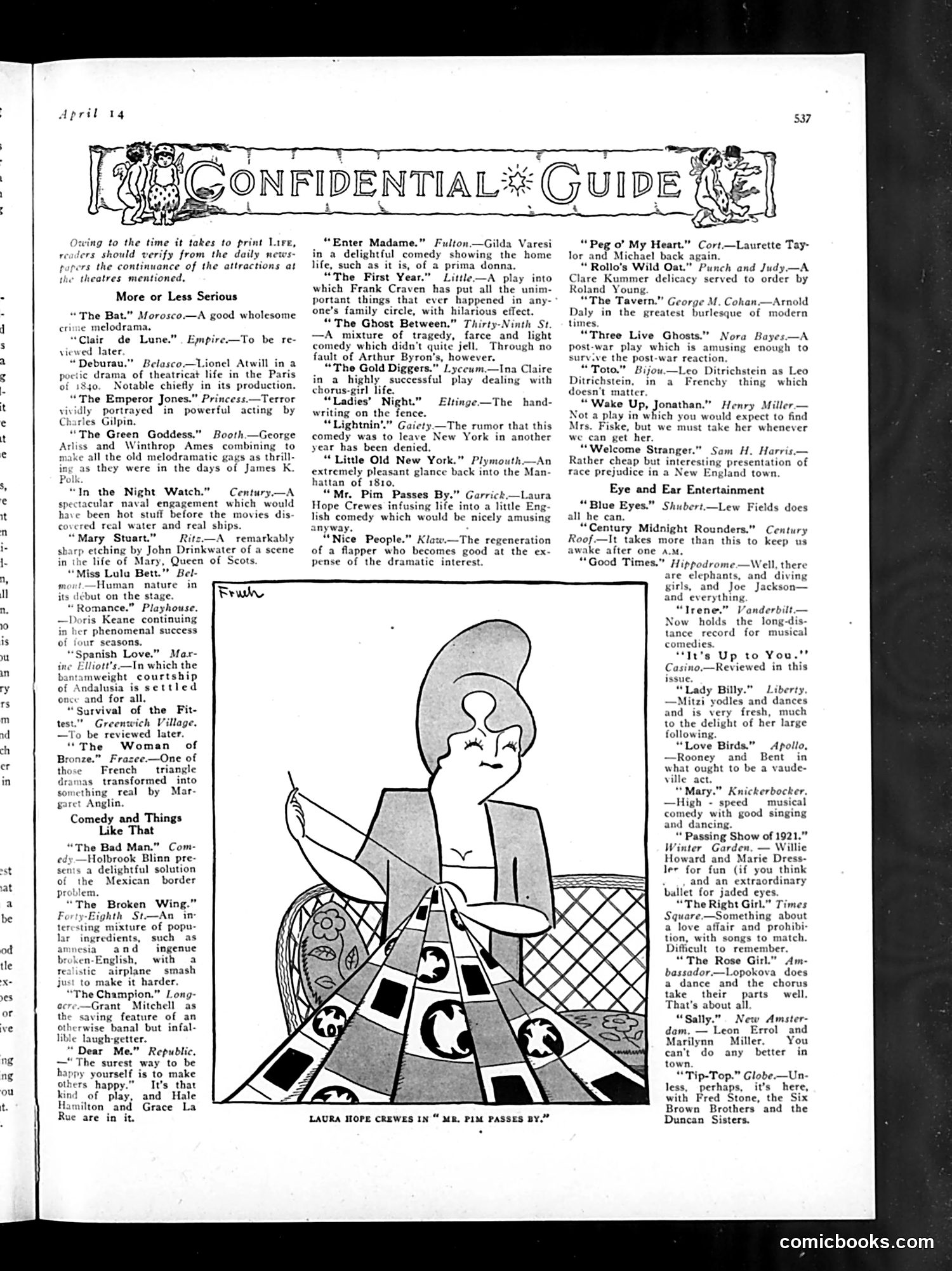
This is a theater review guide from Life magazine's "Confidential Guide" section, dated April 14. It catalogs Broadway and theatrical productions of the era, organized by tone—serious dramas, comedies, and lighter fare. The central illustration shows a stylized woman in 1920s fashion (bobbed hair, dropped waistline) examining what appears to be theatrical playbills or programs, depicted as a patchwork skirt. This visualizes the guide's purpose: helping theatergoers navigate the season's offerings. The reviews are brief, snappy critiques naming actors (Laura Hope Crewes, Gilda Varesi, Charles Gilpin) and theaters (Lyceum, Playhouse, Gaiety). References like "flapper" and post-war themes indicate this is early 1920s entertainment. The tone is witty and conversational—Life's satirical voice applied to theater criticism rather than political satire. It's essentially a entertainment consumer guide for sophisticated urban readers.
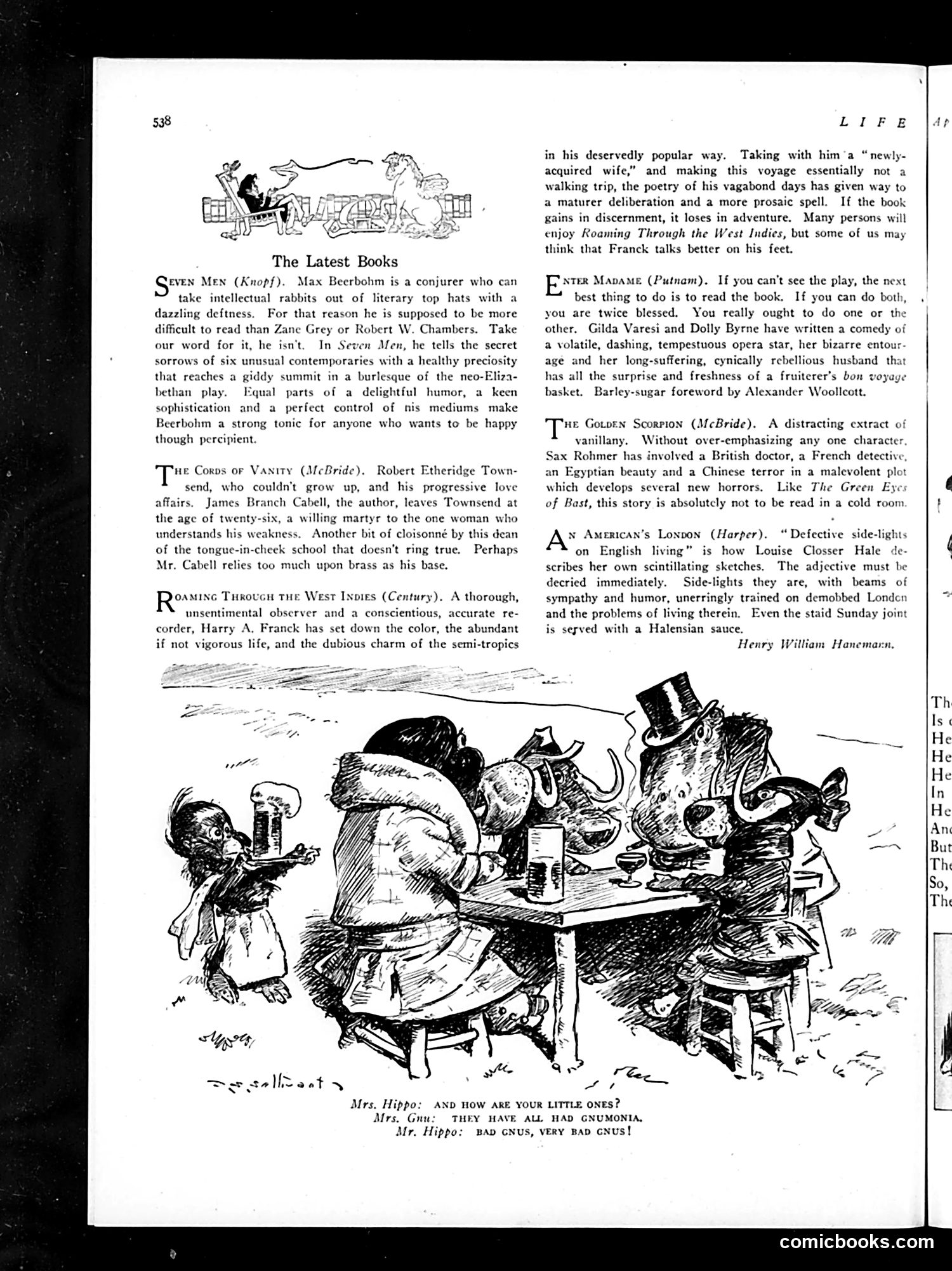
This is a **book review section** from Life magazine, featuring five contemporary literary works with brief critical assessments. The main cartoon below depicts anthropomorphic animals (a hippopotamus and gnu) dining together—a visual joke accompanying the text. The cartoon's caption reveals the humor: Mrs. Hippo asks about Mrs. Gnu's children; Mrs. Gnu responds they all have "gnumonia" (a pun on "pneumonia"). Mr. Hippo responds "Bad gnus, very bad gnus!"—a play on the phrase "bad news." This is **vintage wordplay humor** typical of Life's satirical style. The cartoon is a simple pun cartoon disconnected from the book reviews above it—common in this era's magazines, where reviews and humor features shared pages without thematic connection. The reviews themselves use witty, sophisticated critiques of authors like Max Beerbohm and James Branch Cabell, reflecting early 20th-century literary taste and the magazine's educated audience.
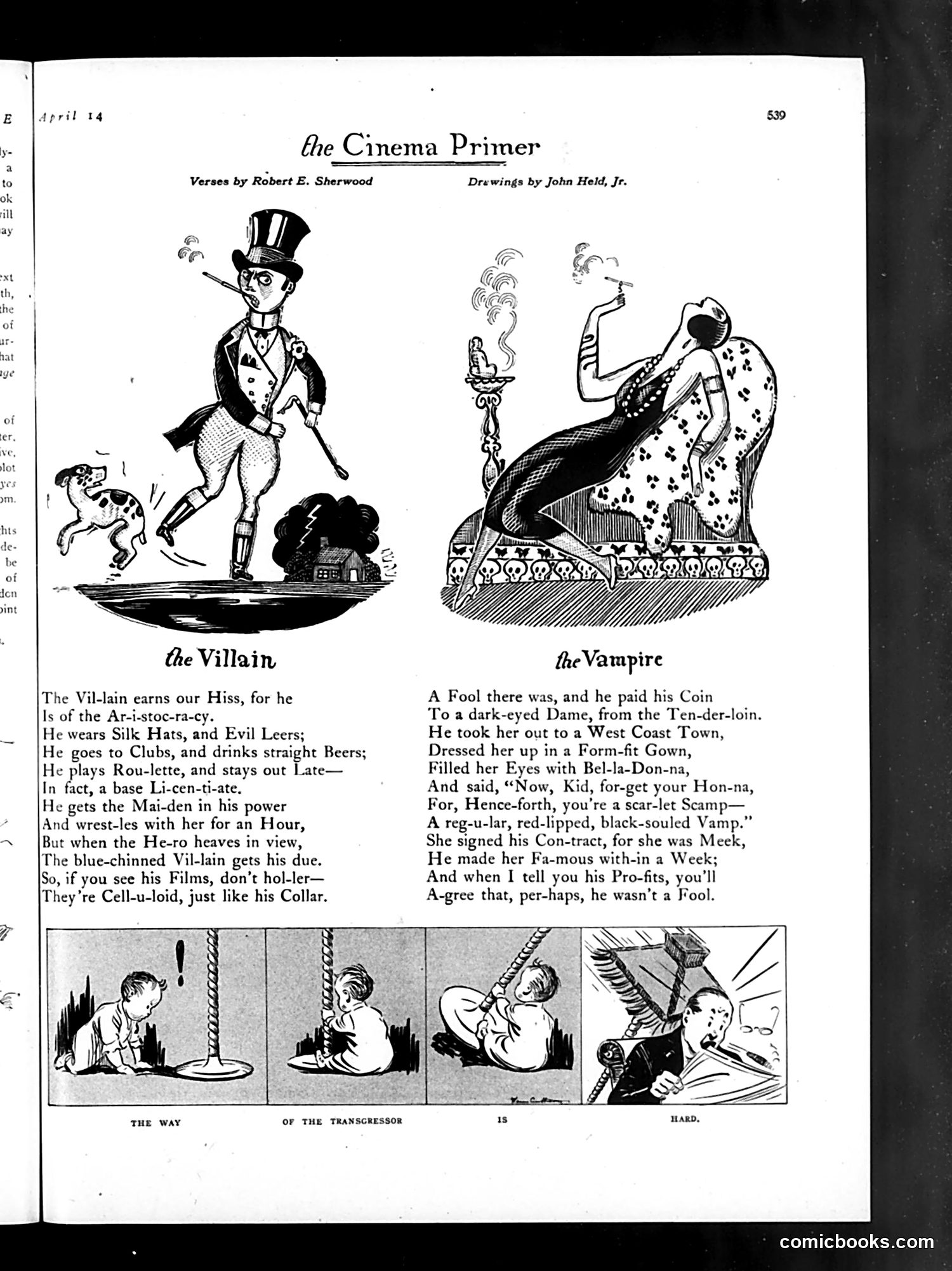
This 1920s satire by Robert E. Sherwood and John Held Jr. mocks silent film stock characters and plots. "The Villain" depicts the aristocratic seducer—top-hatted, evil-leering villain who corrupts innocent women before the heroic "blue-chinned" protagonist defeats him. The verse ridicules this formulaic villain archetype as merely "celluloid," empty artifice. "The Vampire" references the popular "vamp" character type (likely alluding to Theda Bara's famous role), where a scheming woman manipulates a foolish man for profit and fame. The satire's point: Hollywood churns out predictable melodramas where villains and vamps exploit naive characters, yet audiences treat these cardboard archetypes seriously. The bottom comic strip titled "The Way of the Transgressor is Hard" shows physical comedy consequences—slapstick punishment for misconduct, reinforcing cinema's moralistic but simplistic narratives.
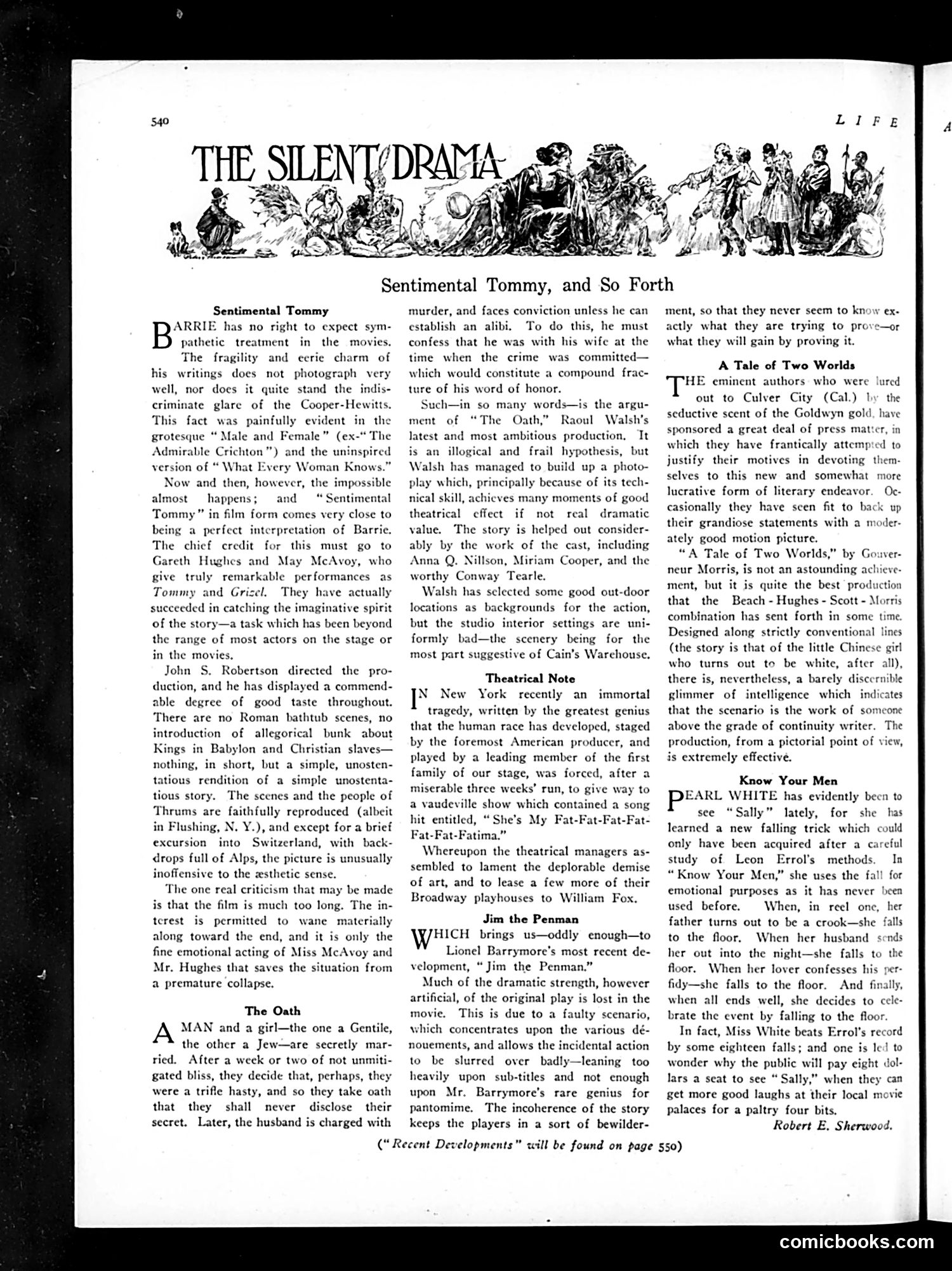
This page from *Life* magazine (circa 1920s) reviews three silent films. The header illustration shows figures from "The Silent Drama," *Life's* film criticism column. **Key Reviews:** 1. **"Sentimental Tommy"** — Praised for faithfully adapting J.M. Barrie's novel, with actors Gareth Hughes and Mary McAvoy delivering emotionally effective performances. Director John S. Robertson is commended for tasteful restraint—notably avoiding the then-trendy "Roman bathtub scenes" and allegorical padding that plagued other literary adaptations. 2. **"The Oath"** — Director Raoul Walsh's ambitious but logically flawed melodrama about a Gentile-Jewish couple whose secret marriage conflicts with courtroom testimony needs. 3. **"Jim the Penman"** — Brief mention of Lionel Barrymore's recent film (review continues on following page). The reviews reflect *Life's* satirical stance: praising artistic restraint while mocking Hollywood's tendency toward excess and sensationalism in adapting literature.
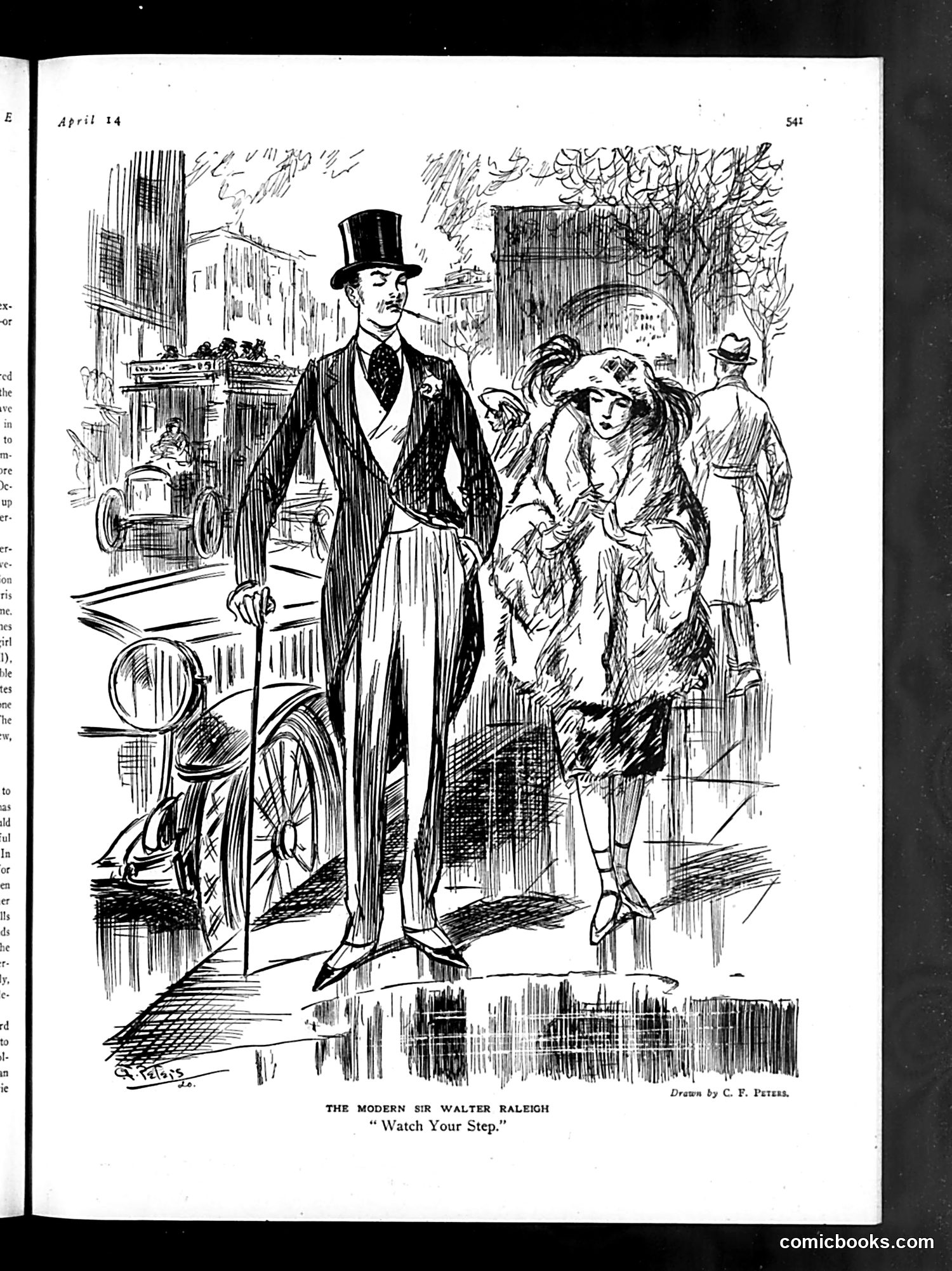
This satirical cartoon by C. F. Peters depicts a well-dressed gentleman in top hat and formal attire assisting a woman across a street or pavement. The title "The Modern Sir Walter Raleigh" with the caption "Watch Your Step" is a humorous commentary on contemporary chivalry. The reference alludes to the legendary Sir Walter Raleigh, who allegedly laid his cloak over a puddle for Queen Elizabeth I. The cartoon satirizes modern gentlemanly behavior by showing a man offering assistance—but the ironic caption "Watch Your Step" suggests the satire cuts deeper, perhaps mocking either exaggerated courtesies or warning against trusting such displays of politeness. The exact critique remains somewhat ambiguous, though it appears to comment on evolving social courtesies in early 20th-century society.
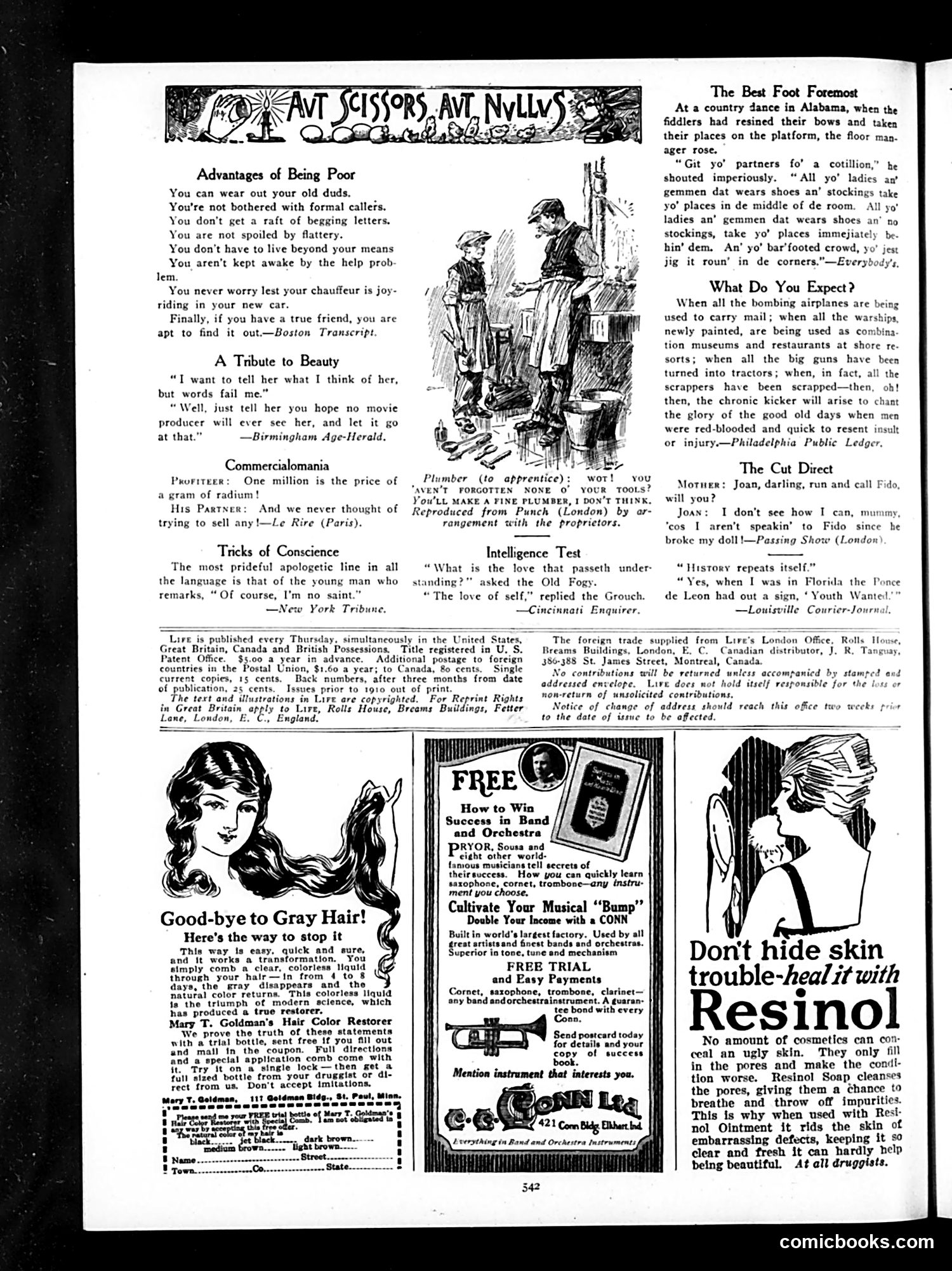
This page from *Life* magazine contains multiple brief satirical pieces typical of early 20th-century American humor: **"Advantages of Being Poor"** ironically lists supposed benefits of poverty (no formal obligations, no servants to worry about), a common humor format mocking wealthy anxieties. **"The Best Foot Foremost"** uses dialect humor to depict a Southern dance organizer segregating dancers by footwear—a class-based social commentary dressed in regional stereotype. **"What Do You Expect?"** satirizes chronic complainers, suggesting that once modern conveniences (airplanes, weapons) are repurposed peacefully, people will still find reasons to lament lost "golden days." **"The Cut Direct"** presents a child refusing to speak to her dog because it broke her doll—a humorous parallel to adult social snubbing. The page also includes advertisements for hair restorer and musical instruments, typical of *Life*'s format mixing editorial content with commercial ads. The humor relies heavily on class commentary and social observation rather than political satire.
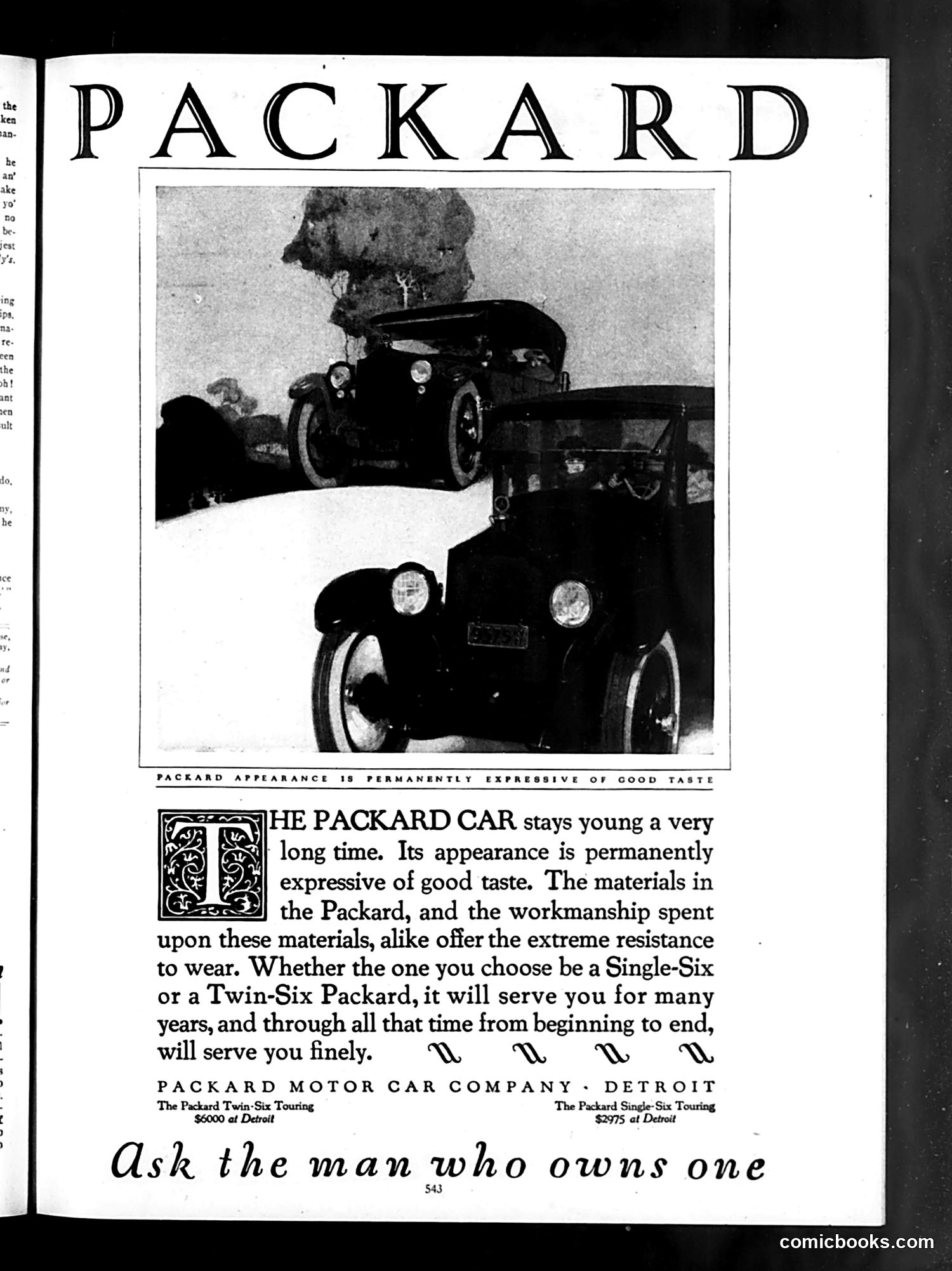
This is **not a satirical cartoon but a straightforward luxury car advertisement** from Life magazine. The page shows two Packard automobiles photographed on a road, emphasizing their elegant appearance and durability. The ad emphasizes quality materials and craftsmanship, claiming the car "stays young a very long time" and maintains "good taste." Two models are offered: the Twin-Six Touring ($6,000) and Single-Six Touring ($2,975). The tagline "Ask the man who owns one" was a famous Packard slogan, designed to suggest owner satisfaction and prestige. For a modern reader: this represents early 20th-century luxury marketing targeting wealthy buyers who valued durability and status—positioning Packard as the sophisticated choice for the discerning automobile owner.
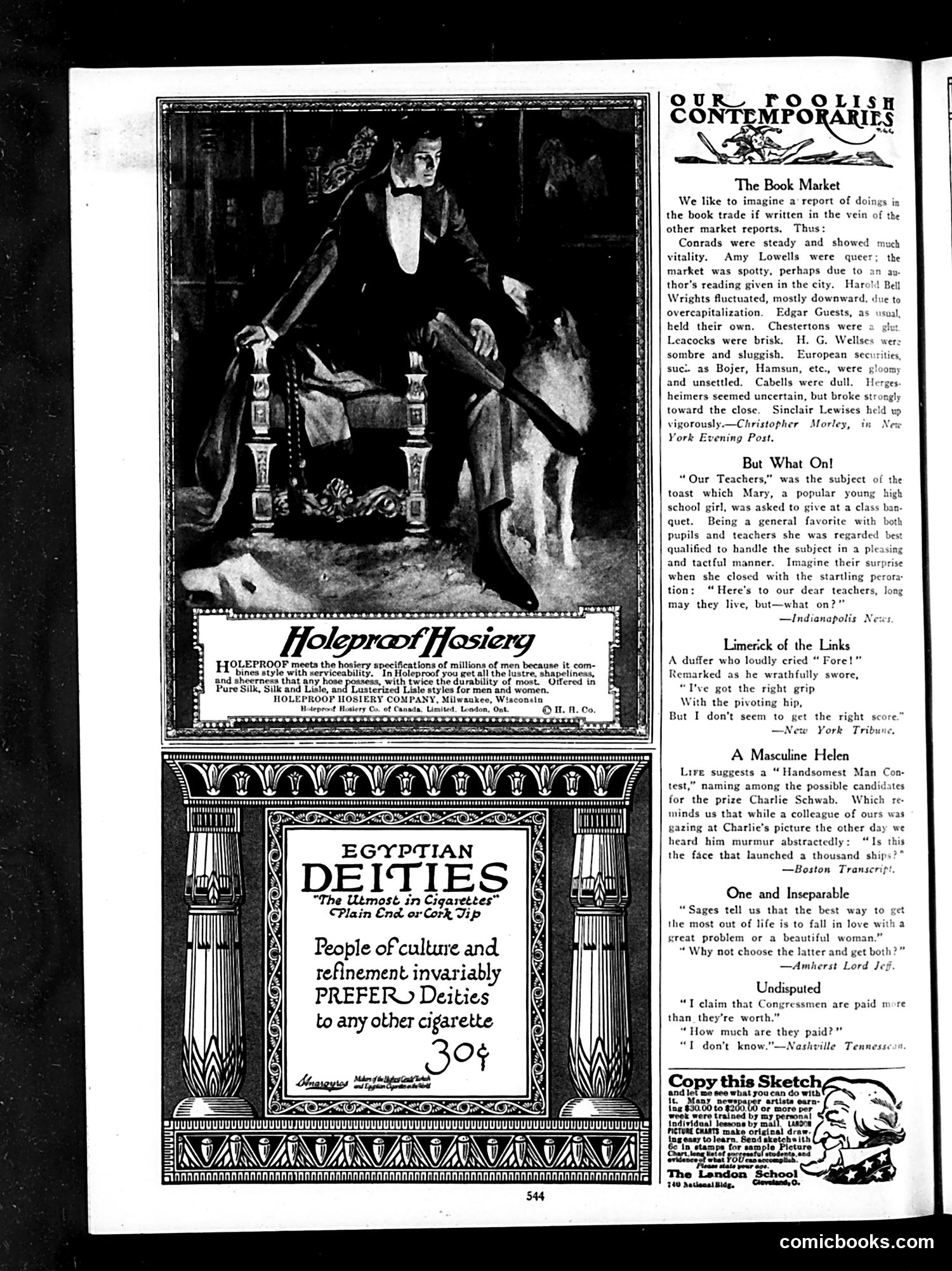
This page satirizes literary market trends and includes humorous social observations. The right column features "Our Foolish Contemporaries," a regular Life feature mocking contemporary absurdities. **Key sections:** - **"The Book Market"**: Christopher Morley parodies stock-market reporting applied to authors' sales, treating writers like commodities. Conrad, Amy Lowell, Harold Bell Wright, and others are evaluated for market performance—satirizing both publishing trends and financial speculation language. - **"But What On!"**: Mocks a schoolgirl's tactless toast to teachers, ending with "long may they live, but—what on?" (implying teachers are underpaid). - **"A Masculine Helen"**: References Charlie Schwab's appearance in a "Handsomest Man Contest," joking that his face "launched a thousand ships" (Helen of Troy allusion), suggesting ironic skepticism about the comparison. The advertisements (Holeproof Hosiery, Egyptian Deities cigarettes) occupy the left side. The overall tone is gentle mockery of contemporary literary and social pretensions.
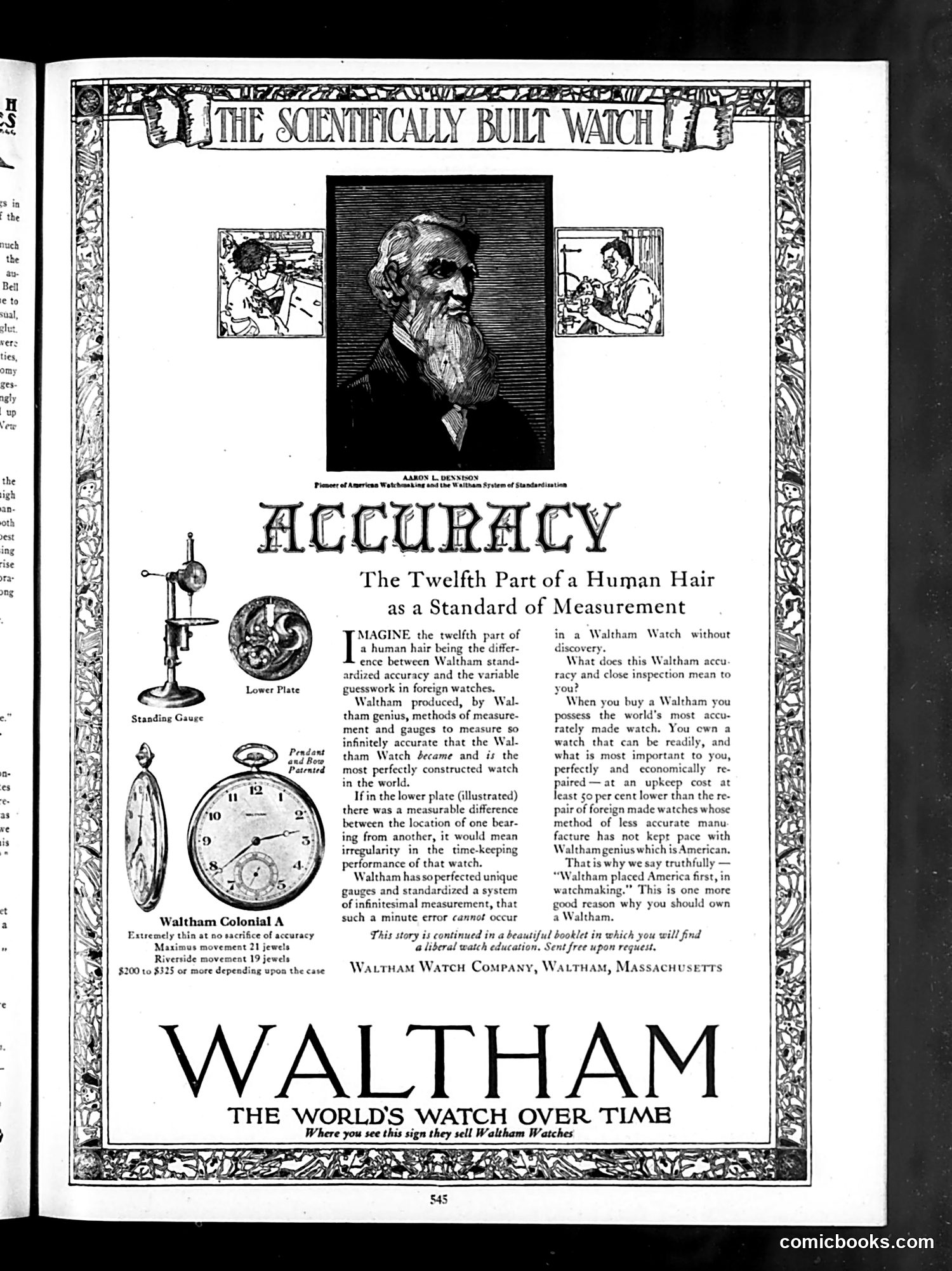
This is **not a cartoon or satire**—it's a straightforward **advertisement for Waltham watches** from an early 20th-century *Life* magazine. The page features Aaron L. Dennison, founder of American watchmaking and the Waltham standardization system. The ad's central claim is that Waltham's precision manufacturing—so exact that accuracy tolerances measure to "the twelfth part of a human hair"—makes their watches superior to foreign competitors. The pitch emphasizes American industrial superiority: Waltham's scientific methods and standardized gauges produce the world's most accurate watches at lower repair costs than imported models. The tagline "Waltham placed America first, in watchmaking" appeals to nationalist sentiment. This reflects early-1900s American confidence in industrial innovation and domestic manufacturing excellence, positioning precision timekeeping as proof of American technological leadership.
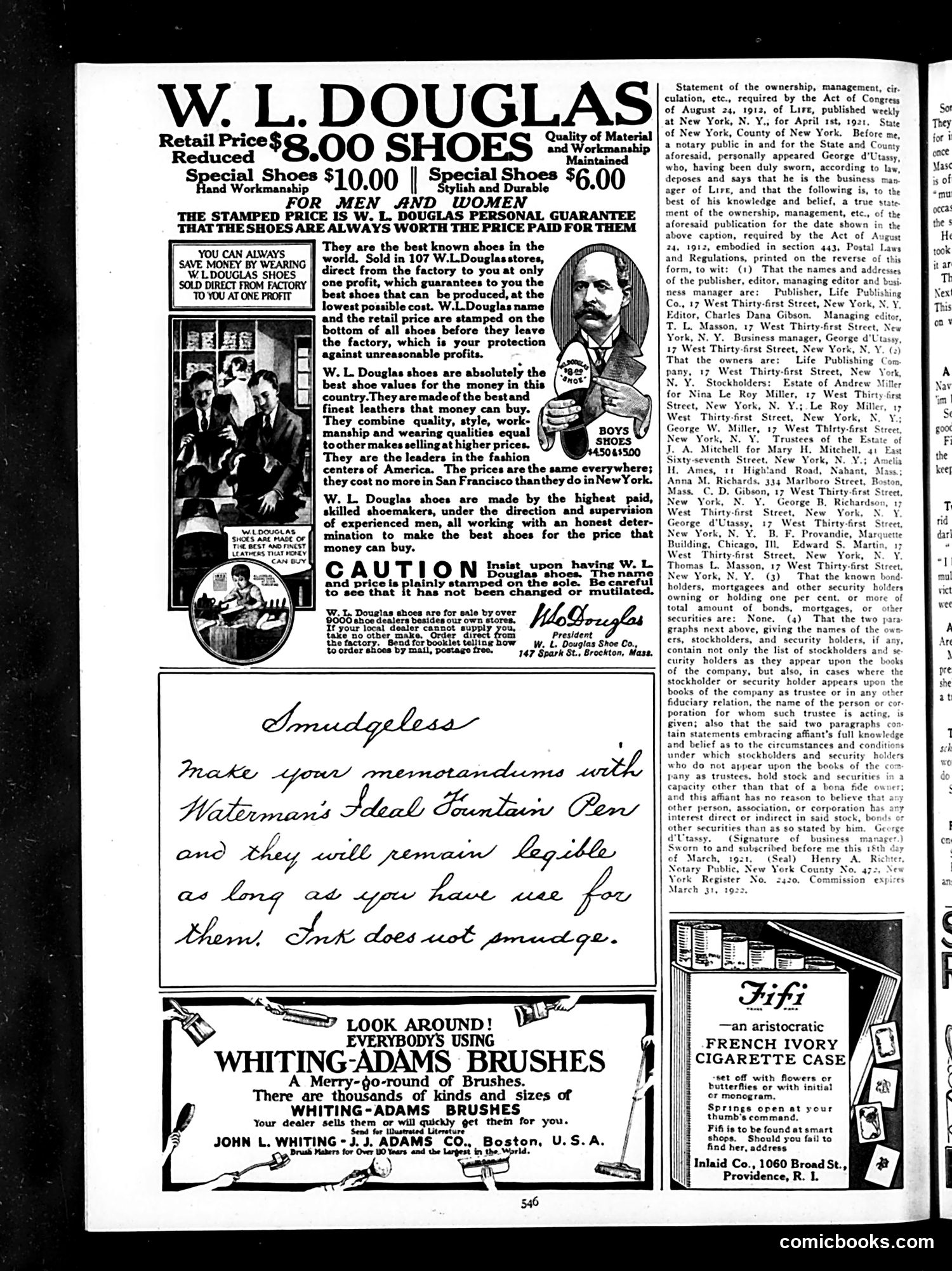
This page is primarily **advertising**, not political satire or cartoons. The dominant content is a W.L. Douglas shoe advertisement featuring the company president and promoting factory-direct sales, emphasizing quality at reasonable prices. The ad uses testimonial language about value and includes a "Smudgeless" Waterman pen advertisement below it. Additional advertisements include **Whiting-Adams Brushes** and a **Fifi French Ivory cigarette case**. The right side contains the **statement of ownership** for *Life* magazine itself, listing Charles Dana Gibson as editor and noting the publication's ownership structure—required legal disclosure. **No political cartoons or satire appear on this page.** This is typical of early 20th-century magazines, which mixed editorial content with substantial advertising revenue. The "Life" masthead indicates this is the famous satirical publication, but this particular page serves primarily commercial rather than editorial purposes.
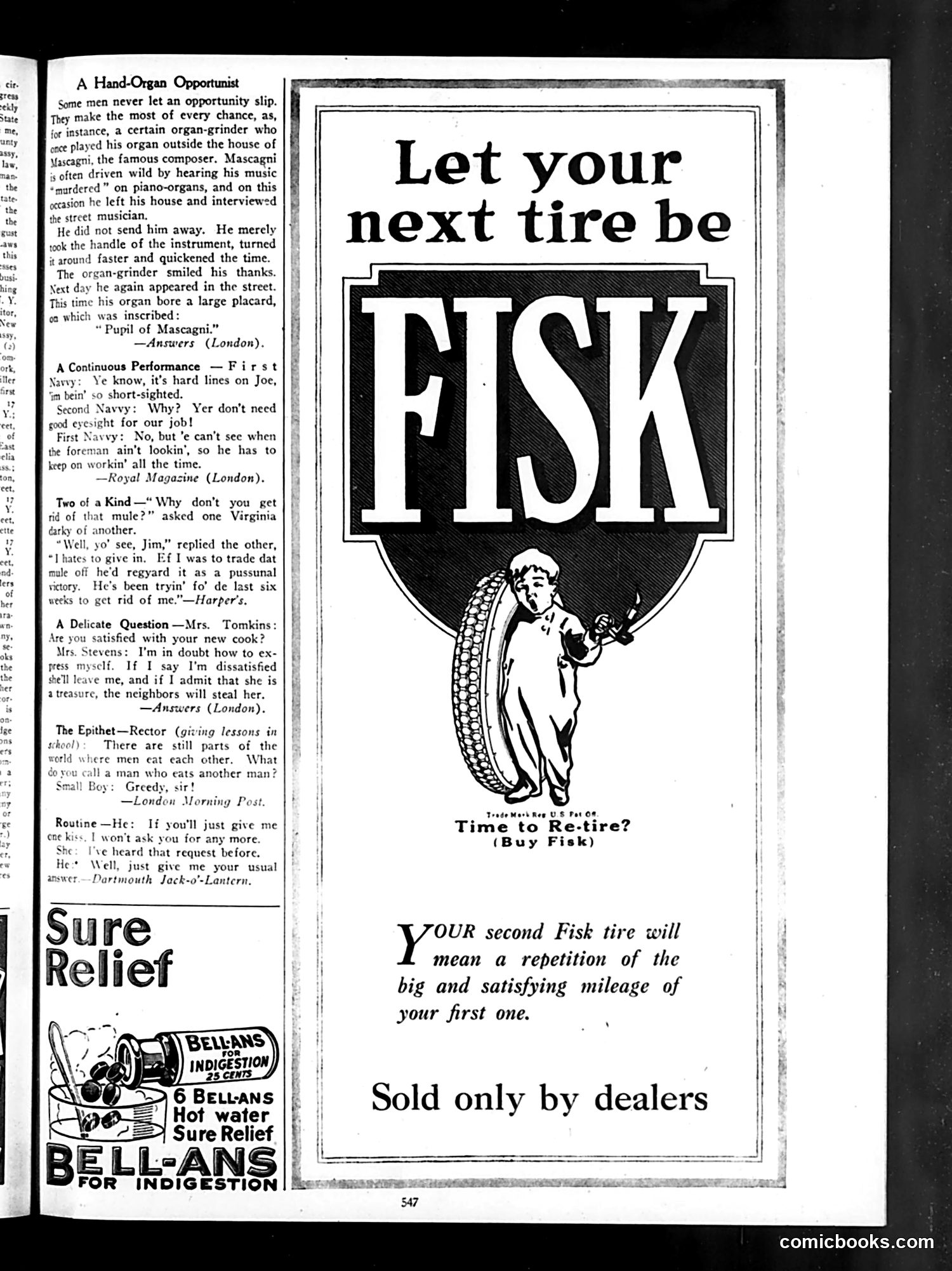
This page contains humorous anecdotes and advertisements typical of early 20th-century Life magazine. **The Cartoons/Stories:** Five brief comedic pieces appear on the left, reprinted from other publications. Notable examples include: - A story about composer Mascagni encountering a street organ-grinder playing his music badly, then endorsing him as a "Pupil of Mascagni" - A joke about a nearsighted navvy (laborer) who must keep working because his boss can't see when he's not looking - A racial dialect joke about a Virginia Black man and his mule (characteristic of the era's problematic humor) **The Advertisement:** The right page features a full-page Fisk tire advertisement with an illustration of a man carrying a large tire. The tagline "Time to Re-tire?" plays on the double meaning—suggesting tire replacement while implying rest/retirement. The copy promises that a second Fisk tire will deliver satisfaction equal to the first. The page represents typical Life magazine content: reprinted humor emphasizing wit and wordplay, alongside period advertising.
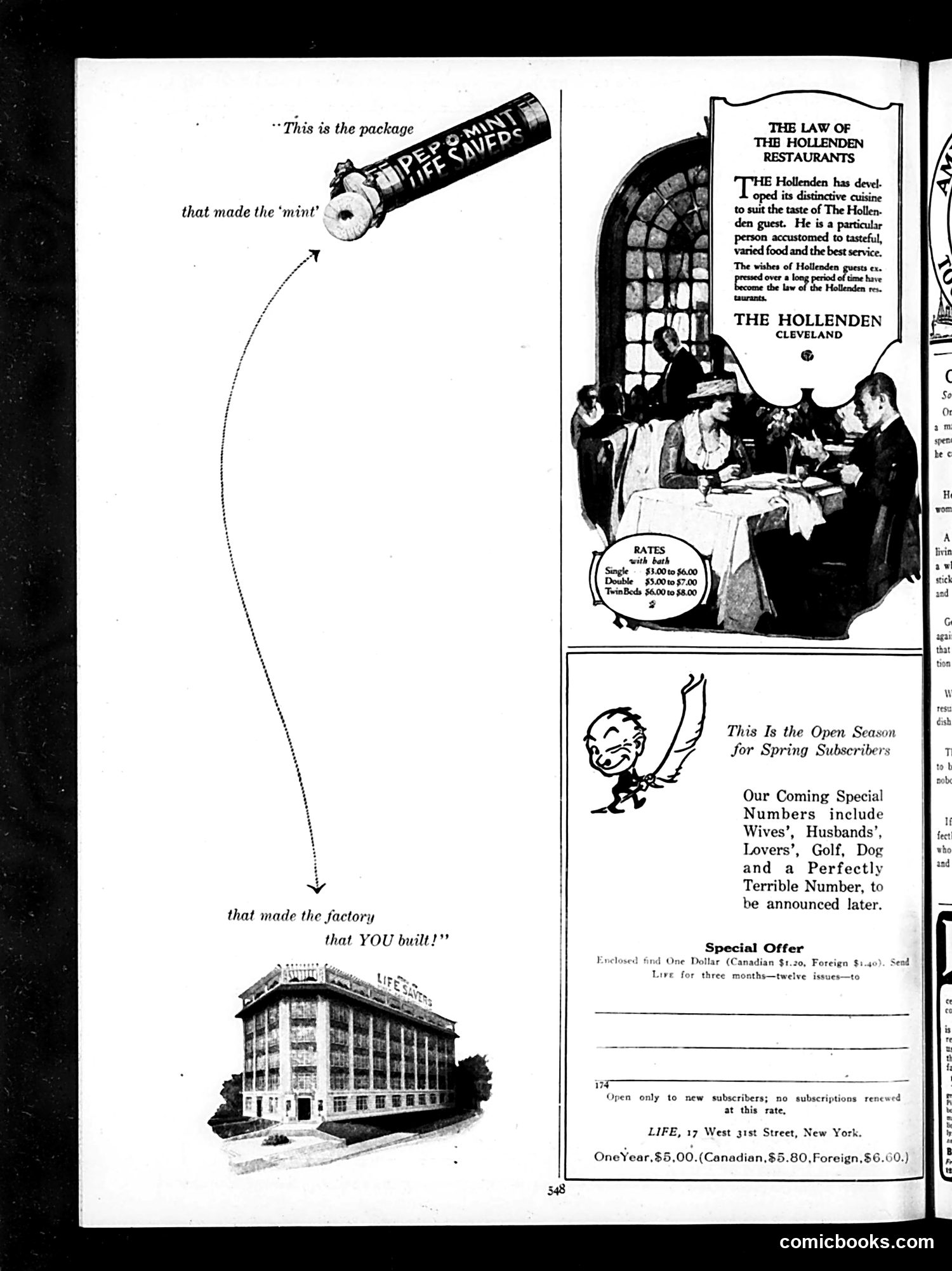
This page is primarily **advertising and subscription material** rather than editorial content. The left side shows a humorous **"Life Savers" mint advertisement** with a curved arrow connecting a Life Savers package ("This is the package that made the 'mint'") to the Life magazine building ("that made the factory that YOU built!"). The joke plays on the Life Savers candy brand, suggesting readers' purchases funded the magazine's success. The right side contains two unrelated advertisements: one for **The Hollenden, a Cleveland restaurant**, describing its refined cuisine and service standards; below that is a **subscription offer for Life magazine** announcing upcoming spring issues themed around "Wives," "Husbands," "Lovers," "Golf," "Dog," and a mysterious "Perfectly Terrible Number." The page reflects Life's dual nature as both satirical publication and commercial vehicle, with advertising supporting the magazine's operations.
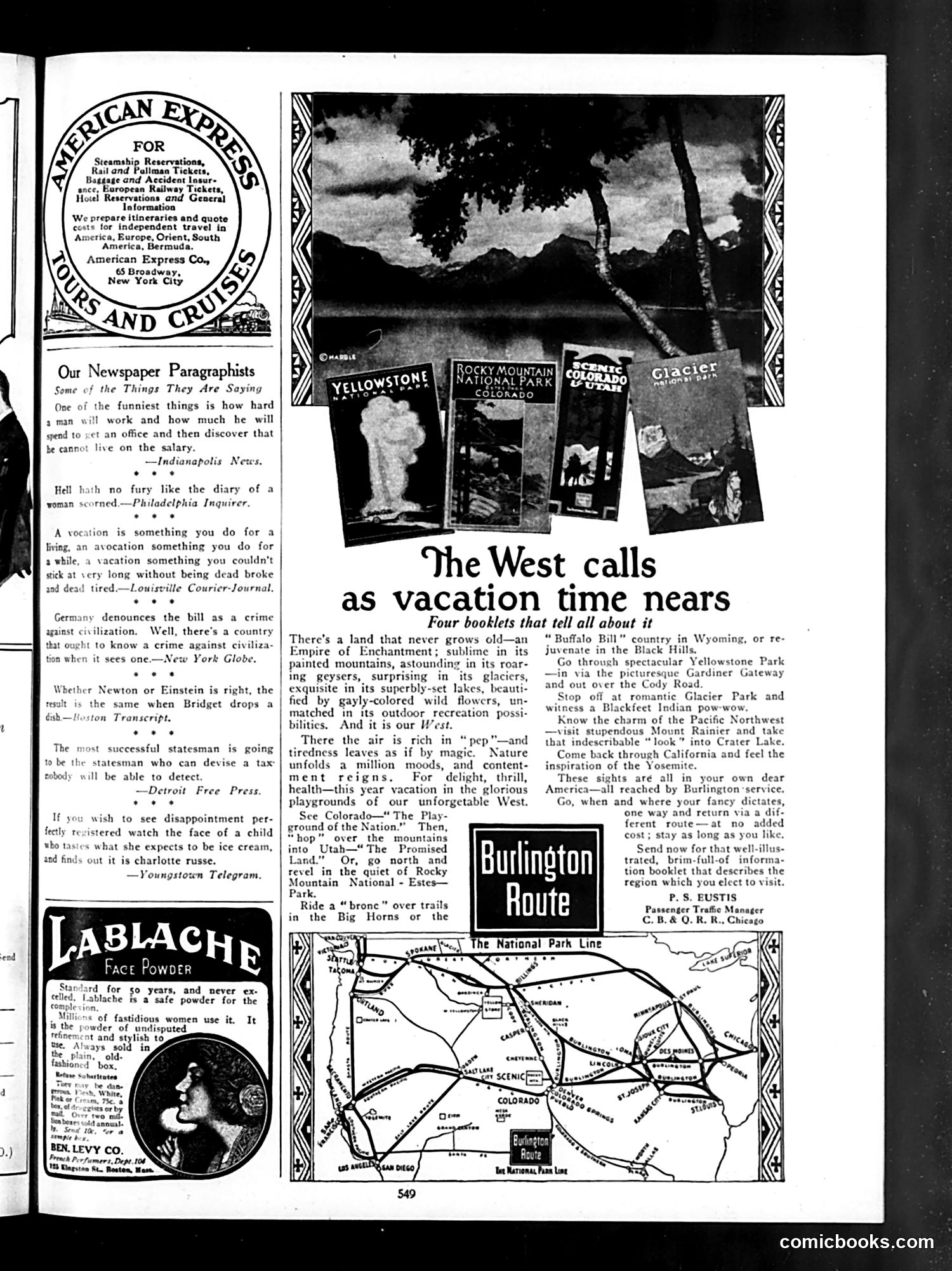
This page is primarily **advertising and travel promotion**, not satire or political commentary. The top section features humorous newspaper quotes—brief, satirical observations about work, vacations, romance, and politics. These are filler content typical of *Life* magazine's "Newspaper Paragraphists" column, offering gentle social commentary (e.g., critiquing Germany's hypocrisy on "civilization," joking about taxation). The dominant content is a **Burlington Route railroad advertisement** promoting Western American vacation destinations: Colorado, Utah, Wyoming, Yellowstone, Glacier Park, and Yosemite. The ad uses romantic language ("Empire of Enchantment," "Playground of the Nation") to market scenic tourism, emphasizing the region's natural wonders and outdoor recreation. A **Lablache Face Powder advertisement** for women appears in the lower left. There are no political cartoons or caricatures on this page—it's a commercial publication showcasing early 20th-century leisure travel marketing and women's cosmetics advertising.
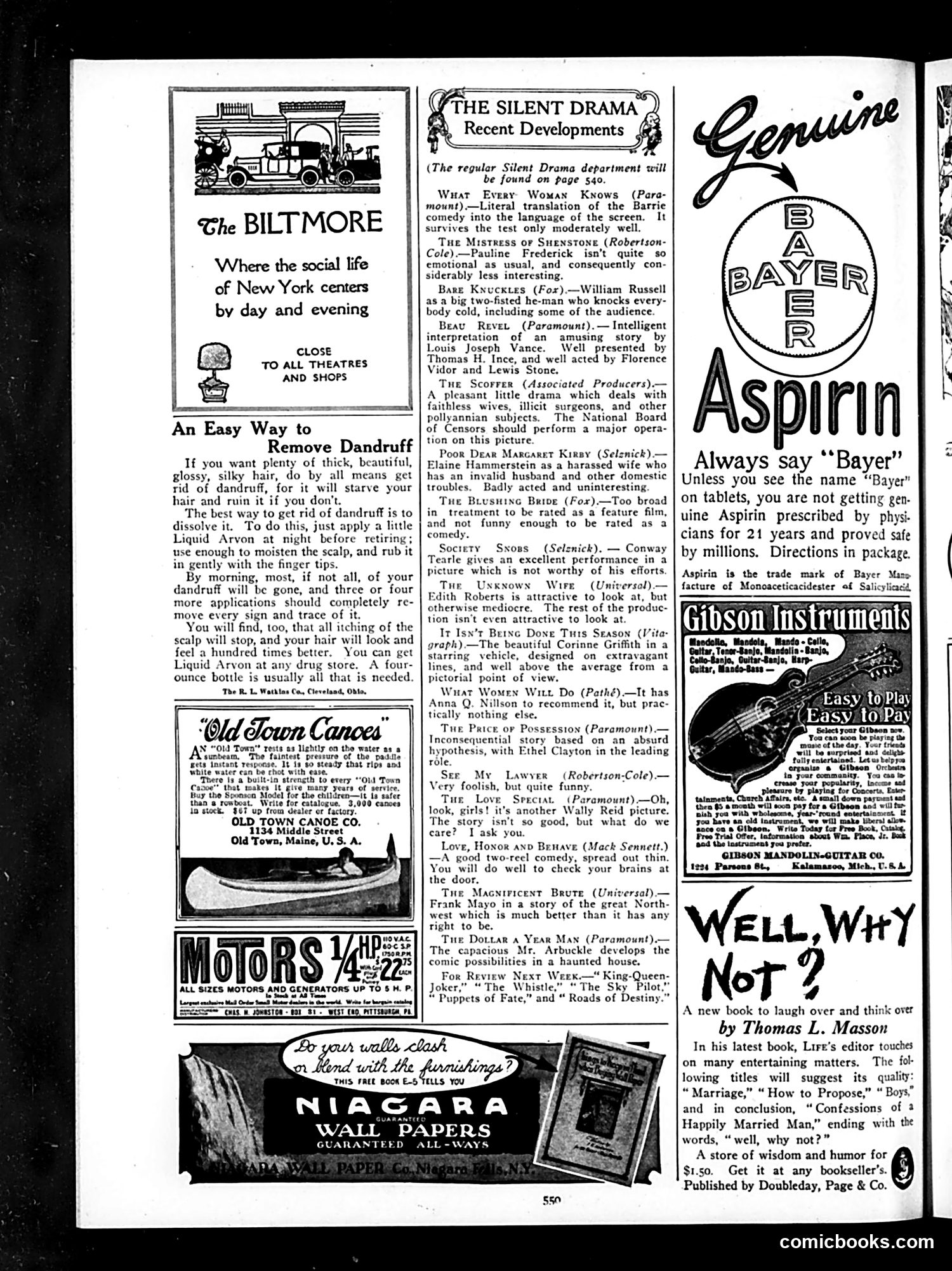
This is primarily a **page of advertisements and film reviews**, not political satire. It contains: **Main Content:** - The "Silent Drama" section reviewing recent movies (appearing to be from the early 1920s, given references to silent films and specific actors like Corinne Griffith and Wally Reid) - Hotel advertisement (The Biltmore) - Product ads (dandruff treatment, canoes, motors, wallpaper, musical instruments, and a book) **Notable Element:** The film reviews use caustic humor typical of Life magazine's entertainment criticism—mocking weak plots and acting. For instance: "The story isn't so good, but what do we care? I ask you" (about a Wally Reid picture). **No Political Cartoon:** There is no political cartoon on this page. The satire is limited to entertainment commentary, which would have been Life's standard format during this era before it shifted toward more overtly political content.
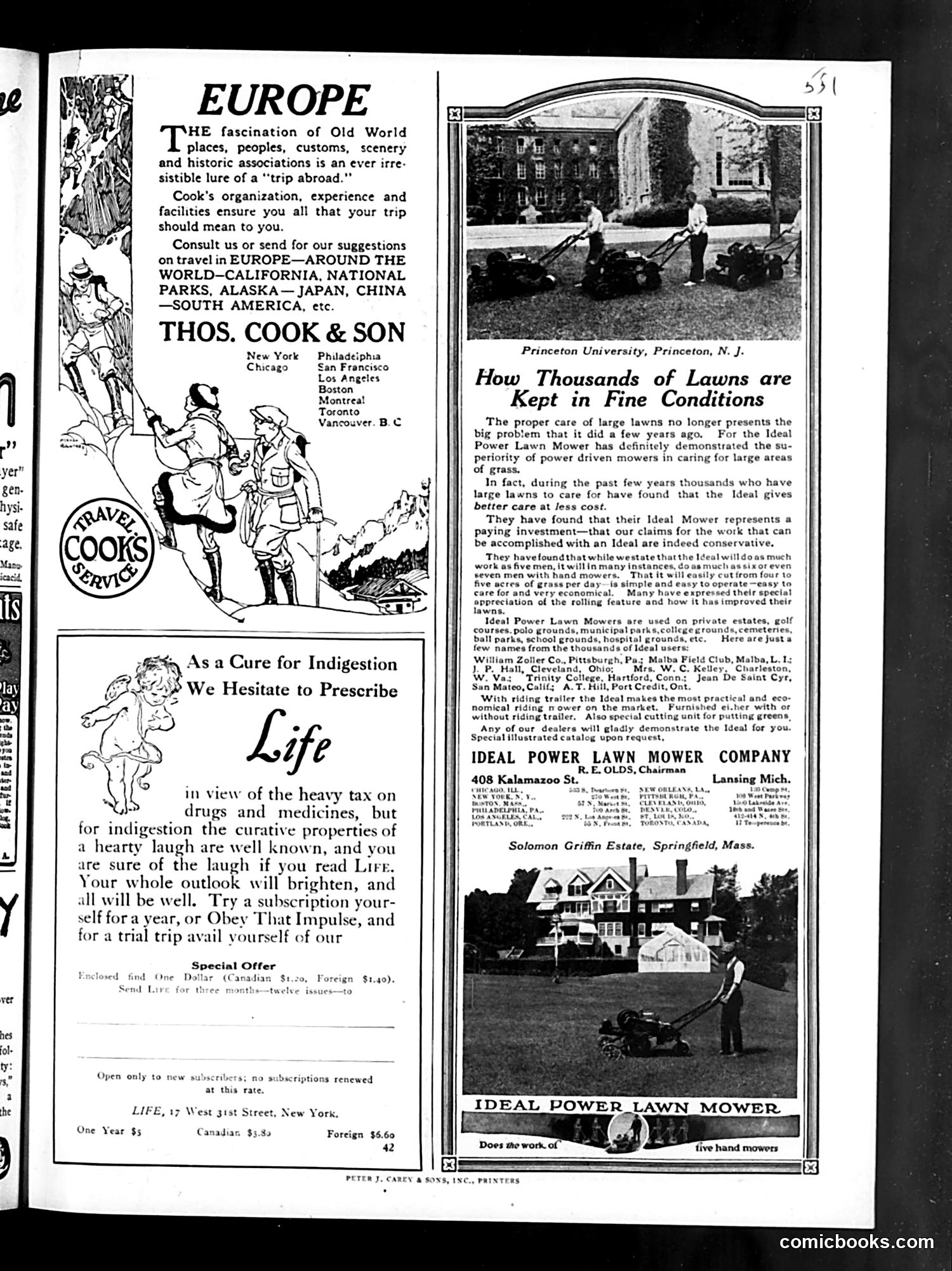
This page consists primarily of **advertisements rather than editorial content or satire**. The top left features a **Thomas Cook & Son travel agency ad**, promoting European and international tours with illustrated figures in travel clothing—marketing leisure tourism to affluent readers. Below that is a **Life magazine subscription ad** that uses gentle humor: it jokingly "prescribes" reading *Life* magazine as a cure for indigestion, claiming laughter from the publication will improve one's outlook. This is self-promotional rather than satirical social commentary. The right side showcases an **Ideal Power Lawn Mower advertisement** featuring photographs of the machine and an estate lawn. The copy emphasizes that mechanical mowers replace manual labor ("five hand mowers"), appeal to wealthy homeowners and institutions, and represent a "paying investment." **Overall context**: This reflects early 20th-century consumer culture targeting the prosperous middle and upper classes—international travel, humor magazines, and labor-saving technology for large property maintenance.
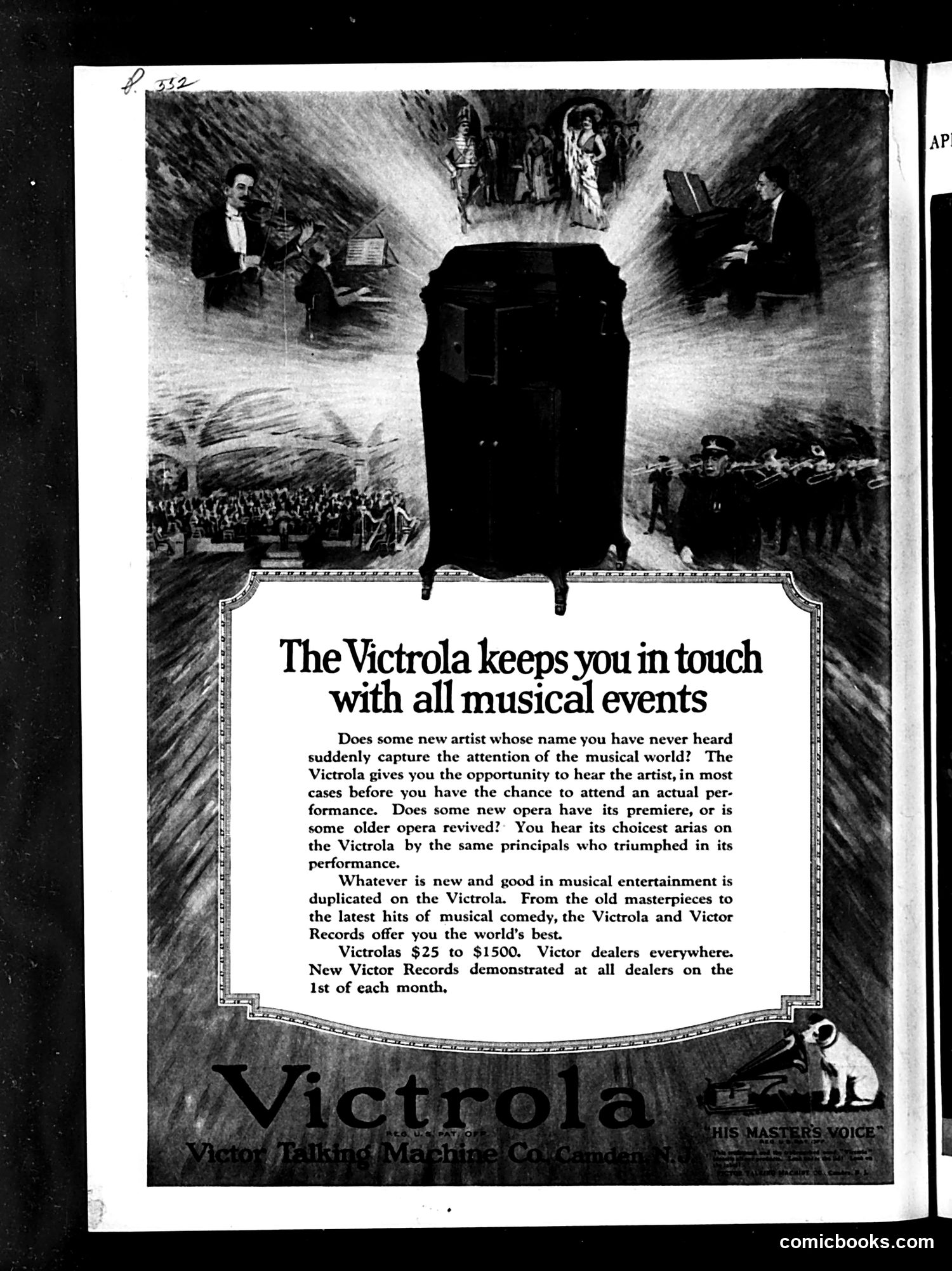
This is a **Victrola phonograph advertisement**, not a political cartoon. The page promotes Victor Talking Machine Company's gramophone technology. The image shows a large Victrola machine as the centerpiece, surrounded by illustrated scenes of musical performances—orchestras, opera singers, and audiences—representing the variety of music available on records. The advertisement's pitch exploits a genuine advantage of recorded music in the early 20th century: **hearing famous performers and new artists before live performances were accessible**. For most people, encountering cutting-edge opera or discovering new musicians required phonograph records; attending actual performances remained expensive and limited. The price range ($25-$1500) indicates Victrola marketed to various income levels. The claim that records featured "the same principals who triumphed in its performance" emphasized authenticity and prestige. This reflects pre-radio era entertainment consumption, when recorded music was a primary means of accessing cultural events beyond one's immediate geography.