
Life, 1921-04-14 · page 20 of 36
Life — April 14, 1921 — page 20: what you’re looking at
What you’re looking at
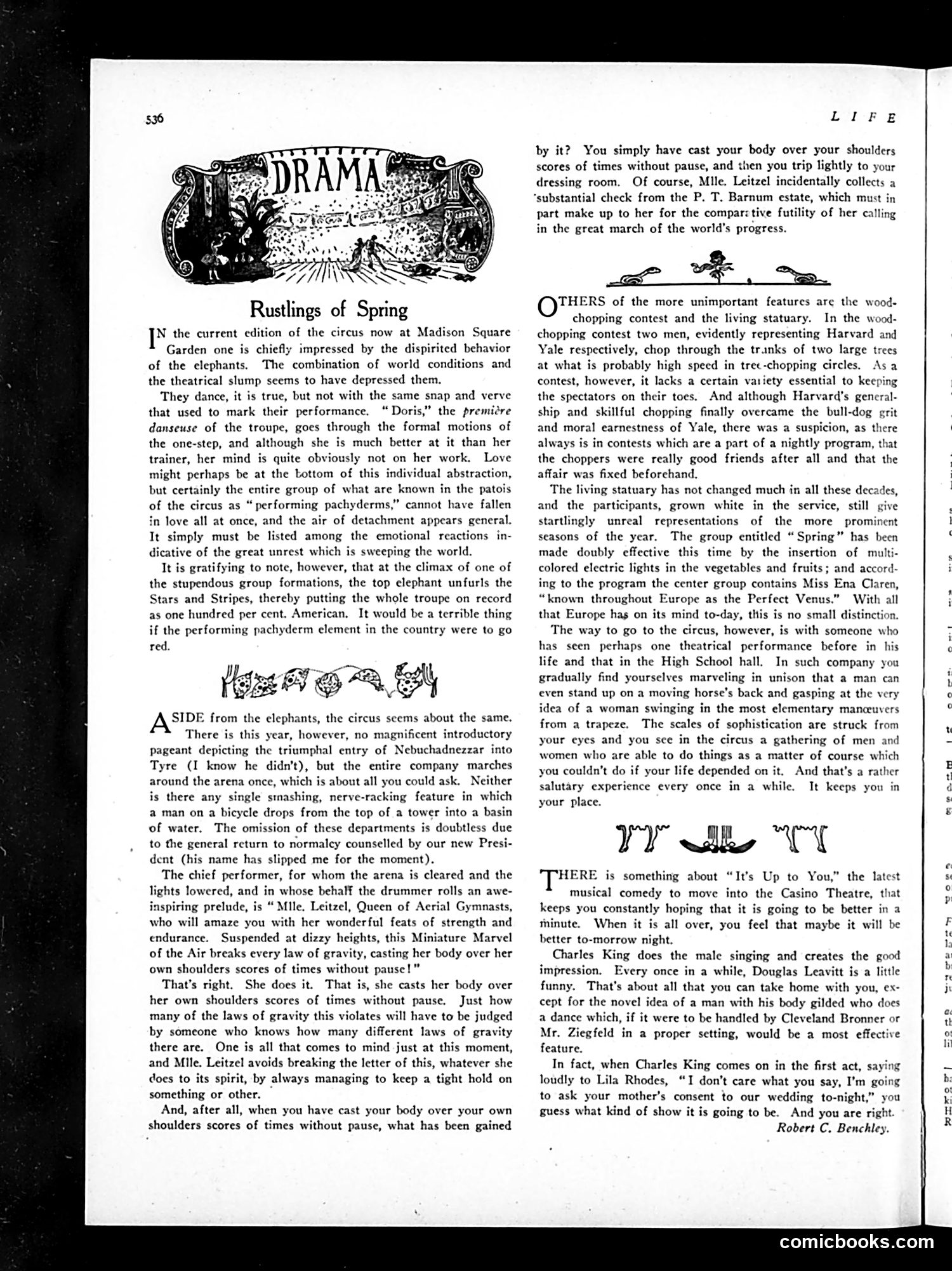
This is a theater/entertainment review column, not a political cartoon. The author satirizes the current circus at Madison Square Garden, using social commentary to mock both the performances and contemporary anxieties. The key satire: **depressed elephants** serve as metaphors for post-WWI malaise. The "world conditions and theatrical slump" have made even circus performers listless. The author mocks this pretentious reading, then pivots to genuine concern that performing elephants might become "red" (communist)—a topical 1920s fear. The review also ridicules Mlle. Leitzel's famous aerial act (the "Miniature Marvel of the Air"), questioning what she actually accomplishes by repeatedly casting her body over her shoulders. This deflates circus spectacle with dry logic: after all that, she simply "trips lightly to your dressing room." The tone is satirical throughout—the author critiques both overwrought circus marketing and contemporary American anxieties about unrest and "normalcy" under the current (unnamed) president.
📄 Transcribed text from this page (OCR, searchable)
Machine-transcribed from the original scan — historical spelling and the odd misread are preserved.
Rustlings of Spring N the current edition of the circus now at Madison Square Garden one is chiefly impressed by the dispirited behavior of the elephants. The combination of world conditions and the theatrical slump seems to have depressed them. They dance, it is true, but not with the same snap and verve that used to mark their performance. “ Doris,” the premiére danseuse of the troupe, goes through the formal motions of the one-step, and although she is much better at it than her trainer, her mind is quite obviously not on her work. Love might perhaps be at the bottom of this individual abstraction, but certainly the entire group of what are known in the patois of the circus as “performing pachyderms,” cannot have fallen in love all at once, and the air of detachment appears general. It simply must be listed among the emotional reactions in- dicative of the great unrest which is sweeping the world. It is gratifying to note, however, that at the climax of one of the stupendous group formations, the top elephant unfurls the Stars and Stripes, thereby putting the whole troupe on record as one hundred per cent. American. It would be a terrible thing if the performing pachyderm element in the country were to go red. ASIDE from the elephants, the circus seems about the same. There is this year, however, no magnificent introductory pageant depicting the triumphal entry of Nebuchadnezzar into Tyre (I know he didn’t), but the entire company marches around the arena once, which is about all you could ask. Neither is there any single stnashing, nerve-racking feature in which a man on a bicycle drops from the top of a tower into a basin of water. The omission of these departments is doubtless due to the general return to normalcy counselled by our new Presi- dent (his name has slipped me for the moment). The chief performer, for whom the arena is cleared and the lights lowered, and in whose behalf the drummer rolls an awe- inspiring prelude, is “ Mlle. Leitzel, Queen of Aerial Gymnasts, who will amaze you with her wonderful feats of strength and endurance. Suspended at dizzy heights, this Miniature Marvel of the Air breaks every law of gravity, casting her body over her own shoulders scores of times without pause!” That’s right. She does it. That is, she casts her body over her own shoulders scores of times without pause. Just how many of the laws of gravity this violates will have to be judged by someone who knows how many different laws of gravity there are. One is all that comes to mind just at this moment, and Mile. Leitzel avoids breaking the letter of this, whatever she does to its spirit, by always managing to keep a tight hold on something or other. And, after all, when you have cast your body over your own shoulders scores of times without pause, what has been gained LIFE by it? You simply have cast your body over your shoulders scores of times without pause, and then you trip lightly to your dressing room. Of course, Mlle. Leitzel incidentally collects a “substantial check from the P. T. Barnum estate, which must in part make up to her for the comparctive futility of her calling in the great march of the world’s progress. a OTHERS of the more unimportant features are the wood- chopping contest and the living statuary. In the wood- chopping contest two men, evidently representing Harvard and Yale respectively, chop through the tranks of two large trees at what is probably high speed in trec-chopping circles. Asa contest, however, it lacks a certain vatiety essential to keeping the spectators on their toes. And although Harvard's general- ship and skillful chopping finally overcame the bull-dog grit and moral earnestness of Yale, there was a suspicion, as there always is in contests which are a part of a nightly program, that the choppers were really good friends after all and that the affair was fixed beforehand. The living statuary has not changed much in all these decades, and the participants, grown white in the service, still gi startlingly unreal representations of the more prominent seasons of the year. The group entitled “Spring” has been made doubly effective this time by the insertion of multi- colored electric lights in the vegetables and fruits; and accord- ing to the program the center group contains Miss Ena Claren, “known throughout Europe as the Perfect Venus.” With all that Europe has on its mind to-day, this is no small distinction. The way to go to the circus, however, is with someone who has seen perhaps one theatrical performance before in his life and that in the High School hall. In such company you gradually find yourselves marveling in unison that a man can even stand up on a moving horse’s back and gasping at the very idea of a woman swinging in the most elementary manceuvers from a trapeze. The scales of sophistication are struck from your eyes and you sce in the circus a gathering of men and women who are able to do things as a matter of course which you couldn't do if your life depended on it. And that's a rather salutary experience every once in a while. It keeps you in your place. HERE is something about “It’s Up to You,” the latest musical comedy to move into the Casino Theatre, that keeps you constantly hoping that it is going to be better in a thinute. When it is all over, you feel that maybe it will be better to-morrow night. Charles King does the male singing and creates the good impression. Every once in a while, Douglas Leavitt is a little funny. That's about all that you can take home with you, ex- cept for the novel idea of a man with his body gilded who does a dance which, if it were to be handled by Cleveland Bronner or Mr. Ziegfeld in a proper setting, would be a most effective feature. In fact, when Charles King comes on in the first act, saying loudly to Lila Rhodes, “I don’t care what you say, I’m going to ask your mother’s consent to our wedding to-night,” you guess what kind of show it is going to be. And you are right. Robert C. Benchley. comicbooks.com