
Life, 1921-04-14 · page 17 of 36
Life — April 14, 1921 — page 17: what you’re looking at
What you’re looking at
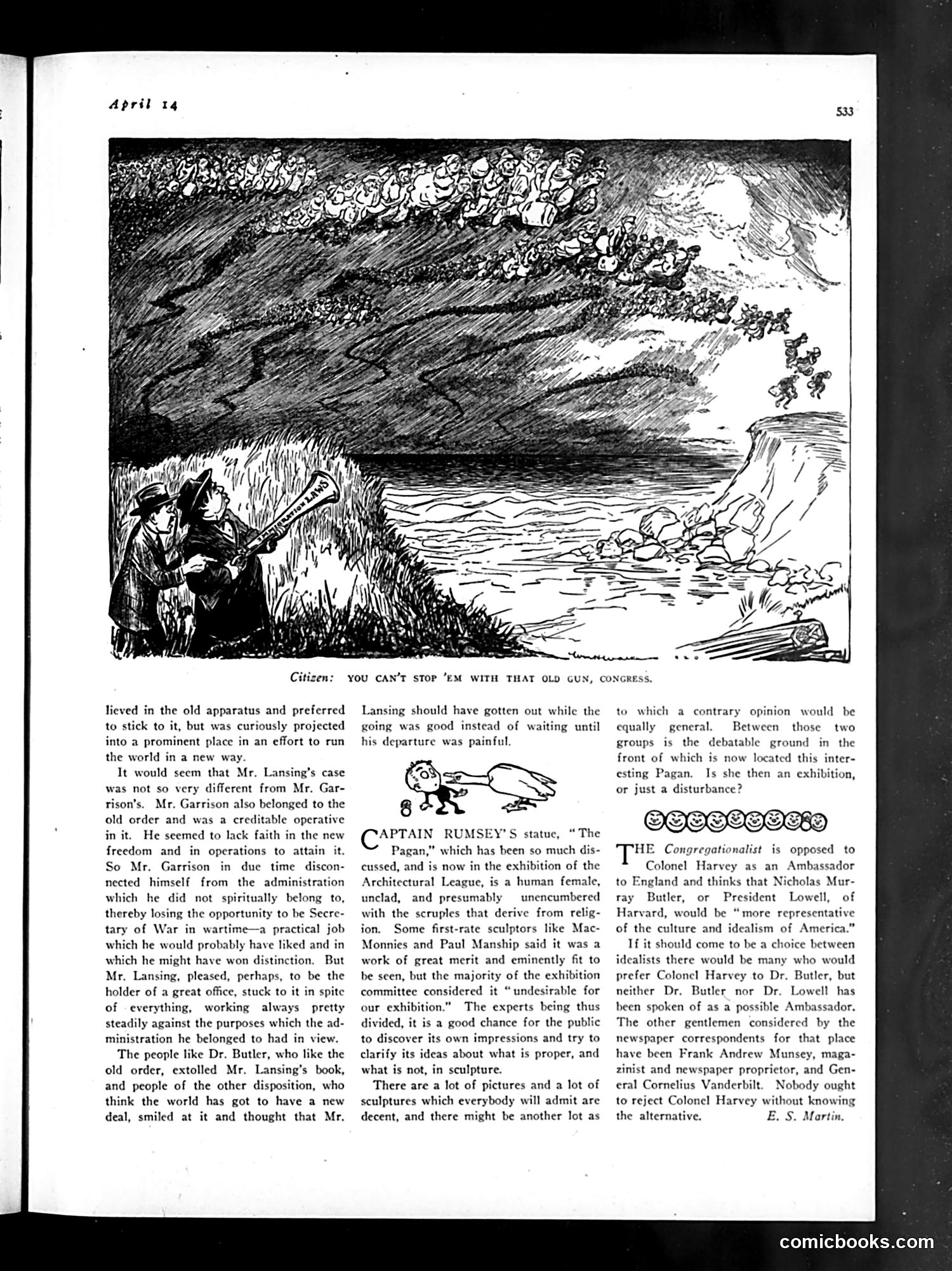
The cartoon depicts Congress as an elderly figure with an outdated gun, unable to stop a flood of people/forces surging over a cliff—likely representing new social movements or progressive changes that traditional legislative power cannot control. The accompanying text discusses Secretary of State Robert Lansing, who (like earlier Secretary of War Lindley Garrison) belonged to the "old order" but remained in Wilson's progressive administration, working against its purposes. The piece criticizes his reluctance to resign, contrasting him with idealists like Dr. Butler who openly reject modernity. A secondary item debates Captain Rumsey's nude sculpture "The Pagan" at the Architectural League—some experts call it meritorious art; others deem it "undesirable." The piece questions where society draws lines on acceptable artistic expression. Finally, commentary opposes Colonel Harvey's potential ambassadorship to England, suggesting Nicholas Murray Butler or President Lowell would better represent "American culture and idealism." The overall theme: old institutions struggle against inevitable modern change.
📄 Transcribed text from this page (OCR, searchable)
Machine-transcribed from the original scan — historical spelling and the odd misread are preserved.
April 14 Citizen: lieved in the old apparatus and preferred to stick to it, but was curiously projected into a prominent place in an effort to run the world in a new way. It would seem that Mr. Lansing’s case was not so very different from Mr. Gar- rison’s. Mr. Garrison also belonged to the old order and was a creditable operative in it. He seemed to lack faith in the new freedom and in operations to attain it. So Mr. Garrison in due time discon- nected himself from the administration which he did not spiritually belong to, thereby losing the opportunity to be Secre- tary of War in wartime—a practical job which he would probably have liked and in which he might have won distinction. But Mr. Lansing, pleased, perhaps, to be the holder of a great office, stuck to it in spite of everything, working always pretty steadily against the purposes which the ad- ministration he belonged to had in view. The people like Dr. Butler, who like the old order, extolled Mr. Lansing’s book, and people of the other disposition, who think the world has got to have a new deal, smiled at it and thought that Mr. YOU CAN’T STOP ’EM WITH THAT OLD GUN, CONGRESS. Lansing should have gotten out while the going was good instead of waiting until his departure was painful. APTAIN RUMSEY’S statue, “The Pagan,” which has been so much dis- cussed, and is now in the exhibition of the Architectural League, is a human female, unclad, and presumably — unencumbered with the scruples that derive from relig- ion. Some first-rate sculptors like Mac- Monnies and Paul Manship said it was a work of great merit and eminently fit to be seen, but the majority of the exhibition committee considered it “undesirable for our exhibition.” The experts being thus divided, it is a good chance for the public to discover its own impressions and try to clarify its ideas about what is proper, and what is not, in sculpture. There are a lot of pictures and a lot of sculptures which everybody will admit are decent, and there might be another lot as to which a contrary opinion would be equally general. Between those two groups is the debatable ground in the front of which is now located this inter- esting Pagan. Is she then an exhibition, or just a disturbance? OQOSLE@A TH Congregationalist is opposed to Colonel Harvey as an Ambassador to England and thinks that Nicholas Mur- ray Butler, President Lowell, of Harvard, would be “more representative of the culture and idealism of America.” If it should come to be a choice between idealists there would be many who would or prefer Colonel Harvey to Dr. Butler, but neither Dr. Butler nor Dr. Lowell has been spoken of as a possible Ambassador. The other gentlemen considered by the newspaper correspondents for that place have been Frank Andrew Munsey, maga- zinist and newspaper proprietor, and Gen- eral Cornelius Vanderbilt. Nobody ought to reject Colonel Harvey without knowing the alternative. E. S. Martin, comicbooks.com