
Life, 1921-04-14 · page 24 of 36
Life — April 14, 1921 — page 24: what you’re looking at
What you’re looking at
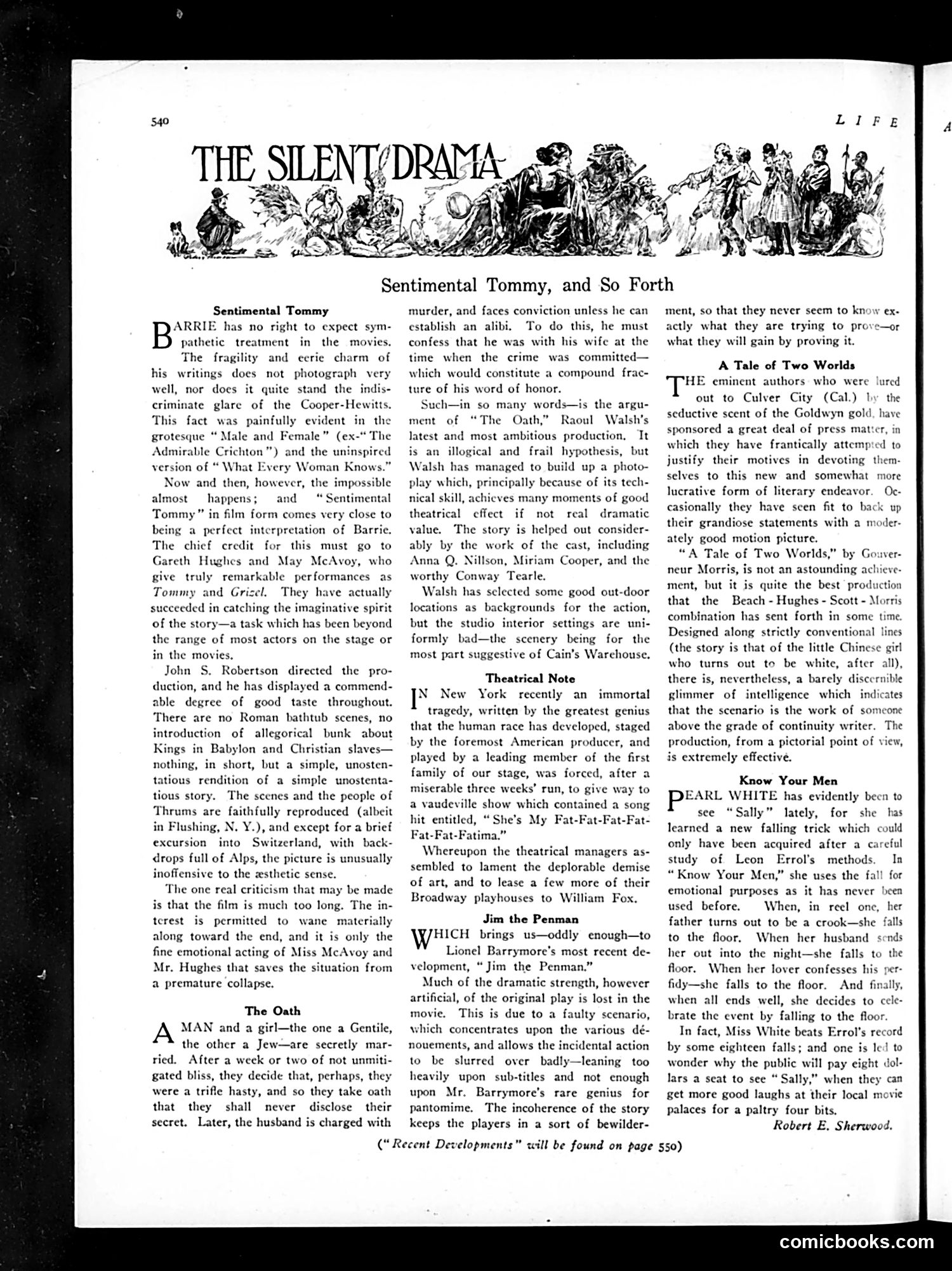
This page from *Life* magazine (circa 1920s) reviews three silent films. The header illustration shows figures from "The Silent Drama," *Life's* film criticism column. **Key Reviews:** 1. **"Sentimental Tommy"** — Praised for faithfully adapting J.M. Barrie's novel, with actors Gareth Hughes and Mary McAvoy delivering emotionally effective performances. Director John S. Robertson is commended for tasteful restraint—notably avoiding the then-trendy "Roman bathtub scenes" and allegorical padding that plagued other literary adaptations. 2. **"The Oath"** — Director Raoul Walsh's ambitious but logically flawed melodrama about a Gentile-Jewish couple whose secret marriage conflicts with courtroom testimony needs. 3. **"Jim the Penman"** — Brief mention of Lionel Barrymore's recent film (review continues on following page). The reviews reflect *Life's* satirical stance: praising artistic restraint while mocking Hollywood's tendency toward excess and sensationalism in adapting literature.
📄 Transcribed text from this page (OCR, searchable)
Machine-transcribed from the original scan — historical spelling and the odd misread are preserved.
Sentimental Tommy, and So Forth Sentimental Tommy ARRIE has no right to expect sym- B pathetic treatment in the movies. The fragility and cerie charm of his writings does not photograph very well, nor does it quite stand the indis- criminate glare of the This fact was painfully evident in the grotesque “ Male and Female” (ex-" The Admirable Crichton”) and the uninspired version of “ What Every Woman Knows. ‘ooper-Hewitts. Now and then, however, the impossible almost happens; and —_“ Sentimental Tommy” in film form comes very close to being a perfect interpretation of Barri The chief credit for this Gareth Hughes and Ma give truly remarkable performances as Tommy and Gri They have actually succeeded in catching the imaginative spirit of the story—a task which has been beyond the range of most actors on the stage or in the movies. John S. Robertson directed the pro- duction, and he has displayed a commend- able degree of good taste throughout. There are no Roman bathtub scenes, no introduction of allegorical bunk about Kings in Babylon and Christian slaves— nothing, in short, but a simple, unosten- tatious rendition of a simple unostenta- tious story. The scenes and the people of Thrums are faithfully reproduced (albeit in Flushing, N. Y.), and except for a brief into Switzerland, with back- drops full of Alps, the picture is unusually inoffensive to the zsthetic sense. must go to McAvoy, who excursion The one real criticism that may be made is that the film is much too long. The in- terest is permitted to wane materially along toward the end, and it is only the fine emotional acting of Miss McAvoy and Mr. Hughes that saves the situation from a premature collapse, The Oath A MAN and a girl—the one a Gentile, the other a Jew—are secretly mar- ried. After a week or two of not unmiti- gated bliss, they decide that, perhaps, they were a trifle hasty, and so they take oath that they shall never disclose their secret. Later, the husband is charged with murder, and faces conviction unless he can establish an alibi. To do this, he must confess that he was with his wife at the time when the crime was committed— which would constitute a compound frac- ture of his word of honor. Such—in so many words—is the argu- “The Oath,” Raoul Walsh's latest and most ambitious production, Tt is an illogical and frail hypothesis, but Walsh has managed to build up a photo- play which, principally because of its tech- ment of nical skill, achieves many moments of good theatrical effect if not real dramatic value. The story is helped out consider- ably by the work of the cast, including Anna Q. Nillson, Miriam Cooper, and the worthy Conway Tearle. Walsh has selected some good out-door locations as backgrounds for the action, but the studio interior settings are uni- formly bad—the scenery being for the most part suggestive of Cain’s Warehouse, Theatrical Note N New York recently an immortal tragedy, written by the greatest genius that the human race has developed, staged by the foremost American producer, and played by a leading member of the first family of our stage, was jorced, after a miserable three weeks’ run, to give way to a vaudeville show which contained a song hit entitled, “ She’s My Fat-Fat-Fat-Fat- Fat-Fat-Fatima.” Whereupon the theatrical managers as- sembled to lament the deplorable demise of art, and to lease a few more of their Broadway playhouses to William Fox, Jim the Penman HICH brings us—oddly enough—to Lionel Barrymore's most recent de- velopment, “Jim the Penman,” Much of the dramatic strength, however artificial, of the original play is lost in the movie. This is due to a faulty scenario, which concentrates upon the various dé- nouements, and allows the incidental action to be slurred over badly—leaning too heavily upon sub-titles and not enough upon Mr. Barrymore’s rare genius for pantomime. The incoherence of the story keeps the players in a sort of bewilder- ment, so that they never seem to kn actly what they are trying to prove. what they will gain by proving it. A Tale of Two Worlds HE eminent authors who were out to Culver City ured (Cal.) by the have seductive scent of the Goldwyn gold sponsored a great deal of press m: in which they have frantically attempted to justify their motives in devoting them- selves to this new and somewhat more lucrative form of literary endeavor. Oc- casionally they have scen fit to back up their grandiose statements with a moder- ately good motion picture. A Tale of Two Worlds,” by Gouver- neur Morris, is not an astounding achieve: ment, but it is quite the best producti that the Beach - Hughes - Scott - M combination has sent forth in some time. Designed along strictly conventional lines (the story is that of the little Chinese girl who turns out to be white, after all), there is, nevertheless, a barely discernible glimmer of intelligence which indicates that the scenario is the work of someone above the grade of continuity writer. The production, from a pictorial point of view, is extremely effective. Know Your Men P RL WHITE has evidently been to “Sally” lately, for she has learned a new falling trick which could only have been acquired after a careful study of Leon Errol's methods. In “Know Your Men,” she uses the fal! for emotional purposes as it has never used before. When, in reel one, her father turns out to be a crook—she falls to the floor, When her husband sends her out into the night—she falls to floor. When her lover confesses his 1 fidy—she falls to the floor. And f when all ends well, she decides to cele- brate the event by falling to the floor. In fact, Miss White beats Errol’s record by some eighteen falls; and one is led to wonder why the public will pay eight lars a seat to see “ Sally,” when they can get more good laughs at their local movie palaces for a paltry four bits. Robert E, Sherwood. see been nally, (“Recent Developments" will be found on page 550) comicbooks.com