
Life, 1921-04-14 · page 8 of 36
Life — April 14, 1921 — page 8: what you’re looking at
What you’re looking at
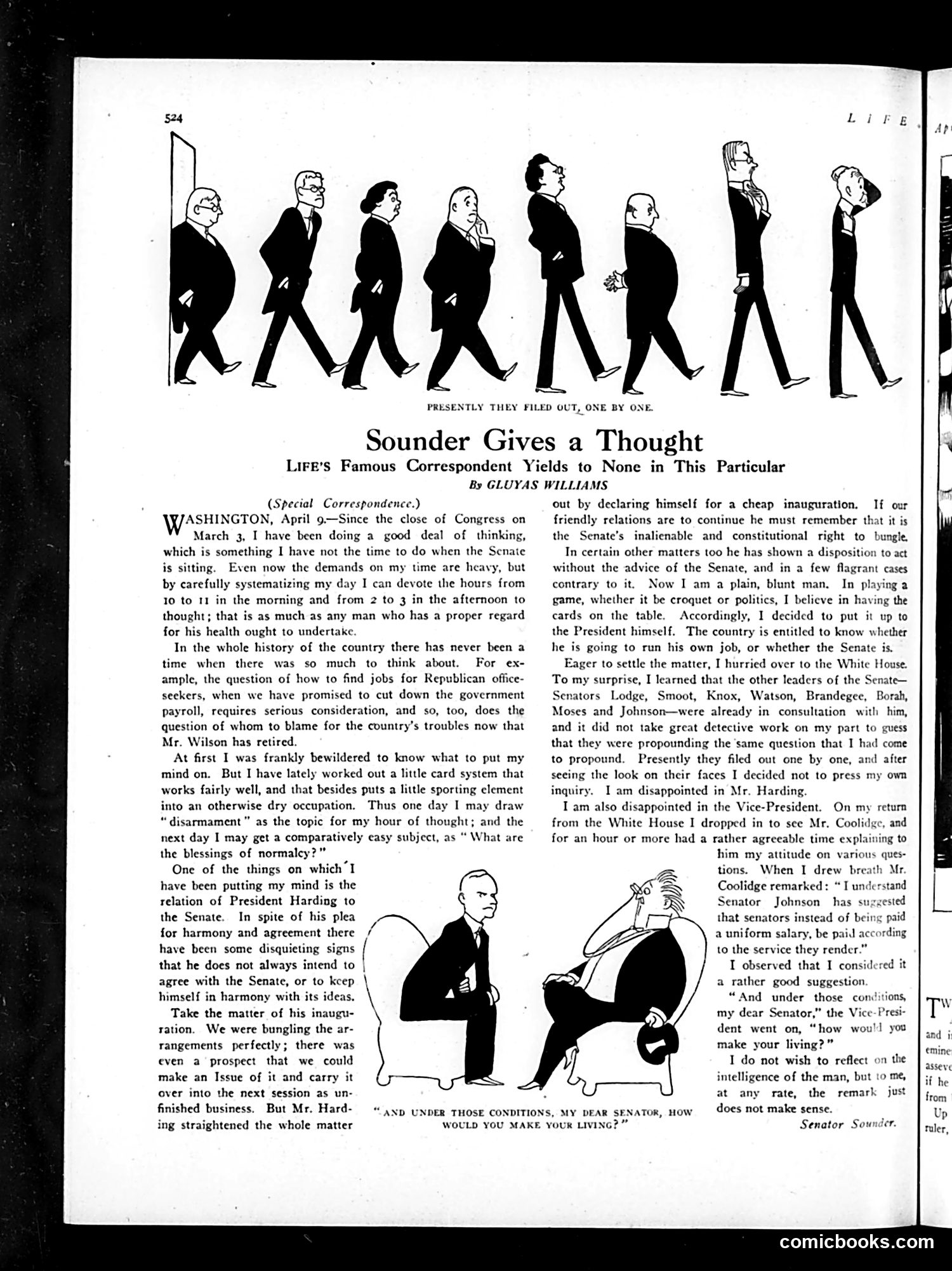
This satirical piece by Williams critiques President Harding's relationship with the Senate regarding appointments and policy decisions. The top cartoon shows eight men in suits filing out one by one—depicting senators leaving after a meeting. The main illustration shows a conversation between what appears to be Vice President Coolidge and Senator Saunders, discussing how senators should be compensated for their work. The satire targets the tension between Harding's executive authority and Senate oversight, particularly regarding job appointments and federal payroll cuts. Williams mockingly suggests senators are negotiating their own salaries while the government faces budget constraints—highlighting perceived hypocrisy and self-interested politics during the early 1920s Harding administration.
📄 Transcribed text from this page (OCR, searchable)
Machine-transcribed from the original scan — historical spelling and the odd misread are preserved.
PRESE. LY THEY FILED OUT, ONE BY ONE. Sounder Gives a Thought LiFe’s Famous Correspondent Yields to None in This Particular By GLUYAS WILLIAMS (Special Correspondence.) ASHINGTON, April 9.—Since the close of Congress on March 3, I have been doing a good deal of thinking, which is something I have not the time to do when the Senate is sitting. Even now the demands on my time are heavy, but by carefully systematizing my day I can devote the hours from 10 to 11 in the morning and from 2 to 3 in the afternoon to thought; that is as much as any man who has a proper regard for his health ought to undertake. In the whole history of the country there has never been a time when there was so much to think about. For ample, the question of how to find jobs for Republican office- seekers, when we have promised to cut down the government payroll, requires serious consideration, and so, too, does the question of whom to blame for the country’s troubles now that Mr. Wilson has retired. At first I was frankly bewildered to know what to put my mind on. But I have lately worked out a little card system that works fairly well, and that besides puts a little sporting element into an otherwise dry occupation. Thus one day I may draw “disarmament” as the topic for my hour of thought; and the next day I may get a comparatively casy subject, as “ What are the blessings of normalcy?” One of the things on which “I have been putting my mind is the relation of President Harding to the Senate. In spite of his plea for harmony and agreement there have been some disquieting signs that he does not always intend to | agree with the Senate, or to kcep himself in harmony with its ideas, Take the matter of his inaugu- ration. We were bungling the ar- rangements perfectly; there was even a prospect that we could make an Issue of it and carry it over into the next session as un- finished business. But Mr. Hard- ing straightened the whole matter “AND UNDER THOSE CONDITI WOULD YOU MAKE YOUR LIVING?” out by declaring himself for a cheap inauguration. If our friendly relations are to continue he must remember ¢ the Senate’s inalienable and constitutional right to In certain other matters too he has shown a disposition to act without the advice of the Senate, and in a few flagrant cases contrary to it. Now I am a plain, blunt man. In playing a game, whether it be croquet or politics, I believe in having the cards on the table. Accordingly, I decided to put it up to the President himself. The country is entitled to know whether he is going to run his own job, or whether the Senate is. Eager to settle the matter, I hurried over to the White House. To my surprise, I learned that the other leaders of the Senate— Senators Lodge, Smoot, Knox, Watson, Brandegee, Borah, Moses and Johnson—were already in consultation with him, and it did not take great detective work on my part to guess that they were propounding the ‘same question that I had come to propound. Presently they filed out one by one, and after seeing the look on their faces I decided not to press my own inquiry. I am disappointed in Mr. Harding. Tam also disappointed in the Vice-President. On my return from the White House I dropped in to see Mr. Coolic for an hour or more had a rather agreeable time expla him my attitude on various ques- tions. When I drew breath Mr. Coolidge remarked: “I understand Senator Johnson has suggested that senators instead of being paid a uniform salary, be paid according to the service they render I observed that I considered it a rather good suggestion. “And under those conditions, my dear Senator,” the Vice-Presi- dent went on, “how wou! you make your living?” I do not wish to reflect on the intelligence of the man, but to me, at any rate, the remark just does not make sense. Senator Sounder. ning to NS, MY DEAR SENATOR, HOW T and i emine asseve if he from Up ruler, comicbooks.com