
Life, 1921-04-14 · page 21 of 36
Life — April 14, 1921 — page 21: what you’re looking at
What you’re looking at
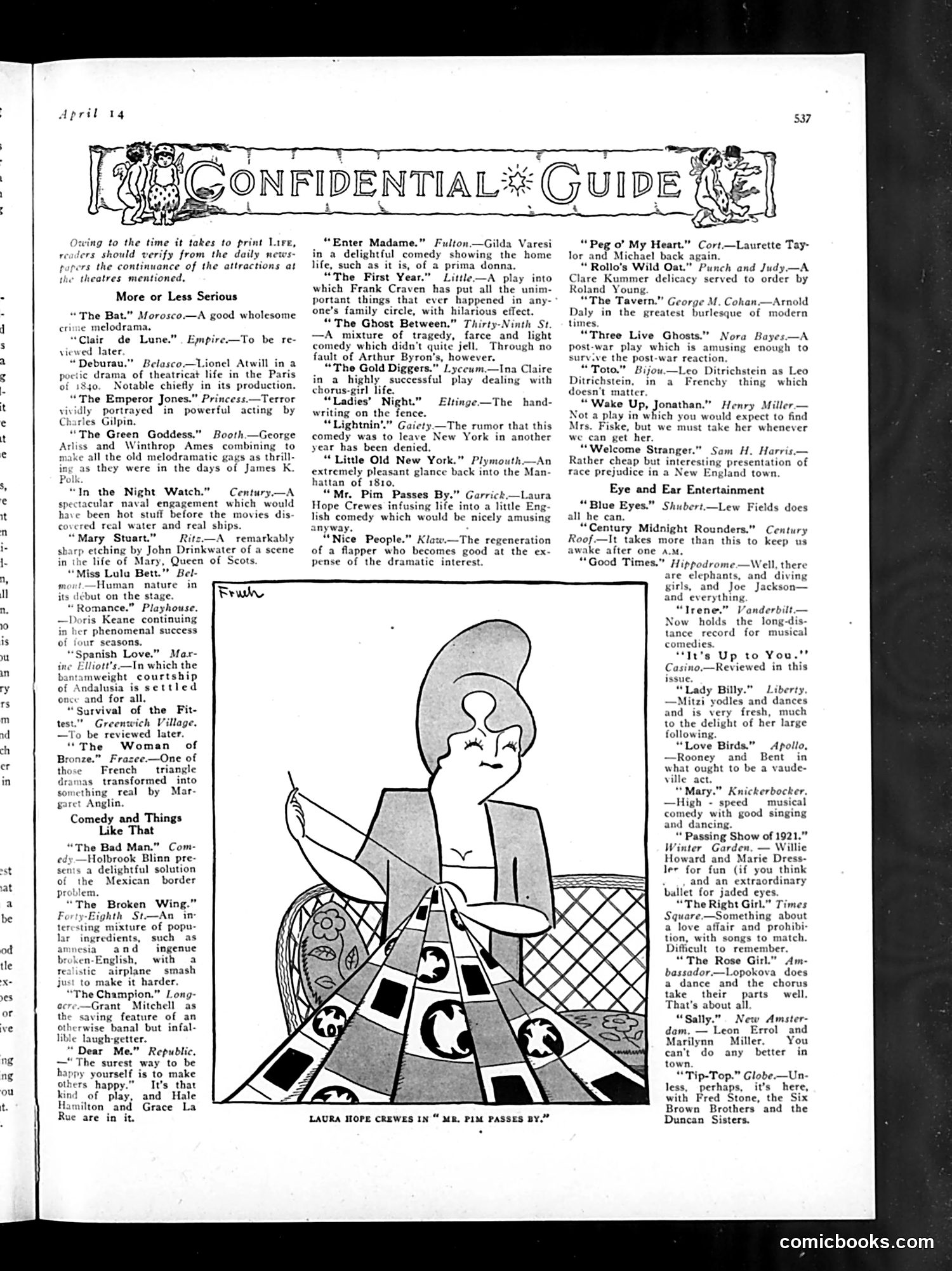
This is a theater review guide from Life magazine's "Confidential Guide" section, dated April 14. It catalogs Broadway and theatrical productions of the era, organized by tone—serious dramas, comedies, and lighter fare. The central illustration shows a stylized woman in 1920s fashion (bobbed hair, dropped waistline) examining what appears to be theatrical playbills or programs, depicted as a patchwork skirt. This visualizes the guide's purpose: helping theatergoers navigate the season's offerings. The reviews are brief, snappy critiques naming actors (Laura Hope Crewes, Gilda Varesi, Charles Gilpin) and theaters (Lyceum, Playhouse, Gaiety). References like "flapper" and post-war themes indicate this is early 1920s entertainment. The tone is witty and conversational—Life's satirical voice applied to theater criticism rather than political satire. It's essentially a entertainment consumer guide for sophisticated urban readers.
📄 Transcribed text from this page (OCR, searchable)
Machine-transcribed from the original scan — historical spelling and the odd misread are preserved.
ONFIDENTIAL** GUIDE ing to the time it takes to print Lire, rs should verify from the daily ne fupers the continuance of the attractions at the theatres mentioned. More or Less Serious “The Bat.” Morosco—A good wholesome crime melodrama. “Clair de Lune.” viewed later “Deburay.” Belasco—Lionel Atwill in a poctic drama of theatricat life in the Paris of 1840. Notable chiefly in its production. The Emperor Jones.” Princess.—Terror vividly portrayed “in powerful acting by Charles Gilpin. “The Green Goddess.” Booth —George iss and Winthrop Ames combining to make all the old melodramatic gags as thrill- as they were in the days of James K. Empire-—To be re- In the Night Watch.” — Century—A cular naval engagement which would have been hot stuff before the movies dis- covered real water and real ships. “Mary Stuart.” — Ritz—A remarkably barp etching by John Drinkwater of a scene e life of Mary, Queen of Scots. Miss Lula Bett.” Bel- mont—Human nature in its début on the stage. “Romance.” Playhouse. —Doris Keane continuing cr phenomenal success ir seasons. Spanish Love.” Maxr- ¢ Elliott’s—In which the bantamweight courtship of Andalusia is settled once and for all, “Survival of the Fit- test.” Greenwich Village. —To be reviewed later. “The Woman of nze.” Frazee.—One of French triangle as transformed into something real by Mar- garet Anglin. Comedy and Things Like That “The Bad Man.” Com- edy —Holbrook Blinn pre- sents a delightful solution he Mexican border oblem. The Broken Wing.” ty-Eighth St—An in- resting mixture of popu- ingredients, such as vesia. «sand = ingenue ken-English, with a istic airplane smash to make it harder. “The Champion.” Long- —Grant Mitchell as ing feature of an rwise banal but infal- laugh-getter. Dear Me.” Republic. The surest way to be happy yourself is to make others hap kind of Hamilton and Grace La Rue are in it. “Enter Madame.” Fulton.—Gilda Varesi in a delightful comedy showing the home life, such as it is, of a prima donna. “The First Year.” Little—A play into which Frank Craven has put all the unim- portant things that ever happened in any- one’s family circle, with hilarious effect. “The Ghost Between.” Thirty-Ninth St. —A mixture of tragedy, farce and light comedy which didn't quite jell. Through no fault of Arthur Byron's, however. “The Gold Diggers.” Lyceum.—Ina Claire in a highly successful play dealing with chorus-girl life. . Night.” writing on the fence. “Lightnin’.” Gaiety.—The rumor that this comedy was to leave New York in another year has been denied. “Little Old New York.” Plymouth—An extremely pleasant glance back into the Man- hattan of 1810. “Mr. Pim Passes By.” Garrick.—Laura Hope Crewes infusing life into a little Eng- lish comedy which would be nicely amusing anyway. “Nice People.” Klaw.—The regeneration of a flapper who becomes good at the ex- pense of the dramatic interest. Eltinge—The hand- LAURA HOPE CREWES IN “ MR. PIM PASSES BY.” i “ Peg o” My Heart.” Cort—Laurette Tay- lor and Michael back again. “ Rollo's Wild Oat.” Punch and Judy—A Clare Kummer delicacy served to order by Roland Young. “The Tavern.” George M. Cohan —Arnold Daly in the greatest burlesque of modern times. “Three Live Ghosts.” Nora Bayes —A post-war play which is amusing enough to survive the post-war reaction, “ Toto.” Bijou.—Leo Ditrichstein as Leo Ditrichstein, in a Frenchy thing which doesn't matter. _ Wake Up, gocethan” Henry Miller — Not a play in which you would expect to find Mrs, Fiske, but we must take her whenever we can get her. “Welcome Stranger.” Sam H. Harris.— Rather cheap but inte: i pre: race prejudice in a New England town. Eye and Ear Entertainment “Blue Eyes.” Shubert. all he can. “Century Midnight Rounders.” Century Roof—It takes more than this to keep us awake after one a.m, “Good Times.” Hippodrome—Well, there are elephants, and diving girls, and Joe Jackson— and everything. “Irene.” Vanderbilt — Now holds the long-d tance record for musical comedies. “It's Up to You.’ Casino.—Reviewed in this issue. “Lady Billy.” Liberty. —Mitzi yodles and dances and is very fresh, much to the delight of her large following. “Love Birds.” Apollo, —Rooney and Bent in what ought to be a vaude- ville act. “Mary.” Knickerbocker. —High - speed — musical comedy with good singing and dancing. Passing Show of 1921.” Winter Garden, — Willie Howard and Marie Dress- ler for fun (if you think ‘ and an extraordinary bullet for jaded eyes. “The Right Girl.” Times Square—Something about a love affair and prohibi- tion, with songs to match. Difficult to remember. “The Rose Girl.” Am- bassador—Lopokova does a dance and the chorus take their parts well. That's about all. “Sally.” New Amster- dam. — Leon Errol and Marilynn Miller. You can't do any better in town. “Tip-Top.” Globe-—Un- less, perhaps, it’s here, with Fred Stone, the Six Brown Brothers and the Duncan Sisters. Lew Fields does comicbooks.com