
Life, 1921-04-14 · page 16 of 36
Life — April 14, 1921 — page 16: what you’re looking at
What you’re looking at
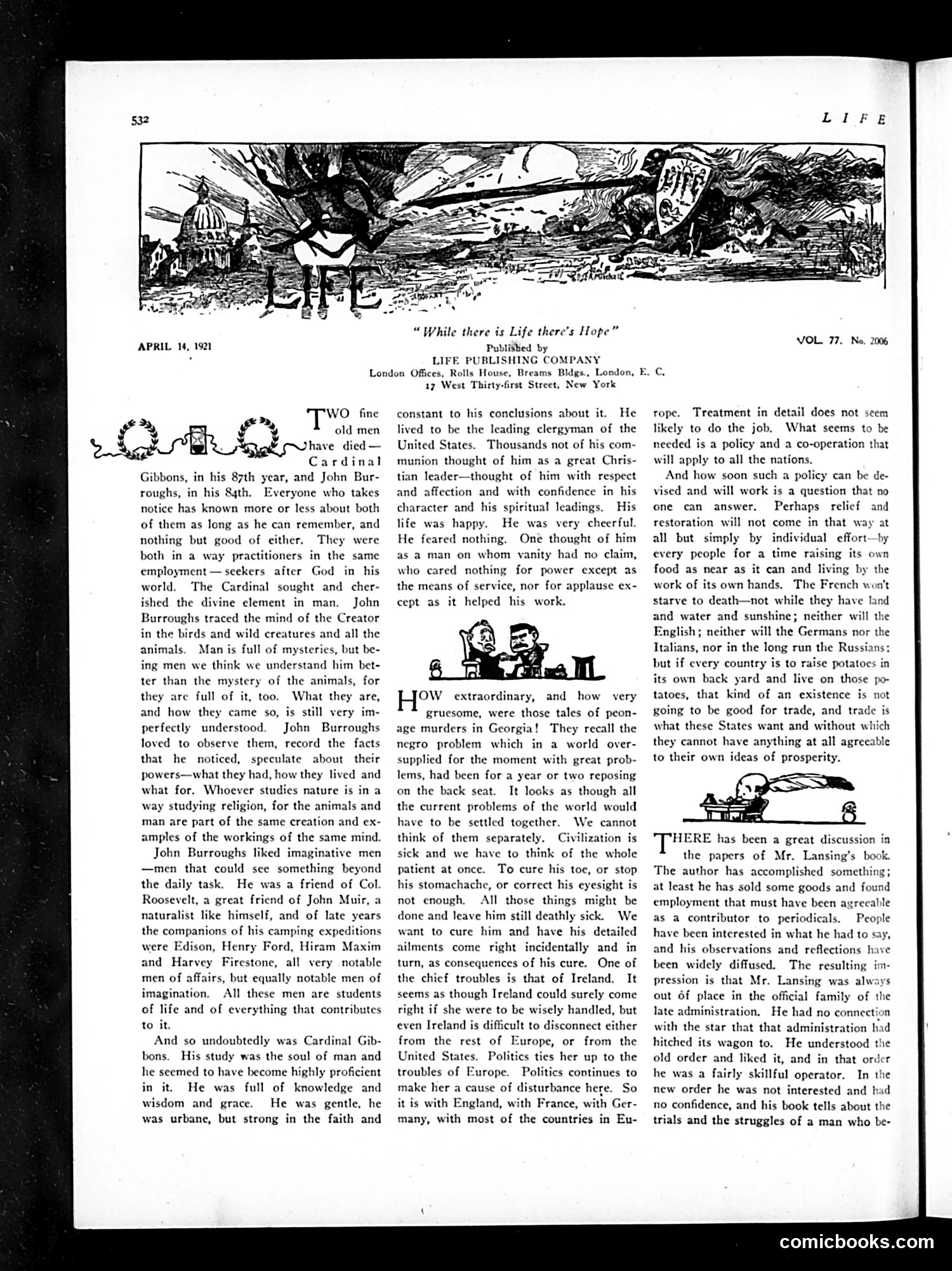
This page contains a literary essay about two deceased prominent figures (Cardinal Gibbons and John Burroughs) rather than political satire. The text praises their character and influence—Gibbons as a leading American clergyman and Burroughs as a naturalist and spiritual guide. The small decorative illustrations at page top and scattered through the text appear to be generic ornamental woodcuts rather than targeted political cartoons. The essay discusses their legacies and argues that individual moral effort and cooperation between nations could help post-WWI recovery, suggesting relief and restoration rather than punishment as policy approaches. This is primarily a commemorative essay page rather than satirical commentary.
📄 Transcribed text from this page (OCR, searchable)
Machine-transcribed from the original scan — historical spelling and the odd misread are preserved.
APRIL 14, 1921 “While there is Life there's Hope” Publistied by LIFE PUBLISHING COMPA’ VOL. 77. No, 2006 London Offices, Rolls House, Breams Bldgs, London, E. C. WO fine old men a i) : Jhave died — Cardinal Gibbons, in his 87th year, and John Bur- roughs, in his 84th. Everyone who takes notice has known more or less about both of them as long as he can remember, and nothing but good of either. They were both in a way practitioners in the same employment — seekers after God in his world. The Cardinal sought and cher- ished the divine element in man. John Burroughs traced the mind of the Creator in the birds and wild creatures and all the animals, Man is full of mysteries, but be- ing men we think we understand him bet- ter than the mystery of the animals, for they are full of it, too. What they are, and how they came so, is still very im- perfectly understood. John Burroughs loved to observe them, record the facts that he noticed, speculate about their powers—what they had, how they lived and what for. Whoever studies nature is in a way studying religion, for the animals and man are part of the same creation and ex- amples of the workings of the same mind. John Burroughs liked imaginative men —men that could see something beyond the daily task. He was a friend of Col. Roosevelt, a great friend of John Muir, a naturalist like himself, and of late years the companions of his camping expeditions were Edison, Henry Ford, Hiram Maxim and Harvey Firestone, all very notable men of affairs, but equally notable men of imagination. All these men are students of life and of everything that contributes to it. And so undoubtedly was Cardinal Gib- bons. His study was the soul of man and he seemed to have become highly proficient in it. He was full of knowledge and wisdom and grace. He was gentle, he was urbane, but strong in the faith and 17 West Thirty-first Street, New York constant to his conclusions about it. He lived to be the leading clergyman of the United States. Thousands not of his com- munion thought of him as a great Chris- tian leader—thought of him with respect and affection and with confidence in his character and his spiritual leadings. His life was happy. He was very cheerful. He feared nothing. One thought of him as a man on whom vanity had no claim, who cared nothing for power except as the means of service, nor for applause ex- cept as it helped his work. es How extraordinary, and how very gruesome, were those tales of peon- age murders in Georgia! They recall the negro problem which in a world over- supplied for the moment with great prob- lems, had been for a year or two reposing on the back seat. It looks as though all the current problems of the world would have to be settled together. We cannot think of them separately. Civilization is sick and we have to think of the whole patient at once. To cure his toe, or stop his stomachache, or correct his eyesight is not enough. All those things might be done and leave him still deathly sick. We want to cure him and have his detailed ailments come right incidentally and in turn, as consequences of his cure. One of the chief troubles is that of Ireland. It seems as though Ireland could surely come right if she were to be wisely handled, but even Ireland is difficult to disconnect either from the rest of Europe, or from the United States. Politics ties her up to the troubles of Europe. Politics continues to make her a cause of disturbance here. So it is with England, with France, with Ger- many, with most of the countries in Eu- rope. Treatment in detail does not seem likely to do the job, What seems to be needed is a policy and a co-operation that will apply to all the nations. And how soon such a policy can be de- vised and will work is a question that no one can answer. Perhaps relief and restoration will not come in that way at all but simply by individual effort—hy every people for a time raising its own food as near as it can and living by the work of its own hands. The French won't starve to death—not while they have land and water and sunshine; neither will the English; neither will the Germans nor the Italians, nor in the long run the Russians; but if every country is to raise potatoes in its own back yard and live on those po- tatoes, that kind of an existence is not going to be good for trade, and trade is what these States want and without which they cannot have anything at all agreeable to their own ideas of prosperity. HERE has been a great discussion in the papers of Mr. Lansing’s book. The author has accomplished something; at least he has sold some goods and found employment that must have been agrecable as a contributor to periodicals. People have been interested in what he had to say, and his observations and reflections have been widely diffused. The resulting im- pression is that Mr. Lansing was always out 6f place in the official family of the late administration, He had no connection with the star that that administration had hitched its wagon to. He understood the old order and liked it, and in that order he was a fairly skillful operator. In the new order he was not interested and had no confidence, and book tells about the trials and the struggles of a man who be- comicbooks.com