
A complete issue · 34 pages · 1921
Life — March 31, 1921
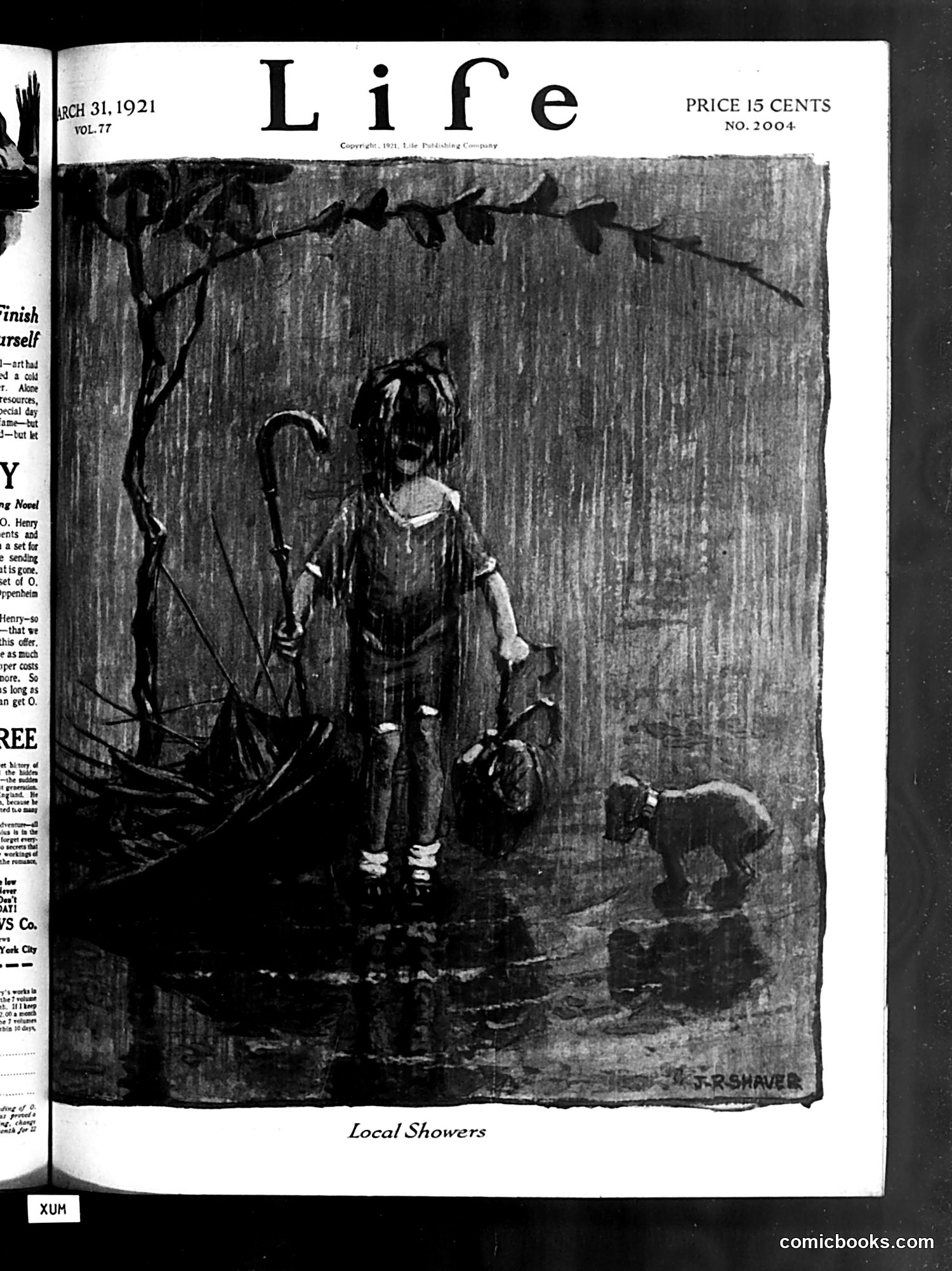
This Life magazine cover from March 31, 1921 presents a humorous illustration titled "Local Showers" by T.S. Shaver. The image depicts a child in rain gear standing in what appears to be a sparse, barren landscape with bare branches overhead and a small dog beside them. The "showers" reference appears to be a gentle visual pun—the child is dressed for rain, yet the environment looks dry and desolate. The satire likely comments on weather unpredictability or false weather predictions common to the era. The contrast between the child's preparedness for rain and the apparently arid surroundings creates the cartoon's humor, poking fun at either overzealous weather warnings or the disappointment of anticipated rain that fails to materialize.
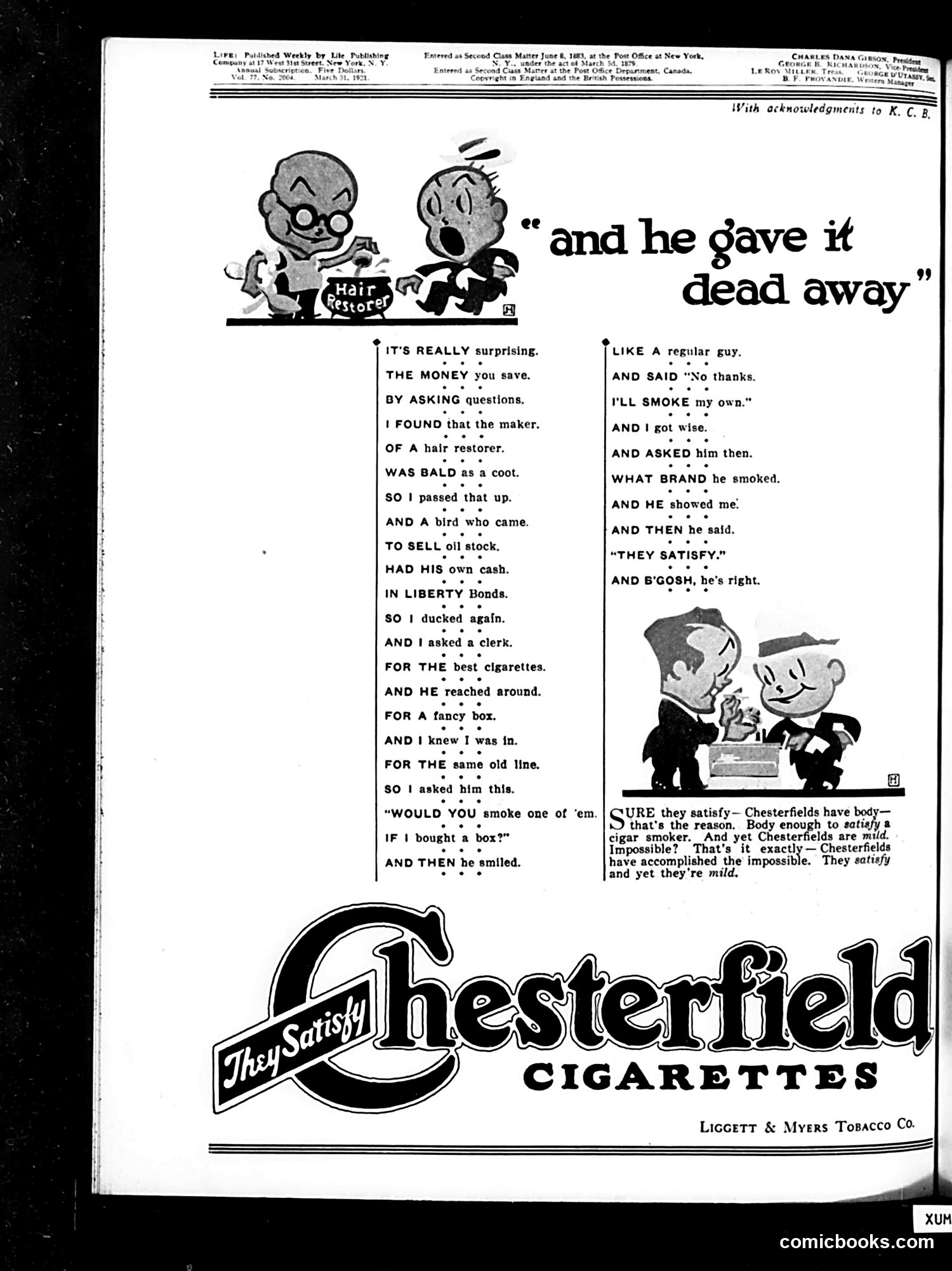
This is primarily a **Chesterfield Cigarettes advertisement** rather than political satire. The narrative poem describes a consumer's shopping journey: seeking a hair restorer, the character encounters a bald man selling oil stock in Liberty Bonds, then asks a clerk about cigarettes in a "fancy box." The clerk's response ("They Satisfy") leads to the advertiser's pitch. The two cartoon characters at right represent satisfied customers endorsing the product's "body" and mildness—Chesterfield's marketing claim that they "satisfy" despite being mild cigarettes. The satire is commercial, not political: it gently mocks consumer gullibility and marketing techniques of the 1920s-30s era, showing how advertising slogans ("They Satisfy") were used to sell cigarettes as sophisticated, satisfying products.
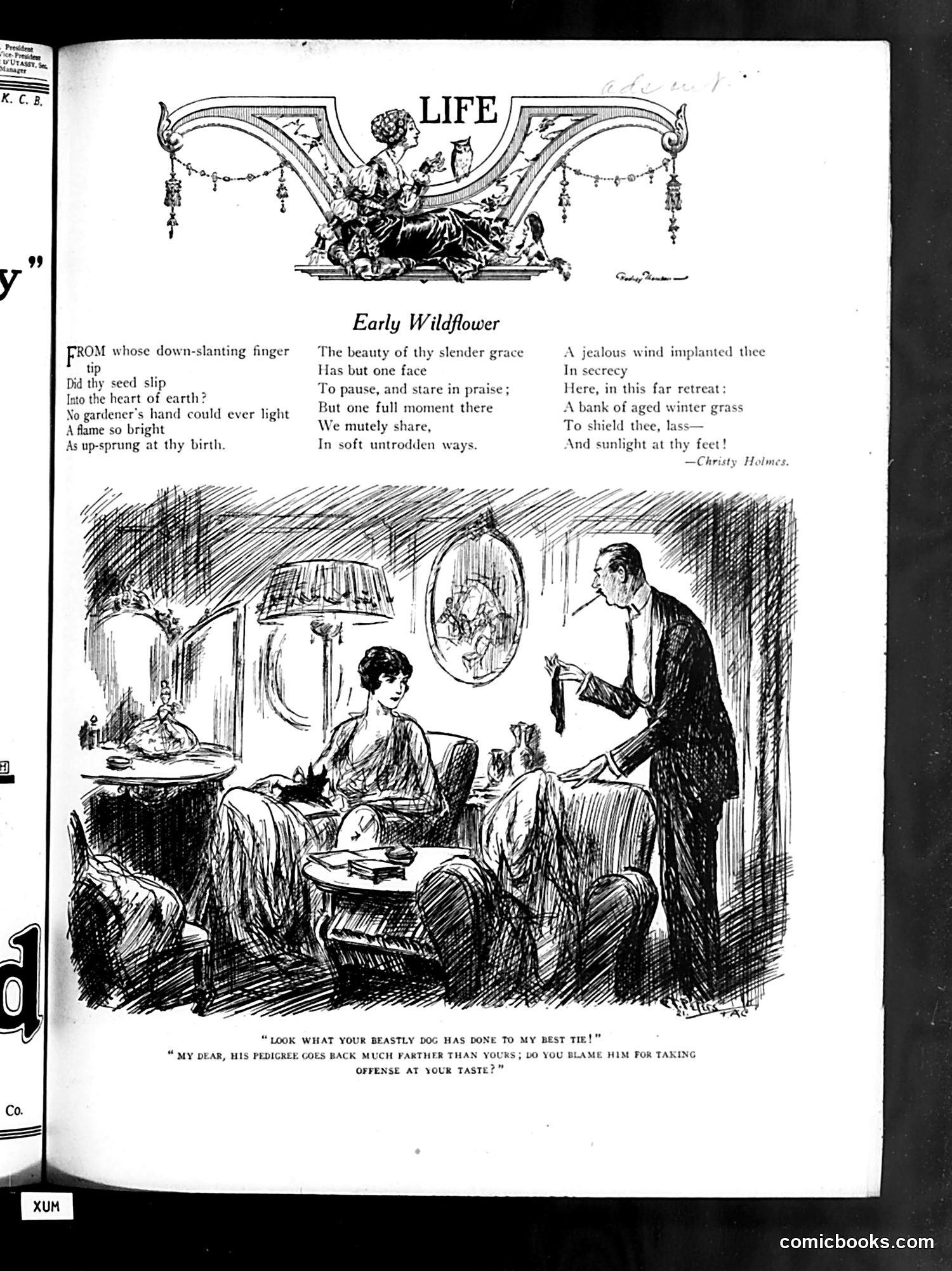
This page features a poem titled "Early Wildflower" by Christy Holmes, celebrating the delicate beauty of an early-blooming flower. The accompanying sketch depicts a domestic scene where a man confronts a woman about her dog damaging her tie. His accusation is humorous—he blames her dog more severely than he blames her for the offense to his taste. The satire targets social dynamics of the era: the man's indignation over a ruined accessory, his pointed criticism of the woman's pet (and implicitly her), and the absurd prioritization of fashion over relationships. The woman's composed reaction suggests she finds his complaint ridiculous. The cartoon mocks masculine vanity and courtship tensions in early 20th-century American society.
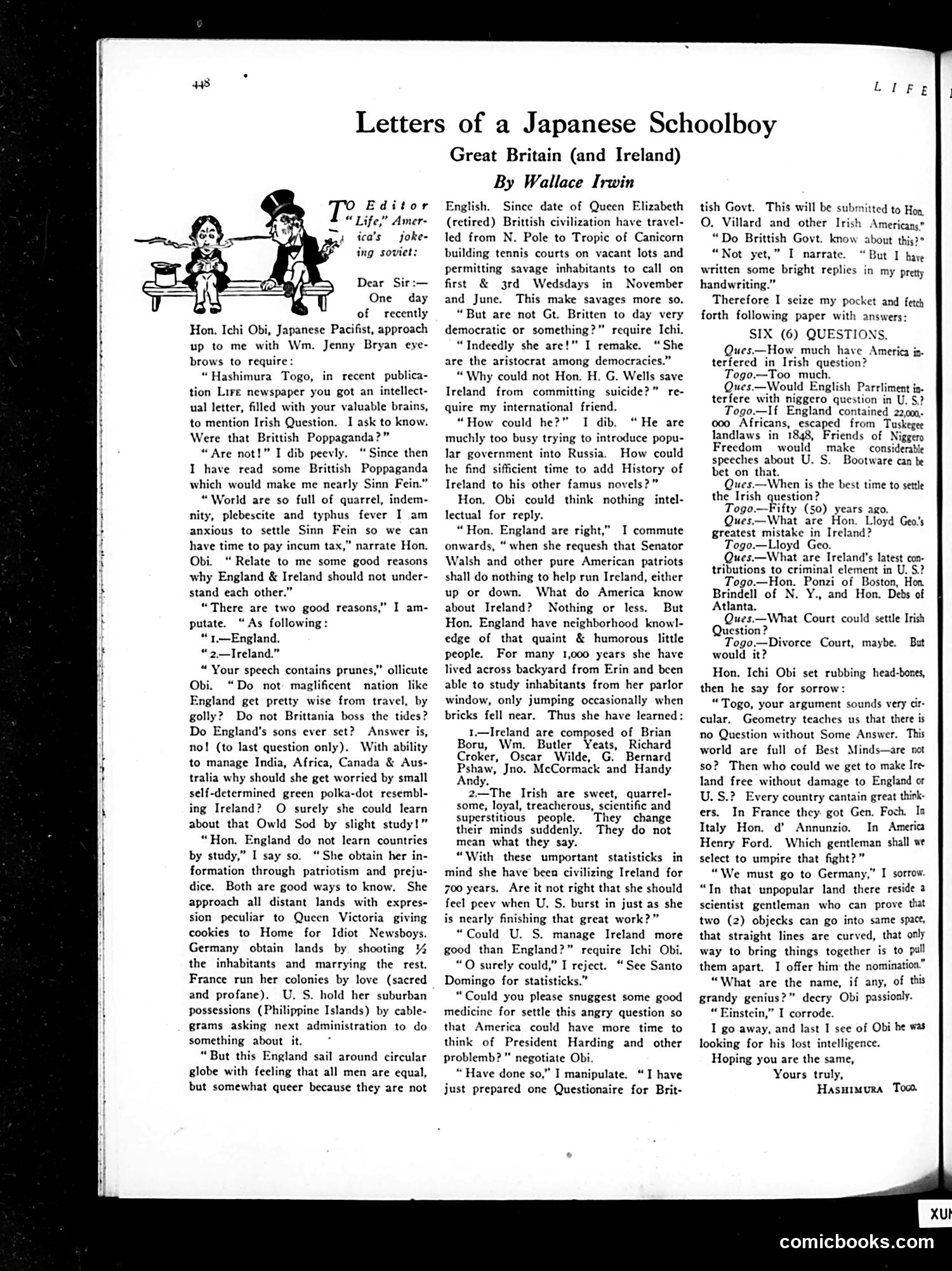
The page features "Letters of a Japanese Schoolboy" by Wallace Irwin, a satirical column using a fictional Japanese correspondent named Hashimura Toa to comment on contemporary American and British affairs. The illustration shows two figures in conversation—one appears to be the Japanese schoolboy character, the other likely Hon. Ichi Obi (a recurring character mentioned in the text). The satire mocks British-Irish relations, American foreign policy toward Ireland, and the British Empire's colonial administration. Through the naive Japanese observer's perspective, Irwin critiques British hypocrisy regarding democracy while ruling colonies, contrasts British and American approaches to Ireland, and questions American intervention in world affairs. The column uses this "outsider's view" device to expose contradictions in Western geopolitical positions that contemporary readers would find absurd when stated plainly.
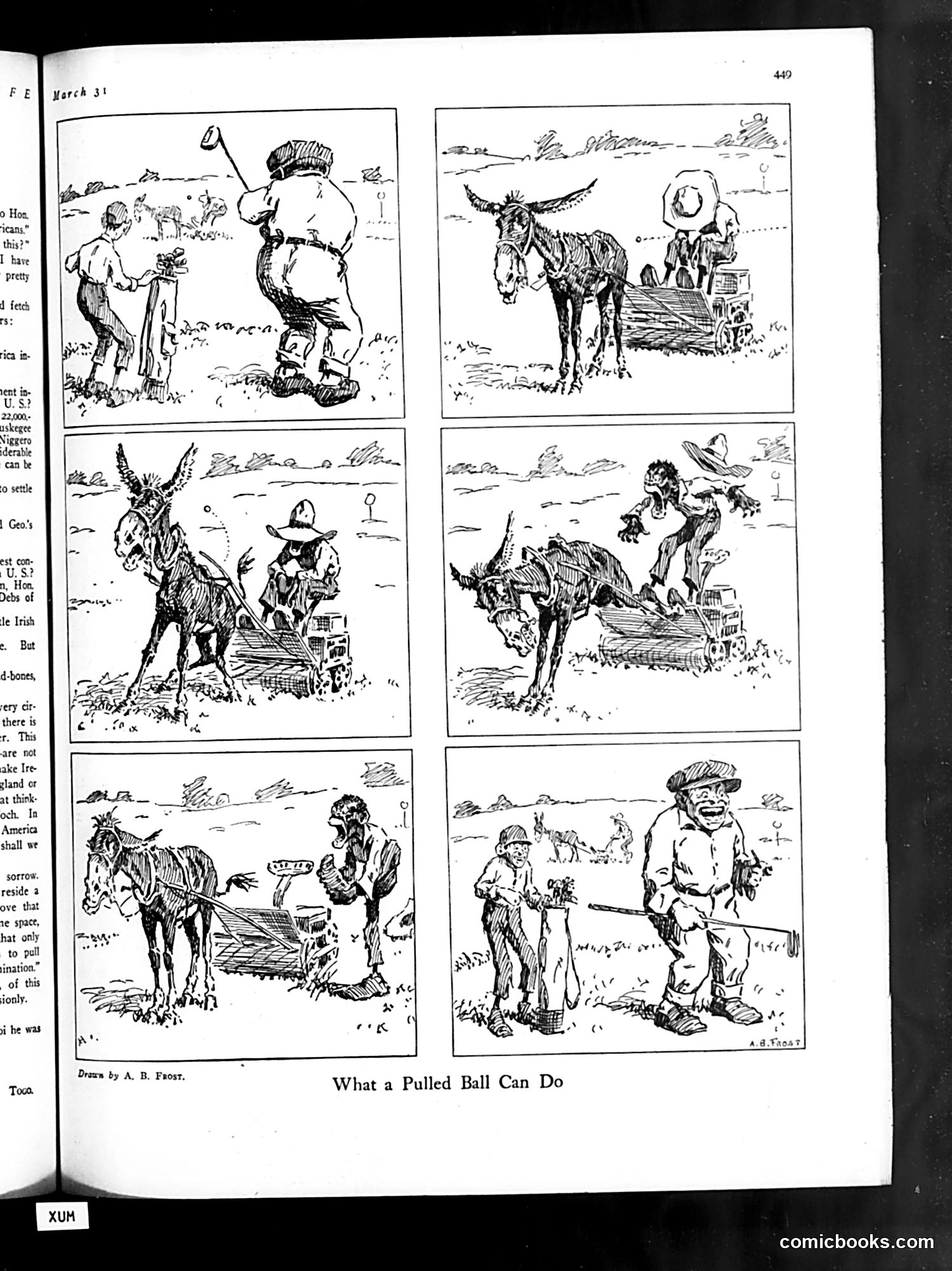
This comic strip by A. B. Frost depicts the escalating chaos caused by a baseball that's been hit foul (a "pulled ball" in baseball terminology). The sequence shows: 1. A batter hitting a wild ball 2. The ball striking a ox/bull, which becomes enraged 3. The maddened animal destroying property and attacking people 4. Widespread mayhem resulting from the initial accident The satire humorously illustrates the domino-effect consequences of a single sporting mishap—how one careless action in baseball can trigger a chain reaction of disaster affecting innocent bystanders and animals. It's a comedic commentary on unintended consequences and chaos, using the popular sport of baseball as its starting point. The exaggerated destruction emphasizes the absurdity of blaming a single "pulled ball" for widespread calamity.
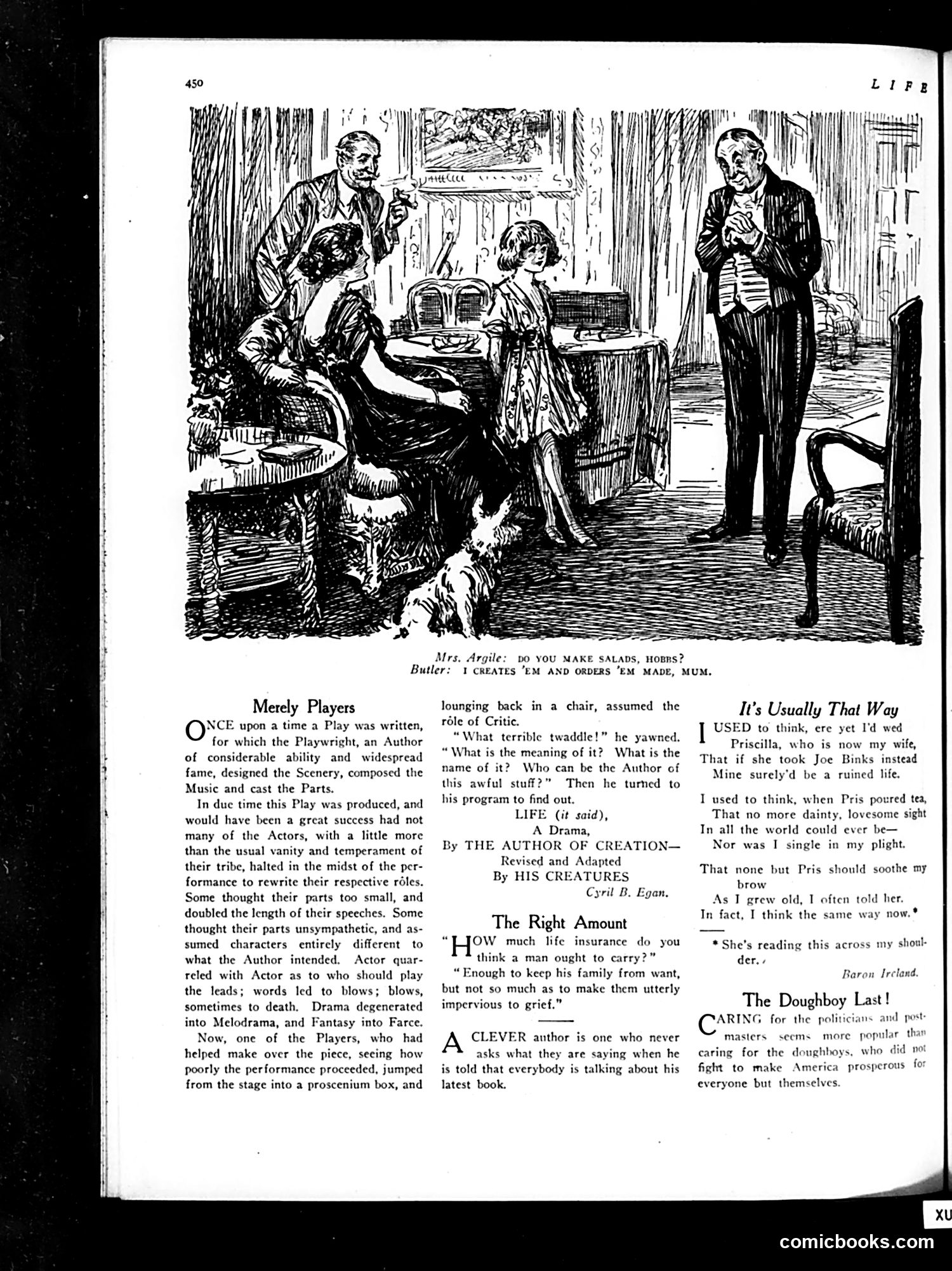
The top illustration satirizes theatrical mediocrity. The caption shows Mrs. Argyle asking the Butler if he makes salads; he responds that he "creates 'em and orders 'em made, mum"—a pretentious answer. This appears to mock both servants who affect grandiosity and the theater world's tendency to overstate the importance of minor roles. The accompanying article "Merely Players" critiques early 20th-century theater productions where minor actors interpreted their parts too seriously, taking small roles as major artistic statements. The satire targets theatrical vanity—the inflation of minor contributions into self-important performances. The other brief pieces discuss writing, insurance, and political patronage, but the main visual humor centers on class pretension and theatrical self-importance masquerading as artistic creation.
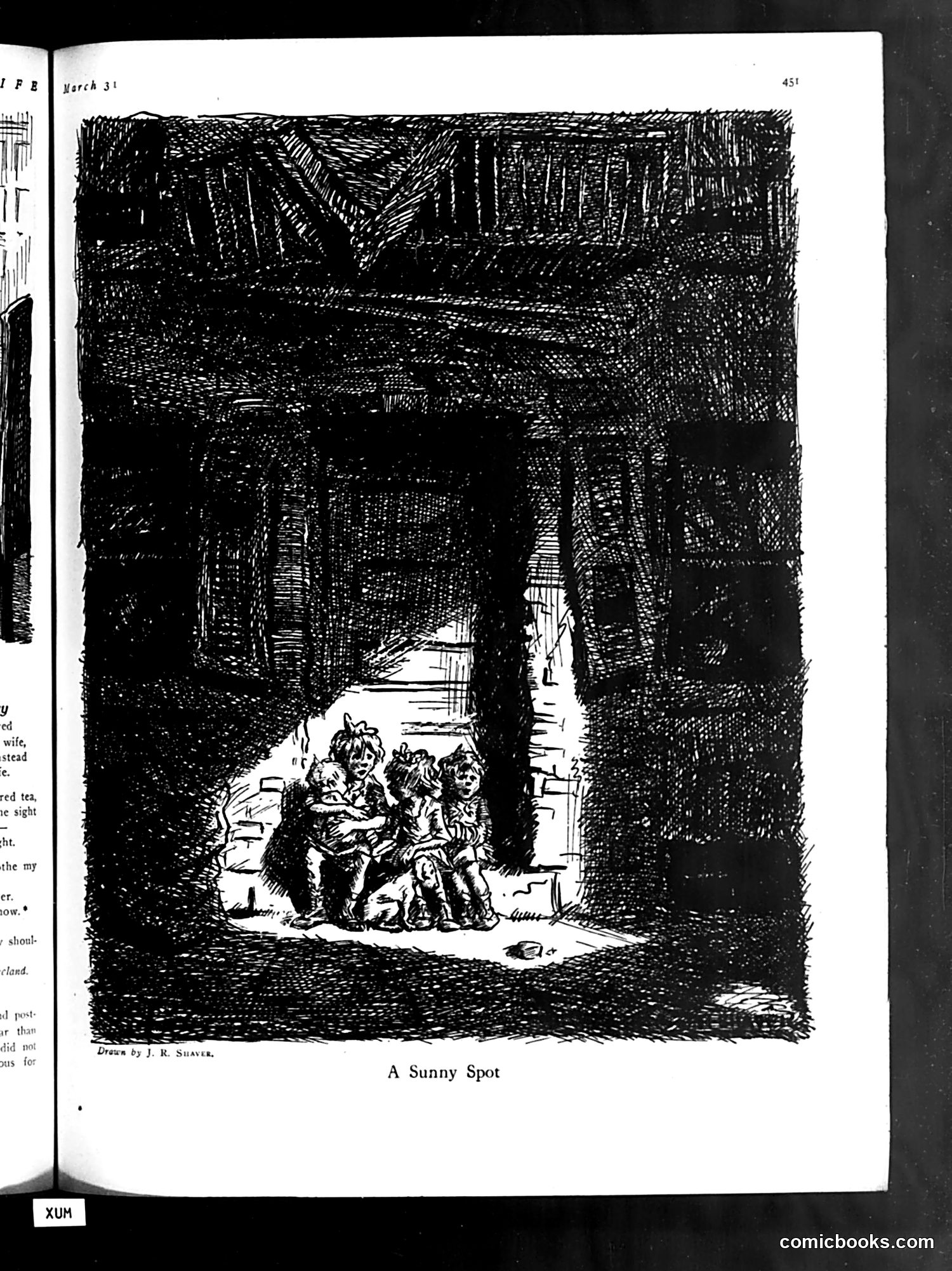
This illustration by J.R. Shaver depicts children gathered in a bright patch of light within what appears to be a dark, shadowy interior space—likely an urban tenement or warehouse. The contrast between the children's cheerful activity and their grim surroundings suggests social commentary about childhood poverty or working-class living conditions in early 20th-century America. The title "A Sunny Spot" carries ironic weight: the children have found a small moment of joy and light in otherwise bleak circumstances. This appears to be satirical commentary on inadequate living conditions for the poor, using the image of innocent children to highlight the social injustice of their environment. The work reflects Life magazine's tradition of addressing urban social issues through illustration.
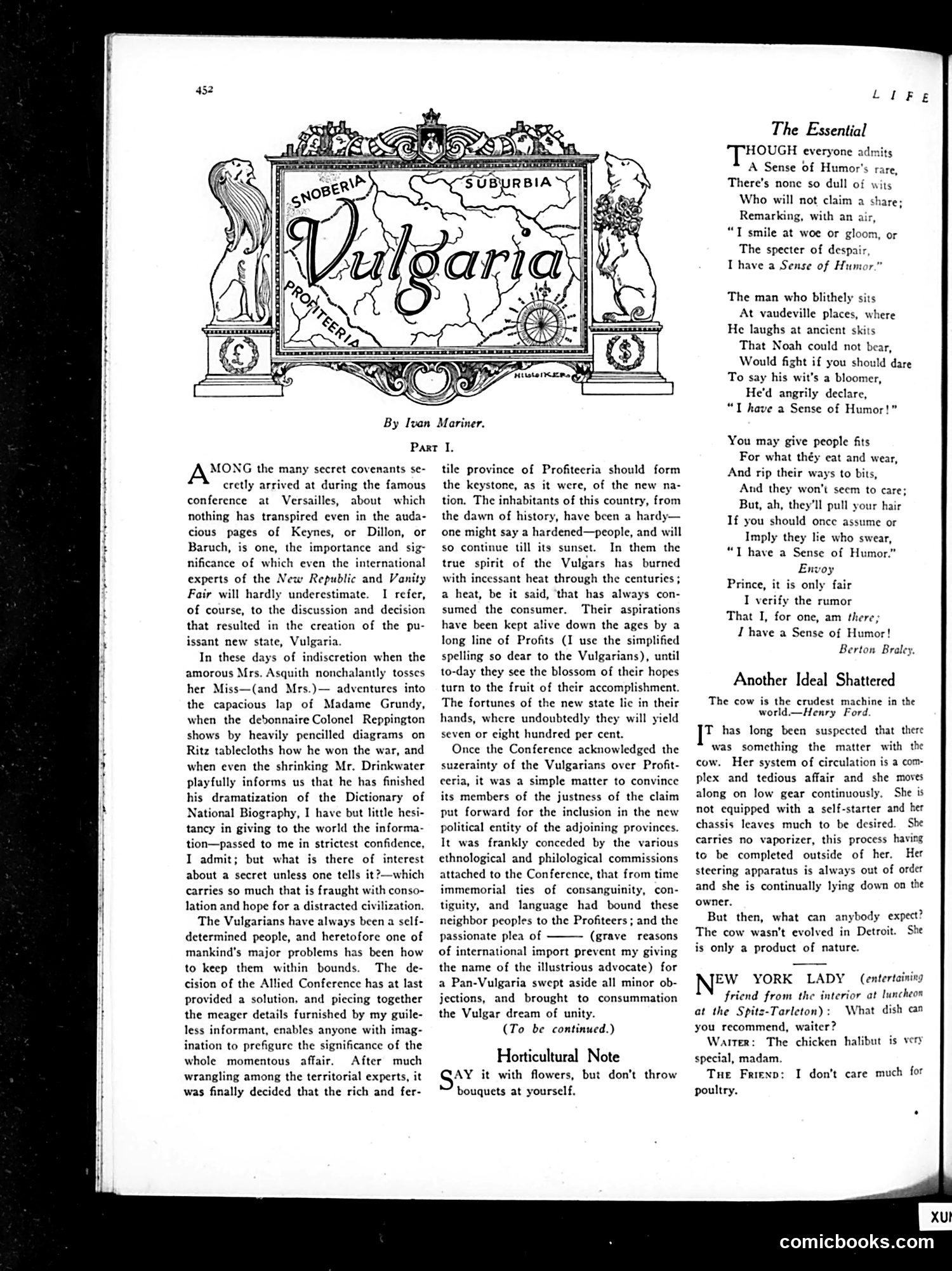
This page contains a satirical article titled "Vulgaria" by Ivan Morimer, Part I, which appears to be a fictional commentary on a new Eastern European state created after World War I. The elaborate decorative header naming "Vulgaria" with regions like "Snoberia," "Suburbia," and "Proleteria" suggests this is imaginary territory used to mock nationalist ambitions and territorial disputes following the 1919 Paris Peace Conference. The satire critiques the "Conference" (likely Versailles) and its complex decisions about new nations, ethnic boundaries, and self-determination. The accompanying humorous verses on the right mock society's pretensions regarding humor and civility. The smaller pieces—"Another Ideal Shattered" about cow machinery and "New York Lady" about food—are typical Life magazine humor sections.
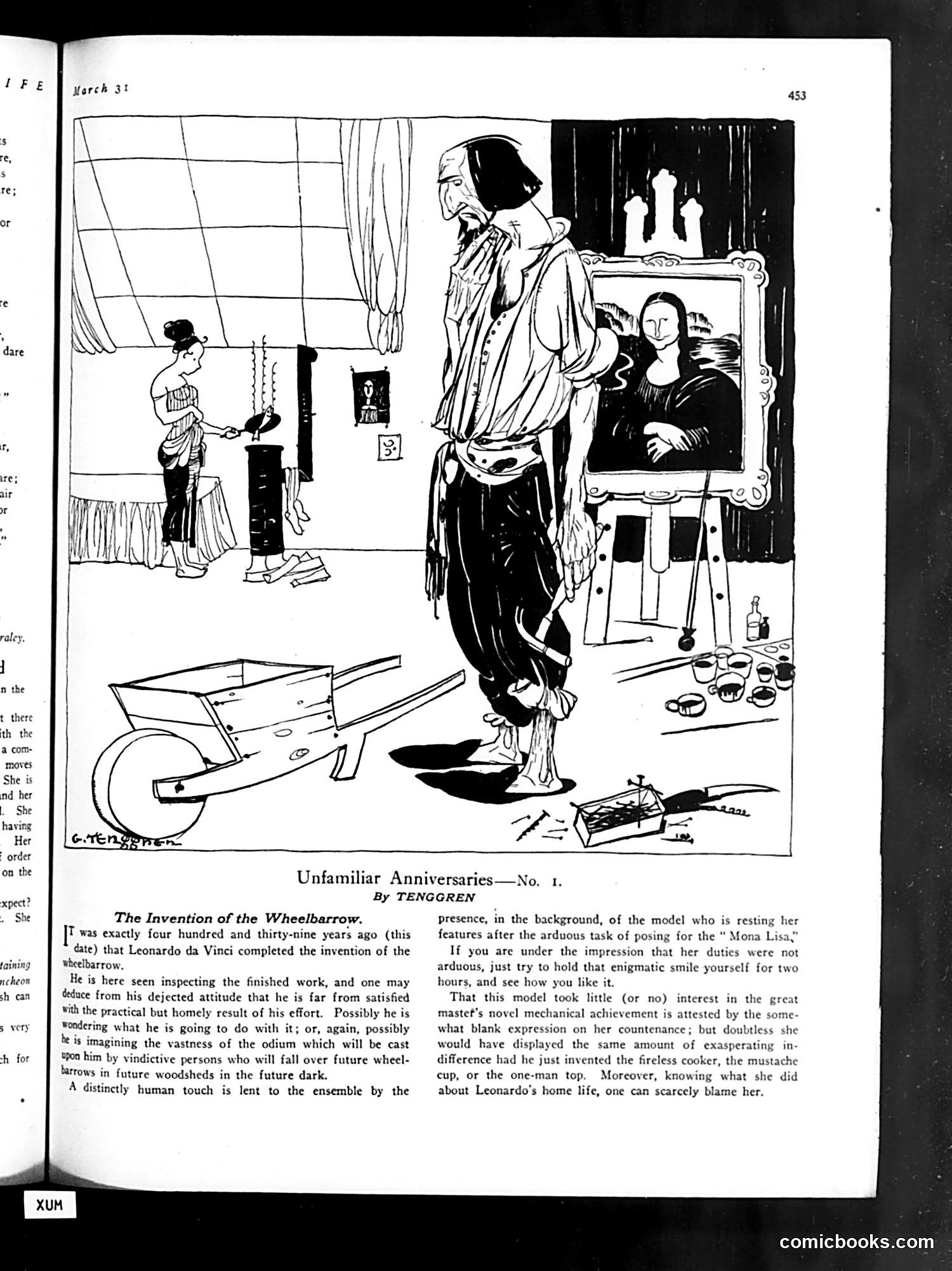
This satirical cartoon by Tengren depicts Leonardo da Vinci inspecting his wheelbarrow invention 449 years prior (dating this article to 1492). The joke centers on **Mona Lisa's exhaustion**: the famous portrait appears framed on the wall behind da Vinci, while a woman in the foreground—presumably the Mona Lisa model—poses irritably surrounded by art supplies and debris. The satire mocks Leonardo's legendary perfectionism and the model's ordeal sitting for his famous painting. The text suggests her "arduous task of posing" was perhaps more burdensome than da Vinci's mechanical inventions. The wheelbarrow itself becomes ironic commentary: while Leonardo created this practical device, his artistic demands left his model literally worn out, suggesting some inventions matter less than others.
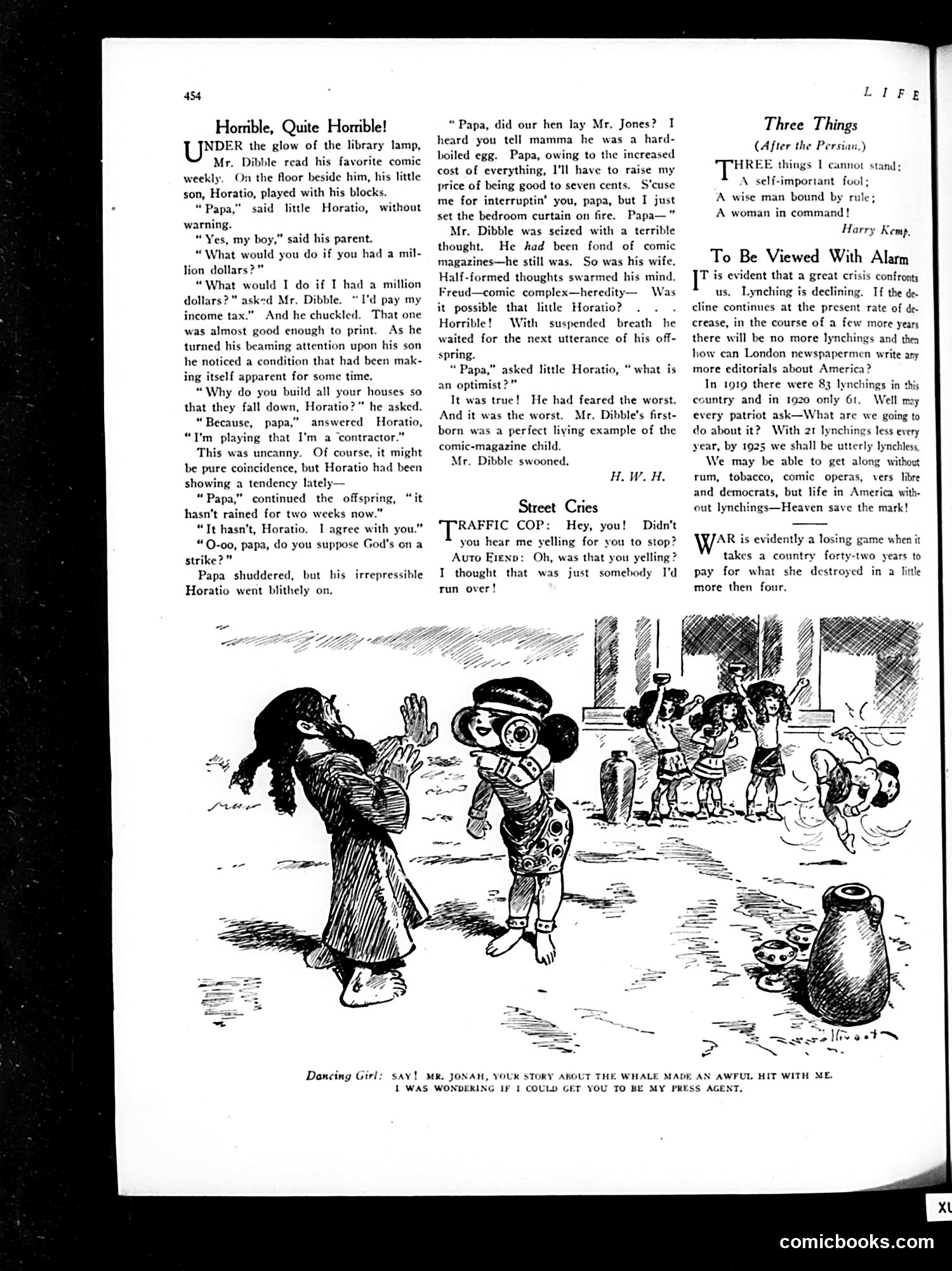
This page contains three separate pieces of humor content: 1. **"Horrible, Quite Horrible!"** - A dialogue-driven story about Mr. Dibble, whose son Horatio reads comic magazines. Mr. Dibble is horrified by the boy's interest in these publications, reflecting contemporary middle-class anxiety about comic books' supposed corrupting influence on children—a major social concern of this era. 2. **"Three Things"** and **"To Be Viewed With Alarm"** - Brief satirical verses about lynching in America, noting the alarming frequency of these incidents (83 in 1919, 61 in 1920) and criticizing newspapers and media for their complicity. 3. **Street Cries cartoon** - A traffic-scene illustration with a dancing girl's caption making a publishing/press-agent joke about the whale story. The page reflects early 20th-century middle-class morality concerns and serious social commentary on racial violence.
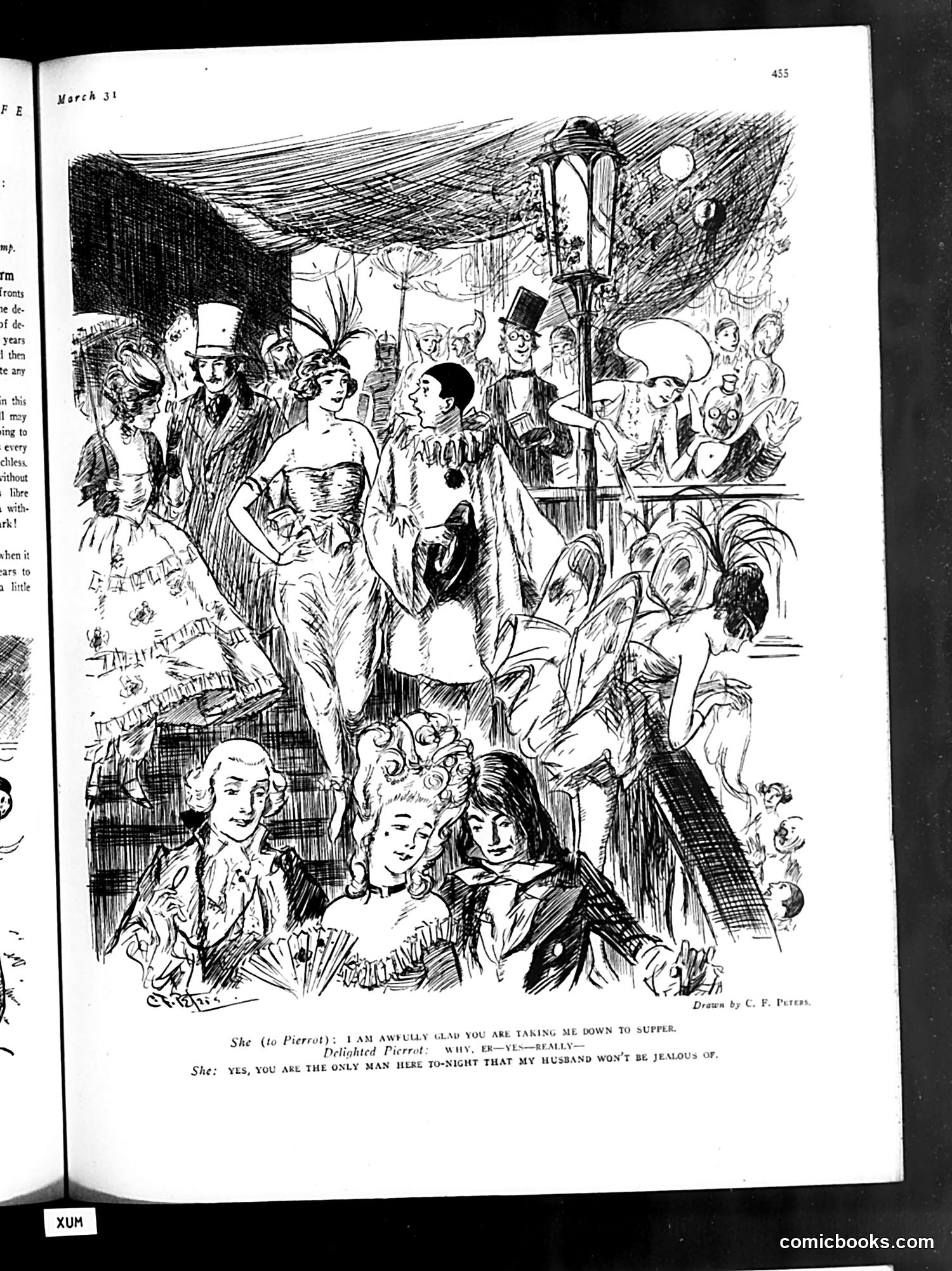
This is a satirical illustration from Life magazine (dated March 31, page 455) drawn by C. F. Peters. It depicts a fashionable social gathering—likely a theatrical or society event—with elegantly dressed attendees in formal wear. The humor centers on a woman's comment to a man named Pierrot. She declares herself "awfully glad" he's taking her to supper, then adds pointedly: "you are the only man here to-night that my husband won't be jealous of." The joke relies on Pierrot being a stock comedic character (from commedia dell'arte tradition)—implying he's either ineffectual, unthreatening, or ridiculous enough that her husband views him as no romantic rival. The satire targets both theatrical pretension and marital jealousy among the social elite.
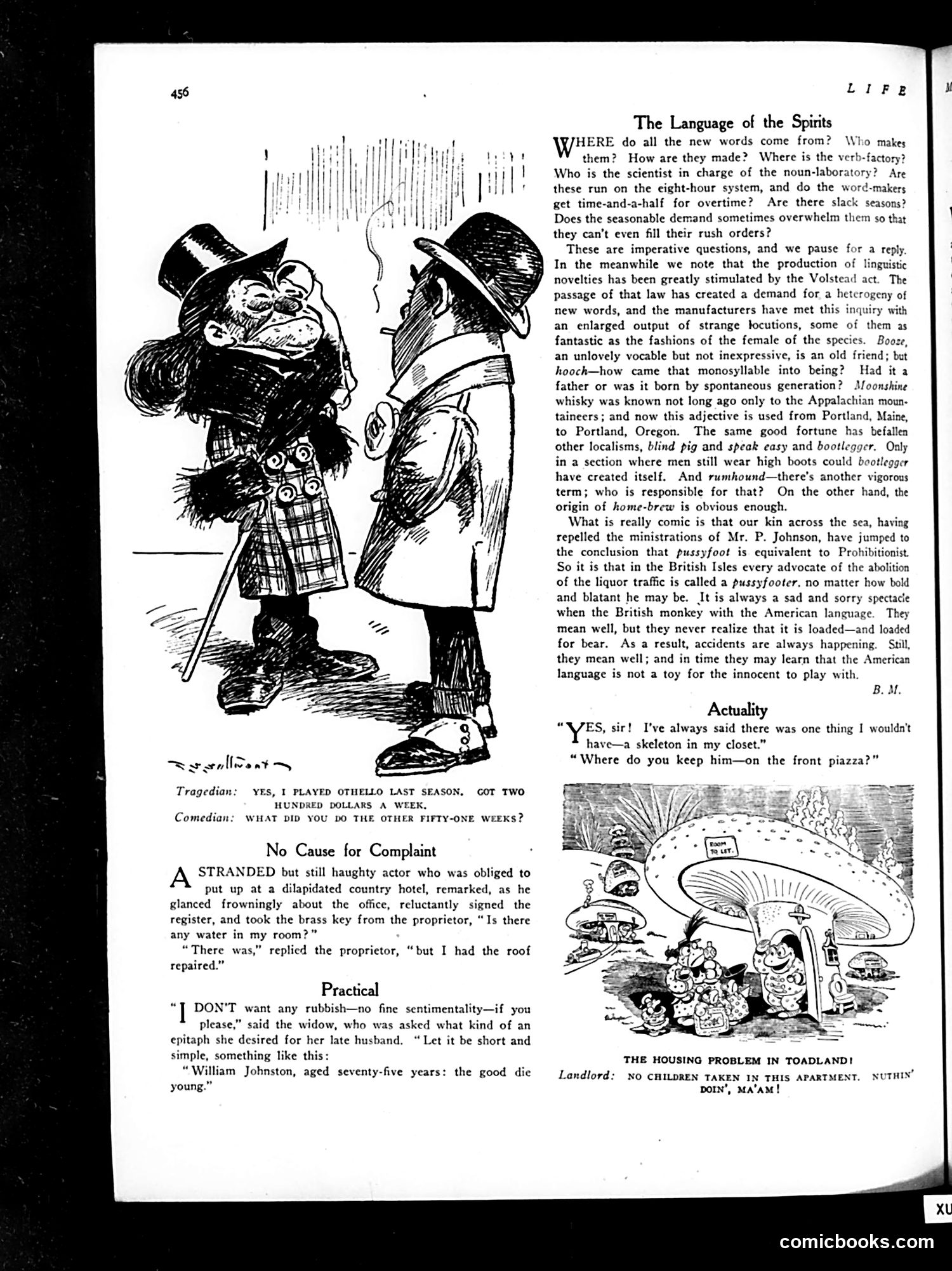
This page discusses how Prohibition (the Volstead Act) has spawned new American slang terms for illegal alcohol: "booze," "hooch," "blind pig," "speakeasy," "bootlegger," and "home-brew." The article notes these words emerged because the liquor trade was driven underground, creating colorful colloquial terminology. The accompanying cartoon shows two well-dressed men in top hats. The "Tragedian" (actor) complains he earned only two hundred dollars weekly; the "Comedian" asks what he did the other fifty-one weeks—implying theatrical work was inconsistent. Below, "No Cause for Complaint" humorously depicts an actor reluctant to sign a hotel register after being told the roof needed repairs—a darkly comedic anecdote about accepting poor conditions.
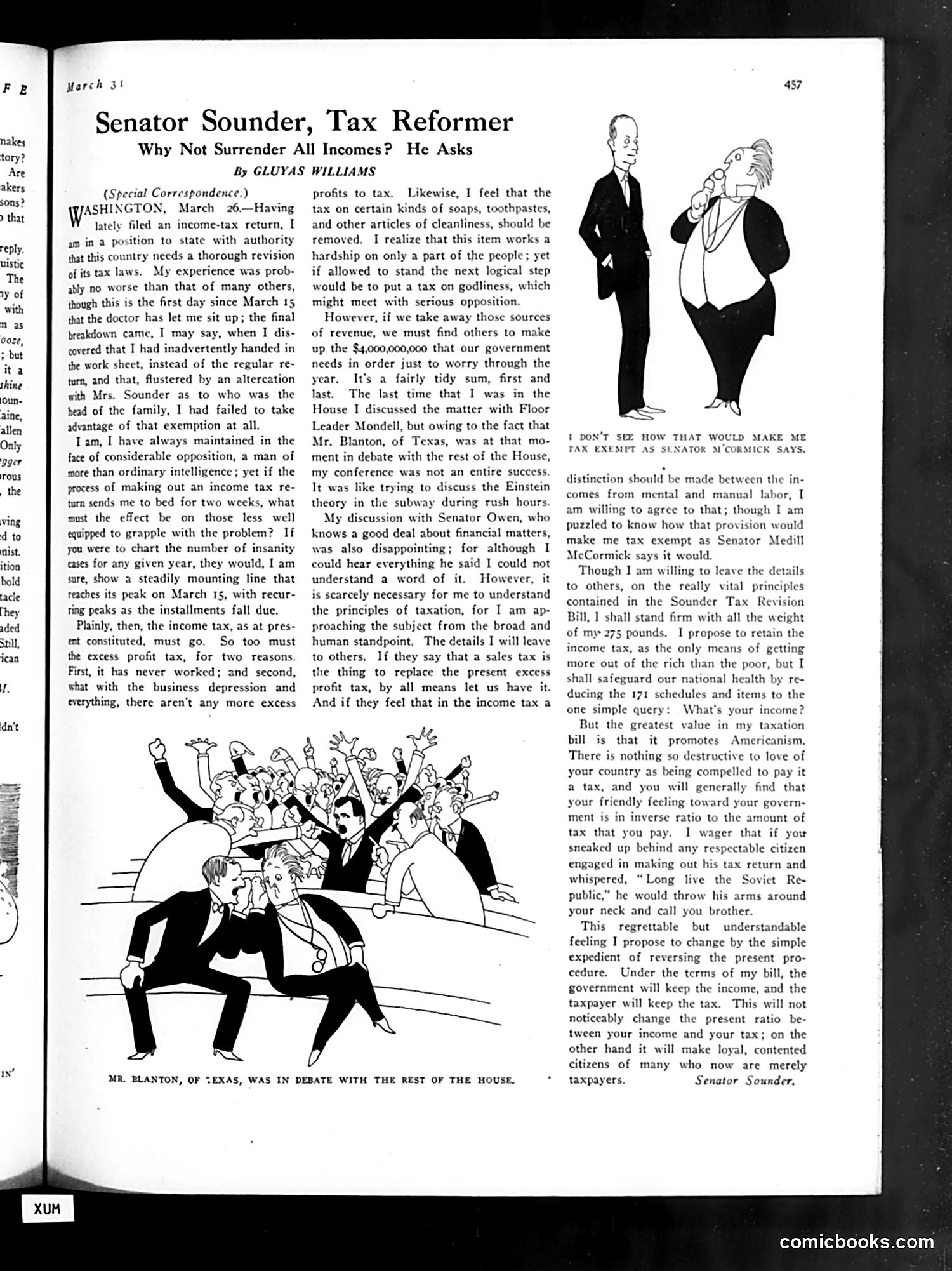
This 1920s satirical piece by Gluyas Williams critiques Senator Sounder's proposal to exempt all incomes from taxation. The large cartoon shows Mr. Blanton of Texas debating tax policy "with the rest of the House"—depicted as a chaotic crowd of politicians gesticulating wildly, suggesting congressional discord over fiscal matters. The article argues Sounder's plan is impractical: removing income tax revenue ($4 billion annually) without replacing it would devastate government operations. The satire mocks the proposal as idealistic but economically naive, comparing it to discussing Einstein during rush hour—timing and feasibility matter. The overall point: radical tax elimination sounds appealing rhetorically but ignores practical governmental needs.
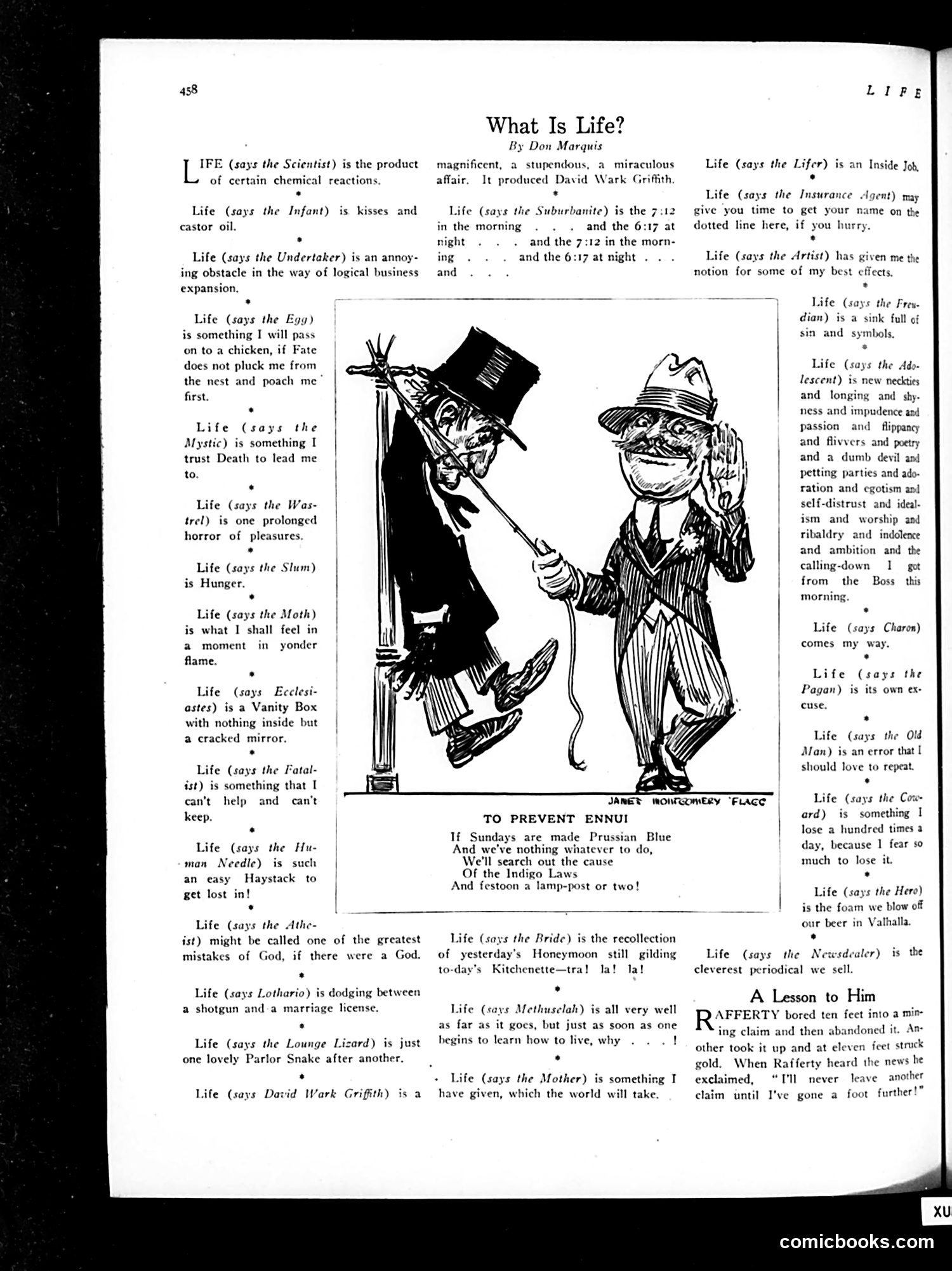
This is a satirical humor piece by Don Marquis featuring multiple philosophical definitions of "life" from various perspectives (the Scientist, the Infant, the Undertaker, etc.). The central cartoon by James Montgomery Flagg depicts two figures in formal attire—appearing to be wealthy gentlemen—with a caption "TO PREVENT ENNUI" referencing the Indigo Laws and lamp-post behavior, suggesting satirical commentary on boredom-driven mischief among the idle rich. The piece mocks different social classes and worldviews through absurdist definitions. Below is a separate short story, "A Lesson to Him," about a character named Rafferty abandoning a mining claim. The overall tone is typical early-20th-century American satirical humor targeting pretension and human folly across social strata.
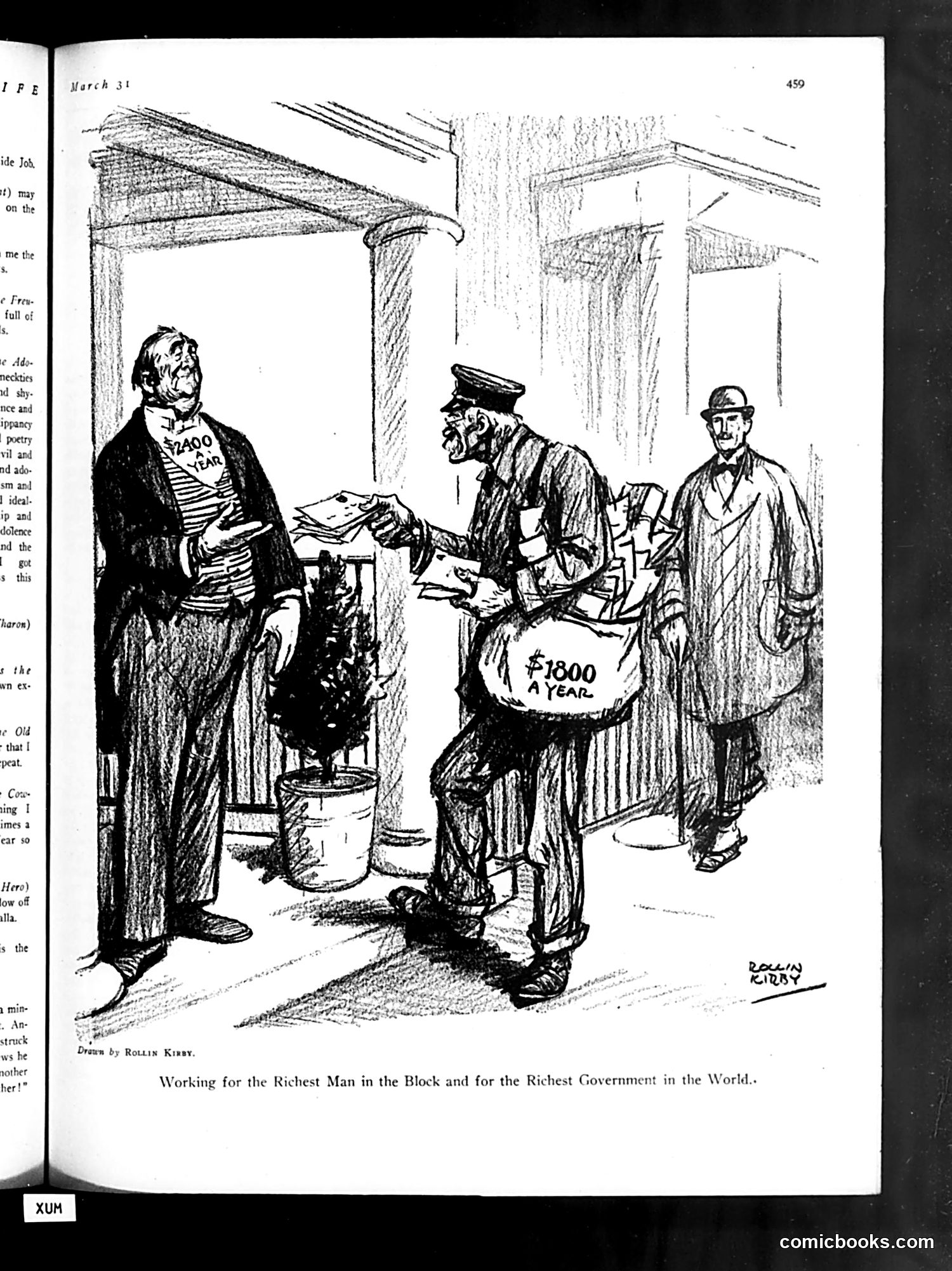
This 1900-era *Life* magazine cartoon by Rollin Kirby depicts a satirical scene titled "Working for the Richest Man in the Block and for the Richest Government in the World." The cartoon shows a well-dressed man (representing wealth/capital) on the left handing money to two working-class men. One worker carries a bag labeled "$1600 A YEAR"—suggesting meager wages despite working for extremely wealthy employers. The satire critiques the economic disparity of the era: workers laboring for both private wealthy industrialists and the prosperous U.S. government receive pittance wages, while their employers accumulate vast wealth. This reflects Progressive-era concerns about labor exploitation and income inequality during America's industrial boom period.
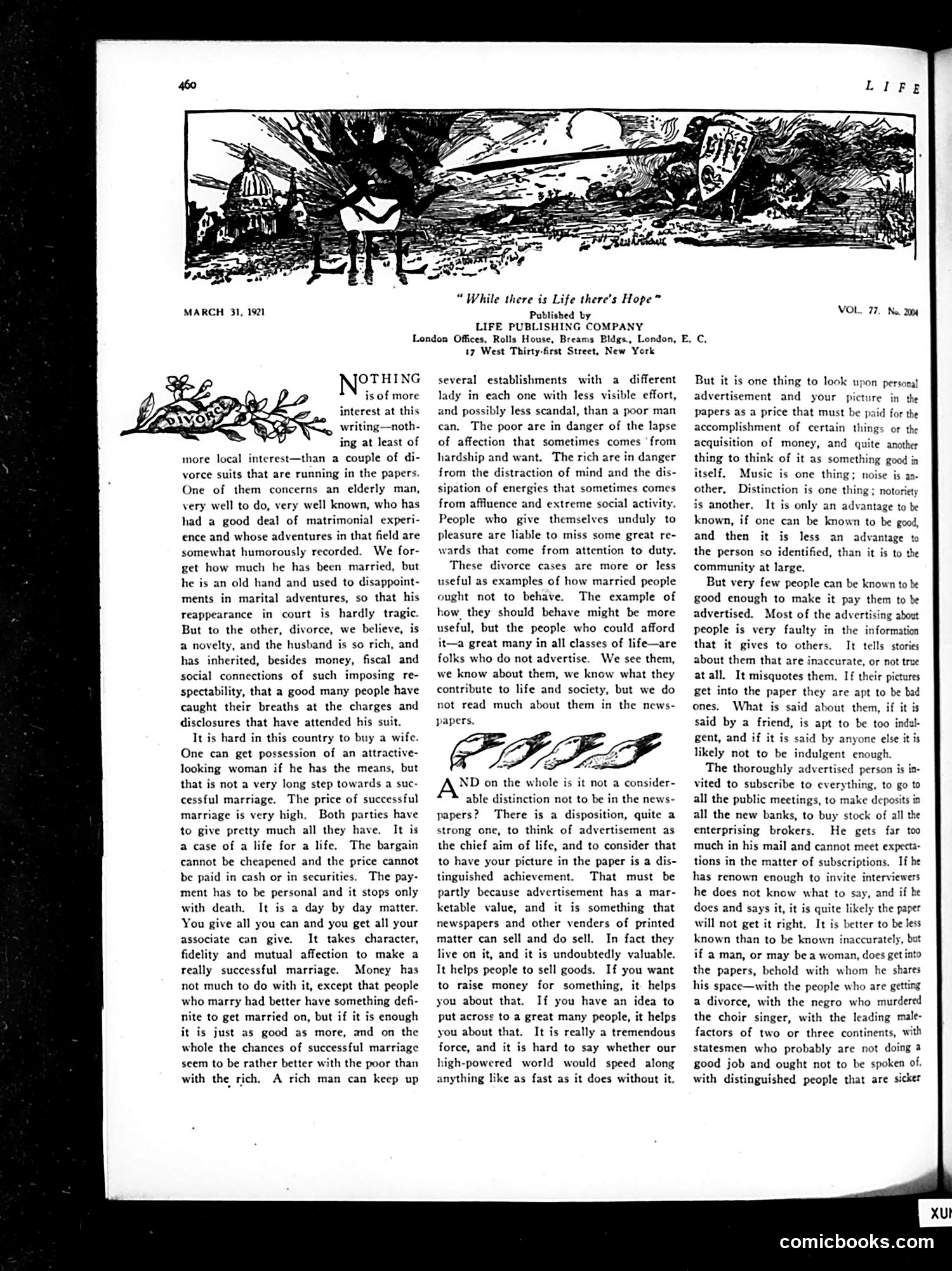
This page contains editorial text rather than political cartoons. The article discusses the social phenomenon of divorce and personal advertisement in newspapers, particularly regarding matrimonial matters. The author argues that while divorce cases involving wealthy or socially prominent people attract newspaper attention, ordinary people's marital troubles should remain private. The piece critiques the growing practice of advertising oneself or one's accomplishments in newspapers to gain public attention or commercial advantage. The editorial suggests this represents a troubling shift toward self-promotion and loss of privacy, warning that excessive personal advertising—whether about divorces, business ventures, or social achievements—reflects poorly on one's character and dignity. The small decorative illustrations are generic ornamental elements, not specific political commentary.
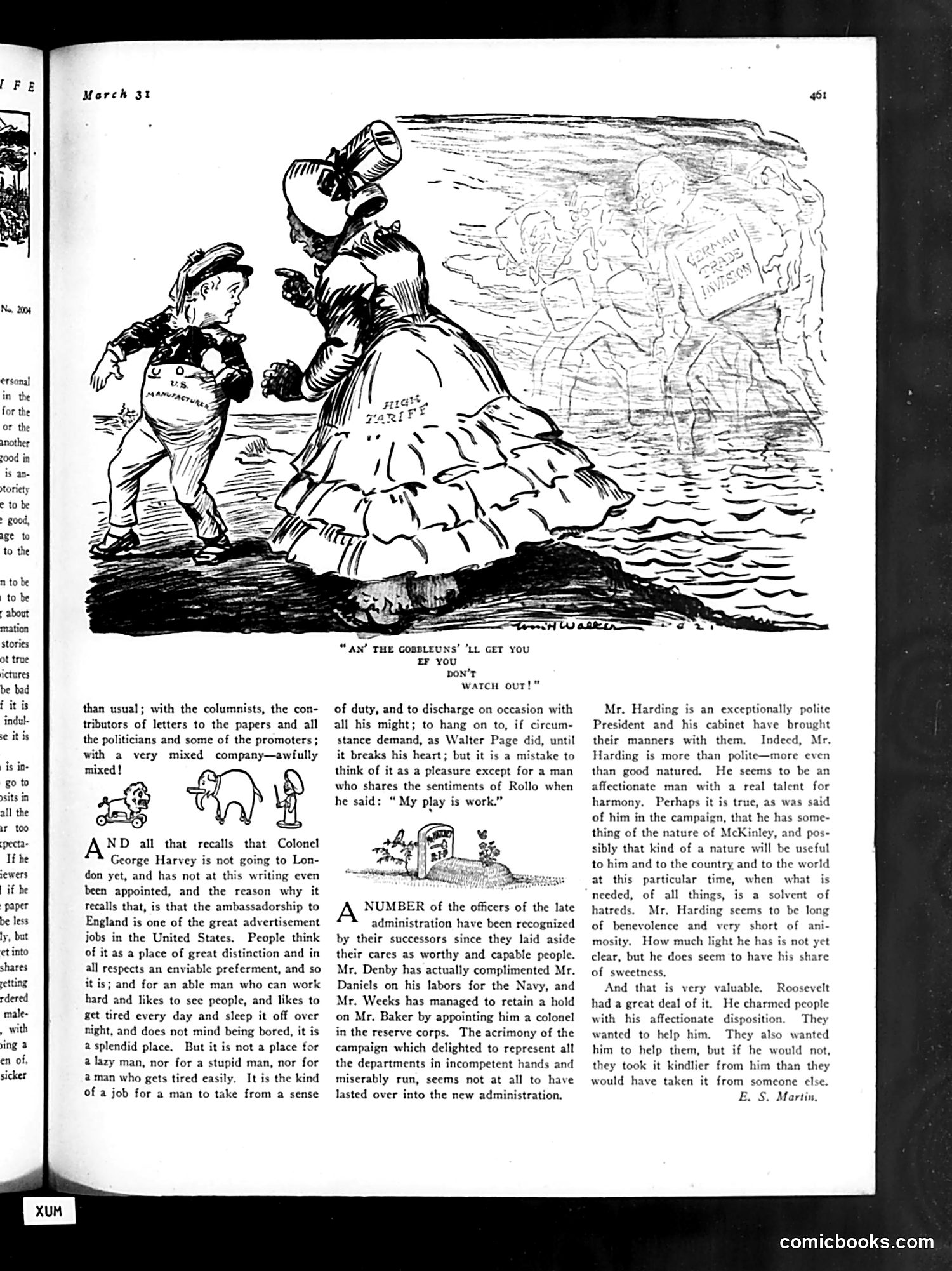
## The Cartoon The illustration depicts a woman in Victorian dress with a child, with text reading "An' the Gobbleuns'll get you ef you don't watch out!" This references James Whitcomb Riley's famous children's poem "Little Orphant Annie," where a character warns children to behave or mysterious creatures will punish them. The cartoon likely uses this as political satire, though the specific target is unclear from the image alone. ## The Text The article discusses President Harding's notably polite demeanor and diplomatic approach, contrasting sharply with the acrimonious 1920 campaign. It praises his "affectionate" nature and talent for "harmony," comparing him favorably to Roosevelt. The writer notes that even members of the previous administration (under Wilson) have been treated with respect by Harding's cabinet—evidence of genuine civility replacing campaign hostility. The piece suggests Harding's sweetness and benevolence may be precisely what the nation needs to resolve "hatreds." The article emphasizes reconciliation and good manners in politics during the early Harding presidency.
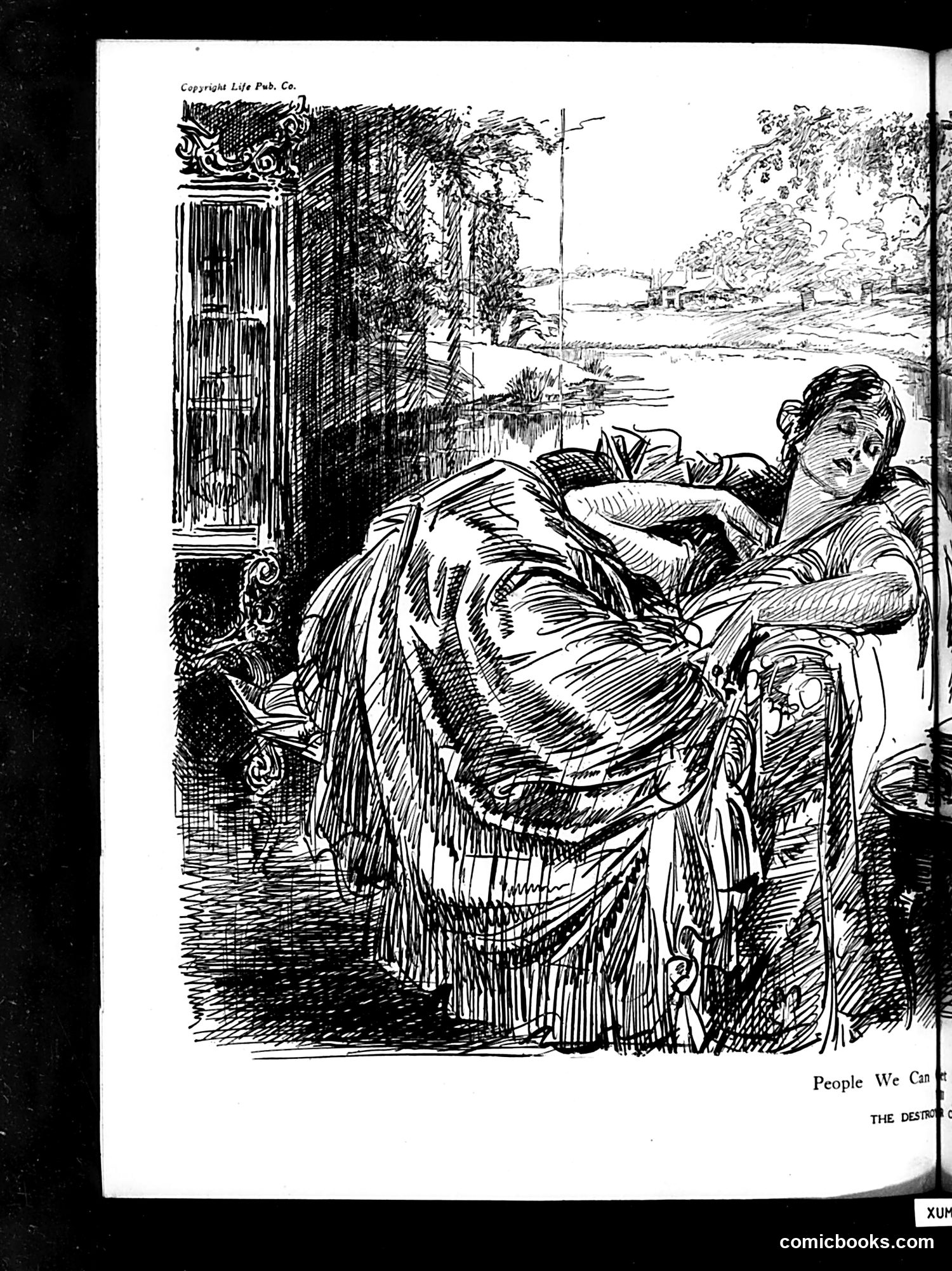
This page shows a detailed ink illustration of a woman in an ornate interior setting, positioned near a decorative doorway with ivy-covered walls visible through an opening behind her. The woman wears an elaborate dress with dramatic drapery and appears to be reclining or posed theatrically. The partially visible text "People We Can" (likely "People We Can Trust" or similar) and "THE DEST[...]" suggest this is part of a satirical feature. However, without the complete caption or surrounding context, I cannot definitively identify the specific figure being caricatured or the precise political or social critique intended. The artistic style and composition suggest early-to-mid 20th century Life magazine illustration, but the fragmentary text prevents me from accurately explaining the satire's target or message to a modern reader.
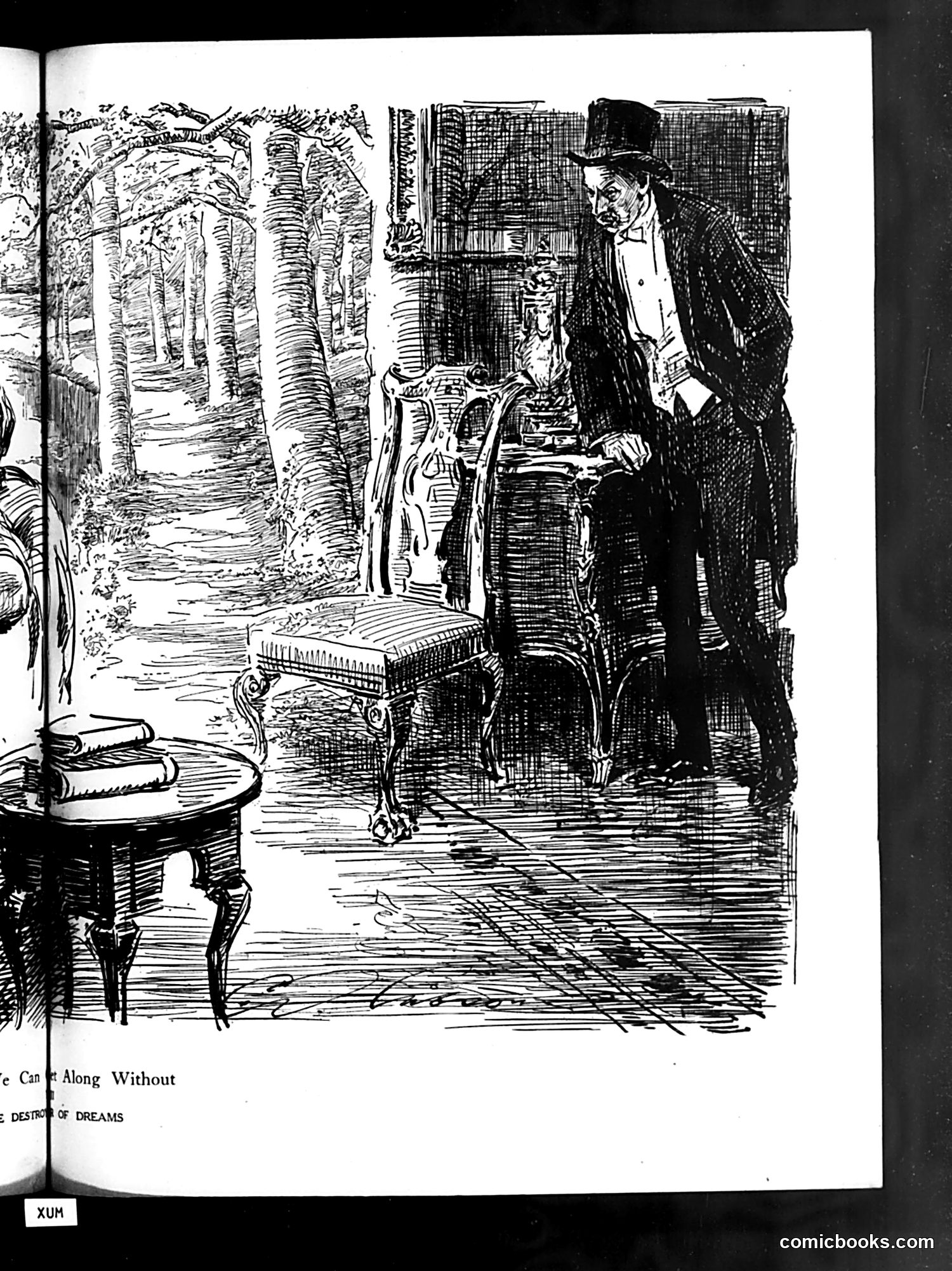
This illustration shows a well-dressed gentleman in formal attire (top hat, suit) examining or working with what appears to be machinery or equipment in an indoor setting. Behind him is a forest landscape visible through a window or doorway. The partial visible text includes "Along Without" and reference to "DESTINY OF DREAMS," suggesting this cartoon comments on themes of ambition, progress, or industrial development. However, **I cannot definitively identify the specific figure or the precise political/social commentary** without seeing the complete caption and surrounding context. The formal dress and mechanized setting suggest commentary on class, industrialization, or technological advancement in early 20th-century America, but the exact satirical point remains unclear from this page fragment alone.
This theater review satirizes the confusion created by two adjacent Broadway theaters—the Apollo and Times Square—that opened simultaneously with different shows ("Love Birds" and "The Right Girl"). The satire centers on **practical comedy of errors**: theater-goers constantly wander into the wrong building between acts due to the lobbies' proximity. The author humorously documents this recurring chaos—couples splitting up, families entering different theaters, people returning sheepishly after arguing with doormen. The piece gently mocks both the **predictable conventions of musical comedy** (the "Love Birds" plot about girls not being like Grandma's era, complete with costumed actresses) and **vaudeville performers** Pat Rooney and Marion Bent, suggesting their fame carries the otherwise formulaic show. The joke culminates when the reviewer themselves becomes confused during intermission, accidentally slipping into the Times Square theater—demonstrating the very problem they've been describing. The humor relies on physical/situational comedy rather than sharp political commentary.
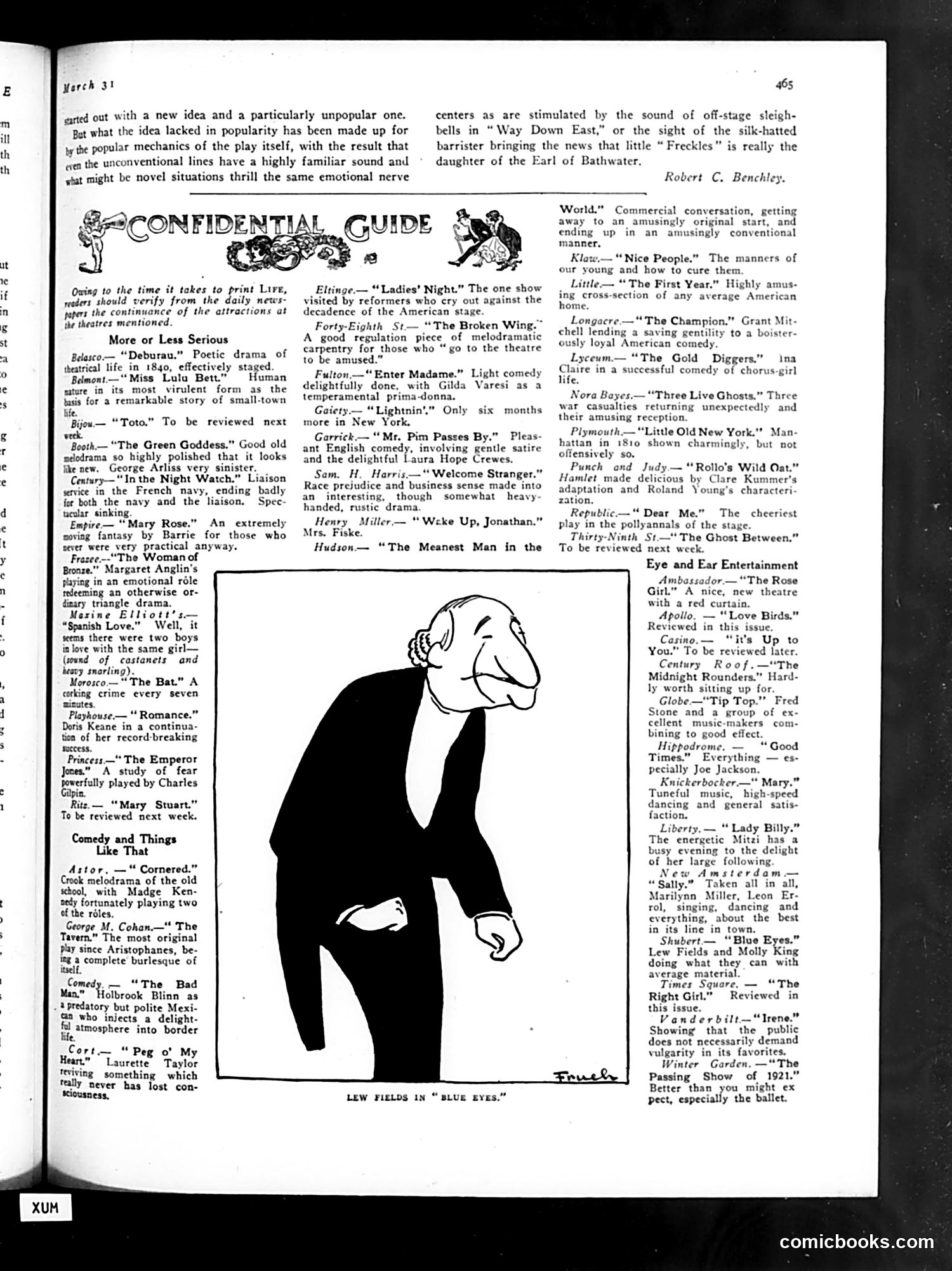
This page from *Life* magazine (March 31, 1921) contains theater reviews and a cartoon titled "Lew Fields in 'Blue Eyes.'" **The Cartoon**: The caricature depicts an exaggerated male figure with a grotesquely large nose and protruding chin, drawn in a style typical of 1920s theatrical caricature. The figure is labeled as Lew Fields, a performer in the play "Blue Eyes." This represents the theatrical practice of physical comedy and broad character work popular in vaudeville and early Broadway. **Context**: The accompanying review section lists current Broadway productions with brief descriptions. The cartoon exemplifies how *Life* magazine used caricature to mock or highlight performers' distinctive physical features as entertainment, reflecting early 20th-century theatrical humor standards that would be considered crude by modern sensibilities. **The Point**: The exaggeration served to promote the show while poking fun at Fields' appearance—typical of *Life's* satirical approach to entertainment coverage.
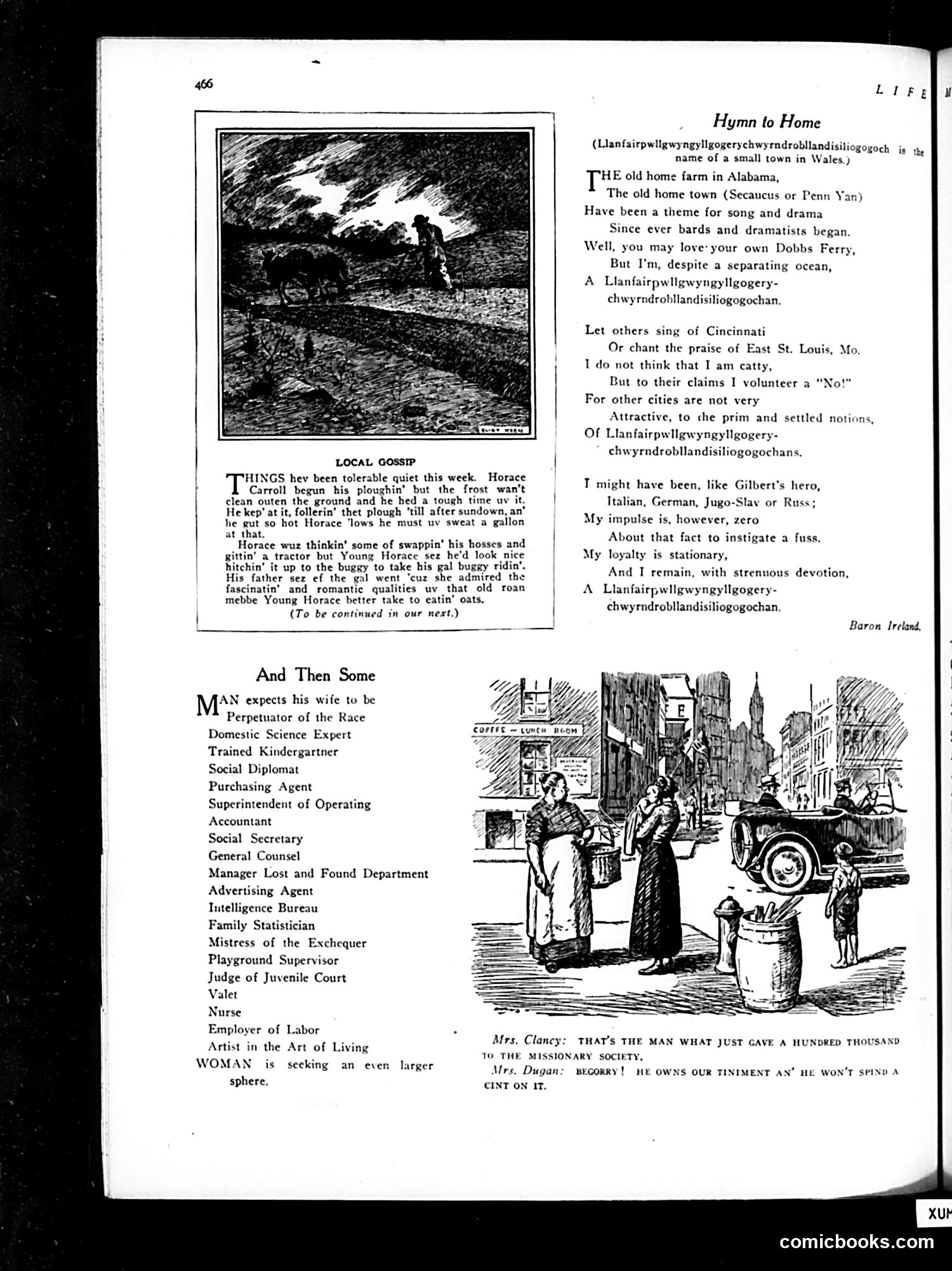
This Life magazine page contains three distinct satirical pieces: **"Local Gossip"**: Rural dialect humor about a farmer named Horace plowing his field and sweating heavily. Young Horace's father jokes that if his son's girlfriend only likes him because of a romantic tractor, she should eat oats instead—a crude rural insult suggesting she's more suited to being livestock. **"Hymn to Home"**: A poem satirizing excessive hometown patriotism. The author humorously defends their loyalty to a Welsh town with an impossibly long, unpronounceable name (Llanfairpwllgwyngyllgogerychwyrndrobllandisiliogogoch—a real place). The joke mocks people who sing provincial towns' praises while dismissing rivals like Cincinnati or East St. Louis. **"And Then Some"**: A satirical list of roles society expects wives to fulfill simultaneously (homemaker, diplomat, accountant, etc.), followed by a cartoon where Mrs. Dugan cynically notes that a wealthy donor won't spend money on their liniment. The satire critiques both unrealistic spousal expectations and shallow charity motivated by business interests.
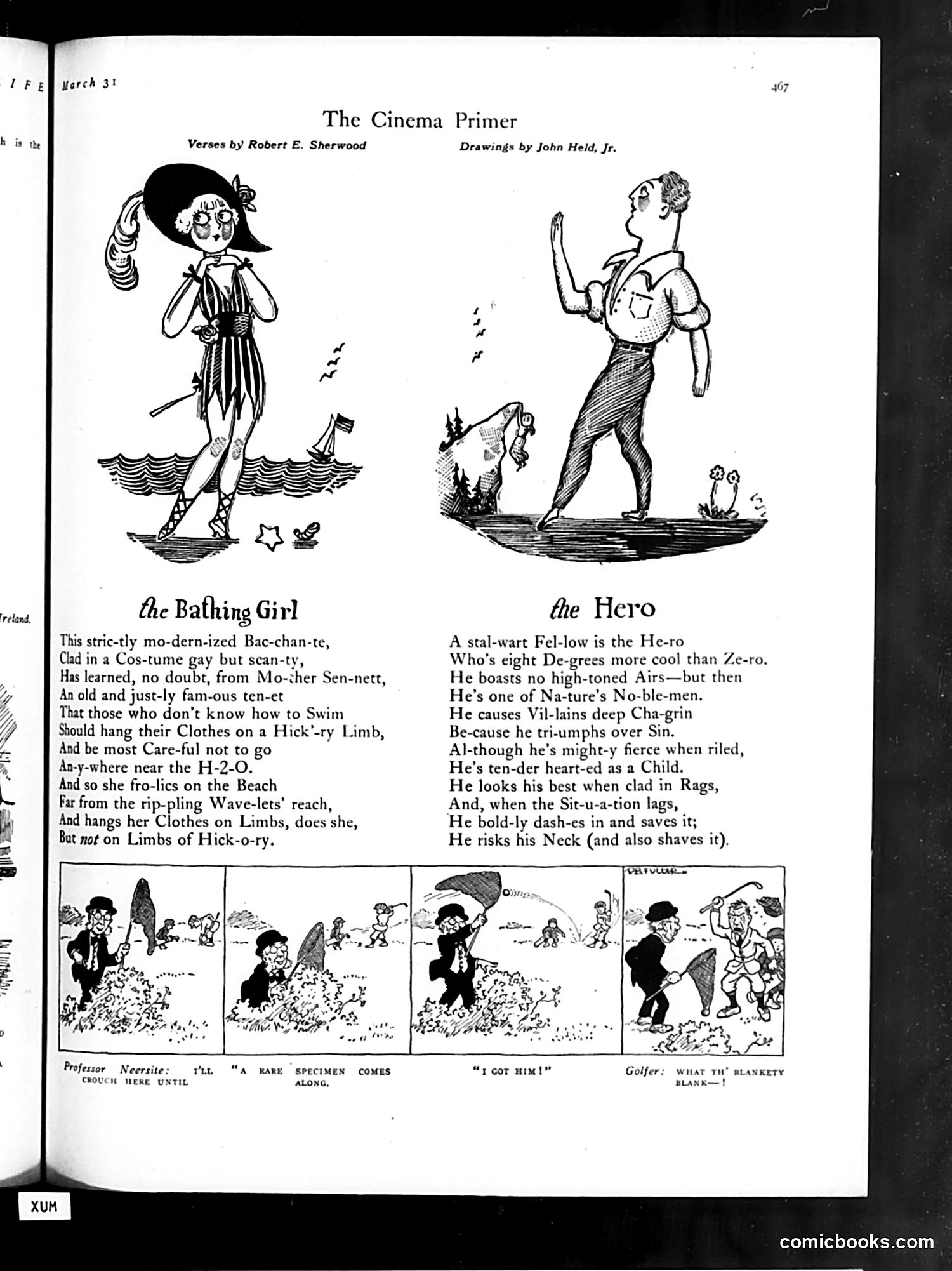
This page satirizes silent film conventions through verses and drawings by Robert E. Sherwood and John Held Jr. **"The Bathing Girl"** mocks the popular bathing beauty genre, referencing producer Mack Sennett's famous swimsuit comedies. The joke: the "modern" flapper wears a scanty costume but ironically avoids water entirely—contradicting the purpose of bathing scenes. **"The Hero"** parodies melodramatic leading men: stoic, virtuous, poverty-stricken yet noble, who rescue situations through bold action. The satirical tone suggests these archetypal characters were already clichéd. The bottom comic strips appear to reference common silent film scenarios—a professor discovering specimens and a golfer's outburst—continuing the mockery of predictable plot devices. The piece reflects 1920s cinema's established visual language becoming recognizable enough to parody, suggesting silent film had already developed standardized character types and storylines.
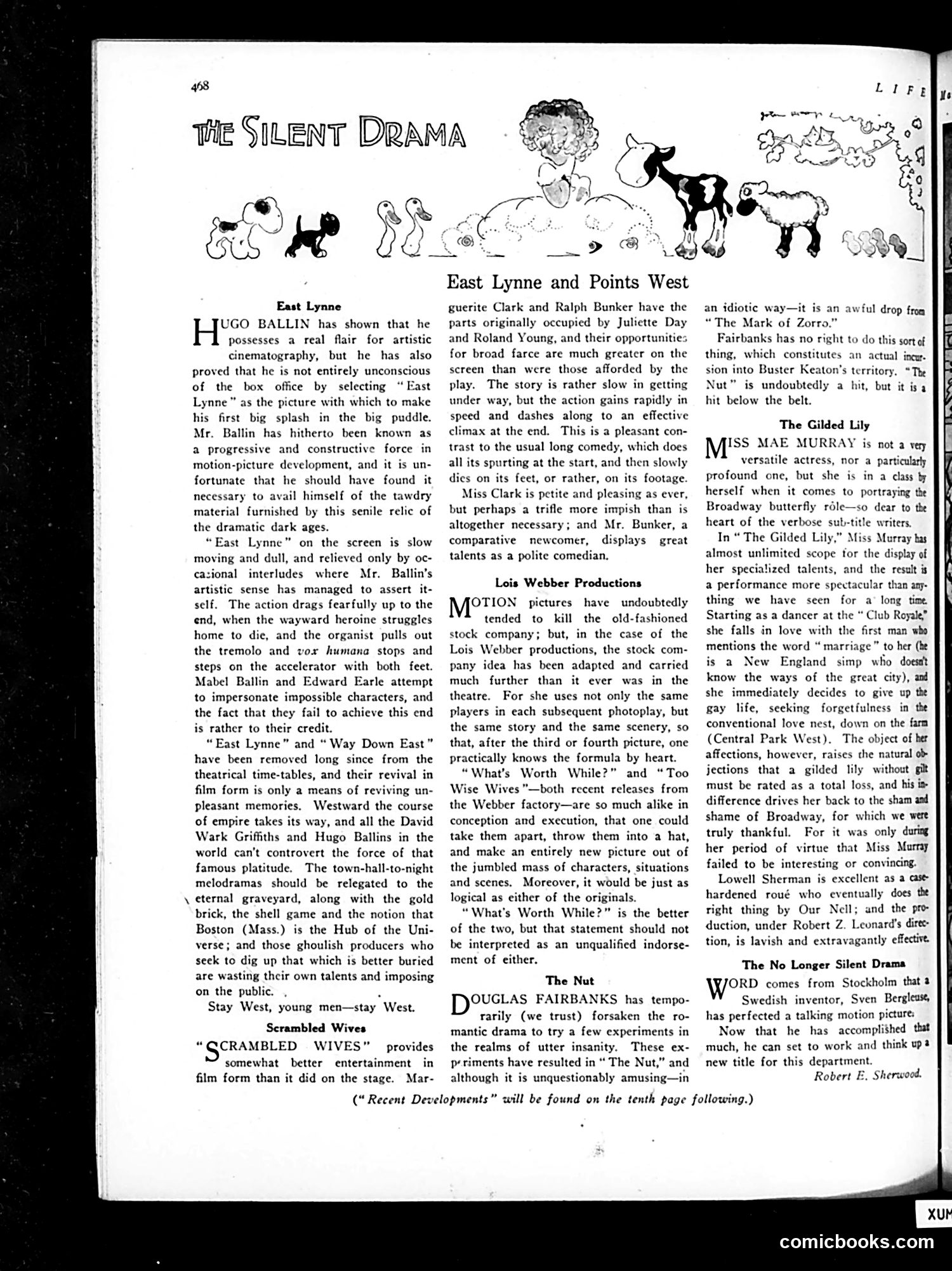
This page reviews several silent films of the era. The top cartoon satirizes outdated theatrical melodramas being revived for cinema. **"East Lynne"** — The critic attacks director Hugo Ballin for adapting this "senile relic of the dramatic dark ages," calling it slow and dull. The review mocks the film's reliance on organ music and melodramatic emotion at the climax. The implicit critique: progressive filmmakers shouldn't resurrect tired Victorian stage plays. **"Scrambled Wives"** — A brief, positive notice praising this adaptation's improvement over its stage version, with actresses Marguerite Clark and Ralph Bunker delivering effective broad farce. **Lois Webber Productions** — The critic satirizes Webber's repetitive formula: she reuses the same actors, stories, and sets across multiple films, making them interchangeable. The reviewer suggests you could shuffle scenes between "What's Worth While?" and "Too Wise Wives" without notice—a cutting indictment of creative laziness masked as economy. The overarching message: cinema should innovate, not recycle worn theatrical material or lazy studio formulas.
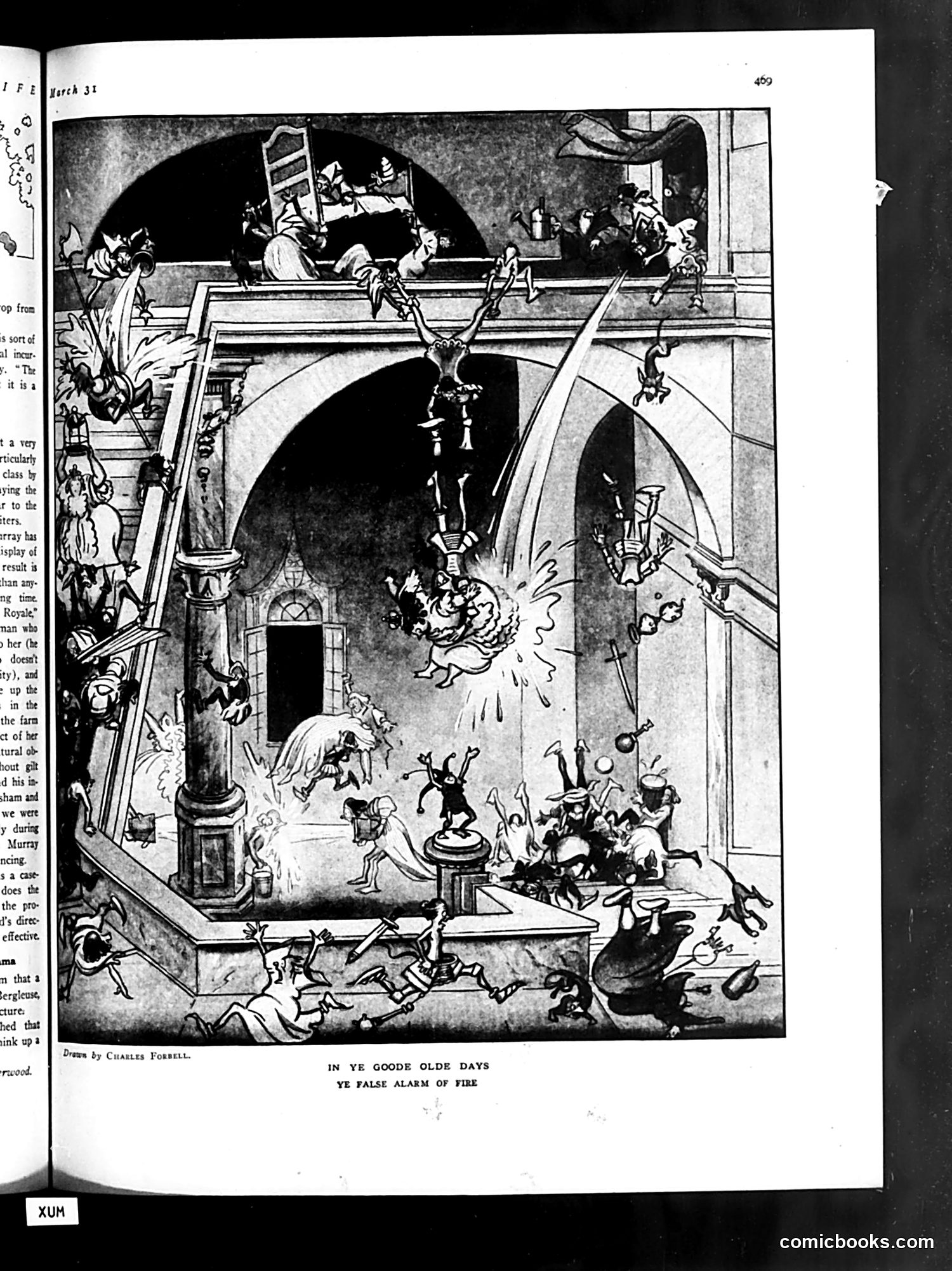
This satirical cartoon by Charles Forrell depicts a chaotic medieval or Renaissance-era fire scene. The drawing shows people in period dress frantically responding to what the title labels a "false alarm"—suggesting the panic is unwarranted. The humor appears to derive from the exaggerated, slapstick chaos: figures tumble from windows and ladders, swing from ropes, and create mayhem while attempting rescue. The architectural setting with vaulted ceilings and formal balconies suggests an important building. The "good old days" framing is ironic—implying that historical periods weren't necessarily better or more orderly than the present. The cartoon likely satirizes contemporary social anxieties or organizational failures by mocking how past generations supposedly handled emergencies with equally ridiculous disorder.
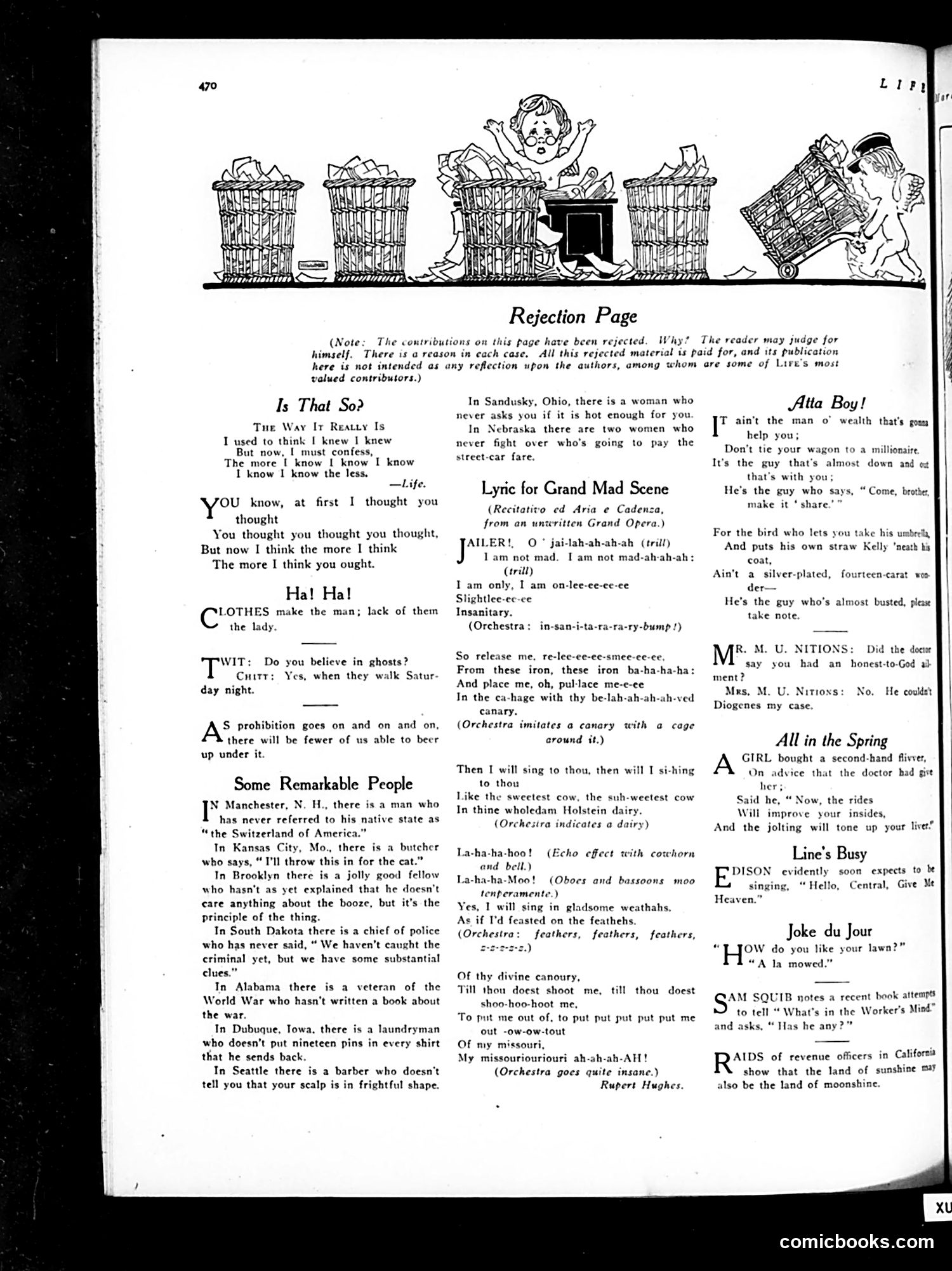
This is Life magazine's "Rejection Page"—a humor section showcasing deliberately rejected submissions. The page demonstrates why each piece didn't meet editorial standards through satirical examples. The top cartoon shows overflowing trash baskets and a cherub amid garbage, visually representing rejected material. The text contains various mild jokes and observations: wordplay about knowledge ("the more I know I know the less"), prohibition-era humor (references to alcohol being banned), and absurdist sketches about remarkably ordinary people (a butcher who gives away scraps, a barber who doesn't exaggerate scalp problems). A longer parody by Rupert Hughes mocks operatic conventions—an "untwritten Grand Opera" with nonsensical lyrics, orchestral sound effects, and melodramatic asylum scenes ("I am not mad"). The humor is deliberately groan-worthy and forgettable—precisely the point. Life's editors are playfully showing readers examples of submissions they rejected, while paying the authors anyway. This transparency about editorial judgment was itself the entertainment.
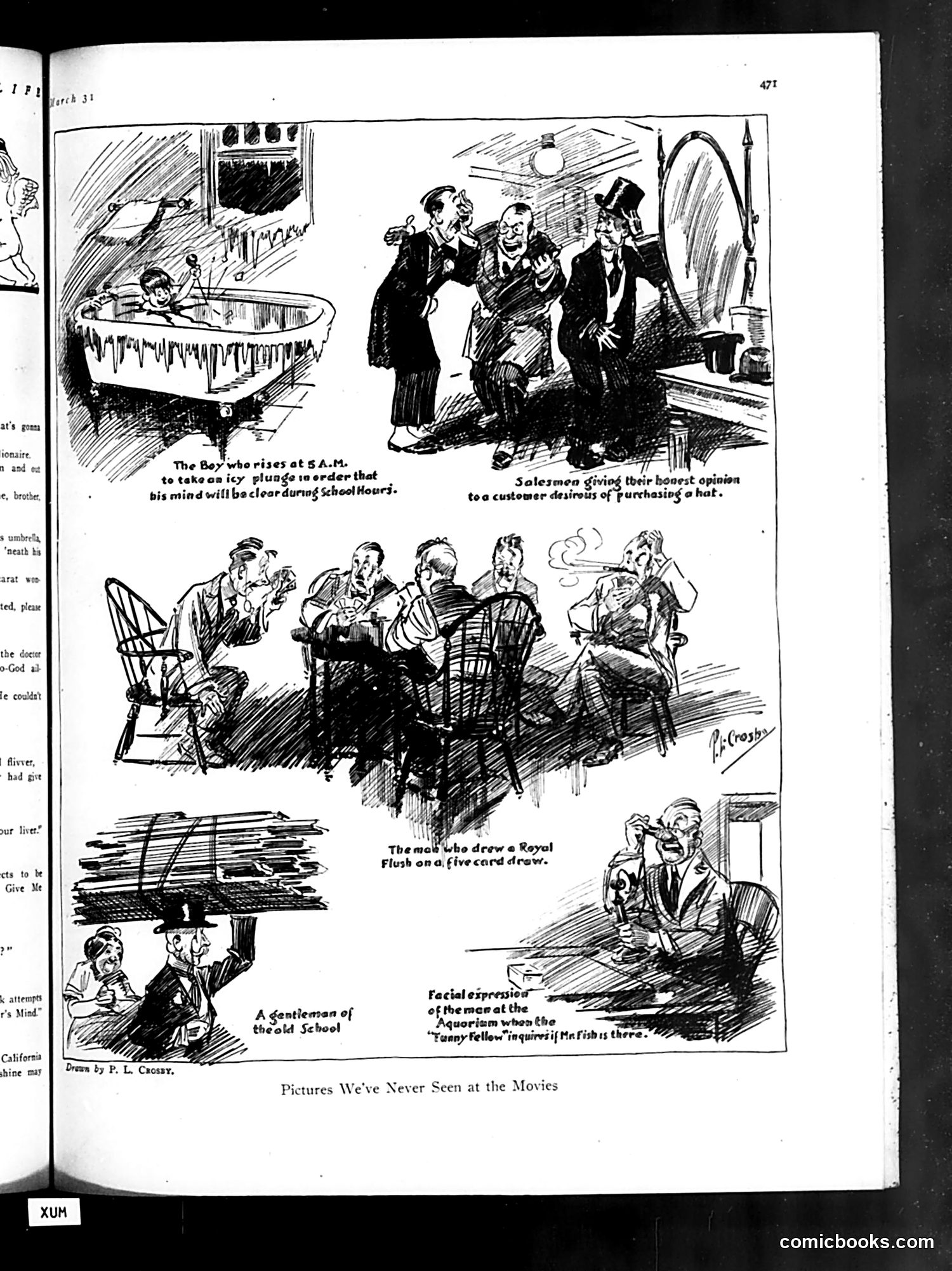
This page of satirical cartoons by P. L. Crosney mocks everyday social pretense and hypocrisy. The top panel ridicules a boy who wakes at 5 A.M. to take an ice plunge, claiming it clears his mind for school—absurd self-improvement theater. The middle cartoon shows salesmen lying to a customer about a hat's quality, satirizing commercial dishonesty. Another depicts men drawing a "Royal Flush" at cards—likely referring to card cheating or gambling deception. The bottom sketches show a "gentleman of the old school" and men's reactions at an aquarium to a "funny fellow," suggesting mockery of social pretension and awkward masculinity. The overall theme: these exaggerated scenarios depict fraudulent, vain, or duplicitous behavior that audiences wouldn't see in sanitized movie entertainment of the era, offering biting social commentary instead.
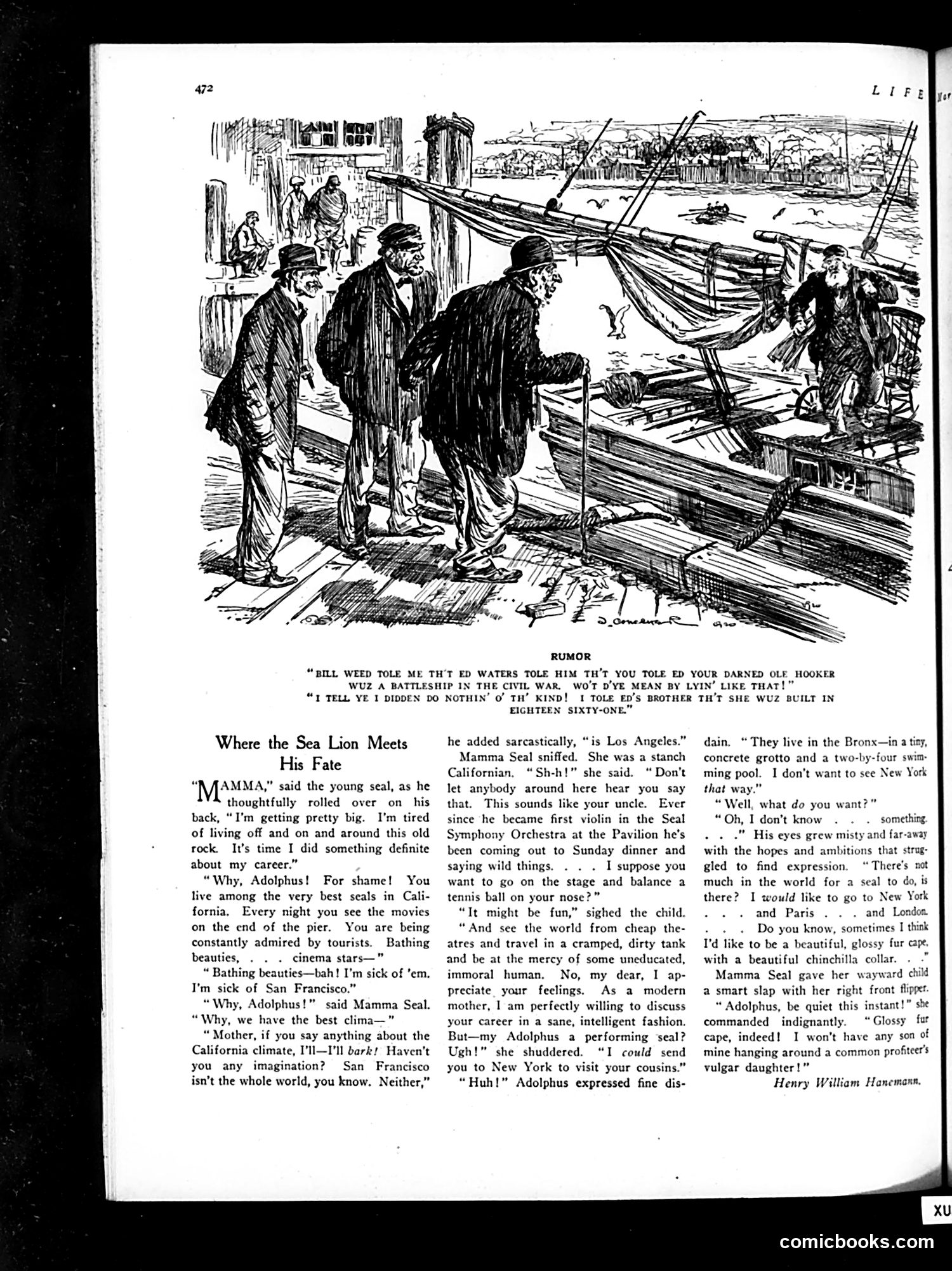
This page contains two satirical pieces from *Life* magazine: **Top: "Rumor"** – A visual joke about how gossip distorts facts. Three men on a dock relay increasingly garbled information about a woman's boat, with each retelling becoming more absurd. The humor lies in the exaggerated dialect and the telephone-game effect of misinformation spreading. **Main Story: "Where the Sea Lion Meets His Fate"** – A allegorical tale satirizing restless youth and parental anxiety. Young seal "Adolphus" complains about his comfortable San Francisco life, yearning for broader horizons (New York, Paris, adventure). His mother embodies provincial contentment and propriety, horrified when he expresses aspirations beyond his station—especially his fantasy of becoming a fur cape, which she interprets as willingness to associate with morally questionable people. The satire targets both youthful ambition and class anxiety: the mother fears her son will lose respectability by chasing dreams or mixing with "profiteers." Written by Henry William Hanemann, it reflects early 20th-century tensions between tradition and modernity.
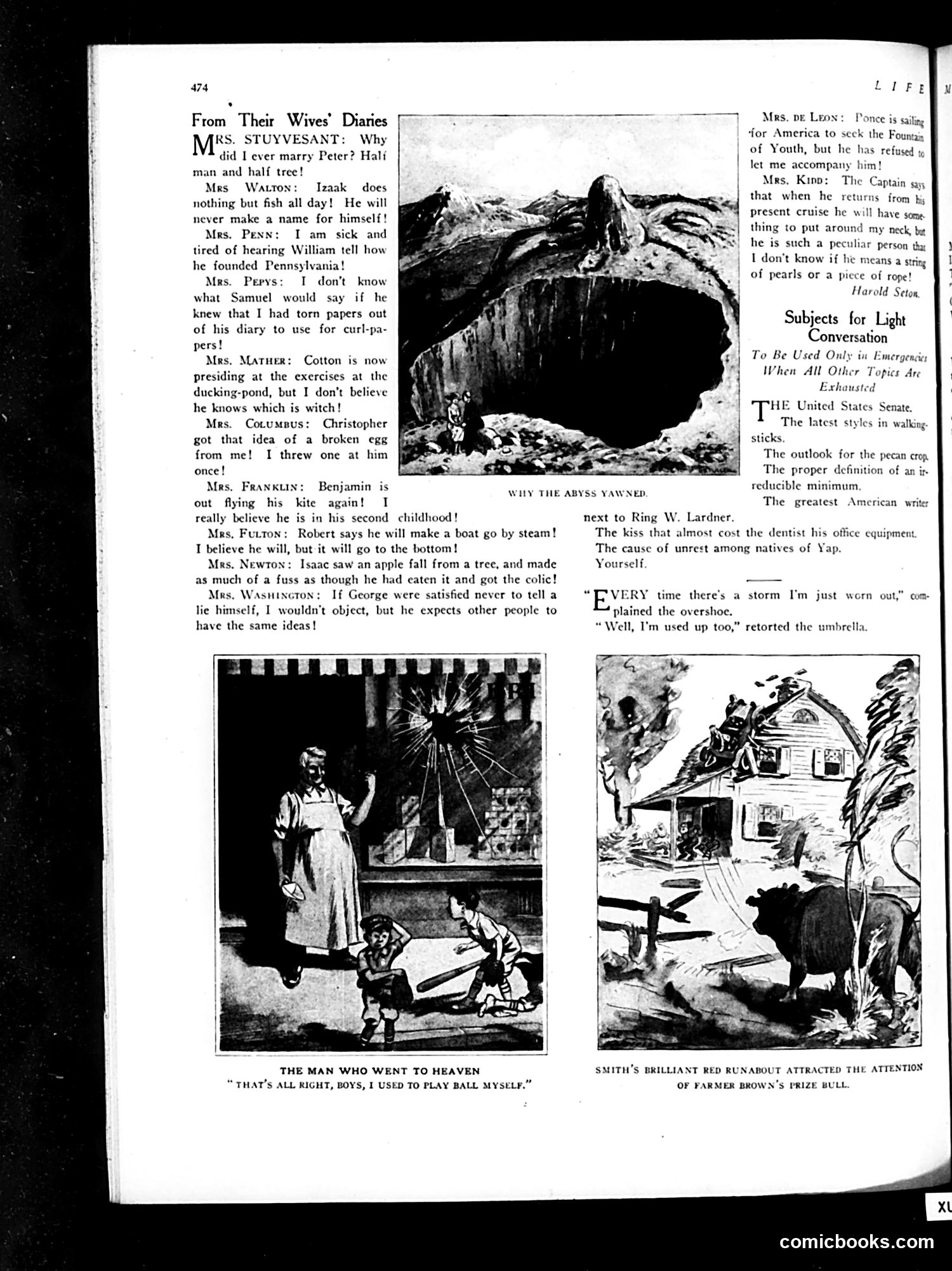
This page satirizes famous historical figures by imagining complaints from their wives. The humor relies on readers recognizing historical names (Peter Stuyvesant, Izaak Walton, William Penn, Samuel Pepys, Cotton Mather, Christopher Columbus, Benjamin Franklin, Robert Fulton, Isaac Newton, George Washington) and their legacies—then subverting expectations by showing domestic annoyance rather than admiration. For example, Pepys's wife allegedly tore pages from his famous diary for curlers; Franklin's wife complains about his kite experiments; Newton's wife dismisses his apple-gravity discovery as excessive fussing. The satire mocks both the glorification of "great men" and suggests their wives endured tedious obsessions. The page also includes unrelated comic illustrations and a humor section on conversation topics, typical of Life's miscellaneous satirical format.
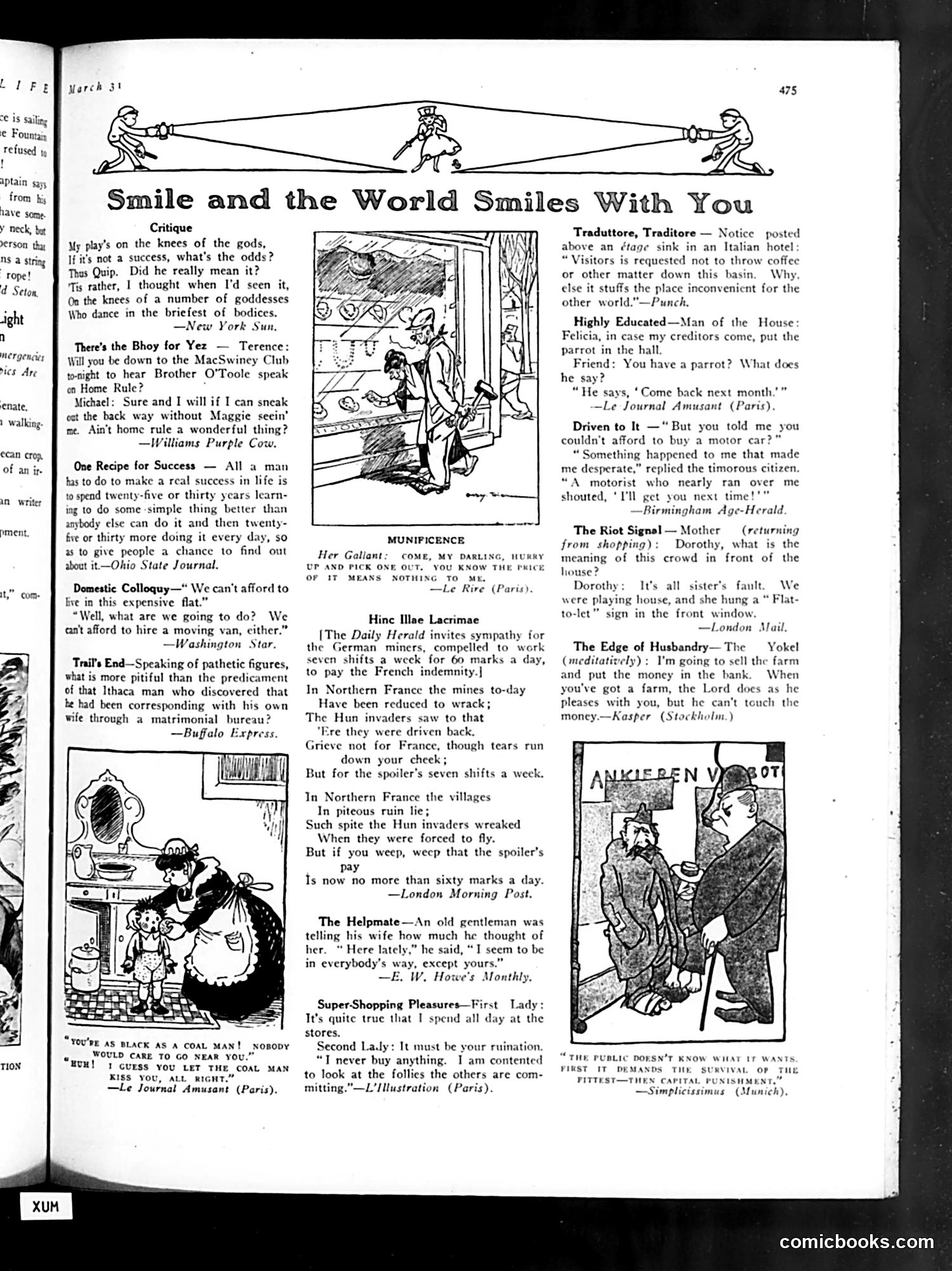
This page is a collection of short satirical jokes and commentary rather than a single cartoon. Key pieces include: **"Hinc Illae Lacrimae"** (the longest piece): This sarcastically criticizes British sympathy for German miners suffering under French reparations after WWI. The London Morning Post ironically suggests readers should pity German workers earning only 60 marks daily, rather than grieve France's war-devastated villages. The satire mocks the absurdity of sympathizing with the aggressor nation's economic hardship while ignoring the victim's destruction. **Other snippets** satirize everyday absurdities: a man unknowingly corresponding with his own wife through a matrimonial bureau; a wealthy woman's compulsive shopping; Italian hotel signs with garbled English; and domestic pretense (hiding a parrot that says "Come back next month" to fool creditors). The cartoons show working-class domestic scenes. The overall tone reflects post-WWI cynicism about human nature and social hypocrisy.
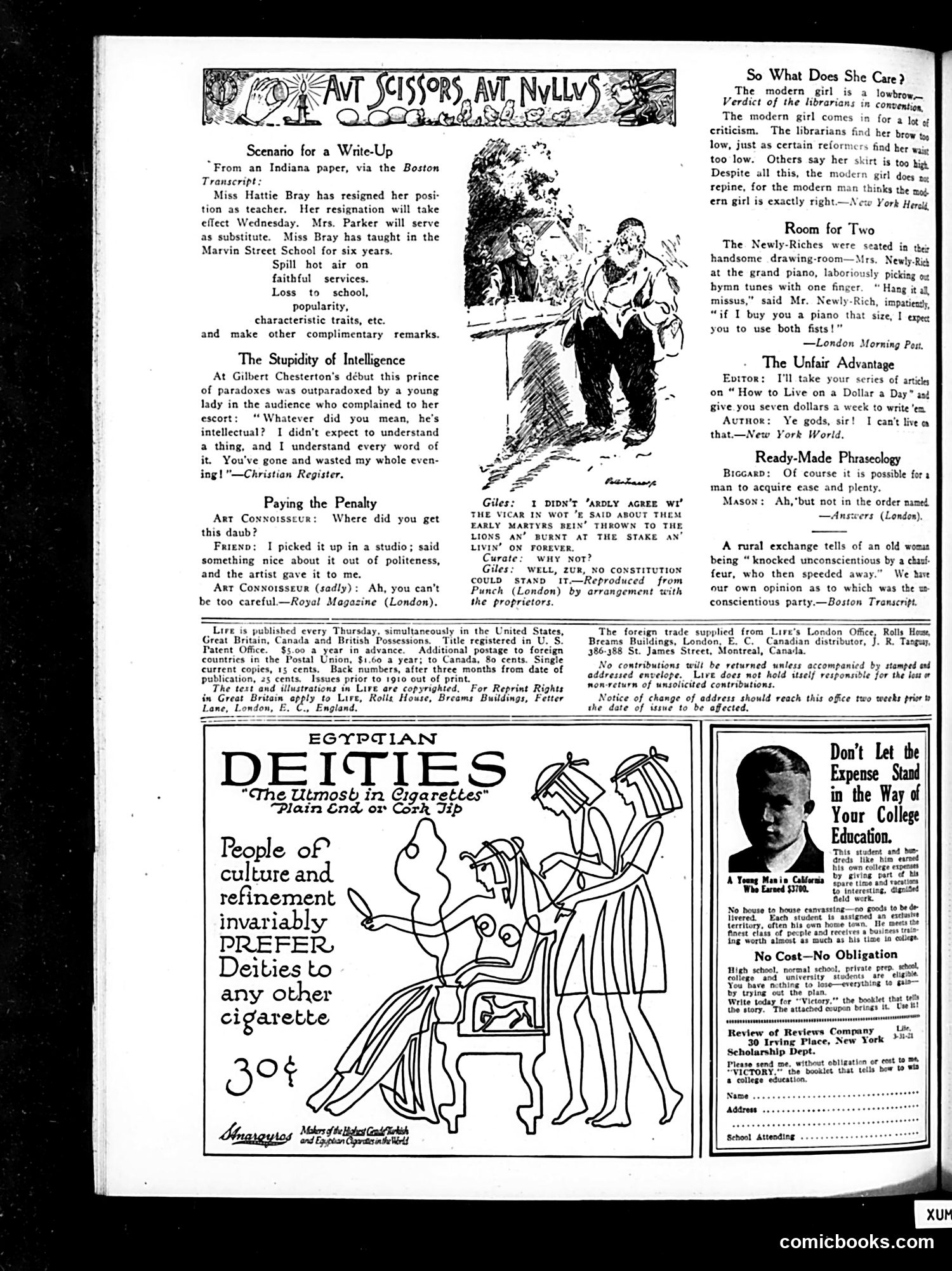
This page from *Life* magazine presents a collection of short humorous pieces and advertisements typical of early-20th-century American satire. The main comic sketches mock social pretension and hypocrisy: "Scenario for a Write-Up" satirizes flowery local newspaper obituaries; "The Stupidity of Intelligence" jokes about an audience member who understood Chesterton perfectly, defeating his purpose; and "Paying the Penalty" warns against insincere compliments—an artist gives away a painting after someone falsely praised it. Other brief items critique modern life: the "modern girl" faces criticism from librarians and reformers despite remaining unbothered; newly wealthy people lack refinement (attempting piano with "both fists"); and writers struggle financially despite offering practical advice. The dialogue pieces, sourced from *Christian Register* and *Punch*, use working-class speech patterns for humor. The **Egyptian Deities cigarette advertisement** (bottom left) uses classical imagery to suggest sophistication and cultural refinement as marketing appeals—ironic given the page's surrounding mockery of pretension.
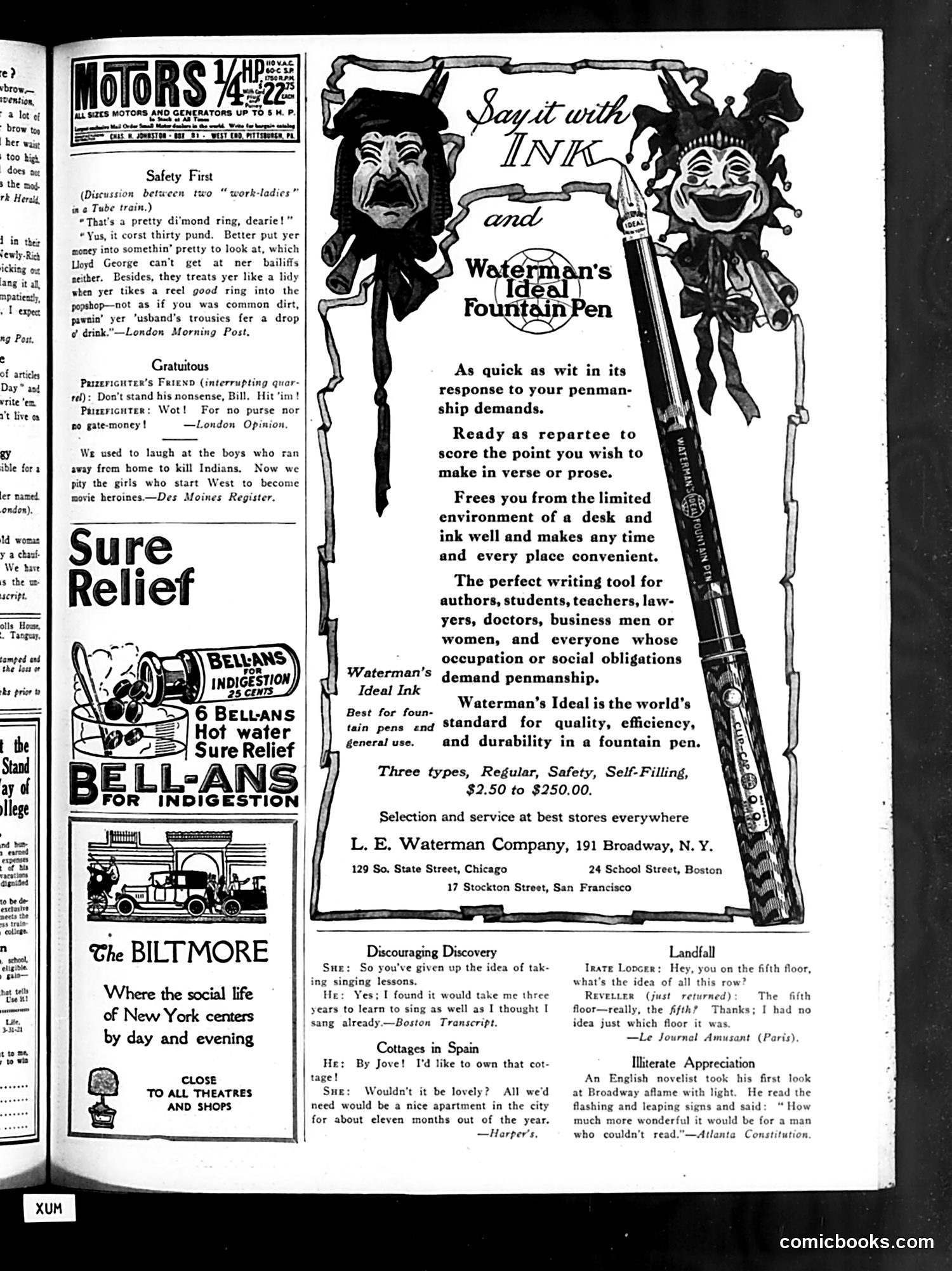
This page contains multiple satirical sections typical of early 20th-century Life magazine: **"Safety First" cartoon**: Two working-class women on a London train discuss a diamond ring. One argues it's smart to buy jewelry rather than save money, since "Lloyd George can't get at" it (referencing British tax policy) and pawn shops treat women respectfully—unlike how husbands are treated when pawning clothes for drinks. The satire mocks working-class financial desperation and marital dysfunction. **"Gratuitous" and other brief jokes**: Short quips about domestic disputes, male infidelity, and social pretension typical of the era's humor. **Waterman's Fountain Pen Advertisement**: The large illustrated ad features comedic theatrical masks promoting the pen as ideal for writers and professionals. **"The Biltmore" theater advertisement**: Notes the venue's social prominence. **Brief jokes at bottom**: Commentary on failed singing lessons and an Englishman's appreciation of Broadway's bright lights, with the punchline that illiterate people would enjoy them even more—mild satire on commercialism and lowbrow entertainment. The page reflects period attitudes toward class, gender, and consumer culture.
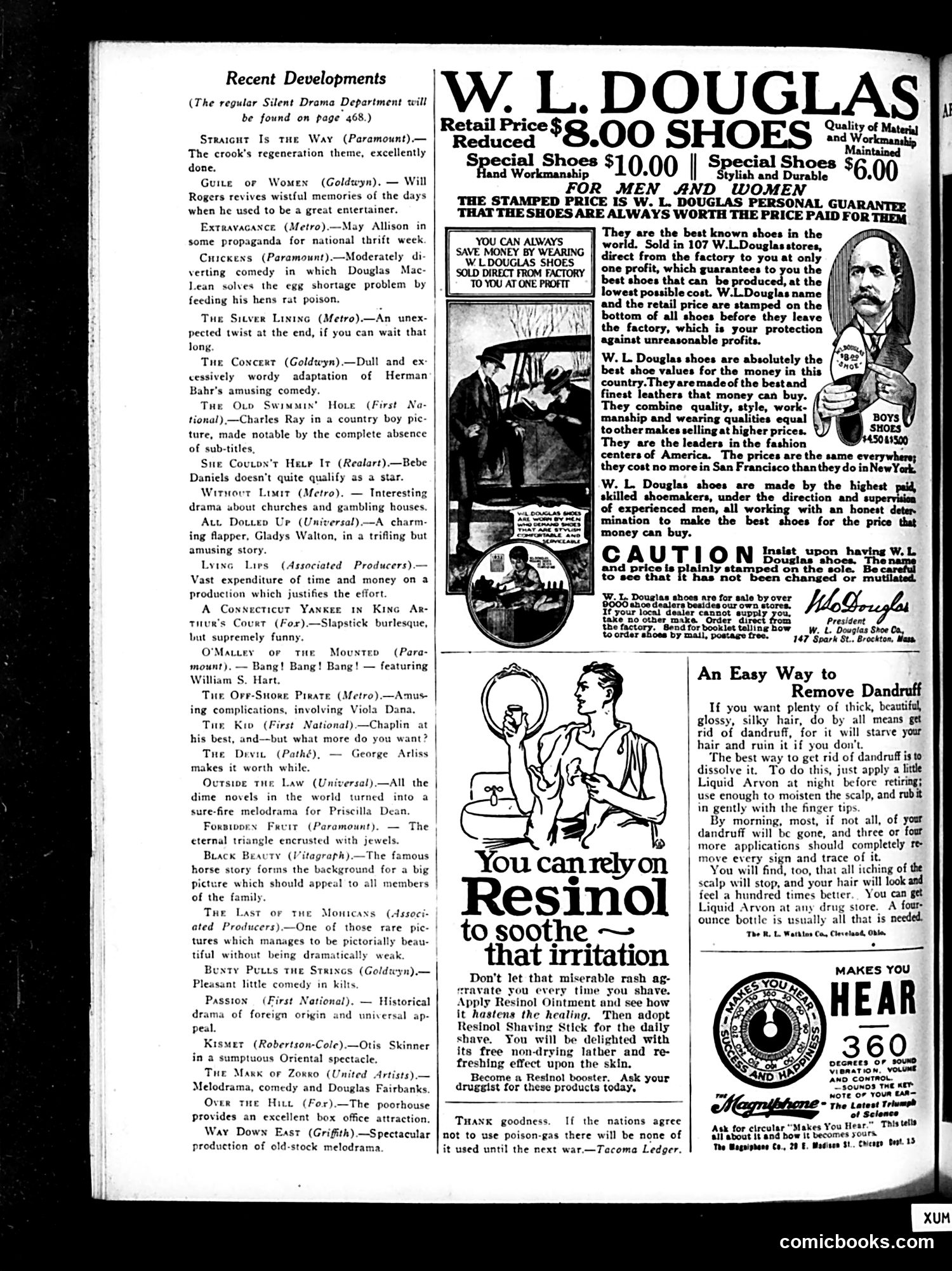
This page primarily consists of **film reviews and advertisements** rather than political cartoons. The "Recent Developments" section reviews silent films from major studios (Paramount, Metro, Goldwyn, etc.), offering brief critical assessments of movies featuring contemporary stars like Will Rogers, Douglas Fairbanks, and Chaplin. The dominant visual content is **W.L. Douglas shoe advertising**, featuring the company president's portrait and claims about factory-direct sales eliminating middleman profits—a common early 20th-century marketing pitch emphasizing value and authenticity. Secondary advertisements include **Resinol ointment** (for dandruff) and **Magnatone hearing aids** ("Makes You Hear 360"). The film reviews reflect 1920s cinema conventions: comedies, melodramas, and Westerns dominate. References to "sub-titles" and "crook's regeneration" themes indicate silent film era concerns. Overall, this is a **commercial page** blending entertainment criticism with consumer goods marketing typical of 1920s magazines.