
Life, 1921-03-31 · page 20 of 34
Life — March 31, 1921 — page 20: what you’re looking at
What you’re looking at
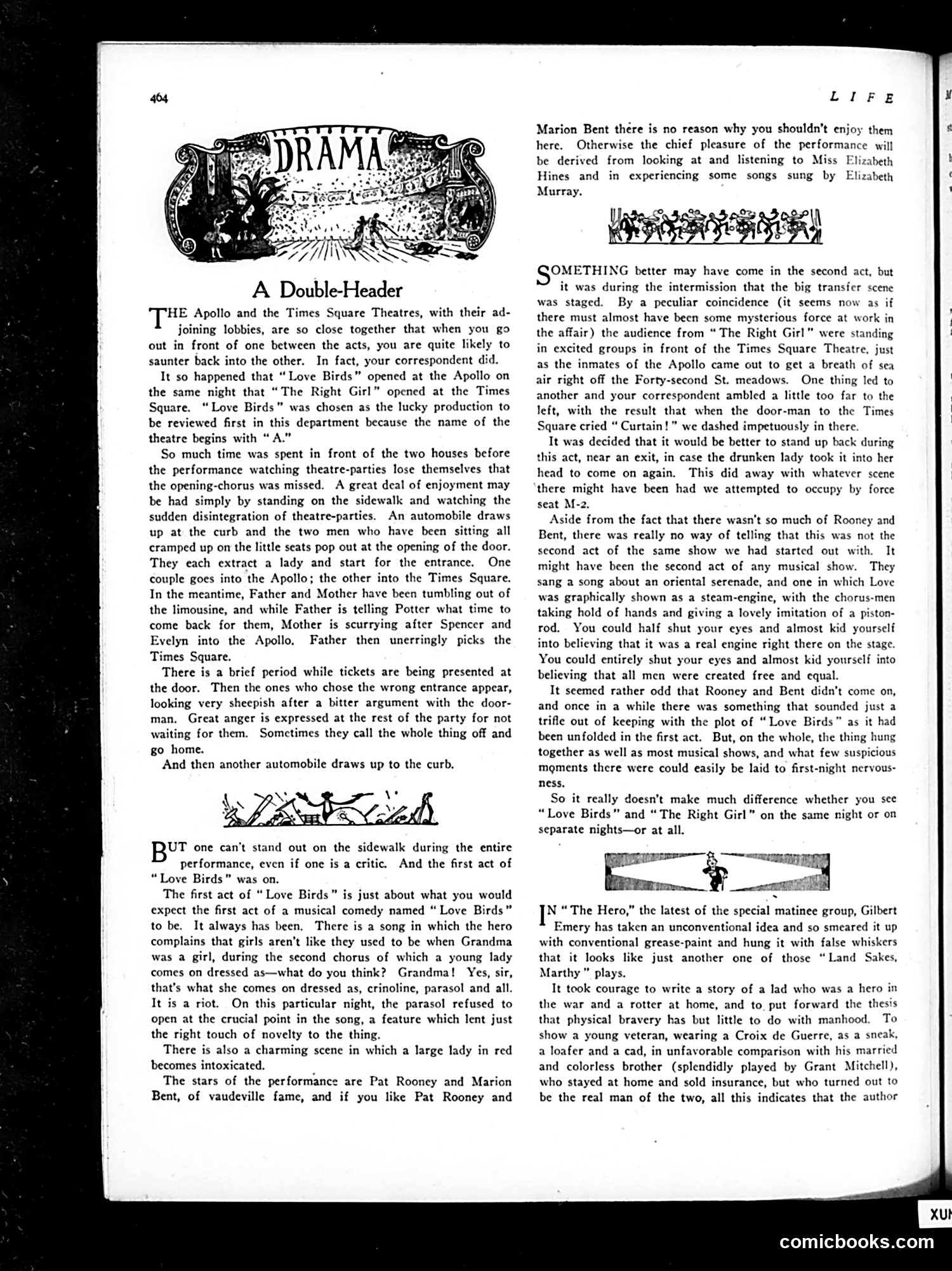
This theater review satirizes the confusion created by two adjacent Broadway theaters—the Apollo and Times Square—that opened simultaneously with different shows ("Love Birds" and "The Right Girl"). The satire centers on **practical comedy of errors**: theater-goers constantly wander into the wrong building between acts due to the lobbies' proximity. The author humorously documents this recurring chaos—couples splitting up, families entering different theaters, people returning sheepishly after arguing with doormen. The piece gently mocks both the **predictable conventions of musical comedy** (the "Love Birds" plot about girls not being like Grandma's era, complete with costumed actresses) and **vaudeville performers** Pat Rooney and Marion Bent, suggesting their fame carries the otherwise formulaic show. The joke culminates when the reviewer themselves becomes confused during intermission, accidentally slipping into the Times Square theater—demonstrating the very problem they've been describing. The humor relies on physical/situational comedy rather than sharp political commentary.
📄 Transcribed text from this page (OCR, searchable)
Machine-transcribed from the original scan — historical spelling and the odd misread are preserved.
A Double-Header TH Apollo and the Times Square Theatres, with their ad- joining lobbies, are so close together that when you go out in front of one between the acts, you are quite likely to saunter back into the other. In fact, your correspondent did. It so happened that “Love Birds” opened at the Apollo on the same night that “The Right Girl” opened at the Times Square. “Love Birds” was chosen as the lucky production to be reviewed first in this department because the name of the theatre begins with “A.” So much time was spent in front of the two houses before the performance watching theatre-parties lose themselves that the opening-chorus was missed. A great deal of enjoyment may be had simply by standing on the sidewalk and watching the sudden disintegration of theatre-parties. An automobile draws up at the curb and the two men who have been sitting all cramped up on the little seats pop out at the opening of the door. They each extract a lady and start for the entrance. One couple goes into the Apollo; the other into the Times Square. In the meantime, Father and Mother have been tumbling out of the limousine, and while Father is telling Potter what time to come back for them, Mother is scurrying after Spencer and Evelyn into the Apollo, Father then unerringly picks the Times Square. There is a brief period while tickets are being presented at the door. Then the ones who chose the wrong entrance appear, looking very sheepish after a bitter argument with the door- man, Great anger is expressed at the rest of the party for not waiting for them. Somctimes they call the whole thing off and go home. And then another automobile draws up to the curb, UT one can’t stand out on the sidewalk during the entire performance, even if one is a critic. And the first act of “Love Birds” was on. The first act of “Love Birds” is just about what you would expect the first act of a musical comedy named “ Love Birds” to be. It always has been. There is a song in which the hero complains that girls aren't like they used to be when Grandma was a girl, during the second chorus of which a young lady comes on dressed as—what do you think? Grandma! Yes, sir, that’s what she comes on dressed as, crinoline, parasol and all. It is a riot. On this particular night, the parasol refused to open at the crucial point in the song, a feature which lent just the right touch of novelty to the thing. There is also a charming scene in which a large lady in red becomes intoxicated. The stars of the performance are Pat Rooney and Marion Bent, of vaudeville fame, and if you like Pat Rooney and LIFE Marion Bent there is no reason why you shouldn't enjoy them here. Otherwise the chief pleasure of the performance will be derived from looking at and listening to Miss Elizabeth Hines and in experiencing some songs sung by Elizabeth Murray. OMETHING better may have come in the second act, but it was during the intermission that the big transfer scene was staged. By a peculiar coincidence (it seems now as if there must almost have been some mysterious force at work in the affair) the audience from “The Right Girl” were standing in excited groups in front of the Times Square Theatre, just as the inmates of the Apollo came out to get a breath of sea air right off the Forty-second St. meadows. One thing led to another and your correspondent ambled a little too far to the left, with the result that when the door-man to the Times Square cried “ Curtain!” we dashed impetuously in there. It was decided that it would be better to stand up back during this act, near an exit, in case the drunken lady took it into her head to come on again. This did away with whatever scene there might have been had we attempted to occupy by force seat M-2. Aside from the fact that there wasn’t so much of Rooney and Bent, there was really no way of telling that this was not the second act of the same show we had started out with. It might have been the second act of any musical show. They sang a song about an oriental serenade, and one in which Love was graphically shown as a steam-engine, with the chorus-men taking hold of hands and giving a lovely imitation of a piston- rod. You could half shut your eyes and almost kid yourself into believing that it was a real engine right there on the stage. You could entirely shut your eyes and almost kid yourself into believing that all men were created free and equal. It seemed rather odd that Rooney and Bent didn’t come on, and once in a while there was something that sounded just a trifle out of keeping with the plot of “Love Birds” as it had been unfolded in the first act. But, on the whole, the thing hung together as well as most musical shows, and what few suspicious mgments there were could easily be laid to first-night nervous- ness. So it really doesn’t make much difference whether you see “Love Birds” and “The Right Girl” on the same night or on separate nights—or at all. eae ORTH PTE a EE N “The Hero,” the latest of the special matinee group, Gilbert Emery has taken an unconventional idea and so smeared it up with conventional grease-paint and hung it with false whiskers that it looks like just another one of those “Land Sakes, Marthy” plays. It took courage to write a story of a lad who was a hero in the war and a rotter at home, and to. put forward the thesis that physical bravery has but little to do with manhood. To show a young veteran, wearing a Croix de Guerre, as a sneak, a loafer and a cad, in unfavorable comparison with his married and colorless brother (splendidly played by Grant Mitchell), who stayed at home and sold insurance, but who turned out to be the real man of the two, all this indicates that the author comicbooks.com