
Life, 1921-03-31 · page 17 of 34
Life — March 31, 1921 — page 17: what you’re looking at
What you’re looking at
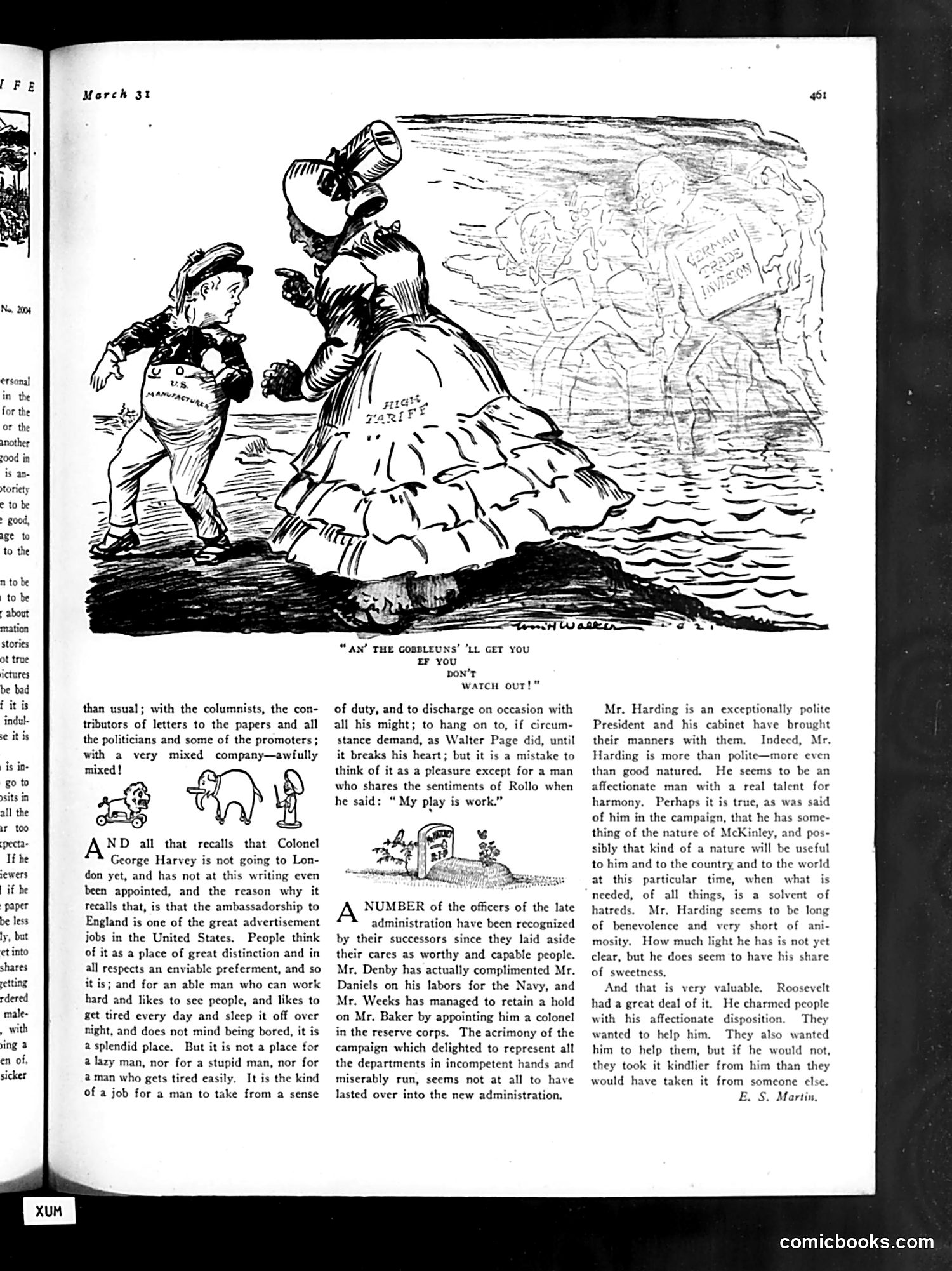
## The Cartoon The illustration depicts a woman in Victorian dress with a child, with text reading "An' the Gobbleuns'll get you ef you don't watch out!" This references James Whitcomb Riley's famous children's poem "Little Orphant Annie," where a character warns children to behave or mysterious creatures will punish them. The cartoon likely uses this as political satire, though the specific target is unclear from the image alone. ## The Text The article discusses President Harding's notably polite demeanor and diplomatic approach, contrasting sharply with the acrimonious 1920 campaign. It praises his "affectionate" nature and talent for "harmony," comparing him favorably to Roosevelt. The writer notes that even members of the previous administration (under Wilson) have been treated with respect by Harding's cabinet—evidence of genuine civility replacing campaign hostility. The piece suggests Harding's sweetness and benevolence may be precisely what the nation needs to resolve "hatreds." The article emphasizes reconciliation and good manners in politics during the early Harding presidency.
📄 Transcribed text from this page (OCR, searchable)
Machine-transcribed from the original scan — historical spelling and the odd misread are preserved.
ersonal in. the for the or the another z00d in is an toriety e to be > good, ge to to the n to be to be ; about mation stories ot true ictures be bad t it is indul- eit is is ine go to sits in all the ir too ‘pecta- If he jewers ly, but et into shares yetting rdered male- , with ying 2 en of, sicker Morch 31 than usual; with the columnists, the con- tributors of letters to the papers and all the politicians and some of the promoters; with a very mixed company—awfully 8 He ND all that recalls that Colonel George Harvey is not going to Lon- don yet, and has not at this writing even been appointed, and the reason why it recalls that, is that the ambassadorship to England is one of the great advertisement jobs in the United States. People think of it as a place of great distinction and in all respects an enviable preferment, and so it is; and for an able man who can work hard and likes to see people, and likes to get tired every day and sleep it off over night, and does not mind being bored, it is a splendid place. But it is not a place for a lazy man, nor for a stupid man, nor for aman who gets tired easily. It is the kind of a job for a man to take from a sense “ AN’ THE GOBBLEUNS’ ’LL GET YOU EF You DON’T WATCH out!” of duty, and to discharge on occasion with all his might; to hang on to, if circum- stance demand, as Walter Page did, until it breaks his heart; but it is a mistake to think of it as a pleasure except for a man who shares the sentiments of Rollo when he said: “ My play is work.” NUMBER of the officers of the late administration have been recognized by their successors since they laid aside their cares as worthy and capable people. Mr. Denby has actually complimented Mr. Daniels on his labors for the Navy, and Mr. Weeks has managed to retain a hold on Mr. Baker by appointing him a colonel in the reserve corps. The acrimony of the campaign which delighted to represent all the departments in incompetent hands and miserably run, seems not at all to have lasted over into the new administration. Mr. Harding is an exceptionally polite President and his cabinet have brought their manners with them. Indeed, Mr. Harding is more than polite—more even than good natured. He seems to be an affectionate man with a real talent for harmony. Perhaps it is true, as was said of him in the campaign, that he has some- thing of the nature of McKinley, and pos- sibly that kind of a nature will be useful to him and to the country and to the world at this particular time, when what is needed, of all things, is a solvent of hatreds. Mr. Harding seems to be long of benevolence and very short of ani- mosity. How much light he has is not yet clear, but he does seem to have his share of sweetness, And that is very valuable. Roosevelt had a great deal of it. He charmed people with his affectionate disposition. They wanted to help him. They also wanted him to help them, but if he would not, they took it kindlier from him than they would have taken it from someone else. E, S. Martin, comicbooks.com