
Life, 1921-03-31 · page 21 of 34
Life — March 31, 1921 — page 21: what you’re looking at
What you’re looking at
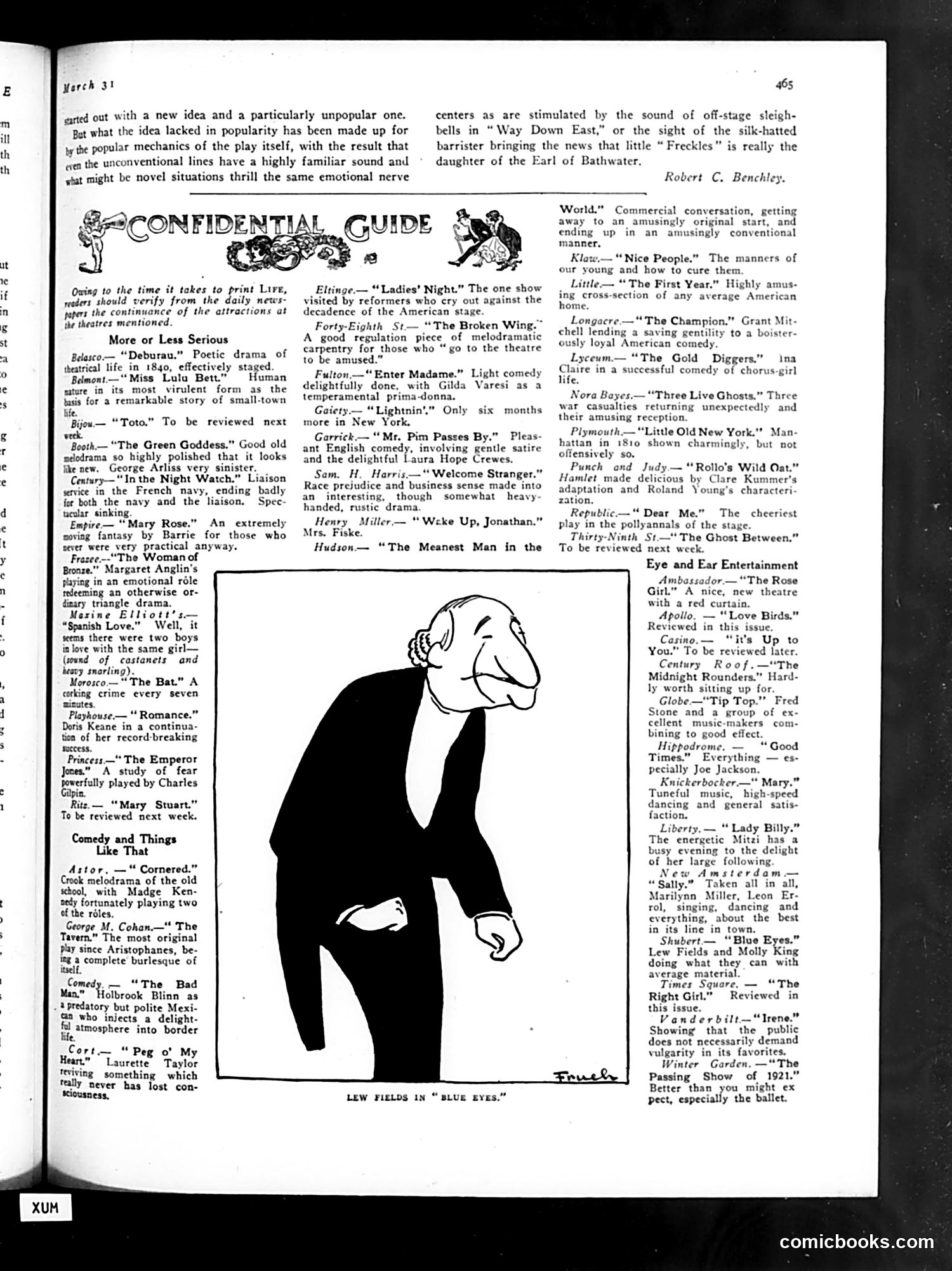
This page from *Life* magazine (March 31, 1921) contains theater reviews and a cartoon titled "Lew Fields in 'Blue Eyes.'" **The Cartoon**: The caricature depicts an exaggerated male figure with a grotesquely large nose and protruding chin, drawn in a style typical of 1920s theatrical caricature. The figure is labeled as Lew Fields, a performer in the play "Blue Eyes." This represents the theatrical practice of physical comedy and broad character work popular in vaudeville and early Broadway. **Context**: The accompanying review section lists current Broadway productions with brief descriptions. The cartoon exemplifies how *Life* magazine used caricature to mock or highlight performers' distinctive physical features as entertainment, reflecting early 20th-century theatrical humor standards that would be considered crude by modern sensibilities. **The Point**: The exaggeration served to promote the show while poking fun at Fields' appearance—typical of *Life's* satirical approach to entertainment coverage.
📄 Transcribed text from this page (OCR, searchable)
Machine-transcribed from the original scan — historical spelling and the odd misread are preserved.
yorch 31 garted out with a new idea and a particularly unpopular one. But what the idea lacked in popularity has been made up for by the popular mechanics of the play itself, with the result that een the unconventional lines have a highly familiar sound and sat might be novel situations thrill the same emotional nerve Owing to the time it takes to print Lire, readers should verify from the daily news- papers the continuance of the attractions at the theatres mentioned. More or Less Serious Belesco— “Deburau.” Poetic drama of theatrical life in 1840, effectively staged. Belmont—“ Miss Lulu Bett.” Human mture in its most virulent form as the tasis for a remarkable story of small-town life. Bijou— “Toto.” To be reviewed next week. Booth— “The Green Goddess.” Good old melodrama so highly polished that it looks like new. George Arliss very sinister. Century—“'In the Night Watch.” Liaison service in the French navy, ending badly for both the navy and the liaison. Spee- tacolar sinking. Empire— ‘Mary Rose.” An_ extremely soving fantasy by Barrie for those who sever were very practical anyway, Margaret Anglin’s playing in an emotional réle redeeming an otherwise or- dinary triangle drama. Mexine Elliott’s— “Spanish Love.” Well, it seems there were two boys is love with the same girl— (sound of castanets and heavy snarling). Morosco—“ The Bat.” A corking crime every seven nisates. Playhouse.— “‘ Romance.” Doris Keane in a continua- tion of her record-breaking soceess. Princess —" The Emperor Jones.” A study of fear jowerfully played by Charles Gilpin. Rit, — “Mary Stuart.” To be reviewed next week. Comedy and Things Like That Astor, —“ Cornered.” Crock melodrama of the old school, with Madge Ken- tedy fortunately playing two ef the réles. George M. Cohan—' The Tavern.” The most original Pay since Aristophanes, be- 2.2 complete burlesque of Comedy. — “The Bad Man.” Holbrook Blinn as . Upredatory but polite Mexi- @a who injects a delight- {il atmosphere into border Cort— “Peg o° M: = y Hear.” “ Laurette. Taylor feviving something which tally never bas lost con- kiousness, centers as are stimulated by bells in “Way Down East,” or the sight of the silk-hatted barrister bringing the news that little “ Freckles” daughter of the Earl of Bathwater. 465 the sound of off-stage sleigh- is really the Robert C. Benchley, Eltinge.— “ Ladies’ Night.” The one show visited by reformers who cry out against the decadence of the American stage. Forty-Eighth St— “The Broken Wing.” A good regulation piece of melodramatic carpentry for those who “go to the theatre to be amused.” Fulton. Enter Madame.” Light comedy delightfully done, with Gilda Varesi as a temperamental prima-donna. Gaiety.— “Lightnin’." Only six more in New York. Garrick.— “Mr. Pim Passes By.” Pleas- ant English comedy, involving gentle satire and the delightful Laura Hope Crewes. Sam. H. Harris‘ Welcome Stranger.” Race prejudice and business sense made into an interesting, though somewhat heavy handed, rustic drama. Henry Miller — ‘* Weke Up, Jonathan.” Mrs, Fiske. Hudson — months “The Meanest Man in the LEW FIELDS IN “ BLUE EYES,” World.” Commercial conversation, getting away to an amusingly original start, and ending up in an amusingly conventional manner. “Nice People.” The manners of ig and how to cure them Little— “ The First Year.” Highly amus- ing cross-section of any average American home. Longacre —“ The Champion.” Grant Mit- chell lending a saving gentility to a boister- ously loyal American comedy. _Lyceum.— “The Gold Diggers.” ina it re in a successful comedy of chorus-girl ife, Nora Bayes.— “Three Live Ghosts.” Three war casualties returning unexpectedly and their amusing reception. Plymouth.— “Little Old New York.'” Man- hattan in 1810 shown charmingly, but not offensively so. Punch and Judy.— “Rollo’s Wild Oat. Hamlet made delicious by Clare Kummer's adaptation and Roland Young's characteri zation. Republic—“ Dear Me.” The play in the pollyannals of the stage. Thirty-Ninth St— The Ghost Between.” To be reviewed next week. Eye and Ear Entertainment Ambassador.— “The Rose Girl.” A nice, new theatre with a red curtain. Apollo, — “ Love Birds.” Reviewed in this issue. Casino.— “it’s Up to You.” To be reviewed later. Century Roof “The Midnight Rounders.” Hard- ly worth sitting up for. Globe-—"Tip Top.” Fred Stone and a group of ex- cellent music-makers com- bining to good effect. Hippodrome. — “Good Times.” Everything — es- pecially Joe Jackson. Knickerbocker.—" Mary.” Tuneful music, high-speed dancing and general satis- faction. Liberty. — “ Lady Billy.” The energetic Mitzi has a busy evening to the delight of her large following New Amsterdam— “Sally.” Taken all in all, Marilynn Miller, Leon Er- rol, singing, dancing and everything, about the best in its line in town. Shubert— “Blue Eyes.” Lew Fields and Molly King doing what they can with average material. Times Square, — “The Right Girl.” Reviewed in this issue. Vander dbilt—“Irene.” Showing that the public does not necessarily demand vulgarity in its favorites, Winter Garden. —“The Passing Show of 1921.” Better than you might ex pect, especially the ballet. cheeriest comicbooks.com