
Life, 1921-03-31 · page 8 of 34
Life — March 31, 1921 — page 8: what you’re looking at
What you’re looking at
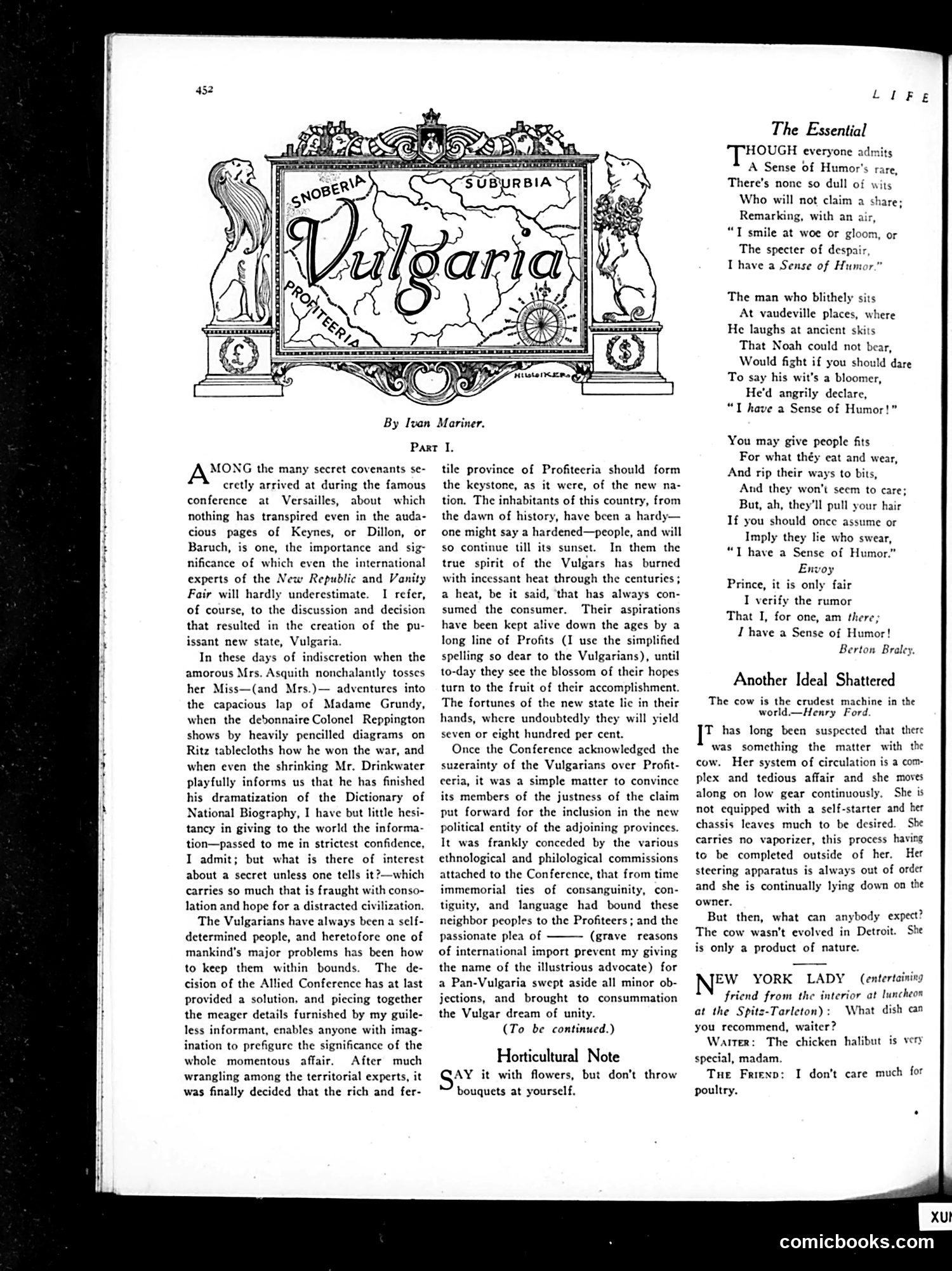
This page contains a satirical article titled "Vulgaria" by Ivan Morimer, Part I, which appears to be a fictional commentary on a new Eastern European state created after World War I. The elaborate decorative header naming "Vulgaria" with regions like "Snoberia," "Suburbia," and "Proleteria" suggests this is imaginary territory used to mock nationalist ambitions and territorial disputes following the 1919 Paris Peace Conference. The satire critiques the "Conference" (likely Versailles) and its complex decisions about new nations, ethnic boundaries, and self-determination. The accompanying humorous verses on the right mock society's pretensions regarding humor and civility. The smaller pieces—"Another Ideal Shattered" about cow machinery and "New York Lady" about food—are typical Life magazine humor sections.
📄 Transcribed text from this page (OCR, searchable)
Machine-transcribed from the original scan — historical spelling and the odd misread are preserved.
By Ivan Mariner. Part I. MONG the many secret covenants se- cretly arrived at during the famous conference at Versailles, about which nothing has transpired even in the auda- cious pages of Keynes, or Dillon, or Baruch, is one, the importance and sig- nificance of which even the international experts of the New Republic and Vanity Fair will hardly underestimate. I refer, of course, to the discussion and decision that resulted in the creation of the pu- issant new state, Vulgaria. In these days of indiscretion when the amorous Mrs. Asquith nonchalantly tosses her Miss—(and Mrs.)— adventures into the capacious lap of Madame Grundy, when the debonnaire Colonel Reppington shows by heavily pencilled diagrams on Ritz tablecloths how he won the war, and when even the shrinking Mr. Drinkwater playfully informs us that he has finished his dramatization of the Dictionary of National Biography, I have but little hesi- tancy in giving to the world the informa- tion—passed to me in strictest confidence, I admit; but what is there of interest about a secret unless one tells it?—which carries so much that is fraught with conso- lation and hope for a distracted civilization. The Vulgarians have always been a self- determined people, and heretofore one of mankind's major problems has been how to keep them within bounds. The de- cision of the Allied Conference has at last provided a solution, and piecing together the meager details furnished by my guile- less informant, enables anyone with imag- ination to prefigure the significance of the whole momentous affair. After much wrangling among the territorial experts, it was finally decided that the rich and fer- tile province of Profiteeria should form the keystone, as it were, of the new na- tion. The inhabitants of this country, from the dawn of history, have been a hardy— one might say a hardened—people, and will so continue till its sunset. In them the true spirit of the Vulgars has burned with incessant heat through the centuries ; a heat, be it said, ‘that has always con- sumed the consumer. Their aspirations have been kept alive down the ages by a long line of Profits (I use the simplified spelling so dear to the Vulgarians), until to-day they see the blossom of their hopes turn to the fruit of their accomplishment. The fortunes of the new state lic in their hands, where undoubtedly they will yield seven or eight hundred per cent. Once the Conference acknowledged the suzerainty of the Vulgarians over Profit- ceria, it was a simple matter to convince its members of the justness of the claim put forward for the inclusion in the new political entity of the adjoining provinces. It was frankly conceded by the various ethnological and philological commissions attached to the Conference, that from time immemorial ties of consanguinity, con- tiguity, and language had bound these neighbor peoples to the Profiteers; and the passionate plea of (grave reasons of international import prevent my giving the name of the illustrious advocate) for a Pan-Vulgaria swept aside all minor ob- jections, and brought to consummation the Vulgar dream of unity. (To be continued.) Horticultural Note AY it with flowers, but don’t throw bouquets at yourself. LIFE The Essential "THOUGH everyone admits A Sense of Humor's rare, There’s none so dull of wits Who will not claim a share; Remarking, with an air, “T smile at woe or gloom, or The specter of despair I have a Sense of Humor.” The man who blithely sits At vaudeville places, where He laughs at ancient skits That Noah could not bear, Would fight if you should dare To say his wit's a bloomer, He'd angrily declare, “I have a Sense of Humor!” You may give people fits For what théy eat and wear, And rip their ways to bits, And they won't seem to care; But, ah, they'll pull your hair If you should once assume or Imply they lie who swear, “T have a Sense of Humor.” Envoy Prince, it is only fair I verify the rumor That I, for one, am there; I have a Sense of Humor! Berton Braley. Another Ideal Shattered The cow is the crudest machine in the world.—Henry Ford. [ has long been suspected that there was something the matter with the cow. Her system of circulation is a com- plex and tedious affair and she moves along on low gear continuously, She is not equipped with a self-starter and her chassis leaves much to be desired. She carries no vaporizer, this process having to be completed outside of her. Her steering apparatus is always out of order and she is continually lying down on the owner. But then, what can anybody expect? The cow wasn't evolved in Detroit. She is only a product of nature. EW YORK LADY (entertai friend from the interior at lunc at the Spitz-Tarleton): What dish can you recommend, waiter? Warter: The chicken halibut is very special, madam. Tue Frienp: poultry. I don’t care much for comicbooks.com