
Life, 1921-03-31 · page 16 of 34
Life — March 31, 1921 — page 16: what you’re looking at
What you’re looking at
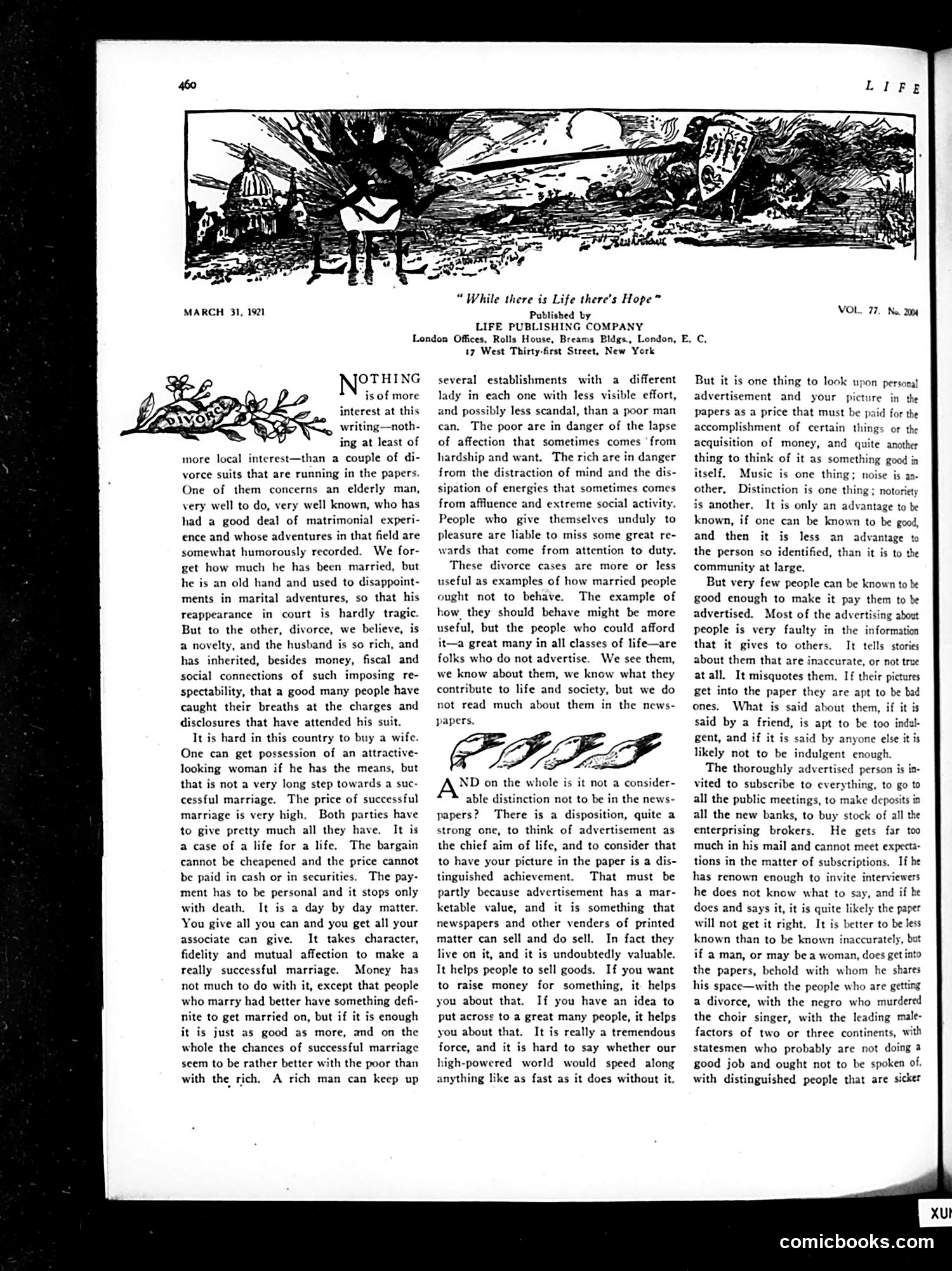
This page contains editorial text rather than political cartoons. The article discusses the social phenomenon of divorce and personal advertisement in newspapers, particularly regarding matrimonial matters. The author argues that while divorce cases involving wealthy or socially prominent people attract newspaper attention, ordinary people's marital troubles should remain private. The piece critiques the growing practice of advertising oneself or one's accomplishments in newspapers to gain public attention or commercial advantage. The editorial suggests this represents a troubling shift toward self-promotion and loss of privacy, warning that excessive personal advertising—whether about divorces, business ventures, or social achievements—reflects poorly on one's character and dignity. The small decorative illustrations are generic ornamental elements, not specific political commentary.
📄 Transcribed text from this page (OCR, searchable)
Machine-transcribed from the original scan — historical spelling and the odd misread are preserved.
MARCH 31, 1921 “While there is Life there’s Hope” Published by LIFE PUBLISHING COMPANY London Offices, Rolls House, Breams Bldgs. London, E. C. OTHING is of more interest at this writing—noth- ing at least of more local interest—than a couple of di- vorce suits that are running in the papers. One of them concerns an elderly man, very well to do, very well known, who has had a good deal of matrimonial experi- ence and whose adventures in that field are somewhat humorously recorded. We for- get how much he has been married, but he is an old hand and used to disappoint- ments in marital adventures, so that his reappearance in court is hardly tragic. But to the other, divorce, we believe, is a novelty, and the husband is so rich, and has inherited, besides money, fiscal and social connections of such imposing re- spectability, that a good many people have caught their breaths at the charges and disclosures that have attended his suit. It is hard in this country to buy a wife. One can get possession of an attractive- looking woman if he has the means, but that is not a very long step towards a suc- cessful marriage. The price of successful marriage is very high, Both parties have to give pretty much all they have. It is a case of a life for a life. The bargain cannot be cheapened and the price cannot be paid in cash or in securities. The pay- ment has to be personal and it stops only with death. It is a day by day matter. You give all you can and you get all your associate can give. It takes character, fidelity and mutual affection to make a really successful marriage. Money has not much to do with it, except that people who marry had better have something defi- nite to get married on, but if it is enough it is just as good as more, and on the whole the chances of successful marriage seem to be rather better with the poor than with the rich. A rich man can keep up 17 West Thirty-first Street, New York several establishments with a different lady in each one with less visible effort, and possibly less scandal, than a poor man can. The poor are in danger of the lapse of affection that sometimes comes ‘from hardship and want. The rich are in danger from the distraction of mind and the dis- sipation of energies that sometimes comes from affluence and extreme social activity. People who give themselves unduly to pleasure are liable to miss some great re- wards that come from attention to duty. These divorce cases are more or less useful as examples of how married people ought not to behave. The example of how, they should behave might be more useful, but the people who could afford it—a great many in all classes of life—are folks who do not advertise. We see them, we know about them, we know what they contribute to life and society, but we do not read much about them in the news- papers. ‘D on the whole is it not a consider- able distinction not to be in the news- papers? There is a disposition, quite a strong one, to think of advertisement as the chief aim of life, and to consider that to have your picture in the paper is a dis- tinguished achievement. That must be partly because advertisement has a mar- ketable value, and it is something that newspapers and other venders of printed matter can sell and do sell. In fact they live on it, and it is undoubtedly valuable. It helps people to sell goods. If you want to raise money for something, it. helps you about that. If you have an idea to put across to a great many people, it helps you about that. It is really a tremendous force, and it is hard to say whether our igh-powered world would speed along anything like as fast as it does without it. But it is one thing to look upon personal advertisement and your picture in the papers as a price that must be paid fc accomplishment of certain things or the acquisition of money, and quite another thing to think of it as something good in itself. Music is one thing; noise is other, Distinction is one thing ; notoriety is another. It is only an advantage to be known, if one can be known to be good, and then it is less an advantage to the person so identified, than it is to the community at large. But very few people can be known to be good enough to make it pay them to be advertised. Most of the advertising about people is very faulty in the information that it gives to others. It tells stories about them that are inaccurate, or not true atall. It misquotes them. If their pictures get into the paper they are apt to be bad ones. What is said about them, if it is said by a friend, is apt to be too induk gent, and if it is said by anyone else it is likely not to be indulgent enough. The thoroughly advertised person is in- vited to subscribe to everything, to go to all the public meetings, to make deposits in all the new banks, to buy stock of all the enterprising brokers. He gets far too much in his mail and cannot meet expecta- tions in the matter of subscriptions. If he has renown enough to invite interviewers he does not know what to say, and if he does and says it, it is quite likely the paper will not get it right. It is better to be less known than to be known inaccurately, but if a man, or may be a woman, does get into the papers, behold with whom he shares his space—with the people who are getting a divorce, with the negro who murdered the choir singer, with the leading male- factors of two or three continents, with statesmen who probably are not doing 3 good job and ought not to be spoken of, with distinguished people that are sicker comicbooks.com