
A complete issue · 34 pages · 1921
Life — March 24, 1921
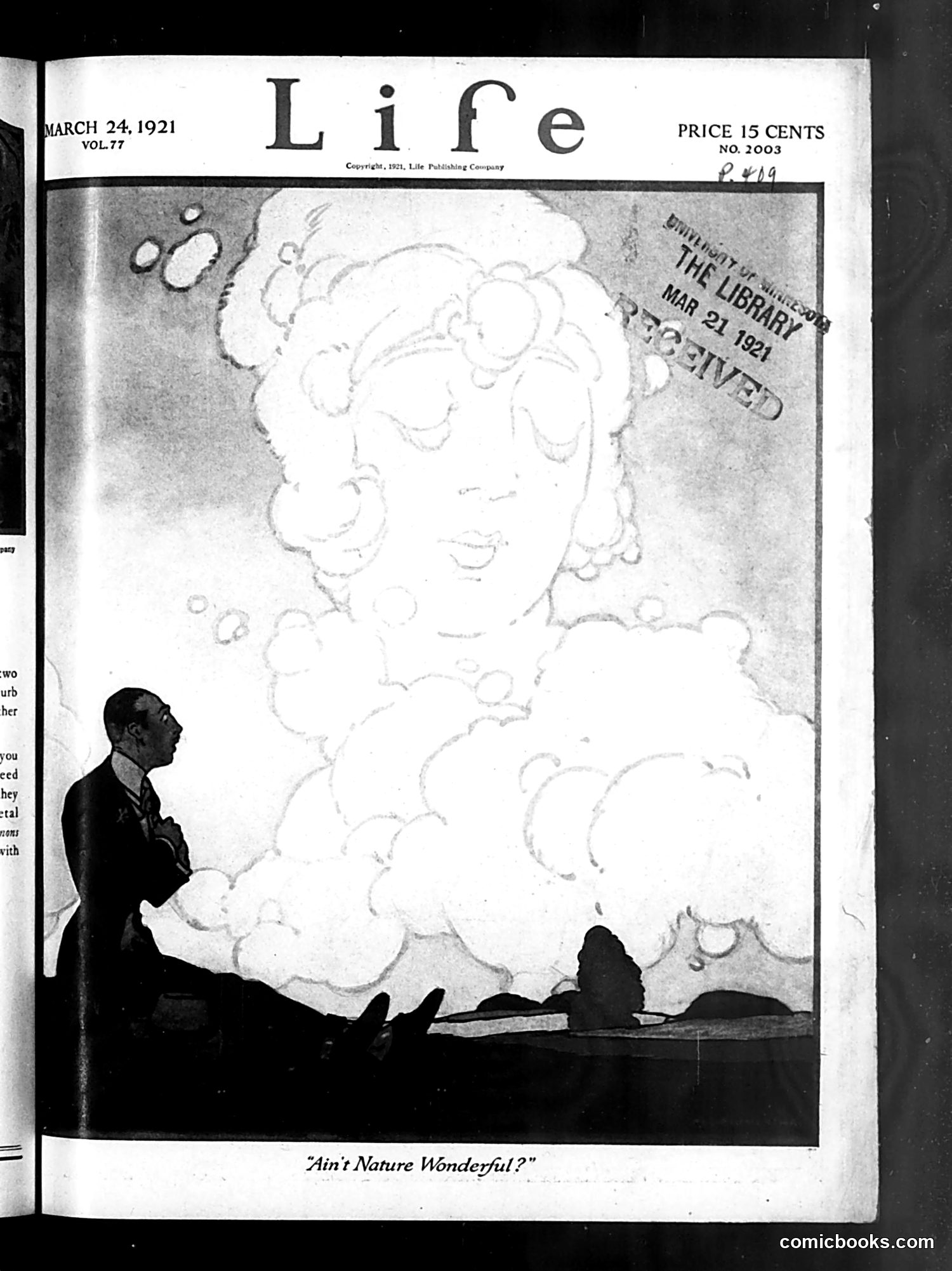
This cover depicts a man in silhouette gazing upward at an enormous cloud formation shaped like a human head or face. The caption reads "Ain't Nature Wonderful?" The satire likely works on multiple levels: the man's admiring posture suggests naive wonder at nature, while the grotesque, bloated cloud-face looming above him may represent something less innocent—possibly a political figure, business magnate, or societal absurdity that the magazine is mocking through the pretense of natural observation. Without additional context from the magazine's content that day, the specific target remains unclear, but the juxtaposition of earnest admiration with an unsettling, oversized visage suggests ironic commentary on American gullibility or misplaced reverence for something fundamentally grotesque.
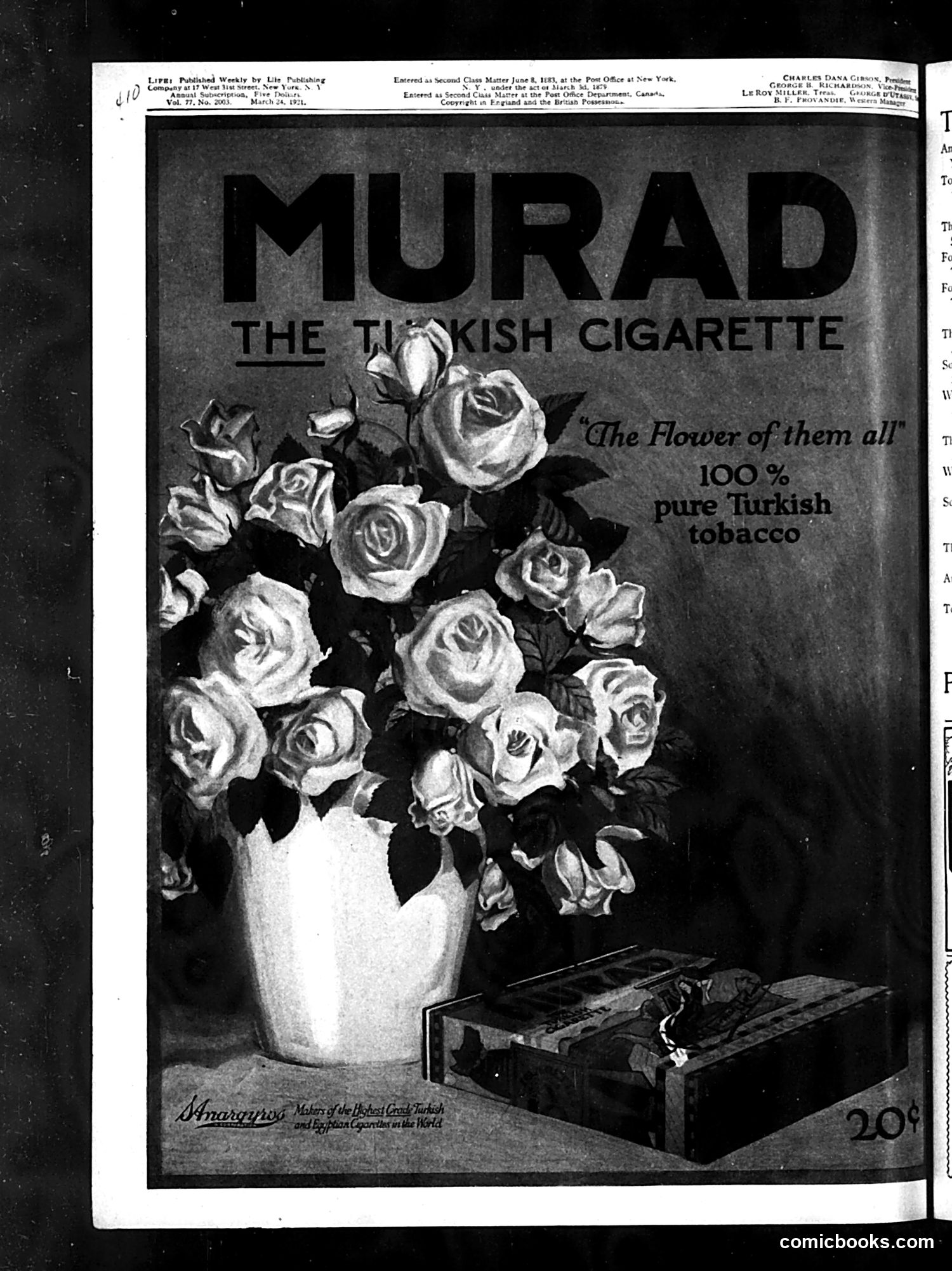
This is primarily a **commercial advertisement**, not political satire. It promotes Murad brand Turkish cigarettes, marketed as "The Flower of them all" and emphasizing "100% pure Turkish tobacco." The ad uses aesthetic imagery—a still life of roses in a white vase alongside an open cigarette box—to convey luxury and elegance. The tagline "Flower of them all" draws a metaphorical connection between the product's quality and natural beauty. The price of 20¢ appears in the lower right. At the bottom, text identifies the manufacturer as Anargyros, described as "Makers of the Finest Greek Turkish and the finest Cigarettes in the World." This represents early-20th-century tobacco marketing, before modern health warnings, using refined imagery to appeal to consumers.
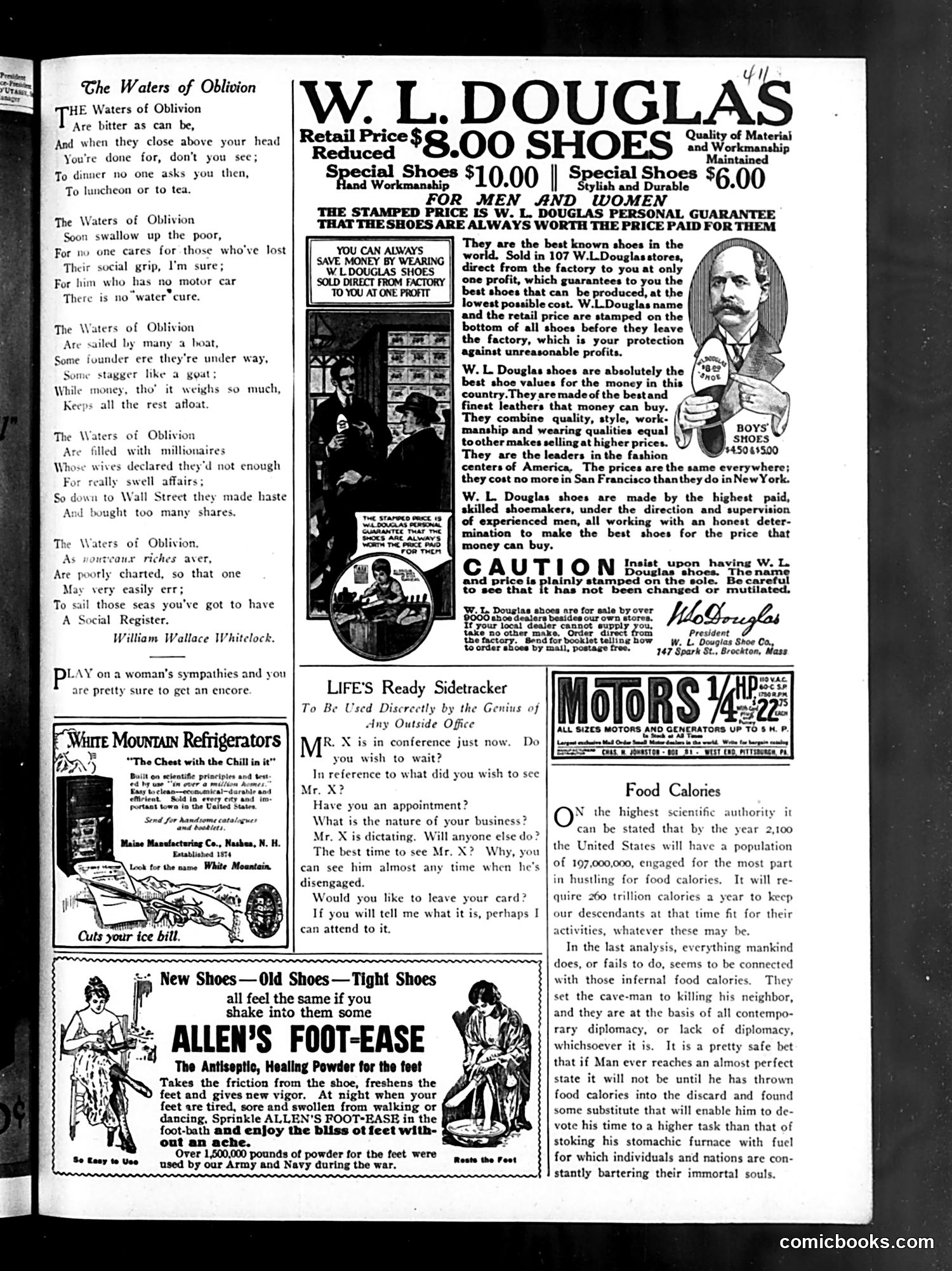
This page is **primarily advertising** rather than political satire. The dominant content consists of commercial advertisements for W.L. Douglas shoes, White Mountain Refrigerators, Motors, and Allen's Foot-Ease powder. The only editorial content is a poem, "The Waters of Oblivion," by William Wallace Whitlock on the left side. The poem appears to be social commentary—using water/flood metaphors to critique wealth inequality and Wall Street speculation ("they made haste / And bought too many shares"). It references "the poor" and those who've "lost / Their wealth and dignity." The remaining page space is filled with period advertisements typical of early 20th-century magazines, with no apparent satirical intent or political cartoons present.
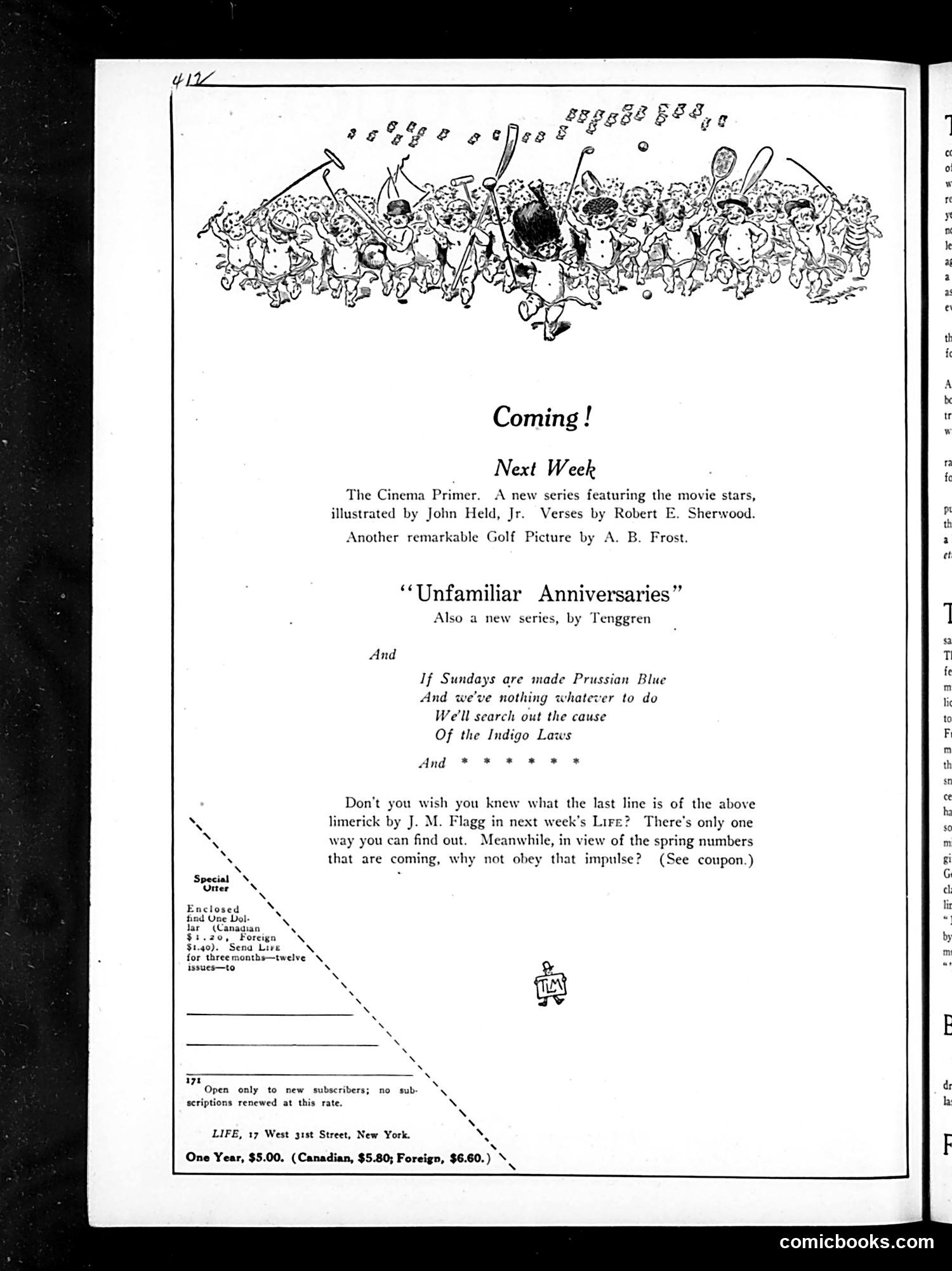
This page is primarily **advertising content** for Life magazine's upcoming features, rather than political commentary or editorial cartoons. The top illustration shows a celebratory crowd of children in a playful, energetic style typical of early-20th-century magazine art. Below, the text announces coming attractions: - **"The Cinema Primer"** — a new series about movie stars, illustrated by John Held Jr. and with verses by Robert E. Sherwood - **"Unfamiliar Anniversaries"** — another new series by Tenggren - A limerick feature by J.M. Flagg The page essentially functions as a **table of contents/promotional piece**, encouraging readers to subscribe or continue their subscriptions. The specific cultural references (cinema focus, particular artists' names) reflect Life's emphasis on entertainment and contemporary celebrity culture of that era.
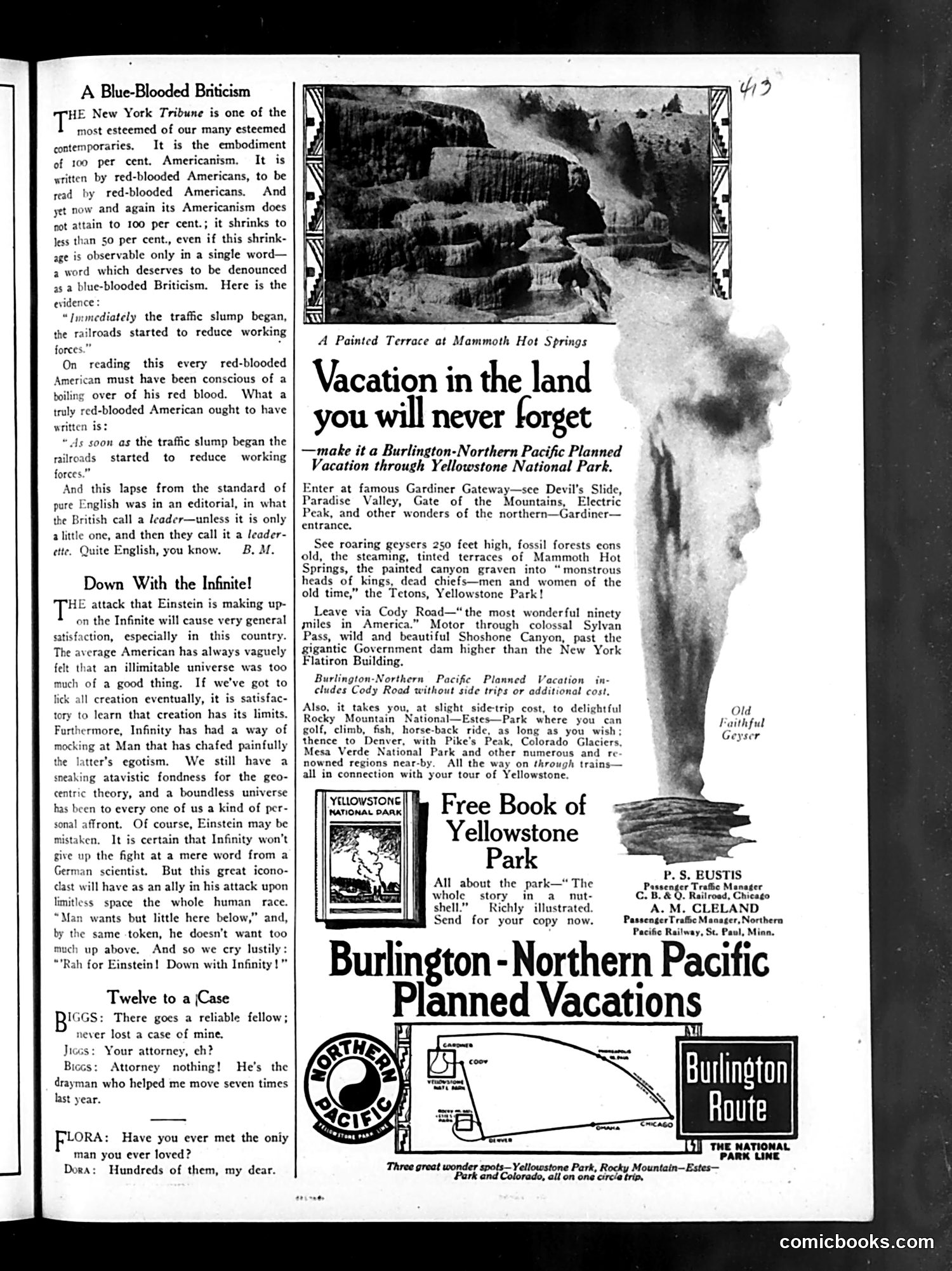
This page contains editorial commentary critiquing the *New York Tribune* newspaper. The author argues the Tribune represents "100 per cent. Americanism" written by and for elite readers, yet its actual Americanism falls short—shrinking to "less than 50 per cent." The specific complaint: when a railroad traffic slump occurred, the Tribune advocated reducing workers' wages rather than management costs. The author calls this "blue-blooded Briticism"—elitist thinking masquerading as American patriotism. The remainder of the page is a Burlington-Northern Pacific railroad advertisement for Yellowstone National Park vacations. This reflects early 20th-century class tensions: critiques of wealthy newspaper owners siding with business interests against working-class welfare.
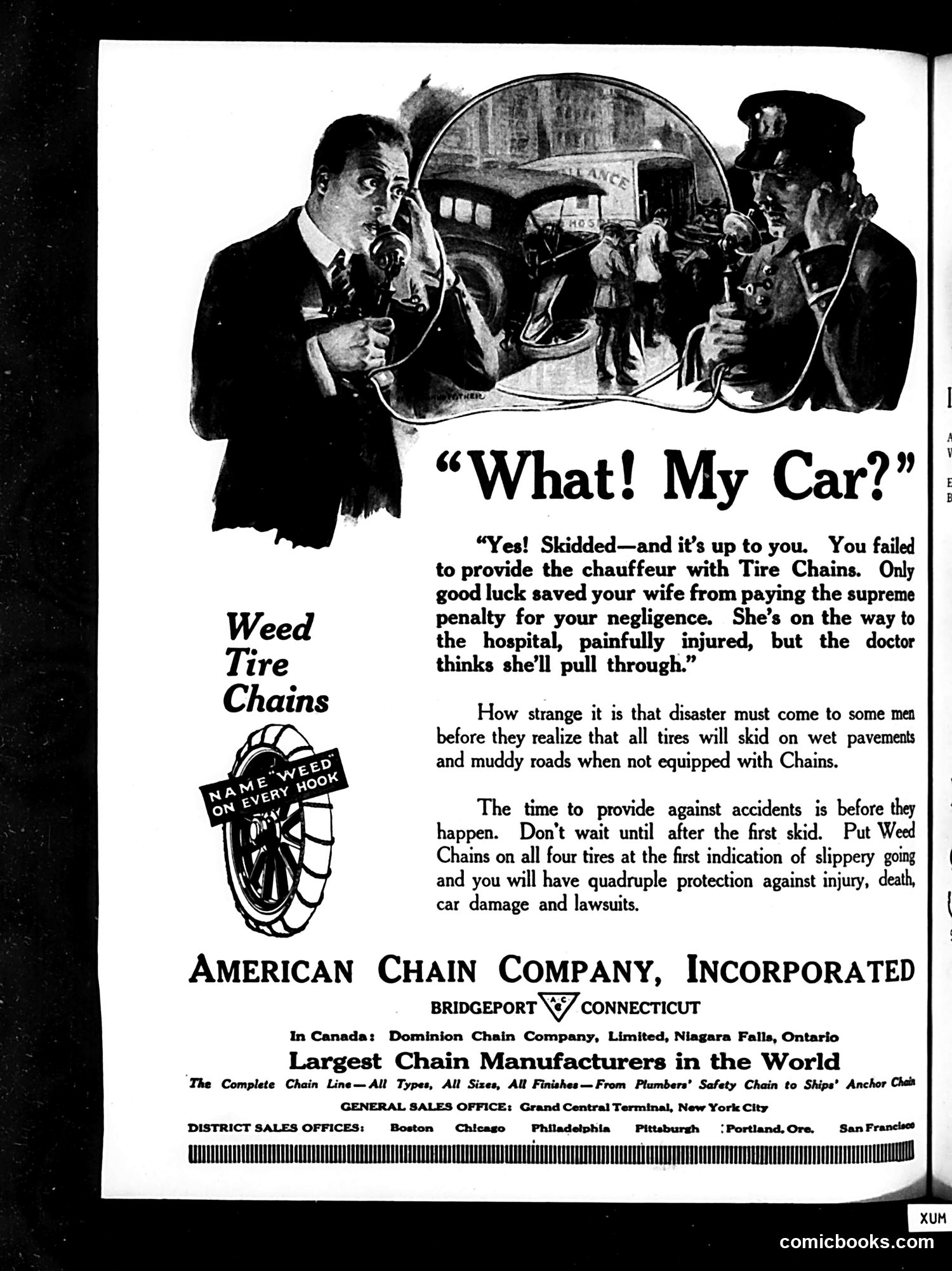
This is primarily a **product advertisement** for tire chains, not political satire. The dramatic illustration shows a distressed man receiving a telephone call about a car accident involving his wife. The scenario is entirely fictional—created to sell safety equipment. The ad's appeal is **fear-based marketing**: it warns that without tire chains, cars will skid on wet roads, potentially causing serious injury or death. The narrative suggests the man is negligent for not equipping his vehicle, and that his wife's hospitalization could have been prevented. This reflects early-20th-century automotive safety concerns—tire chains were genuinely important winter equipment before modern tires existed. The ad targets middle-class car owners, implying that responsible fathers and husbands must purchase this product.
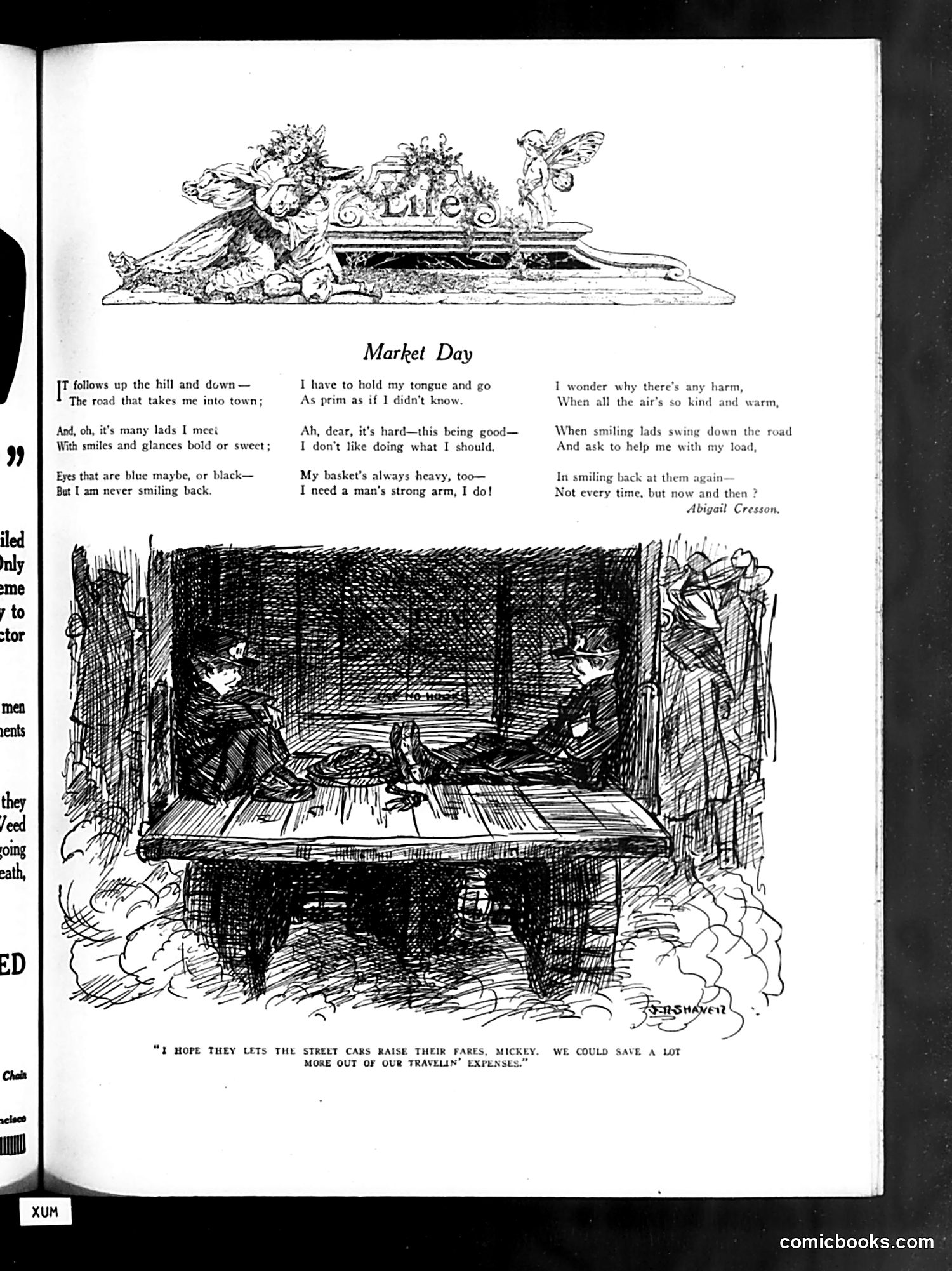
This page presents a poem by Abigail Cresson about a young woman going to market in town. The poem describes her internal conflict: she must maintain a prim, proper demeanor while carrying a heavy basket, though she's tempted to smile at the "lads" she encounters. The accompanying illustration shows two figures in what appears to be a market stall or cart, depicting the scene described. The bottom caption presents a humorous complaint about street car fares, suggesting that raising transit costs would reduce travel expenses. The satire targets the rigid social conventions constraining young women—they're expected to suppress their natural friendliness and remain formally composed in public, even while performing difficult physical labor. The humor lies in the gap between prescribed propriety and genuine human warmth.
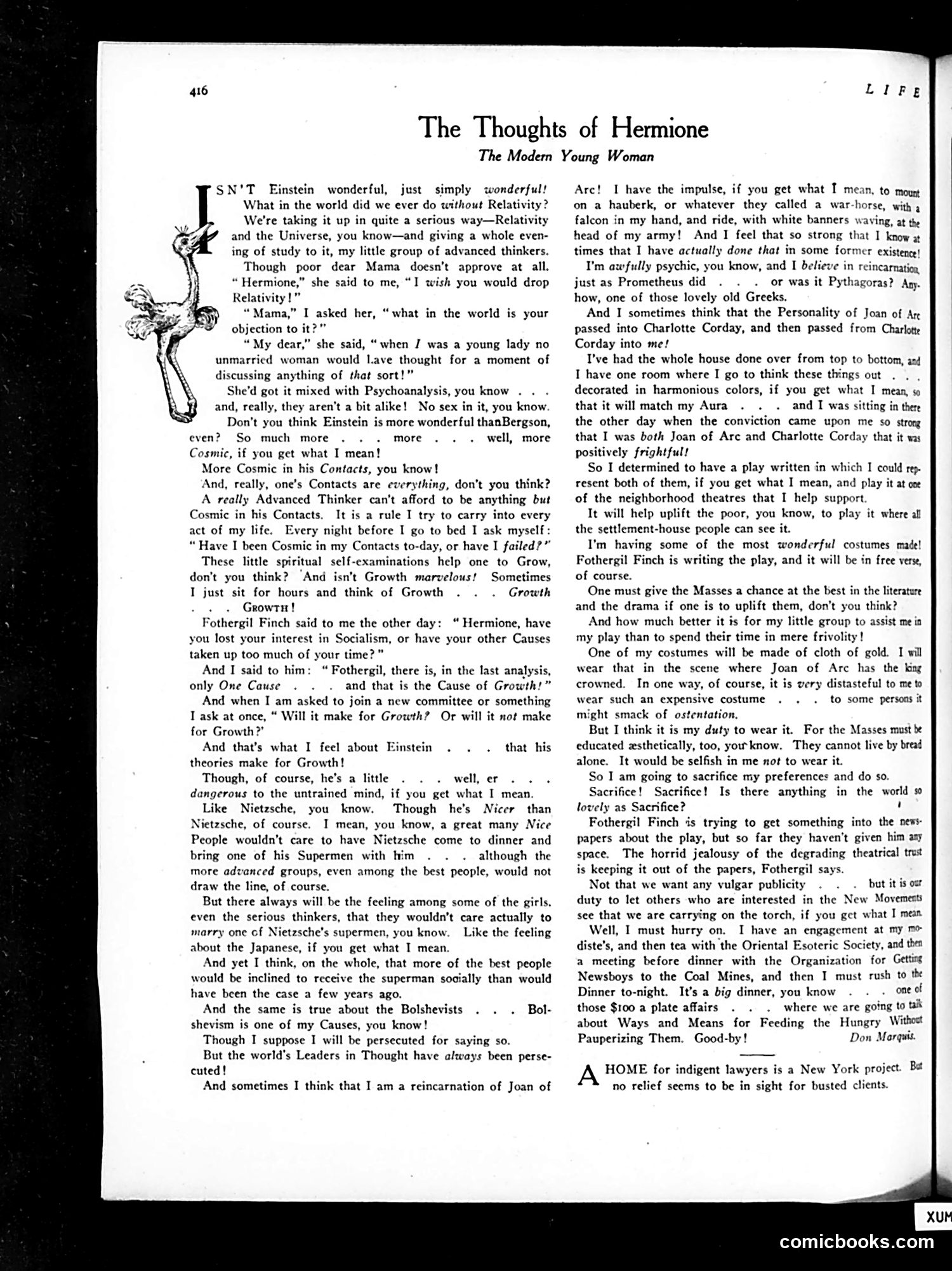
This is a satirical column by Don Marquis featuring a character named Hermione, described as "The Modern Young Woman." The piece mocks intellectually pretentious young women of the 1920s era who adopt trendy philosophical ideas. The cartoon illustration shows a stylized female figure with an elongated neck in an Art Deco style, characteristic of Life magazine's aesthetic. The satire targets Hermione's name-dropping of Einstein, Nietzsche, Freud (Psychoanalysis), and communist ideology (Bolshevism) while contradicting herself and revealing shallow understanding. She discusses "Growth" and "Cosmic consciousness" while planning frivolous activities like costume plays and dinner parties. Marquis ridicules how educated young women of this period adopted avant-garde intellectual fashions without genuine comprehension, using sophisticated concepts as social posturing.
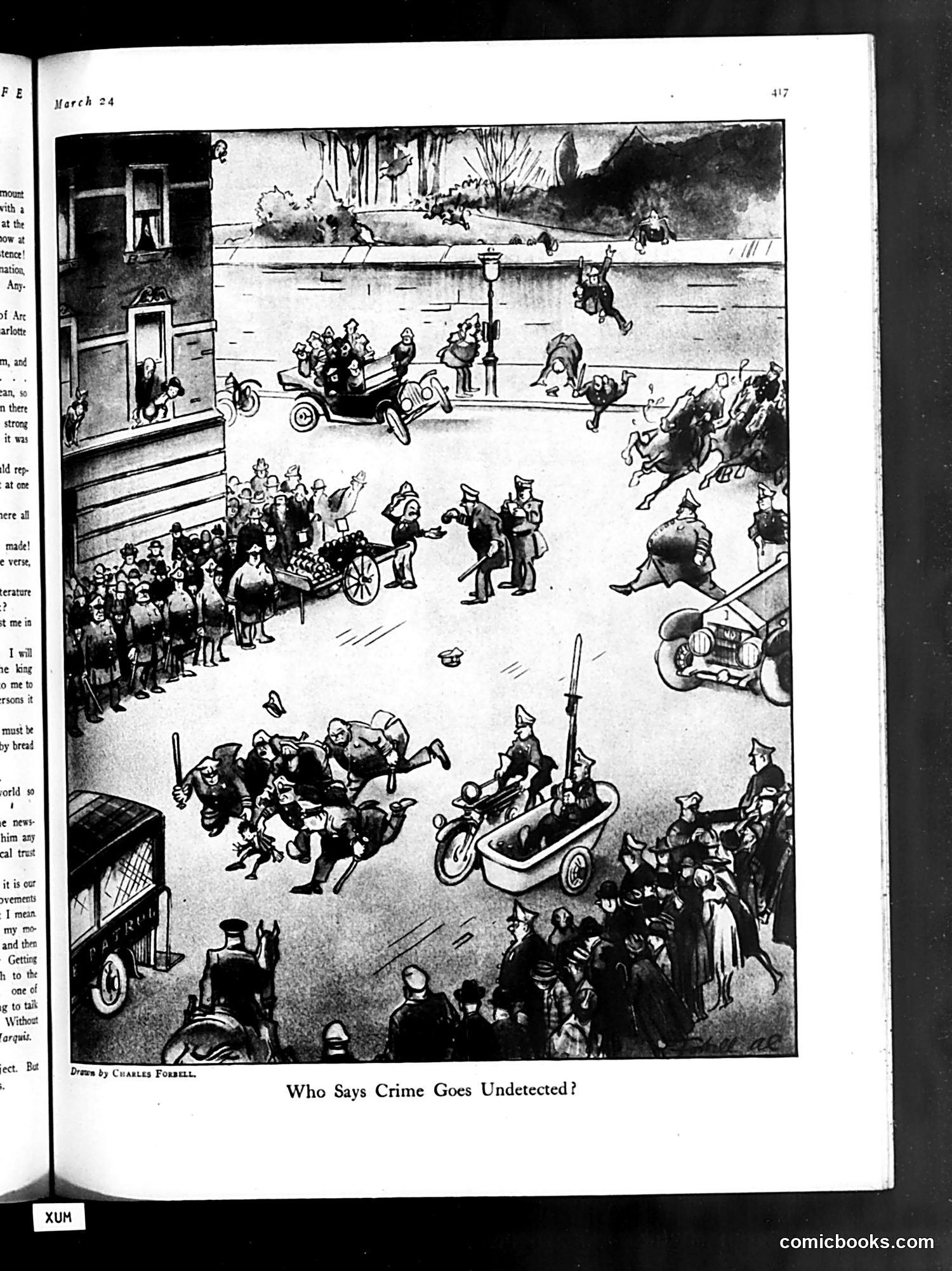
This cartoon by Charles Russell satirizes law enforcement effectiveness. The drawing depicts a chaotic street scene with numerous crimes occurring simultaneously—robberies, assaults, motorcycle chases, and violence—while police and authorities appear overwhelmed and ineffective in responding. The title's ironic question suggests that despite claims by law enforcement about catching criminals, crime actually flourishes openly and extensively. The cartoon critiques the gap between official narratives of police competence and the visible reality of widespread criminal activity going unchecked. The detailed, busy composition emphasizes the sheer volume and brazenness of criminal acts occurring in plain sight, implying that either police are insufficient in number or ineffective in their duties. This reflects early-to-mid 20th century concerns about urban crime and police performance.
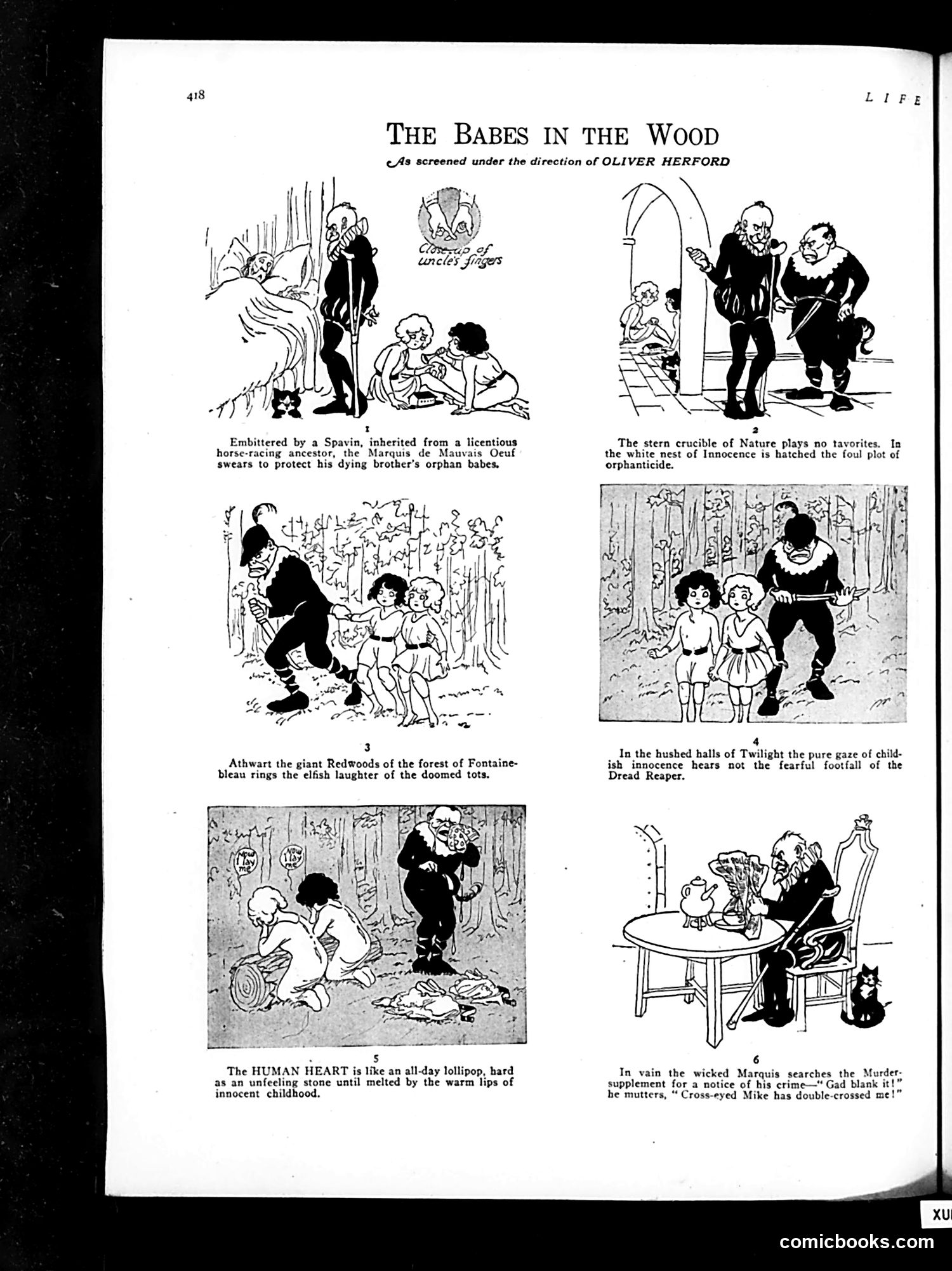
This is a serialized illustrated story adaptation, not political satire. It depicts the classic English fairy tale about two orphaned children abandoned in a forest by a wicked guardian (the Marquis de Mauvais Œuf, according to the caption). The narrative follows the children's peril: panel 1 shows their abandonment; panel 3 depicts forest giants; panel 4 shows them in danger indoors; panel 5 uses the metaphor of a hardened human heart melting through childhood innocence; panel 6 shows the villain plotting murder. The satirical element appears minimal—the main "joke" is the villain's complaint that "Cross-eyed Mike has double-crossed me!" This is a straightforward melodramatic tale rendered as dark humor rather than political commentary.
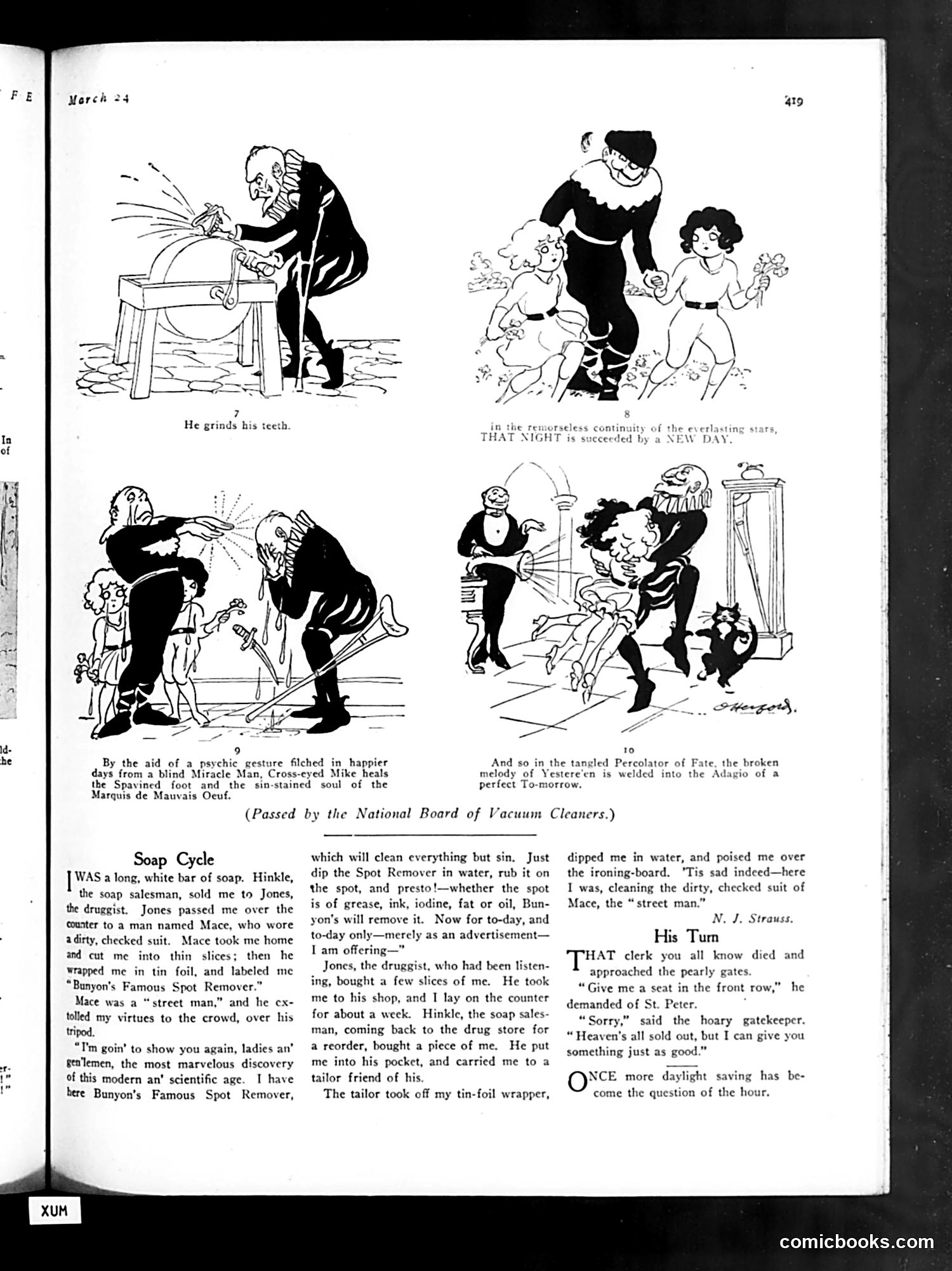
This page contains four cartoon panels (numbered 7-10) satirizing miraculous or supernatural "cures" and dubious medical remedies popular in the early 20th century. The panels mock: 1. A man grinding teeth at a machine—likely satirizing pain-relief devices 2. A woman with children and supernatural imagery—mocking faith healing 3. Men using psychic or magnetic healing techniques on patients 4. A mysterious "Percolator of Fate" allegedly combining past and future Below is a humorous fictional narrative called "Soap Cycle" about a bar of soap claiming miraculous cleaning powers, sold through exaggerated testimonials. This parodies the era's common "miracle product" advertising culture where soap manufacturers, medicine shows, and questionable healers made outlandish curative claims to credulous customers. The satire targets both fraudulent vendors and the public's desperate belief in magical solutions.
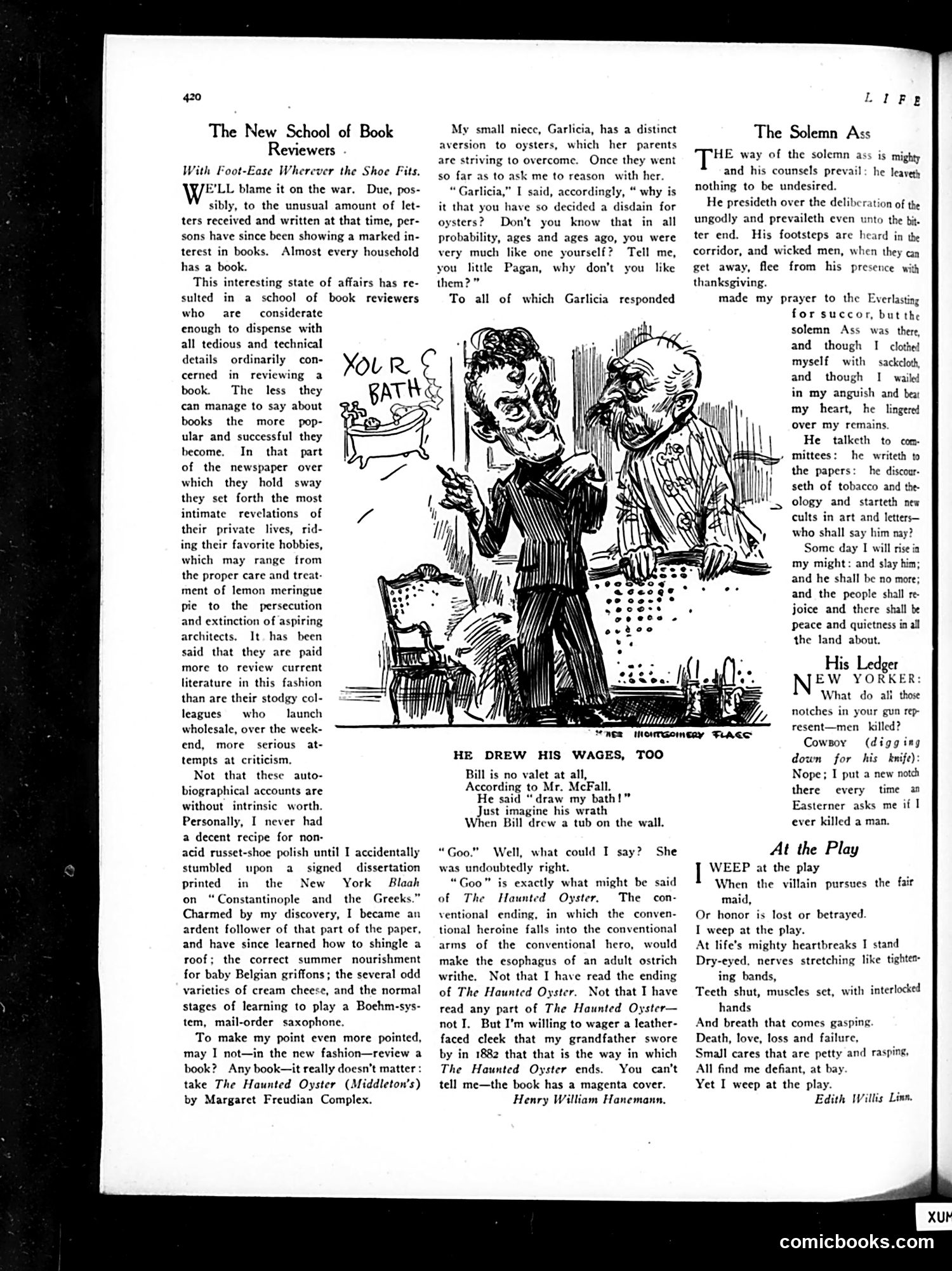
This cartoon satirizes a book reviewer's complaint about writers who use their newspaper book-review columns for personal gain rather than honest criticism. The caption references someone named "Bill" who "drew his bath" on the wall—a visual pun suggesting he literally illustrated his wages/payment. The cartoon shows a man in formal dress drawing on a wall while a small figure (possibly representing a publisher or editor) watches. The satire targets reviewers who abuse their positions: the article criticizes those "paid more to review current literature" than their salaried colleagues, suggesting they profit from favorable reviews or use their platform for self-promotion rather than genuine literary assessment. The piece advocates for more rigorous, honest book criticism and less personal interest-driven reviewing.
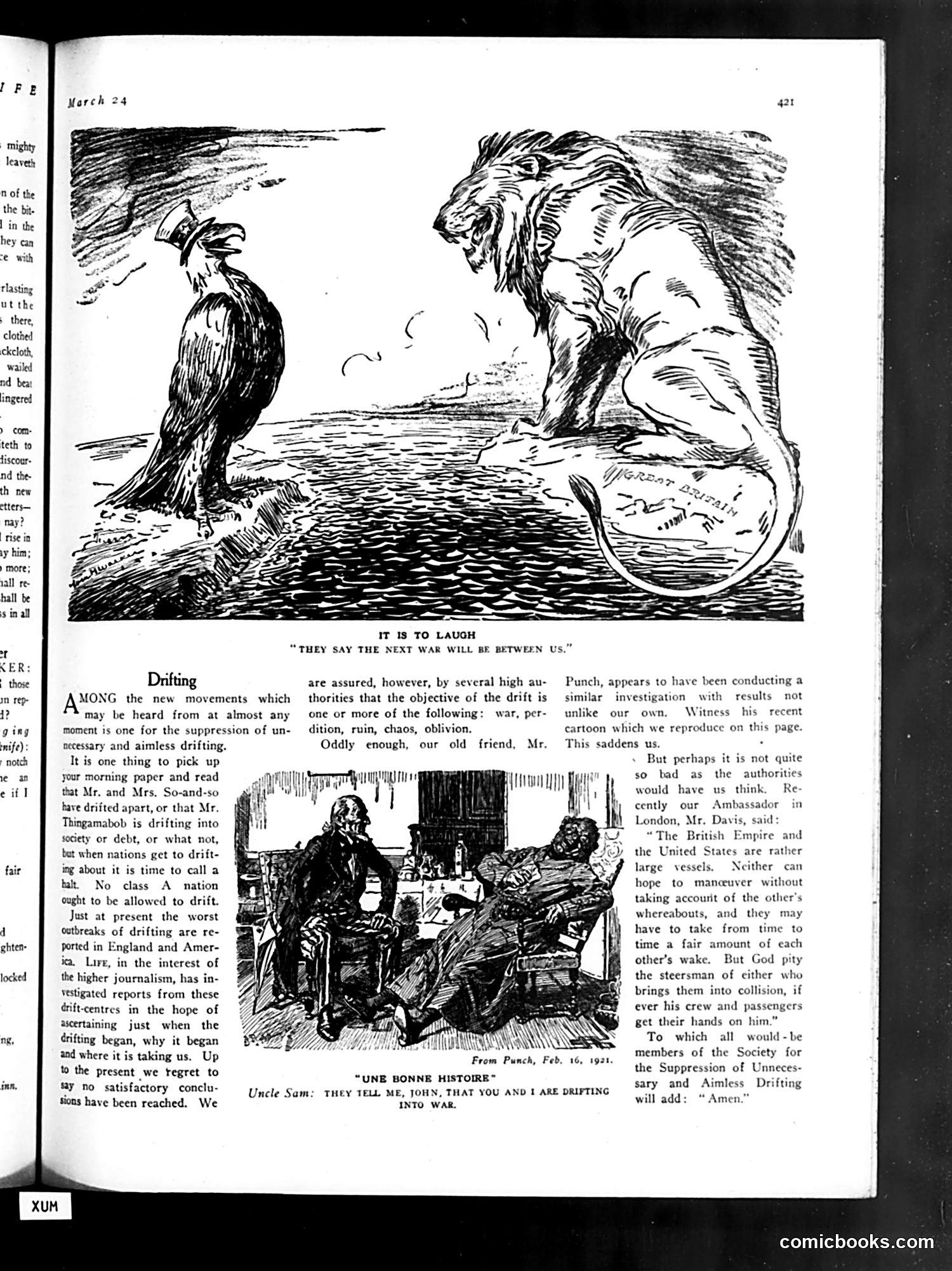
**Top Cartoon - "It is to Laugh"** This political cartoon depicts a rooster confronting a lion, with the caption "They say the next war will be between us." This appears to be Cold War-era satire about potential conflict between nations, likely representing smaller and larger powers through the animal metaphor. **"Drifting" Article & Bottom Cartoon** The article discusses concerns about "drifting" into war and references suppression of "unnecessary and aimless drifting." The lower cartoon titled "Une Bonne Histoire" shows Uncle Sam in discussion, captioned "They tell me, John, that you and I are drifting into war"—satirizing how nations might inadvertently slide toward conflict through diplomatic tension rather than deliberate action. Both pieces critique the danger of unintentional war escalation.
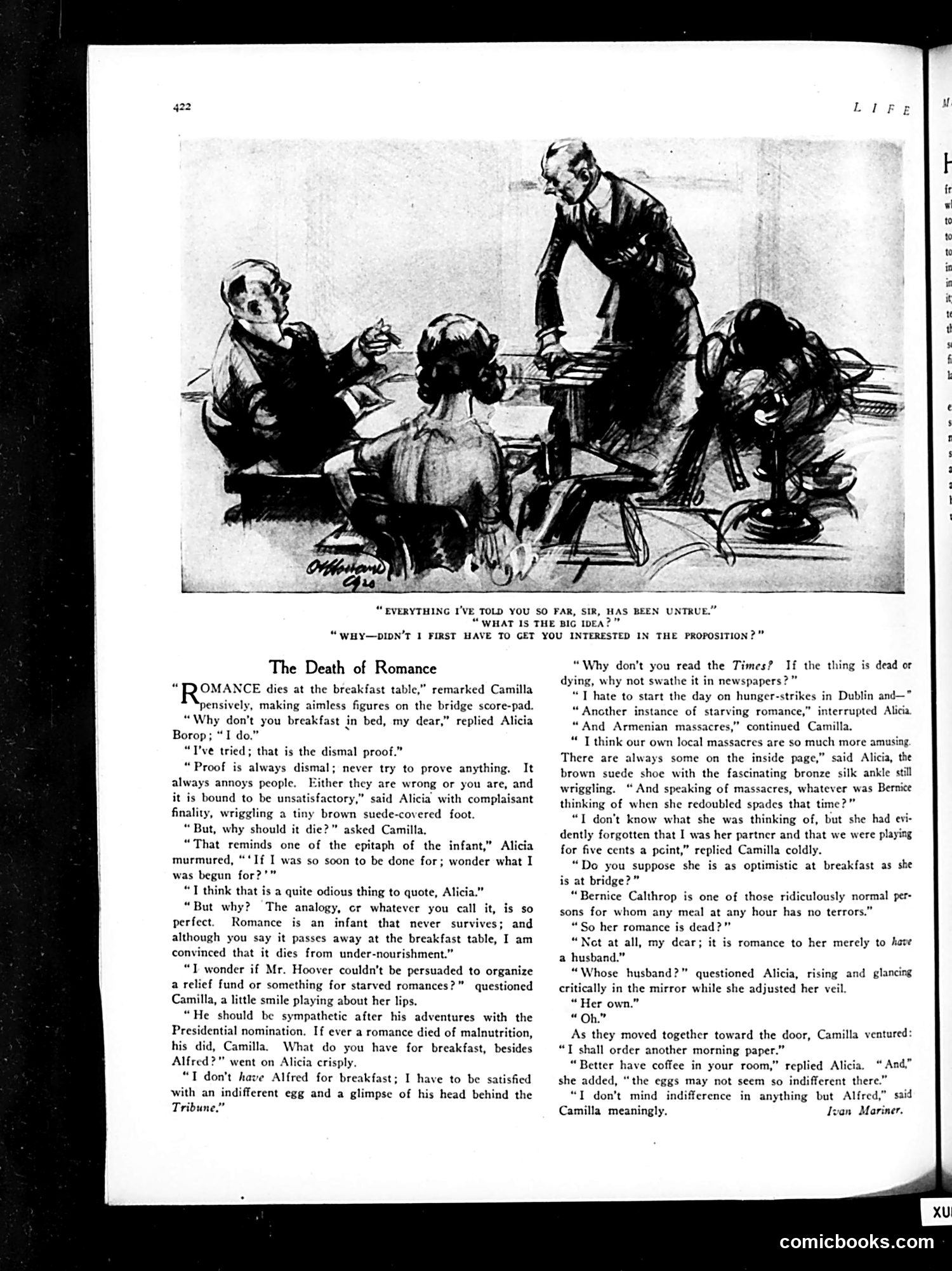
This satirical piece critiques romance's decline in modern life. The cartoon depicts what appears to be a business or editorial meeting where romance is being discussed as a dead concept. The dialogue mocks both romantic idealism and practical modern attitudes. Characters debate whether romance survives in contemporary society, with references to newspapers, massacres, and breakfast table conversations suggesting romance has been replaced by mundane reality and current events. The specific mention of "Bernice Calthrop" and discussions of husbands indicates this satirizes how women's romantic expectations clash with ordinary married life. The overall point: romance as an ideal is incompatible with modern reality, dying under the weight of practicality and disillusionment. The tone is cynical about both romantics and those who've abandoned romance entirely.
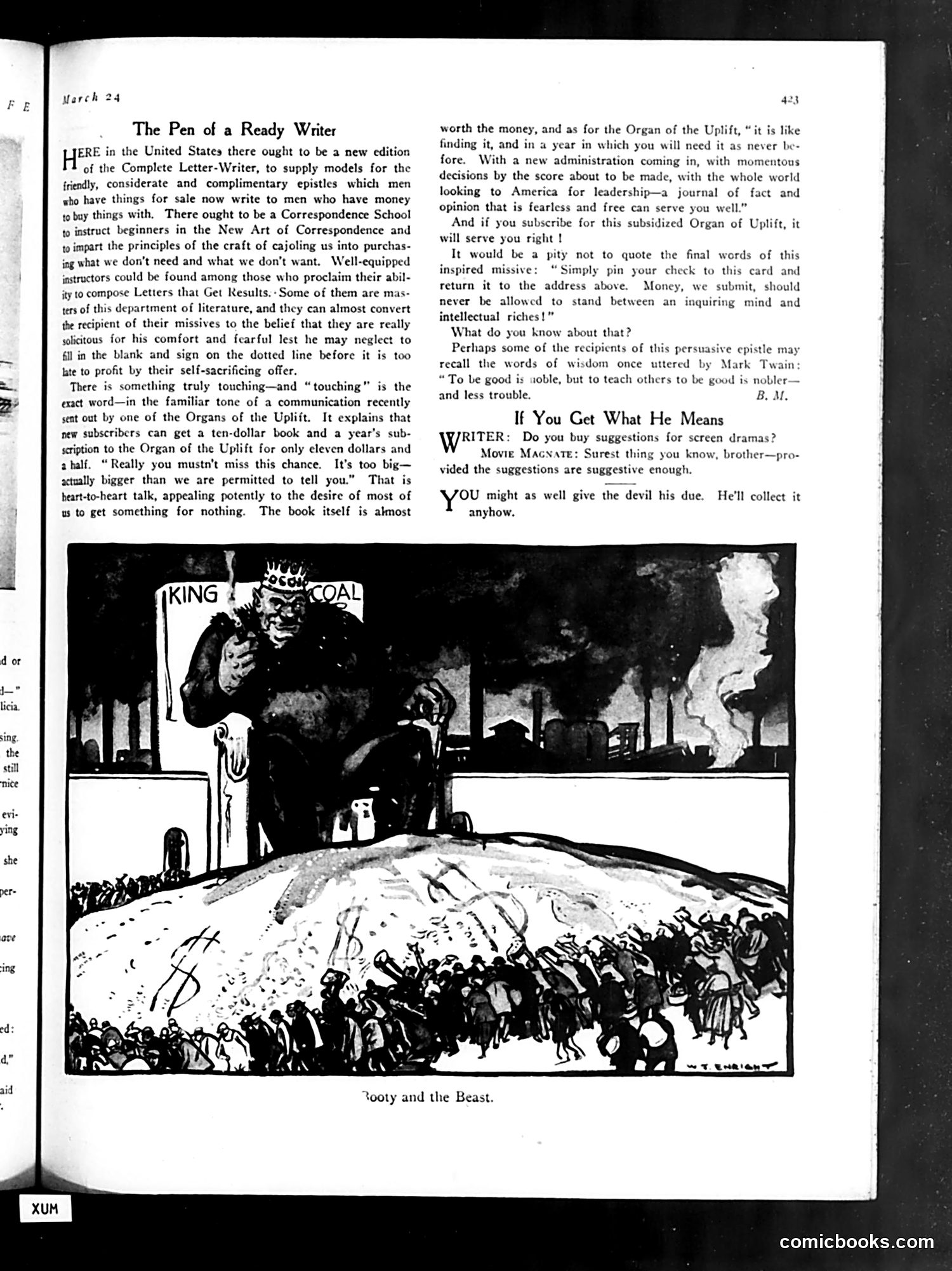
This political cartoon depicts **King Coal** as a crowned, demonic figure presiding over an industrial landscape of smokestacks and factories. Below, masses of workers toil in a quarry or mine, while the King Coal figure hoards wealth above them. The satire critiques the coal industry's exploitation of labor and environmental destruction during America's industrial era. The "beast" refers to both the inhuman King Coal personification and the brutal system it represents. Workers are depicted as enslaved masses serving an all-powerful industrial oligarch. The cartoon advocates for labor rights and criticizes unchecked industrial capitalism's human and environmental costs—a common theme in *Life* magazine's satirical commentary on American economic inequality and worker conditions.
The main cartoon depicts **four figures in military/diplomatic dress** representing the Allied powers (the four soldiers with helmets at top left appear to represent Britain, France, America, and Germany in the context of post-WWI negotiations). The article discusses **post-war reparations and German occupation** by Allied troops. It references debates over whether Germany can afford reparations, mentions **Lenin, Trotsky, and Bolshevism** as threats to European stability, and criticizes the failed League of Nations treaty ratification in the U.S. Senate. The satirical point: The Allies occupied German cities but cannot agree on fair terms; meanwhile, political instability spreads across Europe. The cartoon suggests the occupying powers are squabbling children rather than serious negotiators addressing continental crises. A separate joke about NYC streetcar fares appears at bottom.
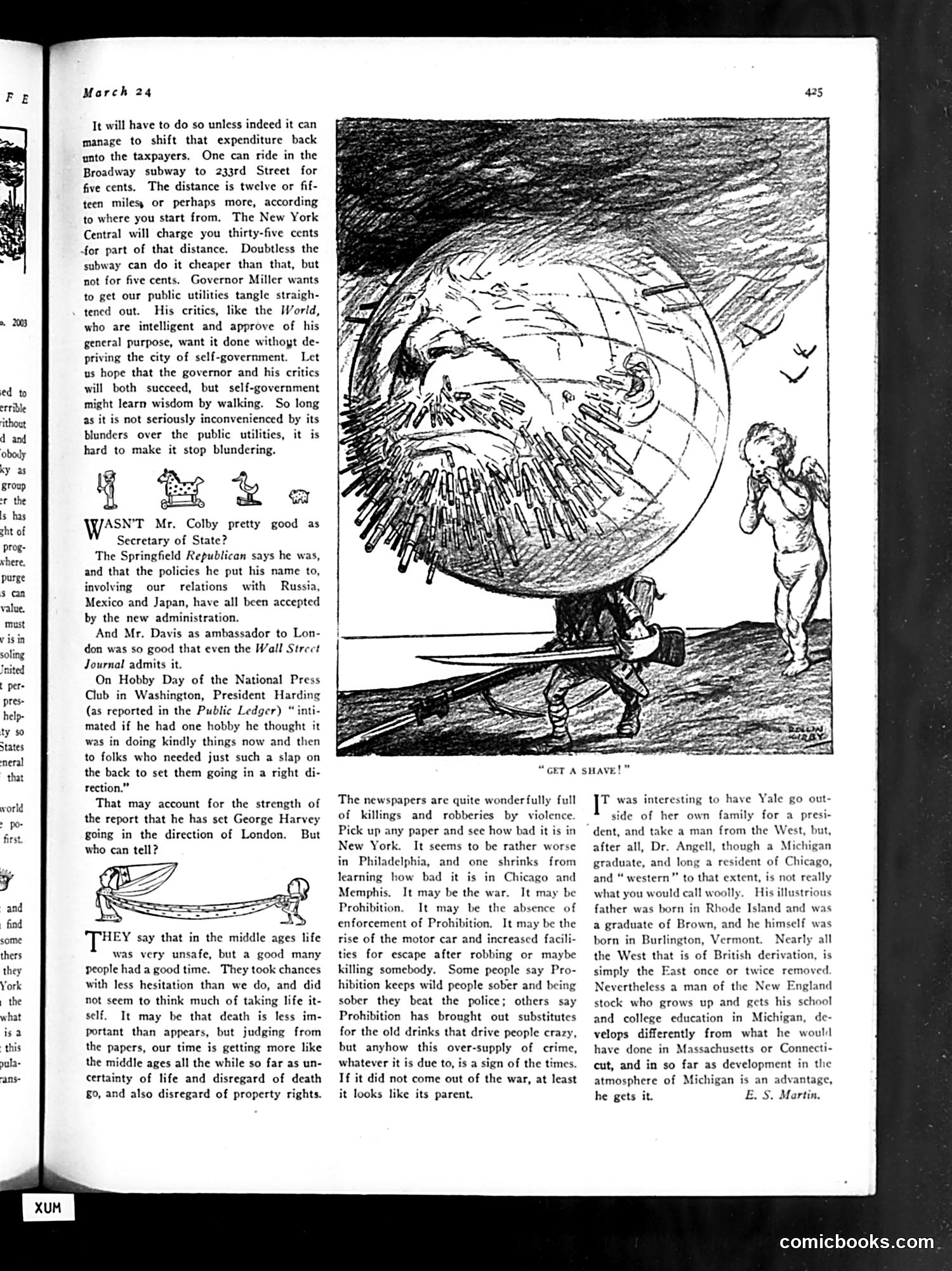
This page contains political commentary and satire typical of Life's early 1920s editorial content. **Main Cartoon ("Get a Shave!"):** A cherub or cupid figure appears to be shaving or trimming a large, bearded male head. The cartoon likely satirizes a political or public figure, though the specific identity isn't definitively clear from the image alone. **Text Commentary:** The page discusses several topics: 1. **Governor Miller's utilities reform** in New York, criticizing the contradiction between five-cent subway fares and higher railroad charges 2. **Secretary of State Colby and Ambassador Davis** — praised for continuing policies from the previous administration regarding Russia, Mexico, and Japan 3. **President Harding's "hobby"** — sarcastically noting his supposed kindness to people, with veiled criticism about appointment of George Harvey as ambassador to London 4. **Crime and Prohibition** — extensive discussion of rising violence and robberies, debating whether Prohibition, the war, or motor vehicles caused increased lawlessness 5. **Yale's new president** — Dr. Angell, praised as bringing Western perspective despite Eastern family roots The overall tone is sophisticated political mockery aimed at early Harding administration policies.
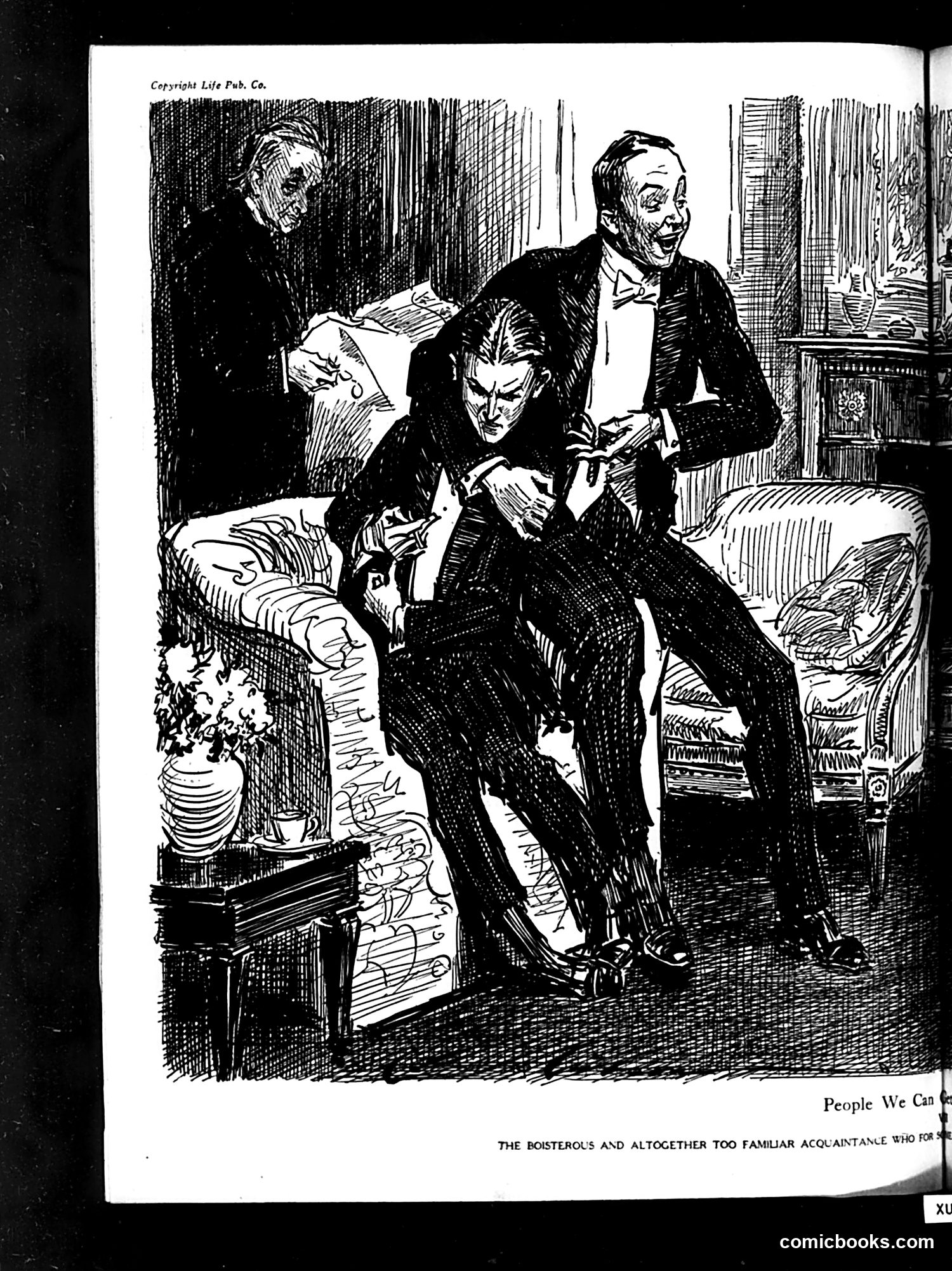
This is a satirical illustration from *Life* magazine depicting a social situation. The caption refers to "the boisterous and altogether too familiar acquaintance"—a commentary on unwanted social behavior. The image shows three well-dressed men in formal attire in what appears to be a parlor or drawing room. The central figure is seated and appears uncomfortable, while two others stand nearby—one holding papers (possibly a servant or attendant) and another smiling broadly. The seated man's posture and expression suggest he's enduring an intrusive or overly casual interaction from someone of lower social standing who doesn't understand proper social boundaries. The satire targets social climbing or inappropriate familiarity—someone acting too friendly or informal with their betters, violating Victorian-era social conventions about class and decorum.
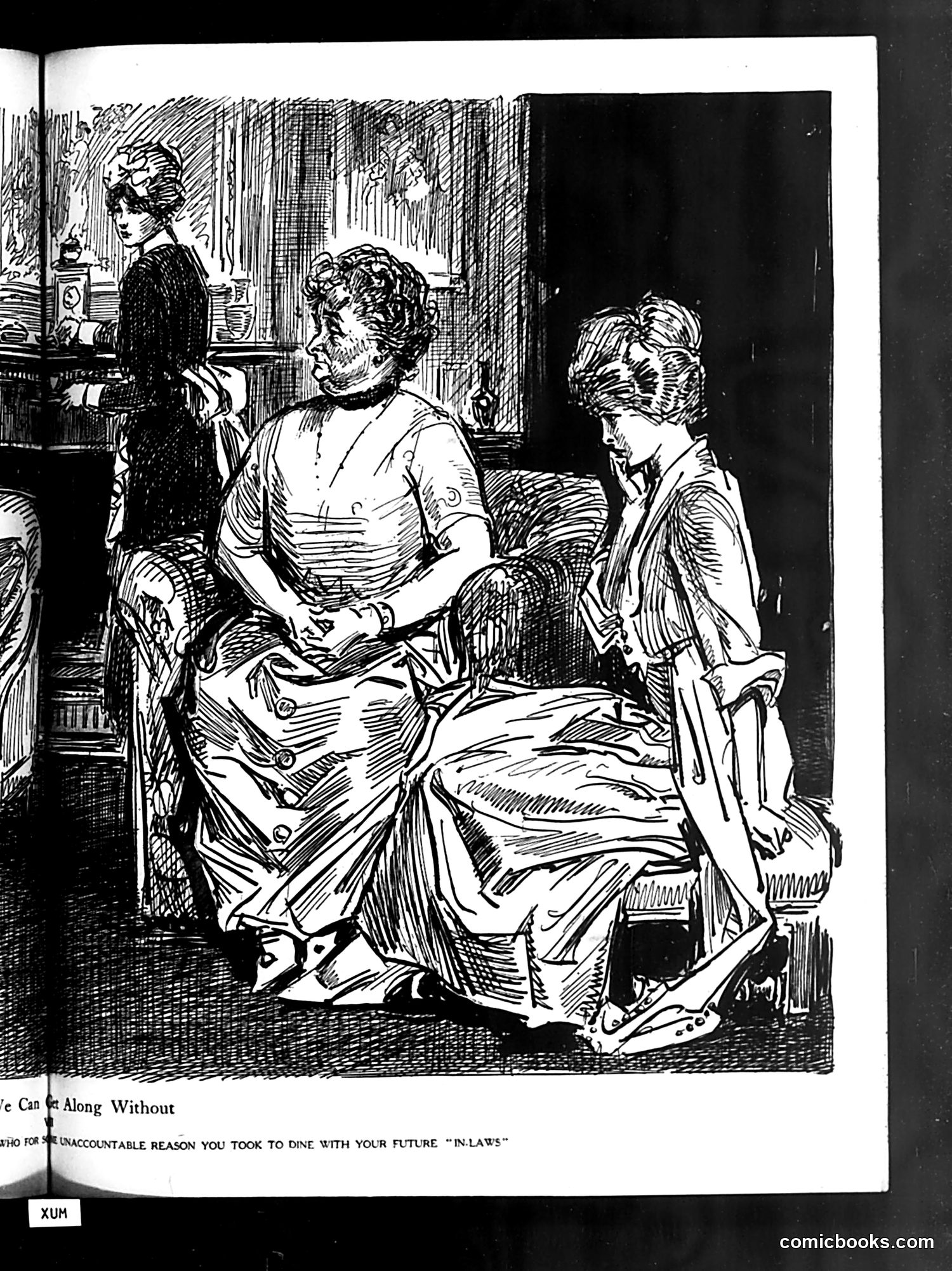
This appears to be a page from Life magazine featuring a satirical cartoon about social etiquette or marital relations. The visible caption reads: "WHO FOR NO UNACCOUNTABLE REASON YOU TOOK TO DINE WITH YOUR FUTURE 'IN-LAWS.'" The scene depicts three women in an interior setting—one seated centrally in an elaborate dress, another seated to the right, and a third standing in the background. The artwork style is characteristic of early 20th-century pen-and-ink illustration. The satire appears to target uncomfortable social situations, likely focusing on awkward dynamics or tensions between a woman and her prospective in-laws during a formal dinner engagement. The phrase "unaccountable reason" suggests the cartoon mocks inexplicable social decisions or poor judgment in courtship situations. The specific identities and precise historical context remain unclear from the visible text and image alone.
This page from Life magazine's drama criticism section contains satirical commentary on contemporary Broadway productions, circa 1920s. **Main Satire:** The critic mocks a theatrical cliché: plays depicting moral reformation always require the character to don overalls and move to the country. The piece ridicules how playwrights use this tired device as a shortcut for showing virtue, noting the irony that this convention may actually drive people *from* rural areas to cities (since countryside life appears uniformly dull on stage). **Specific Play Critiques:** - **"Nice People"** by Rachel Crothers: The reviewer finds the early acts (showing young characters rejecting conventions) entertaining, but loses interest once moral regeneration occurs and the characters relocate to a farm. - **"The Tie That Liberates"**: Satirized for excessive dialogue—characters literally talk others into submission to achieve their goals. The critic implies the play is so dialogue-heavy that even police officers attend to manage the verbal onslaught. The tone is witty mockery of formulaic playwriting and theatrical conventions that sacrifice realism for melodrama.
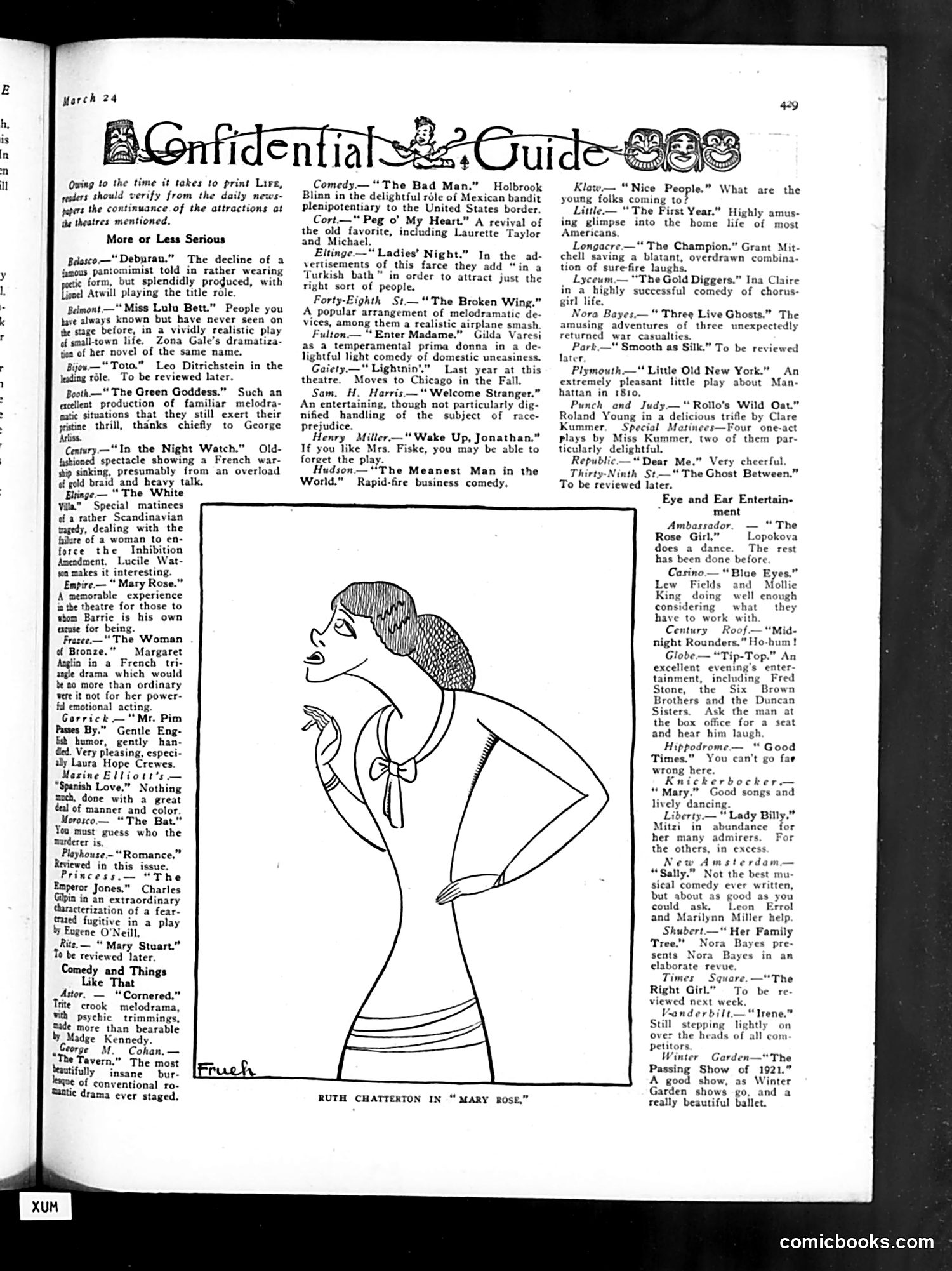
This page is a **theater listing and review section**, not a political cartoon. It's a "Confidential Guide" to Broadway shows currently running, with brief critical assessments of comedies, dramas, and melodramas. The **illustration** shows **Ruth Chatterton** in costume from "Mary Rose," a J.M. Barrie play described as "a memorable experience" for theater-goers. The drawing depicts her in period dress, labeled simply "Fruen" (likely the character name). The reviews are gossipy and snide—typical of Life's satirical theater criticism. They mock conventional romantic drama ("beautifully insane burlesque of conventional romantic drama"), note which actors carry weak plays, and make sly comments about audience appeal (the "Eltinge" entry jokes that "Ladies' Night" advertises a Turkish bath setting "to attract just the right sort of people"). This is **entertainment journalism**, not political satire—a snapshot of 1921 Broadway tastes and Life magazine's irreverent critical voice.
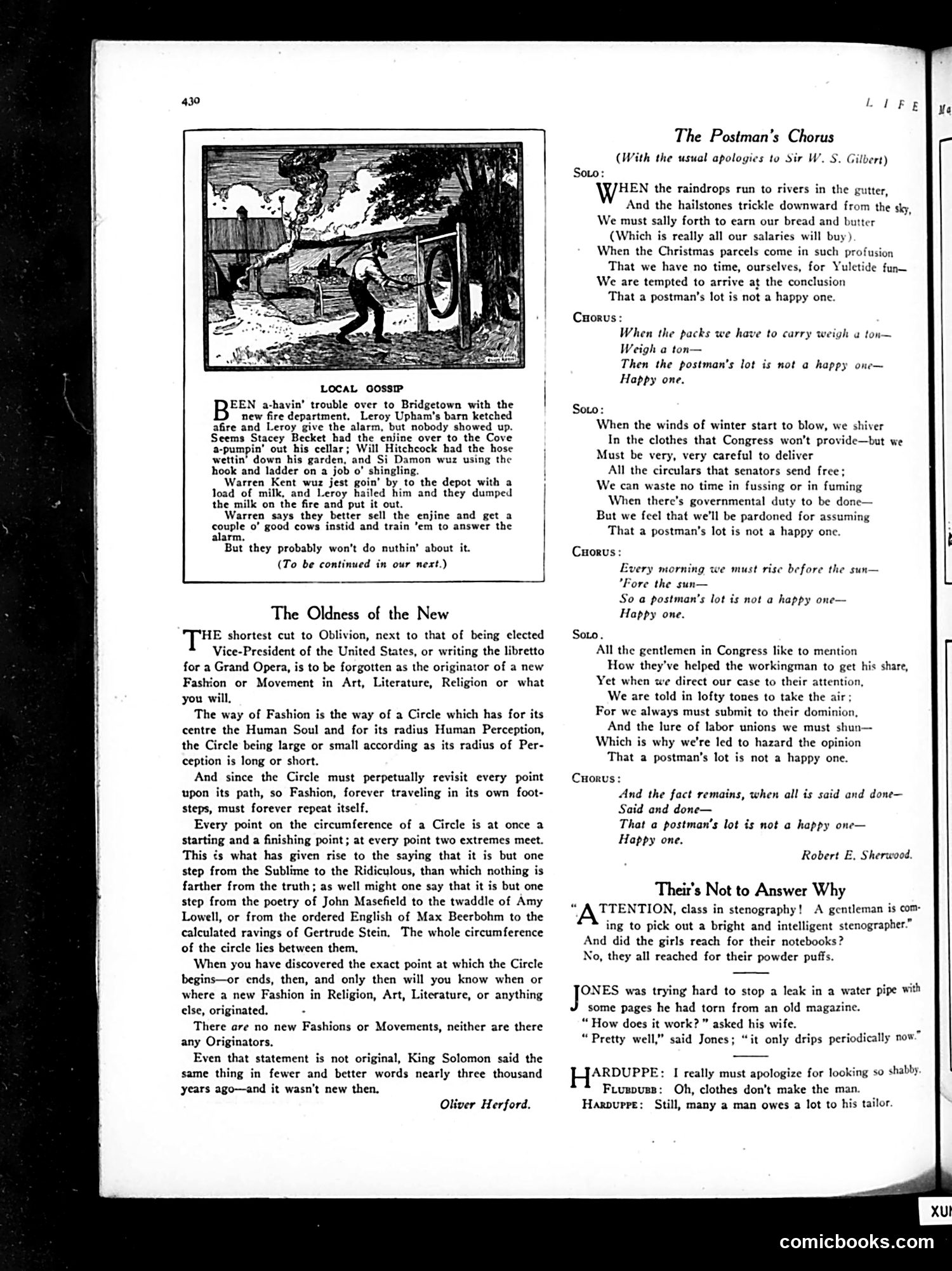
This page contains three distinct pieces of satirical content: **"Local Gossip"** (with cartoon): A humorous rural anecdote about a small-town volunteer fire department so disorganized that when a barn burns, the firefighters are scattered doing other tasks. A passing milk wagon extinguishes the fire instead. The joke satirizes small-town inefficiency and the suggestion to replace the fire engine with trained cows mocks the department's uselessness. **"The Oldness of the New"** by Oliver Herford: A philosophical essay arguing that nothing is truly original—all fashions and movements in art, literature, and religion merely repeat past cycles. Herford supports this with literary references (Masefield, Lowell, Beerbohm, Stein) and cites King Solomon, sardonically noting even *that* observation isn't new. **"The Postman's Chorus"**: A Gilbert & Sullivan parody depicting postal workers' complaints—bad weather, heavy loads, underpaid work, and lack of Congressional support despite politicians' claims of helping workers. The refrain "a postman's lot is not a happy one" mimics Gilbert's style while critiquing labor conditions and political neglect.
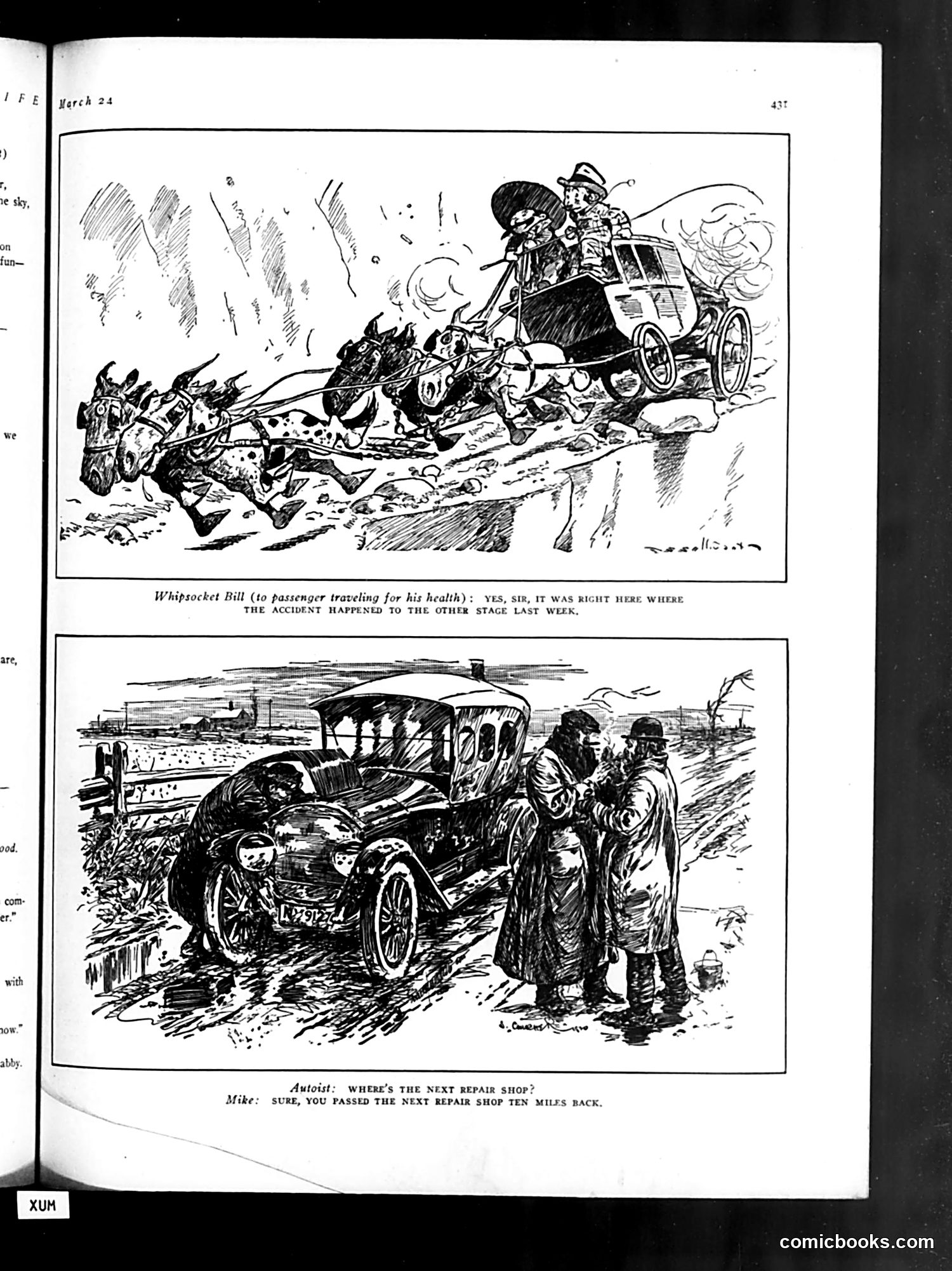
These two cartoons satirize early automobile travel hazards and the primitive roadside infrastructure of the era. **Top cartoon:** "Whipsocket Bill" is a stagecoach driver boasting to a passenger about a previous accident at that exact spot—implying dangerous conditions and poor safety records were routine and unremarkable. **Bottom cartoon:** An automobile has broken down in rural countryside. The "Autoist" asks for the nearest repair shop, and "Mike" replies they've already passed it ten miles back—a joke about the scarcity of auto repair facilities in the early motoring era, forcing stranded drivers to backtrack or be stranded far from help. Together, these cartoons mock the risks and inconveniences of early 20th-century travel, whether by stagecoach or automobile, highlighting inadequate infrastructure and casual acceptance of frequent accidents.
This is a film review (not a political cartoon) praising the motion picture adaptation of Blasco Ibáñez's WWI novel. The critic argues the film succeeds where the original novel didn't fully engage readers—it holds attention powerfully. The review emphasizes the film's importance as a historical record of World War I, warning that future generations will judge the war through artistic works like this one. It credits director Rex Ingram's "superb direction" and June Mathis's screenplay as responsible for the film's power. Notably, the review highlights newcomer **Rudolph Valentino** in the leading role, claiming he surpasses established "stock movie heroes" through superior ability and appearance. This appears to be an early recognition of Valentino's star potential during the silent film era.
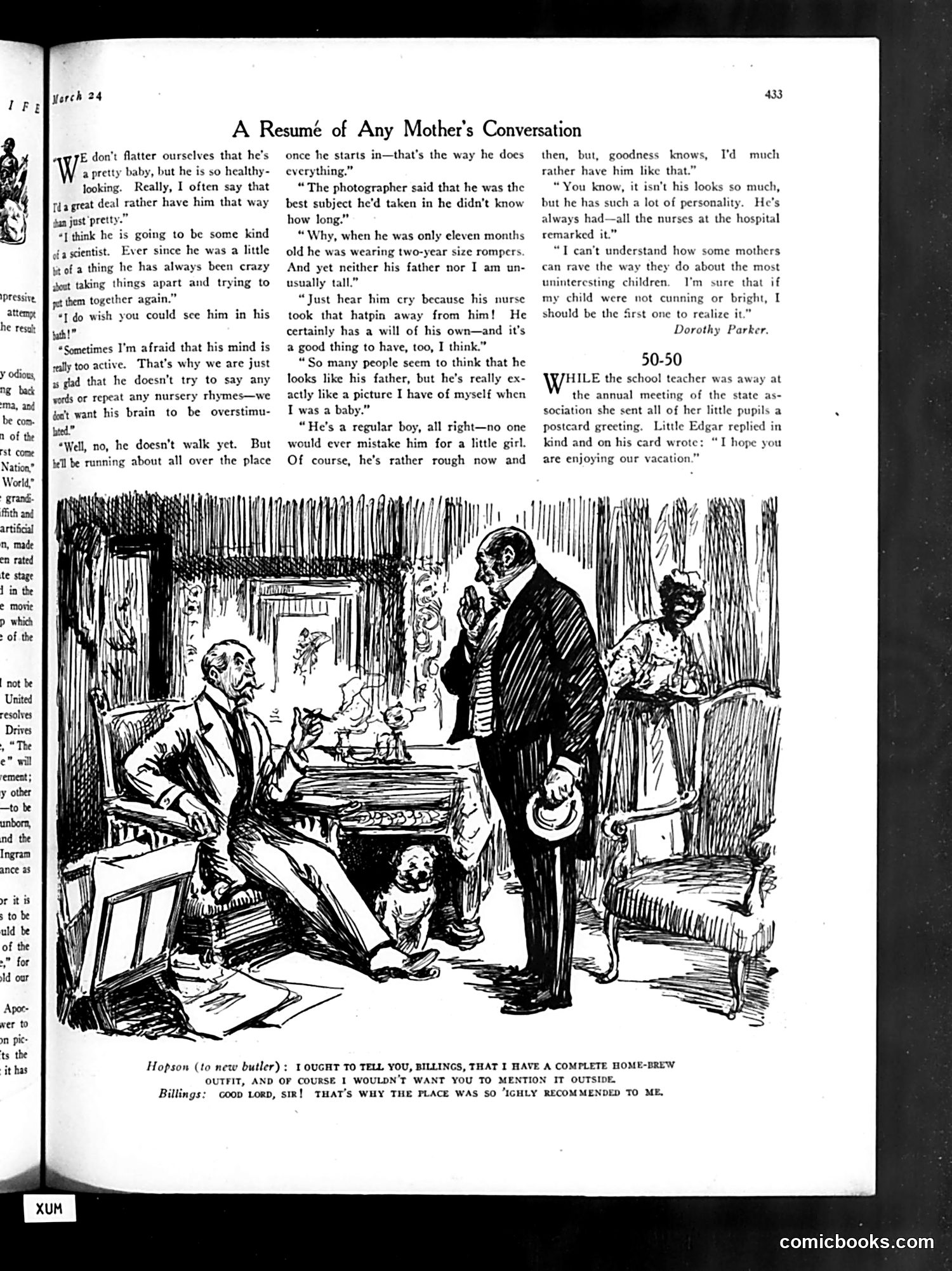
This is a satirical piece by Dorothy Parker mocking mothers who obsessively brag about their babies. The text presents a monologue of a self-deluded mother making contradictory claims: her child is healthy (not pretty), intellectually gifted yet needing brain rest, won't walk but will run everywhere, resembles her not the father, has exceptional personality, and is perfectly behaved despite being "rough." The humor lies in Parker's exposure of maternal vanity and the clichéd, often absurd praise mothers heap on unremarkable children. The piece ridicules how mothers convince themselves their ordinary babies are exceptional through selective perception. The accompanying cartoon and "50-50" joke (child assumes teacher's vacation is shared with students) are lighter, unrelated humor pieces. The bottom cartoon references Prohibition-era home brewing, a topical concern when alcohol was illegal.
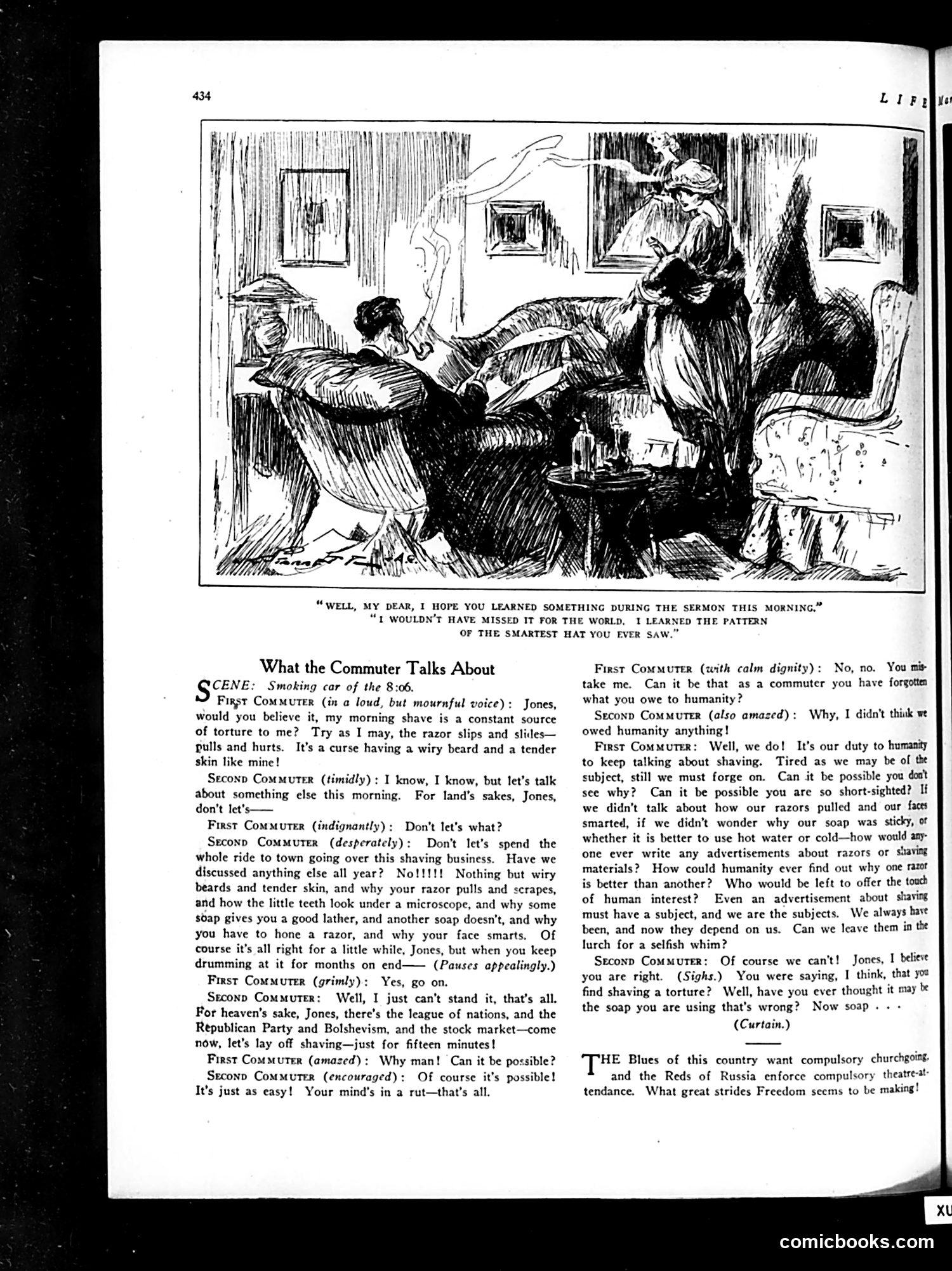
This two-part page satirizes early 20th-century consumer culture and advertising. **The top cartoon** jokes about selective female attention: a woman learns nothing from church sermon but instead memorizes the pattern of another woman's fashionable hat—reducing spiritual instruction to fashion consumption. **The main dialogue piece** mocks how advertisers exploit mundane complaints to drive sales. Two commuters debate shaving: the first obsessively complains about razor performance, while the second protests this is tedious. When challenged, the first invokes "duty to humanity"—arguing that without constant complaints about shaving problems, advertisers couldn't sell razors and soap. The satire suggests advertisers have convinced consumers their personal grievances serve a social purpose, making them willing vehicles for endless product promotion. **The closing note** sardonically contrasts "compulsory churchgoing" (Blues/conservatives) and Soviet "compulsory theatre-attendance" (Reds/communists), suggesting America's equivalent coercion is advertising—mandatory consumer participation disguised as freedom.
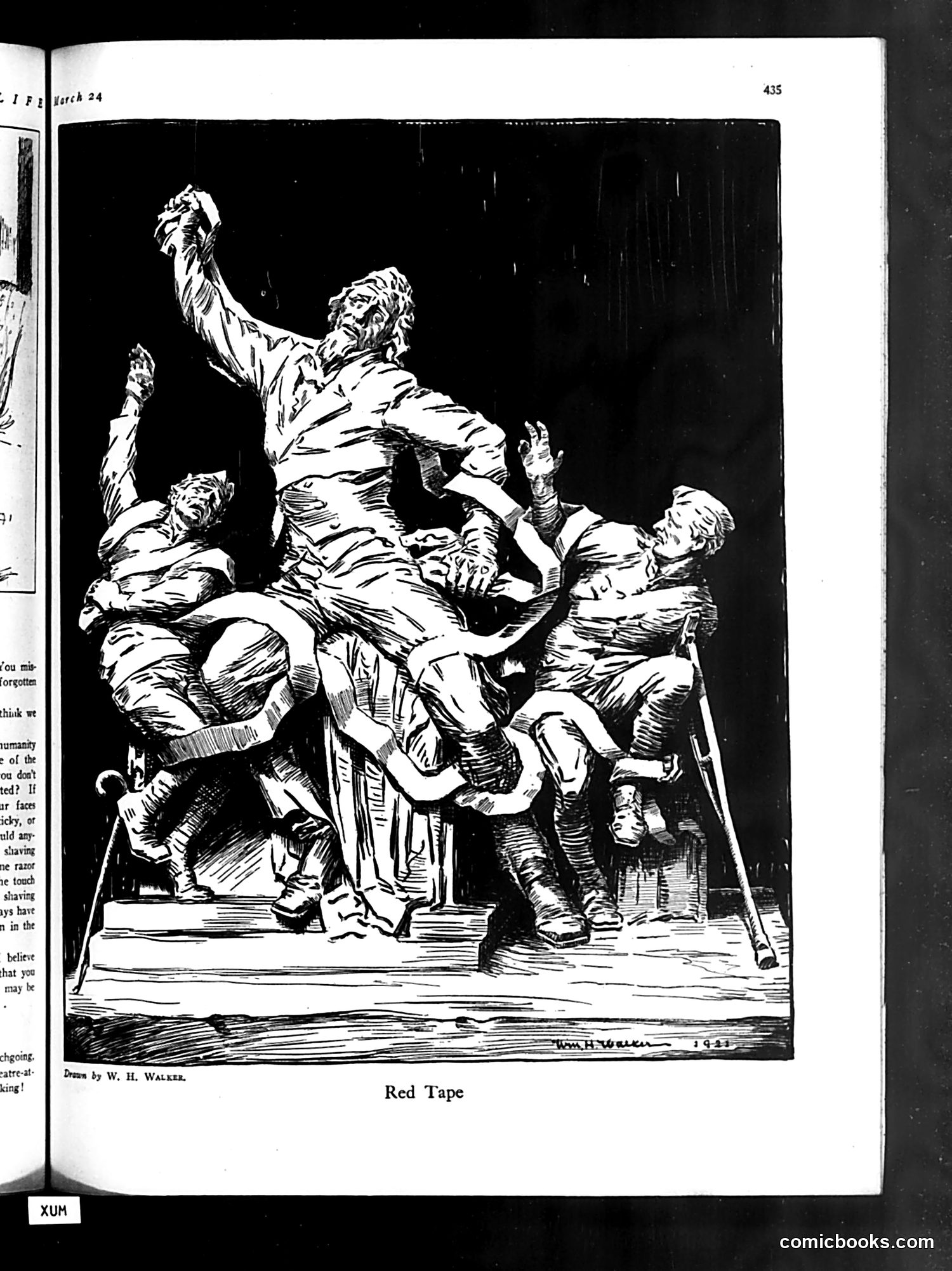
This political cartoon by W. H. Walker depicts a central male figure being lifted or supported by several smaller figures, with his fist raised triumphantly. The title "Red Tape" suggests commentary on bureaucratic obstruction or governmental inefficiency. The composition—with one dominant figure elevated above others who appear to be straining to support him—likely satirizes how bureaucratic processes or red tape impede progress, or how certain individuals benefit from (or exploit) complex governmental systems while others do the actual work. The dramatic, heroic pose of the central figure may be ironic, suggesting the subject claims victory despite being dependent on the system's mechanics below. Without additional context about the specific 1924 issue, the exact political target remains unclear, though it concerns bureaucratic obstacles.
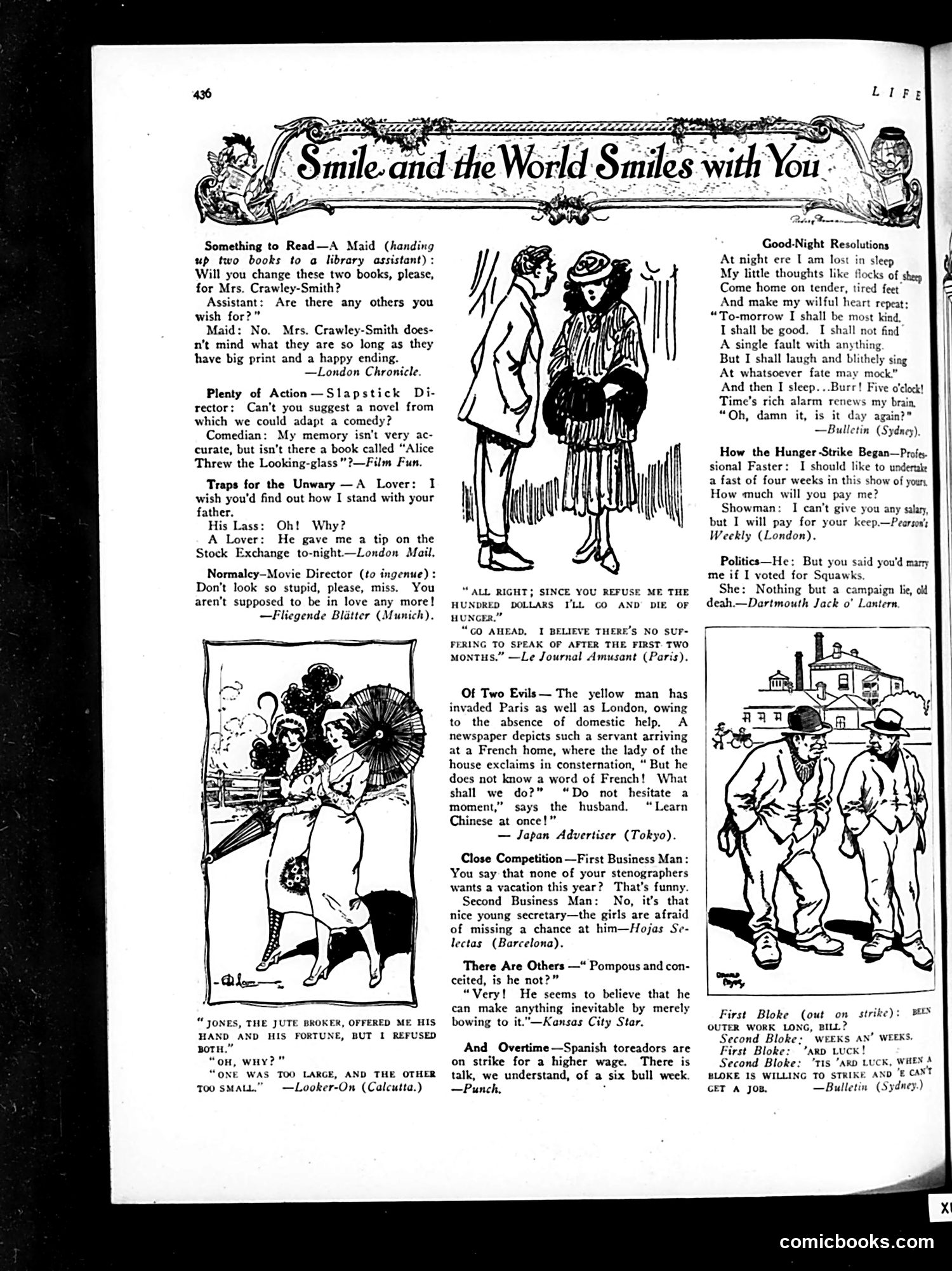
This page collects brief humorous anecdotes from international publications, reflecting early 20th-century social anxieties and workplace dynamics. Key satirical points include: **"Of Two Evils"**: References anti-Asian xenophobia common post-WWI, mocking European fears of Chinese workers replacing domestic servants. The "solution"—learning Chinese—ridicules the absurdity of this prejudice. **"Close Competition"**: Jokes about workplace romance and gender dynamics, suggesting young female secretaries compete for attention from an attractive male colleague rather than seeking vacation time. **"How the Hunger-Strike Began"**: Likely references suffragist hunger strikes (common 1910s-20s), satirizing the practice by imagining a performer striking for theatrical compensation rather than political rights. **"Overtime"**: A Punch cartoon mocking Spanish bullfighter strikes, with dark humor about replacing dead bulls weekly. The overall tone reflects typical satirical magazines' approach: workplace comedy, gentle mockery of social movements, and xenophobic humor considered acceptable contemporary humor.
This is a **full-page advertisement for Phoenix Hosiery**, not a political cartoon or satire. The elaborate decorative border (ornate scrollwork at top and bottom) is typical of early 20th-century magazine design and lends prestige to the product. The ad's messaging targets economical consumers during what it calls "strenuous days"—likely referencing post-WWI or Depression-era concerns about household budgets. The phrase "by the foot and by the mile" uses colloquial language to suggest durability and value. The claim that Phoenix "leads in world sales" was a standard advertising boast. The ornamental framing makes affordable hosiery appear luxurious, a common marketing technique of the era. There is no satirical content on this page—it's straightforward commercial messaging.
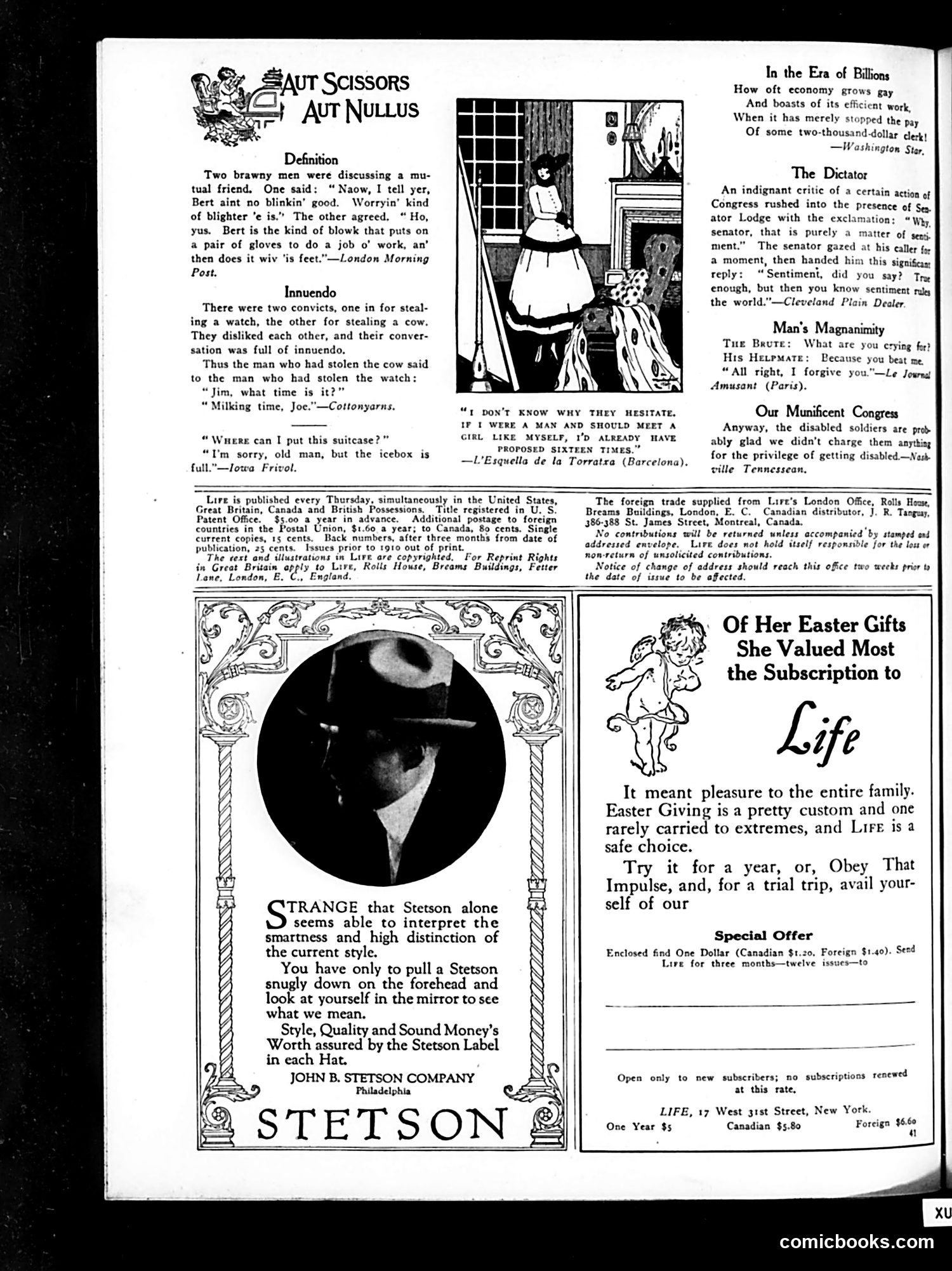
This page from *Life* magazine contains several short humorous pieces satirizing contemporary society, plus advertisements. The **cartoons/jokes** mock various targets: working-class British men ("Bert") who bungle their jobs; prison inmates trading insults; a woman's aggressive romantic boldness; and Congress's treatment of disabled soldiers—criticized for failing to compensate them adequately for their sacrifices (likely post-WWI). One piece quotes Senator Henry Cabot Lodge dismissing a critic's objection as mere "sentiment," suggesting politicians prioritize pragmatism over principle. The **Stetson hat advertisement** emphasizes quality and status signaling through proper headwear. The **Life subscription offer** positions the magazine as wholesome family entertainment suitable as an Easter gift. Overall, the page reflects early 20th-century satirical humor targeting class distinctions, gender dynamics, and political indifference to veterans' welfare.
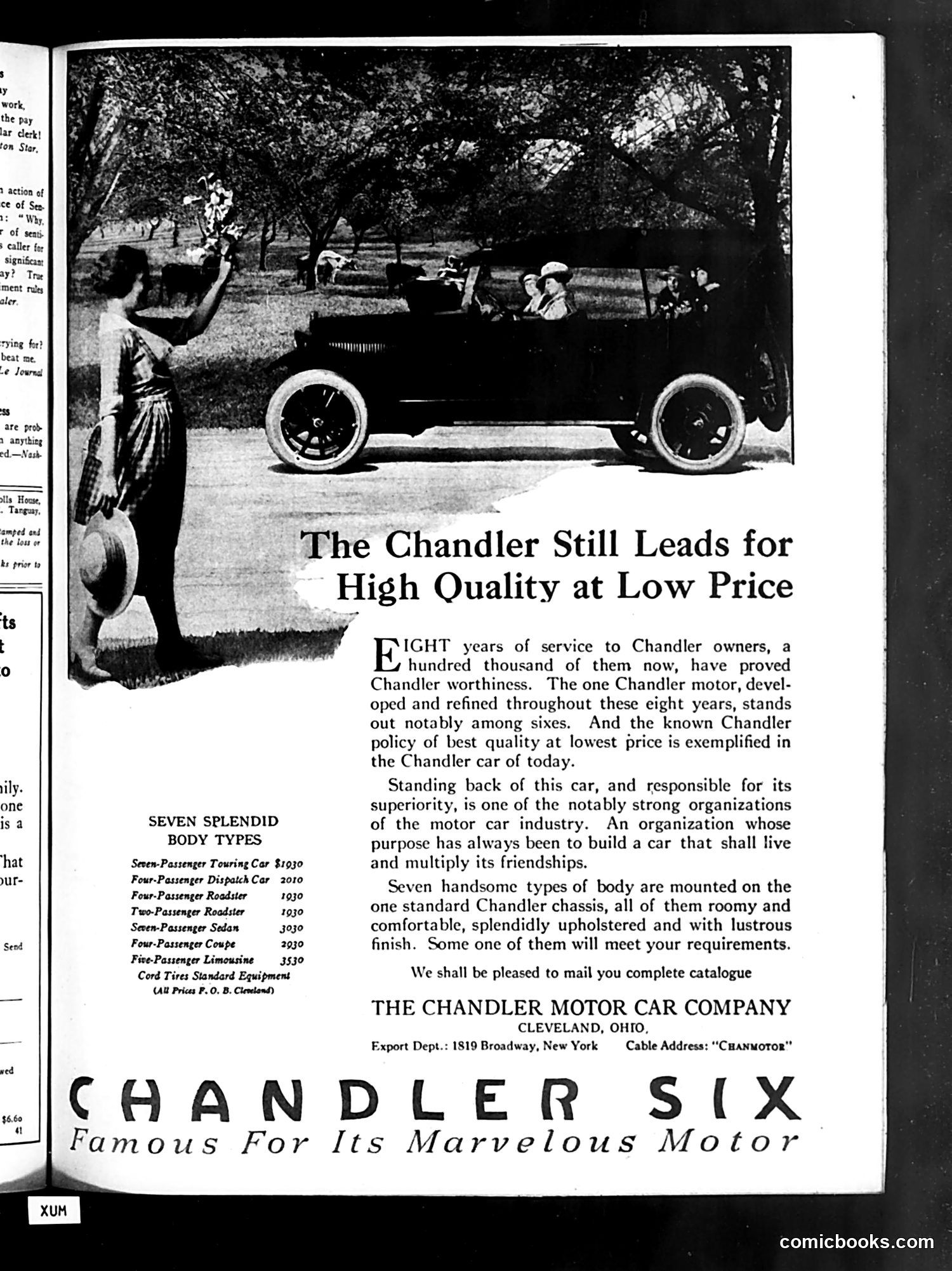
This is primarily a **car advertisement**, not a political cartoon. The page promotes the Chandler Six automobile from the Chandler Motor Car Company of Cleveland, Ohio. The image shows a vintage automobile (appearing to be from the 1920s-30s era) with passengers, alongside a woman in period dress waving. The advertisement emphasizes the car's value proposition: "high quality at low price." The text boasts eight years of proven reliability among owners and highlights seven different body styles available on a single chassis—a selling point for manufacturers of that era. The Chandler Six was marketed as famous "for its marvelous motor." **For modern readers**: This reflects early automotive advertising strategies emphasizing durability, variety of options, and affordability as competitive advantages in a growing consumer market. The prices listed (roughly $1,930-$3,530) represent significant purchases for the period.
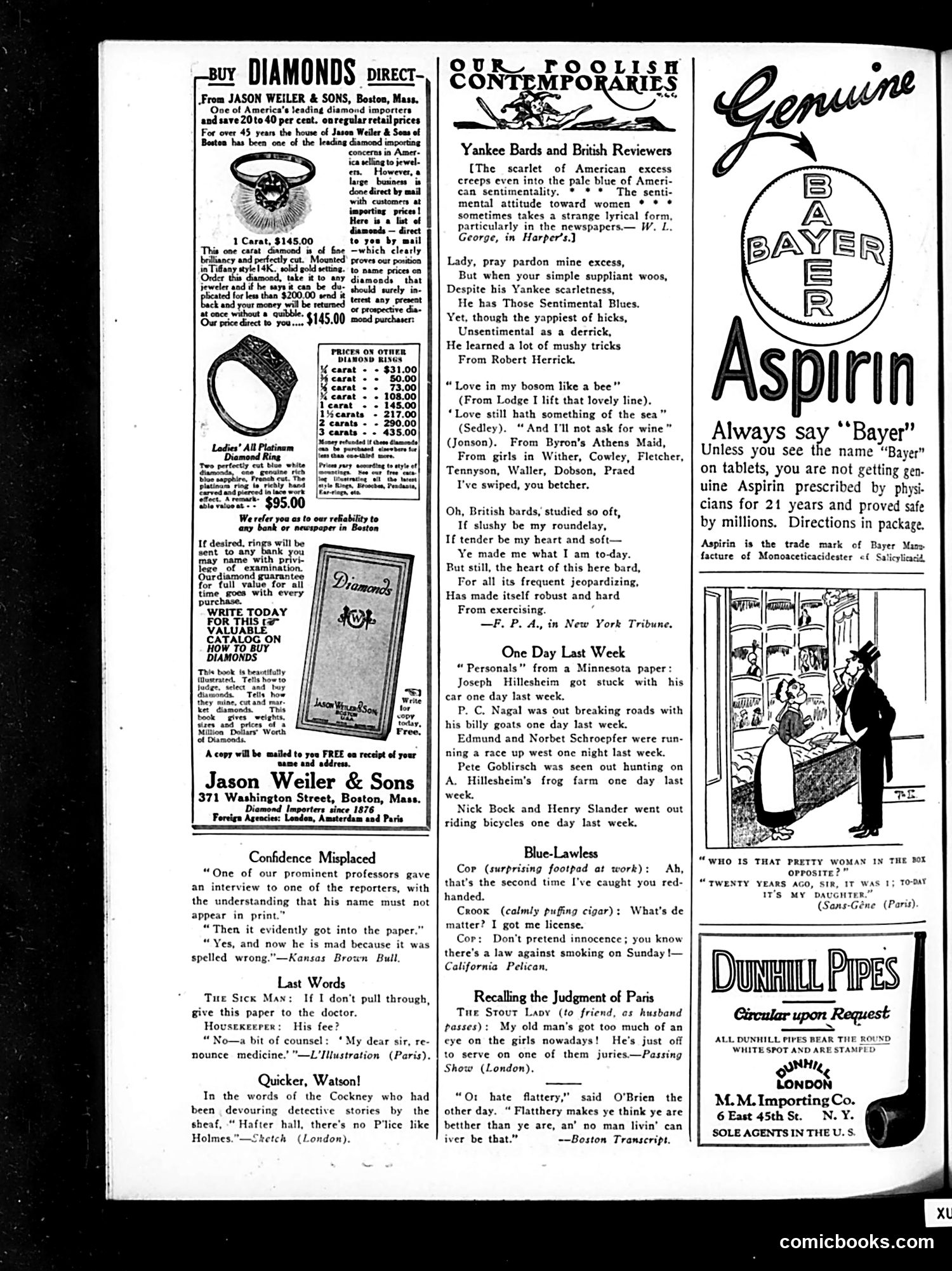
This page is primarily **advertising and humor shorts**, not political cartooning. The main advertorial content promotes **Jason Weiler & Sons diamonds** from Boston, emphasizing direct purchasing saves 20-40% versus retail prices. The humor section includes several brief jokes and a satirical poem titled "Yankee Bards and British Reviewers." This poem mocks American sentimentality in love poetry, suggesting American writers plagiarize from British poets (Lodge, Sedley, Byron, Tennyson, etc.) to produce overly sentimental verse. The critique references a Harper's essay by W.L. George about American "excess" in sentimental attitudes toward women. Other jokes satirize academic hypocrisy, detective fiction clichés, and local newspaper absurdities (the "One Day Last Week" section). A small cartoon depicts a man and woman, captioned about "that pretty woman in the *opposite*," playing on romantic misunderstandings. The **Bayer Aspirin advertisement** occupies the right column, claiming 21 years of proven safety. Overall: a typical Life magazine mixture of commerce, light satire, and product promotion.
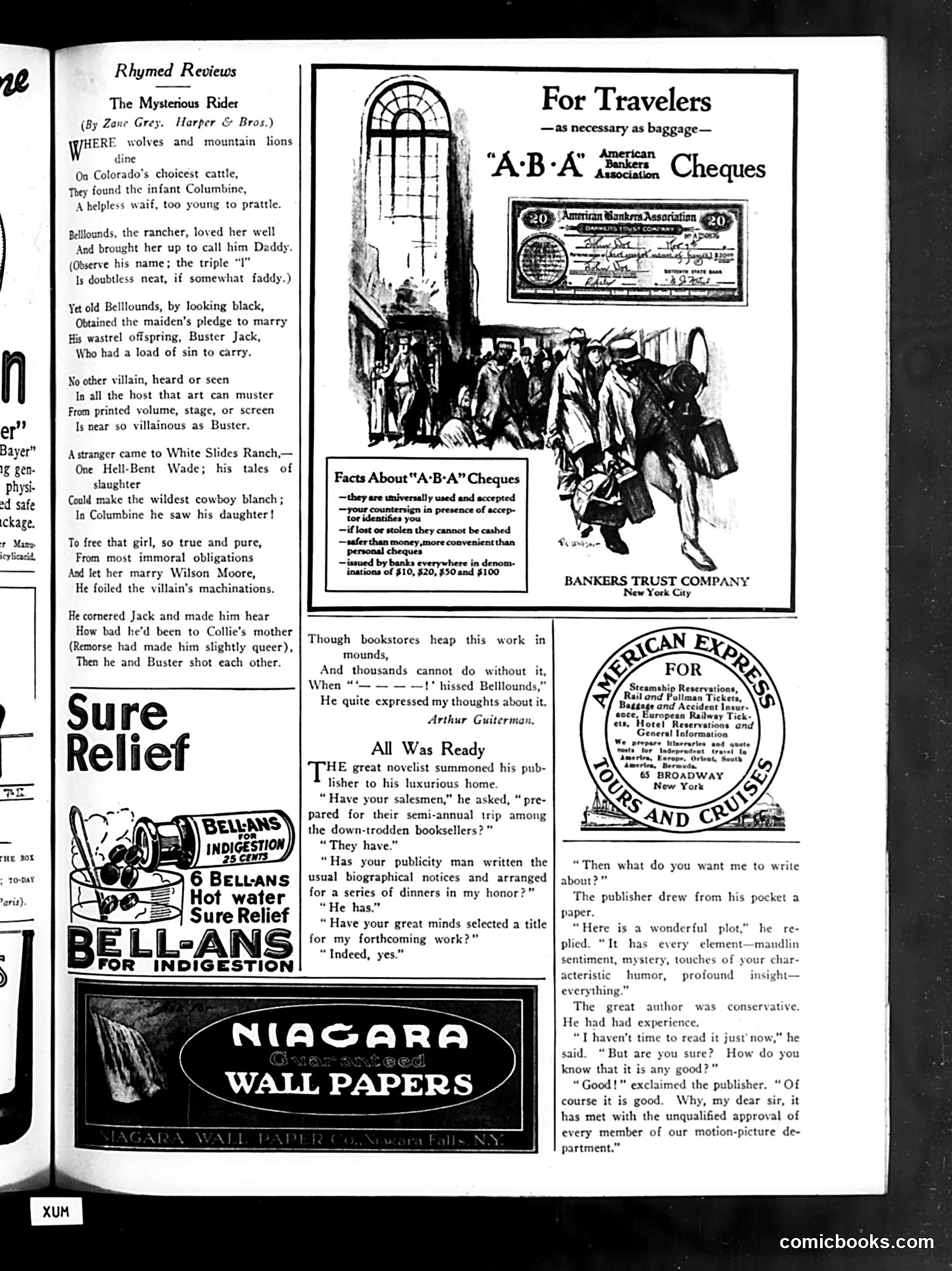
This page contains literary and advertising content rather than political cartoons. **"The Mysterious Rider" (Zane Grey review):** A humorous verse review of a Western novel. The reviewer satirizes the predictable plot—a rancher's adopted daughter (Columbine) is pressured to marry his dissolute son (Buster Jack), but a stranger (Hell-Bent Wade) reveals he's her father and engineers the villains' downfall. The satire mocks the formula's melodrama and overwrought villainy, with the critic suggesting the censored expletive ("— — —!") better expresses his frustration than words. **"All Was Ready":** A joke about modern publishing. A publisher presents a novelist with a pre-written plot, having already prepared salesmen, publicity, biographical notices, and dinners—but admits the book's approval comes solely from the motion-picture department, not literary merit. This satirizes how 1920s publishers prioritized film adaptations over literary quality. **Advertisements** fill the remaining space, promoting traveler's cheques, indigestion relief, and wallpaper.
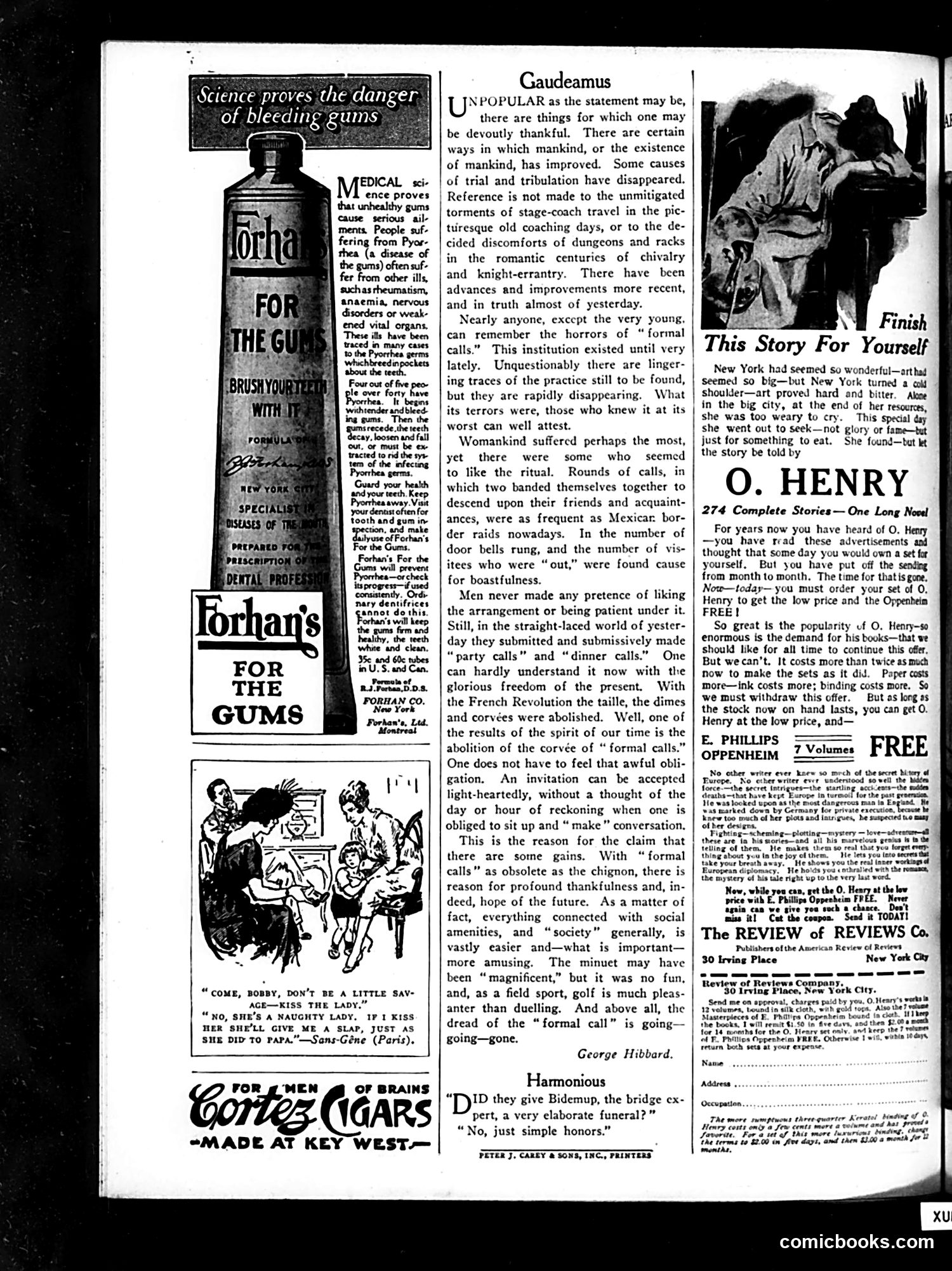
This page contains three distinct elements for a modern reader: **The Forhan's Toothpaste Ad** (left) uses pseudo-scientific claims linking gum disease to serious ailments like rheumatism and anemia—typical early 20th-century marketing exaggeration before modern FDA regulation. **The "Sans-Géne" Cartoon** (bottom left) shows a child refusing to kiss a woman, explaining she'll slap him like she did his father. It's a domestic humor joke playing on marital discord and children's innocent observations of adult relationships. **The "Gaudeamus" Essay** (center-right) celebrates the disappearance of "formal calls"—obligatory social visits that were tedious social rituals, especially burdensome for women. The author argues modern society has mercifully eliminated this Victorian-era requirement, comparing it to the French Revolution's abolition of feudal obligations. **The O. Henry Advertisement** (right) promotes a 274-story collection, using a melodramatic snippet about a destitute woman in New York seeking food—characteristic O. Henry subject matter about urban poverty and desperation.