
Life, 1921-03-24 · page 24 of 34
Life — March 24, 1921 — page 24: what you’re looking at
What you’re looking at
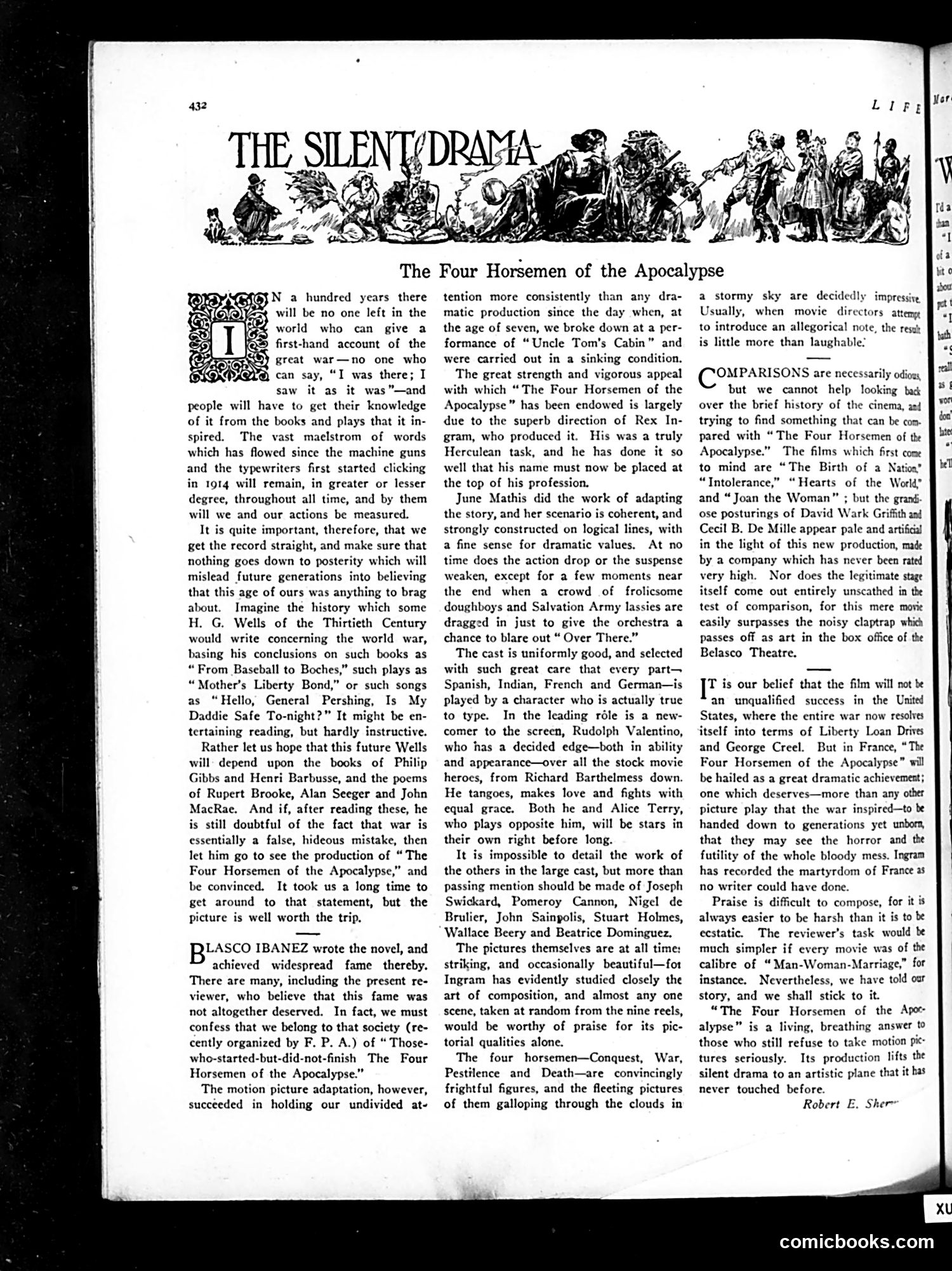
This is a film review (not a political cartoon) praising the motion picture adaptation of Blasco Ibáñez's WWI novel. The critic argues the film succeeds where the original novel didn't fully engage readers—it holds attention powerfully. The review emphasizes the film's importance as a historical record of World War I, warning that future generations will judge the war through artistic works like this one. It credits director Rex Ingram's "superb direction" and June Mathis's screenplay as responsible for the film's power. Notably, the review highlights newcomer **Rudolph Valentino** in the leading role, claiming he surpasses established "stock movie heroes" through superior ability and appearance. This appears to be an early recognition of Valentino's star potential during the silent film era.
📄 Transcribed text from this page (OCR, searchable)
Machine-transcribed from the original scan — historical spelling and the odd misread are preserved.
The Four Horsemen of the Apocalypse world who can give a first-hand account of the great war—no one who can say, “I was there; I saw it as it was”—and people will have to get their knowledge of it from the books and plays that it in- spired. The vast maelstrom of words which has flowed since the machine guns and the typewriters first started clicking in 1914 will remain, in greater or lesser degree, throughout all time, and by them will we and our actions be measured. It is quite important, therefore, that we get the record straight, and make sure that nothing goes down to posterity which will mislead future generations into believing that this age of ours was anything to brag about. Imagine the history which some H. G. Wells of the Thirtieth Century would write concerning the world war, basing his conclusions on such books as “From Baseball to Boches,” such plays as “Mother’s Liberty Bond,” or such songs as “Hello, General Pershing, Is My Daddie Safe To-night?” It might be en- tertaining reading, but hardly instructive. Rather let us hope that this future Wells will depend upon the books of Philip Gibbs and Henri Barbusse, and the poems of Rupert Brooke, Alan Seeger and John MacRae. And if, after reading these, he is still doubtful of the fact that war is essentially a false, hideous mistake, then let him go to see the production of “The Four Horsemen of the Apocalypse,” and be convinced. It took us a long time to get around to that statement, but the picture is well worth the trip. LASCO IBANEZ wrote the novel, and achieved widespread fame thereby. There are many, including the present re- viewer, who believe that this fame was not altogether deserved. In fact, we must confess that we belong to that society (re- cently organized by F. P. A.) of “ Those- who-started-but-did-not-finish The Four Horsemen of the Apocalyps The motion picture adaptation, however, succeeded in holding our undivided at- tention more consistently than any dra- matic production since the day when, at the age of seven, we broke down at a per- formance of “Uncle Tom's Cabin” and were carried out in a sinking condition. The great strength and vigorous appeal with which “The Four Horsemen of the Apocalypse” has been endowed is largely due to the superb direction of Rex In- gram, who produced it. His was a truly Herculean task, and he has done it so well that his name must now be placed at the top of his profession. June Mathis did the work of adapting the story, and her scenario is coherent, and strongly constructed on logical lines, with a fine sense for dramatic values, At no time does the action drop or the suspense weaken, except for a few moments near the end when a crowd of frolicsome doughboys and Salvation Army lassies are dragged in just to give the orchestra a chance to blare out “ Over There.” The cast is uniformly good, and selected with such great care that every part— Spanish, Indian, French and German—is played by a character who is actually true to type. In the leading rdle is a new- comer to the screen, Rudolph Valentino, who has a decided edge—both in ability and appearance—over all the stock movie heroes, from Richard Barthelmess down. He tangoes, makes love and fights with equal grace. Both he and Alice Terry, who plays opposite him, will be stars in their own right before long. It is impossible to detail the work of the others in the large cast, but more than passing mention should be made of Joseph Swickard, Pomeroy Cannon, Nigel de Brulier, John Sainpolis, Stuart Holmes, Wallace Beery and Beatrice Dominguez. The pictures themselves are at all time: striking, and occasionally beautiful—for Ingram has evidently studied closely the art of composition, and almost any one scene, taken at random from the nine reels, would be worthy of praise for its pic- torial qualities alone. The four horsemen—Conquest, War, Pestilence and Death—are convincingly frightful figures, and the fleeting pictures of them galloping through the clouds in a stormy sky are decidedly impressing Usually, when movie directors attemg to introduce an allegorical note, the resat is little more than laughable: OMPARISONS are necessarily odious, but we cannot help looking bac over the brief history of the cinema, and trying to find something that can be com- pared with “The Four Horsemen of the Apocalypse.” The films which first come to mind are “The Birth of a N; “Intolerance,” “Hearts of the World’ and “Joan the Woman” ; but the grand. ose posturings of David Wark Griffith and Cecil B, De Mille appear pale and artifical in the light of this new production, made by a company which has never been rated very high. Nor does the legitimate stage itself come out entirely unscathed in the test of comparison, for this mere movie easily surpasses the noisy claptrap which passes off as art in the box office of the Belasco Theatre. T is our belief that the film will not be an unqualified success in the United States, where the entire war now resolves itself into terms of Liberty Loan Drives and George Creel. But in France, “The Four Horsemen of the Apocalypse” will be hailed as a great dramatic achievement; one which deserves—more than any other picture play that the war inspired—to be handed down to generations yet unborm, that they may see the horror and the futility of the whole bloody mess. Ingram has recorded the martyrdom of France as no writer could have done. Praise is difficult to compose, for it is always easier to be harsh than it is to be cestatic. The reviewer's task would be much simpler if every movie was of the calibre of “ Man-Woman-Marriage,” for instance. Nevertheless, we have told oar story, and we shall stick to it. “The Four Horsemen of the Apor alypse” is a living, breathing answer to those who still refuse to take motion pic- tures seriously. Its production lifts the silent drama to an artistic plane that it bas never touched before. Robert E, Sher comicbooks.com