
Life, 1921-03-24 · page 12 of 34
Life — March 24, 1921 — page 12: what you’re looking at
What you’re looking at
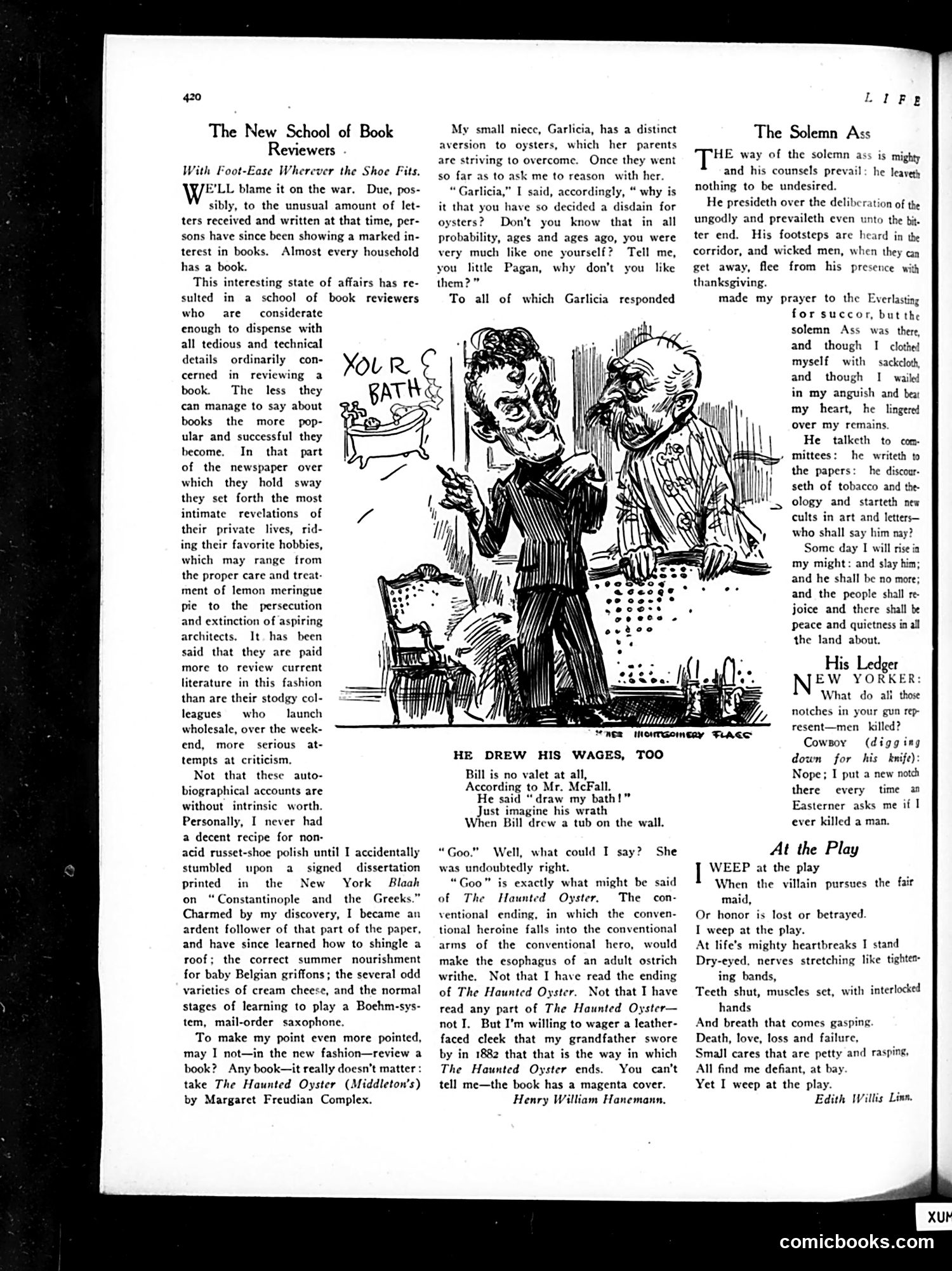
This cartoon satirizes a book reviewer's complaint about writers who use their newspaper book-review columns for personal gain rather than honest criticism. The caption references someone named "Bill" who "drew his bath" on the wall—a visual pun suggesting he literally illustrated his wages/payment. The cartoon shows a man in formal dress drawing on a wall while a small figure (possibly representing a publisher or editor) watches. The satire targets reviewers who abuse their positions: the article criticizes those "paid more to review current literature" than their salaried colleagues, suggesting they profit from favorable reviews or use their platform for self-promotion rather than genuine literary assessment. The piece advocates for more rigorous, honest book criticism and less personal interest-driven reviewing.
📄 Transcribed text from this page (OCR, searchable)
Machine-transcribed from the original scan — historical spelling and the odd misread are preserved.
The New School of Book Reviewers With Foot-Ease Wherever the Shoe Fits. ‘LL blame it on the war. Due, pos- sibly, to the unusual amount of let- ters received and written at that time, per- sons have since been showing a marked in- terest in books. Almost every houschold has a book. This interesting state of affairs has re- sulted in a school of book reviewers who are considerate enough to dispense with all tedious and technical details ordinarily con- cerned in reviewing a book. The less they can manage to say about books the more pop- ular and successful they become. In that part of the newspaper over which they hold sway they set forth the most intimate revelations of their private lives, rid- ing their favorite hobbies, which may range from the proper care and treat- ment of lemon meringue pie to the persecution and extinction of aspiring architects. It has been said that they are paid more to review current literature in this fashion than are their stodgy col- leagues who launch wholesale, over the week- end, more serious at- tempts at criticism. Not that these auto- biographical accounts are without intrinsic worth. Personally, I never had a decent recipe for non- acid russet-shoe polish until I accidentally stumbled upon a signed dissertation printed in the New York Blaah on “Constantinople and the Greeks.” Charmed by my discovery, I became an ardent follower of that part of the paper, and have since learned how to shingle a roof; the correct summer nourishment for baby Belgian griffons; the several odd varietics of cream cheese, and the normal stages of learning to play a Boehm-sys- tem, mail-order saxophone. To make my point even more pointed, may I not—in the new fashion—review a book? Any book—it really doesn’t matter : take The Haunted Oyster (Middleton’s) by Margaret Freudian Complex. My small niece, Garlicia, has a distinct aversion to oysters, which her parents are striving to overcome. Once they went so far as to ask me to reason with her. “Garlicia,” I said, accordingly, “ why is it that you have so decided a disdain for oysters? Don’t you know that in all probability, ages and ages ago, you were very much like one yourself? Tell me, you little Pagan, why don’t you like them?” To all of which Garlicia responded age HE DREW HIS WAGES, Bill is no valet at all, According to Mr. McFall. He said “draw my bath!” Just imagine his wrath When Bill drew a tub on the wall. TOO “Goo.” Well, what could I say? She was undoubtedly right. “Goo” is exactly what might be said of The Haunted Oyster, The con- ventional ending, in which the conven- tional heroine falls into the conventional arms of the conventional hero, would make the esophagus of an adult ostrich writhe. Not that I have read the ending of The Haunted Oyster. Not that I have read any part of The Haunted Oyster— not I. But I'm willing to wager a leather- faced cleek that my grandfather swore by in 1882 that that is the way in which The Haunted Oyster ends. You can’t tell me—the book has a magenta cover. Henry William Hanemann, MonTGomeny FLAES LIfe The Solemn Ass THe way of the solemn ass is mighty and his counsels prevail nothing to be undesired. He presideth over the deliberation of the ungodly and prevaileth even unto the bit. ter end. His footsteps are heard in the corridor, and wicked men, when they can get away, flee from his presence with thanksgiving. made my prayer to the Everlasting for succor, but the solemn Ass was there, and though I clothe! myself with — sackcloth, and though I wailed in my anguish and bear my heart, he lingered over my remains. He talketh to com mittees: he writeth to the papers: he discoar- seth of tobacco and the- _> ology and starteth new cults in art and letters— who shall say him nay? Some day I will rise in my might: and slay him; and he shall be no more; and the people shall re- joice and there shall be peace and quictness in all the land about. His Ledger EW YORKER: What do ali. those notches in your gun rep- resent—men_ killed? Cowpoy (digging down for his knife): Nope; I put a new notch there every time an Easterner asks me if I he leaveth ever killed a man. At the Play WEEP at the play When the villain pursues the fair maid, Or honor is lost or betrayed. I weep at the play. At life’s mighty heartbreaks I stand Dry-eyed, nerves stretching like tighten ing bands, Teeth shut, muscles set, with interlocked hands And breath that comes gasping. Death, love, loss and failure, Small cares that are petty and rasping, All find me defiant, at bay. Yet I weep at the pla Edith Willis Linn. comicbooks.com