
Life, 1921-03-24 · page 20 of 34
Life — March 24, 1921 — page 20: what you’re looking at
What you’re looking at
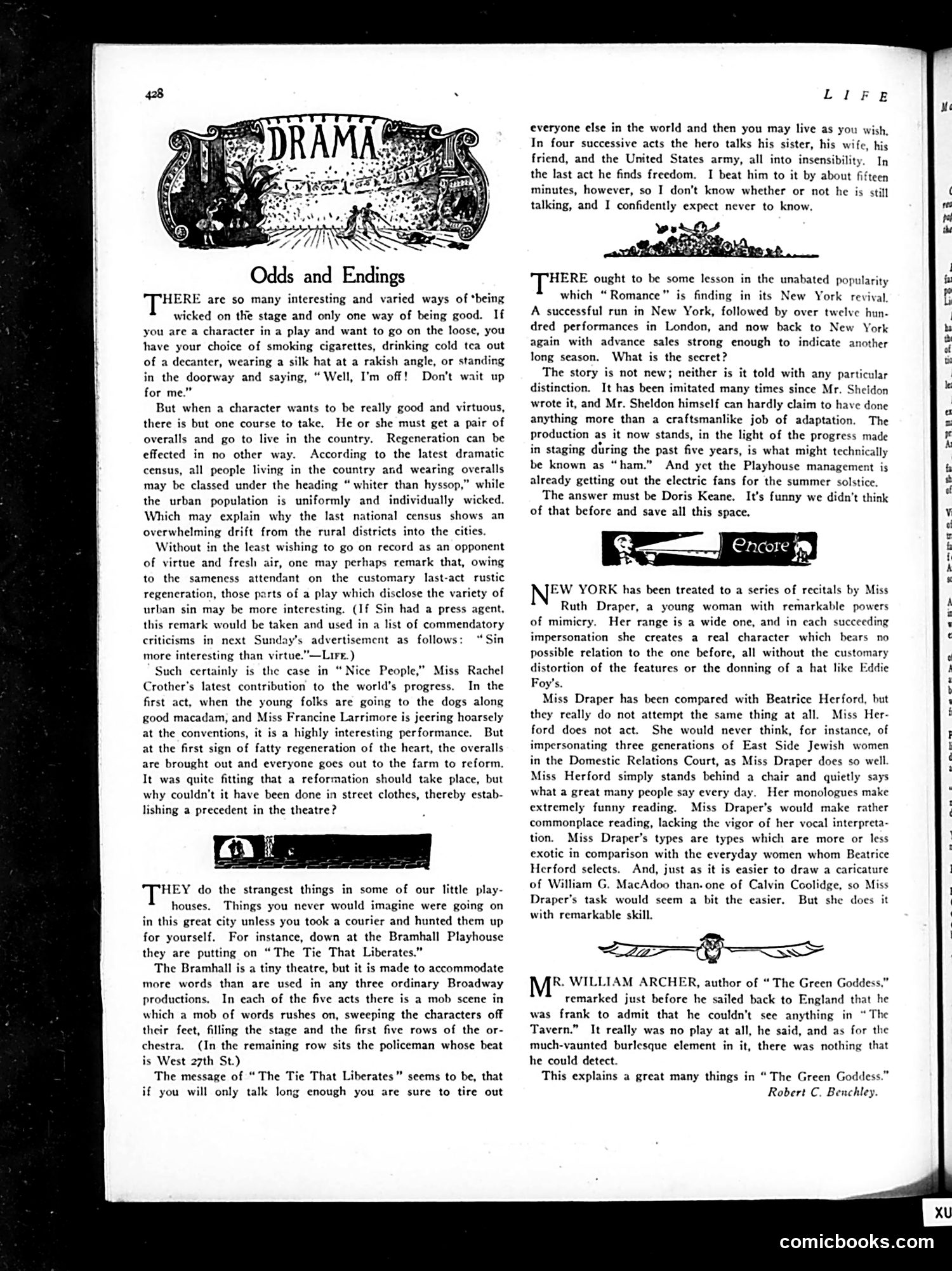
This page from Life magazine's drama criticism section contains satirical commentary on contemporary Broadway productions, circa 1920s. **Main Satire:** The critic mocks a theatrical cliché: plays depicting moral reformation always require the character to don overalls and move to the country. The piece ridicules how playwrights use this tired device as a shortcut for showing virtue, noting the irony that this convention may actually drive people *from* rural areas to cities (since countryside life appears uniformly dull on stage). **Specific Play Critiques:** - **"Nice People"** by Rachel Crothers: The reviewer finds the early acts (showing young characters rejecting conventions) entertaining, but loses interest once moral regeneration occurs and the characters relocate to a farm. - **"The Tie That Liberates"**: Satirized for excessive dialogue—characters literally talk others into submission to achieve their goals. The critic implies the play is so dialogue-heavy that even police officers attend to manage the verbal onslaught. The tone is witty mockery of formulaic playwriting and theatrical conventions that sacrifice realism for melodrama.
📄 Transcribed text from this page (OCR, searchable)
Machine-transcribed from the original scan — historical spelling and the odd misread are preserved.
Odds and Endings HERE are so many interesting and varied ways of *being wicked on the stage and only one way of being good. If you are a character in a play and want to go on the loose, you have your choice of smoking cigarettes, drinking cold tea out of a decanter, wearing a silk hat at a rakish angle, or standing in the doorway and saying, “ Well, I'm off! Don't wait up for me.” But when a character wants to be really good and virtuous, there is but one course to take. He or she must get a pair of overalls and go to live in the country. Regeneration can be effected in no other w According to the latest dramatic census, all people living in the country and wearing overalls may be classed under the heading “whiter than hyssop,” while the urban population is uniformly and individually wicked. Which may explain why the last national census shows an overwhelming drift from the rural districts into the cities. Without the least wishing to go on record as an opponent of virtue and fresh air, one may perhaps remark that, owing to the sameness attendant on the customary last-act rustic regeneration, those parts of a play which disclose the variety of urban sin may be more interesting. (If Sin had a press agent, this remark would be taken and used in a list of commendatory criticisms in next Sunday’s advertisement as follows: more interesting than virtue.”—Lire.) Such certainly is the case in “Nice People,” Miss Rachel Crother’s latest contribution to the world’s progress. In the first act, when the young folks are going to the dogs along good macadam, and Miss Francine Larrimore is jeering hoarsely at the conventions, it is a highly interesting performance. But at the first sign of fatty regeneration of the heart, the overalls are brought out and everyone goes out to the farm to reform. It was quite fitting that a reformation should take place, but why couldn't it have been done in street clothes, thereby estab- lishing a precedent in the theatre? HEY do the strangest things in some of our little play- houses. Things you never would imagine were going on in this great city unless you took a courier and hunted them up for yourself. For instance, down at the Bramhall Playhouse they are putting on “The Tie That Liberate: The Bramhall is a tiny theatre, but it is made to accommodate more words than are used in any three ordinary Broadway productions, In each of the five acts there is a mob scene in which a mob of words rushes on, sweeping the characters off their feet, filling the stage and the first five rows of the or- chestra. (In the remaining row sits the policeman whose beat is West 27th St.) The message of “ The Tie That Liberates"” seems to be, that if you will only talk long enough you are sure to tire out LIFE everyone else in the world and then you may live as you wish. In four successive acts the hero talks his sister, his wife, his friend, and the United States army, all into insensibility. In the last act he finds freedom. I beat him to it by about en minutes, however, so I don’t know whether or not he is talking, and I confidently expect never to know. “THERE ought to be some lesson in the unabated popularity which “Romance” is finding in its New York revival, A successful run in New York, followed by over twelve hun- dred performances in London, and now back to New York again with advance sales strong enough to indicate another long season. What is the secret? The story is not new; neither is it told with any particular distinction. It has been imitated many times since Mr. Sheldon wrote it, and Mr. Sheldon himself can hardly claim to have done anything more than a craftsmanlike job of adaptation. The production as it now stands, in the light of the progress made in staging during the past five years, is what might technically be known as “ham.” And yet the Playhouse management is already getting out the electric fans for the summer solstice. The answer must be Doris Keane. It’s funny we didn’t think of that before and save all this space. EW YORK has been treated to a series of recitals by Miss Ruth Draper, a young woman with remarkable powers of mimicry, Her range is a wide one, and in cach succeeding impersonation she creates a real character which bears no possible relation to the one before, all without the customary distortion of the features or the donning of a hat like Eddie Foy’s. Miss Draper has been compared with Beatrice Herford, but they really do not attempt the same thing at all. Miss Her- ford does not act. She would never think, for instance, of impersonating three generations of East Side Jewish women in the Domestic Relations Court, as Miss Draper does so well. Miss Herford simply stands behind a chair and quietly says what a great many people say every da Her monologues make extremely funny reading. Miss Draper's would make rather commonplace reading, lacking the vigor of her vocal interpreta- tion. Miss Draper’s types are types which are more or less exotic in comparison with the everyday women whom Beatrice Herford selects. And, just as it is easier to draw a caricature of William G. MacAdoo than. one of Calvin Coolidge, so Miss Draper's task would scem a bit the easier. But she does it with remarkable skill. 7 ee M® WILLIAM ARCHER, author of “ The Green Goddess,” remarked just before he sailed back to England that he was frank to admit that he couldn’t see anything in “The Tavern.” It really was no play at all, he said, and as for the much-vaunted burlesque element in it, there was nothing that he could detect. This explains a great many things in “The Green Goddess.” Robert C. Benchley. comicbooks.com zi. rr P8Aeer oser._ — wn h oil an goat taxa an at Uk ok