
Life, 1921-03-24 · page 22 of 34
Life — March 24, 1921 — page 22: what you’re looking at
What you’re looking at
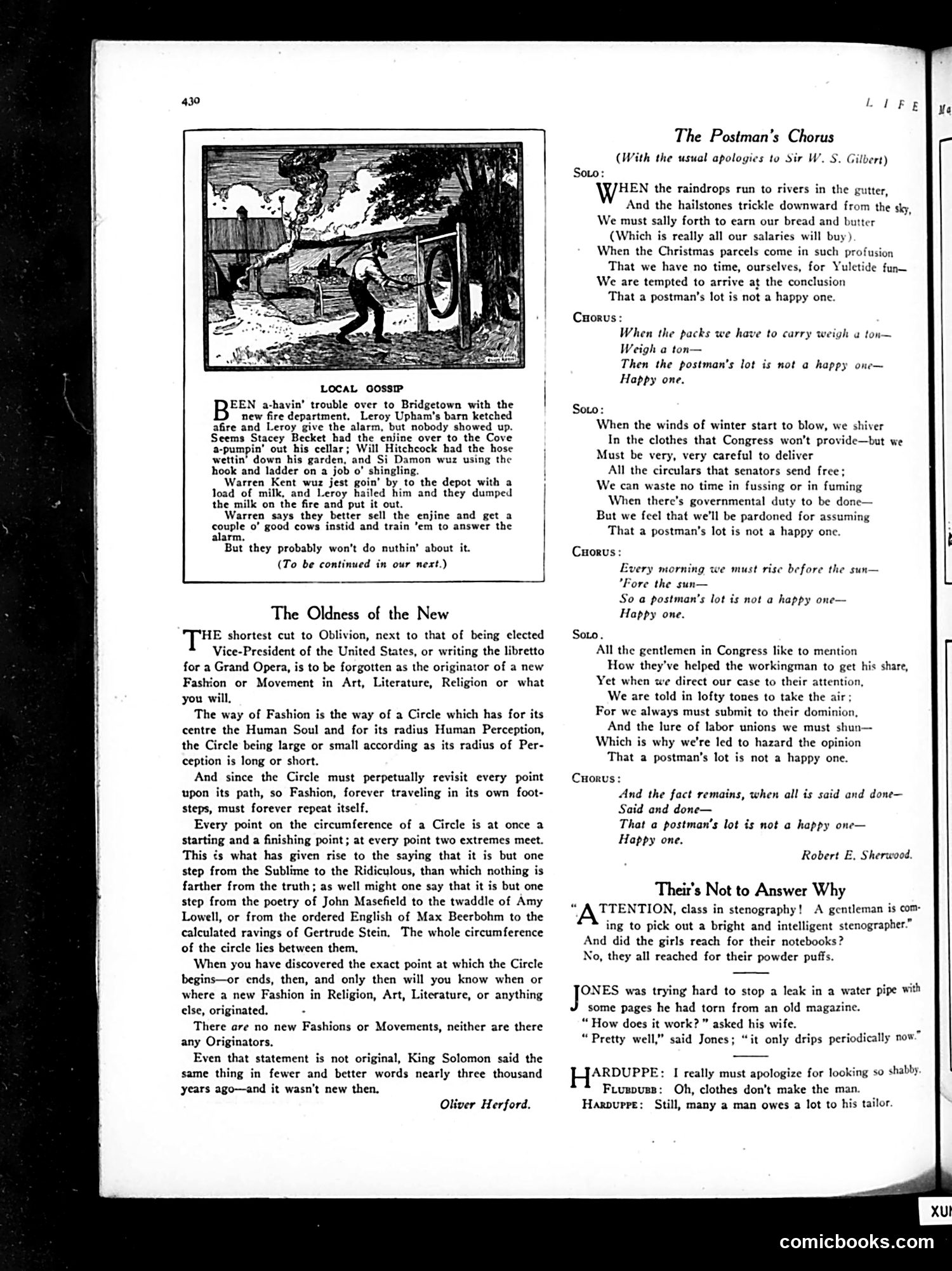
This page contains three distinct pieces of satirical content: **"Local Gossip"** (with cartoon): A humorous rural anecdote about a small-town volunteer fire department so disorganized that when a barn burns, the firefighters are scattered doing other tasks. A passing milk wagon extinguishes the fire instead. The joke satirizes small-town inefficiency and the suggestion to replace the fire engine with trained cows mocks the department's uselessness. **"The Oldness of the New"** by Oliver Herford: A philosophical essay arguing that nothing is truly original—all fashions and movements in art, literature, and religion merely repeat past cycles. Herford supports this with literary references (Masefield, Lowell, Beerbohm, Stein) and cites King Solomon, sardonically noting even *that* observation isn't new. **"The Postman's Chorus"**: A Gilbert & Sullivan parody depicting postal workers' complaints—bad weather, heavy loads, underpaid work, and lack of Congressional support despite politicians' claims of helping workers. The refrain "a postman's lot is not a happy one" mimics Gilbert's style while critiquing labor conditions and political neglect.
📄 Transcribed text from this page (OCR, searchable)
Machine-transcribed from the original scan — historical spelling and the odd misread are preserved.
LOCAL GossIP EEN a-havin’ trouble over to Bridgetown with the new fire department. Leroy Upham's barn ketched afire and Leroy give the alarm, but nobody showed up. Seems Stacey Becket had the enjine over to the Cove a-pumpin’ out his cellar; Will Hitchcock had the hose wettin’ down his garden, and Si Damon wuz using the hook and ladder on a job o’ shingling. Warren Kent wuz jest goin’ by to the depot with a load of milk, and Leroy hailed him and they dumped the milk on the fire and put it out. Warren says they better sell the enjine and get a couple o’ good cows instid and train 'em to answer the alarm. But they probably won’t do nuthin’ about it. (To be continued in our next.) The Oldness of the New HE shortest cut to Oblivion, next to that of being elected Vice-President of the United States, or writing the libretto for a Grand Opera, is to be forgotten as the originator of a new Fashion or Movement in Art, Literature, Religion or what you will. The way of Fashion is the way of a Circle which has for its centre the Human Soul and for its radius Human Perception, the Circle being large or small according as its radius of Per- ception is long or short. And since the Circle must perpetually revisit every point upon its path, so Fashion, forever traveling in its own foot- steps, must forever repeat itself. Every point on the circumference of a Circle is at once a Starting and a finishing point; at every point two extremes meet. This ¢s what has given rise to the saying that it is but one step from the Sublime to the Ridiculous, than which nothing is farther from the truth; as well might one say that it is but one step from the poetry of John Masefield to the twaddle of Amy Lowell, or from the ordered English of Max Beerbohm to the calculated ravings of Gertrude Stein. The whole circumference of the circle lies between them, ‘When you have discovered the exact point at which the Circle begins—or ends, then, and only then will you know when or where a new Fashion in Religion, Art, Literature, or anything else, originated. - There are no new Fashions or Movements, neither are there any Originators. Even that statement is not original, King Solomon said the same thing in fewer and better words nearly three thousand years ago—and it wasn’t new then. Oliver Herford. The Postman’s Chorus (With the usual apologies to Sir W. S. Gilbert) Soto: HEN the raindrops run to rivers in the gutter, And the hailstones trickle downward from the sky, We must sally forth to earn our bread and butter (Which is really all our salaries will buy) When the Christmas parcels come in such profusion That we have no time, ourselves, for Yuletide fun— We are tempted to arrive at the conclusion That a postman’s lot is not a happy one. Cuorus: When the packs we have to carry Weigh a ton— Then the postman’s lot is not a happy one— Happy one. righ a ton— Soto: When the winds of winter start to blow, we shiver In the clothes that Congress won’t provide—but we Must be very, very careful to deliver All the circulars that senators send free; We can waste no time in fussing or in fuming When there's governmental duty to be done— But we feel that we'll be pardoned for assuming That a postman's lot is not a happy one. Cuorus: Every morning we must rise before the sun— ’Fore the sun— So a postman’s lot is not a happy one— Happy one. Soto. All the gentlemen in Congress like to mention How they've helped the workingman to get his share, Yet when we direct our case to their attention, We are told in lofty tones to take the air; For we always must submit to their dominion, And the lure of labor unions we must shun— Which is why we're led to hazard the opinion That a postman’s lot is not a happy one. Cuorus: And the fact remains, when all is said and done— Said and done— That a postman’s lot is not a happy one— Happy one. Robert E, Sherwood. Their's Not to Answer Why ATTENTION, class in stenography! A gentleman is com- ing to pick out a bright and intelligent stenographer.” And did the girls reach for their notebooks? No, they all reached for their powder puffs. ONES was trying hard to stop a leak in a water pipe with some pages he had torn from an old magazine. “How does it work?” asked his wife. “Pretty well,” said Jones; “it only drips periodically now.” ARDUPPE: I really must apologize for looking so shabby Fruspuss: Oh, clothes don’t make the man. Hagpurre: Still, many a man owes a lot to his tailor. comicbooks.com