
Life, 1921-03-24 · page 21 of 34
Life — March 24, 1921 — page 21: what you’re looking at
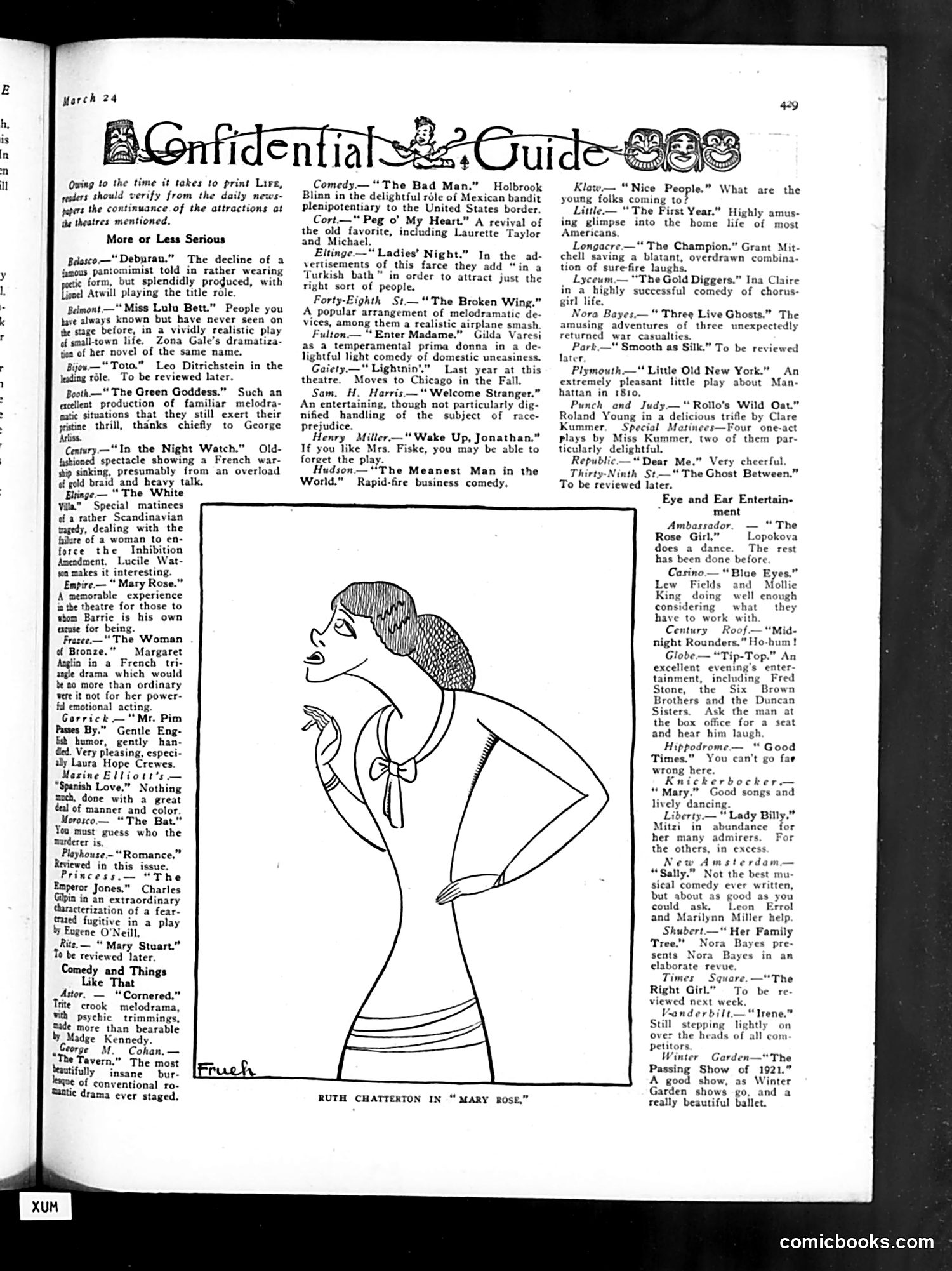
What you’re looking at
This page is a **theater listing and review section**, not a political cartoon. It's a "Confidential Guide" to Broadway shows currently running, with brief critical assessments of comedies, dramas, and melodramas. The **illustration** shows **Ruth Chatterton** in costume from "Mary Rose," a J.M. Barrie play described as "a memorable experience" for theater-goers. The drawing depicts her in period dress, labeled simply "Fruen" (likely the character name). The reviews are gossipy and snide—typical of Life's satirical theater criticism. They mock conventional romantic drama ("beautifully insane burlesque of conventional romantic drama"), note which actors carry weak plays, and make sly comments about audience appeal (the "Eltinge" entry jokes that "Ladies' Night" advertises a Turkish bath setting "to attract just the right sort of people"). This is **entertainment journalism**, not political satire—a snapshot of 1921 Broadway tastes and Life magazine's irreverent critical voice.
📄 Transcribed text from this page (OCR, searchable)
Machine-transcribed from the original scan — historical spelling and the odd misread are preserved.
March 24 Owing to the time it takes to print Lire, readers should verify from the daily news- papers the continuance of the attractions at tie theatres mentioned, More or Less Serious Beasco—“Deburau.” The decline of a famous pantomimist told in rather wearing wie form, but splendidly proguced, with Lionel Atwill playing the title role. Belmont —‘* Miss Lulu Bett.” People you hive always known but have never seen on te stage before, in a vividly realistic play small-town life. Zona Gale’s dramatiza- tea of her novel of the same name. Bijou —“ Toto.” Leo Ditrichstein in the eding réle. To be reviewed later. Booth“ The Green Goddess.” Such an qcllent production of familiar melodra- matic situations that they still exert their pestine thrill, thanks chiefly to George Artiss. Century—“In the Night Watch.” Old- fishioned spectacle showing a French war- stip sinking, presumably from an overload of gold braid and heavy talk. Eliinge— “The White Vila.” Special matinees of a rather Scandinavian tragedy, dealing with the fidure of a woman to en- foree the Inhibition Amendment. Lucile Wat- wa makes it interesting. Enpire— “ Mary Rose.” A memorable experience ithe theatre for those to whom Barrie is his own acuse for being. Fresee—“ The Woman of Bronze.” Margaret deglin in a French tri- age drama which would te 20 more than ordinary were it not for her power- fd emotional acting. Gorrick —“ Mr. Pim Passes By.” Gentle Eng- ksh humor, gently han- ded. Very pleasing, especi- aly Laura Hope Crewes. Mexine Elliott's — “Spanish Love.” Nothing soch, done with a great of manner and color. Merosco— “The Bat.” ® must guess who the Barderer is, Playhouse. **Romance.” iewed in this issue. Princess.— “The Jones.” Charles Gipin in an extraordinary icterization of a fear- crzed fugitive in a play by Eugene O'Neill, Rite, “ Mary Stuart.” To be reviewed later. Comedy and Things Like That Astor. — “Cornered.” Trite crook melodrama, with psychic trimmings, ¢ more than bearable by Madge Kennedy. corse M. Cohan, — t Tavern.” The most beautifully insane bur- %¢ of conventional ro- Santic drama ever staged. Comedy— “The Bad Man.” Holbrook Blinn in the delightful role of Mexican bandit plenipotentiary to the United States border. Cort—* Peg o’ My Heart.” A revival of the old favorite, including Laurette Taylor and Michael. Eltinge—“ Ladies’ Night.” In the ad- yertisements of this farce they add “in a Turkish bath” in order to attract just the right sort of people. Forty-Eighth St— “The Broken Wing.” A popular arrangement of melodramatic de- vices, among them a realistic airplane smash. Fulton— “ Enter Madame.” Gilda Varesi as a temperamental prima donna in a de- lightful light comedy of domestic uneasiness. Gaiety.—" Lightnin’.” Last year at this theatre. Moves to Chicago in the Fall. Sam, H. Harris—‘ Welcome Strang: An entertaining, though not particularly dig- nified handling of the subject of race- prejudice. Henry Miller—“ Wake Up, Jonathan.” If you like Mrs. Fiske, you may be able to forget the play. Hudson—“'The Meanest Man in the World.” Rapid-fire business comedy. RUTH CHATTERTON IN “ MARY ROSE.” Klaw— “ Nice People.” What are the young folks coming to? Little — “ The First Year.” Highly amus- ing glimpse into the home life of most Americans. Longacre —“ The Champion.” Grant Mit- chell saving a blatant, overdrawn combina- tion of surefire laughs. Lyceum.— “The Gold Diggers.” Ina Claire in a highly successful comedy of chorus- girl life, Nora Bayes.— “ Three Live Ghosts.” The amusing adventures of three unexpectedly returned war casualties. Park,—“ Smooth as Silk.” To be reviewed later, Plymouth—“ Little Old New York.” An extremely pleasant little play about Man- hattan in 1810. Punch and Judy—“ Rollo's Wild Oat.” Roland Young in a delicious trifle by Clare Kummer. Special Matinees—Four one-act plays by Miss Kummer, two of them par- ticularly delightful. Republic—“ Dear Me.” Very cheerful. Thirty-Ninth St—“ The Ghost Between.” To be reviewed later. Eye and Ear Entertain- . ment Ambassador. Rose Girl.” Lopokova does a dance. The rest has been done before Casino — “Blue Eyes. Lew Fields and Mollie King doing well enough considering what they have to work with Century Roof— night Rounders.” Ho-h Globe-— “Tip-Top. excellent evening's enter- tainment, including Fred Stone, the Six Brown Brothers and the Duncan Sisters. Ask the man at the box office for a seat and hear him laugh. Hippodrome— ‘ Good Times.” You can't go far wrong here. Knickerbocker,— “Mary.” Good songs and lively dancing. Liberty.— “ Lady Billy.” Mitzi in ndance for her many admirers. For the others, in excess. y sterdam— Not the best mu- — “The Ne “Sally. sical comedy ever written, but about as good as you could ask. Leon Errol and Marilynn Miller help Shubert—“ Her Family Tree.” Nora Bayes pre- sents Nora Bayes in an elaborate revue Times Square. —“The Right Gir.” To be re- viewed next week. Veanderdilt— “Irene.” Still stepping lightly on over the heads of all com: petitors. Winter Garden—"The Passing Show of 1921.” A good show, as Winter Garden shows go, and a really beautiful bailet. comicbooks.com